30 Lead Qualification Questions to Ask Before You Pitch (2026)
Most deals die because nobody asked the right question early. Here are 30 lead qualification questions grouped by stage, a framework comparison, and a simple scoring rubric you can copy into your CRM.
TL;DR
- Good lead qualification questions test four things: the problem, who has authority, the timing, and fit. Budget matters less early on than most reps assume.
- Pick one framework and map every question to a field in your CRM. BANT suits transactional sales. MEDDIC suits complex enterprise deals.
- Ask open questions early and closed, confirming questions late. A first call should never feel like an interrogation.
- Do some qualifying before the call. Verified contact data and firmographics answer many questions you would otherwise spend call time on.
- Below you'll find 30 questions grouped by stage, a framework comparison table, and a scoring rubric you can adapt.
What are lead qualification questions?#
Lead qualification questions are the questions a rep asks to decide whether a prospect is worth pursuing now, later, or never. They show whether the person has a real problem your product solves, the authority or influence to buy, a reason to act soon, and an organization that fits your ideal customer profile.
A doctor's intake appointment is a good comparison. The doctor doesn't prescribe anything in the first five minutes. They ask about symptoms, history, and what the patient has already tried, so the treatment fits the actual condition. Qualification does the same job in a sales cycle. It keeps you from pitching a cure to someone who isn't sick.
Qualification is also a stage in the lead lifecycle, not a single event. Marketing hands over a marketing qualified lead based on behavior such as downloads, visits, and form fills. Sales then uses qualification questions to confirm intent and turn that MQL into a sales-qualified lead or an opportunity. If you want the wider context of how leads move through that funnel, the lead generation overview on Wikipedia is a good neutral primer.
Which lead qualification framework should you use?#
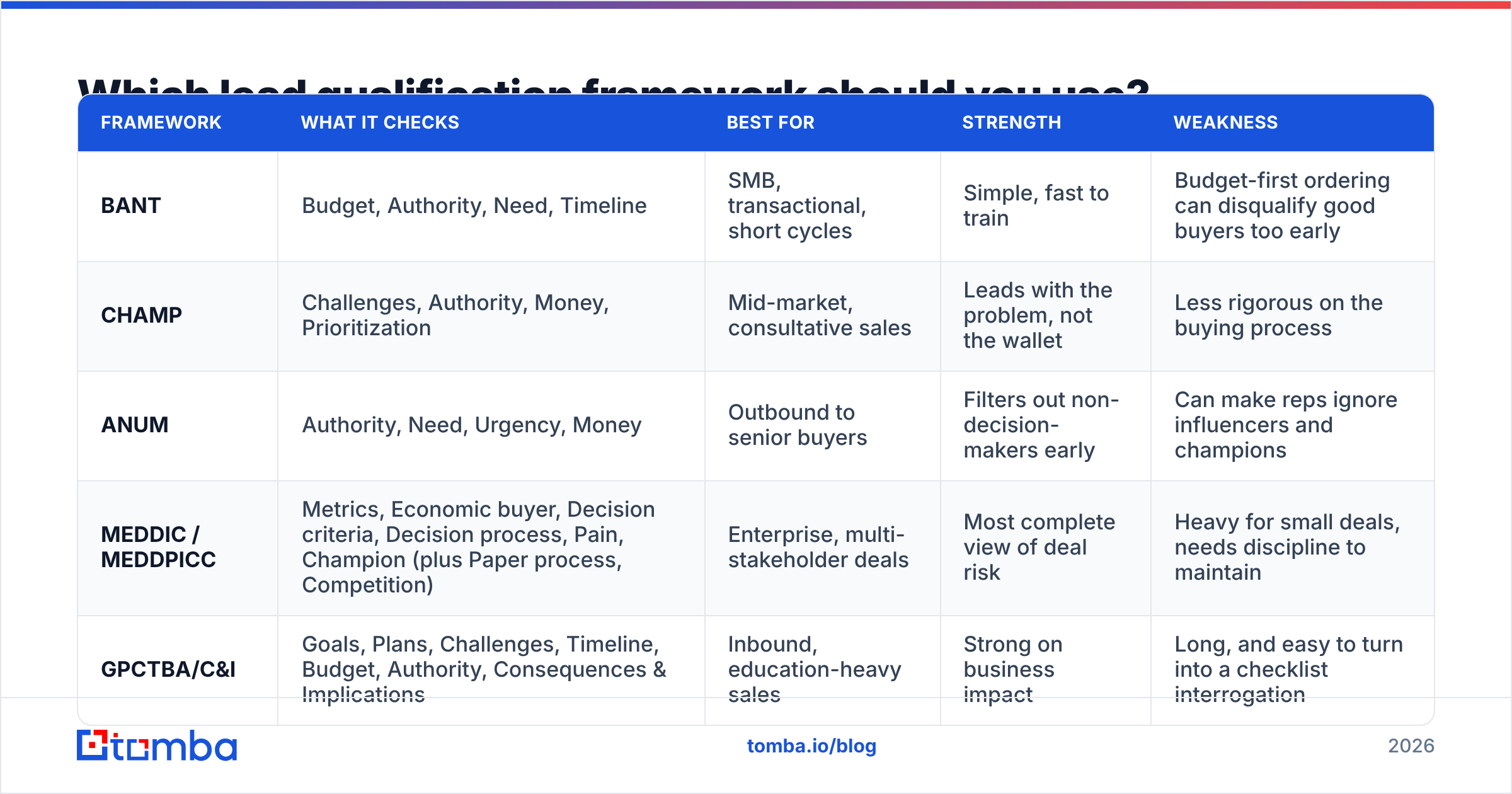
Frameworks give your questions a structure, so every rep collects the same data and your pipeline reviews compare like with like. The right one depends mostly on deal size and how many people are involved in the buying decision.
| Framework | What it checks | Best for | Strength | Weakness |
|---|---|---|---|---|
| BANT | Budget, Authority, Need, Timeline | SMB, transactional, short cycles | Simple, fast to train | Budget-first ordering can disqualify good buyers too early |
| CHAMP | Challenges, Authority, Money, Prioritization | Mid-market, consultative sales | Leads with the problem, not the wallet | Less rigorous on the buying process |
| ANUM | Authority, Need, Urgency, Money | Outbound to senior buyers | Filters out non-decision-makers early | Can make reps ignore influencers and champions |
| MEDDIC / MEDDPICC | Metrics, Economic buyer, Decision criteria, Decision process, Pain, Champion (plus Paper process, Competition) | Enterprise, multi-stakeholder deals | Most complete view of deal risk | Heavy for small deals, needs discipline to maintain |
| GPCTBA/C&I | Goals, Plans, Challenges, Timeline, Budget, Authority, Consequences & Implications | Inbound, education-heavy sales | Strong on business impact | Long, and easy to turn into a checklist interrogation |
A practical rule: if your average deal closes in under 30 days with one or two stakeholders, BANT or CHAMP is plenty. If you regularly see procurement, security review, and a committee, use MEDDPICC. HubSpot's guide to BANT explains the classic model well if you are starting from zero.
Whatever you choose, don't treat it as a script. The framework tells you what to find out. It doesn't tell you what order to ask in.
What should you know before the first call?#
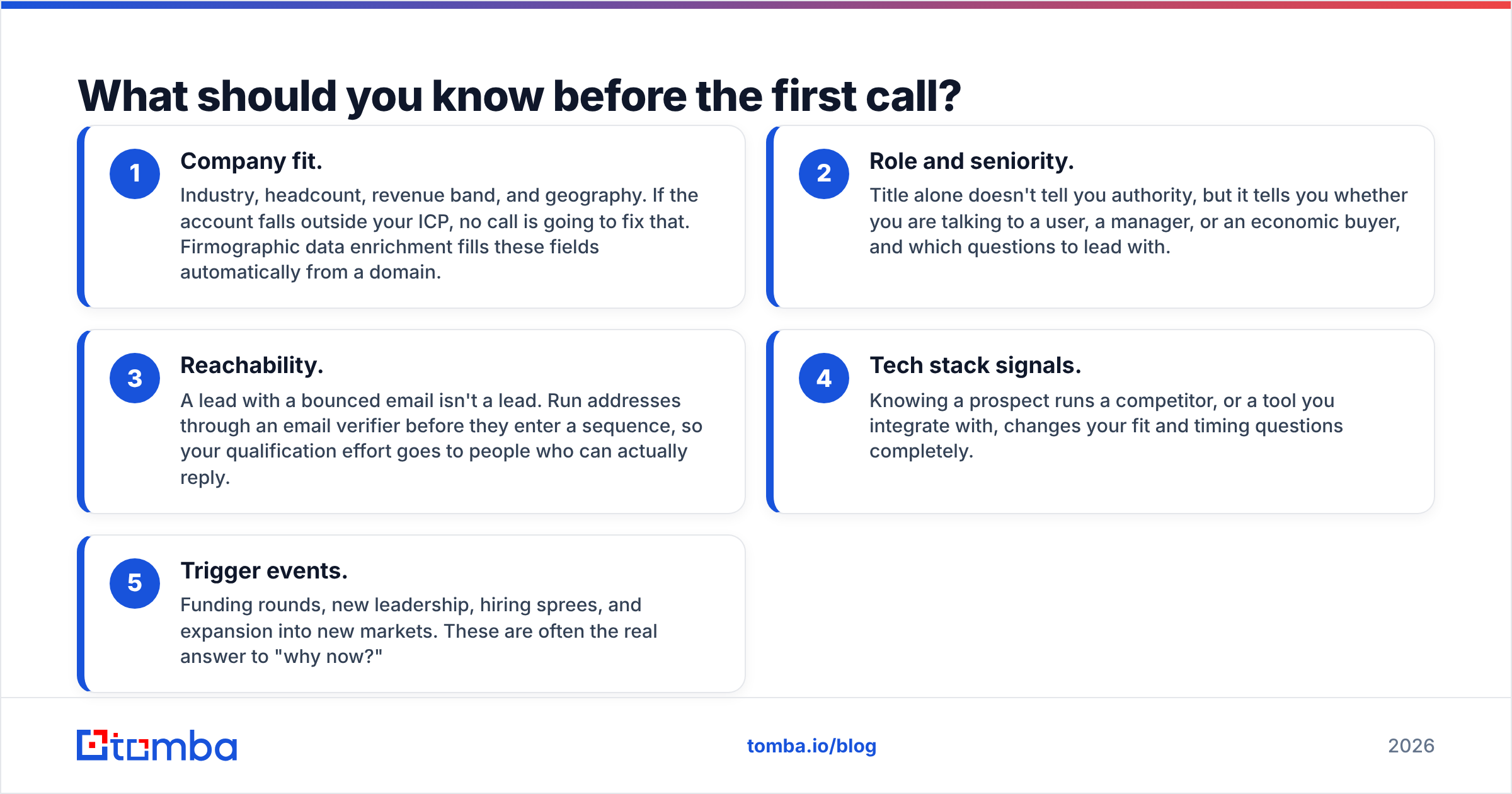
The fastest qualification call is one where half the answers were known before you dialed. Every question you can answer from data is a question you don't have to spend the prospect's patience on. Before any discovery call, confirm these five things:
- Company fit. Industry, headcount, revenue band, and geography. If the account falls outside your ICP, no call is going to fix that. Firmographic data enrichment fills these fields automatically from a domain.
- Role and seniority. Title alone doesn't tell you authority, but it tells you whether you are talking to a user, a manager, or an economic buyer, and which questions to lead with.
- Reachability. A lead with a bounced email isn't a lead. Run addresses through an email verifier before they enter a sequence, so your qualification effort goes to people who can actually reply.
- Tech stack signals. Knowing a prospect runs a competitor, or a tool you integrate with, changes your fit and timing questions completely.
- Trigger events. Funding rounds, new leadership, hiring sprees, and expansion into new markets. These are often the real answer to "why now?"
With this done, your call can skip "So, what does your company do?" and open with a sharper question about the problem.
What are the best lead qualification questions to ask?#
Here are 30 questions grouped by what they uncover. You won't ask all of them on one call. Choose three or four per category depending on the stage, and note each answer in the matching CRM field.
Problem and pain questions#
These come first because everything else depends on them. No pain means no deal, whatever the budget.
- What made you start looking at this now?
- How are you handling this today, and what's not working about it?
- What happens if nothing changes in the next six months?
- Who on your team feels this problem most directly?
- Have you tried to solve this before? What happened?
- How are you measuring the cost of this problem today: time, revenue, headcount?
Question 3 matters most here. If the honest answer is "nothing much," you have found a nice-to-have, not a priority.
Authority and buying process questions#
Avoid "Are you the decision-maker?" People almost always say yes, and it sounds dismissive. Ask about the process instead.
- Walk me through how your team usually evaluates and buys a tool like this.
- Besides you, who else will want a say in this decision?
- Who signs off on the budget for this kind of purchase?
- Is there a security, legal, or procurement review we should plan for?
- What would make your leadership say no to this?
- Have you bought something similar recently? How long did that take?
Timing and urgency questions#
Timing is where forecasts go wrong. A prospect with pain and budget but no deadline tends to slip quarter after quarter.
- When would you ideally want this up and running?
- What's driving that date: a launch, a renewal, a board meeting?
- What else is competing for your team's attention this quarter?
- If we solved this perfectly, what would you need to see before starting?
- Is there an existing contract that ends or renews soon?
Budget and business case questions#
Budget matters, but ask about value before price. "Do you have budget?" is a yes/no trap. These questions work better:
- Have you set aside budget for this, or would it need a business case?
- What range were you expecting to invest to solve this?
- How does your team usually justify a new tool's cost: ROI, time saved, headcount avoided?
- What would this problem need to be costing you for the investment to make sense?
- Which budget does this come out of: sales, marketing, ops, or IT?
Fit and current-stack questions#
These questions protect you from closing customers who will churn.
- Which tools does this need to connect with: CRM, sequencer, data warehouse?
- How many people would use this day to day?
- What does success look like 90 days after you buy?
- What did you like or dislike about the tools you've used before?
- Are there must-have requirements that would rule a vendor out immediately?
Commitment and next-step questions#
End each call by testing whether the prospect is actually moving forward.
- Based on what we discussed, does it make sense to take a next step?
- Who should join the next conversation?
- What would you need from me to take this to your team?
A prospect who won't commit to a specific next step with a date is telling you where they stand, even if the call felt warm.
How do you ask qualification questions without sounding like an interrogation?#
The questions above only work if the conversation feels like two people solving a problem, not a form being filled in. Four habits make the difference:
- Earn the right with a hypothesis. Rather than "What are your challenges?", try "Teams your size usually tell us list quality is what slows outbound down. Is that true for you, or is it something else?" You show that you've done your homework and give them something concrete to react to.
- Follow the thread, not the list. When a prospect mentions a failed rollout, stay there for two or three follow-ups. The best information comes from the third "why," not the next scripted question.
- Mix open and closed questions on purpose. Open questions ("How do you handle this today?") collect context. Closed questions ("So the renewal is in March?") confirm facts. Discovery calls lean open, and later calls lean closed.
- Summarize out loud. Near the end, play back what you heard: problem, impact, people involved, timing. Prospects correct things they would never volunteer, and your notes become far more accurate.
Timing across the cycle matters too. On a first outbound call, three or four questions are the limit before trust runs out. Save the budget and procurement questions until they have agreed there is a problem worth solving.
How do you score answers and decide who's qualified?#
Answers only help if they lead to a consistent decision. A lightweight scoring rubric turns qualitative call notes into something your pipeline reviews and forecasts can use. Here is a simple version you can adapt:
| Dimension | 0 points | 1 point | 2 points | 3 points |
|---|---|---|---|---|
| Pain | None stated | Vague interest | Clear problem, no cost attached | Quantified cost of inaction |
| Authority | Unknown | Influencer only | Champion identified | Economic buyer engaged |
| Timing | No timeline | "This year" | Target quarter | Dated trigger (renewal, launch) |
| Budget | Unknown | Would need a business case | Range discussed | Budget allocated |
| Fit | Outside ICP | Partial fit | ICP fit, integration gaps | Full ICP and stack fit |
A reasonable starting threshold: 10 or more out of 15 becomes an opportunity, 6 to 9 goes to nurture with a follow-up date, and 5 or below is disqualified with the reason logged. Adjust the thresholds after a quarter of data by checking which scores actually closed.
Log disqualification reasons as structured fields, not free text. After a few months, "Outside ICP" showing up in 40% of disqualifications tells you something important about your top-of-funnel targeting. Industry research from firms like Gartner keeps finding that B2B buying groups are getting larger, which is another reason to track authority and champion fields carefully.
What are the most common lead qualification mistakes?#
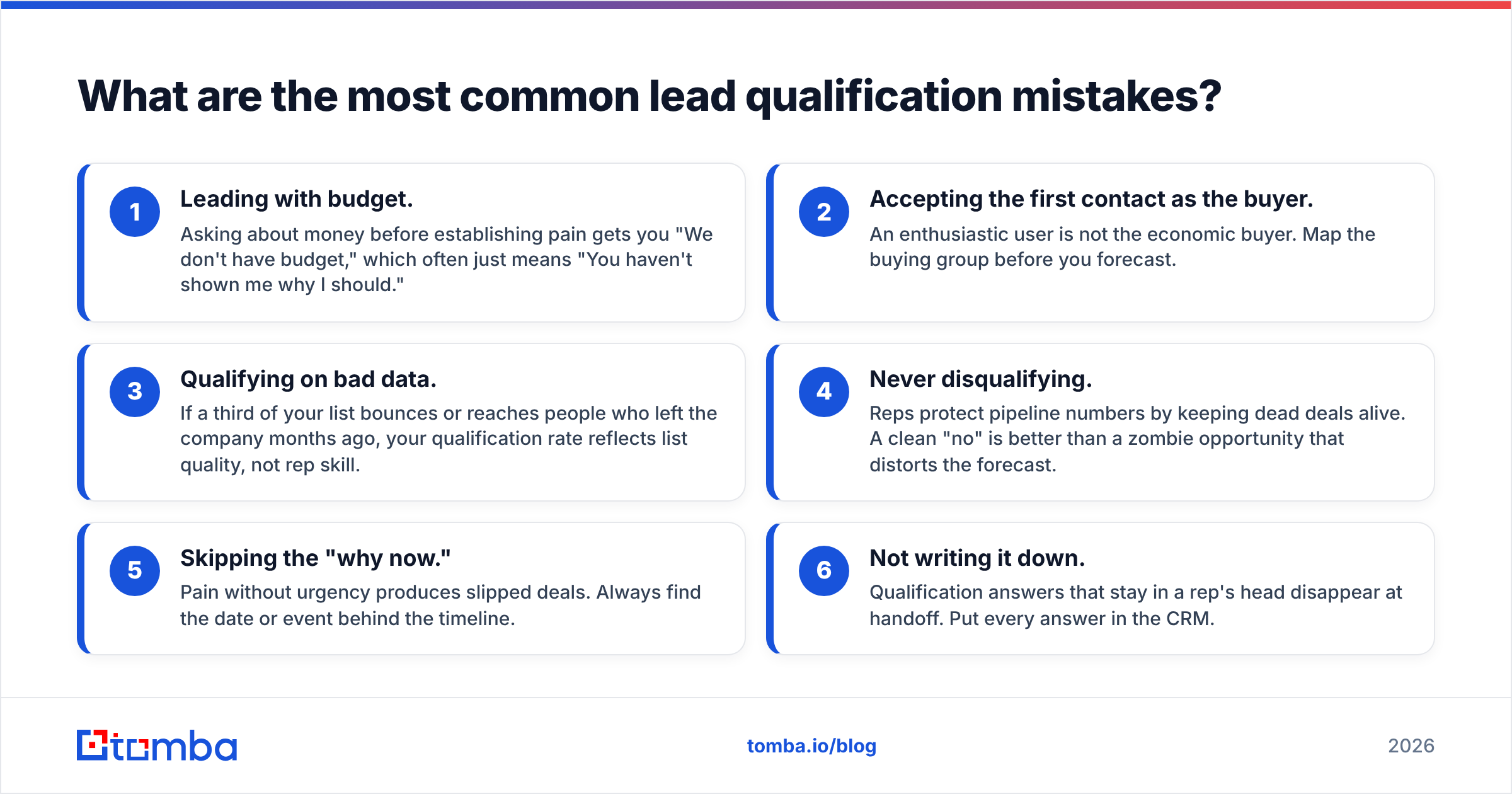
Most qualification failures come down to a handful of repeat patterns:
- Leading with budget. Asking about money before establishing pain gets you "We don't have budget," which often just means "You haven't shown me why I should."
- Accepting the first contact as the buyer. An enthusiastic user is not the economic buyer. Map the buying group before you forecast.
- Qualifying on bad data. If a third of your list bounces or reaches people who left the company months ago, your qualification rate reflects list quality, not rep skill.
- Never disqualifying. Reps protect pipeline numbers by keeping dead deals alive. A clean "no" is better than a zombie opportunity that distorts the forecast.
- Skipping the "why now." Pain without urgency produces slipped deals. Always find the date or event behind the timeline.
- Not writing it down. Qualification answers that stay in a rep's head disappear at handoff. Put every answer in the CRM.
The third mistake is worth dwelling on, because it tends to hide. Teams tune scripts, retrain reps, and swap frameworks when the real problem is upstream: they are running qualification on contacts who were never reachable or never a fit. Fixing the data usually improves conversion more than any new question list.
What do sales teams ask most about lead qualification questions?#
How many qualification questions should you ask on a first call?#
Plan for four to six, mostly about the problem and timing. Save authority and budget questions for when the prospect has confirmed there is a problem worth solving. A 30-minute discovery call that covers every BANT field usually means the rep did most of the talking.
Should SDRs or AEs handle qualification?#
Both, at different depths. SDRs typically confirm the basics: fit, a stated problem, and a willing next meeting. AEs go deeper into the buying process, business case, and decision criteria. Write down exactly which fields each role owns, so nothing gets asked twice and nothing gets missed.
Is BANT outdated in 2026?#
Not outdated, just often misused. BANT still works well for transactional deals. The common failure is treating it as a sequence that starts with budget. Many teams keep the four BANT fields but ask about need and timeline first, which is essentially CHAMP.
Can you qualify leads before talking to them?#
Partly. Firmographics, tech stack, role, verified contact data, and trigger events can all be confirmed beforehand. Pain, urgency, and the buying process still need a conversation. The more you settle before the call, the more of the call you can spend on the questions that only a human can answer.
What should you do with leads that don't qualify?#
Log the reason, then route them. Poor-fit accounts get closed out. Good-fit accounts with bad timing go into a nurture track with a dated follow-up. Those "not now" leads often become next year's easiest deals.
Where does Tomba fit in your qualification process?#
The best lead qualification questions are wasted on the wrong person or on an inbox that bounces. Before a rep asks "What made you start looking at this now?", they need the right contact at the right account, with an email that will actually arrive. The Tomba Email Finder finds professional email addresses by name, domain, or company, so your qualification effort starts with decision-makers you can reach rather than guesses from a stale spreadsheet. Pair it with verification and enrichment, and more of your call time goes to the questions that matter. You can start on the free tier with 25 searches a month, and paid plans begin at $49/mo when you're ready to scale.
Related guides#
// get started
Find, verify and enrich your first contacts today
Start on the free plan with 25 searches a month, then scale when your team is ready.
Free plan · No credit card required · GDPR & CCPA
// about the author