Lead Qualification Services: Costs, Models, and How to Choose
Outsourced lead qualification can double your SQL output or burn your budget on junk meetings. Here is how the pricing models, SLAs, and data requirements actually compare in 2026.
- Lead qualification services are outsourced teams, usually SDRs or inside-sales reps, that contact your inbound or outbound leads, apply a framework like BANT or MEDDIC, and pass only sales-ready prospects to your closers.
- Pricing falls into three models: per-SDR retainer (about $4,000–$10,000/month), pay-per-qualified-lead (about $50–$300 per SQL), and pay-per-meeting (about $150–$600 per booked meeting). The right one depends on your deal size and how much risk you want to push onto the vendor.
- Most outsourced programs fail because of the data, not the reps. Bad emails, stale titles and missing phone numbers waste the hours you're paying for.
- Outsource when you need speed, coverage across time zones, or a test of a new segment. Keep it in-house when your product is complex and the qualifying conversation is effectively the first discovery call.
- Whatever you pick, verify and enrich the lead list before handing it over. It's the cheapest way to raise output per SDR hour.
What are lead qualification services?#
Lead qualification services are third-party teams that sit between marketing and sales. Your leads go in: form fills, webinar signups, trial users, purchased lists, or outbound targets. The vendor contacts them by phone, email and sometimes LinkedIn, asks a set of qualifying questions, and returns a subset that meets your definition of sales-ready.
Think of the vendor as a hospital triage nurse. The nurse doesn't operate, but they decide who sees the surgeon now, who waits, and who goes home. If triage is sloppy, your surgeons (account executives) spend their day on people who were never going to need them.
In practice, the service covers some or all of these jobs:
- Speed-to-lead response on inbound, often within 5 minutes
- Scoring and routing against your marketing qualified lead and SQL criteria
- Discovery questioning using BANT, CHAMP, MEDDIC or a custom scorecard
- Meeting booking directly onto AE calendars
- CRM hygiene: logging dispositions, notes and disqualification reasons
For background on how leads move from raw contact to opportunity, Wikipedia's entry on the sales lead gives a quick primer on the vocabulary.
How do lead qualification services work step by step?#
Vendors package it differently, but almost every competent program follows the same five-stage flow. If a vendor can't describe each of these stages clearly on a sales call, treat that as a red flag.
- ICP and scorecard workshop. You define firmographics (industry, headcount, revenue), technographics, buyer titles, and disqualifiers. A good vendor pushes back if your criteria are vague.
- Data intake and cleaning. Leads come in through a CRM integration or CSV. Strong vendors verify emails, append phone numbers and remove duplicates before any rep touches the list. Weak ones skip this step and bill you for the bounces.
- Multichannel outreach. Reps run a cadence, typically 8–12 touches over 2–3 weeks mixing calls, emails and LinkedIn.
- Qualification conversation. The rep works through your scorecard and records answers in structured CRM fields, not free-text notes.
- Handoff and feedback loop. Qualified leads get booked or warm-transferred. Your AEs flag bad handoffs, and the vendor adjusts scripts and criteria each week.
Stage 2 is where most programs quietly lose money. An SDR earning $25/hour who spends 30% of their dials on wrong numbers and 20% of emails on hard bounces is effectively costing you $35–$40/hour of useful work.
What qualification frameworks do these services use?#
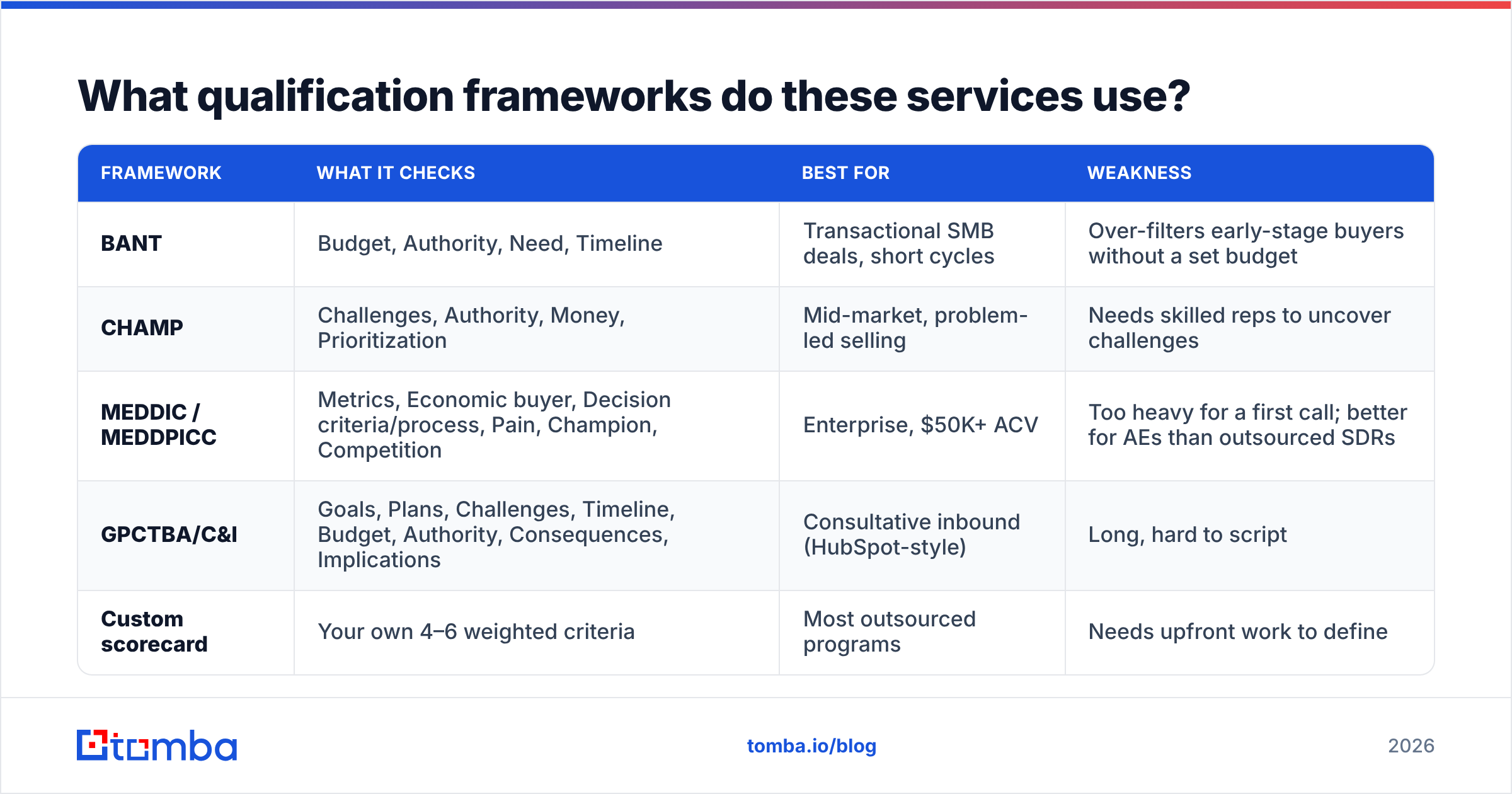
The framework decides what "qualified" means, and that definition decides whether your AEs trust the handoffs. Here's how the common frameworks compare:
| Framework | What it checks | Best for | Weakness |
|---|---|---|---|
| BANT | Budget, Authority, Need, Timeline | Transactional SMB deals, short cycles | Over-filters early-stage buyers without a set budget |
| CHAMP | Challenges, Authority, Money, Prioritization | Mid-market, problem-led selling | Needs skilled reps to uncover challenges |
| MEDDIC / MEDDPICC | Metrics, Economic buyer, Decision criteria/process, Pain, Champion, Competition | Enterprise, $50K+ ACV | Too heavy for a first call; better for AEs than outsourced SDRs |
| GPCTBA/C&I | Goals, Plans, Challenges, Timeline, Budget, Authority, Consequences, Implications | Consultative inbound (HubSpot-style) | Long, hard to script |
| Custom scorecard | Your own 4–6 weighted criteria | Most outsourced programs | Needs upfront work to define |
Most mature outsourced programs use a trimmed custom scorecard: three or four hard gates (right title, right company size, active pain, timeline under 6 months) plus a few soft signals that add points. MEDDIC-level depth usually belongs to your AE's first discovery call, not an outsourced SDR's ten-minute conversation.
How much do lead qualification services cost?#
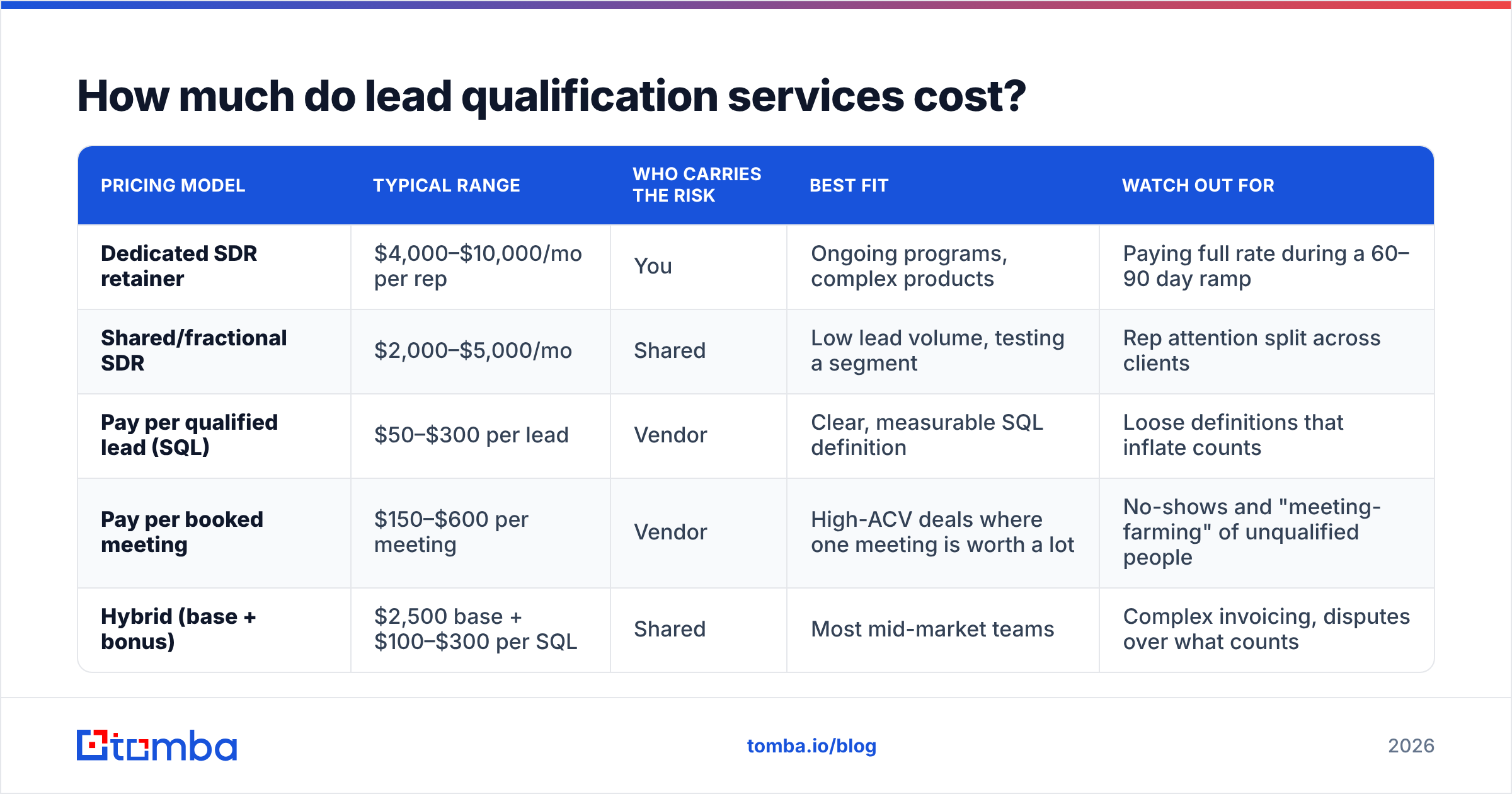
This is where buyers get confused, because vendors quote in completely different units. Normalize every quote to cost per sales-accepted opportunity before you compare anything.
The figures below are typical ranges from public vendor pricing pages and quotes buyers commonly report in 2026. Your quote will depend on region, seniority of reps, and deal complexity.
| Pricing model | Typical range | Who carries the risk | Best fit | Watch out for |
|---|---|---|---|---|
| Dedicated SDR retainer | $4,000–$10,000/mo per rep | You | Ongoing programs, complex products | Paying full rate during a 60–90 day ramp |
| Shared/fractional SDR | $2,000–$5,000/mo | Shared | Low lead volume, testing a segment | Rep attention split across clients |
| Pay per qualified lead (SQL) | $50–$300 per lead | Vendor | Clear, measurable SQL definition | Loose definitions that inflate counts |
| Pay per booked meeting | $150–$600 per meeting | Vendor | High-ACV deals where one meeting is worth a lot | No-shows and "meeting-farming" of unqualified people |
| Hybrid (base + bonus) | $2,500 base + $100–$300 per SQL | Shared | Most mid-market teams | Complex invoicing, disputes over what counts |
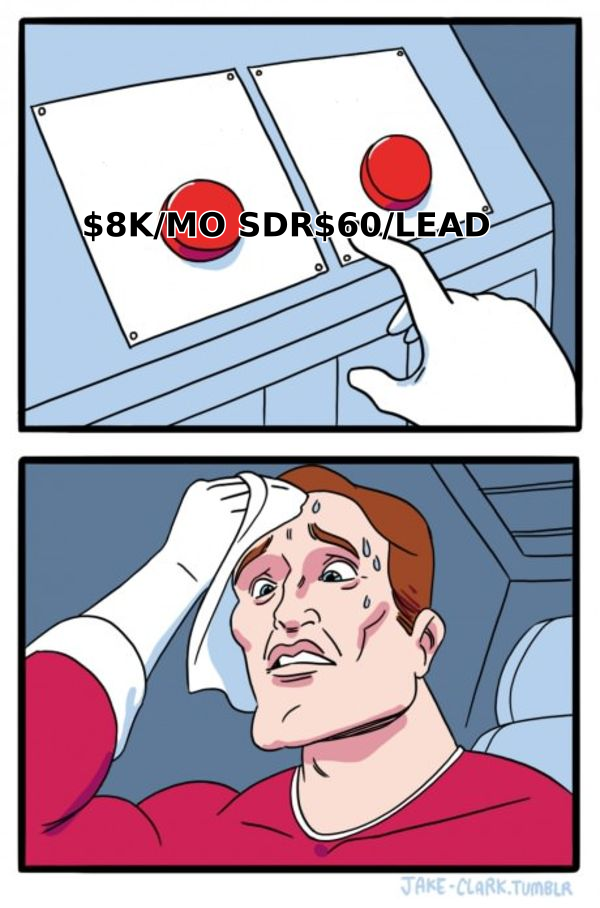
For comparison, a fully loaded in-house SDR in the US commonly costs $85,000–$120,000 a year once you add salary, commission, benefits, tools and management time. That's roughly $7,000–$10,000 a month, before ramp.
The quick math: if your average deal is worth $20,000 and your SQL-to-close rate is 15%, each SQL is worth about $3,000 in expected revenue. Paying $250 per SQL looks cheap until you learn half of them won't take a second meeting. Always ask vendors for their SQL-to-opportunity acceptance rate across current clients, not just the number of SQLs delivered.
Is outsourcing lead qualification better than building in-house?#
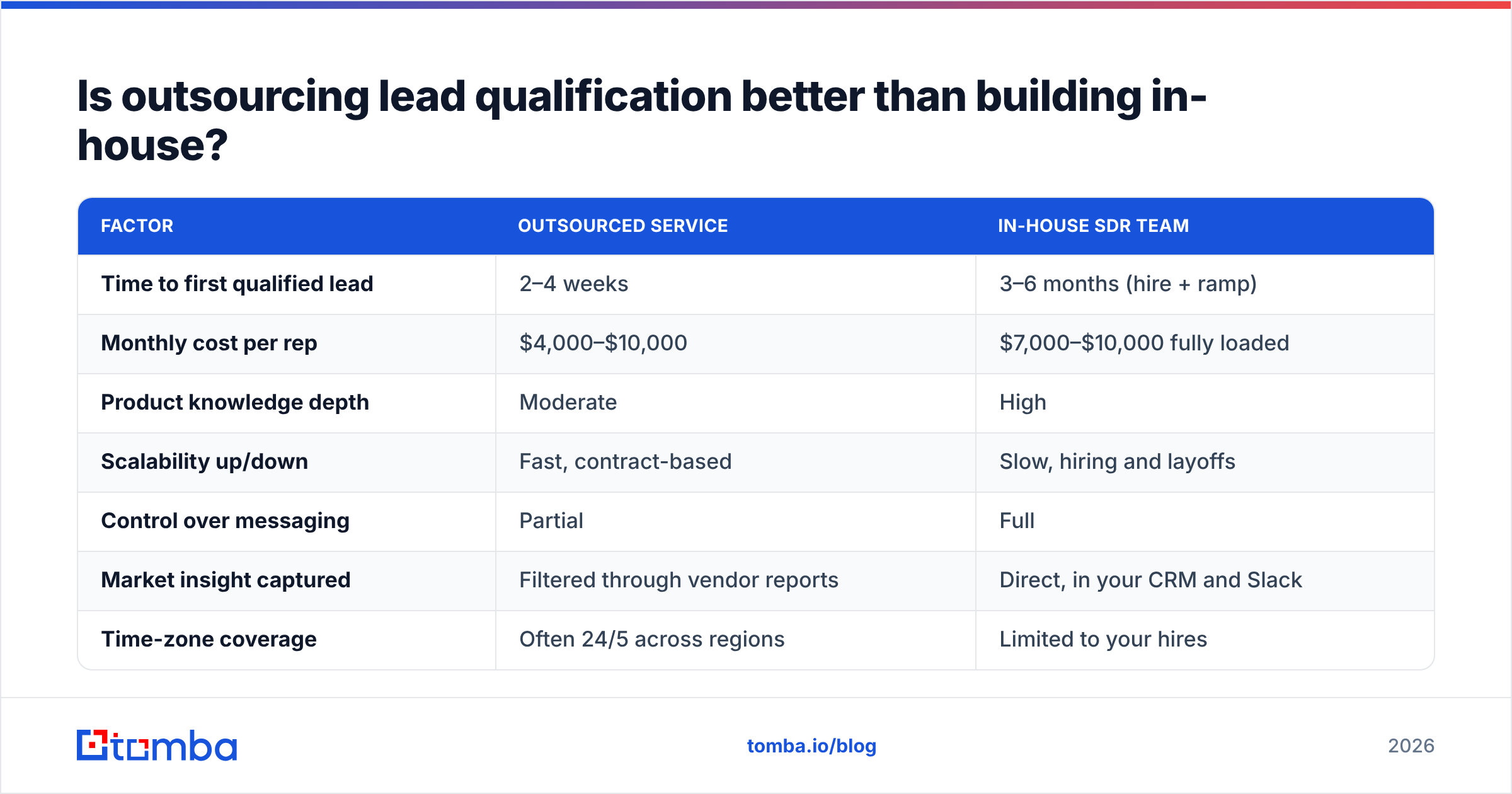
Neither option wins across the board. The decision comes down to four variables: speed, product complexity, volume consistency, and how much you want to learn from the conversations directly.
| Factor | Outsourced service | In-house SDR team |
|---|---|---|
| Time to first qualified lead | 2–4 weeks | 3–6 months (hire + ramp) |
| Monthly cost per rep | $4,000–$10,000 | $7,000–$10,000 fully loaded |
| Product knowledge depth | Moderate | High |
| Scalability up/down | Fast, contract-based | Slow, hiring and layoffs |
| Control over messaging | Partial | Full |
| Market insight captured | Filtered through vendor reports | Direct, in your CRM and Slack |
| Time-zone coverage | Often 24/5 across regions | Limited to your hires |
| Management overhead | Low to moderate | High (SDR manager required) |
Outsource when:
- You need pipeline this quarter, not in six months.
- You're testing a new vertical or region and don't want to commit to headcount before the segment is proven.
- Your inbound volume spikes around events, launches or seasonal peaks.
- You sell a relatively simple product where the qualifying call is mostly about fit and timing.
Build in-house when:
- Your product needs real domain expertise to discuss (security, healthcare, infrastructure).
- The SDR seat is your AE farm team and you want to promote from within.
- Your lead volume is steady and predictable, so fixed headcount pays off.
- Customer conversations feed product strategy, and you don't want them filtered through a vendor.
Many teams end up hybrid: in-house SDRs handle inbound and strategic accounts, and an outsourced team covers outbound prospecting in secondary segments or off-hours inbound response.
What should you look for when choosing a lead qualification service?#
Vendor sales decks look alike. These are the questions that separate them.
- Ask for their SQL acceptance rate. Anything under 60% AE acceptance means their definition of "qualified" doesn't match yours. Strong vendors report 70–85%.
- Ask who owns the data work. Do they verify emails and append phone numbers before outreach, or do they run whatever list you hand over? This matters more than rep headcount.
- Ask about rep tenure and ramp. SDR turnover across the industry is high. Ask how long the average rep stays on an account and how the vendor handles knowledge transfer when someone leaves.
- Check CRM integration depth. Native write-back into Salesforce or HubSpot, with structured fields for every scorecard answer, is table stakes. Screenshots of a sample record will tell you more than a feature list.
- Review contract terms. Look for a 90-day pilot with a clear exit, no multi-year lock-in, and a defined dispute process for leads you reject.
- Look at compliance. Calling and emailing across regions brings in GDPR, CAN-SPAM, TCPA and local do-not-call rules. Ask for their compliance documentation in writing.
Third-party review sites like G2 are useful for checking how vendors hold up after the honeymoon period. Filter reviews for companies with your ACV and sales cycle, not just the overall star rating.
Why do most outsourced qualification programs underperform?#
The most common failure doesn't come from bad scripts or lazy reps. It comes from bad inputs. Here's the pattern:
- Stale contact data. B2B contact data decays fast as people change jobs and companies restructure. A list that was clean six months ago can have a large share of outdated titles and dead inboxes.
- High bounce rates. Unverified lists routinely bounce at double-digit rates, which damages the sending domain and pushes the vendor's later emails into spam.
- Missing direct dials. Without mobile or direct numbers, reps end up in switchboard loops and connect rates fall to low single digits.
- Misaligned definitions. Marketing calls a lead an MQL, the vendor calls it an SQL, and the AE calls it a waste of 30 minutes.

The fix is operational, and it isn't expensive. Before a single lead goes to the vendor:
- Run the list through an email verifier and remove invalid and risky addresses. Handle catch-all domains separately.
- Use data enrichment to add current titles, company size and phone numbers, so reps can disqualify on firmographics before they ever dial.
- Fill gaps for high-value accounts with an email finder so reps reach the actual decision-maker instead of a generic info@ inbox.
- Deduplicate against your CRM so the vendor doesn't cold-call an open opportunity.
Teams that clean data up front typically see connect rates and SQL output rise noticeably with the same vendor, same reps, and same contract. You're paying for SDR hours either way, so give them a list that deserves those hours.
How do you measure whether a lead qualification service is working?#
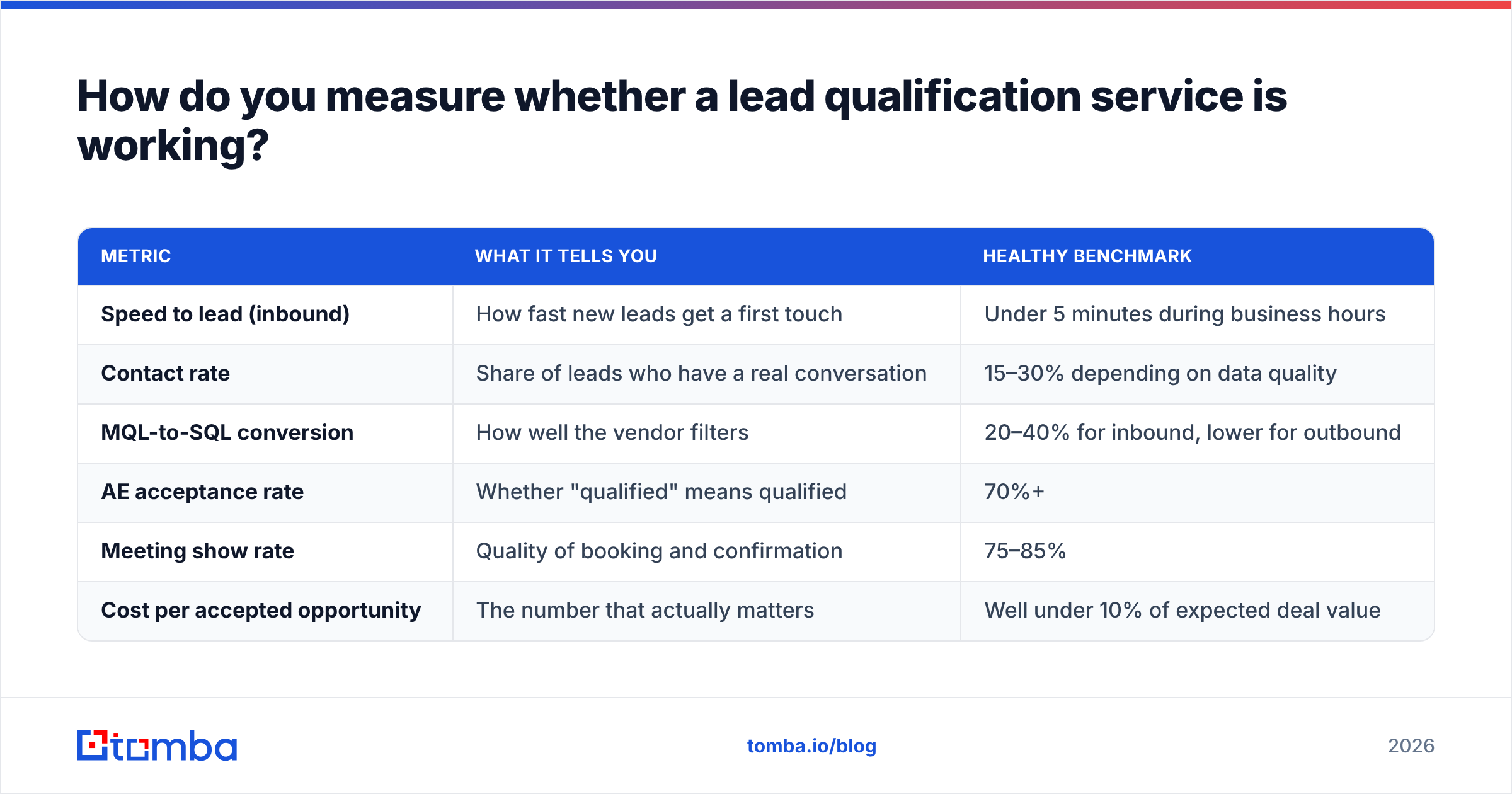
Set these metrics in the contract before the pilot starts, and review them every week for the first 90 days.
| Metric | What it tells you | Healthy benchmark |
|---|---|---|
| Speed to lead (inbound) | How fast new leads get a first touch | Under 5 minutes during business hours |
| Contact rate | Share of leads who have a real conversation | 15–30% depending on data quality |
| MQL-to-SQL conversion | How well the vendor filters | 20–40% for inbound, lower for outbound |
| AE acceptance rate | Whether "qualified" means qualified | 70%+ |
| Meeting show rate | Quality of booking and confirmation | 75–85% |
| Cost per accepted opportunity | The number that actually matters | Well under 10% of expected deal value |
Push vendors to report through your CRM instead of their own dashboards. If the numbers only exist in the vendor's portal, you can't reconcile them against closed-won revenue, and that revenue is the only outcome that justifies the spend.
Which tools support a lead qualification program?#
Whether qualification is outsourced or in-house, the stack usually has four layers:
- CRM and routing. Salesforce or HubSpot's sales tools hold the scorecard fields and assign leads.
- Data layer. Email finding, verification and enrichment tools make sure every lead has a reachable contact and accurate firmographics. Contact databases such as Tomba, BookYourData and others cover this layer, and many teams run two sources to fill gaps.
- Engagement. Sequencers and dialers run the cadence.
- Conversation intelligence. Call recording and scoring tools let you audit how the vendor's reps actually qualify.
Gartner's sales research hub regularly points out that B2B buyers now do most of their research before they talk to a rep. That makes the first qualifying conversation more valuable and less forgiving. A rep who calls with the wrong title or a dead email has already lost ground.
What is the verdict on lead qualification services?#
Lead qualification services work well when three things are true: your definition of "qualified" is written down and agreed with sales, the pricing model shares risk with the vendor, and the data you hand over is verified and enriched. If one of those is missing, you'll pay for activity instead of pipeline.
For most mid-market B2B teams in 2026, the practical setup is a hybrid contract (modest base plus a per-SQL bonus), a 90-day pilot with AE acceptance as the main KPI, and a data cleaning step owned by your team, not the vendor.
If you're getting a lead list ready for an outsourced SDR team, or for your own reps, start with the contacts. Tomba Email Finder finds verified professional email addresses by name, domain or company, so every hour you pay a qualifier for goes to real conversations with real decision-makers. The free tier includes 25 searches a month for testing a sample list, and paid plans start at $49/month when you're ready to clean a full pipeline.
Related guides#
Ready to find emails that actually work?
Join 150,000+ professionals who stopped guessing and started sending. Free credits on signup — no credit card required.
Get the Tomba newsletter
Practical outbound tactics and product updates — once every two weeks.
About the author