Lead Qualification Strategies: 7 Frameworks Compared for 2026
Most pipelines don't have a lead problem. They have a qualification problem. Here are seven frameworks compared side by side, plus how to choose one and keep it working in your CRM.
TL;DR
- Lead qualification strategies decide which leads your reps actually spend time on. Pick the wrong one and you end up with a busy calendar and very little revenue.
- BANT still works for simple, transactional deals. MEDDICC and its variants work better for complex, multi-stakeholder enterprise sales.
- Most mature teams use two layers: automated scoring (fit plus intent) to filter leads, then a conversational framework on discovery calls.
- No framework works on bad data. If the email bounces or the job title is two years old, your score is wrong before anyone makes a call.
- Start simple, write your criteria down, and review your disqualification reasons every quarter.
What are lead qualification strategies?#
Lead qualification strategies are the rules and conversations you use to decide whether a prospect is worth pursuing, and how hard. They answer three questions:
- Fit. Does this company and this person match your ideal customer profile?
- Intent. Are they actively looking to solve the problem you solve?
- Ability. Can they buy? That covers budget, authority, timing, and the internal process.
A qualification strategy puts those questions into a repeatable system. Sometimes that's a checklist a rep runs through on a discovery call. Sometimes it's a points-based model in your CRM that routes leads automatically. Usually it's both.
Everyone agrees qualification matters. The hard part is choosing a strategy that fits your deal size, your sales cycle, and how many people have to sign off before a contract goes through. A $30/month self-serve tool and a $250k platform deal need very different filters.
If you want the formal definitions of stages like MQL and SQL, the marketing qualified lead entry in the Tomba glossary covers the handoff points in detail.
Which lead qualification frameworks should you know?#
Almost every framework you'll run into is a variant of one of the seven below. Here's what each one checks and where it works best.
- BANT (Budget, Authority, Need, Timeline). IBM's original framework. It's fast and easy to teach. Its weakness is that it assumes the buyer already knows their budget, which is rarely true early in a deal.
- CHAMP (Challenges, Authority, Money, Prioritization). BANT reordered so the conversation opens with the prospect's pain instead of their wallet. It usually makes for a better first call.
- MEDDIC / MEDDICC (Metrics, Economic buyer, Decision criteria, Decision process, Identify pain, Champion, Competition). The standard for enterprise sales. It's thorough and forces reps to map the buying committee. The downside is that it's heavy for anything under a five-figure ACV.
- GPCTBA/C&I (Goals, Plans, Challenges, Timeline, Budget, Authority, Consequences & Implications). HubSpot's framework for inbound-led, consultative sales. It focuses on what happens if the prospect does nothing.
- ANUM (Authority, Need, Urgency, Money). Puts authority first. It works well when you're selling top-down and a gatekeeper would otherwise waste weeks of your time.
- FAINT (Funds, Authority, Interest, Need, Timing). Built for outbound. It checks whether the company has funds at all, instead of a formal budget, which suits prospects who didn't plan to buy.
- Predictive or points-based lead scoring. Not a conversational framework but a model. You assign points for fit attributes (industry, headcount, title) and behaviors (pricing-page visits, email replies), and leads that cross a threshold get routed to a rep. Wikipedia's lead scoring overview explains the explicit vs. implicit scoring split well.
How do the main frameworks compare side by side?#
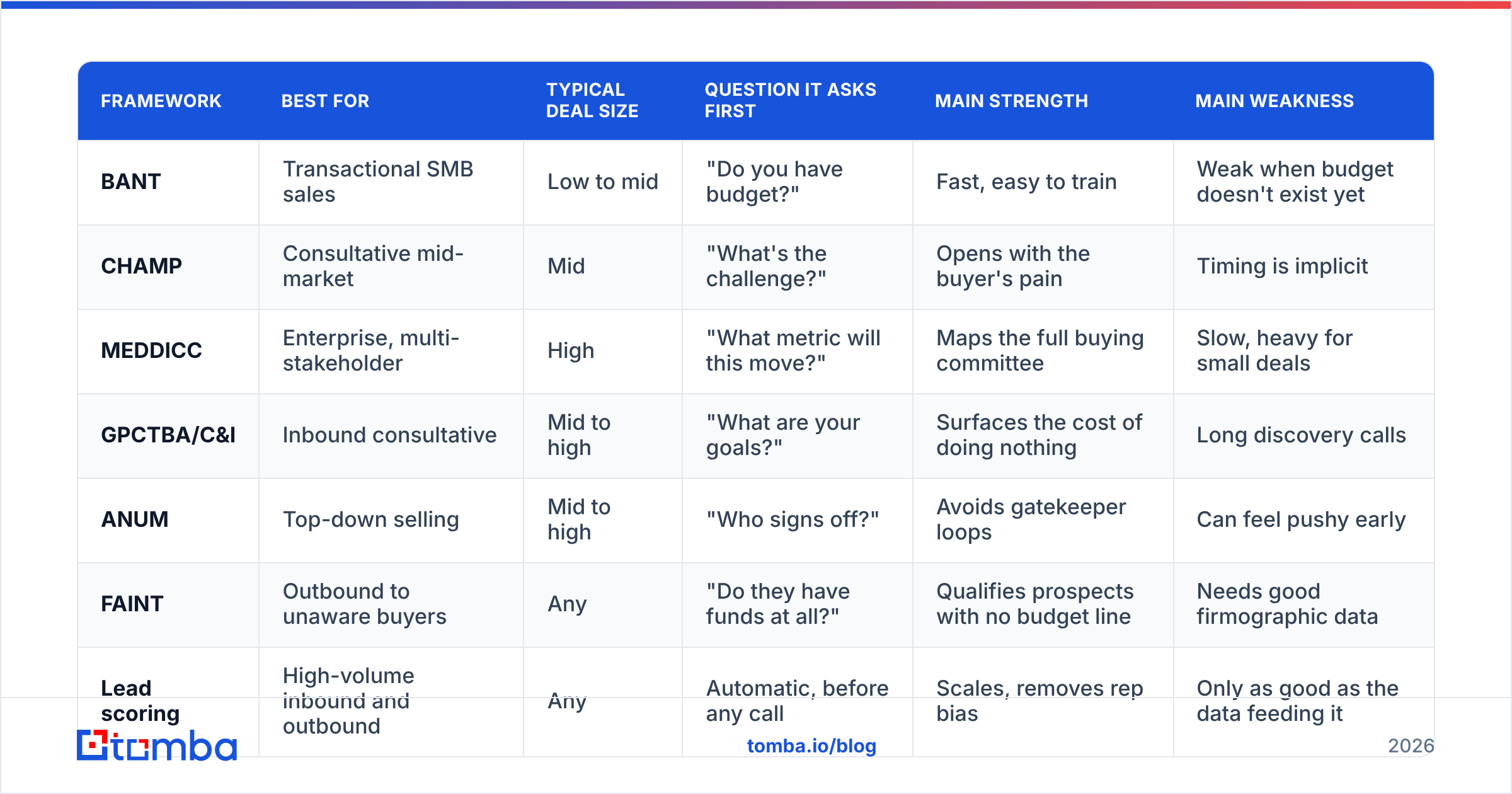
This is the table to screenshot for your next sales-ops meeting.
| Framework | Best for | Typical deal size | Question it asks first | Main strength | Main weakness |
|---|---|---|---|---|---|
| BANT | Transactional SMB sales | Low to mid | "Do you have budget?" | Fast, easy to train | Weak when budget doesn't exist yet |
| CHAMP | Consultative mid-market | Mid | "What's the challenge?" | Opens with the buyer's pain | Timing is implicit |
| MEDDICC | Enterprise, multi-stakeholder | High | "What metric will this move?" | Maps the full buying committee | Slow, heavy for small deals |
| GPCTBA/C&I | Inbound consultative | Mid to high | "What are your goals?" | Surfaces the cost of doing nothing | Long discovery calls |
| ANUM | Top-down selling | Mid to high | "Who signs off?" | Avoids gatekeeper loops | Can feel pushy early |
| FAINT | Outbound to unaware buyers | Any | "Do they have funds at all?" | Qualifies prospects with no budget line | Needs good firmographic data |
| Lead scoring | High-volume inbound and outbound | Any | Automatic, before any call | Scales, removes rep bias | Only as good as the data feeding it |
Look at the last column. Every framework fails in a predictable way, so choosing one is really choosing which failure you can live with.
Is BANT still useful in 2026?#
Yes, as long as you use it for the right deals.
BANT gets criticised because buyers rarely have a budget line for something they haven't decided to buy. Ask "what's your budget?" on a first cold call and you'll mostly hear "we don't have one," which is honest and tells you nothing.
BANT still does a job, though. For short-cycle, low-ACV deals where one person decides and pays with a card, it's the fastest filter you have. Two practical changes make it work better:
- Ask about budget last. Cover need and timeline first, then ask how they've paid for similar tools before.
- Treat "no budget" as unknown, not disqualified. A strong need plus a near-term timeline usually produces a budget.
If your ACV goes above roughly five figures, or procurement gets involved, move to CHAMP or MEDDICC.
When should you use MEDDICC instead?#
Use MEDDICC when three or more people have to say yes before a contract gets signed.
The framework makes your rep write down things they usually assume: who the economic buyer is, what the formal decision process looks like, and who inside the account is actively selling for you (the champion). Many enterprise deals don't slip because the prospect lost interest. They slip because nobody identified the CFO who had veto power.
The cost is time. A proper MEDDICC workup can take several calls, so it's wasted effort on a $5k deal. A reasonable rule: use BANT or CHAMP for the first-pass filter, then apply MEDDICC only to opportunities above your enterprise ACV threshold.
Salesforce's guidance on sales qualification and pipeline management and Gartner's research on B2B buying both point out that buying groups keep getting larger. That trend favors frameworks that map stakeholders explicitly.
How does lead scoring fit with conversational frameworks?#
Think of scoring and frameworks as two layers, not two alternatives.
Layer 1: scoring (before any human touches the lead). A model in your CRM gives each lead a fit score and an intent score:
- Fit uses firmographic and demographic data: industry, headcount, revenue band, tech stack, job title, seniority.
- Intent uses behavior: pricing-page views, demo requests, replies to outbound, content downloads, repeat visits.
Leads above the threshold go to SDRs. Leads below it go to nurture.
Layer 2: framework (on the discovery call). The rep uses BANT, CHAMP, or MEDDICC to confirm what the score suggested and to catch what data can't show, such as internal politics, urgency, or a competitor already in the running.
A basic scoring model might look like this:
| Signal | Type | Points |
|---|---|---|
| Title is VP or above in target function | Fit | +20 |
| Company headcount 50–1,000 | Fit | +15 |
| Uses a complementary tool in tech stack | Fit | +10 |
| Visited pricing page twice in 7 days | Intent | +25 |
| Replied to outbound email | Intent | +20 |
| Personal/free email domain | Fit | −15 |
| Email hard-bounced | Data quality | −30 |
The last two rows matter more than most teams realize. A lead with a Gmail address or an invalid mailbox should drop sharply, because nothing your rep does next will reach a real decision-maker.
Why does data quality make or break qualification?#
Every qualification strategy runs on assumptions about who the lead is. If those assumptions are wrong, the strategy produces confident, well-organised mistakes.
A few common ways this happens:
- Stale titles. Your CRM says "Head of Ops," but that person left eight months ago. They score high on authority, and your sequence goes to an inbox nobody reads.
- Invalid emails. Hard bounces keep the lead from ever qualifying, and they damage your sender reputation along the way, so your good leads start landing in spam too.
- Missing firmographics. If half your leads have no headcount or industry, your fit score is really an intent score, and intent without fit fills calendars with students and competitors.
- Catch-all domains. Some servers accept every address, so you can't tell whether the specific mailbox exists. Scoring those as "verified" inflates your pipeline.
The fix belongs upstream of the framework. Run new leads through an email verifier before they're scored, and use data enrichment to fill in title, seniority, company size, and tech stack automatically. Once those fields are reliable, your fit score means something, and your SDRs stop working ghosts.
Several data providers cover this layer. Tomba, BookYourData, Apollo, and others each have strengths depending on your region and verticals, so test two or three against a sample of your own closed-won accounts before you commit.
How do you choose the right strategy for your team?#
Use these four questions to narrow it down:
- How many people sign the contract? One person: BANT or ANUM. Two or three: CHAMP or GPCTBA/C&I. A buying committee: MEDDICC.
- Where do your leads come from? Mostly inbound: scoring plus CHAMP. Mostly outbound: FAINT for the first touch, then escalate.
- How many leads a month? Under about 100, reps can qualify manually. Above that, you need automated scoring or your SDRs spend their week triaging.
- How clean is your data? If you can't trust title and email fields, fix that before you build a scoring model. Otherwise you're automating noise.
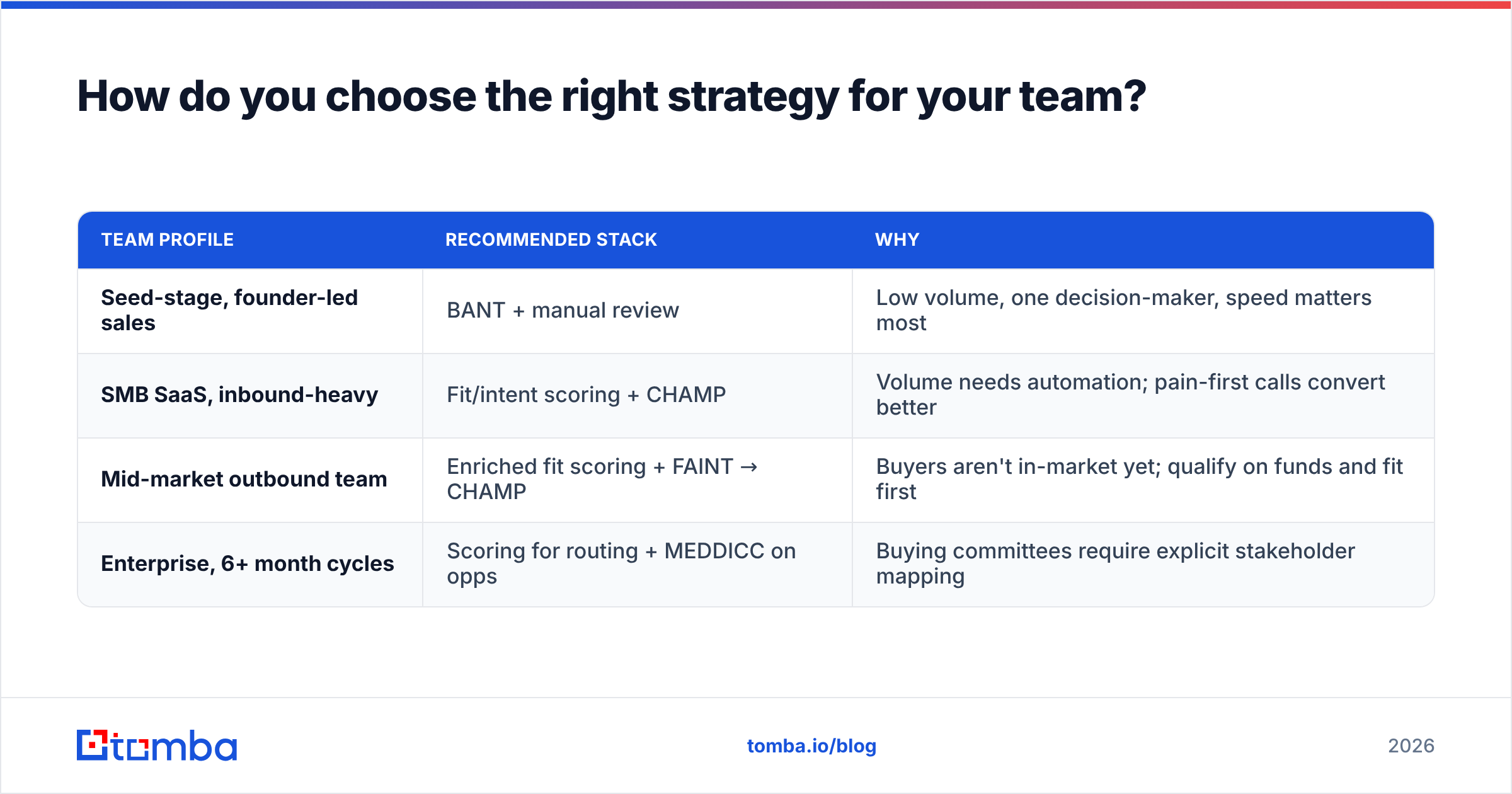
Here's how those answers map onto common team profiles:
| Team profile | Recommended stack | Why |
|---|---|---|
| Seed-stage, founder-led sales | BANT + manual review | Low volume, one decision-maker, speed matters most |
| SMB SaaS, inbound-heavy | Fit/intent scoring + CHAMP | Volume needs automation; pain-first calls convert better |
| Mid-market outbound team | Enriched fit scoring + FAINT → CHAMP | Buyers aren't in-market yet; qualify on funds and fit first |
| Enterprise, 6+ month cycles | Scoring for routing + MEDDICC on opps | Buying committees require explicit stakeholder mapping |

What are the most common lead qualification mistakes?#
These are the patterns that show up again and again in pipeline reviews:
- Qualifying too late. If reps only apply the framework after the demo, the unqualified leads have already cost you the most expensive hour in your funnel.
- Keeping criteria in reps' heads. "I just know a good lead" doesn't scale and can't be coached. Write your definitions down and put them in CRM fields.
- Never disqualifying. A pipeline full of "maybe next quarter" deals looks healthy and forecasts badly. Give reps permission and a required field to close out leads as lost with a reason.
- Set-and-forget scoring. Your ICP changes. Re-check your scoring weights against closed-won data at least once a quarter.
- Treating MQL volume as the goal. Marketing hits its number while sales complains about lead quality. Agree on SQL acceptance rate as the shared metric.
- Scoring unverified contacts. A lead you can't reach isn't a lead. Put verification before scoring, not after.
How do you roll out a new qualification strategy without chaos?#
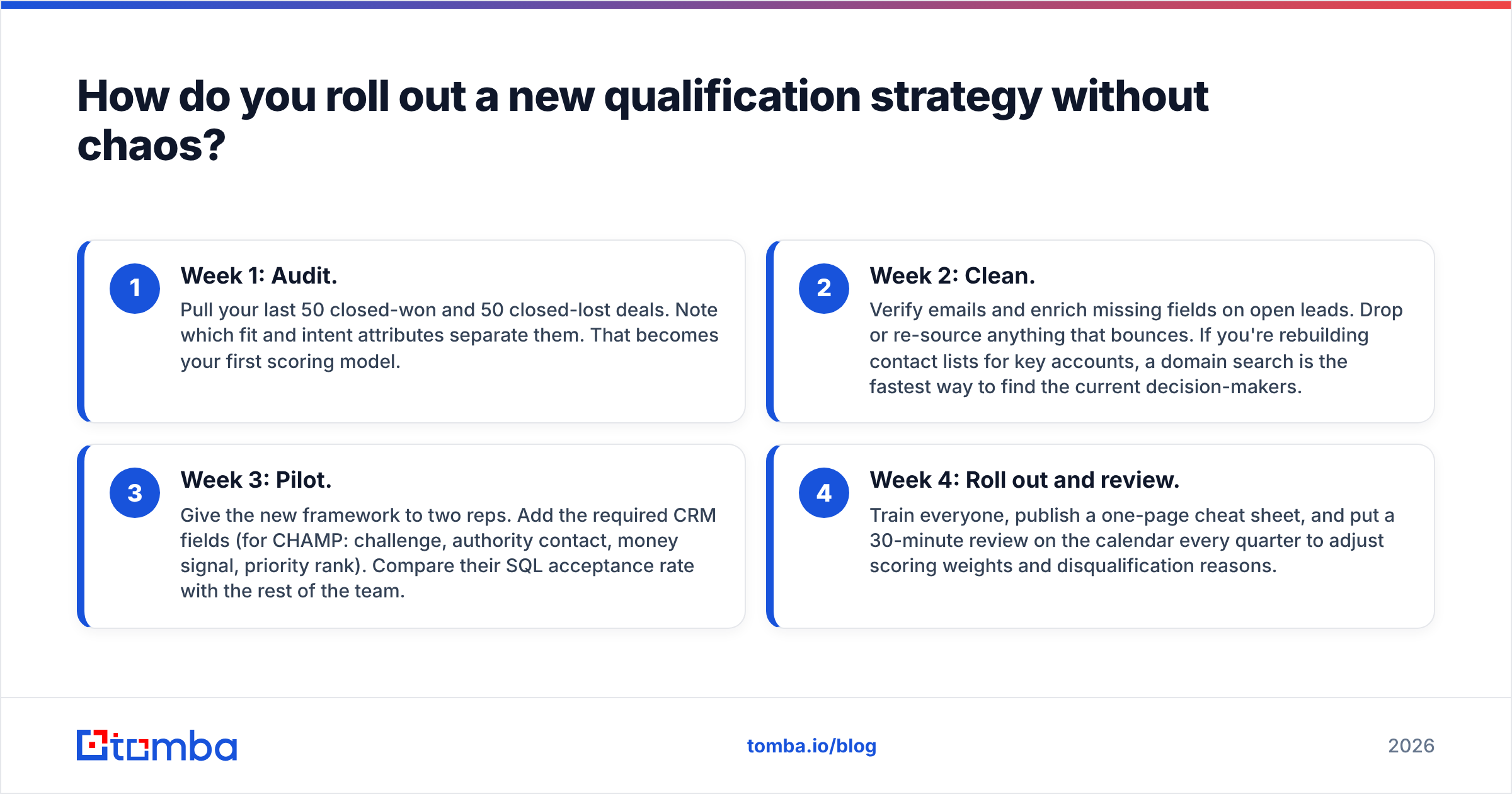
A four-week rollout that doesn't stop the pipeline:
- Week 1: Audit. Pull your last 50 closed-won and 50 closed-lost deals. Note which fit and intent attributes separate them. That becomes your first scoring model.
- Week 2: Clean. Verify emails and enrich missing fields on open leads. Drop or re-source anything that bounces. If you're rebuilding contact lists for key accounts, a domain search is the fastest way to find the current decision-makers.
- Week 3: Pilot. Give the new framework to two reps. Add the required CRM fields (for CHAMP: challenge, authority contact, money signal, priority rank). Compare their SQL acceptance rate with the rest of the team.
- Week 4: Roll out and review. Train everyone, publish a one-page cheat sheet, and put a 30-minute review on the calendar every quarter to adjust scoring weights and disqualification reasons.
If you already run HubSpot or Salesforce, both have native scoring properties and required-field validation. You probably don't need a new tool, just clearer rules inside the one you already have. HubSpot's CRM documentation covers how to set up custom lead-score properties.
What does good lead qualification look like in practice?#
A healthy qualification system usually shows these signs:
- Reps can explain in one sentence why a lead is or isn't qualified, and the reason matches a CRM field.
- SQL acceptance rate is stable or improving quarter over quarter.
- Disqualification reasons are specific ("no champion identified," "under 20 employees") rather than "not interested."
- Bounce rates on outbound sequences stay low because contacts are verified before they enter the queue.
- Marketing and sales review the same dashboard and argue about the same numbers.
None of this depends on picking a clever framework. It depends on consistent criteria, clean data, and actually running the review meeting.
Where should you start?#
Start with the data, because every lead qualification strategy in this guide assumes you're talking to the right person at the right company. If that assumption is wrong, BANT, MEDDICC, and the most carefully weighted scoring model will all give you the wrong answer.
For most teams the quickest improvement is to make sure every lead in the queue has a verified, current work email for the actual decision-maker. Tomba Email Finder finds professional email addresses by name, domain, or company, so your scoring model and discovery calls start from accurate contacts. Try it on the free tier (25 searches a month) against a handful of your target accounts, then check Tomba pricing when you're ready to run it across your whole pipeline.
Related guides#
// get started
Find, verify and enrich your first contacts today
Start on the free plan with 25 searches a month, then scale when your team is ready.
Free plan · No credit card required · GDPR & CCPA
// about the author