Lead Qualification Strategy: Frameworks, Scoring, and Examples
Most pipelines are full of leads that were never going to buy. Here's how to compare BANT, MEDDIC, CHAMP and three other frameworks, add fit and intent scoring, and build a lead qualification strategy your reps will actually follow.
TL;DR
- A lead qualification strategy has three layers: fit (does this account match your ICP?), intent (are they showing buying signals?), and conversation (does a framework like BANT or MEDDIC confirm a real opportunity?).
- Your framework should follow your deal size. BANT and ANUM suit transactional, sub-$10k deals. CHAMP and GPCT suit mid-market. MEDDIC or MEDDPICC suits enterprise deals with long buying committees.
- Score fit and intent before a rep ever gets on a call, then use the framework only on leads that clear a threshold. Your reps spend their time on the conversations most likely to close.
- Bad contact data breaks qualification first. If a third of your "leads" bounce, your conversion math is wrong before scoring even starts.
- Review your qualification criteria every quarter against closed-won and closed-lost deals. A strategy you never check against outcomes turns into guesswork.
What is a lead qualification strategy?#
A lead qualification strategy is the documented set of rules your team uses to decide which leads deserve sales time, and in what order. It answers three questions for every new name that enters your pipeline:
- Should we sell to this company at all?
- Is now the right time?
- Is this person the right entry point?
Think of it as a series of filters. Marketing captures leads, scoring filters out obvious mismatches, and a rep runs a structured discovery conversation to confirm the rest. Anything that survives all three becomes a sales-qualified opportunity.
Without a written strategy, qualification falls back on individual judgment. One rep chases every inbound demo request, another only works companies they recognize, and your forecast becomes a blend of optimism and anecdote. Gartner's sales research has repeatedly pointed out that B2B buyers spend only a small share of their buying journey talking to vendors. That makes the calls you do get more valuable, and the calls you waste more expensive.
The terms matter too. A marketing qualified lead (MQL) has passed marketing's fit and engagement bar. A sales-accepted lead (SAL) is one a rep has agreed to work. A sales-qualified lead (SQL) has passed a discovery conversation. Your strategy should define exactly what moves a lead from one stage to the next.
Why do most lead qualification strategies fail?#
Most strategies don't fail because the team picked the wrong framework. They fail at the edges:
- The data is wrong. Job titles are two roles out of date, emails bounce, and company size came from a form field someone filled in as "1-10" to skip the question.
- There's no shared definition. Marketing counts an ebook download as an MQL, and sales treats that as noise. Both teams are measuring different things.
- The framework is used as a script. Reps open with "What's your budget?" on the first call, and prospects shut down.
- Nobody closes the loop. Qualification criteria are set once and never tested against which deals actually closed.

Fixing these is less glamorous than choosing between BANT and MEDDIC, but it moves the numbers more.
Which lead qualification frameworks should you compare?#
Six frameworks cover almost every B2B sales motion. They overlap heavily. The real difference is where each one starts and how much detail it asks the rep to collect.
| Framework | Stands for | Best for | Typical deal size | Main strength | Main weakness |
|---|---|---|---|---|---|
| BANT | Budget, Authority, Need, Timeline | Transactional SMB sales | Under $10k ACV | Fast, easy to train | Budget-first questions feel pushy; misses buying committees |
| ANUM | Authority, Need, Urgency, Money | SMB and inside sales | Under $15k ACV | Starts with the decision-maker | Still assumes a single buyer |
| CHAMP | Challenges, Authority, Money, Prioritization | Mid-market, consultative | $10k–$50k ACV | Leads with the prospect's problem | Can run long on low-value leads |
| GPCT (GPCTBA/C&I) | Goals, Plans, Challenges, Timeline, Budget, Authority, Consequences & Implications | Inbound, solution selling | $10k–$75k ACV | Uncovers the business case | Heavy for reps to remember |
| FAINT | Funds, Authority, Interest, Need, Timing | Outbound to cold accounts | Any | Works when no budget line exists yet | Less rigorous on the buying process |
| MEDDIC / MEDDPICC | Metrics, Economic buyer, Decision criteria, Decision process, (Paper process), Identify pain, Champion, (Competition) | Enterprise, multi-stakeholder | $50k+ ACV | Maps the full buying committee | Overkill below enterprise deal sizes |
When BANT is enough#
BANT dates back to IBM and is still the most widely taught framework because it's simple. If your product has a self-serve tier, a short sales cycle, and usually one decision-maker, BANT gets you to "yes" or "no" in a single call. The mistake is asking the four questions in order. Start with need and timeline. Budget and authority come up naturally once the prospect is talking about their problem.
When CHAMP or GPCT works better#
CHAMP and GPCT move the problem to the front of the conversation. That suits mid-market deals where the buyer may not have budget set aside yet but has a painful enough problem to create it. GPCT's "consequences and implications" step is especially useful for inbound leads: it forces the rep to find out what happens if the prospect does nothing.
When you need MEDDIC or MEDDPICC#
Once deals involve procurement, security review, and five or more stakeholders, the simpler frameworks stop working. MEDDIC makes the rep identify the economic buyer and a champion, and write down the decision process and the paper process. It takes more effort, but in enterprise sales that effort is the job. Using MEDDIC on a $3k deal, though, just slows everyone down.
How do you build a lead qualification strategy step by step?#
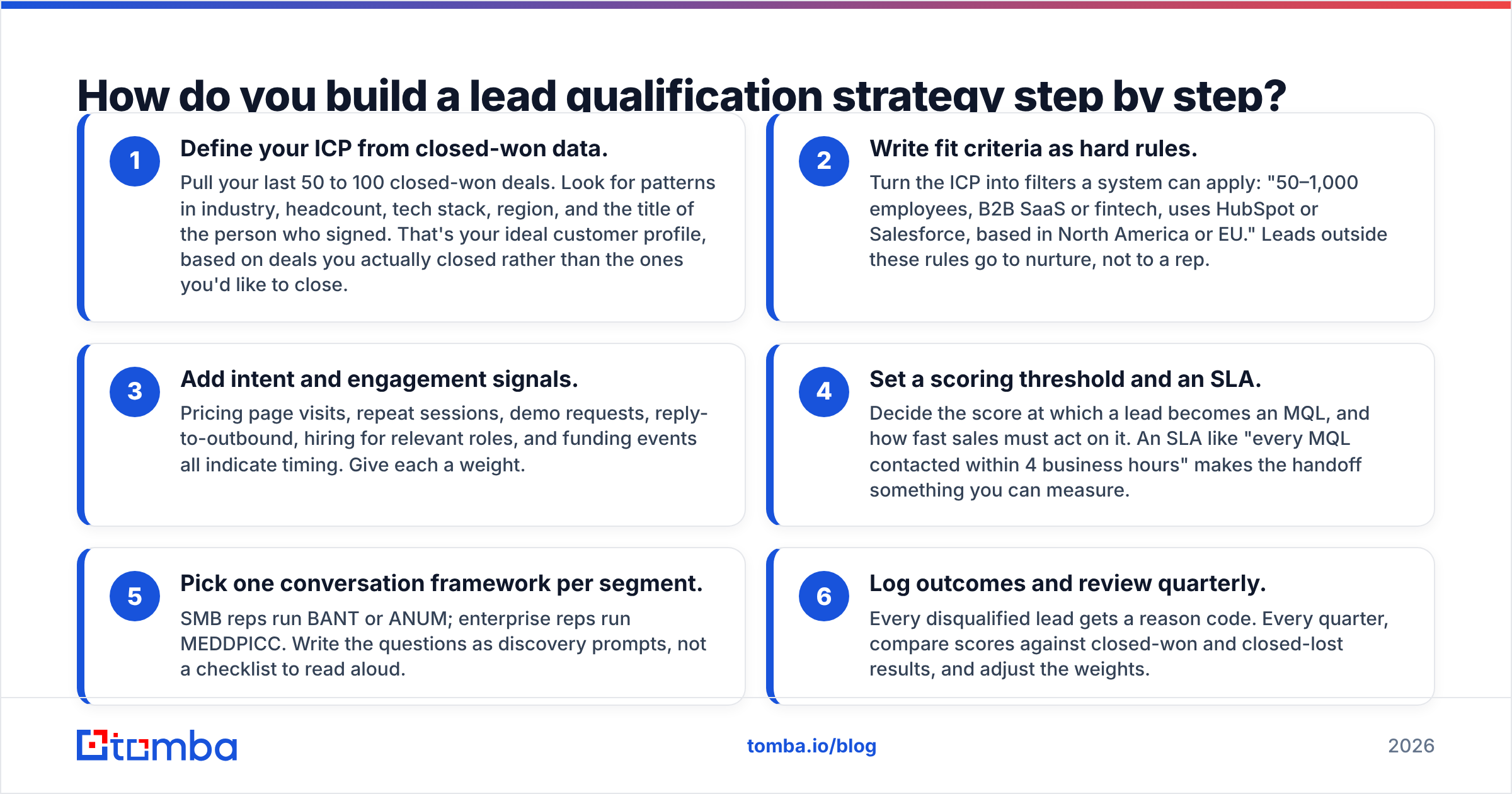
A framework is one piece of a strategy. Here's the full build, in the order you should do it.
- Define your ICP from closed-won data. Pull your last 50 to 100 closed-won deals. Look for patterns in industry, headcount, tech stack, region, and the title of the person who signed. That's your ideal customer profile, based on deals you actually closed rather than the ones you'd like to close.
- Write fit criteria as hard rules. Turn the ICP into filters a system can apply: "50–1,000 employees, B2B SaaS or fintech, uses HubSpot or Salesforce, based in North America or EU." Leads outside these rules go to nurture, not to a rep.
- Add intent and engagement signals. Pricing page visits, repeat sessions, demo requests, reply-to-outbound, hiring for relevant roles, and funding events all indicate timing. Give each a weight.
- Set a scoring threshold and an SLA. Decide the score at which a lead becomes an MQL, and how fast sales must act on it. An SLA like "every MQL contacted within 4 business hours" makes the handoff something you can measure.
- Pick one conversation framework per segment. SMB reps run BANT or ANUM; enterprise reps run MEDDPICC. Write the questions as discovery prompts, not a checklist to read aloud.
- Log outcomes and review quarterly. Every disqualified lead gets a reason code. Every quarter, compare scores against closed-won and closed-lost results, and adjust the weights.
Steps 1 and 2 are where most teams cut corners, and they're also where good contact data matters most. If you can't reliably find email addresses for the right titles at ICP accounts, your "qualified" pipeline fills up with generic info@ inboxes and people who left the company months ago.
How should you score leads before qualification calls?#
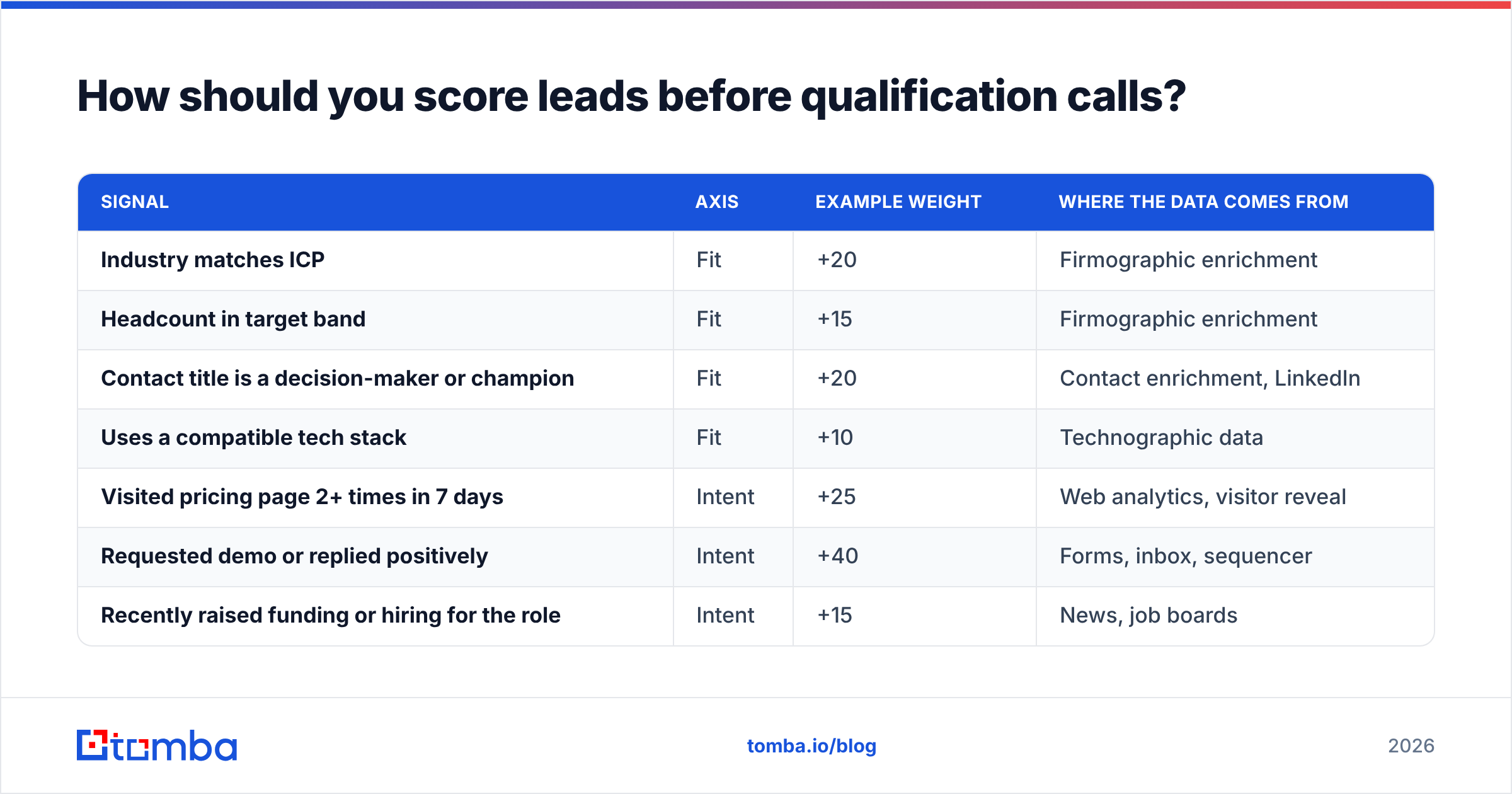
Scoring is the filter before the conversation. It tells you which leads get a call first. A two-axis model, fit multiplied by intent, beats a single blended number because it separates "great account, not ready" from "ready, but wrong account."
| Signal | Axis | Example weight | Where the data comes from |
|---|---|---|---|
| Industry matches ICP | Fit | +20 | Firmographic enrichment |
| Headcount in target band | Fit | +15 | Firmographic enrichment |
| Contact title is a decision-maker or champion | Fit | +20 | Contact enrichment, LinkedIn |
| Uses a compatible tech stack | Fit | +10 | Technographic data |
| Visited pricing page 2+ times in 7 days | Intent | +25 | Web analytics, visitor reveal |
| Requested demo or replied positively | Intent | +40 | Forms, inbox, sequencer |
| Recently raised funding or hiring for the role | Intent | +15 | News, job boards |
| Personal email domain (gmail, etc.) | Fit | -20 | Email verification |
| Competitor or student | Fit | -100 | Manual flag, enrichment |
A simple routing rule on top of this:
- High fit, high intent: route to an AE immediately.
- High fit, low intent: enroll in targeted outbound or ABM.
- Low fit, high intent: SDR qualifies quickly; often self-serve.
- Low fit, low intent: nurture or drop.
Most of the fit column depends on data enrichment: turning a bare email or domain into company size, industry, title, and location. If you run a CRM like Salesforce or HubSpot, enrich at the point of capture so your scoring model has data to work with before a human touches the record.
How do inbound and outbound qualification differ?#
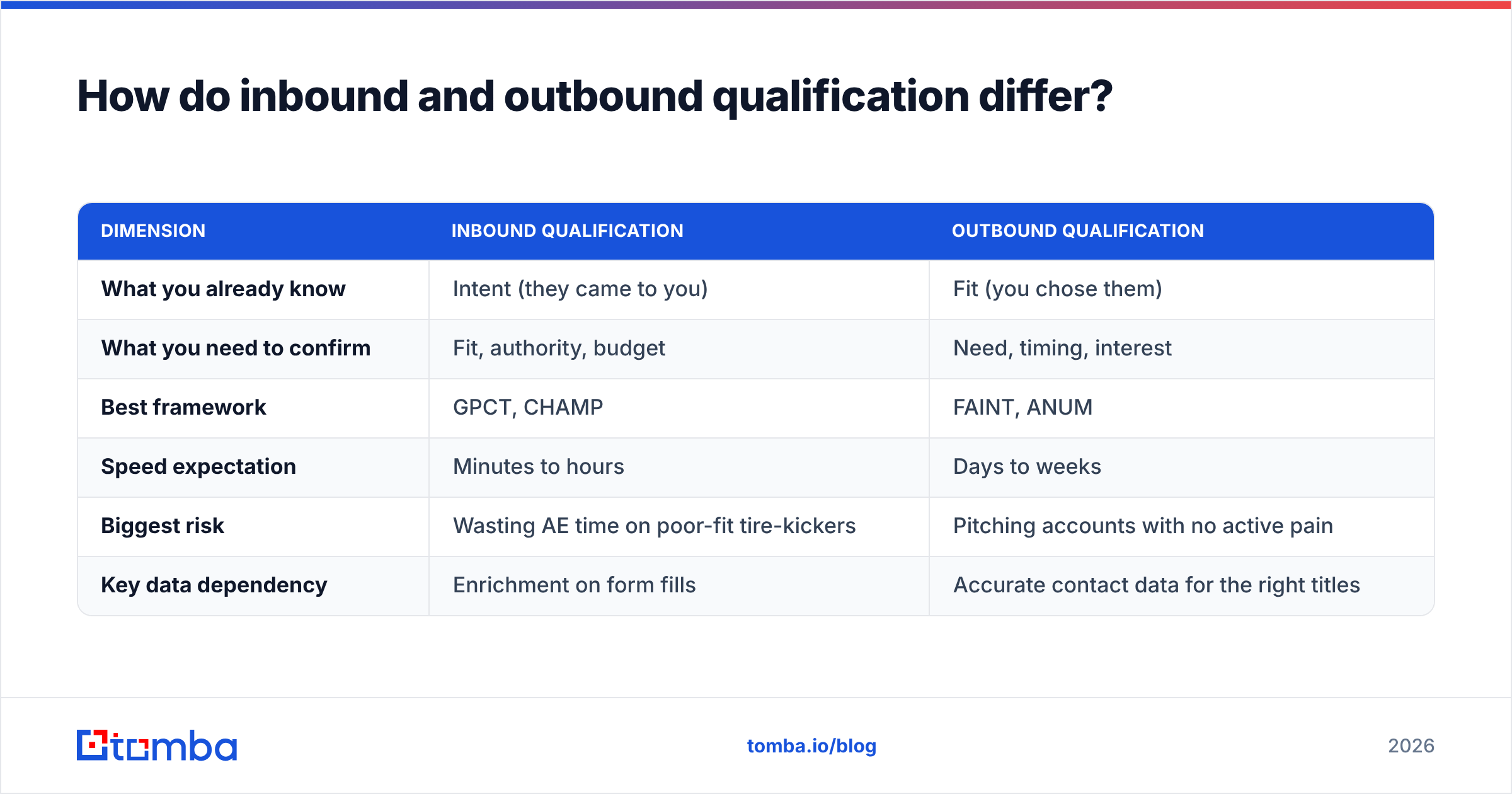
Inbound and outbound leads arrive with opposite information gaps, so your strategy should handle them differently.
| Dimension | Inbound qualification | Outbound qualification |
|---|---|---|
| What you already know | Intent (they came to you) | Fit (you chose them) |
| What you need to confirm | Fit, authority, budget | Need, timing, interest |
| Best framework | GPCT, CHAMP | FAINT, ANUM |
| Speed expectation | Minutes to hours | Days to weeks |
| Biggest risk | Wasting AE time on poor-fit tire-kickers | Pitching accounts with no active pain |
| Key data dependency | Enrichment on form fills | Accurate contact data for the right titles |
For inbound, speed to lead matters most. A demo request that sits for a day often goes cold, because the prospect has booked calls with two of your competitors in the meantime. Enrich and score instantly, then route.
For outbound, the qualification work happens before the first email. You're choosing accounts that already fit and contacts who can act. That makes list quality the most important variable, which is why teams building outbound lists usually start with a domain search against their target account list rather than buying a generic database.
What questions should reps actually ask?#
A framework is only as good as the questions behind it. Here are discovery prompts that cover BANT, CHAMP, and MEDDIC ground without sounding like an interrogation:
- Problem (Need / Challenges / Identify pain): "Walk me through how you handle X today. Where does it break?"
- Impact (Metrics / Consequences): "If nothing changes in the next six months, what does that cost you?"
- Priority (Timeline / Prioritization): "Where does fixing this sit against the other projects on your plate this quarter?"
- Process (Authority / Decision process): "Besides you, who else weighs in on a decision like this? How did your team buy the last tool of this size?"
- Money (Budget / Funds): "Is there budget allocated for this already, or would it need a business case?"
- Champion: "If this turned out to be the right fit, would you be the one to take it to the team?"
Notice the order: problem first, money last. Prospects who have talked for ten minutes about their pain will answer the budget question honestly. Prospects asked about budget in the first two minutes tend to give a vague "it depends."
How do you measure whether your qualification strategy works?#
If you don't measure the strategy, you can't tell whether it's working. Track these five metrics monthly, broken down by lead source and segment:
- MQL-to-SQL conversion rate. If this is very low, your scoring threshold is too loose or your fit criteria are wrong.
- SQL-to-close rate. If SQLs aren't closing, reps are qualifying too generously on the call. Tighten the framework.
- Speed to first touch. Time from MQL creation to first rep contact. This is your SLA in practice.
- Disqualification reason codes. If "no budget" dominates, add a budget proxy (headcount, funding) to your fit score. If "wrong contact" dominates, fix your data.
- Sales cycle length by score band. High-scoring leads should close faster. If they don't, your intent weights are off.

The meme above shows a common way strategies fail. Reps chase the big logo that falls outside the ICP and ignore the mid-market account that matches every closed-won pattern you have. Your scoring model is there to keep them focused on the fit.
Should you automate lead qualification?#
Partly. Automate the parts that are rules and leave judgment to people.
Automate:
- Enrichment of every new lead at capture
- Email verification before a lead enters a sequence
- Fit scoring and routing
- Intent signal aggregation
- SLA alerts when an MQL goes untouched
Keep human:
- Discovery conversations
- Champion identification
- Deciding when a "low fit" lead is actually a strategic exception
- Quarterly review of weights and criteria
AI tools can now summarize call notes into MEDDIC fields and flag missing criteria, which saves real time on enterprise deals. They still depend on what goes in, though. If the call happened with the wrong person because the contact data was stale, an AI summary only makes the mistake look tidier.
For deeper background on how qualification fits into demand generation overall, Wikipedia's overview of lead generation is a useful neutral primer, and your CRM documentation will show you where scoring fields and routing rules live.
Which lead qualification strategy is right for you?#
Pick based on deal size and sales motion, not on which acronym is most popular this year:
- Self-serve or SMB, short cycles: Fit score + BANT or ANUM. One call, fast decision.
- Mid-market, consultative: Fit + intent scoring + CHAMP or GPCT. Two to three discovery touches.
- Enterprise, multi-stakeholder: Account-level fit + MEDDPICC. Qualification continues through the whole cycle.
- Outbound-heavy teams: Strict fit filters at list-build time + FAINT on the first conversation.
Whichever framework you choose, it only works if the data going into it is accurate. Every scoring model and discovery framework assumes you're reaching the right person at the right company.
Start with contacts you can trust#
A lead qualification strategy relies on accurate contact data. If emails bounce and titles are out of date, your scores, routing rules, and conversion metrics will all be off. Tomba Email Finder lets you find verified professional email addresses by name, domain, or company, so the leads entering your scoring model are real decision-makers at ICP accounts. The free tier gives you 25 searches a month to test it against your own target list, and paid plans start at $49/mo. Build your next qualified list with Tomba and put your reps' time into conversations that can close.
Related guides#
// get started
Find, verify and enrich your first contacts today
Start on the free plan with 25 searches a month, then scale when your team is ready.
Free plan · No credit card required · GDPR & CCPA
// about the author