Lead Scoring Best Practices: 12 Rules That Actually Predict Revenue
Most lead scoring models reward email opens and webinar clicks, not buying intent. Here are 12 lead scoring best practices that tie points to closed revenue, plus a scoring template you can copy.
TL;DR
- A lead score only works when it predicts revenue. Build it from closed-won deals, not from what marketing thinks matters.
- Score two separate axes: fit (who they are) and intent (what they're doing). A single blended number hides which one is missing.
- Bad contact data quietly breaks every model. Verify and enrich records before they get scored, not after.
- Use negative scoring and score decay. Without them, your "hot" list slowly fills with students, competitors, and people who went quiet six months ago.
- Recalibrate every quarter against real conversion data, and agree on the MQL threshold with sales in writing.
What is lead scoring, and why do most models fail?#
Lead scoring gives each prospect a numeric value that estimates how likely they are to buy, so your reps work the best opportunities first. The idea is simple. Most implementations go wrong anyway.
A useful comparison is airport security. A good screening process spends its attention on the few signals that actually matter and waves everyone else through quickly. A bad one flags everybody with a water bottle and lets the real problems slip through. Most lead scoring models behave like the bad version: they add points for every email open, PDF download, and pricing-page visit, and then sales gets a queue of "hot" leads that includes interns, students, and competitors doing research.
The formal definition on Wikipedia's lead scoring entry describes it as ranking prospects against a scale of perceived value. In practice, the word that matters is perceived. If nobody checks the model against closed deals, it measures activity and nothing else.
Models usually fail for three reasons:
- They're built on opinion. Someone in marketing decides a webinar is worth 15 points because it feels important.
- They mix fit and intent together. A lead at 80 points could be a perfect-fit VP with no activity, or a bad-fit freelancer who clicked everything. Those two leads need completely different follow-up.
- They score dirty data. When the job title is missing, the company domain is a Gmail address, or the email bounces, the model is guessing.
The 12 practices below address all three.
What are the core components of a lead scoring model?#
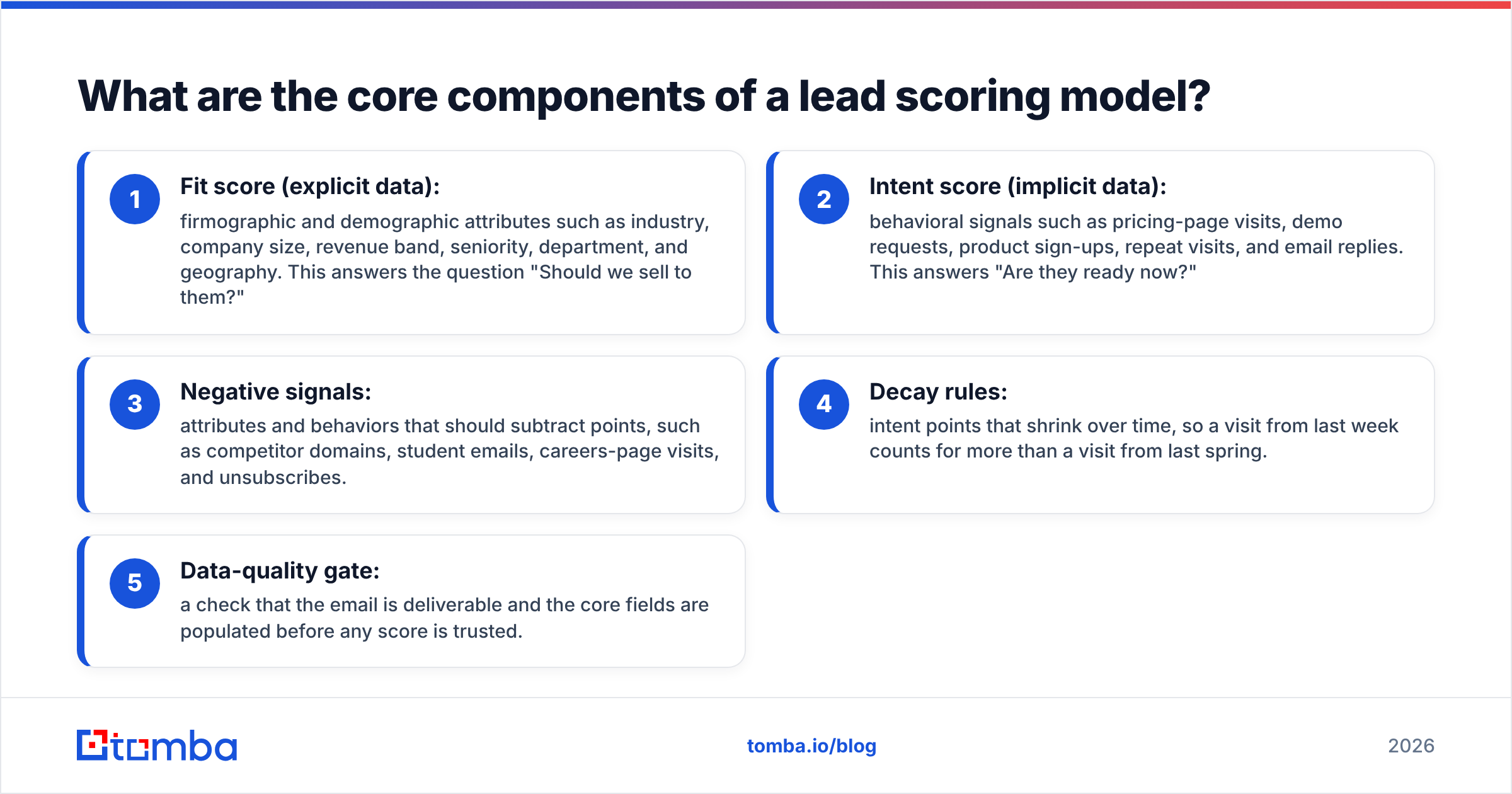
Before you tune point values, get the structure right. A solid model has five parts, and the list below is the framework the rest of this guide builds on.
- Fit score (explicit data): firmographic and demographic attributes such as industry, company size, revenue band, seniority, department, and geography. This answers the question "Should we sell to them?"
- Intent score (implicit data): behavioral signals such as pricing-page visits, demo requests, product sign-ups, repeat visits, and email replies. This answers "Are they ready now?"
- Negative signals: attributes and behaviors that should subtract points, such as competitor domains, student emails, careers-page visits, and unsubscribes.
- Decay rules: intent points that shrink over time, so a visit from last week counts for more than a visit from last spring.
- Data-quality gate: a check that the email is deliverable and the core fields are populated before any score is trusted.
Most teams build the first two, skip the last three, and then wonder why their marketing qualified lead volume looks healthy while conversion to opportunity keeps falling.
Which lead scoring best practices actually move revenue?#
1. Start from closed-won data, not a whiteboard#
Export your last 12–24 months of closed-won and closed-lost opportunities from your CRM. For each attribute (industry, company size, title, lead source, first-touch content), compare how often it shows up in wins versus losses. Attributes that appear far more often in wins get high points. Attributes that appear about equally in both get almost none, however important they feel.
If you have fewer than about 50 closed-won deals, you don't have enough data for a statistical model. Start with a simple rules-based model and plan to recalibrate once you have more data.
2. Keep fit and intent as separate scores#
Don't blend them into a single number. Use a two-axis grid instead, such as A–D for fit and 1–4 for intent. An "A1" lead (great fit, high intent) goes to sales right away. An "A4" (great fit, no intent) goes into a nurture or targeted outbound sequence. A "D1" (poor fit, high intent) should get a polite self-serve path, not an SDR's afternoon.
This single change usually fixes more routing problems than any change to point values.
3. Weight high-intent actions heavily and low-intent actions barely#
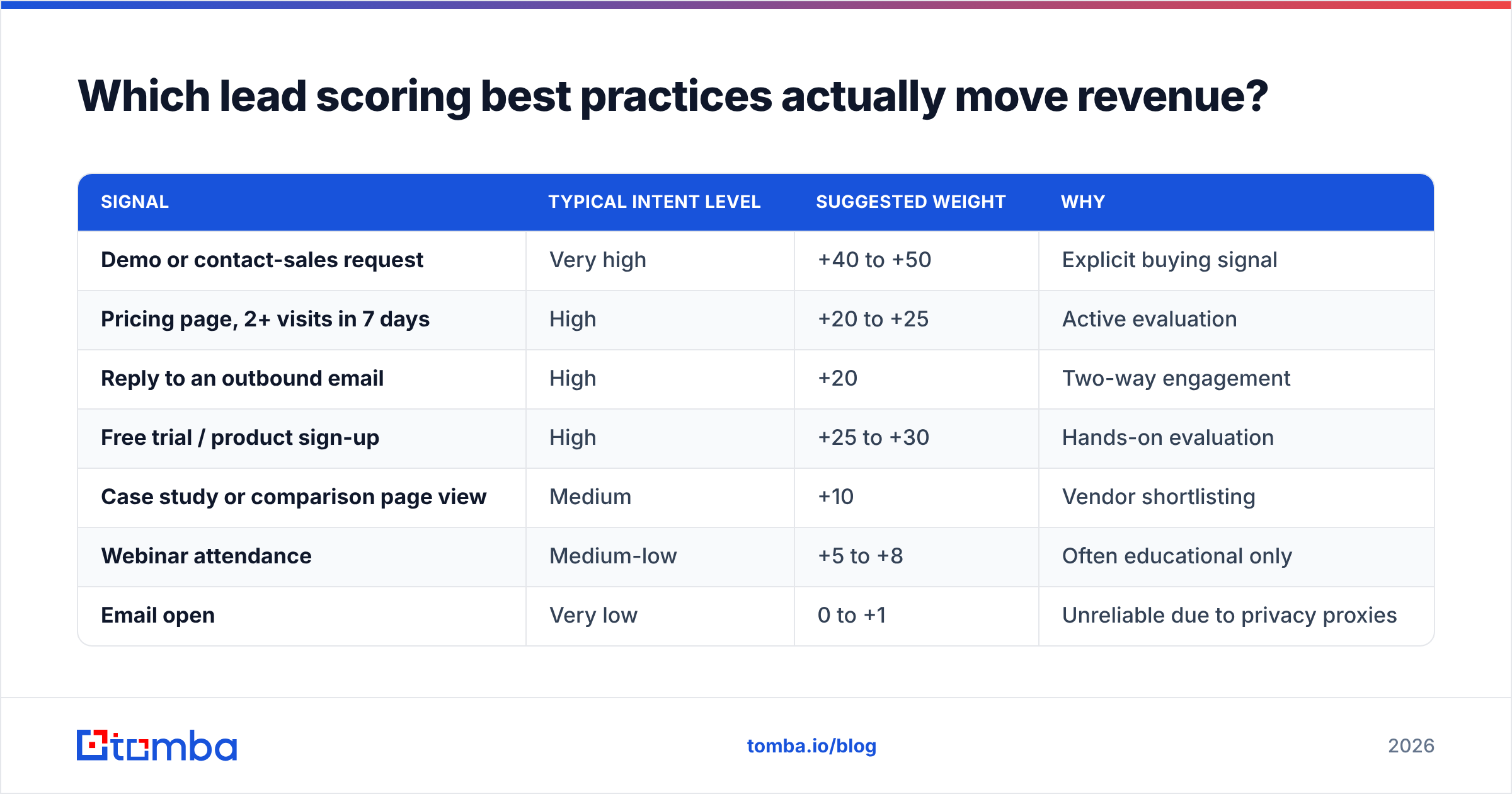
Some actions are close to hand-raises. Others are noise. Treat them that way:
| Signal | Typical intent level | Suggested weight | Why |
|---|---|---|---|
| Demo or contact-sales request | Very high | +40 to +50 | Explicit buying signal |
| Pricing page, 2+ visits in 7 days | High | +20 to +25 | Active evaluation |
| Reply to an outbound email | High | +20 | Two-way engagement |
| Free trial / product sign-up | High | +25 to +30 | Hands-on evaluation |
| Case study or comparison page view | Medium | +10 | Vendor shortlisting |
| Webinar attendance | Medium-low | +5 to +8 | Often educational only |
| Email open | Very low | 0 to +1 | Unreliable due to privacy proxies |
| Blog visit | Very low | +1 to +2 | Top-of-funnel curiosity |
Email opens deserve a note. Mail privacy features that preload images inflate open rates, so opens are close to meaningless as intent signals. Weight replies and clicks, not opens.
4. Score negative signals aggressively#
Negative scoring is the cheapest accuracy gain you can get. Subtract points for:
- Free email domains on a B2B form (gmail.com, yahoo.com), unless your ICP includes solopreneurs
- Competitor domains and known agency or consultant domains
- Job titles containing "student," "intern," or "freelance" (adjust to your ICP)
- Careers-page visits, which often signal a job seeker rather than a buyer
- Hard bounces and unsubscribes
- Countries or regions you can't sell into
If a lead can't legally or practically become a customer, its score should drop close to zero no matter how active it is.
5. Add score decay to every behavioral point#
Intent has a shelf life. A common pattern is to reduce behavioral points by 25–50% after 30 days of inactivity and reset them after 90. Fit points shouldn't decay, because a company's size doesn't expire, but intent points should. Without decay, your MQL list turns into a collection of leads that were hot a long time ago.
6. Put a data-quality gate in front of the model#
This is the practice most guides leave out, and it matters more than any point value. A scoring model is only as good as the fields it reads. If 30% of your inbound leads have no job title, a personal email, or a mistyped domain, the fit score for those records is essentially random.
Before a lead enters scoring:
- Verify the email. Undeliverable addresses should never become MQLs. An email verifier catches invalid, disposable, and risky addresses at the form or import stage.
- Enrich missing firmographics. Short forms convert better, but they leave you with thin records. Data enrichment fills in company size, industry, and seniority from the email or domain, so you can keep the form short and still score fit.
- Normalize titles. Map "VP Sales," "Vice President, Sales," and "Head of Revenue" to one seniority bucket before scoring.
Enrichment plus verification is what turns a three-field form into a fully scoreable lead.
7. Score the account, not only the person#
In B2B, several people are involved in a purchase. Three mid-level people from the same target account researching your product is a stronger signal than one director who downloaded an ebook. Roll individual scores up to an account-level score, and alert sales when multiple contacts at one account cross a threshold within the same window. Most modern CRMs support this, including HubSpot and Salesforce, usually on higher tiers.
8. Define the MQL threshold with sales, in writing#
A threshold that marketing sets alone is really a marketing KPI. Sit down with sales leadership and agree on:
- The exact score (or grade combination) that makes a lead an MQL
- The SLA for first touch (for example, within 4 business hours for A1 leads)
- What sales does with a lead it rejects, and a required rejection reason
Rejection reasons are your best source of feedback. If "wrong persona" shows up constantly, your fit weights are off. If "not ready" dominates, you're overweighting low-intent behavior.
9. Keep the model simple enough to explain#
If a rep can't tell why a lead scored 72, they won't trust it, and a model reps don't trust gets ignored. Aim for 10–20 scoring rules, not 80. Show the top three contributing factors next to the score in the CRM record.
10. Recalibrate quarterly against real outcomes#
Every quarter, pull every lead that crossed your MQL threshold and check the conversion rate to opportunity and to closed-won, broken out by score band. If leads scoring 60–70 convert at the same rate as leads scoring 90+, the model isn't separating anything. Adjust the weights, move the threshold, or retire rules that don't predict anything.
11. Treat predictive scoring as an upgrade, not a starting point#
Machine-learning scoring can be excellent, but it needs volume (hundreds of conversions), clean historical data, and consistent CRM hygiene. Analysts at firms like Gartner have repeatedly pointed to data quality as the main blocker for sales AI initiatives. If your rules-based model is running on messy data, a predictive model will learn the same mess faster.
12. Score outbound leads too, not only inbound#
Many teams only score form fills. Your outbound lists deserve the same treatment. Before you load a list into a sequencer, score it on fit (seniority, company size, industry) and on data quality (verified email, confirmed domain pattern). Low-fit or unverified contacts shouldn't use up sending volume, because they hurt deliverability and response rate together.
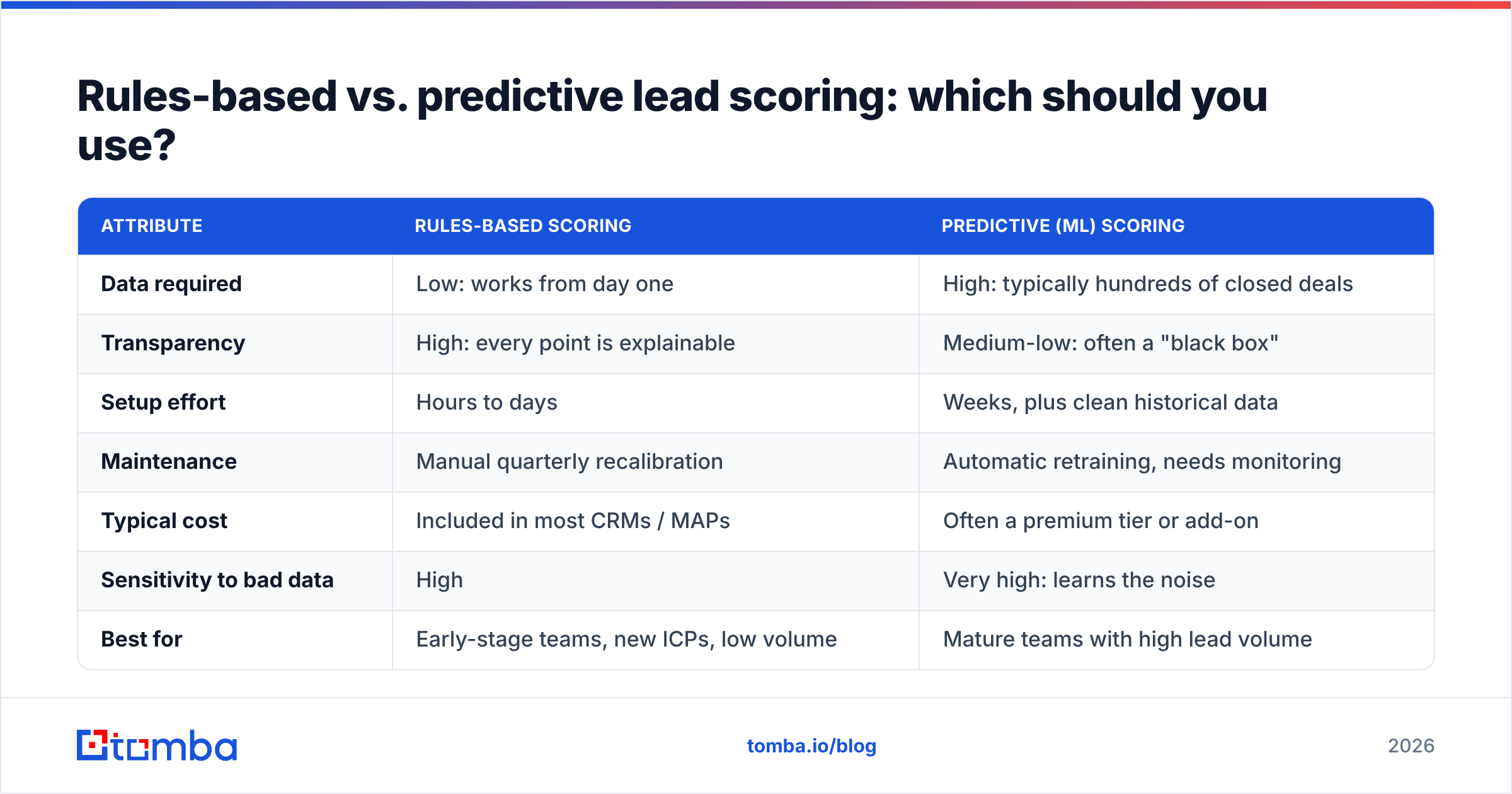
Rules-based vs. predictive lead scoring: which should you use?#
Both approaches work. The right one depends on your data volume and team maturity.
| Attribute | Rules-based scoring | Predictive (ML) scoring |
|---|---|---|
| Data required | Low: works from day one | High: typically hundreds of closed deals |
| Transparency | High: every point is explainable | Medium-low: often a "black box" |
| Setup effort | Hours to days | Weeks, plus clean historical data |
| Maintenance | Manual quarterly recalibration | Automatic retraining, needs monitoring |
| Typical cost | Included in most CRMs / MAPs | Often a premium tier or add-on |
| Sensitivity to bad data | High | Very high: learns the noise |
| Best for | Early-stage teams, new ICPs, low volume | Mature teams with high lead volume |
| Biggest risk | Built on opinion if never validated | Reps ignore scores they can't explain |
A practical path for most B2B teams is to start rules-based, validate it against closed-won data for two or three quarters, fix data quality, and only then test predictive scoring side by side against the rules model.
What does a simple lead scoring template look like?#
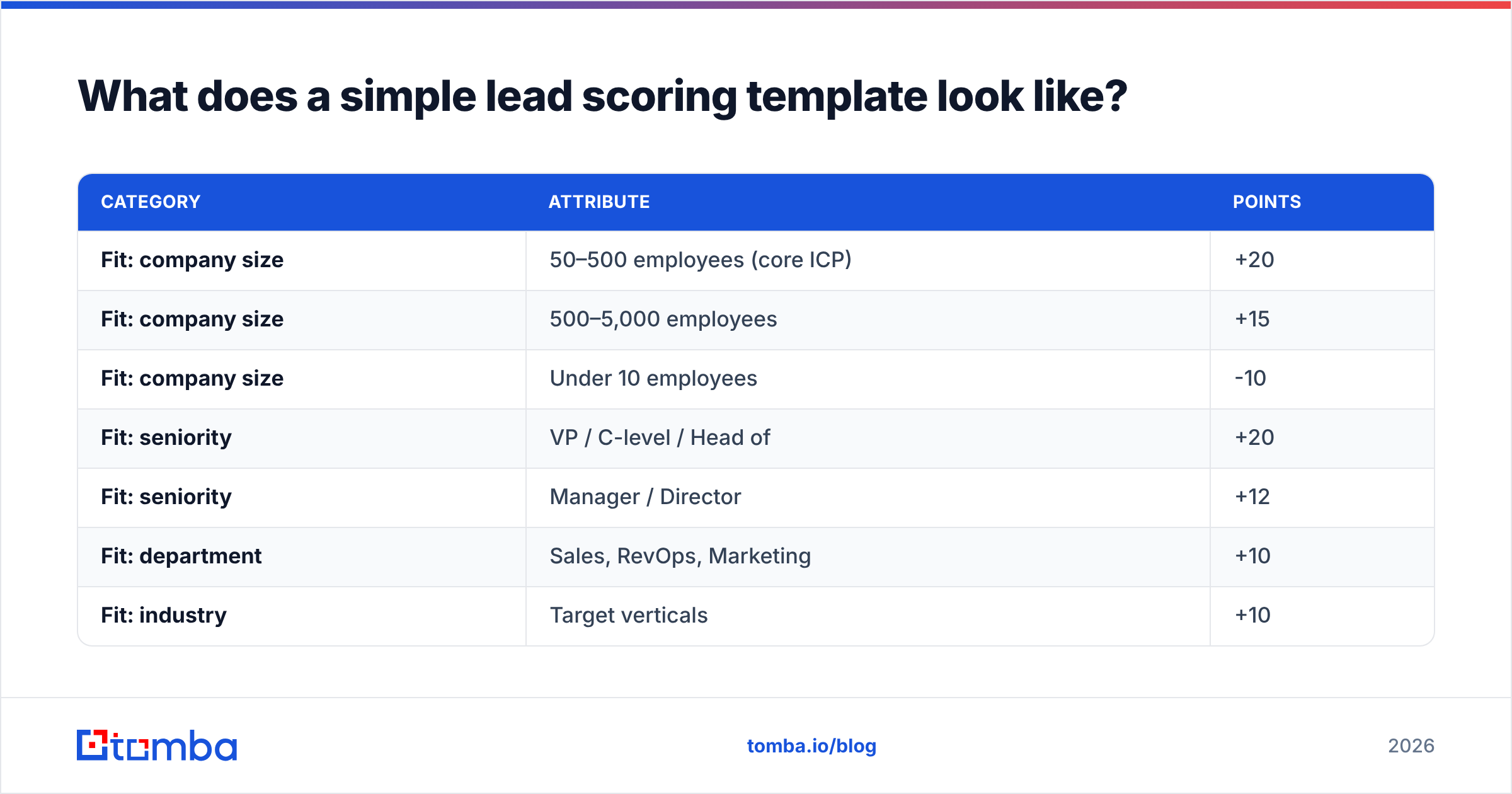
Here's a starting template for a mid-market B2B SaaS company. Change the weights to match your own closed-won analysis.
| Category | Attribute | Points |
|---|---|---|
| Fit: company size | 50–500 employees (core ICP) | +20 |
| Fit: company size | 500–5,000 employees | +15 |
| Fit: company size | Under 10 employees | -10 |
| Fit: seniority | VP / C-level / Head of | +20 |
| Fit: seniority | Manager / Director | +12 |
| Fit: department | Sales, RevOps, Marketing | +10 |
| Fit: industry | Target verticals | +10 |
| Intent | Demo request | +45 |
| Intent | Pricing page (2+ visits / 7 days) | +20 |
| Intent | Email reply | +20 |
| Intent | Case study view | +10 |
| Negative | Free email domain | -20 |
| Negative | Competitor domain | -100 |
| Negative | Unverified / bounced email | -50 |
| Decay | No activity for 30 days | -50% of intent points |
Suggested thresholds: fit of 40+ plus intent of 30+ = MQL. Fit of 40+ with intent under 30 = targeted outbound. Fit under 20 = nurture or self-serve only.
The "unverified / bounced email" row is there on purpose. A lead you can't reach isn't a lead, however strong the rest of the profile looks.
How does data quality affect lead scoring accuracy?#
Here's a quick way to see it. Take 100 inbound leads. Suppose 15 have invalid emails, 20 are missing company size, and 10 used a personal address that hides the company. That's up to 45% of your pipeline being scored on partial information, and every one of those scores is really a guess.
Fixing this is less work than it sounds:
- At capture: verify emails in real time on your forms and reject disposable domains.
- At import: run lists through bulk verification before they touch the CRM.
- At enrichment: fill firmographic gaps from the email domain. A domain search also shows you other contacts at the same account, which feeds account-level scoring directly (practice #7).
- Ongoing: re-verify contacts every 90 days. B2B data decays as people change jobs, and a lead whose email now bounces should lose its score automatically.
Data providers differ in coverage and freshness. Tomba, Apollo, BookYourData, and others each have strengths depending on your region and industry. Review sites such as G2 are useful for comparing them on your specific ICP. The rule doesn't change with the vendor: verify before you score.
What are the most common lead scoring mistakes?#
- Rewarding volume of activity. Ten blog visits don't equal one pricing-page visit.
- Never subtracting points. Without negative scoring and decay, every lead eventually becomes "hot."
- Setting and forgetting. A model built two years ago reflects an ICP you may no longer sell to.
- Scoring before cleaning. Fit scores on records with missing titles and invalid emails are fiction.
- One threshold for every segment. Enterprise and SMB leads behave differently. Consider separate models or thresholds.
- No sales feedback loop. If reps can't reject a lead with a reason, you'll never learn what's broken.
How do you know your lead scoring model is working?#
Track four numbers every month:
- MQL-to-SQL conversion rate by score band. Higher bands should convert noticeably better. If they don't, the model isn't separating good leads from bad.
- Sales acceptance rate. A low acceptance rate means sales doesn't trust the scores.
- Time to first touch for top-grade leads. A great score doesn't help if a rep calls three days later.
- Closed-won share from top-scored leads. Ideally a large share of revenue comes from your top one or two score bands.
When those four trend the right way, your model is doing its job. If they don't, go back to practice #1 and rebuild the weights from real outcomes.
Ready to score leads on data you can trust?#
Every one of these lead scoring best practices depends on accurate contact data. A lead with no verified email can't be routed, sequenced, or closed, whatever its score says. Tomba Email Finder finds and verifies professional email addresses by name, domain, or company, so the leads entering your scoring model are real, reachable, and complete enough to score properly. You can start on the free tier (25 searches per month) and move to paid plans from $49/mo when your pipeline grows. Compare options on Tomba pricing, clean up your data first, and your lead scores will be more reliable.
Related guides#
Ready to find emails that actually work?
Join 150,000+ professionals who stopped guessing and started sending. Free credits on signup — no credit card required.
Get the Tomba newsletter
Practical outbound tactics and product updates — once every two weeks.
About the author