Lead Scoring Systems in 2026: Models, Tools, and How to Build One
Most lead scoring systems go wrong by rewarding the wrong signals, not because the math is off. This guide compares rule-based, predictive, and hybrid models and walks you through building a system your reps will trust.
TL;DR
- A lead scoring system ranks prospects by two things: how closely they match your ideal customer (fit) and how actively they're engaging (intent). A system that scores only one of the two will send the wrong leads to your reps.
- Rule-based scoring is the right place to start for most teams under roughly 1,000 closed deals. Predictive scoring only pays off once you have enough won and lost history for a model to learn from.
- The most common failure has nothing to do with the model. It's bad input data: missing job titles, personal Gmail addresses, and bounced emails that still collect points.
- Rebuild your scores against real closed-won data every quarter. A threshold set in January is usually wrong by June.
- Enrich and verify contacts before they reach the scoring engine. Otherwise you're ranking noise.
What is a lead scoring system?#
A lead scoring system gives each prospect a number, or a grade such as A1 to D4, that estimates how likely they are to buy. Marketing uses that number to decide when a lead becomes a marketing qualified lead (MQL) and gets passed to sales. Sales uses it to decide who to call first.
The idea has been around for years (the Wikipedia entry on lead scoring covers the history). What's different in 2026 is how many signals you can feed in. Fifteen years ago that meant form fills and email opens. Now you can add firmographics, technographics, website visitor identification, third-party intent topics, product usage, and conversation data from calls.
Having more signals doesn't make scoring easier. It makes it easier to build a scoring system that looks sophisticated and still ranks the wrong people first.
Every working system scores two dimensions:
- Fit (explicit data): Who is this person, and is their company someone you can sell to? This covers job title, seniority, department, company size, industry, revenue, geography, and tech stack.
- Intent (implicit or behavioral data): Are they showing buying behavior right now? This covers pricing page visits, demo requests, repeat sessions, webinar attendance, email replies, and third-party intent spikes.
A VP of Sales at a 300-person SaaS company who has never visited your site is a great fit with no intent. A student who has downloaded all six of your ebooks has high intent and zero fit. A system that adds both together into one number treats those two people as equals. They aren't equal, which is why the stronger systems keep fit and intent as separate axes.
What are the main types of lead scoring models?#
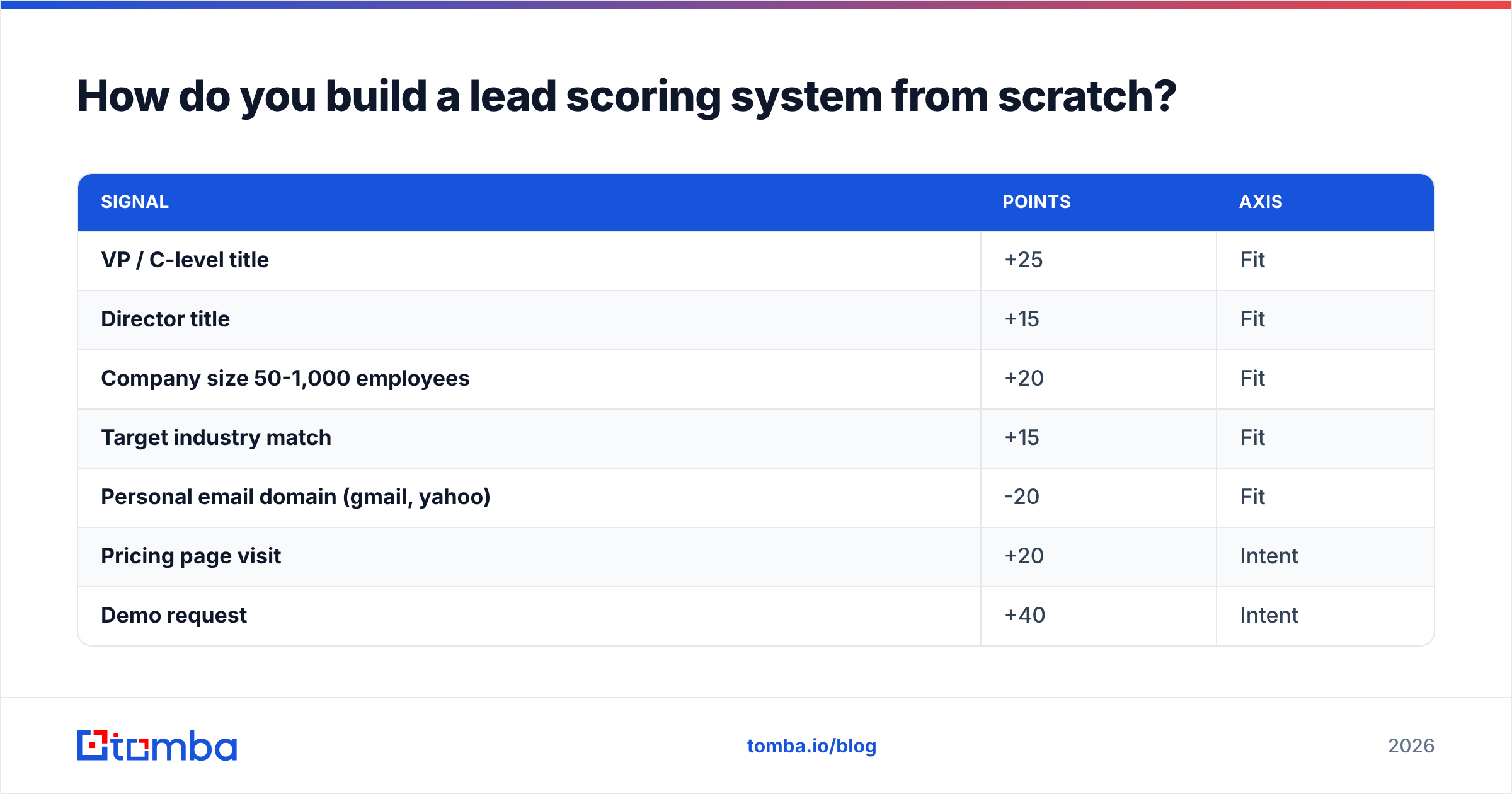
There are four approaches you'll see in practice. Most mature teams end up running a hybrid.
| Model | How it works | Data you need | Setup time | Best for | Main weakness |
|---|---|---|---|---|---|
| Rule-based (points) | You assign points manually, e.g. +15 for Director title, +20 for pricing page, -10 for student email | Clean CRM fields and basic web tracking | 1-2 weeks | Early-stage teams, fewer than ~500 closed deals | Built on assumptions and goes stale quickly |
| Predictive (ML) | A model learns which attributes correlate with closed-won deals | Hundreds of won and lost opportunities, consistent field history | 2-6 weeks plus a training period | Mid-market and enterprise with deep history | Black box, and it's only as good as the history it trains on |
| Fit/Intent matrix (two-axis) | Fit gets a letter grade (A-D) and intent gets a number (1-4), and they're routed as a pair | Firmographic enrichment plus engagement tracking | 2-3 weeks | Teams whose reps want an explanation for each score | More routing rules to maintain |
| Account-based | Engagement is scored across every contact at an account, not per person | Contact-to-account matching, intent data | 3-8 weeks | ABM and enterprise deals with buying committees | Needs good account matching and usually a paid intent platform |
Rule-based scoring#
Rule-based scoring is a spreadsheet of if-then rules. It's transparent, so any rep can see why a lead scored 72. It's cheap, because every major CRM and marketing automation platform supports it. And you can change it the same day you spot a problem.
Its weakness is that it encodes what you believe converts, not what actually converts. Teams routinely give webinar attendance big points and then find that webinar attendees close at a lower rate than cold outbound replies.
Predictive scoring#
Predictive scoring hands the weighting to a model. Salesforce (Einstein) and HubSpot both offer native predictive scoring on their higher tiers. Standalone platforms such as 6sense and MadKudu build models from your CRM plus their own data.
The catch is volume. A model trained on 40 closed-won deals is mostly guessing. Before you pay for predictive scoring, count your won and lost opportunities from the last 12-18 months. If you have fewer than a few hundred, a well-built rule-based system will usually beat the model, and your reps will be able to see how it works.
Fit/intent matrix#
This is the practical middle ground. Fit is a grade (A = ICP bullseye, D = not a buyer). Intent is a number (1 = hot, 4 = cold). An A1 lead gets routed to an AE within the hour. An A4 goes into an outbound sequence because the fit is right but the timing isn't. A D1 gets nurture content, not a rep's time.

Account-based scoring#
If you sell six-figure deals to buying committees, individual lead scores can mislead you. Three mid-level people at one account each scoring 30 means more than one enthusiastic intern scoring 90. Account-based scoring adds engagement up to the account level and triggers a play when the account crosses a threshold, whatever any single contact's score is.
How do lead scoring tools compare?#
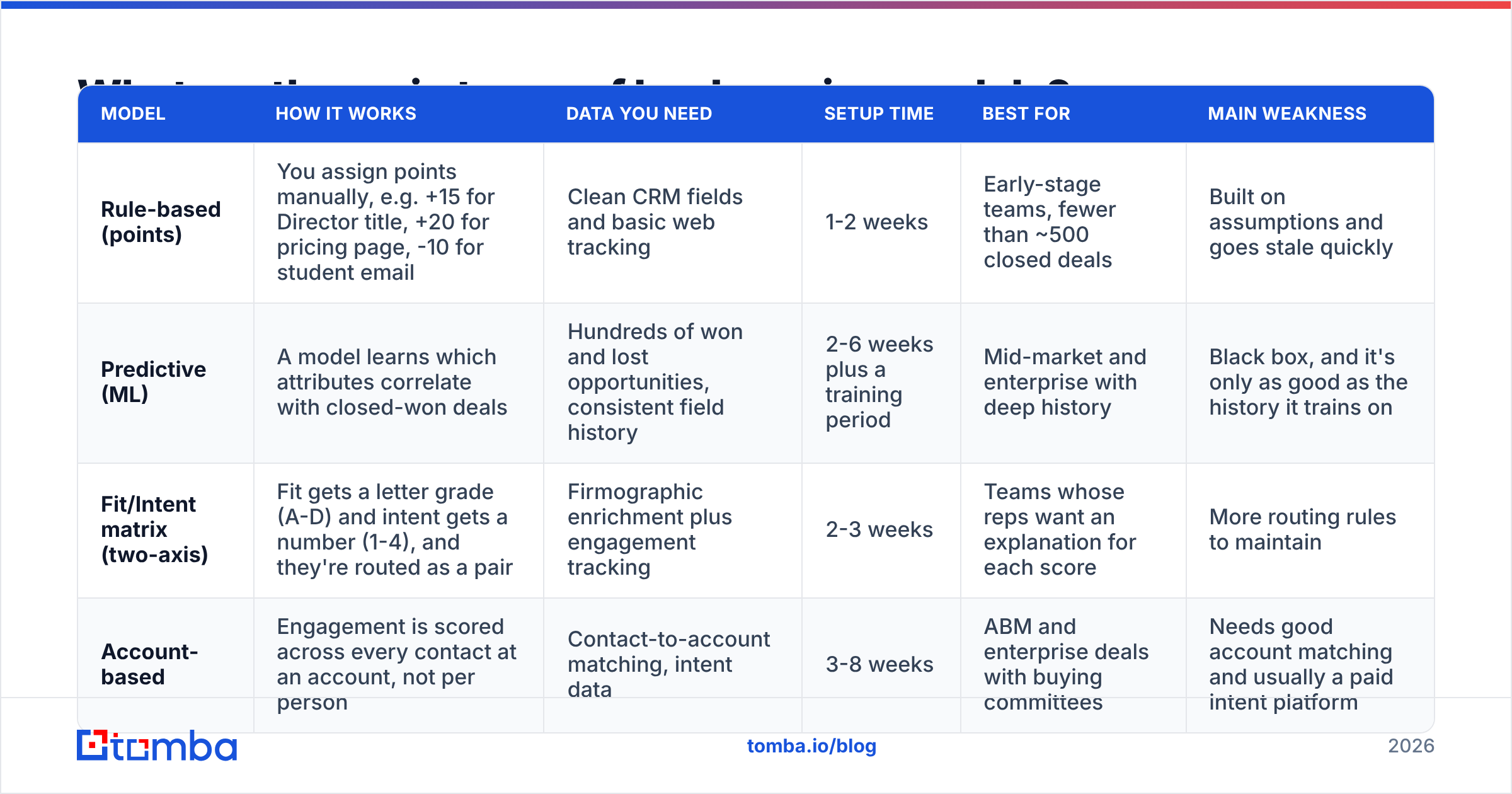
Most teams don't need a dedicated scoring vendor. The capability is probably already in the CRM or MAP you pay for. Here's how the common options compare on the attributes that matter for scoring:
| Tool | Scoring type | Predictive option | Account-level scoring | Transparency to reps | Typical fit |
|---|---|---|---|---|---|
| HubSpot Marketing/Sales Hub | Rule-based, fit + engagement scores | Yes, on higher tiers | Yes (company scores) | High for manual scores, lower for predictive | SMB to mid-market on HubSpot |
| Salesforce + Einstein | Rule-based via flows/fields, plus Einstein Lead Scoring | Yes, in Einstein-enabled editions | Via Account Engagement or custom build | Shows top contributing factors | Mid-market and enterprise on Salesforce |
| Adobe Marketo Engage | Highly configurable behavioral + demographic rules | Via add-ons and partners | Yes, with ABM module | High, but complex to maintain | Enterprise marketing ops teams |
| 6sense / Demandbase | Account-level intent + predictive fit | Core feature | Core feature | Medium (stage-based, not point-based) | ABM-led enterprise sales |
| Apollo / sales engagement platforms | Simple rule-based on contact + engagement data | Limited | Limited | High | Outbound-heavy teams scoring cold prospects |
Some honest guidance on choosing:
- If you're on HubSpot or Salesforce, start with the native scoring. Integration is already done, reps see the score in their existing views, and you avoid a sync layer that can break.
- Consider 6sense or Demandbase when account-level intent is the bottleneck, meaning you can't tell which accounts are in-market. Don't buy them to fix contact-level data quality. That's not what they do.
- Marketo suits teams with a dedicated marketing ops person. Its flexibility is a strength if someone maintains it and a liability if nobody does.
Peer reviews on G2 are useful for checking how painful each tool's scoring setup is in practice. Filter reviews for "lead scoring" rather than reading overall ratings.
How do you build a lead scoring system from scratch?#
This is the sequence that works for most B2B teams, whichever tool you use:
- Pull 12-18 months of closed-won and closed-lost deals. Export the contacts on those deals with their title, seniority, company size, industry, and first-touch source. You'll build your rules from this, not from a whiteboard session.
- Find the attributes that separate winners from losers. Compare conversion rates by segment. If Directors close at 3x the rate of Managers, that gap should drive your point values. If company size 50-500 wins and 5,000+ stalls, score that way even if leadership wants enterprise logos.
- Build fit and intent separately. Keep a fit score (0-100) and an intent score (0-100) as distinct fields. Add negative scoring too: competitors, students, personal email domains, job seekers visiting your careers page, and unsubscribes.
- Add score decay. Intent from 90 days ago isn't intent now. Most platforms let you reduce behavioral points over time. Something like 25% after 30 days and 50% after 60 is a sensible starting point.
- Set the MQL threshold with sales, not for sales. Pick a threshold, route a week's worth of leads, and have reps tag each one as "would work" or "wouldn't work." Adjust until at least 70-80% get a "would work."
- Review quarterly against real outcomes. Compare MQL-to-opportunity and opportunity-to-won rates by score band. If your 80-100 band doesn't clearly out-convert the 60-79 band, your weights are off.
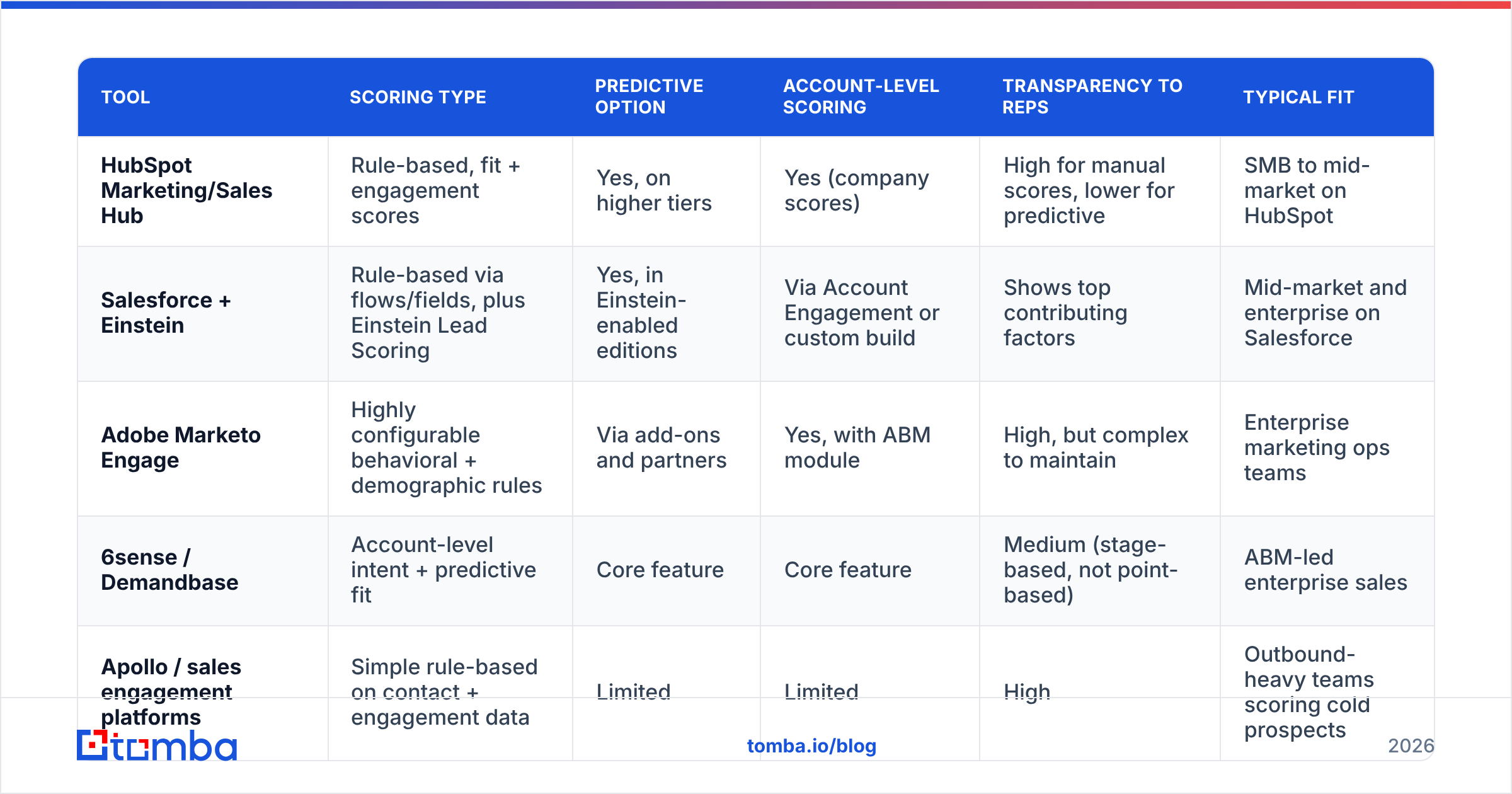
A starter rule set for a mid-market SaaS company might look like this:
| Signal | Points | Axis |
|---|---|---|
| VP / C-level title | +25 | Fit |
| Director title | +15 | Fit |
| Company size 50-1,000 employees | +20 | Fit |
| Target industry match | +15 | Fit |
| Personal email domain (gmail, yahoo) | -20 | Fit |
| Pricing page visit | +20 | Intent |
| Demo request | +40 | Intent |
| Replied to outbound email | +25 | Intent |
| Blog visit only | +2 | Intent |
| No activity in 45 days | -15 | Intent |
These values are an example, not a benchmark. Your own closed-won data should set the real ones.
Why do most lead scoring systems fail?#
Teams tend to blame the model. Usually the model is fine and the problem is somewhere else.
The input data is broken#
Fit scoring depends on firmographic and role data. If a third of your inbound leads arrive with only a first name and a Gmail address, your fit score for them is zero. It's not low because they're a bad fit. It's zero because you don't know. Your system can't tell those two cases apart, so it treats "unknown" as "bad."
This is where data enrichment earns its place in the scoring stack. Adding company, title, seniority, and company size to a record before it hits the scoring engine turns unknown leads into scorable ones. Teams that enrich at the point of capture often find that a noticeable share of leads they had dismissed as low-fit were actually strong ICP matches whose records were incomplete.
The same applies to deliverability. A lead whose email hard-bounces can't be nurtured, can't be sequenced, and shouldn't keep a score that routes it to a rep. Running addresses through an email verifier on capture, and on a schedule for your existing database, stops dead contacts from inflating your MQL numbers.
Engagement gets over-weighted#
Content downloads are easy to track, so they end up with lots of points. But downloading a guide is research, not buying intent. If your top-scored leads are mostly people who consume content, move points toward bottom-funnel actions: pricing, demo, comparison pages, integration docs, and direct replies.
Nobody owns the model#
Scoring breaks quietly. A new form field gets renamed, a tracking script drops, a product launch changes which pages matter, and scores drift for months before anyone notices. Give scoring a named owner, usually in revenue operations, and put the quarterly review on a calendar.
Sales doesn't trust it#
If reps can't see why a lead scored high, they'll ignore the score and work their own gut list. Show the top 3 contributing factors next to the score in the CRM view. Transparency drives adoption more than accuracy does.
Is predictive lead scoring better than rule-based?#
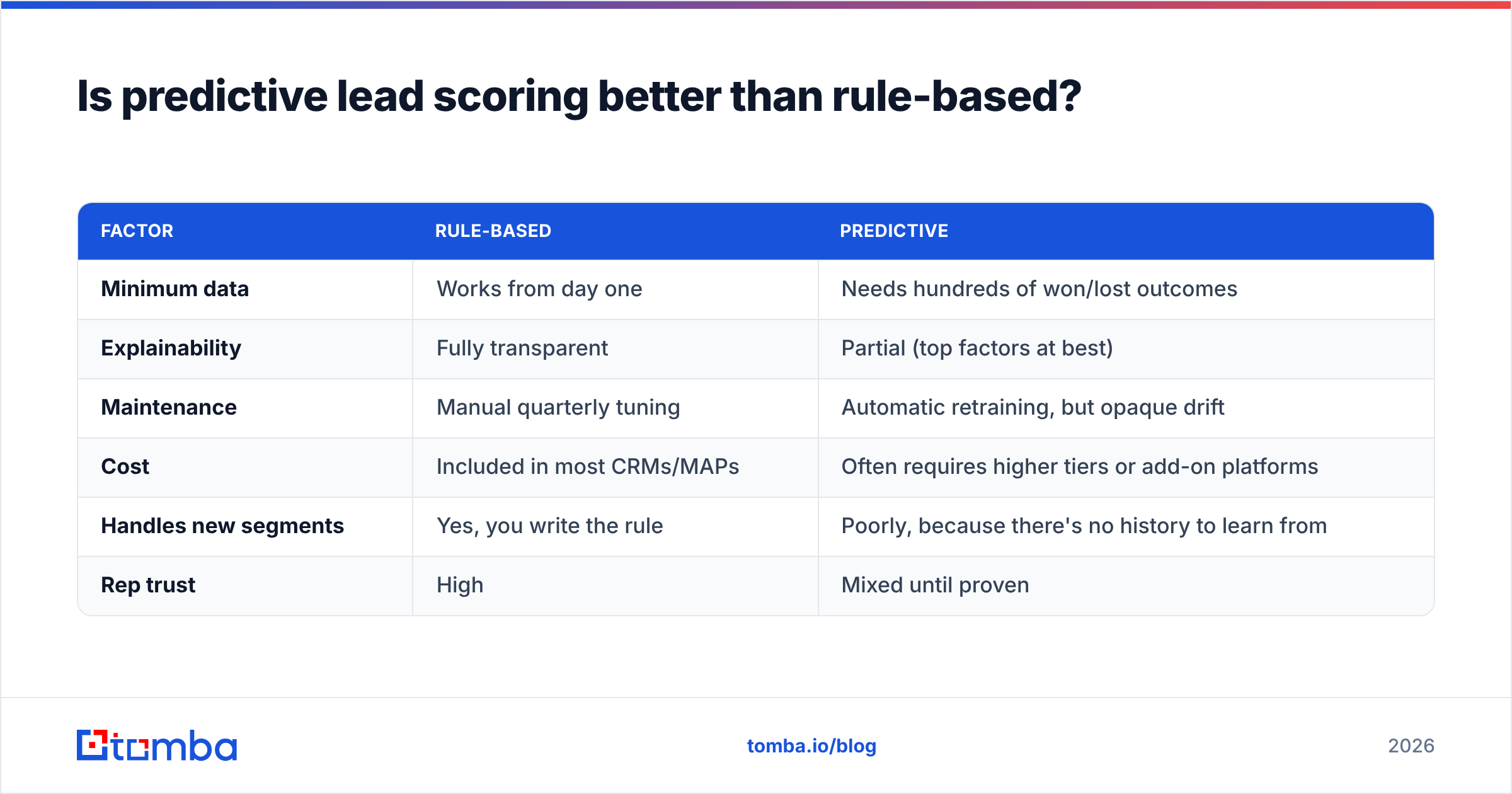
Only when you have the data volume, and only if reps will use it.
Predictive models find non-obvious patterns. For example, companies that recently hired a RevOps lead might close at twice the base rate. No human would think to write that rule. With enough history, a model will beat a rule set on raw ranking accuracy.
The trade-offs are real, though:
| Factor | Rule-based | Predictive |
|---|---|---|
| Minimum data | Works from day one | Needs hundreds of won/lost outcomes |
| Explainability | Fully transparent | Partial (top factors at best) |
| Maintenance | Manual quarterly tuning | Automatic retraining, but opaque drift |
| Cost | Included in most CRMs/MAPs | Often requires higher tiers or add-on platforms |
| Handles new segments | Yes, you write the rule | Poorly, because there's no history to learn from |
| Rep trust | High | Mixed until proven |
Many teams start rule-based, collect clean outcome data for a year, then layer predictive scoring on top. They keep manual rules as guardrails (the student-email penalty, for example) and let the model handle the weighting.
How does lead scoring work for outbound prospects?#
Most scoring content assumes inbound leads, meaning people who came to you. Outbound teams have a different problem. The prospect hasn't engaged yet, so intent is close to zero, and fit is almost the whole score.
For outbound, the scoring system becomes a prioritization layer on your prospect list:
- Tier accounts by fit before you source contacts. Score companies on size, industry, tech stack, funding, and hiring signals. Only source contacts at Tier 1 and Tier 2 accounts.
- Score contacts by role proximity to the buying decision. The economic buyer, champion, and technical evaluator get the most points. Adjacent roles get fewer.
- Treat reachability as a scoring factor. A perfect-fit contact with no verified email is worth less, right now, than a strong-fit contact you can actually reach. Add points for a verified business email and a validated direct phone.
- Let first engagement flip intent on. A reply, a click-through to pricing, or a meeting booked should move an outbound prospect into the same fit/intent matrix your inbound leads use.
This is also where fit data quality matters most. You're scoring people who have never filled in a form, so everything you know about them comes from sourcing and enrichment. Pushing enriched, verified contacts straight into your CRM (the HubSpot integration is one example) means the scoring engine gets complete records from the start.
What metrics tell you your lead scoring system works?#
Track these by score band (for example 0-39, 40-59, 60-79, 80-100):
- MQL-to-SQL acceptance rate. Sales should accept most MQLs. If they reject more than 30-40%, the threshold is too low or the weights are wrong.
- SQL-to-opportunity and opportunity-to-won rates. Higher bands should convert at clearly higher rates. If they don't, the score isn't predicting anything.
- Speed-to-lead on top-band leads. Scoring only helps if hot leads get worked fast.
- Share of pipeline from scored MQLs versus rep-sourced. If most pipeline comes from leads the system scored low, the system is missing the real buyers.
- Percentage of leads with incomplete fit data. This is the metric most teams skip, and it's often the root cause of everything above.
Final take: what should you build in 2026?#
If you're just starting, build a rule-based fit/intent matrix inside your existing CRM. Base the point values on your own closed-won history, add negative scoring and decay, and review it every quarter with sales in the room. Move to predictive when you have the outcome volume to justify it, not before.
Whichever model you choose, the quality of your lead scoring is capped by the quality of the contact data underneath it. Incomplete titles, missing company data, and unverified emails will undermine even a well-designed model.
If your fit scores are dragged down by incomplete records, or your outbound lists need verified contacts before they can be prioritized, start at the source. Tomba Email Finder finds and verifies professional email addresses by name, domain, or company, so the leads going into your scoring system are real, reachable, and complete enough to score properly. You can try it on the free tier (25 searches a month) before committing to a plan, starting at $49/mo.
Related guides#
// get started
Find, verify and enrich your first contacts today
Start on the free plan with 25 searches a month, then scale when your team is ready.
Free plan · No credit card required · GDPR & CCPA
// about the author