Lead vs Prospect: Key Differences, Examples and When to Convert
A lead is someone you know about. A prospect is someone worth a rep's time. Mixing up the two slows your pipeline, muddies your forecasts, and burns rep hours. Here's where the line sits and how to move contacts across it.
TL;DR
- A lead is any person or company that has shown some sign of interest or matches your market. Nobody has confirmed they fit or that they need what you sell.
- A prospect is a lead that has been qualified. They match your ideal customer profile (ICP), they have a real need, and they can plausibly buy.
- The difference is qualification, not volume. Treating leads like prospects wastes rep time, and treating prospects like leads slows deals down.
- Write down the handoff criteria (fit, need, authority, timing) and enforce them in your CRM. That line should not live in someone's head.
- Clean contact data (verified emails, the right decision-maker) is usually what turns a lead into a prospect you can actually work.
What is the difference between a lead and a prospect?#
A lead is a possibility. A prospect is a bet you've decided to place.
The two words get used as synonyms in standups, pipeline reviews, and vendor marketing. They describe two different stages of the buying process, and the gap between them is where most outbound inefficiency happens.
A lead is an individual or organization that has entered your world. They might have downloaded a whitepaper, visited your pricing page, shown up in a list you built, or dropped a business card at a trade show. You know they exist and you have some contact information. You don't yet know whether they fit your ICP, have a problem you solve, or have any authority to buy.
A prospect is a lead you have qualified. Someone on your team, or your scoring model, has checked that the contact matches your target profile and has a plausible need. Usually they have also engaged in a two-way way: they replied to an email, took a discovery call, or answered qualifying questions. A prospect is worth a salesperson's personal attention.
Here's a simple way to picture it. Leads are the names on a guest list. Prospects are the guests you've actually talked to at the party and decided you want to follow up with.
The term "lead" has a long history in sales and marketing literature. The Wikipedia entry on lead generation is a useful neutral primer on how the concept moved from cold lists to inbound marketing.
How do leads and prospects compare side by side?#
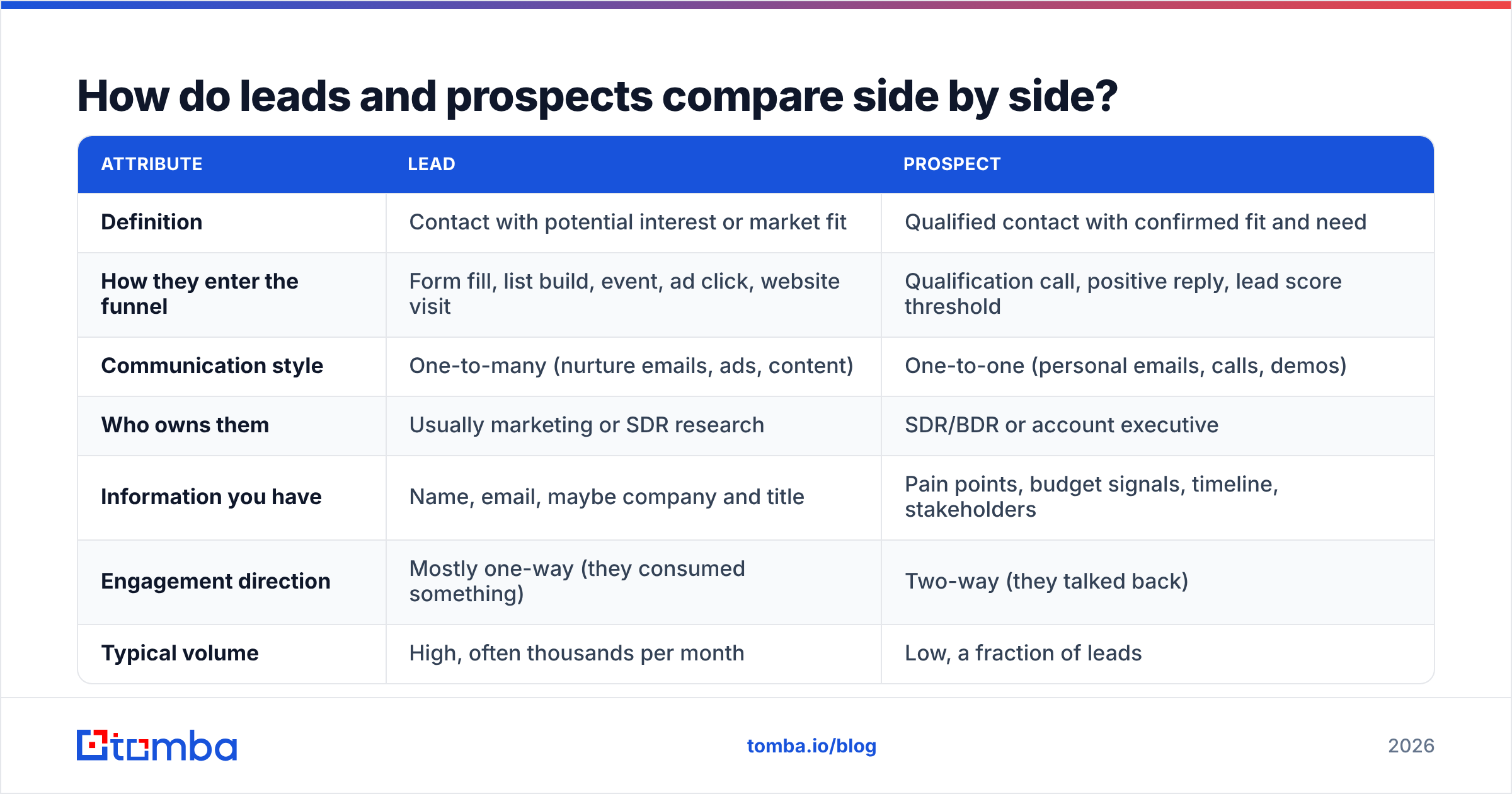
The table below covers the attributes sales and marketing teams most often argue about.
| Attribute | Lead | Prospect |
|---|---|---|
| Definition | Contact with potential interest or market fit | Qualified contact with confirmed fit and need |
| How they enter the funnel | Form fill, list build, event, ad click, website visit | Qualification call, positive reply, lead score threshold |
| Communication style | One-to-many (nurture emails, ads, content) | One-to-one (personal emails, calls, demos) |
| Who owns them | Usually marketing or SDR research | SDR/BDR or account executive |
| Information you have | Name, email, maybe company and title | Pain points, budget signals, timeline, stakeholders |
| Engagement direction | Mostly one-way (they consumed something) | Two-way (they talked back) |
| Typical volume | High, often thousands per month | Low, a fraction of leads |
| Main risk | Wasting rep time on bad fits | Losing momentum from slow follow-up |
| Primary metric | Lead volume, MQL rate | Meeting rate, opportunity conversion, win rate |
| Data quality need | Valid email, basic firmographics | Verified direct contact, correct decision-maker |
The key row is "engagement direction." A lead has received something from you. A prospect has given something back: information, time, or intent.
What are the stages between lead and prospect?#
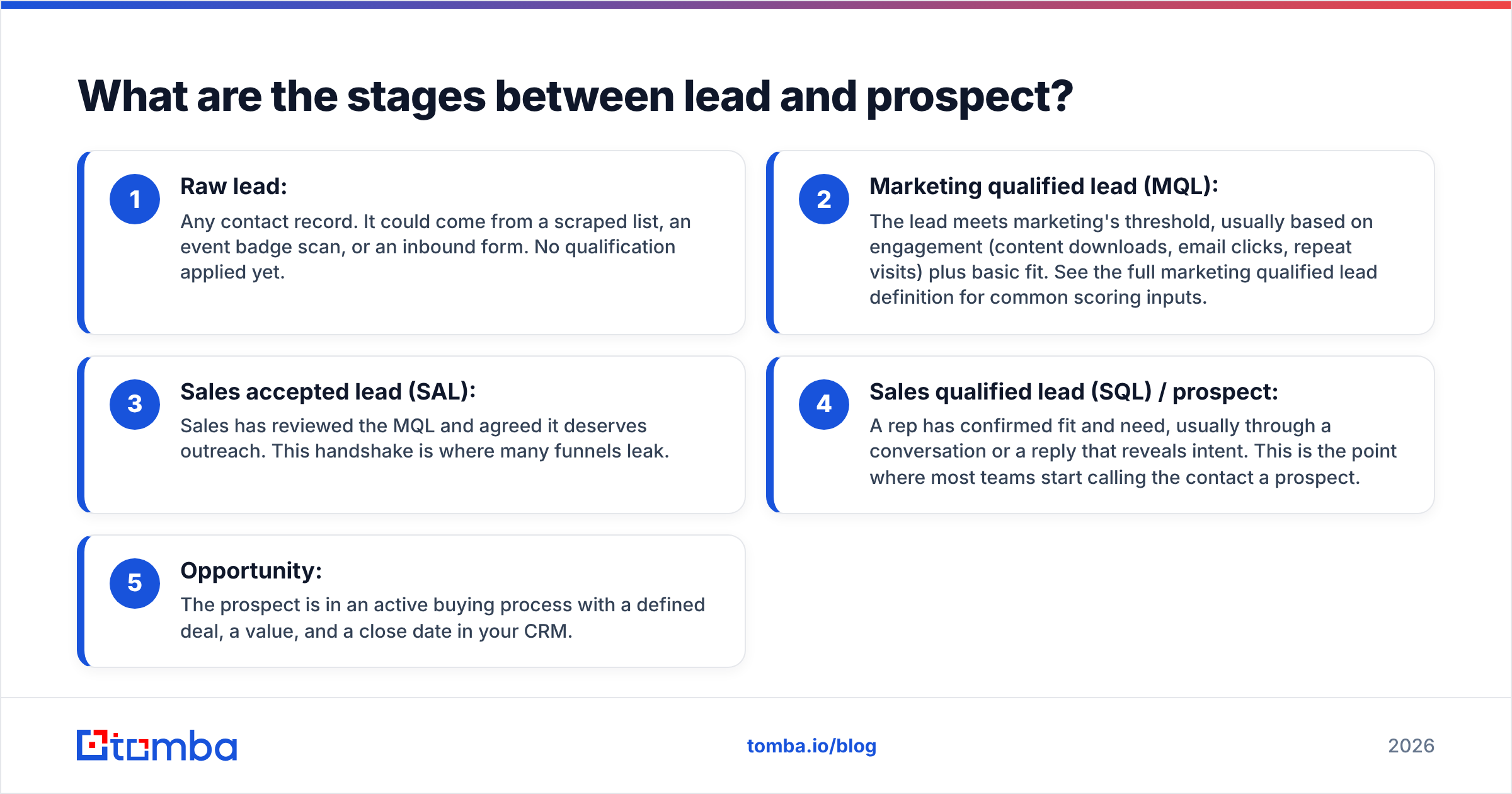
Most B2B teams have a few steps between "we have a name" and "this person is in an active sales conversation." Terminology varies by company and CRM vendor. Here is the progression you'll see most often:
- Raw lead: Any contact record. It could come from a scraped list, an event badge scan, or an inbound form. No qualification applied yet.
- Marketing qualified lead (MQL): The lead meets marketing's threshold, usually based on engagement (content downloads, email clicks, repeat visits) plus basic fit. See the full marketing qualified lead definition for common scoring inputs.
- Sales accepted lead (SAL): Sales has reviewed the MQL and agreed it deserves outreach. This handshake is where many funnels leak.
- Sales qualified lead (SQL) / prospect: A rep has confirmed fit and need, usually through a conversation or a reply that reveals intent. This is the point where most teams start calling the contact a prospect.
- Opportunity: The prospect is in an active buying process with a defined deal, a value, and a close date in your CRM.
Some teams skip the SAL stage and some merge MQL and SQL. Pick definitions your team will actually use consistently, and write them down.
Is a prospect more valuable than a lead?#
Per record, yes. In aggregate, not necessarily.
A single prospect is worth far more than a single lead because the uncertainty has been removed. You know the account fits, you know who you're talking to, and you know there's a problem to solve. That's why reps should spend the bulk of their selling hours on prospects.
Leads are still the raw material, though. With no leads coming in, you'll eventually run out of prospects. The goal is not to prefer one over the other. It's to keep each in its proper lane:
- Leads get scalable, low-cost touches: nurture sequences, retargeting, content, light-touch outbound.
- Prospects get expensive, high-touch attention: tailored emails, discovery calls, demos, multi-threading.
Problems start when these lanes blur. Marketing sends unqualified names straight to AEs, and AEs stop trusting inbound. Reps then get buried in personalized outreach to contacts who were never going to buy. Or the opposite happens: a genuinely hot prospect is left on an automated nurture track for three weeks because nobody flagged the change in status.
How do you qualify a lead into a prospect?#
Qualification answers one question: is this contact worth one-to-one time from a salesperson? Most frameworks come down to four checks.
Fit. Does the company match your ICP on industry, size, geography, tech stack, and revenue? Does the person hold a role that influences the purchase? Fit is the easiest check to automate because it relies on firmographic and demographic data you can collect before talking to anyone.
Need. Do they have the problem you solve, and do they know it? Signals include hiring for relevant roles, visiting specific product pages, engaging with problem-focused content, or explicitly describing the pain in a reply.
Authority. Can this person buy, or at least champion the purchase? If your lead is a junior analyst, the prospect may actually be their VP. Identifying and reaching the right person is a data problem as much as a sales problem.
Timing. Is there a trigger event? That could be a new funding round, a new executive, a contract renewal, or a failing incumbent tool. Without timing, a great-fit contact stays a lead in a long-term nurture track.
Classic frameworks like BANT (Budget, Authority, Need, Timeline), MEDDIC, and CHAMP are variations on these checks. Which one you pick matters less than applying it consistently and recording the outcome in your CRM, so the lead-to-prospect transition is visible and measurable. Most CRMs, including HubSpot's CRM and Salesforce, let you define lifecycle stages and required fields that enforce these gates.
Why does bad contact data keep leads from becoming prospects?#
Many "unqualified" leads were never actually tested. The outreach simply never reached them.
Consider a typical outbound motion. You build a list of 1,000 contacts that match your ICP on paper. If a meaningful share of those emails bounce or land in unmonitored inboxes, those contacts never get a chance to qualify. Your funnel reports show poor lead-to-prospect conversion, but the real issue is upstream: the data.
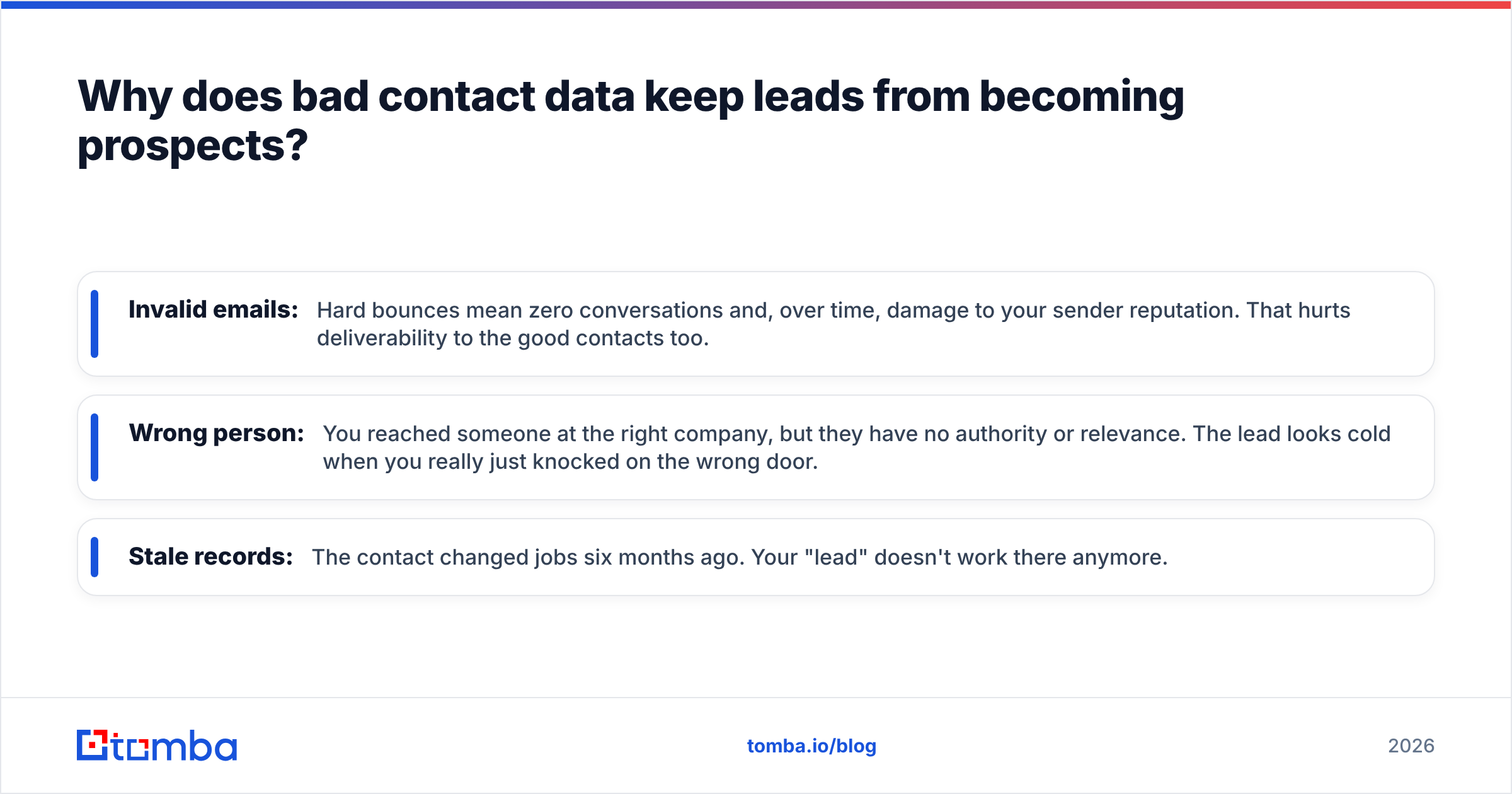
Bad data blocks qualification in three ways:
- Invalid emails: Hard bounces mean zero conversations and, over time, damage to your sender reputation. That hurts deliverability to the good contacts too.
- Wrong person: You reached someone at the right company, but they have no authority or relevance. The lead looks cold when you really just knocked on the wrong door.
- Stale records: The contact changed jobs six months ago. Your "lead" doesn't work there anymore.
That's why lead-to-prospect conversion is partly a data hygiene metric. Before you blame your messaging or your SDRs, check how much of your list you actually reached. Running a list through an email verifier before a sequence goes out is cheap insurance. Filling in missing titles, company size, and LinkedIn URLs through data enrichment makes the fit check far more reliable.
Lead vs prospect: which should your team focus on?#
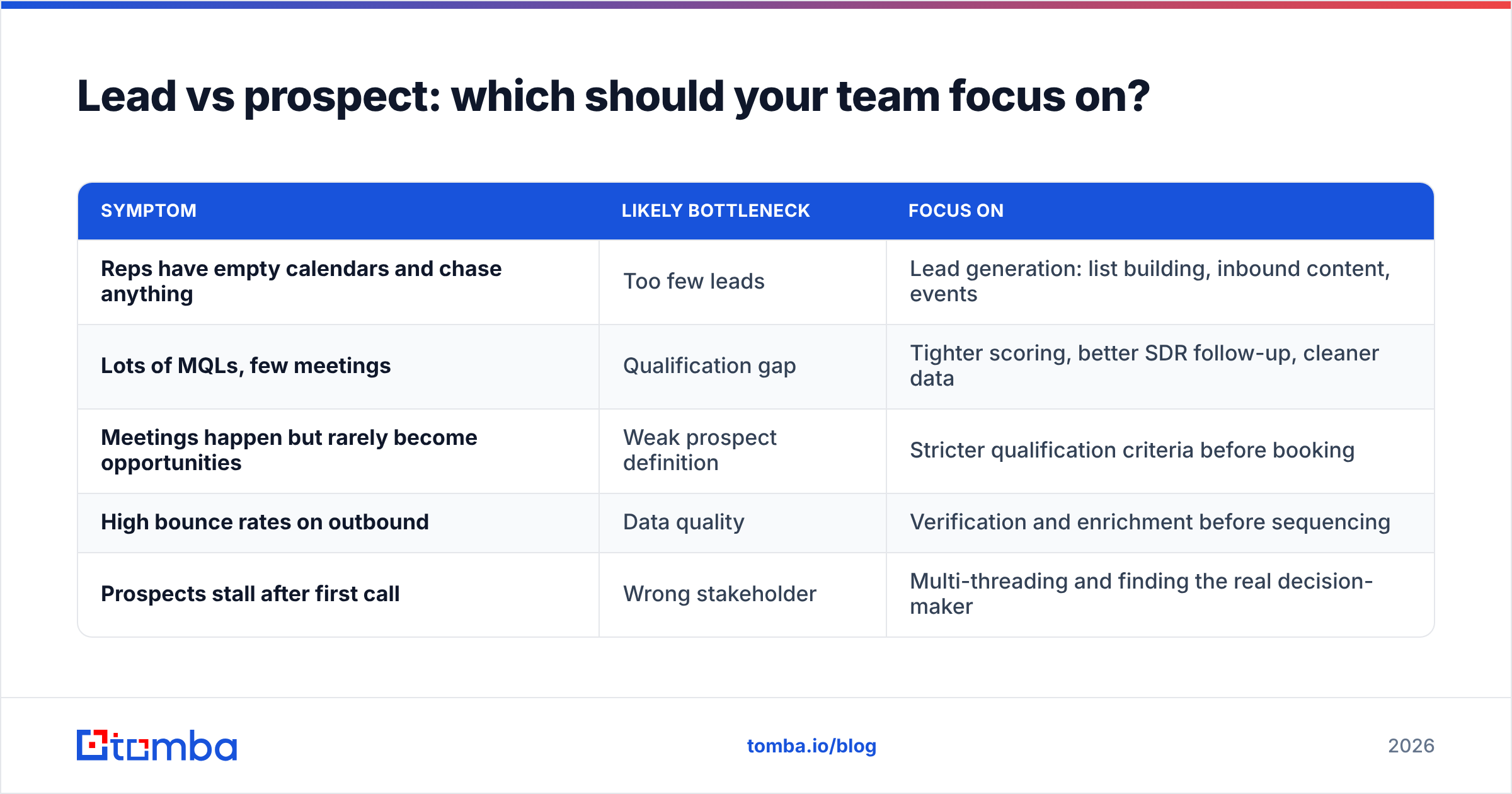
It depends on where your funnel is actually broken. Use this quick diagnostic:
| Symptom | Likely bottleneck | Focus on |
|---|---|---|
| Reps have empty calendars and chase anything | Too few leads | Lead generation: list building, inbound content, events |
| Lots of MQLs, few meetings | Qualification gap | Tighter scoring, better SDR follow-up, cleaner data |
| Meetings happen but rarely become opportunities | Weak prospect definition | Stricter qualification criteria before booking |
| High bounce rates on outbound | Data quality | Verification and enrichment before sequencing |
| Prospects stall after first call | Wrong stakeholder | Multi-threading and finding the real decision-maker |
For most B2B teams in 2026, the bottleneck is rarely raw lead volume. Buying contact lists, running ads, and scraping directories are all easy. What's hard is getting from a big pile of names to a short list of verified, reachable, relevant people. That's the lead-to-prospect gap, and it's where your effort usually pays off most.
What does a lead-to-prospect workflow look like in practice?#
Here's a concrete outbound example for a B2B SaaS company that sells to mid-market finance teams.
Step 1 — Build the lead list. Pull companies with 200–2,000 employees in your target regions that use a relevant accounting stack. Result: roughly 800 accounts. These are leads at the account level.
Step 2 — Find the people. For each account, identify the VP Finance, Controller, or CFO. Use an email finder to get professional addresses by name and domain. Now you have person-level leads.
Step 3 — Verify and enrich. Remove invalid and risky emails. Flag catch-all domains for careful handling. Enrich with title seniority and recent company news (funding, hiring, leadership changes).
Step 4 — Score. Give points for fit (company size, stack, region), timing (recent trigger events), and authority (seniority). The top tier goes to SDRs for personalized outreach. The rest go to a lighter automated sequence.
Step 5 — Engage and qualify. When someone replies with interest, or even a thoughtful "not now, but…", the SDR runs a short qualification check. If it passes, the contact becomes a prospect and is handed to an AE or booked for discovery.
Step 6 — Feed back. Track which lead sources and score bands actually produce prospects. Adjust your ICP and scoring monthly.
The important point: only step 5 creates prospects. Steps 1 through 4 exist to make step 5 efficient.

What mistakes do teams make with leads and prospects?#
Calling everyone a prospect. If your CRM has 40,000 "prospects," the word has lost its meaning. Pipeline forecasts built on that number will be wrong.
No written handoff criteria. "Sales will know a good lead when they see one" guarantees disputes between marketing and sales. Define the MQL and SQL thresholds on paper and review them every quarter.
Scoring on engagement alone. A student downloading five ebooks has high engagement and zero buying potential. Fit has to be part of the score.
Ignoring recycling. Leads that don't qualify today aren't dead. Tag them with a reason ("no budget until Q2," "wrong contact") and route them back into nurture with a re-check date.
Letting prospects cool off. Once someone qualifies, speed matters. A prospect who waits a week for follow-up often slides back to lead status or buys from whoever answered first.
Skipping data validation. Sending a sequence to an unverified list and then concluding "this segment doesn't convert" is a measurement error, not a market insight.
How should you measure lead-to-prospect performance?#
Track a small set of metrics that separate volume problems from qualification problems:
- Lead-to-prospect conversion rate: Prospects created ÷ leads worked, per source.
- Reach rate: Share of leads that actually received your outreach (delivered, not bounced).
- Response rate: Replies ÷ delivered emails. This is your earliest signal of message-market fit.
- Time to qualification: Days from lead creation to prospect status.
- Prospect-to-opportunity rate: Shows whether your qualification bar is set correctly. If this is low, you're promoting leads too easily.
Break every metric down by source. A lead source that produces lots of volume but few prospects is costing you more than it looks.
For broader benchmarks on funnel stages and CRM lifecycle design, Salesforce's guides are a solid reference point. Just calibrate any industry averages against your own historical data.
FAQ: Lead vs prospect#
Is a prospect the same as an opportunity? No. A prospect is qualified, but there may not be an active deal yet. An opportunity is a prospect in a defined buying process with a deal value and an expected close date.
Can a prospect go back to being a lead? Yes. If timing changes, budget disappears, or the contact leaves the company, move them back into nurture with a clear reason code.
Who decides when a lead becomes a prospect? Usually an SDR or BDR after a qualifying interaction, guided by criteria that sales and marketing have agreed on together. Some teams automate part of the decision with lead scoring.
Is a cold outbound contact a lead or a prospect? They're a lead until they engage and pass qualification. Being in your target ICP makes them a good lead, not a prospect.
Ready to turn more leads into real prospects?#
The fastest way to improve your lead-to-prospect conversion is to stop losing leads to bad data before a conversation ever starts. If your outbound lists are full of guessed, outdated, or missing emails, Tomba Email Finder finds professional addresses by name, company, or domain, so your outreach reaches the actual decision-maker. You can start with the free tier (25 searches a month) and move to Starter at $49/mo once the workflow proves itself.
Related guides#
// get started
Find, verify and enrich your first contacts today
Start on the free plan with 25 searches a month, then scale when your team is ready.
Free plan · No credit card required · GDPR & CCPA
// about the author