Lead411 Pricing in 2026: Real Costs, Limits & Alternatives
Lead411 publishes a headline seat price, but the real cost lands elsewhere: export caps, annual-only discounts, and per-seat math that punishes small teams. Here's the full breakdown.
TL;DR
- Lead411's published entry point is roughly $99 per user per month on an annual Basic Plus Unlimited plan, with month-to-month pricing running meaningfully higher. Pro and Enterprise tiers are quote-only.
- "Unlimited" in Lead411's marketing means unlimited views, not unlimited exports. Export credits are the real ceiling — typically a few hundred to a few thousand per year depending on tier.
- The cost you actually pay is driven by three multipliers: seats, export volume, and add-ons (intent data, Bombora topics, CRM sync on higher plans).
- If your job is finding and verifying work emails at scale, a dedicated email finder costs a fraction — Tomba's Starter plan is $49/mo and Growth is $99/mo with no per-seat tax on the core finder.
- Lead411 earns its price when you need US-heavy contact data plus intent signals in one screen. It's overpriced if all you needed was email discovery.
What is Lead411 and who actually buys it?#
Lead411 is a B2B sales intelligence platform: a contact and company database with direct dials, verified emails, growth-trigger alerts, and Bombora-powered buyer intent. It sits in the same competitive bracket as ZoomInfo, Apollo, Cognism, and Seamless.AI — the "one screen for prospecting" category.
The typical buyer is a US-focused SDR team of 3–15 reps who want direct dials and intent signals without ZoomInfo's six-figure contract. That framing matters, because Lead411 pricing only looks reasonable when you compare it against enterprise sales-intelligence suites. Compare it against a focused email finder and the math reverses fast.
Two things set it apart in practice:
- Direct-dial density in North America. Lead411's phone coverage for US mid-market is genuinely competitive, and that's a big part of what you're paying for.
- Bombora intent bundled in on higher tiers, rather than sold as a separate six-figure module.
Neither of those helps you if your motion is pure cold email.
How much does Lead411 cost in 2026?#
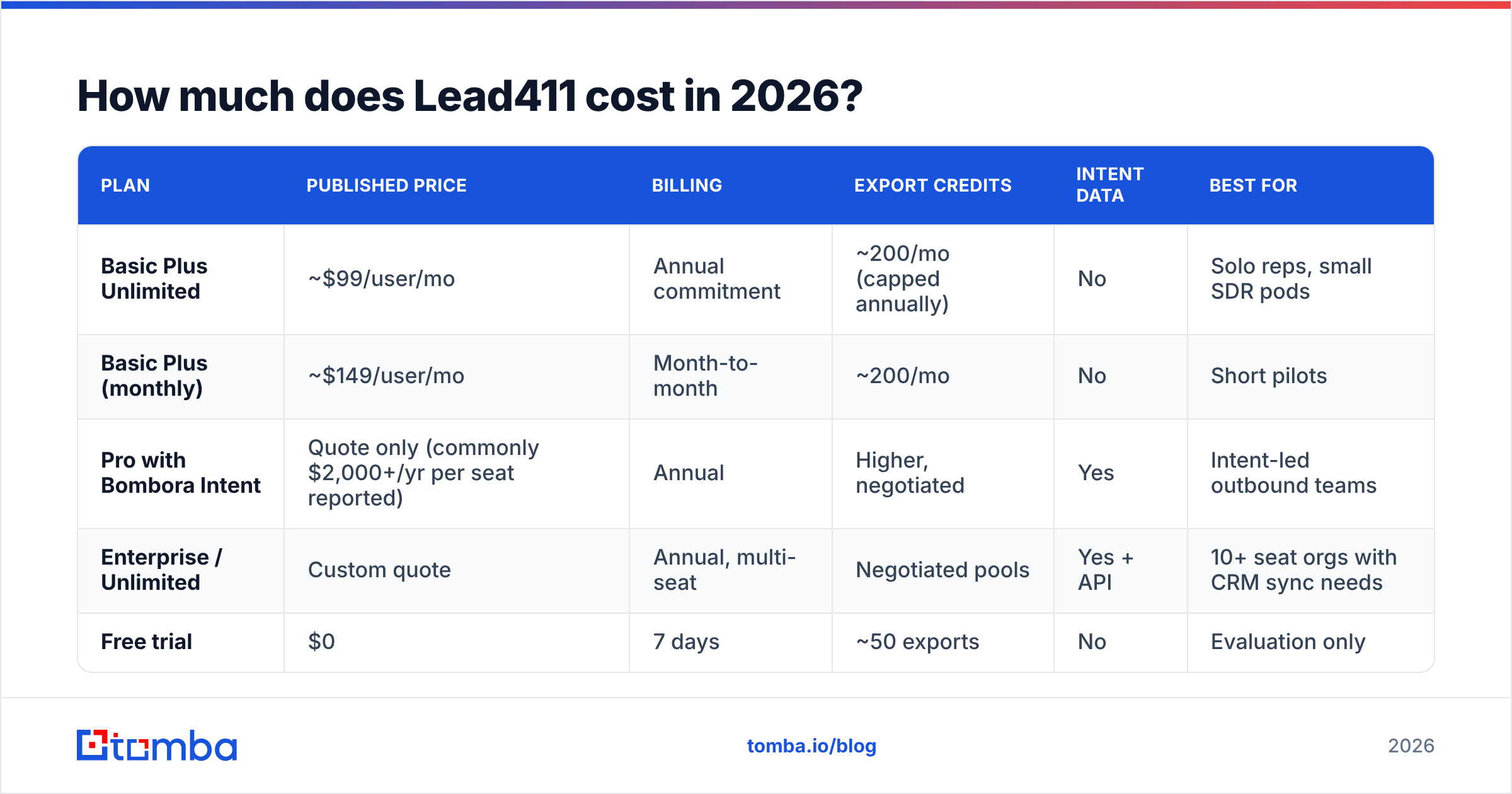
Here's the structure as publicly listed and as reported by buyers on G2 and Capterra. Always confirm current numbers on Lead411's own pricing page — vendors in this category revise tiers quietly.
| Plan | Published price | Billing | Export credits | Intent data | Best for |
|---|---|---|---|---|---|
| Basic Plus Unlimited | ~$99/user/mo | Annual commitment | ~200/mo (capped annually) | No | Solo reps, small SDR pods |
| Basic Plus (monthly) | ~$149/user/mo | Month-to-month | ~200/mo | No | Short pilots |
| Pro with Bombora Intent | Quote only (commonly $2,000+/yr per seat reported) | Annual | Higher, negotiated | Yes | Intent-led outbound teams |
| Enterprise / Unlimited | Custom quote | Annual, multi-seat | Negotiated pools | Yes + API | 10+ seat orgs with CRM sync needs |
| Free trial | $0 | 7 days | ~50 exports | No | Evaluation only |
Three notes that change the math:
- The annual discount is not optional in practice. The attractive per-seat number assumes a 12-month prepay. Month-to-month is roughly 40–50% more expensive.
- Seats are not poolable. Two reps means two full seats. There's no cheaper "viewer" tier.
- Export credits reset on the plan's terms, not always monthly. Several buyers report annual pools that can be burned through in a quarter during a heavy list-building sprint.

What does "unlimited" actually mean on Lead411?#
This is the single most misread part of Lead411 pricing, so be precise about it.
Unlimited applies to viewing. You can search the database and look at contact records without a per-record charge. That's a real advantage over credit-metered tools where every peek costs you.
Unlimited does not apply to exporting. The moment you push a contact to CSV, your CRM, or your sequencer, it consumes an export credit. Those credits are finite and tier-bound.
For a working team, exports are the only number that matters. You cannot run a sequence off a record you looked at on screen. So the honest way to price Lead411 is:
- Effective cost per usable contact = (annual seat cost × seats) ÷ (annual export credits actually available)
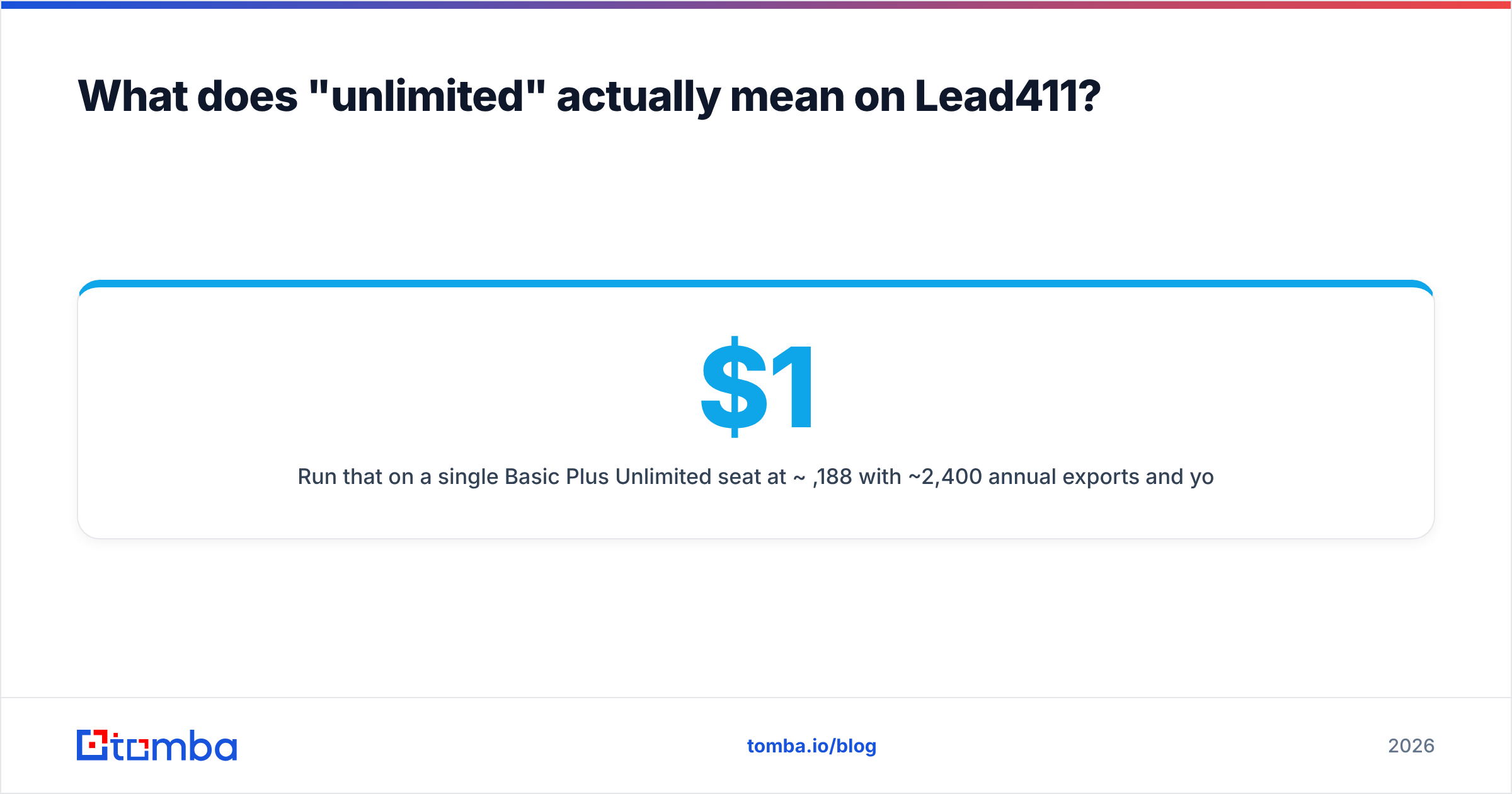
Run that on a single Basic Plus Unlimited seat at ~$1,188/year with ~2,400 annual exports and you land near $0.50 per exported contact — before you account for the share of those records that bounce or are stale. At a 90% deliverable rate, your effective cost per usable contact is closer to $0.55. At 80%, it's $0.62.
That's the number to carry into any comparison.
How does Lead411 pricing compare to the alternatives?#
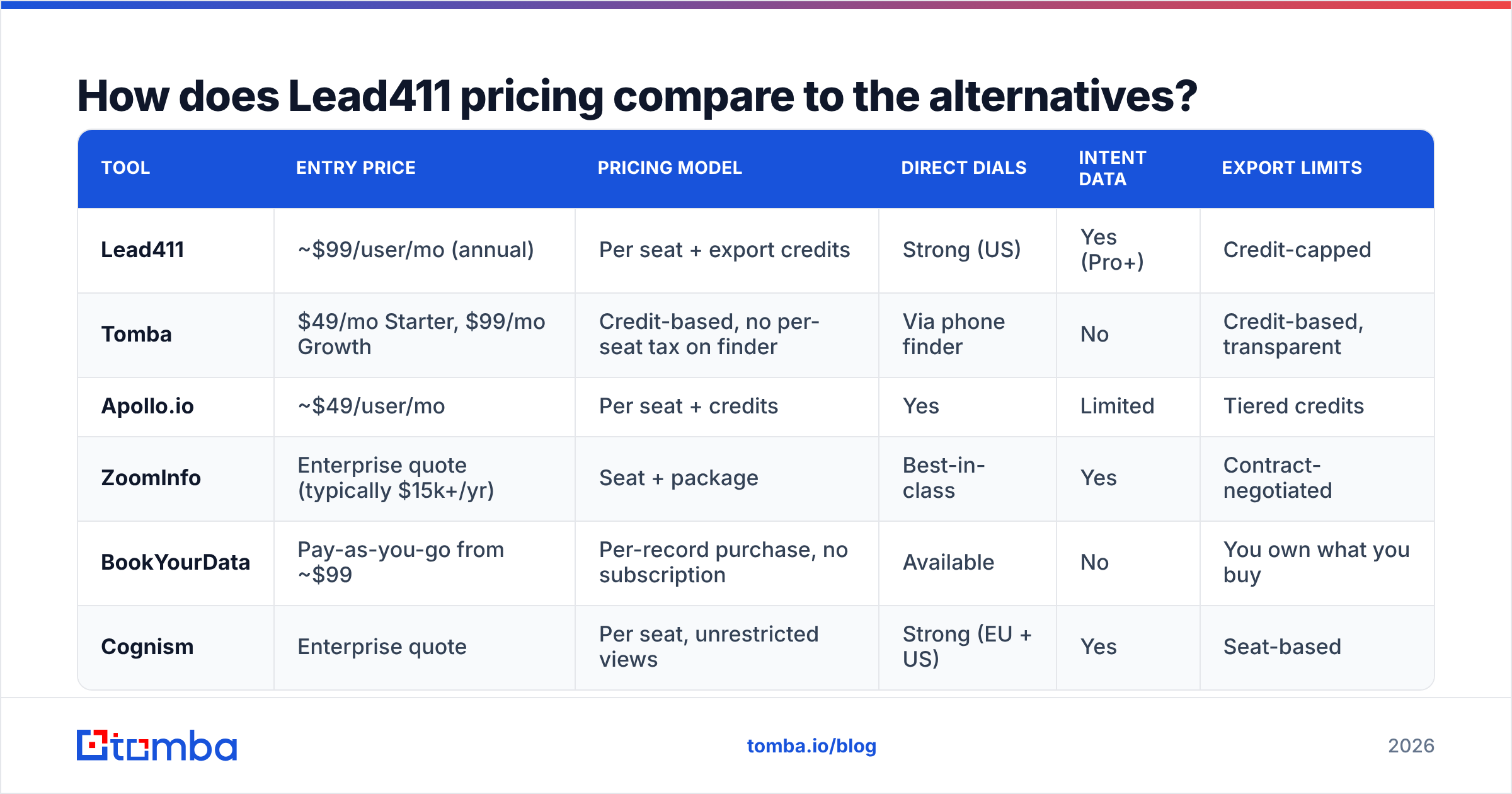
Different tools solve different slices of the problem, and the price gap tracks scope, not quality. Here's the honest layout:
| Tool | Entry price | Pricing model | Direct dials | Intent data | Export limits |
|---|---|---|---|---|---|
| Lead411 | ~$99/user/mo (annual) | Per seat + export credits | Strong (US) | Yes (Pro+) | Credit-capped |
| Tomba | $49/mo Starter, $99/mo Growth | Credit-based, no per-seat tax on finder | Via phone finder | No | Credit-based, transparent |
| Apollo.io | ~$49/user/mo | Per seat + credits | Yes | Limited | Tiered credits |
| ZoomInfo | Enterprise quote (typically $15k+/yr) | Seat + package | Best-in-class | Yes | Contract-negotiated |
| BookYourData | Pay-as-you-go from ~$99 | Per-record purchase, no subscription | Available | No | You own what you buy |
| Cognism | Enterprise quote | Per seat, unrestricted views | Strong (EU + US) | Yes | Seat-based |
A few readings of that table:
If you need EU/UK coverage, Lead411 is the wrong tool at any price — its strength is North America. Cognism is the usual answer there.
If you hate subscriptions, BookYourData is a genuinely different model worth a look: you buy records outright, pay-as-you-go, and there's no seat math to manage. For teams that build one big list per quarter rather than prospecting daily, that structure can be cheaper than any per-seat plan — and you keep the data.
If your bottleneck is email discovery and verification, you're paying Lead411 for a database, a UI, an intent feed, and a phone layer when you only wanted one of those four. A focused tool at Tomba pricing — $49/mo Starter, $99/mo Growth, $249/mo Pro — covers finding and verifying at a fraction of per-seat sales-intelligence cost.
If you want both, the common stack is a cheap finder for volume plus a targeted intelligence seat for the accounts that matter. That's usually less than two full Lead411 seats.
What are the hidden costs buyers report?#
Public pricing pages don't show these. Reviews and renewal conversations do.
- Annual lock-in with limited mid-term downgrade. Cutting a seat mid-contract is generally a renewal-time conversation, not a self-serve toggle. Size your seat count conservatively at signup.
- Intent data is a tier jump, not an add-on. You can't bolt Bombora topics onto Basic Plus. Wanting intent means moving to Pro pricing, which is a multiple — not an increment.
- CRM sync lives upmarket. Native bidirectional sync with Salesforce or HubSpot is a higher-tier feature. On Basic Plus you're exporting CSVs and importing them, which costs you time and introduces duplicates. Budget for cleanup, or use a remove duplicates pass before every import.
- API access is quote-gated. If your plan is to pipe contacts into your own system, Lead411's API is an enterprise conversation. A standalone email finder API is available from far lower tiers if programmatic access is the actual requirement.
- Data decay you pay for twice. B2B contact data degrades roughly 25–30% per year as people change roles — a figure HubSpot and others have tracked consistently. Records you exported in January may be dead by August, and re-exporting the corrected record spends a fresh credit.

Is Lead411 worth the price for your team?#
Score yourself honestly against these five conditions. Three or more "yes" answers and Lead411 is defensible.
- Your ICP is predominantly US-based. Coverage outside North America thins out noticeably.
- Phone matters as much as email. If reps are dialing daily, direct-dial density is worth real money and Lead411 delivers it.
- You will actually act on intent signals. Intent data only pays for itself if someone works the surge list within days. Most teams buy it and never operationalize it.
- Your team is 3–10 seats. Below three, per-seat pricing is inefficient. Above ten, you have the volume to negotiate against ZoomInfo or Cognism and should.
- You export fewer than ~200 contacts per rep per month. Past that, credit overages or a forced tier jump wreck the unit economics.
If you answered "no" to most of those — especially if you're a one-or-two-person outbound team doing email-first prospecting — you're buying a platform to use one feature.
What's the cheapest way to get the same outcome?#
The outcome most buyers actually want from Lead411 is: a list of correct, deliverable work emails for people matching my ICP, refreshed regularly. You can assemble that for well under a single Lead411 seat.
- Source the accounts. Build your target list from LinkedIn Sales Navigator, a niche directory, or your existing CRM. This step is free or already paid for.
- Find the contacts by company. Run domain search against each target domain to pull the people and email patterns in one pass, rather than guessing names first.
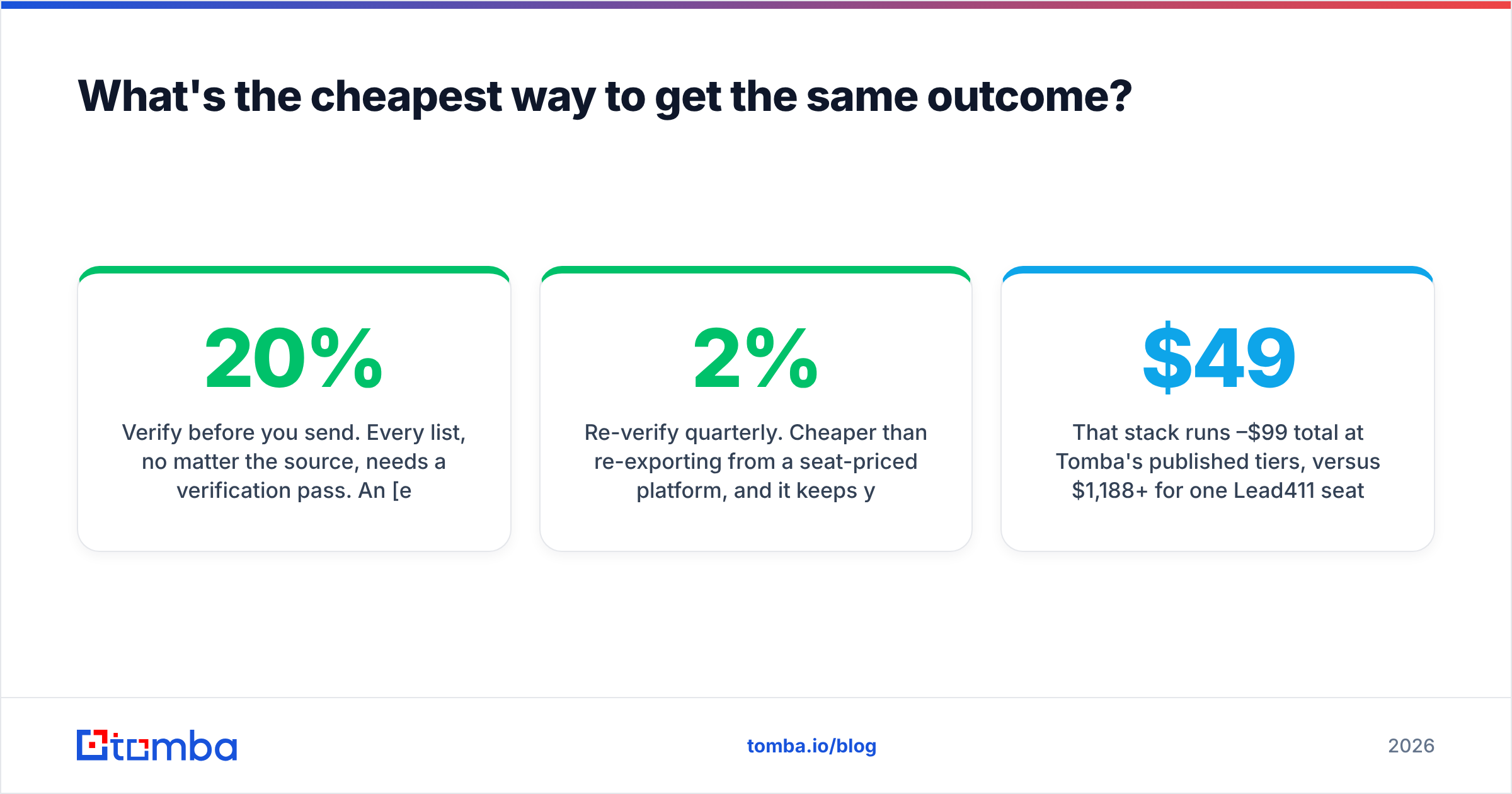
- Verify before you send. Every list, no matter the source, needs a verification pass. An email verifier catches the 10–20% that would otherwise bounce and damage your sender reputation.
- Handle catch-all domains explicitly. A large share of enterprise domains accept everything at SMTP level. A catch-all verifier is the difference between a usable list and a coin flip.
- Add phones only where you'll dial. Buy phone data for the accounts you're actually calling instead of paying for full coverage across a database you'll never work through.
- Re-verify quarterly. Cheaper than re-exporting from a seat-priced platform, and it keeps your bounce rate under the 2% threshold that mailbox providers watch.
That stack runs $49–$99/mo total at Tomba's published tiers, versus $1,188+/year for one Lead411 seat that still caps your exports.
The trade-off is real and worth naming: you give up intent signals and the single-pane UI. If those two things drive your pipeline, pay for Lead411. If they don't, you're funding features you never open.
How should you negotiate Lead411 if you do buy?#
Sales intelligence pricing is soft. Gartner and every procurement team will tell you the same thing: published per-seat numbers are the opening bid.
- Ask for the export pool, not the seat discount. Vendors defend headline pricing harder than they defend credits. An extra 1,000 exports is often easier to get than 15% off.
- Buy at quarter-end. The discount available on March 28 is not the discount available on April 10.
- Start with fewer seats than you need. Adding a seat mid-contract is easy; removing one is not.
- Get the accuracy guarantee in writing. Lead411 markets verified data — ask what happens to your credits when a record bounces, and whether re-exports are free.
- Run a real pilot. Export 100 records during the trial, verify them independently with a third-party free email checker, and measure the actual deliverable rate before you sign twelve months.
That last step is the one teams skip, and it's the one that would save them the most. A vendor's stated accuracy rate and your measured accuracy rate on your ICP are different numbers.
The bottom line#
Lead411 is fairly priced for what it is — a US-focused sales intelligence platform with real direct-dial depth and bundled intent — and badly priced for what most buyers use it for, which is finding work emails. The trap isn't the sticker price. It's paying per seat, annually, for a database when your actual constraint is export volume.
Before you sign, do the arithmetic: seats × 12 months, divided by the exports you'll genuinely get. If that number is above $0.40 per contact and you're not working the phone or the intent feed, you're overpaying for scope you don't use.
Start with the narrow tool and add scope only when you feel the gap. The Tomba Email Finder gives you 25 free searches a month to test accuracy against your own ICP before any commitment, and Starter at $49/mo covers most solo and two-person outbound motions outright. Find the emails, verify them, send — and put the money you saved into the sequencing tool that actually books the meetings.
Related guides#
// get started
Find, verify and enrich your first contacts today
Start on the free plan with 25 searches a month, then scale when your team is ready.
Free plan · No credit card required · GDPR & CCPA
// about the author