Lead411 Pros and Cons: An Honest 2026 Review for B2B Teams
Lead411 sells unlimited contact data, verified emails, direct dials and Bombora intent in one seat. Here is where it genuinely wins, where the contract bites, and when a cheaper stack beats it.
The short version of the Lead411 pros and cons: great direct dials, fair email data, and hard contract terms. This review covers what the tool does well, where it falls short, and who should buy something cheaper.
TL;DR
- Lead411's strongest card is bundling. One seat gets you verified emails, direct-dial mobile numbers, Bombora intent data and trigger alerts. The price is about $99 per user per month on an annual plan.
- The biggest weakness is commercial, not technical. Annual contracts, per-seat pricing and export caps catch teams mid-quarter. "Unlimited" is not unlimited.
- Email accuracy is solid in US tech and mid-market SaaS. It drops in EMEA, APAC and outside tech, such as manufacturing, construction and health care.
- If you need intent signals plus contacts in one login, Lead411 earns its price. If you mainly need accurate emails at volume, a dedicated finder plus verifier costs a fraction.
- Most teams do well with a lean 2026 setup. Use one data source to find leads. Verify every address before you send. Add intent tools only if you run account-based plays.
What is Lead411 and who is it built for?#
Lead411 is a B2B sales intelligence platform. At its core sits a contact and company database. It holds work emails, direct-dial phone numbers, tech stacks, growth intent and hiring triggers. A Chrome extension and CRM sync come with it. The company has been around since 2001. That makes it one of the older names in the field, next to ZoomInfo and Apollo.
The product is built for one buyer in particular. Picture a small or mid-size sales team. They want prospect data and buying signals in one login. They do not want to haggle over a five-figure enterprise contract. That choice shapes every one of the Lead411 pros and cons below.
Here is what you actually get inside a seat:
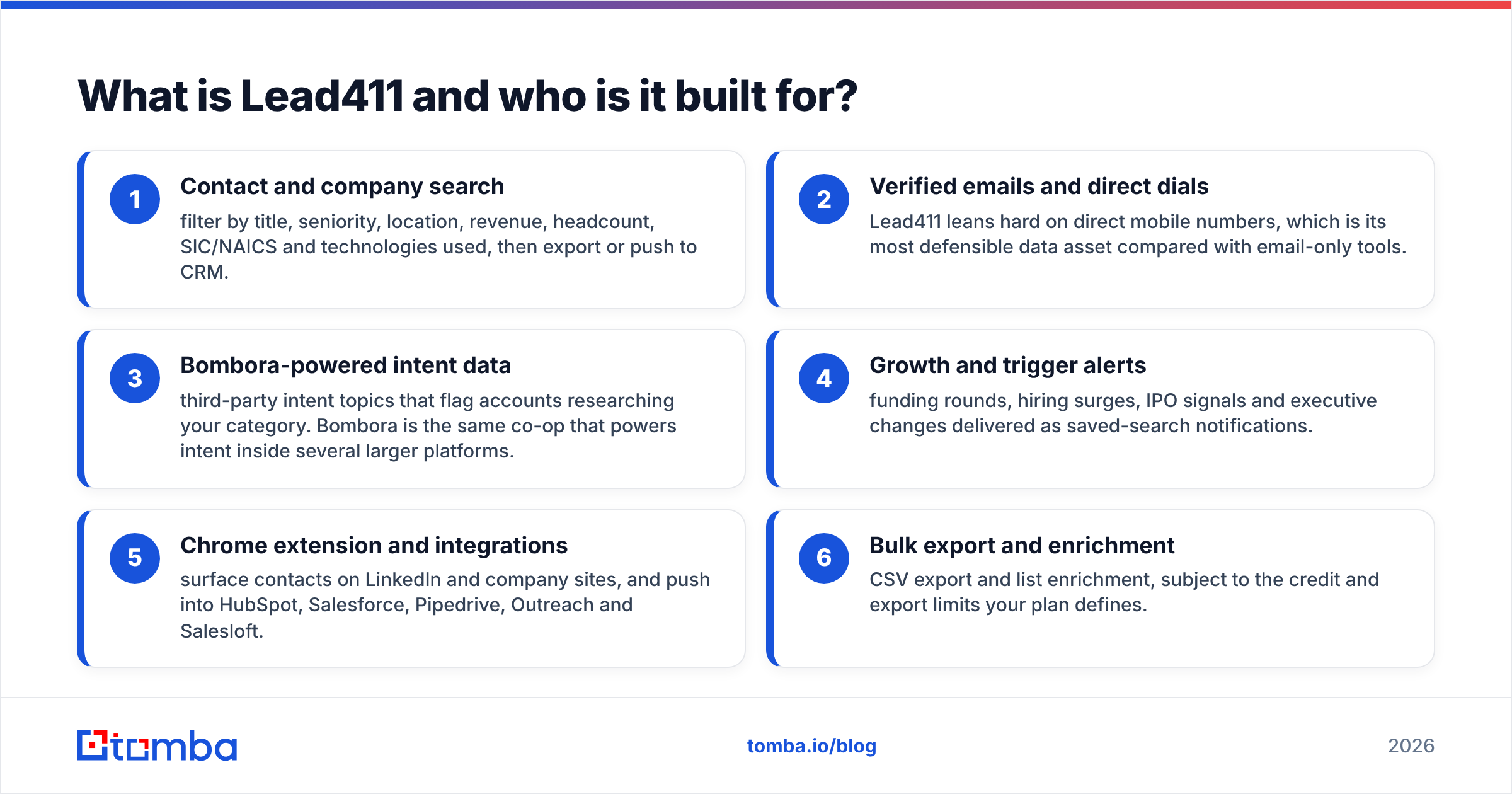
- Contact and company search — filter by title, seniority, location, revenue, headcount, SIC/NAICS and tech used. Then export the list or push it to your CRM.
- Verified emails and direct dials — Lead411 leans hard on direct mobile numbers. That is its strongest data asset next to email-only tools.
- Bombora-powered intent data — third-party intent topics flag accounts researching your category. Bombora is the same co-op that powers intent inside several larger platforms.
- Growth and trigger alerts — funding rounds, hiring surges, IPO signals and executive changes arrive as saved-search notifications.
- Chrome extension and integrations — surface contacts on LinkedIn and company sites. Push them into HubSpot, Salesforce, Pipedrive, Outreach and Salesloft.
- Bulk export and enrichment — CSV export and list enrichment, subject to the credit and export limits in your plan.
That bundle is the whole pitch. No single part of it is unique. The mix at a below-enterprise price is why Lead411 keeps landing on shortlists.
What are the real pros of Lead411?#
Direct dials are genuinely good. This is the honest standout. Cold-calling teams report better mobile hit rates here than from email-first tools. If your pipeline runs on phone calls, that alone can pay for the seat. Still, check any number list before you dial. Run it through a phone validator first. Even good direct-dial data goes stale fast.
Intent plus contacts in one place. Most stacks buy intent from a second vendor. Then they fight to join the two data sets. Lead411 ships both together. You can filter for accounts surging on "data warehouse" topics and pull decision-maker contacts in the same query. For a two-person SDR team, that saved setup work is worth real money.
Trigger alerts that actually fire. Funding, hiring and leadership-change alerts land in your inbox as saved searches. It is a small feature that changes how reps work. They open the alert. The reason for reaching out writes itself. Reply rates go up because the note is tied to something real.
Pricing that is published and human-scale. Big incumbents push you into a sales call and a $15k-plus yearly deal. Lead411 lists a per-seat price on its official site. You can work out your first-year spend in an afternoon.
No hostile lock on CRM sync. HubSpot and Salesforce connectors are included. Several rivals sell the same thing as a premium data-ops tier.
What are the biggest cons of Lead411?#
"Unlimited" is a marketing word, not a technical one. The headline unlimited-views plan still carries export caps and fair-use limits. Teams that build large outbound lists hit the ceiling often. Then a sales rep calls about a higher tier. Read the export allowance in your order form before you sign.
Annual contracts are the default. A month-to-month plan exists, but the price pushes you away from it. Say your team or your motion changes in month four. You still pay for seats nobody uses. This is the most common gripe in G2 reviews. No amount of data quality fixes a contract problem.
Coverage falls off outside US mid-market tech. The sweet spot is US-headquartered companies with 50 to 5,000 staff in software, IT services and nearby fields. Search for European manufacturers, LATAM logistics firms or APAC health care instead. Record counts thin out fast. You get more stale titles and more generic info@ addresses.
Email freshness lags direct-dial quality. Phone data is the strength. Email is fine, but not best in class. Mail a raw export and it bounces more than the stated accuracy suggests. Always run exports through an email verifier before they touch a sending domain.
The UI shows its age. Search works, but it feels clunky next to newer tools. Saved filters are fiddly. Bulk jobs take more clicks than they should.
Support speed varies by tier. Small accounts wait longer on data disputes and credit refunds. Mid-market accounts with a named CSM get faster answers.
How accurate is Lead411's data in practice?#
Every vendor quotes a headline accuracy number. Every one of those numbers comes from a test the vendor designed. Treat the figure as a starting guess. Then test it on your own ICP.

What holds up across independent testing patterns:
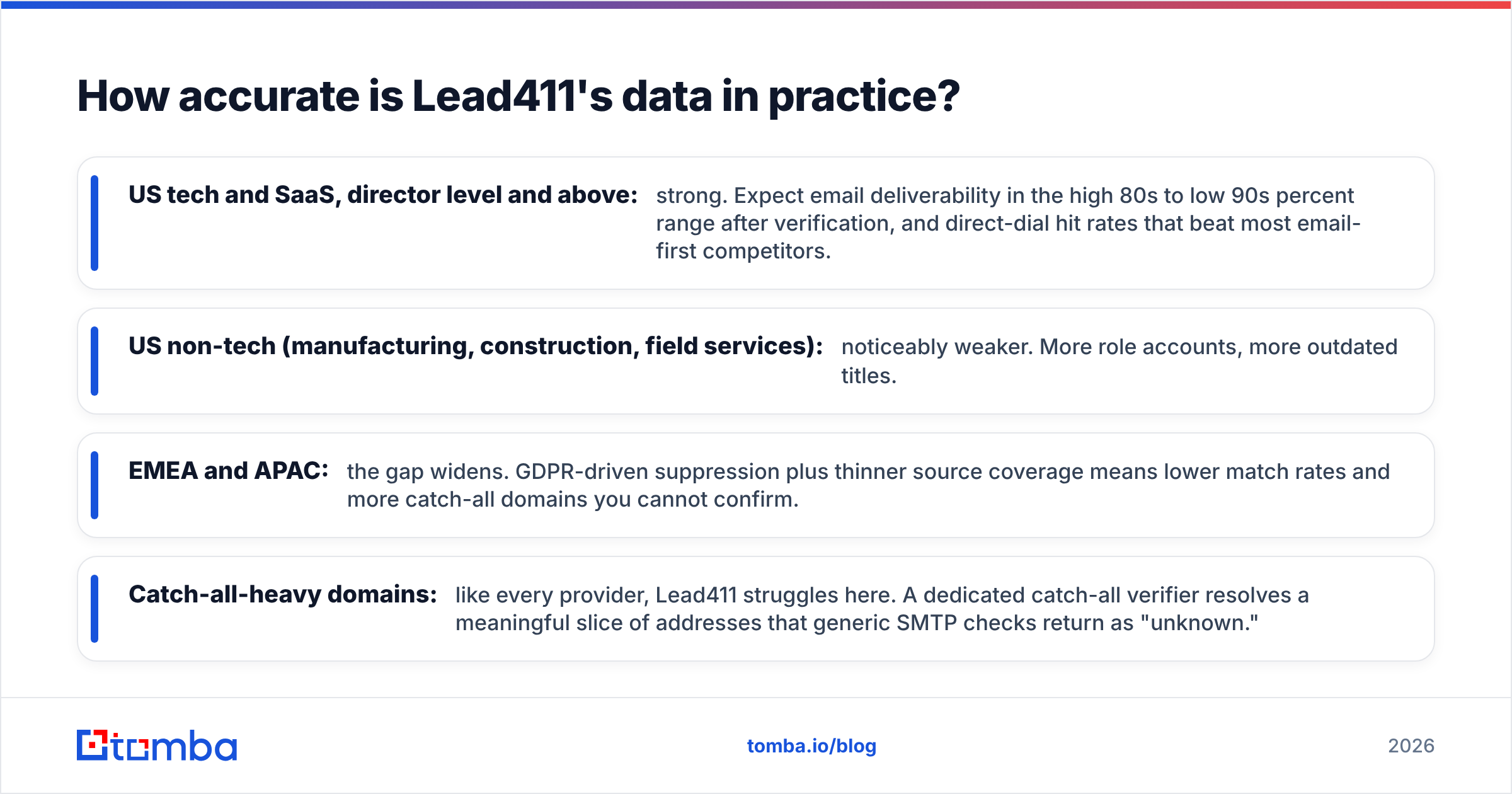
- US tech and SaaS, director level and above: strong. After verification, expect email deliverability in the high 80s to low 90s percent. Direct-dial hit rates beat most email-first rivals.
- US non-tech (manufacturing, construction, field services): clearly weaker. More role accounts. More outdated titles.
- EMEA and APAC: the gap widens. GDPR suppression and thinner sources mean lower match rates. You also meet more catch-all domains you cannot confirm.
- Catch-all-heavy domains: every provider struggles here, Lead411 included. A dedicated catch-all verifier resolves a good slice of the addresses that plain SMTP checks return as "unknown."
The rule is simple. Never mail a raw export from any database, Lead411 included. A verification pass costs cents per thousand. A sending reputation takes months to rebuild.
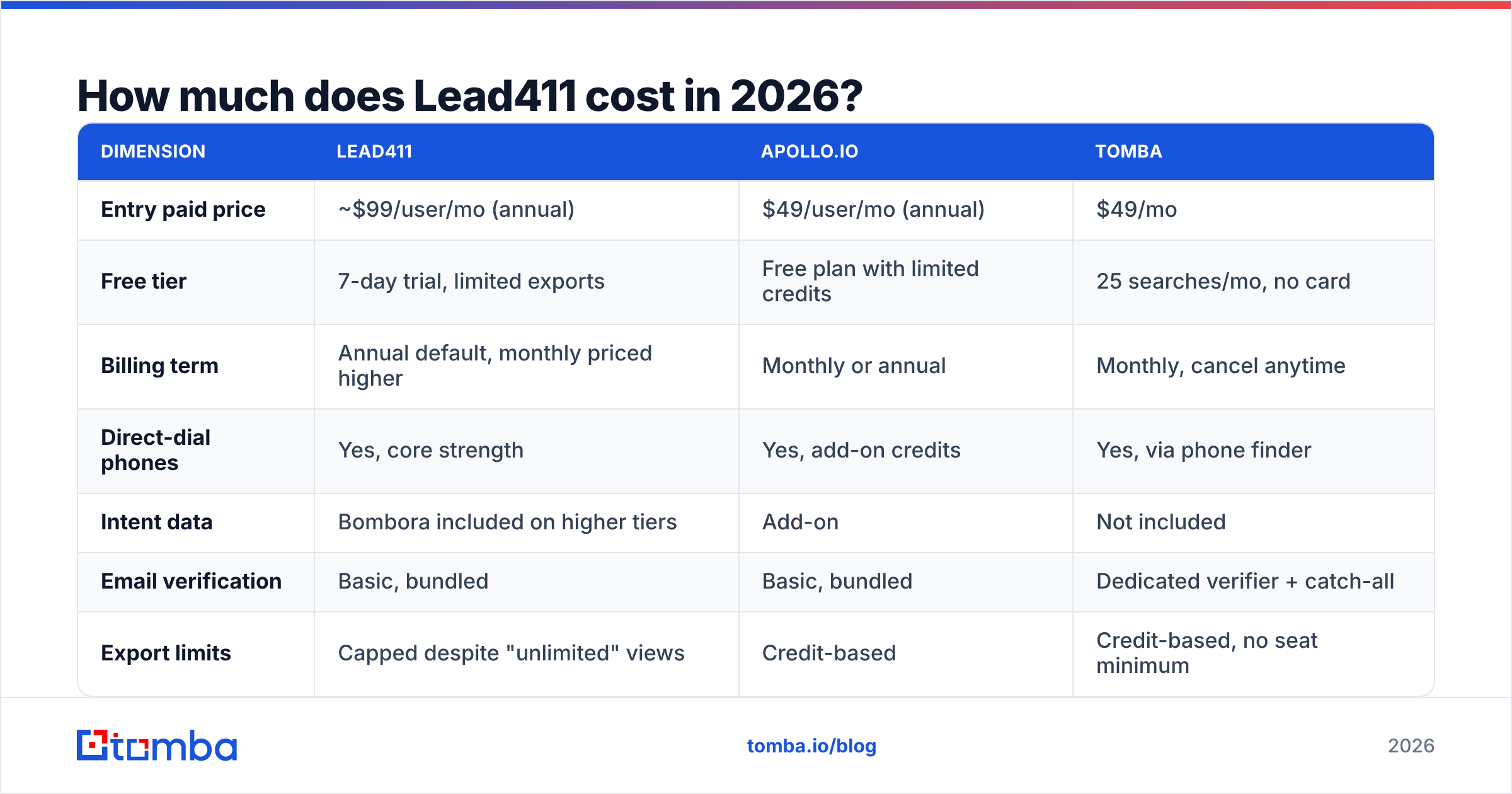
How much does Lead411 cost in 2026?#
Prices move, and Lead411 negotiates. Confirm current numbers with them. As a planning baseline, here is the published structure today next to two common alternatives.
| Dimension | Lead411 | Apollo.io | Tomba |
|---|---|---|---|
| Entry paid price | ~$99/user/mo (annual) | $49/user/mo (annual) | $49/mo |
| Free tier | 7-day trial, limited exports | Free plan with limited credits | 25 searches/mo, no card |
| Billing term | Annual default, monthly priced higher | Monthly or annual | Monthly, cancel anytime |
| Direct-dial phones | Yes, core strength | Yes, add-on credits | Yes, via phone finder |
| Intent data | Bombora included on higher tiers | Add-on | Not included |
| Email verification | Basic, bundled | Basic, bundled | Dedicated verifier + catch-all |
| Export limits | Capped despite "unlimited" views | Credit-based | Credit-based, no seat minimum |
| Best fit | Call-heavy SMB/mid-market teams | All-in-one outbound platform | Accurate email discovery at volume |

Two cost realities that do not appear on any pricing page:
Seat math dominates. At about $99 per user per month on annual terms, five reps cost near $6,000 a year. That is before any overage. Now compare a single API data source feeding one shared enrichment job. There, cost tracks records rather than headcount. See Tomba pricing for what per-record scaling looks like.
Overage is where budgets break. Export caps hit in month two of a busy quarter. The mid-contract upgrade rarely gets the discount your first deal did.

Is Lead411 better than the alternatives?#
It depends on the job you are hiring the tool for.
Versus ZoomInfo: Lead411 is far cheaper and faster to buy. ZoomInfo has deeper enterprise coverage, better org charts and stronger APAC and EMEA data. If your ACV is above $50k and you sell into the Fortune 2000, the ZoomInfo price starts to make sense. Below that, it rarely does.
Versus Apollo: Apollo bundles sequencing, dialer and data in one platform at a lower entry price. That makes it the better all-in-one for a team with no outbound stack yet. Lead411 wins on direct-dial quality, and its intent data is native rather than an add-on. Teams that already run a sequencer often prefer a focused data source. See the Apollo alternative comparison for that trade-off in detail.
Versus BookYourData: a different purchase model entirely. BookYourData sells prepaid, pay-as-you-go list credits. There is no seat commitment, and it carries a bounce guarantee. That suits teams who buy data in bursts. Lead411 suits teams who need a research surface open all day with intent attached. Both are legitimate. The deciding factor is whether your demand for data is steady or spiky.
Versus a dedicated email finder plus verifier: say your bottleneck is simple. You have a target list and you need valid work emails. Then a purpose-built email finder plus verification is the cheapest accurate path by a wide margin. You give up intent data and direct dials. That only matters if you were going to use them.
Who should buy Lead411, and who should skip it?#
Buy it if:
- Cold calling is a core channel and mobile-number quality decides your pipeline.
- You sell into US mid-market tech and want intent signals without a separate Bombora contract.
- You have three or more reps who log in daily, so the per-seat price pays off.
- Your outbound volume is steady enough that export caps will not bite.
Skip it if:
- Your market sits mostly outside North America.
- You need high-volume email discovery and verification rather than a research UI.
- You cannot commit to an annual contract, or your team size is still changing.
- You already own an intent vendor. You would pay twice for the same Bombora topics.
How do you get most of the benefit for less?#
Unbundle. Email-led teams find Lead411 pricey for one reason. They pay for phone and intent tooling they touch twice a month.
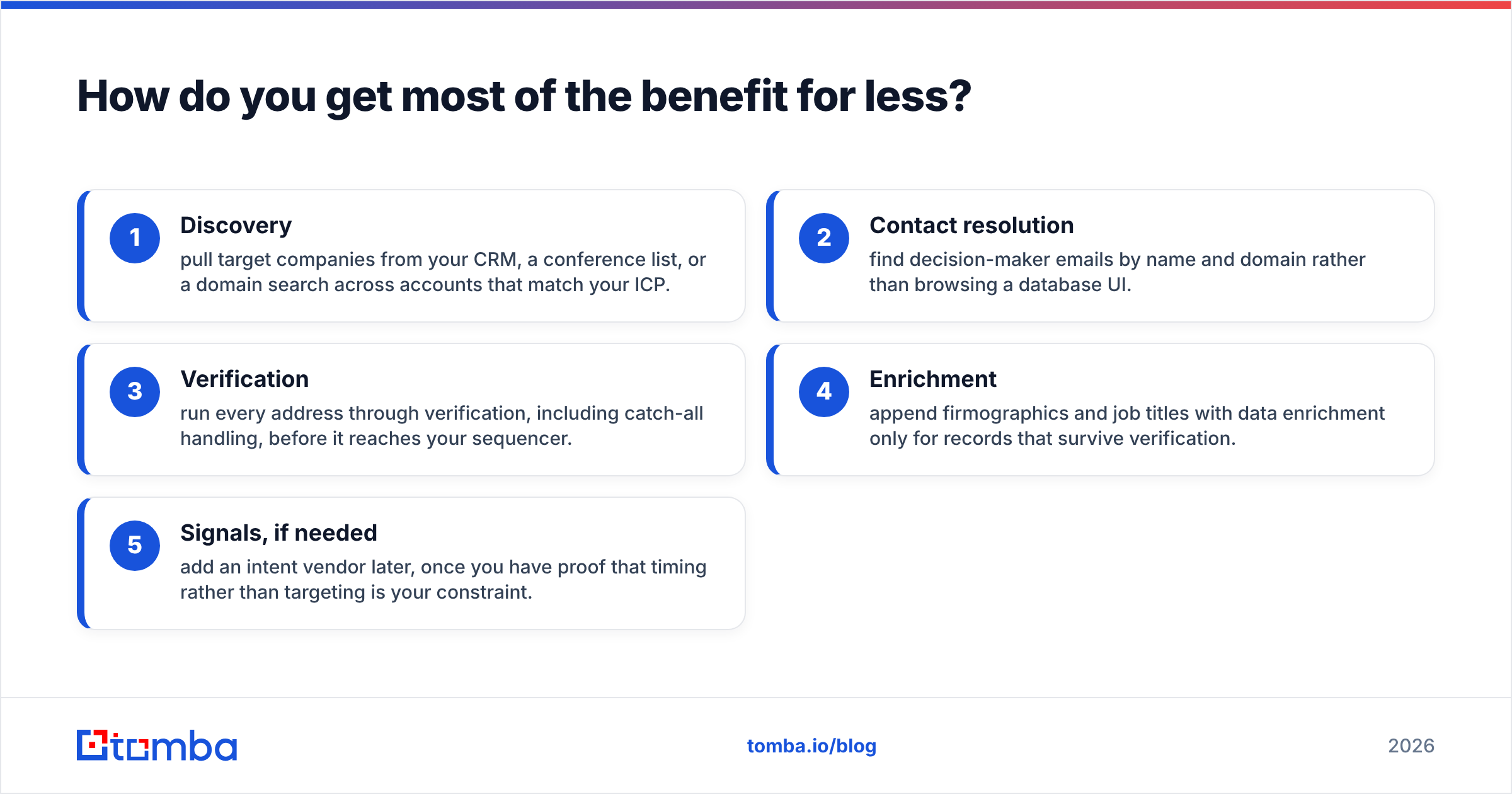
A leaner 2026 stack looks like this:
- Discovery — pull target companies from your CRM, a conference list, or a domain search across accounts that match your ICP.
- Contact resolution — find decision-maker emails by name and domain rather than browsing a database UI.
- Verification — run every address through verification before it reaches your sequencer. Include catch-all handling.
- Enrichment — append firmographics and job titles with data enrichment, but only for records that survive verification.
- Signals, if needed — add an intent vendor later, once you can prove that timing rather than targeting is your constraint.
Most teams find that steps one through four solve 80 percent of the problem at 20 percent of the cost. Intent data pays off later, once you have outbound that already works. For a wider view of how these tools fit together, HubSpot's sales research is a fair neutral source on reply and connect rates.
What is the verdict on Lead411 pros and cons?#
Weigh the Lead411 pros and cons and one pattern shows up. It is a fair-value product with an unfair contract. The data is good where the site says it is good. The direct dials are a real edge. The intent bundle removes real integration pain. What trips teams up is the commercial wrapper: annual terms, per-seat scaling, and export caps hiding behind the word "unlimited."
If you are call-heavy, US-focused and staffed for it, sign the annual deal and use the trigger alerts hard. If you are email-led, international, or still testing your ICP, buy data by the record instead of by the seat.
Ready to test the cheaper path before you sign? Start with the Tomba Email Finder. You get 25 free searches a month with no card, then $49 a month when you scale. Verification and catch-all handling are built in. Run your next 200-account list through it. Compare the bounce rate with your current tool. Let the numbers pick your stack.
Related guides#
// get started
Find, verify and enrich your first contacts today
Start on the free plan with 25 searches a month, then scale when your team is ready.
Free plan · No credit card required · GDPR & CCPA
// about the author