Lead411 vs LeadMine: Which B2B Data Tool Wins in 2026?
Lead411 sells intent data and direct dials at a per-seat price. LeadMine sells cheap, credit-metered email lookups. Here is which one actually fits your outbound motion in 2026, and where both leave money on the table.
Lead411 vs LeadMine comes down to one question. Do you need buying signals, or do you just need email addresses? Lead411 sells a full sales intelligence stack, priced per seat. LeadMine sells cheap, credit-metered lookups. This guide compares both on price, data quality, and cost per usable contact.
TL;DR
- Lead411 is a full sales-intelligence platform: a contact database plus Bombora-powered intent data, growth triggers, direct dials, and CRM sync. It is priced per seat and sold like software.
- LeadMine is a lean B2B lead-finder: search a database by title/industry/location, pull emails, export. Credit-metered, cheap, no intent layer.
- Pick Lead411 if you need buying signals and phone numbers and you have 3+ reps who will log in daily. Pick LeadMine if you need a few thousand verified emails a month and nothing else.
- Both are seat- or credit-locked in ways that punish spiky workloads. If your volume is bursty or API-driven, a pay-for-what-you-use email finder usually costs less per usable contact.
- Whichever you choose, run every export through an email verifier before it touches your sending domain. Neither vendor's "verified" label survives a 90-day-old record.
What are Lead411 and LeadMine, exactly?#
They solve the same surface problem — "I need contact data for people who might buy" — but they are built for different buyers.
Lead411 has been around since 2001 and positions itself as a sales intelligence platform rather than a list vendor. You get a searchable B2B database, verified business emails, direct-dial and mobile numbers, technographics, and intent data sourced through Bombora. The pitch is simple. Do not just find contacts. Find contacts who are already researching your category. It sells on annual, per-user contracts with export caps.
LeadMine is deliberately smaller in scope. It offers a lead database you filter by job title, company, industry, and location. An email finder turns a name plus domain into an address. A Chrome extension pulls contacts while you browse. Credits meter everything. There is no intent layer, no signal feed, no revenue-team dashboarding. That is a feature if you are a two-person agency and a dealbreaker if you are running a 12-rep SDR floor.
The honest framing: Lead411 competes with ZoomInfo and Apollo. LeadMine competes with Hunter and Snov. Comparing them is really comparing two different budget lines.
Lead411 vs LeadMine: how do they compare head-to-head?#
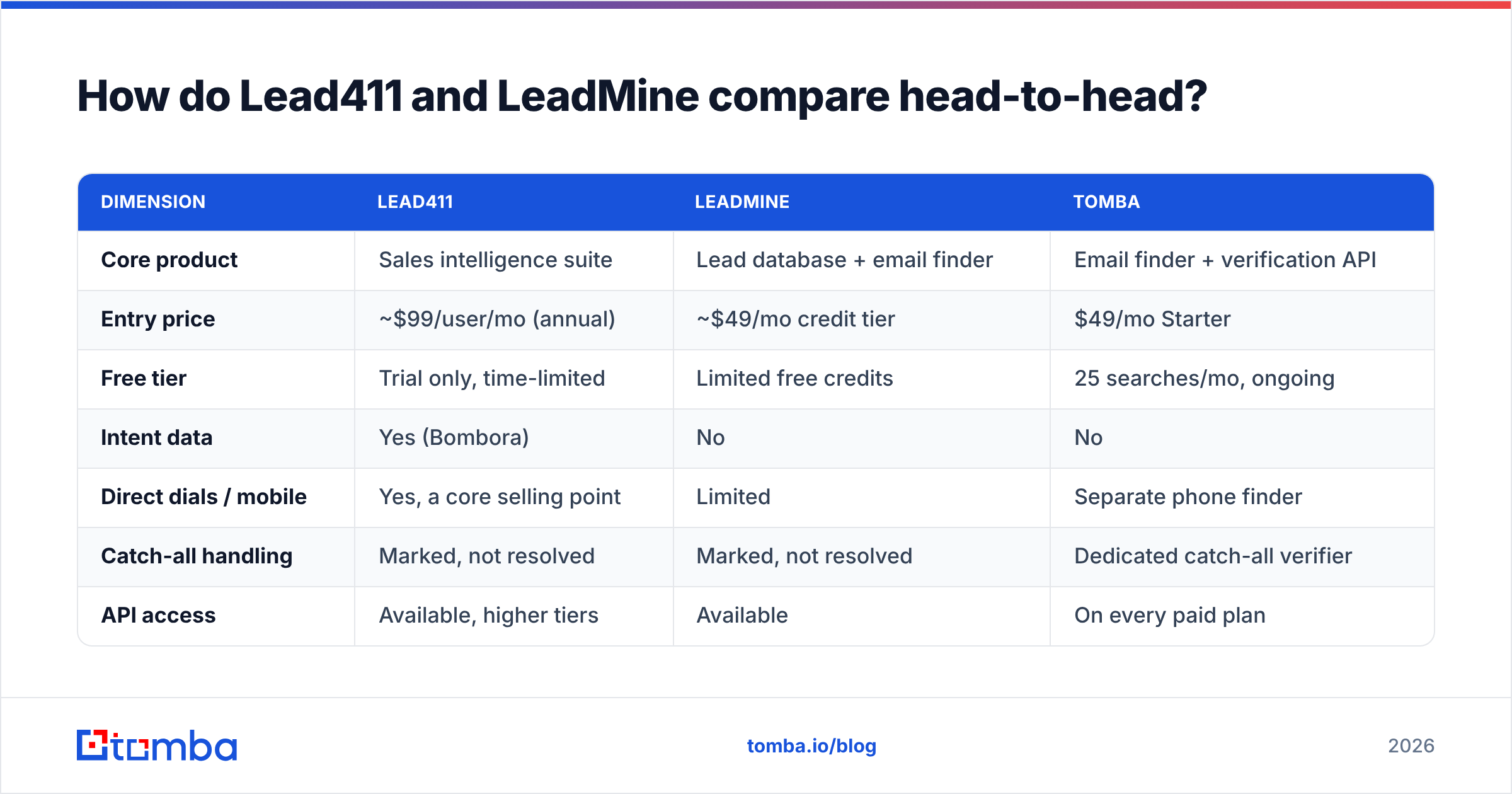
Here is the practical breakdown. Pricing below reflects publicly listed rates at the time of writing. Both vendors move numbers and gate tiers behind sales calls. Confirm on their own pricing pages before you sign.
| Dimension | Lead411 | LeadMine | Tomba |
|---|---|---|---|
| Core product | Sales intelligence suite | Lead database + email finder | Email finder + verification API |
| Entry price | ~$99/user/mo (annual) | ~$49/mo credit tier | $49/mo Starter |
| Free tier | Trial only, time-limited | Limited free credits | 25 searches/mo, ongoing |
| Intent data | Yes (Bombora) | No | No |
| Direct dials / mobile | Yes, a core selling point | Limited | Separate phone finder |
| Catch-all handling | Marked, not resolved | Marked, not resolved | Dedicated catch-all verifier |
| API access | Available, higher tiers | Available | On every paid plan |
| Export caps | Yes, per seat per month | Credit-based | Credit-based, no seat tax |
| Best for | SDR teams chasing signals | Solo founders, small agencies | Builders and bulk workflows |
Three things stand out when you put them side by side.
Seats versus credits. Lead411 charges per user. Need access for four people? You are at roughly $400/month before you pull a single record. Your export allowance is still capped. LeadMine does not care how many people log in as long as credits last. For a team of one, LeadMine wins on pure arithmetic. For a team of eight where only two people actually prospect, Lead411's model is actively hostile.
Signals versus addresses. Intent data is the only genuinely differentiated thing in this comparison. If your motion depends on reaching accounts while they are in-market, Lead411 gives you something LeadMine structurally cannot. If your motion is "we know exactly who we want, get me their email," intent data is an expensive feature you will not open twice.
Depth versus breadth. Lead411 is stronger on US mid-market and enterprise, especially for direct dials. LeadMine's coverage is thinner outside common tech and SaaS titles, and non-US SMB data gets sparse fast. Test both against a sample of your real ICP before committing — vendor-published coverage numbers are marketing, not measurement.
How accurate is the data in each?#
Accuracy is where every contact-data comparison gets slippery, because vendors define "verified" differently. Some run a real SMTP handshake at export time. Some replay a verification result from months ago. Some infer a pattern and call high confidence "verified."

Lead411 publishes high accuracy claims and backs them with a triple-verification process plus a bounce credit policy. In practice, reviewers on G2 report strong results on US corporate emails. Direct dials land noticeably weaker. That is the same pattern you see across the category. LeadMine's email finder performs respectably on standard corporate domains with predictable patterns. It degrades on catch-all domains, which it flags rather than resolves.
Neither behavior is unusual. What matters is what you do about it. Here is the verification workflow that actually holds bounce rates down, regardless of which vendor you buy:
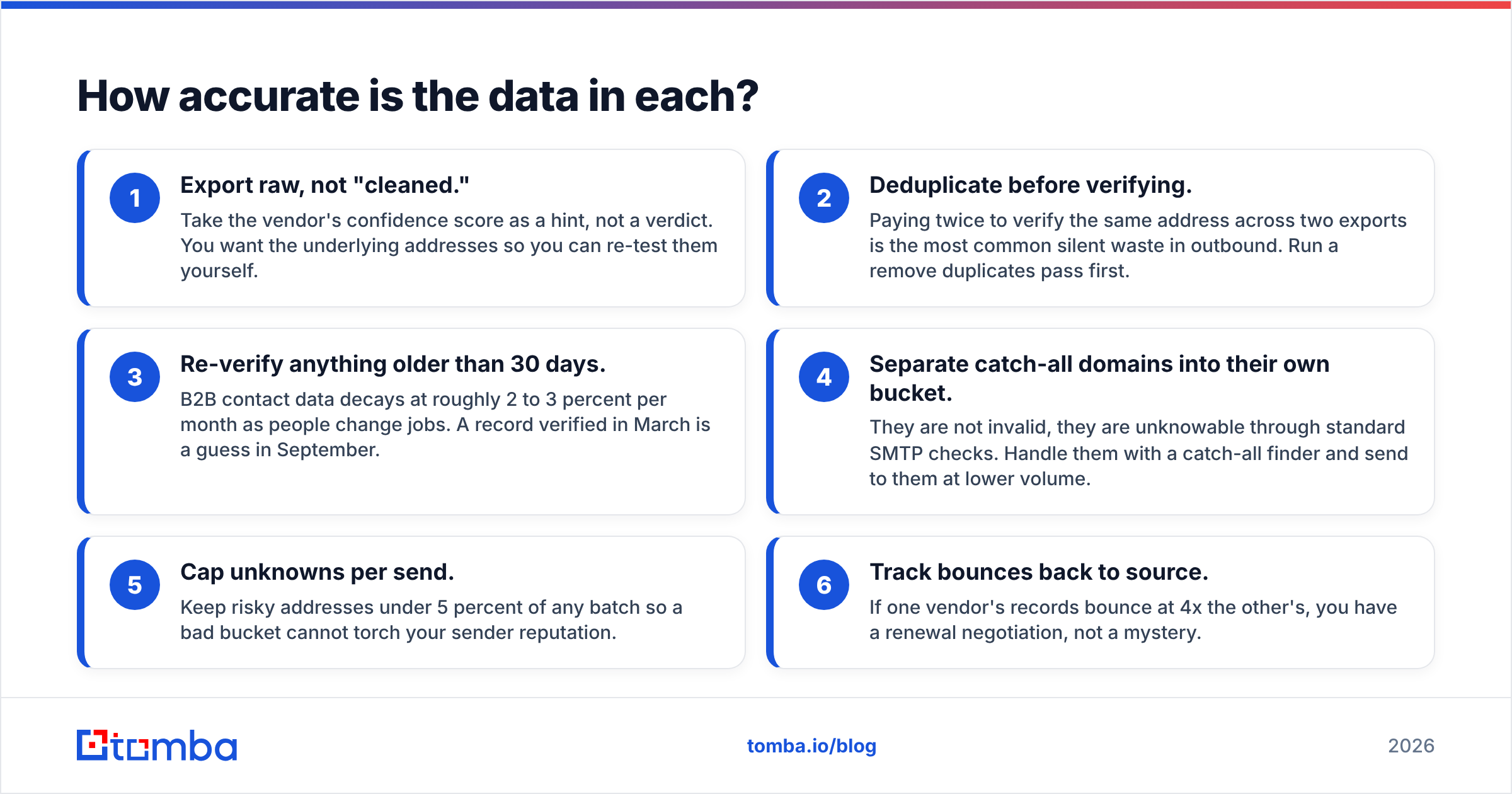
- Export raw, not "cleaned." Take the vendor's confidence score as a hint, not a verdict. You want the underlying addresses so you can re-test them yourself.
- Deduplicate before verifying. Paying twice to verify the same address across two exports is the most common silent waste in outbound. Run a remove duplicates pass first.
- Re-verify anything older than 30 days. B2B contact data decays at roughly 2 to 3 percent per month as people change jobs. A record verified in March is a guess in September.
Then handle the records you cannot fully trust:
- Separate catch-all domains into their own bucket. They are not invalid, they are unknowable through standard SMTP checks. Handle them with a catch-all finder and send to them at lower volume.
- Cap unknowns per send. Keep risky addresses under 5 percent of any batch so a bad bucket cannot torch your sender reputation.
- Track bounces back to source. If one vendor's records bounce at 4x the other's, you have a renewal negotiation, not a mystery.
Do this and the accuracy gap between Lead411 and LeadMine stops being the deciding factor. Do not do it, and the better database will still burn your domain.
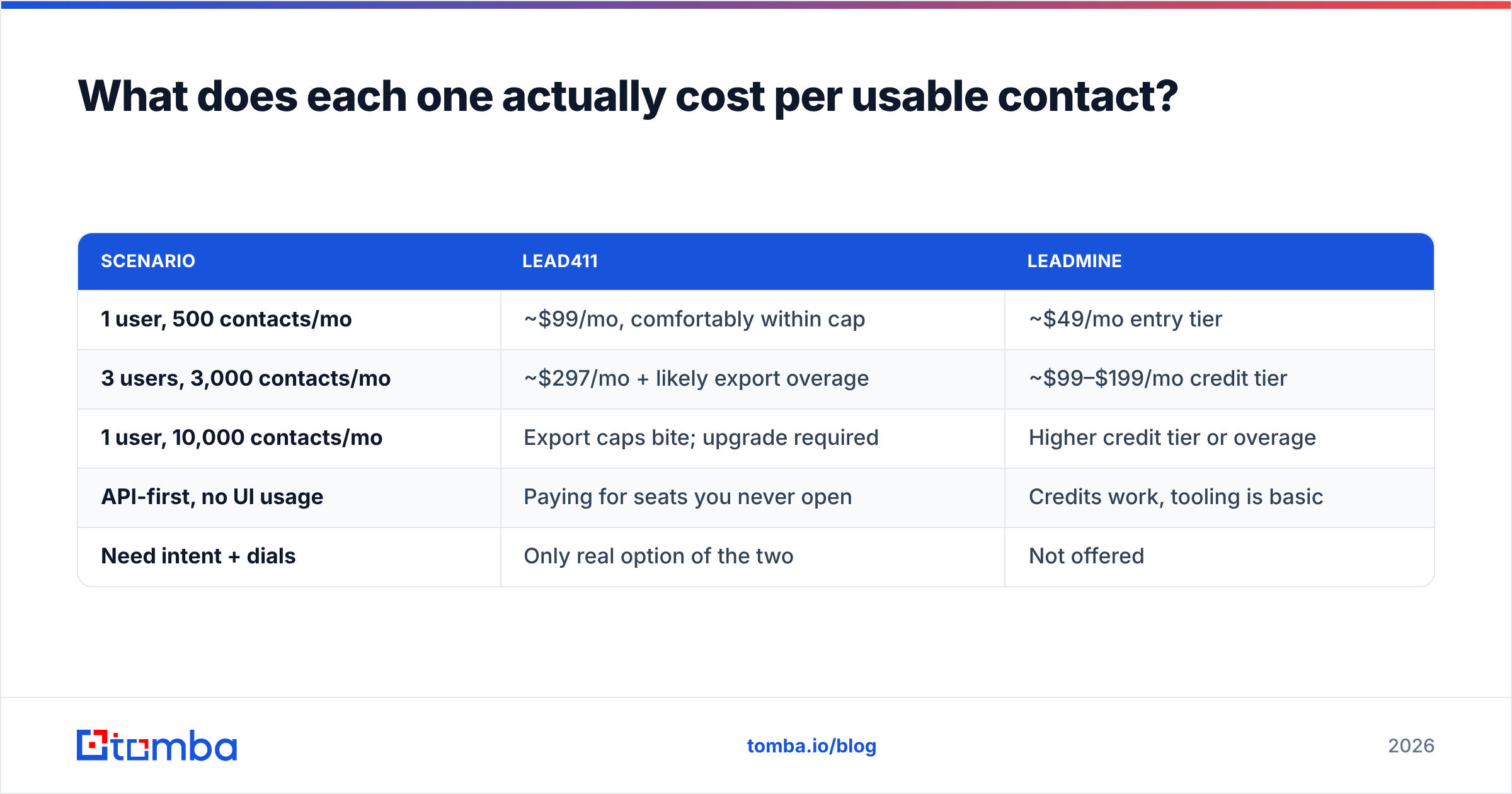
What does each one actually cost per usable contact?#
Sticker price is the wrong metric. The number that matters is cost per contact that is valid, reachable, and inside your ICP.
| Scenario | Lead411 | LeadMine |
|---|---|---|
| 1 user, 500 contacts/mo | ~$99/mo, comfortably within cap | ~$49/mo entry tier |
| 3 users, 3,000 contacts/mo | ~$297/mo + likely export overage | ~$99–$199/mo credit tier |
| 1 user, 10,000 contacts/mo | Export caps bite; upgrade required | Higher credit tier or overage |
| API-first, no UI usage | Paying for seats you never open | Credits work, tooling is basic |
| Need intent + dials | Only real option of the two | Not offered |
Two failure modes show up repeatedly in this category.
The first is paying for seats nobody uses. Sales ops buys five Lead411 licenses in January. By March, two reps have left and one never logged in, but the annual contract runs to December. Per-seat pricing only works when seat count tracks actual daily usage.
The second is credit burn on unusable records. A credit spent on a contact who left the company last quarter is a credit spent. Credit-metered tools like LeadMine look cheap until you measure the effective rate after bounces, out-of-ICP hits, and duplicates across exports. A $49 plan with 1,000 credits and a 70 percent usable rate is really $0.07 per usable contact, not $0.049.
For comparison, Tomba pricing starts with a free tier of 25 searches per month. Paid plans run $49/mo Starter, $99/mo Growth, and $249/mo Pro, with no per-seat multiplier. The relevant difference is not the headline number. It is that adding a fourth teammate does not change the bill.

Who should pick Lead411?#
Buy Lead411 if three things are true at once.
You have a defined SDR function with people whose job is to work a queue every day. Intent data only pays off when someone acts on it within days of the signal firing. If your "outbound team" is a founder doing 40 minutes on Friday, intent data is a rounding error you are paying a premium for.
You need phone numbers, not just email. Lead411's direct-dial coverage is one of its stronger arguments. It matters if your motion involves actual cold calling rather than email-only sequences. Expect mobile accuracy well below email accuracy, as is true of every vendor in this space.
You will use the CRM sync. Lead411 integrates with Salesforce, HubSpot, and the usual suspects. If the data lands in a CSV that sits in someone's Downloads folder, you have bought a platform to use one feature of it.
Where Lead411 frustrates buyers: annual commitments, export caps that surprise people mid-quarter, and a UI that shows its age next to newer competitors. Read recent reviews on Capterra with an eye for renewal complaints, not just first-month enthusiasm.
Who should pick LeadMine?#
Buy LeadMine if your requirement list is genuinely short.
You are a solo operator, small agency, or early-stage founder who needs a few hundred to a few thousand emails a month. The database filters are adequate, the Chrome extension is convenient, and the price is defensible without a procurement conversation.
You do not need signals. You already know your target list. Maybe it came from a conference roster, a funding database, or a niche directory. The only missing piece is contact details. Paying for an intent layer you will not use is pure waste.
You want to avoid annual lock-in. Credit models let you stop, start, and scale down without a renegotiation.
Where LeadMine frustrates buyers: thinner international coverage, a database that feels small next to the big platforms, and limited tooling once your workflow grows past manual exports. It is a good tool at its size, and it does not pretend to be more.

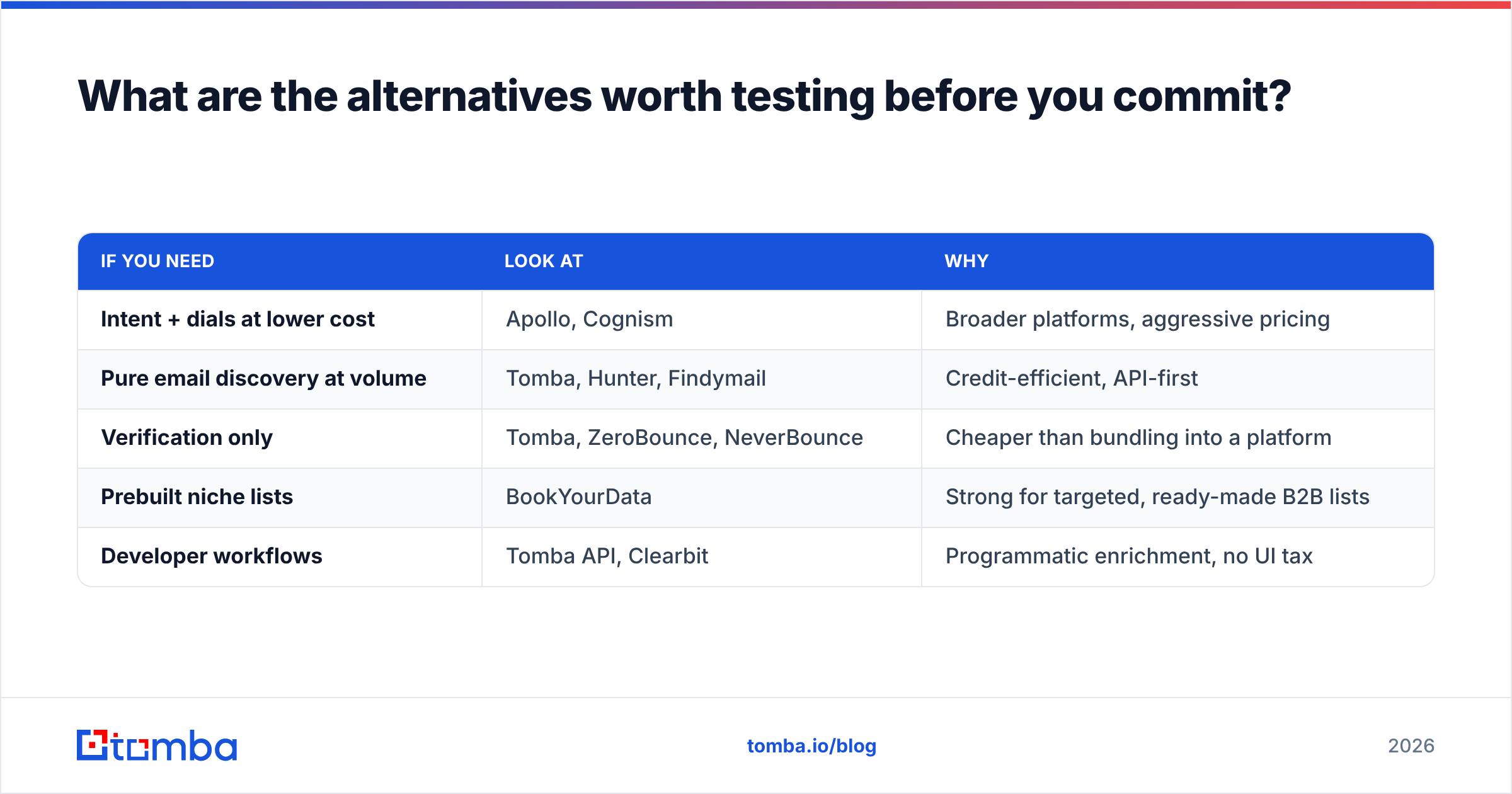
What are the alternatives worth testing before you commit?#
Neither of these is the only option, and the middle of this market is crowded. A few directions worth a trial:
| If you need | Look at | Why |
|---|---|---|
| Intent + dials at lower cost | Apollo, Cognism | Broader platforms, aggressive pricing |
| Pure email discovery at volume | Tomba, Hunter, Findymail | Credit-efficient, API-first |
| Verification only | Tomba, ZeroBounce, NeverBounce | Cheaper than bundling into a platform |
| Prebuilt niche lists | BookYourData | Strong for targeted, ready-made B2B lists |
| Developer workflows | Tomba API, Clearbit | Programmatic enrichment, no UI tax |
If you are evaluating platform-level replacements, the Apollo alternative breakdown covers how the all-in-one suites stack up. If your real need is discovery plus validation rather than a full suite, the Tomba API handles finding, verifying, and enriching in one call. That removes the stitching work most teams do with CSVs.
One practical suggestion: run a blind bake-off. Take 200 real target contacts from your ICP. Run them through each tool's trial. Measure four numbers — match rate, bounce rate after verification, cost per usable contact, and time to export. The winner is usually obvious within a day, and it is frequently not the tool with the best-looking website.
Frequently asked questions#
Is Lead411 more accurate than LeadMine? On US corporate emails, both perform well and the gap is smaller than either vendor's marketing implies. Lead411 has an edge on depth and on phone data. LeadMine holds its own on straightforward domain-pattern lookups. Test on your own list — category-level accuracy claims never survive contact with a specific ICP.
Can I use both? Yes, and some teams do: Lead411 for signal-driven accounts, a cheaper finder for volume backfill. Just deduplicate across sources or you will pay twice for the same person.
Do I still need a separate verifier? Almost always. Vendor verification happens at record-creation time, not at export time. A standalone email verification pass immediately before sending catches the decay that accumulated in between.
What about GDPR and CCPA? Both vendors publish compliance positions. Read them, and confirm how each handles data-subject deletion requests before you load a European list into your CRM.
The bottom line#
The Lead411 vs LeadMine call is simpler than it looks. Lead411 wins if you are buying a sales intelligence platform and will actually operate it: intent signals, direct dials, CRM sync, daily SDR usage. LeadMine wins if you are buying emails and want to spend as little as possible doing it. Neither is the wrong answer; they are answers to different questions.
What both leave you holding is the verification problem. Every list decays, every "verified" flag has a timestamp, and your sending domain pays the bill when you ignore it.
If your core need is finding and validating professional email addresses at predictable cost, start with the Tomba Email Finder. There is no per-seat tax, an API ships on every paid plan, and a free tier lets you test against your real ICP. Run 25 searches free, compare the match and bounce rates against whatever you use now, and let the numbers decide.
Related guides#
// get started
Find, verify and enrich your first contacts today
Start on the free plan with 25 searches a month, then scale when your team is ready.
Free plan · No credit card required · GDPR & CCPA
// about the author