Lead411 vs LimeLeads (2026): Which B2B Data Tool Wins?
Lead411 sells intent data and direct dials at a per-seat price. LimeLeads sells cheap, exportable lists. We break down accuracy, pricing, export limits, and who should actually buy which.
Lead411 vs LimeLeads comes down to one question: do you need intent signals and direct dials, or just a cheap list you can export today?
TL;DR
- Lead411 is a full sales-intelligence platform: verified emails, direct dials, Bombora-powered intent signals, growth triggers, and a CRM-friendly workflow. You pay per seat, and the price reflects that.
- LimeLeads is a lean list-builder: filter a B2B database, preview leads, export CSV. Cheaper, simpler, far fewer signals.
- If your motion is intent-led outbound with phone follow-up, Lead411 is the stronger buy. If your motion is volume list building on a tight budget, LimeLeads gets you moving faster.
- Neither tool is a great verification layer. Both benefit from a dedicated email verifier before you load a list into a sequencer.
- Best real-world setup for most small teams: a cheap list source (or targeted finder) plus an independent verifier and enrichment API, rather than one expensive all-in-one seat per rep.
What are Lead411 and LimeLeads?#
Lead411 launched in 2001. It has spent two decades positioning itself as a sales intelligence platform rather than a list vendor. The pitch: unlimited-ish contact views on its main plan, verified emails plus direct-dial mobile numbers, company "growth intent" triggers (funding rounds, hiring spikes, tech installs), and Bombora intent topics on higher tiers. It sells to SDR teams and RevOps buyers. They want one place to build, score, and push contacts into a CRM.
LimeLeads is a different animal. It is a B2B contact database with a filtering UI: pick industry, employee count, revenue, geography, job title, then preview and export. No intent scoring, no sequence builder, no dialer integration worth mentioning. The selling point is price and speed. You can build and download a targeted list in under ten minutes. There is no demo call and no annual contract.
That difference in scope explains almost every other difference here. Lead411 is a platform you adopt. LimeLeads is a utility you use.

Lead411 vs LimeLeads: how do they compare at a glance?#
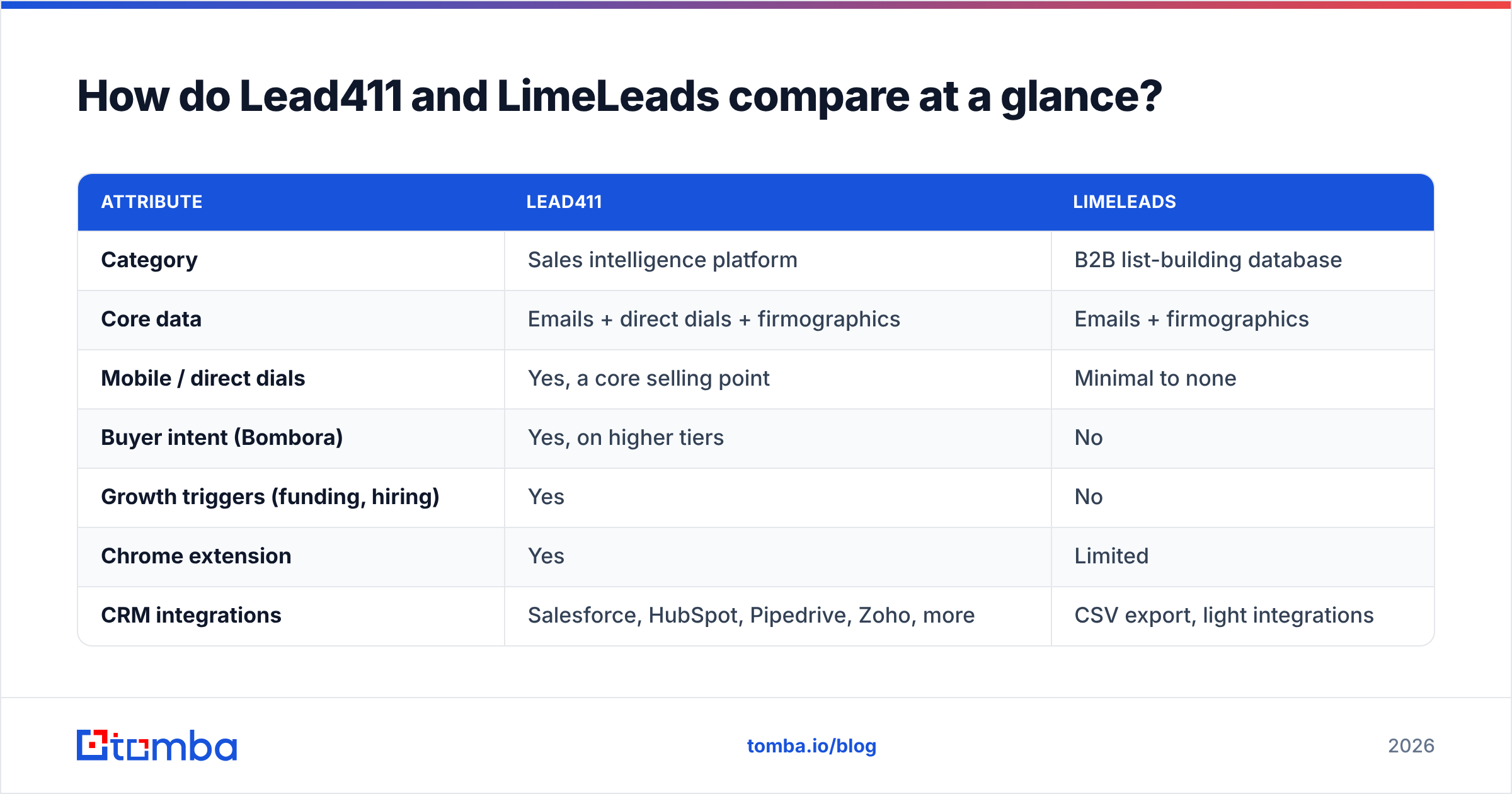
| Attribute | Lead411 | LimeLeads |
|---|---|---|
| Category | Sales intelligence platform | B2B list-building database |
| Core data | Emails + direct dials + firmographics | Emails + firmographics |
| Mobile / direct dials | Yes, a core selling point | Minimal to none |
| Buyer intent (Bombora) | Yes, on higher tiers | No |
| Growth triggers (funding, hiring) | Yes | No |
| Chrome extension | Yes | Limited |
| CRM integrations | Salesforce, HubSpot, Pipedrive, Zoho, more | CSV export, light integrations |
| API access | Yes (enterprise-oriented) | Limited |
| Export limits | Capped per plan, enforced strictly | Credit/export-pack based |
| Typical buyer | SDR team of 3-50 | Solo founder, agency, small team |
| Contract | Usually annual, per seat | Month-to-month friendly |
Read that table as a fork in the road, not a scoreboard. A three-person agency that needs 2,000 contacts a quarter does not benefit from intent topics it will never use. A 20-rep SDR floor lives inside Salesforce. That team will find LimeLeads' CSV-only workflow painful by week two.
Whose data is actually more accurate?#
Accuracy is where vendor marketing gets least reliable. It is also where your money goes. Both companies claim high verification rates. Neither publishes a method you can test yourself.

The Lead411 vs LimeLeads accuracy gap is smaller than either vendor implies. Here is what practitioners keep reporting, and what you should expect in your own test:
- Lead411 does well on mid-market and enterprise contacts in North America, especially in tech, SaaS, finance, and healthcare. Its direct-dial coverage is really above average. That is the line item you are paying for. Coverage thins outside the US and on companies under ~20 employees.
- LimeLeads does fine on SMB and local-business records where the email pattern is easy to guess (
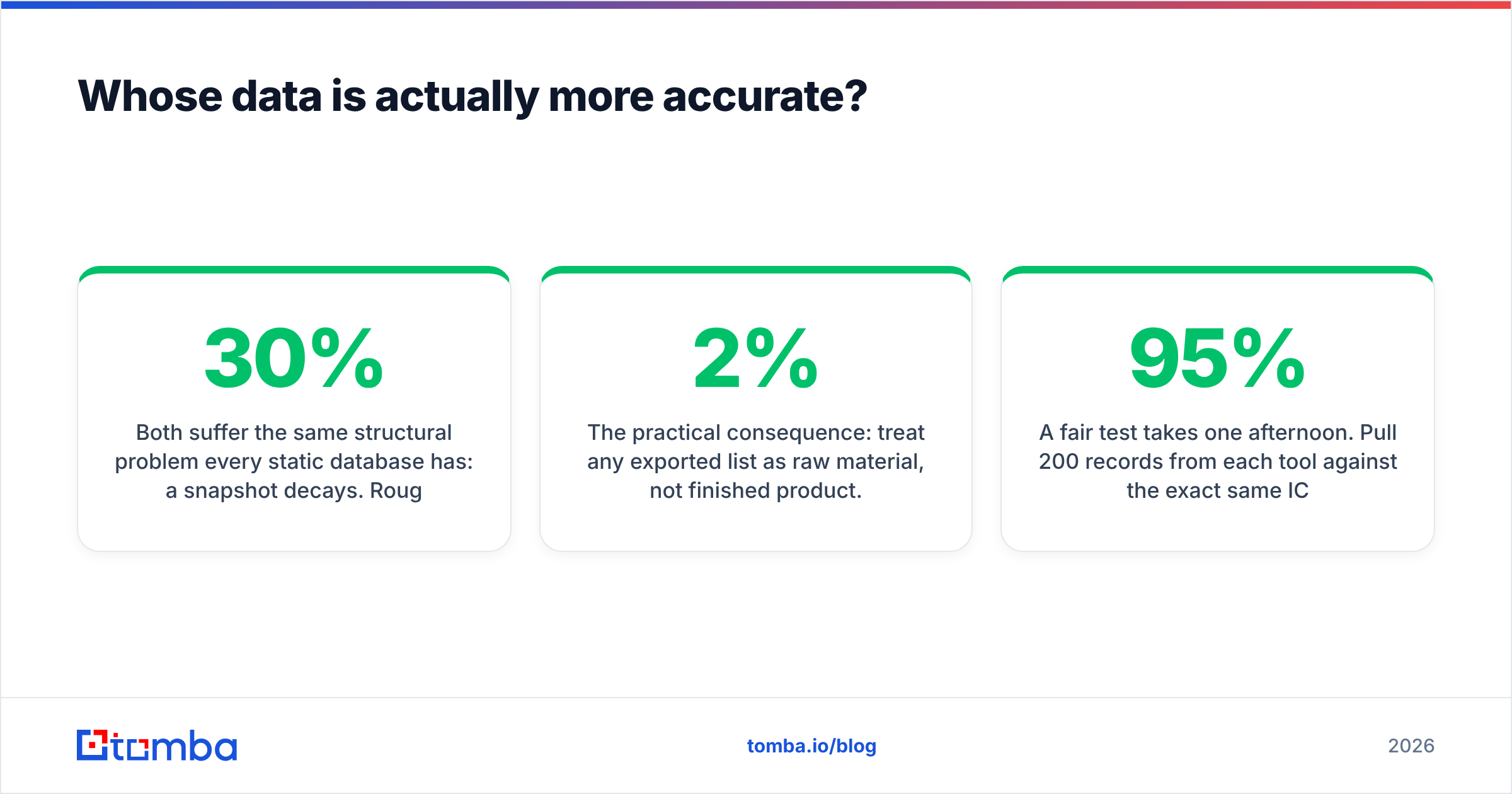
first@,info@,firstlast@). It gets worse on enterprise records and on people who just changed roles. It gets worse again on catch-all domains, where a pattern guess passes a shallow check but bounces on send. - Both share the same core problem every static database has: a snapshot decays. Roughly 25-30% of B2B contact data goes stale each year as people change jobs. A record verified in January is a coin flip by December.
So treat any exported list as raw material, not a finished product. Run it through an independent email verifier before it touches your sending domain. If much of your list sits on catch-all domains, a dedicated catch-all verifier is the difference between a 2% bounce rate and a 12% one. At 12% you are burning sender reputation faster than you are booking meetings.
A fair test takes one afternoon. Pull 200 records from each tool against the same ICP filter. Verify all 400 through a third-party verifier neither vendor owns. Then send a small, warmed batch and measure real bounce rate, not claimed accuracy. The gap between "95% verified" on a pricing page and what lands in the inbox is the only number that matters.
How does the pricing compare?#
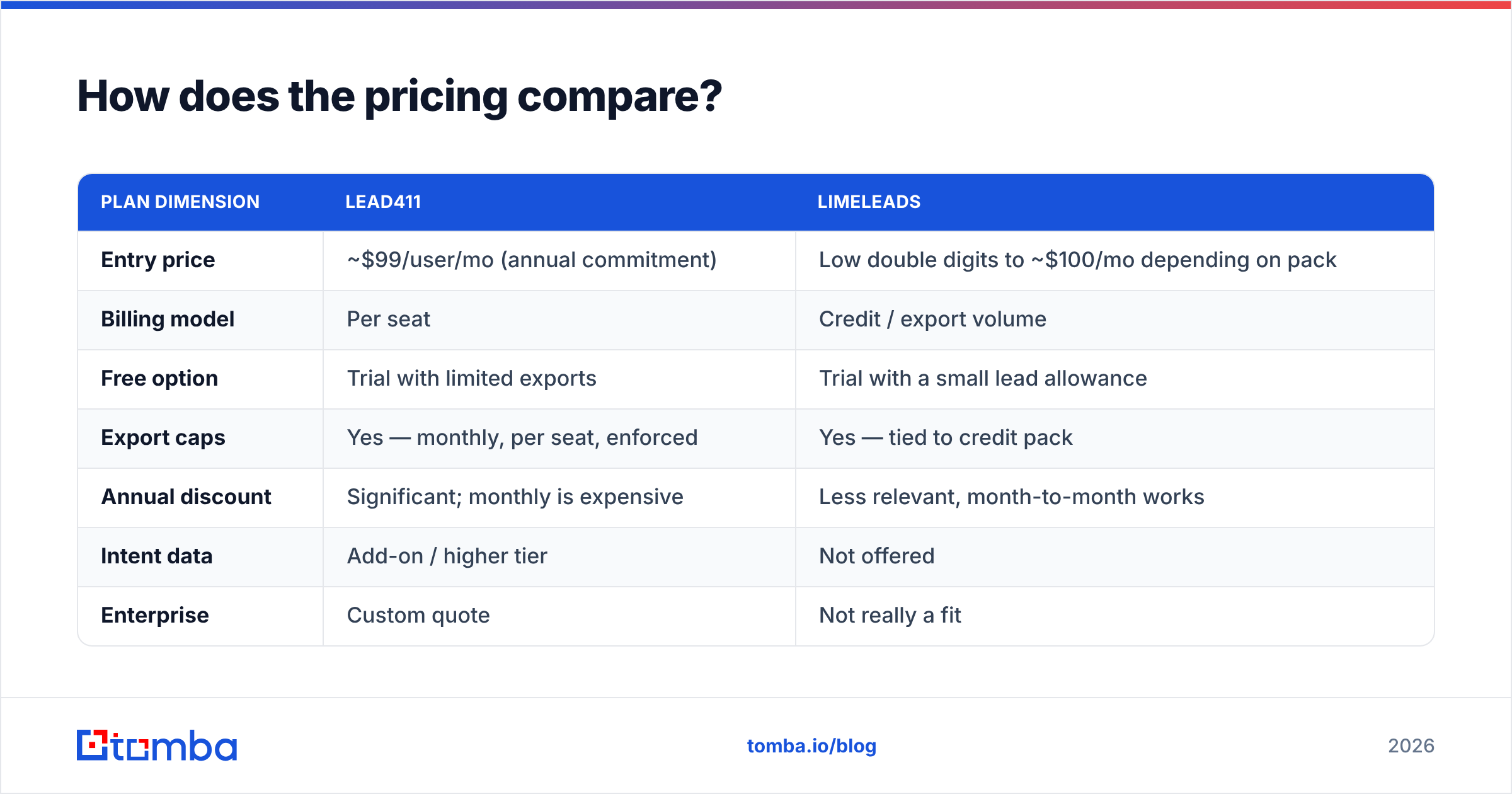
Both vendors move their published pricing. Lead411 in particular quotes case by case, so confirm on the vendor site before you budget. At the time of writing, the shape looks like this:
| Plan dimension | Lead411 | LimeLeads |
|---|---|---|
| Entry price | ~$99/user/mo (annual commitment) | Low double digits to ~$100/mo depending on pack |
| Billing model | Per seat | Credit / export volume |
| Free option | Trial with limited exports | Trial with a small lead allowance |
| Export caps | Yes — monthly, per seat, enforced | Yes — tied to credit pack |
| Annual discount | Significant; monthly is expensive | Less relevant, month-to-month works |
| Intent data | Add-on / higher tier | Not offered |
| Enterprise | Custom quote | Not really a fit |
The per-seat model decides this more often than the headline number. Lead411 at roughly $99 per user per month is easy to justify for one rep who books meetings from it. Multiply by eight reps and you spend close to $9,500 a year on data. That is before a sequencer, a dialer, or a CRM. LimeLeads at a fraction of that, shared across a team, looks very different on a spreadsheet. The trade is simple: you are buying rows, not workflow.
Watch the export caps in both cases. This is the most common source of buyer regret in the category. Teams evaluate on data quality, sign, and then find that the monthly export ceiling throttles a campaign they already scheduled. Ask for the exact cap in writing, and ask what overage costs.
Which one fits your workflow?#
Pick based on how your team actually sells, not on feature count:
- You run intent-led outbound. You want to know which accounts are researching your category this week, then hit them while the window is open. Lead411 wins. Bombora topics and growth triggers are the whole reason to pay platform pricing.
- You cold call as much as you cold email. Direct-dial coverage decides your connect rate. Lead411 wins, and it is not close. If you need numbers at lower cost, a standalone phone finder plus a cheap list source is the budget path.
- You need volume lists for a broad SMB play. Local services, e-commerce, regional B2B. LimeLeads wins on cost per usable record.
The cheaper and more technical cases look like this:
- You are a one-person agency or bootstrapped founder. Annual per-seat contracts are the wrong shape for you. LimeLeads wins, or skip both and use a pay-as-you-go finder API.
- You need programmatic enrichment inside your own product or pipeline. Neither is ideal. A finder/verifier API wins. You want data enrichment you can call from code, not a UI you export from.
- You sell outside North America. Test both hard before committing. Coverage in EMEA, LATAM, and APAC is the weakest spot for both platforms, and no pricing page will tell you that.

Is Lead411 worth the platform price?#
It is worth it under one condition: you will actually use the signals.
Intent data only pays off when a human changes their behavior because of it. That means reordering an account list, changing a first line, or calling instead of emailing. Plenty of teams buy intent, admire the dashboard, and keep working the same alphabetical list. If that is your team, you are paying platform pricing for a contact database. A cheaper source would serve you better.
Where Lead411 earns its keep:
- Trigger-based outreach. A company that just closed a Series B and is hiring six engineers is a different prospect than the same company eight months later. Lead411 surfaces that timing.
- Multichannel SDR motions. Email plus phone plus LinkedIn, with the direct dial as the unlock. The dial data is the strongest part of the product.
- CRM-native teams. The Salesforce and HubSpot pushes are mature enough that reps do not fight CSVs. If you already run a HubSpot integration-style workflow, this matters more than you think.
Where it disappoints: small-team buyers who feel the export cap right away, non-US coverage, and anyone hoping the annual contract will flex. Check recent reviews on G2 before signing. The pattern of complaints there predicts your experience better than any demo.
What are LimeLeads' real limits?#
LimeLeads is honest about what it is, which is refreshing. But know the ceilings before you build a process on it:
- No intent, no triggers. You are working a static snapshot. Timing is on you.
- Thin verification. Records pass basic checks, not deep SMTP-level validation. Assume you need your own verification step.
- Export-and-pray workflow. CSV in, CSV out. If your CRM hygiene is weak, this creates duplicates fast — budget time for a deduplication pass.
- Limited API surface. If you want to enrich records automatically as they enter your CRM, this is not the tool.
- Weaker enterprise coverage. Titles at large organizations churn constantly. A low-cost database is the last place that churn shows up.
None of these are dealbreakers for the buyer LimeLeads targets. They are dealbreakers for the buyer Lead411 targets. That, again, is the real story of this comparison.
What are the alternatives to both?#
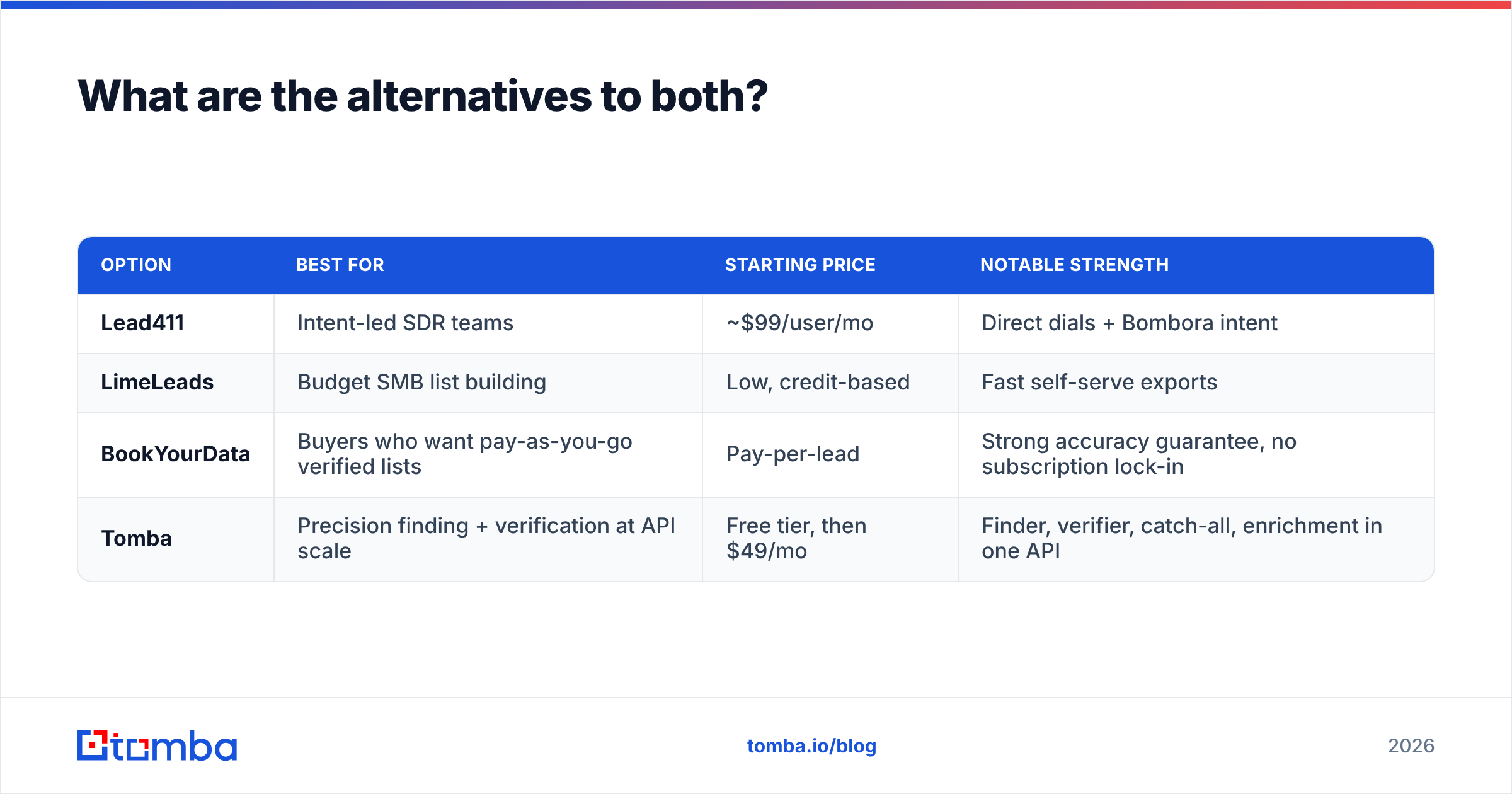
Neither tool has to win. The category is crowded. For many teams the right answer is a different shape: a targeted finder plus a verifier plus an enrichment API, assembled for less than one platform seat.

| Option | Best for | Starting price | Notable strength |
|---|---|---|---|
| Lead411 | Intent-led SDR teams | ~$99/user/mo | Direct dials + Bombora intent |
| LimeLeads | Budget SMB list building | Low, credit-based | Fast self-serve exports |
| BookYourData | Buyers who want pay-as-you-go verified lists | Pay-per-lead | Strong accuracy guarantee, no subscription lock-in |
| Tomba | Precision finding + verification at API scale | Free tier, then $49/mo | Finder, verifier, catch-all, enrichment in one API |
A few honest notes on that table. BookYourData fits well if you want verified contacts without a subscription. Its pay-as-you-go model solves the export-cap problem that frustrates Lead411 buyers, and the accuracy guarantee is more concrete than most. Tomba sits in a different lane. Rather than selling a static list, it finds and verifies addresses on demand. That suits teams building enrichment into their own stack.
Tomba's pricing is public and simple: a free tier with 25 searches per month, Starter at $49/mo, Growth at $99/mo, Pro at $249/mo, and custom Enterprise. Full detail is on the Tomba pricing page. Note that $99/mo on Growth is a team-level spend, not a per-seat one.
How should you test before you buy?#
Run the same steps against both tools. It takes an afternoon and saves an annual contract you regret:
- Define one narrow ICP. Not "SaaS companies" — "Series A-B US SaaS, 50-200 employees, VP Marketing or Head of Demand Gen." Vague filters make every database look equally good.
- Pull 200 records from each. Same filter, same day.
- Verify all 400 externally. Use a verifier neither vendor owns. Record the valid / risky / invalid split per source.
- Check the caps. Note how much of your monthly export allowance those 200 records consumed. Extrapolate to your real campaign volume.
- Send a warmed test batch. 50 contacts per source, identical copy. Measure bounce rate and reply rate separately. A low bounce rate with zero replies means the data is clean but the targeting is wrong.
- Price the year, not the month. Seats × months × expected overage. Compare that total against a finder-plus-verifier stack doing the same job.
Most teams that run this test find the same thing. The expensive platform wins on dials and signals. The cheap database wins on cost per row. Neither wins on verification, which is the step that actually protects deliverability.
The verdict: Lead411 vs LimeLeads#
Buy Lead411 if you run a multichannel SDR motion, you will act on intent and trigger data, and direct dials change your connect rate. It is a real platform. The per-seat price holds up when reps use it daily.
Buy LimeLeads if you need targeted B2B lists cheaply, you are fine with a CSV workflow, and you will own verification yourself. It does one job at a fair price and does not pretend otherwise.
Skip both if what you need is precision: specific people at specific companies, verified before send, available through an API you can wire into your own pipeline.
That last case is where Tomba fits. Use the Tomba Email Finder to find professional email addresses by domain, name, or company. Then verify them in the same workflow, before a single message leaves your domain. Start on the free tier with 25 searches a month. Test it against whatever list you exported from Lead411 or LimeLeads, and let the bounce rate decide. That is a cheaper experiment than an annual seat, and a more honest one than any vendor benchmark.
Related guides#
// get started
Find, verify and enrich your first contacts today
Start on the free plan with 25 searches a month, then scale when your team is ready.
Free plan · No credit card required · GDPR & CCPA
// about the author