Lead411 vs Lusha 2026: Which B2B Data Tool Wins?
Lead411 sells intent-backed growth signals and unlimited-view pricing. Lusha sells fast, clean contacts inside LinkedIn. We compare pricing, data accuracy, compliance, and which one actually fits your outbound motion.
Lead411 vs Lusha comes down to one question: do you buy timing, or do you buy speed? Lead411 tells you when a company is ready to talk. Lusha gets you a phone number in two clicks. Here is how the two compare on price, data quality, intent, and privacy rules.
TL;DR
- Lead411 wins on intent. It flags funding rounds, hiring spikes, and new tech installs. Its main plan also allows unlimited email views.
- Lusha wins on speed. Its Chrome extension turns a LinkedIn profile into a phone number in seconds. The free tier suits a solo rep.
- Neither is cheap. Lead411 starts near $99 per user each month. Lusha starts near $36, but it caps credits hard.
- Accuracy depends on your market. Lusha is stronger on US and European mobiles. Lead411 is stronger on US small-business email.
- Need email only? Both are overkill. A dedicated email finder costs far less and scores every address.
Lead411 vs Lusha: what does each tool do?#
They solve the same problem from opposite ends.
Lead411 is a B2B sales database built around growth signals. Its pitch is simple. A contact record is only half the value. The other half is timing. You learn that a company just raised a Series B, opened twelve sales roles, or added a new CRM. You search by that trigger first, then pull the contacts attached to it.
Lusha is a contact layer that sits where reps already work: LinkedIn, Sales Navigator, and company sites. You open a profile, click the extension, and get a work email and a mobile. It is the fastest single lookup in the category. You pay per user, with a cap on credits.
The practical split: Lead411 wants to be your list-building system. Lusha wants to be the button you press 40 times a day.

Lead411 vs Lusha pricing: what do you pay?#
Price is where the two split hardest. Both stay vague on their public pages. The figures below are list prices as of early 2026. Confirm them on a call, since both discount on annual deals.
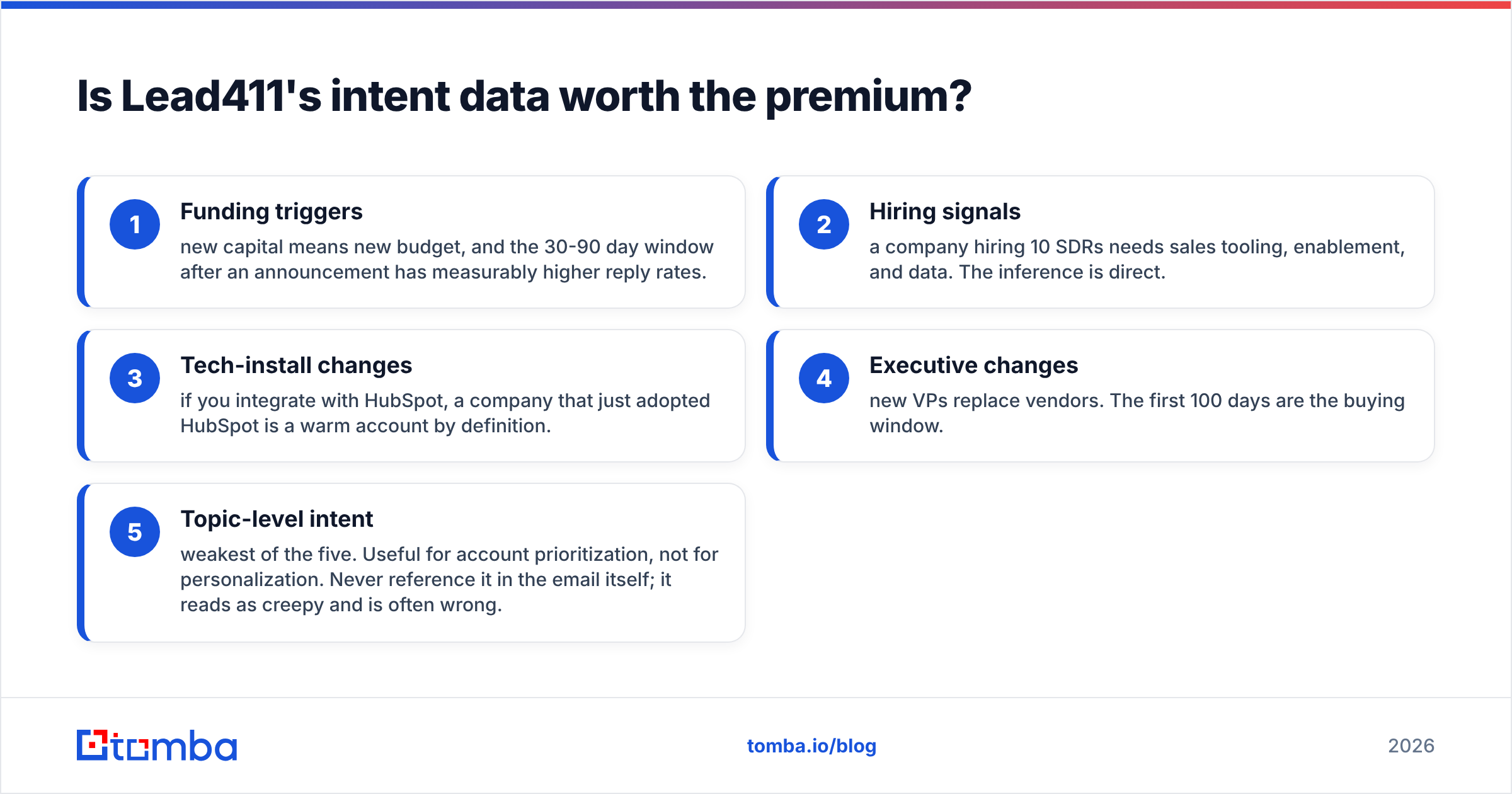
| Attribute | Lead411 | Lusha |
|---|---|---|
| Free tier | 14-day trial, ~50 credits | Yes — 5 credits/mo, no card |
| Entry paid plan | ~$99/user/mo (annual) | ~$36-49/user/mo (annual) |
| Contact views | Unlimited email views on Basic Plus | Hard credit caps per tier |
| Mobile numbers | Add-on / limited pool | Core selling point, included |
| Intent data | Bombora-powered, included on higher tiers | Job-change + basic intent signals |
| CRM sync | Salesforce, HubSpot, Pipedrive | Salesforce, HubSpot, Outreach, Salesloft |
| API access | Yes, paid add-on | Yes, higher tiers only |
| Bulk enrichment | Yes, list upload | Yes, credit-consuming |
| Annual lock-in | Common for best rate | Common for best rate |
Two things matter more than the headline price.
First, credits are not the same unit. Lusha burns a credit each time you reveal a contact. A reveal that returns only an email still costs you one. Lead411's "unlimited" email views come with a fair-use export cap. That cap is often a few thousand records a month. Read the contract, not the pricing page.
Second, per-seat pricing punishes teams. Six reps on Lusha at $49 is about $3,500 a year, before mobile add-ons. If those reps work the same accounts, you pay six times for the same data. Lead411 handles shared territories a little better. Not by much.
For a floor price, Tomba pricing runs Free (25 searches a month), Starter $49, Growth $99, and Pro $249. Those are account plans, not seats. The product scope is narrower, but the gap is worth knowing.
Which one has better data accuracy?#
Honest answer: it depends on your market. Both oversell it.
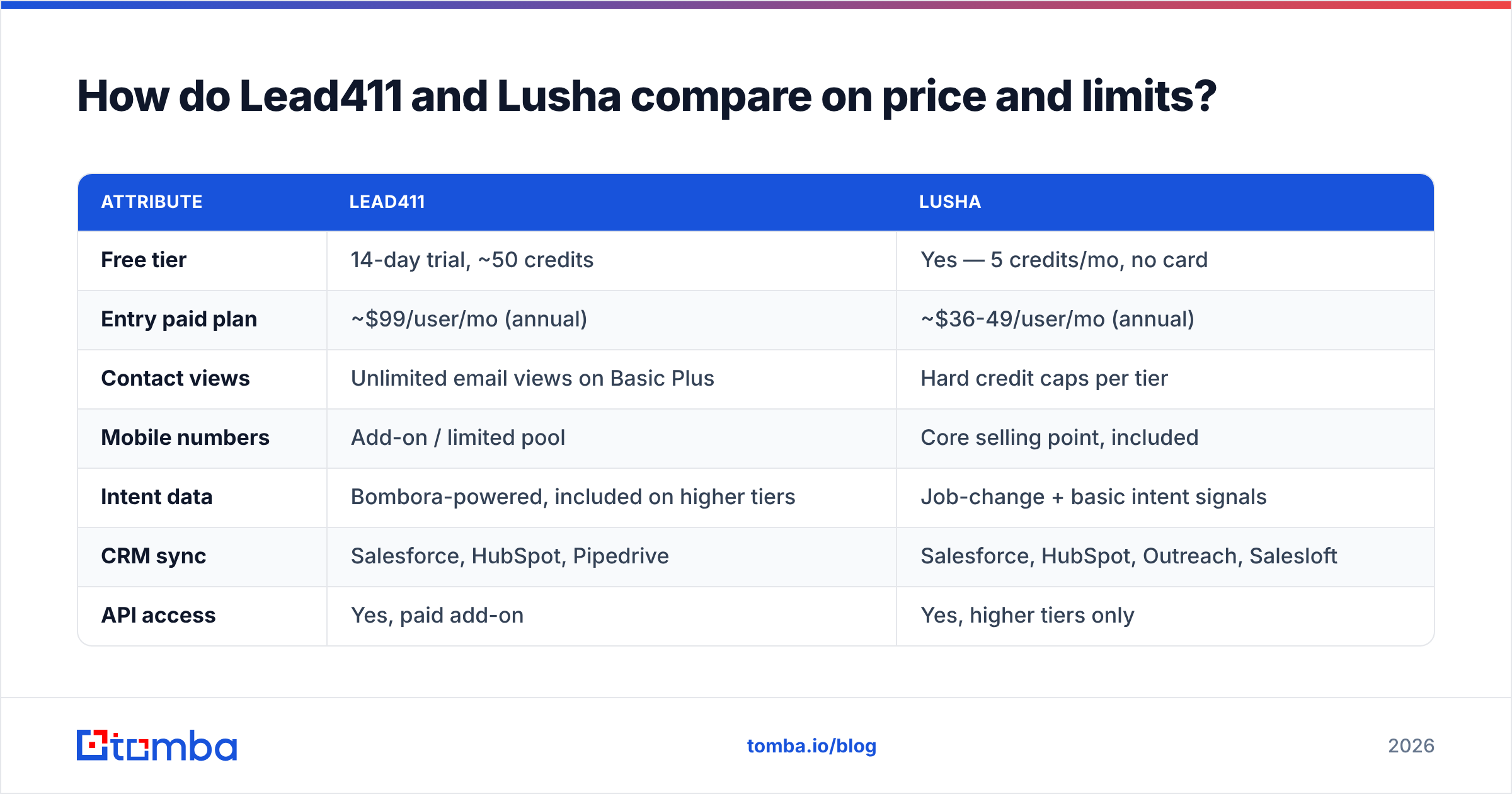
Vendors in this category claim 90% to 98% accuracy. Those tests are run by the vendor, on samples the vendor picked. Treat them as marketing.
In a Lead411 vs Lusha accuracy test, the winner changes with your market. Here is what holds up in outside testing and G2 review patterns:
- Lusha's mobile numbers are its best asset. Coverage is strongest in North America and Western Europe, at firms above 200 staff. Reps report connect rates that pay for the seat.
- Lead411's verified emails hold up for US small and mid-market firms. It checks each address three times. Its database is smaller but cleaner than rivals that pad the count.
- Both drop off sharply below 50 staff, across APAC, and outside English. Expect 40-60% coverage, not 90%.
- Stale data is the quiet killer. B2B contacts decay 25-30% a year through job changes alone. A weekly refresh beats a quarterly one. Neither vendor will show you its refresh schedule.
The fix is the same either way: check the list before you send it. Run every export through an email verifier first. A 4% bounce rate hurts your sender reputation more than the extra contacts help.
Is Lead411's intent data worth the premium?#
Yes, but only if it changes what your reps do. Most teams never act on it.
Lead411 mixes Bombora intent topics with its own growth triggers. The triggers cover funding, hiring spikes, exec changes, and new tech. They are the stronger half. "This company posted 14 sales jobs last month" is a fact. "This company is researching CRM topics" is a guess drawn from cookie data. Its accuracy swings a lot by category.
Where it pays off:
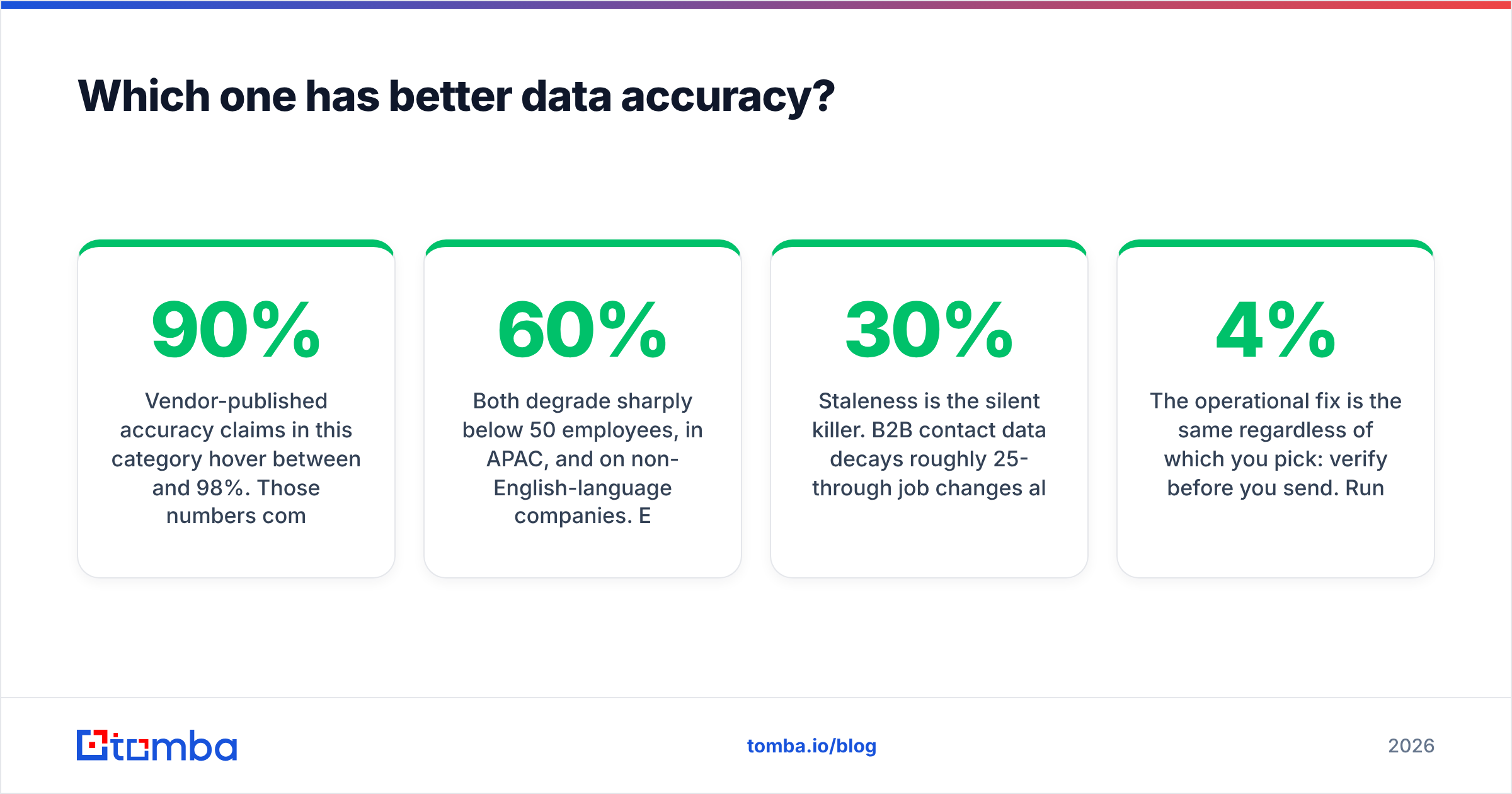
- Funding — new money means new budget. The 30-90 days after an announcement get higher reply rates.
- Hiring — a firm hiring 10 reps needs tools, training, and data. The link is direct.
- New tech installs — if you plug into HubSpot, a new HubSpot user is a warm account.
- Exec changes — new VPs swap vendors. The first 100 days are the window.
- Topic intent — the weakest of the five. Use it to rank accounts, not to write the email. It reads as creepy, and it is often wrong.
Lusha's signals are narrower. You get job changes on tracked contacts, plus basic buying flags on higher tiers. If you sell to the person, that is enough. If you sell to the moment, Lead411 is worth the extra cost.
How do they handle privacy rules?#
Both claim GDPR and CCPA alignment. The details differ.
Lusha treats privacy as a selling point. It holds ISO 27701 certification and runs an opt-out flow. It has also drawn scrutiny over where its contacts come from, as most rivals have. Lead411 says its data comes from public sources plus its own checks, not from a contributory network. That is a cleaner story on paper. "Public sources" still does a lot of work in that sentence.
If you sell into the EU or UK:
- Legitimate interest is your basis, and it is narrow. Email to a relevant role at a work address is usually fine. Mobile numbers are not.
- Sign a DPA with the vendor you pick. Keep your export logs.
- Honor opt-outs everywhere, not just in your sequencer. A suppression list stuck in one tool is a risk.
- Mobile dialing in Germany and France is tightly limited. Lusha's best feature is also its biggest exposure there.
Neither vendor carries your risk. You become the data controller the moment you import a list.
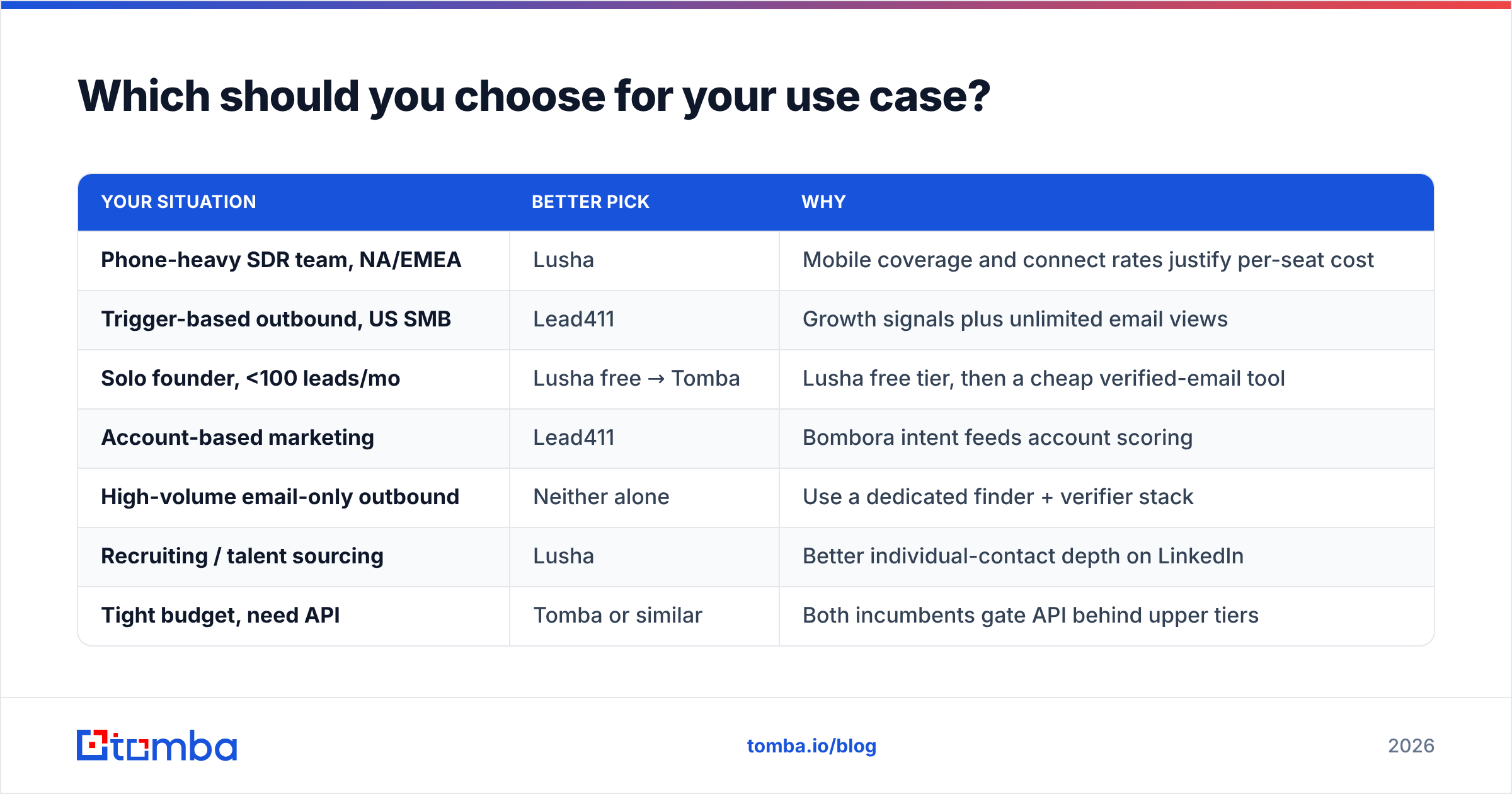
Which should you choose for your use case?#
| Your situation | Better pick | Why |
|---|---|---|
| Phone-heavy SDR team, NA/EMEA | Lusha | Mobile coverage and connect rates justify per-seat cost |
| Trigger-based outbound, US SMB | Lead411 | Growth signals plus unlimited email views |
| Solo founder, <100 leads/mo | Lusha free → Tomba | Lusha free tier, then a cheap verified-email tool |
| Account-based marketing | Lead411 | Bombora intent feeds account scoring |
| High-volume email-only outbound | Neither alone | Use a dedicated finder + verifier stack |
| Recruiting / talent sourcing | Lusha | Better individual-contact depth on LinkedIn |
| Tight budget, need API | Tomba or similar | Both incumbents gate API behind upper tiers |

What else should you look at?#
The Lead411 vs Lusha choice assumes you need a full sales suite. Often you need one feature.
For verified email at volume, a focused finder wins on cost per usable record. Tomba's domain search returns every address it can find at a company, with a confidence score and a source. The bulk email finder handles big lists without per-seat fees.
For mobile numbers, Lusha is hard to beat at its price. The real rivals to compare are Cognism and ContactOut, not Lead411.
For one big all-in-one database, look at Apollo and ZoomInfo. They sit a tier above, and the price shows it. Apollo's free tier is broad enough that many teams stay on it. See Apollo alternatives if you have outgrown it.
For contacts without a subscription, BookYourData sells lists pay-as-you-go with a verification guarantee. You own the credits instead of renting a seat. For one quarter-long campaign, that often costs less than an annual deal.
For LinkedIn work only, the LinkedIn finder covers the same profile-to-email path as Lusha's extension.
What is the verdict?#
Pick Lead411 if company events drive your outbound and you send mostly email. Unlimited email views on Basic Plus help. So does the growth-signal layer. Its email quality in US small business is a real strength.
Pick Lusha if your reps live in LinkedIn and pick up the phone. Nothing here is faster to a mobile number. The free tier lets you test coverage on your own list before you pay. The CRM links are cleaner too.
Pick neither if your gap is verified email volume, not research. Both tools charge for research you may never use. A finder plus a verifier costs less and builds cleaner lists. You can add intent data later.
Either way, run a 100-contact test before you sign an annual deal. Export the same 100 target accounts from each trial. Verify the results yourself. Then count the usable records. Vendor accuracy claims fall apart under a real sample. Thirty minutes of testing beats every review page you can read.
Ready to test your own coverage? Start with the Tomba Email Finder. You get 25 free searches a month, a confidence score on every result, and no per-seat fee. Run your target list through it next to any Lead411 or Lusha trial. Compare usable records side by side. That is the only benchmark your pipeline cares about.
Related guides#
// get started
Find, verify and enrich your first contacts today
Start on the free plan with 25 searches a month, then scale when your team is ready.
Free plan · No credit card required · GDPR & CCPA
// about the author