Lead411 vs Vainu: Which B2B Data Platform Wins in 2026?
Lead411 sells verified US contacts with intent data. Vainu sells European company signals and firmographics. They solve different problems — here's which one your pipeline actually needs.
TL;DR
- Lead411 is a US-first contact database. Verified emails, direct dials, growth-intent triggers, and unlimited-view pricing on most plans. Strongest for SDR teams selling into North America.
- Vainu is a European company-intelligence platform. Deep Nordic and Benelux company records, financial filings, and real-time company signals — but it is not a contact-email tool in the way Lead411 is.
- They are not true substitutes. Lead411 answers "who do I email?" Vainu answers "which company is worth approaching right now?"
- Pricing differs structurally. Lead411 publishes per-seat plans starting around $99/user/month annually; Vainu quotes platform pricing and generally lands higher for multi-seat teams.
- Most teams need a third layer: an email-finding and verification engine that works across any domain, in any region, at API scale. That's where a tool like Tomba fits alongside either platform.
What Problem Does Each Tool Actually Solve?#
Start here, because the naming convention "Lead411 vs Vainu" implies a head-to-head that only half exists.
Lead411 is a contact-data provider. You search by title, industry, location, technology, or revenue band and get back people — with work emails, mobile numbers, and LinkedIn URLs. Layered on top is Bombora-sourced intent data and a "growth intent" feed built from hiring signals, funding events, and executive changes. The output is a list you push to your CRM and start sequencing.
Vainu is a company-data platform. Its core asset is a company database built primarily from official registries, financial statements, websites, and news sources across Finland, Sweden, Norway, Denmark, and the Netherlands, with broader international coverage that thins out fast outside those markets. The output is a filtered account list and a stream of company events — a new office, a leadership change, a filed annual report — that trigger workflows inside HubSpot, Salesforce, or Pipedrive.
So the honest framing is: Vainu tells you which accounts to work. Lead411 tells you who to contact inside them. A team selling to Finnish manufacturers might genuinely need both. A US SaaS team selling to American mid-market almost certainly needs only one of them — Lead411 — plus a way to fill contact gaps.

How Do Lead411 and Vainu Compare Feature by Feature?#
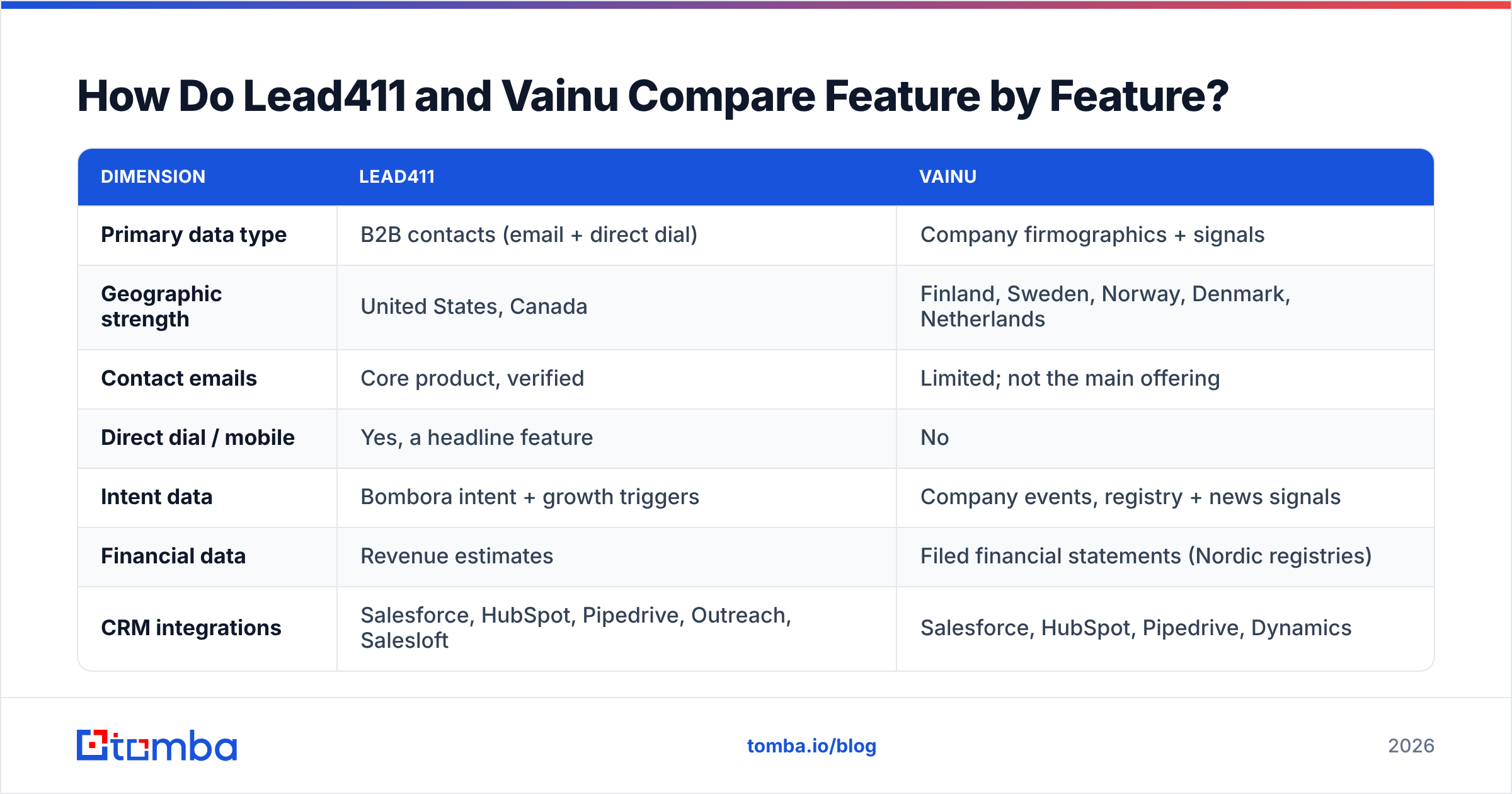
| Dimension | Lead411 | Vainu |
|---|---|---|
| Primary data type | B2B contacts (email + direct dial) | Company firmographics + signals |
| Geographic strength | United States, Canada | Finland, Sweden, Norway, Denmark, Netherlands |
| Contact emails | Core product, verified | Limited; not the main offering |
| Direct dial / mobile | Yes, a headline feature | No |
| Intent data | Bombora intent + growth triggers | Company events, registry + news signals |
| Financial data | Revenue estimates | Filed financial statements (Nordic registries) |
| CRM integrations | Salesforce, HubSpot, Pipedrive, Outreach, Salesloft | Salesforce, HubSpot, Pipedrive, Dynamics |
| API access | Yes, paid add-on | Yes, included on higher tiers |
| Entry pricing | ~$99/user/mo (annual) | Custom quote, typically 4-figure annual |
| Free option | Free trial, limited | Demo + limited free company search |
| Best-fit buyer | US SDR / outbound team | EU account-based marketing / RevOps |
Two things stand out in that table.
First, the overlap is narrow. Only "CRM integrations," "API access," and "intent-ish signals" genuinely overlap. Everything else is a different product category wearing a similar label.
Second, pricing transparency differs sharply. Lead411 publishes numbers. Vainu runs a quote-based motion, which usually means the deal size scales with seats and data volume. If you're a three-person team, expect Vainu to feel expensive relative to Lead411 for the same headcount.
Which One Has Better Data Accuracy?#
This is where most comparison posts hand-wave. Let's be concrete about what "accuracy" means for each.
For Lead411, accuracy means: does this email address land, and does this phone number reach the right person? Lead411 markets a triple-verification process and publishes deliverability claims in the mid-90s. Independent G2 reviews are more mixed — users consistently praise the direct dials, and consistently report that email bounce rates on older records run higher than the marketing number. That pattern is normal for every contact database, not a Lead411-specific flaw. Contact data decays somewhere between 20% and 30% per year because people change jobs.
For Vainu, accuracy means something different: is this company record current, and did this signal actually happen? Because Vainu pulls heavily from official business registries and filed financial statements in the Nordics, its firmographic accuracy in those markets is genuinely strong — arguably stronger than any US-centric provider operating in the same geography. The tradeoff is that registry-grade depth doesn't exist in most countries, so Vainu's coverage quality drops sharply once you leave its home markets.
The practical implication: you cannot evaluate these two tools with the same test. Run a Lead411 trial by exporting 200 contacts and bounce-testing them. Run a Vainu trial by pulling 200 target accounts and checking whether the firmographics match reality.
Whichever you pick, run exports through an independent email verifier before you load them into a sequencer. Vendor-reported validity and your actual inbox placement are two different numbers, and your sender reputation only cares about the second one.
How Does Pricing Compare in Practice?#
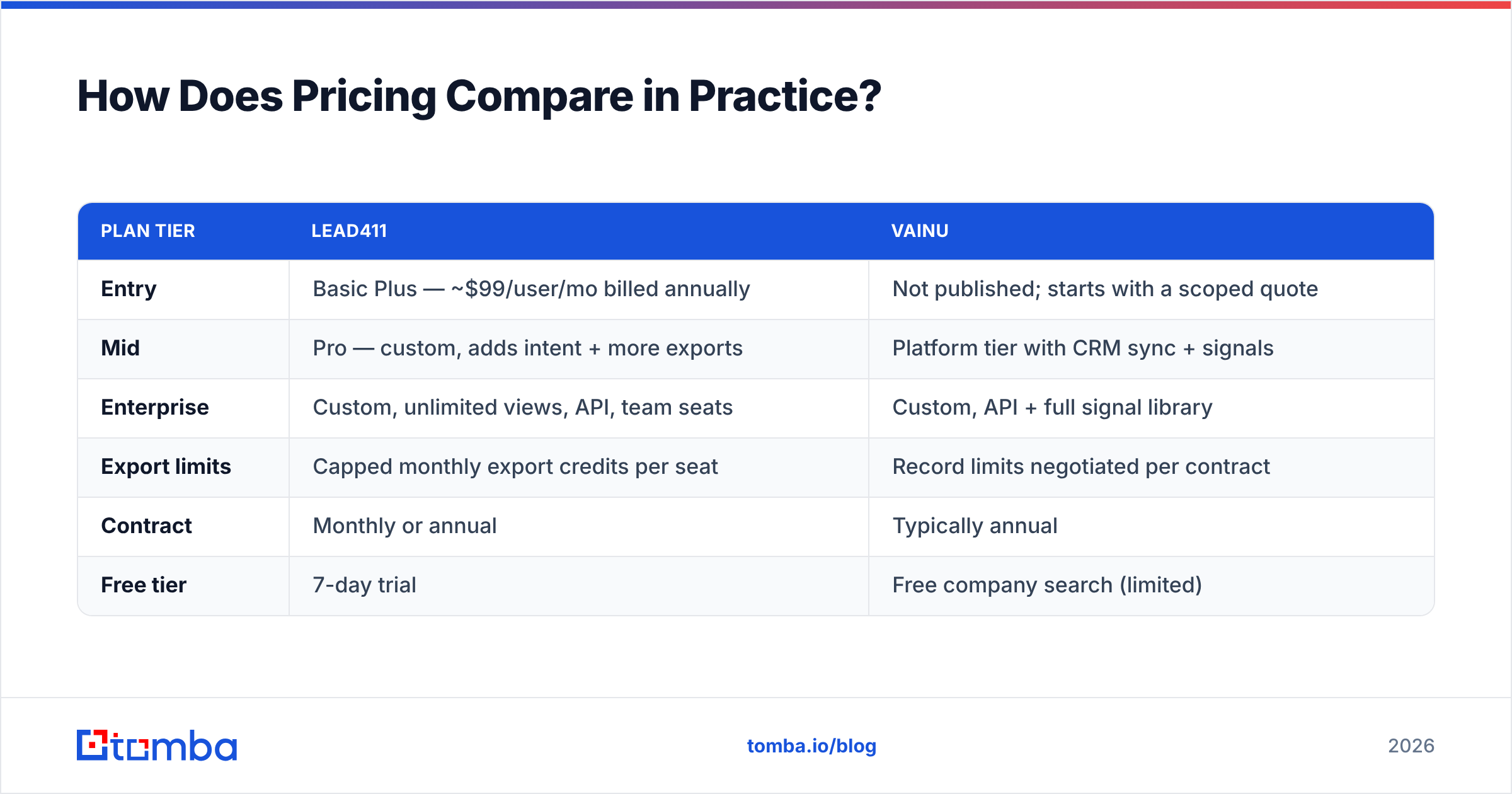
| Plan tier | Lead411 | Vainu |
|---|---|---|
| Entry | Basic Plus — ~$99/user/mo billed annually | Not published; starts with a scoped quote |
| Mid | Pro — custom, adds intent + more exports | Platform tier with CRM sync + signals |
| Enterprise | Custom, unlimited views, API, team seats | Custom, API + full signal library |
| Export limits | Capped monthly export credits per seat | Record limits negotiated per contract |
| Contract | Monthly or annual | Typically annual |
| Free tier | 7-day trial | Free company search (limited) |
The structural difference matters more than the headline number. Lead411 charges per seat with export caps — so cost scales with how many reps you have. Vainu charges for platform access and data scope — so cost scales with how much of the database you want and how deeply it syncs into your CRM.
If you have 10 SDRs who each need 500 contacts a month, Lead411's model is predictable and you can forecast it. If you have two RevOps people who need to enrich 40,000 account records once a quarter, Vainu's model fits better and Lead411's per-seat export caps become an annoying ceiling.
Compare both against the Tomba pricing structure, which is credit-based rather than seat-based: Free (25 searches/month), Starter $49/mo, Growth $99/mo, Pro $249/mo. Credit-based pricing removes the "who owns the seat" problem entirely — useful when engineering, marketing, and sales all need the same lookups.
Is Vainu Better Than Lead411 for European Outbound?#
For account selection in the Nordics and Benelux: yes, clearly. Nothing in Lead411's US-centric index competes with registry-sourced Finnish or Swedish company data.
For actually reaching people at those companies: no. Vainu will tell you that a Swedish logistics firm just filed a 30% revenue increase and opened a new site. It will not reliably hand you the operations director's work email and mobile number. That gap is real, and it's the single most common complaint from Vainu users trying to run a full outbound motion on one platform.
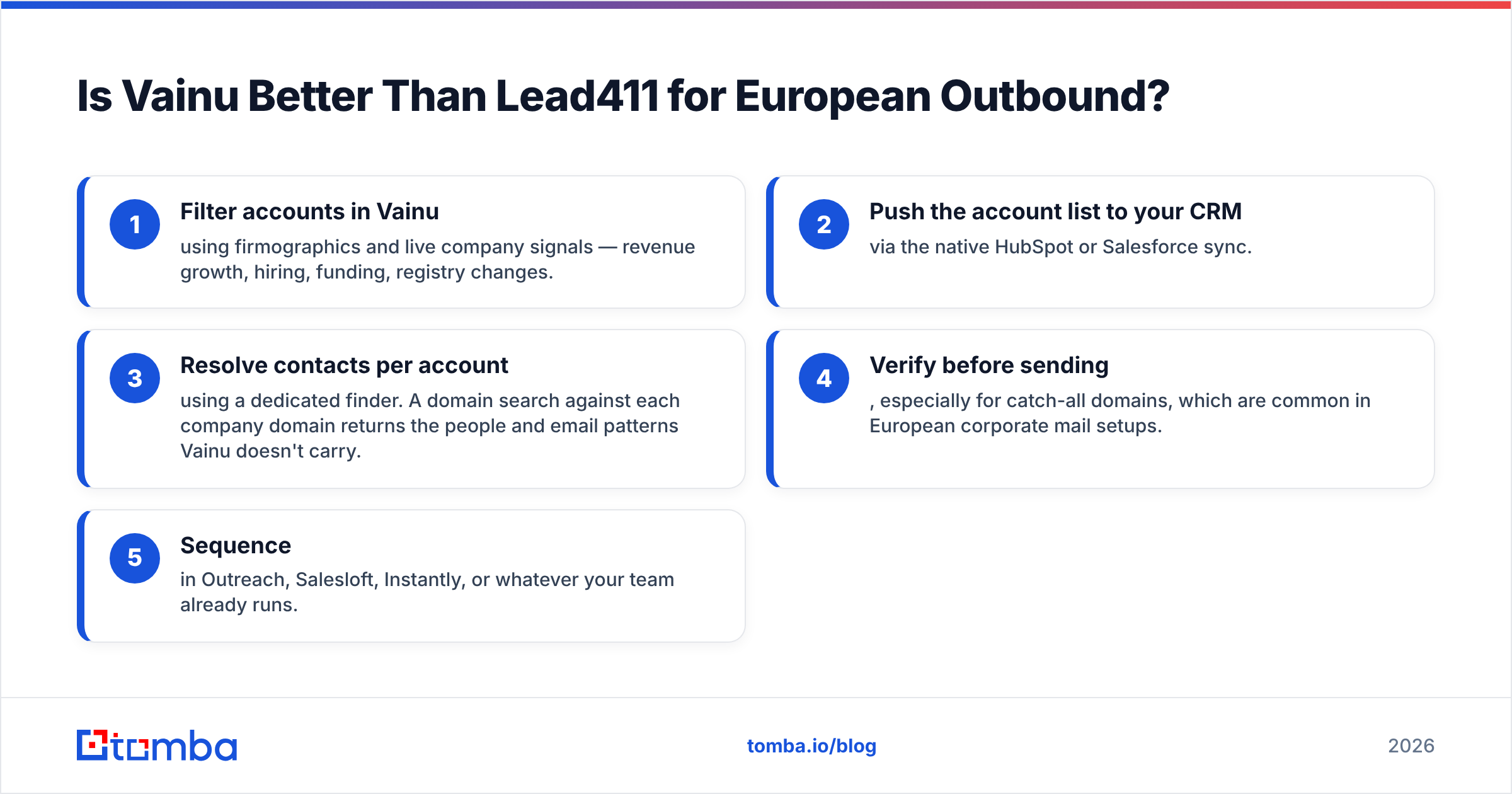
The workflow that actually works looks like this:
- Filter accounts in Vainu using firmographics and live company signals — revenue growth, hiring, funding, registry changes.
- Push the account list to your CRM via the native HubSpot or Salesforce sync.
- Resolve contacts per account using a dedicated finder. A domain search against each company domain returns the people and email patterns Vainu doesn't carry.
- Verify before sending, especially for catch-all domains, which are common in European corporate mail setups.
- Sequence in Outreach, Salesloft, Instantly, or whatever your team already runs.
Lead411 collapses steps 1 and 3 for the US market, which is exactly why it feels simpler to American teams — and exactly why it frustrates European ones.

What Are the Real Weaknesses of Each Platform?#
Lead411's weak points:
- Coverage outside North America thins fast. EMEA and APAC records exist but are noticeably shallower.
- Export credits are the real constraint, not search volume. "Unlimited views" reads well in marketing and matters less than the number you can actually download.
- The UI is functional, not modern. Reviewers describe it as dated relative to newer platforms.
- Intent data is licensed, not proprietary. Bombora intent is available through many vendors, so it's not a defensible differentiator.
Vainu's weak points:
- Contact-level data is the gap. You will need a second tool for emails and phones.
- Pricing opacity slows evaluation. No published tiers means a sales cycle before you know if it's affordable.
- Coverage cliff outside core markets. Great in Helsinki and Amsterdam, thin in Lisbon or Warsaw.
- Signal noise requires tuning. Out of the box, the event feed surfaces more than most teams can act on; someone has to own filter configuration.
Neither of these is disqualifying. They're the predictable consequences of each vendor's data strategy — registry depth versus contact breadth.
How Do They Compare to Other Alternatives?#
If you've landed on this comparison, you're probably also evaluating a wider set. Here's the honest positioning:
- Apollo.io — the volume play. Huge contact database, built-in sequencing, aggressive pricing. Accuracy is inconsistent at the edges. See Apollo alternatives for a breakdown.
- BookYourData — strong for pre-verified, pay-as-you-go B2B lists with a bounce guarantee. Good option when you want data without a subscription commitment.
- ZoomInfo — the enterprise standard. Best-in-class US coverage, contract minimums that price out small teams.
- Cognism — the closest thing to a European ZoomInfo, with GDPR-conscious sourcing and strong DNC-checked mobile data.
- Clearbit / Breeze Intelligence — enrichment-first, now inside HubSpot's ecosystem. See Clearbit alternatives.
- Tomba — email finding, verification, and enrichment via UI, API, CLI, and spreadsheet add-ins. Narrower scope than the platforms above, and priced accordingly.
The pattern worth noticing: platforms that try to do account selection and contact resolution and sequencing tend to be mediocre at one of the three. Buying a focused tool for each layer often costs less and performs better than one suite that claims all three.
Which Should You Choose?#
Use this decision frame rather than a scorecard:
- You sell to US companies and need emails plus phone numbers today. Choose Lead411. It's built for exactly this, and the direct dials are its strongest asset.
- You sell to Nordic or Dutch companies and need to prioritize accounts by real signals. Choose Vainu. Registry-grade company data is a genuine moat in those markets.
- You sell across both regions. Use Vainu (or your CRM's own account scoring) for targeting, and a region-agnostic finder for contacts. One platform will not cover you.
- You're a developer or RevOps engineer building enrichment into a pipeline. Neither platform's API is the cheapest route. Credit-based email APIs are.
- You're early-stage and budget-constrained. Skip both for now. Start with a bulk email finder and a verified list, prove the motion converts, then buy a platform when the account-selection problem is real.
One caution regardless of which you pick: do not let the platform's built-in verification be your only quality gate. Every provider grades its own homework. Run a final catch-all verifier pass on European domains in particular, where catch-all configurations are widespread and a "valid" flag from a source database means less than it does in the US.
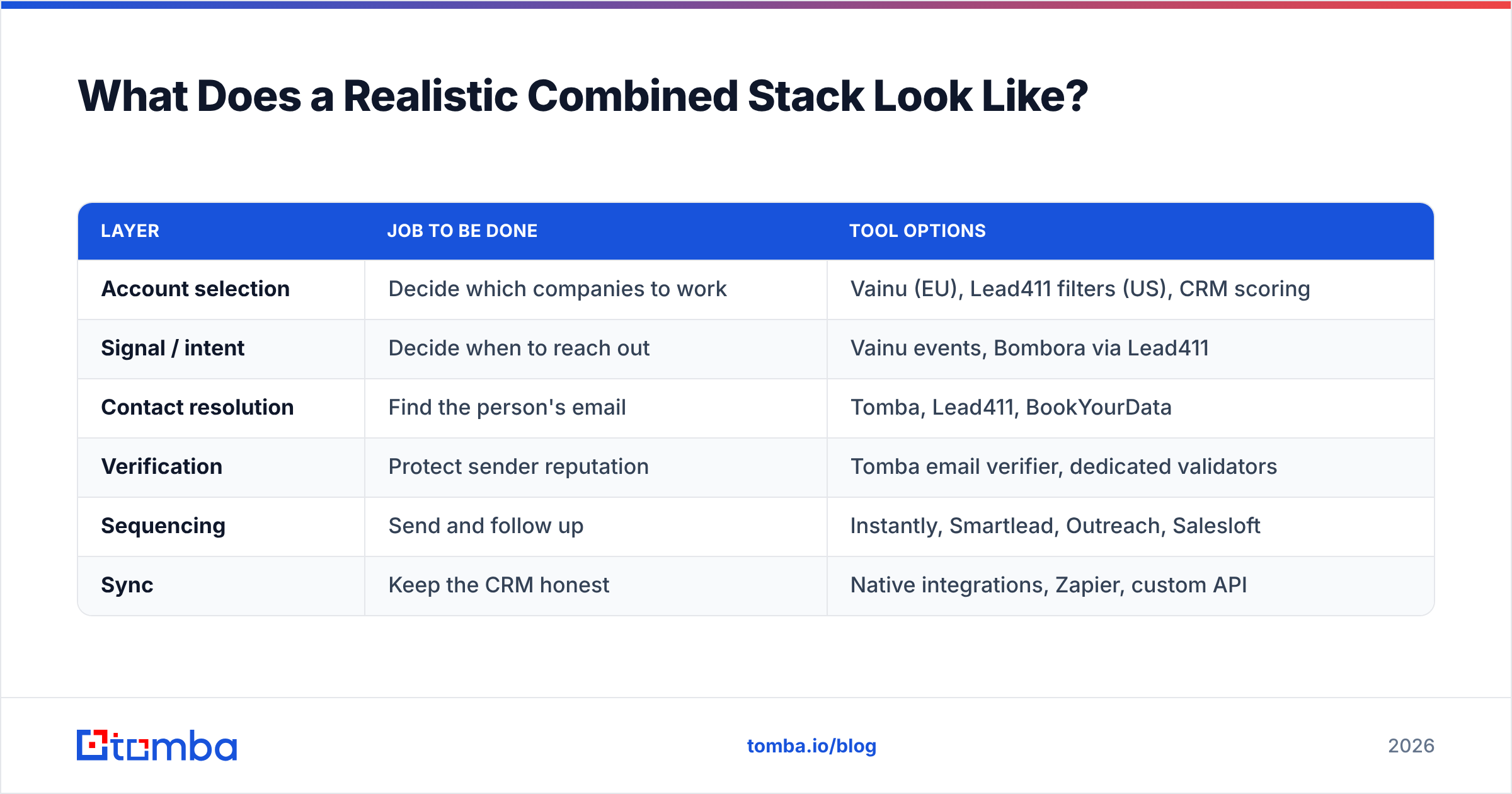
What Does a Realistic Combined Stack Look Like?#
| Layer | Job to be done | Tool options |
|---|---|---|
| Account selection | Decide which companies to work | Vainu (EU), Lead411 filters (US), CRM scoring |
| Signal / intent | Decide when to reach out | Vainu events, Bombora via Lead411 |
| Contact resolution | Find the person's email | Tomba, Lead411, BookYourData |
| Verification | Protect sender reputation | Tomba email verifier, dedicated validators |
| Sequencing | Send and follow up | Instantly, Smartlead, Outreach, Salesloft |
| Sync | Keep the CRM honest | Native integrations, Zapier, custom API |
Most teams over-invest in the first two rows and under-invest in rows three and four. That's backwards. A perfectly targeted account list sent to a 22%-bounce email list will damage your sender reputation faster than a mediocre account list sent to clean data will ever earn you.
Final Verdict#
Lead411 wins for US outbound teams that need contacts and dials in one place. Vainu wins for European teams whose hardest problem is deciding which accounts deserve attention. Neither wins the other's category, and any content that declares an overall winner is comparing tools that were never competing.
The real decision isn't Lead411 vs Vainu. It's: what's the bottleneck in my pipeline right now? If it's "I don't know who to call," buy targeting. If it's "I have a list but half the emails bounce," buy contact data and verification — and buy it separately, because bundled verification is almost always the weakest module in any suite.
If your gap is contact resolution — you already know your target accounts and just need accurate, deliverable email addresses across any domain, US or European — start with the Tomba Email Finder. It's free for 25 searches a month, $49/mo on Starter, works through the web app, Chrome extension, Google Sheets, or API, and pairs cleanly with whichever targeting platform you end up choosing. Find the contacts, verify them, then let Lead411 or Vainu do the job it's actually good at.
Related guides#
// get started
Find, verify and enrich your first contacts today
Start on the free plan with 25 searches a month, then scale when your team is ready.
Free plan · No credit card required · GDPR & CCPA
// about the author