LeadEngineAI vs Sendflock: Which B2B Tool Wins in 2026?
One finds and scores leads. The other sends to them. Here is an honest breakdown of where LeadEngineAI and Sendflock actually overlap, where they do not, and which layer of your outbound stack you should buy first.
TL;DR
- LeadEngineAI vs Sendflock is not a true head-to-head. One tool finds leads. The other sends mail to them. The real question is which job you fix first.
- Both are small, new vendors. Neither one publishes outside accuracy tests. So treat every claim as a claim until you run your own.
- Is your bounce rate the problem? A better sender will not fix it. Bad contact data ruins every number after it.
- Is your reply rate the problem, with bounces under 3%? Then the sending layer and your copy are where the gain is.
- The cheapest setup for most teams under 50 seats: one tool to find and verify contacts, plus one sending tool you already know how to run. An all-in-one that does both jobs badly is the costly mistake.
What are LeadEngineAI and Sendflock?#
LeadEngineAI sells the smart half of outbound. It finds prospects, fills in their records, scores intent, and pushes good contacts into a CRM or a sequencer. The pitch: you stop building lists by hand.
Sendflock sells the doing half. It runs many inboxes, branches sequences, warms up domains, spots replies, and reports on campaigns. The pitch: you stop worrying about whether the mail lands.
That split matters more than any feature grid. It tells you what to blame when a campaign fails. Say LeadEngineAI feeds Sendflock and the numbers come back bad. You still know which half broke. Teams that buy one blended product lose that clue.
Both vendors are small. Check what they ship today rather than trust any comparison post, this one included. Read the live listings on G2 and Capterra before you sign a year-long deal. Read the review dates too, not just the stars. A 4.8 built on eleven reviews from 2024 says little about the 2026 product.
LeadEngineAI vs Sendflock: how do the features compare?#
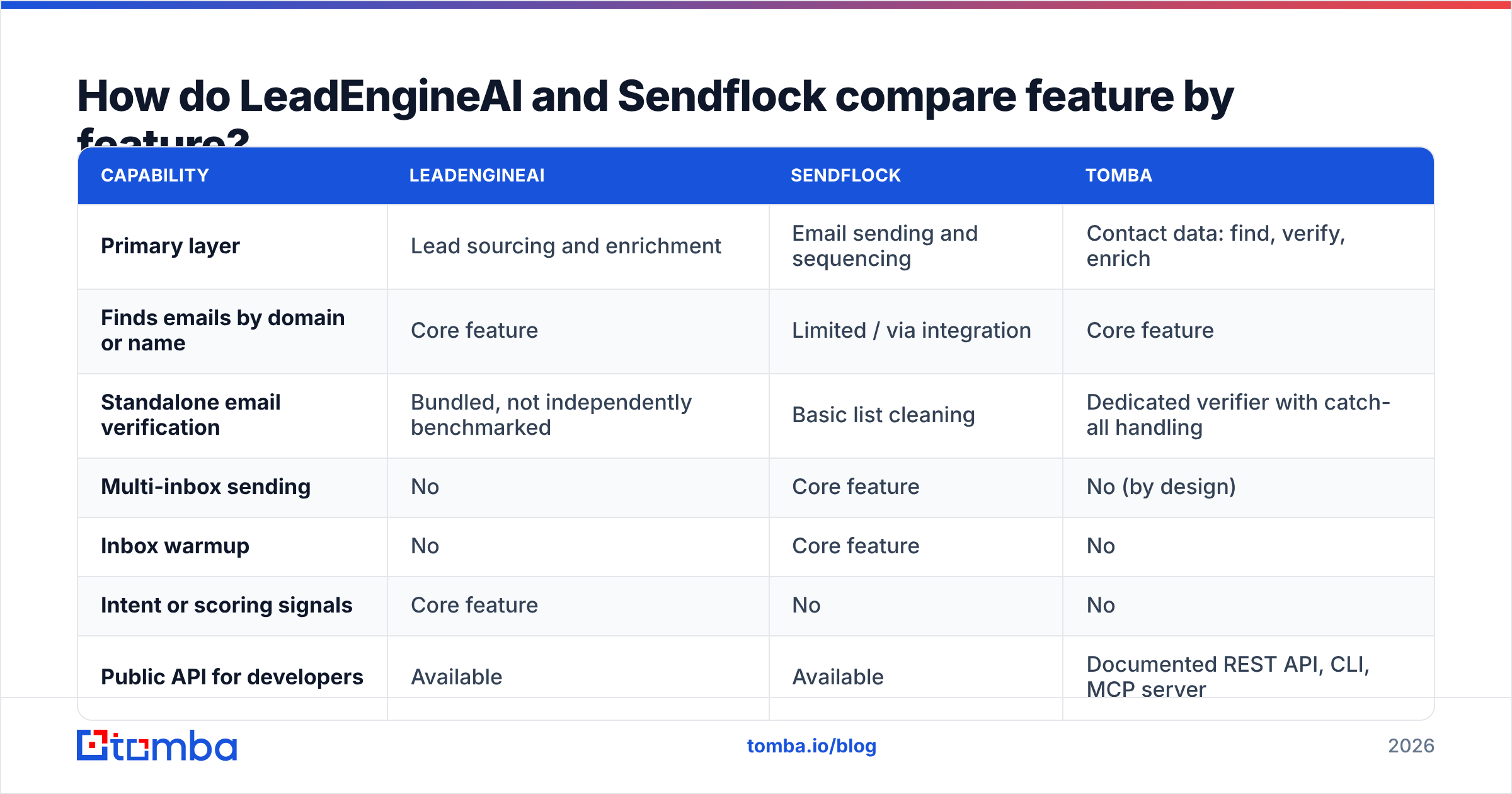
Here is the practical split. "Limited" below means the feature exists, but it is not what the tool is built for. That is usually where it cracks under load.
| Capability | LeadEngineAI | Sendflock | Tomba |
|---|---|---|---|
| Primary layer | Lead sourcing and enrichment | Email sending and sequencing | Contact data: find, verify, enrich |
| Finds emails by domain or name | Core feature | Limited / via integration | Core feature |
| Standalone email verification | Bundled, not independently benchmarked | Basic list cleaning | Dedicated verifier with catch-all handling |
| Multi-inbox sending | No | Core feature | No (by design) |
| Inbox warmup | No | Core feature | No |
| Intent or scoring signals | Core feature | No | No |
| Public API for developers | Available | Available | Documented REST API, CLI, MCP server |
| Spreadsheet / CRM workflows | CRM push | Campaign sync | Sheets, Excel, Airtable, HubSpot, Pipedrive |
| Free tier to test accuracy | Trial-gated | Trial-gated | 25 searches/month, no card |
The last row decides most deals. A trial that needs a sales call before you can test accuracy on your own list is a friction tax. It usually means the vendor does not want a cold test.
Which one has better data quality?#
Neither vendor has published a test you can repeat. So the honest answer is simple: run it yourself, on your own ICP, not on a generic sample.
Here is the protocol. It takes about forty minutes and settles the argument for good:
- Build a 100-row control list. Pull real firms from your target segment. Mix company sizes. Add at least 20 non-US domains and a few known catch-all servers.
- Run that same list through every tool. Do not let a vendor run it for you. Vendor tests get filtered first.
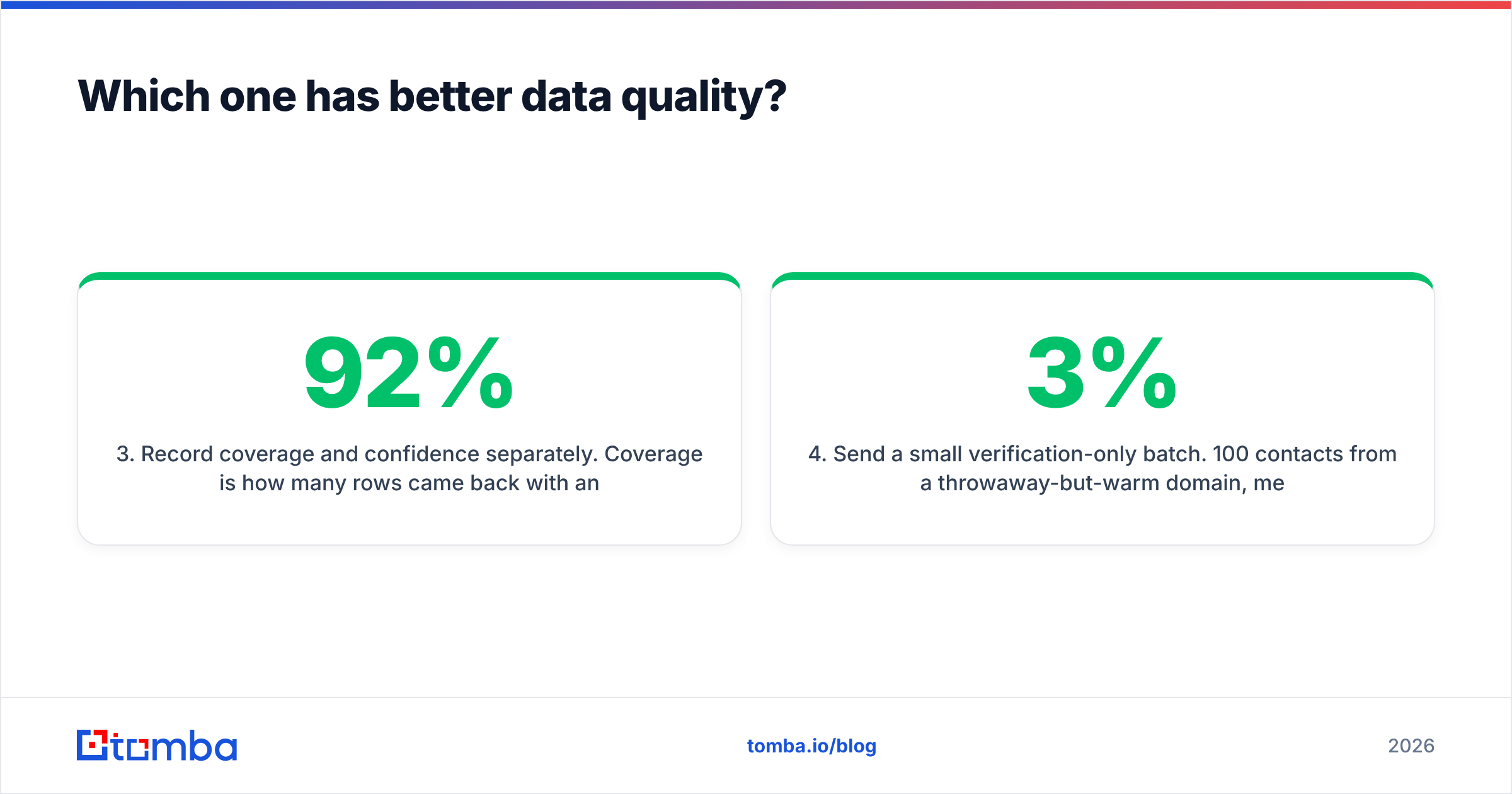
- Score coverage and confidence apart. Coverage is how many rows came back with an address. Confidence is what the tool claimed about each one. 92% coverage at 60% confidence is worse than 70% at 95%.
- Send a small test batch. Use 100 contacts from a warm spare domain and count hard bounces. Over 3% is a data problem, not a sending problem.
- Check the catch-all rows on their own. Cheap tools fall apart here. A tool that marks every catch-all as "valid" is guessing, not verifying.
Step five is the one most buyers skip. A catch-all domain says yes to every address at the door, then drops the mail it cannot place. So a naive checker hands you a clean list while your delivery quietly rots. A proper catch-all verifier reads pattern confidence and other signals, not just the SMTP reply.
Weigh this test heavily if a vendor claims to do both jobs. Sending is mostly a solved problem in 2026. Good B2B contact data is not. That is where quality still varies.
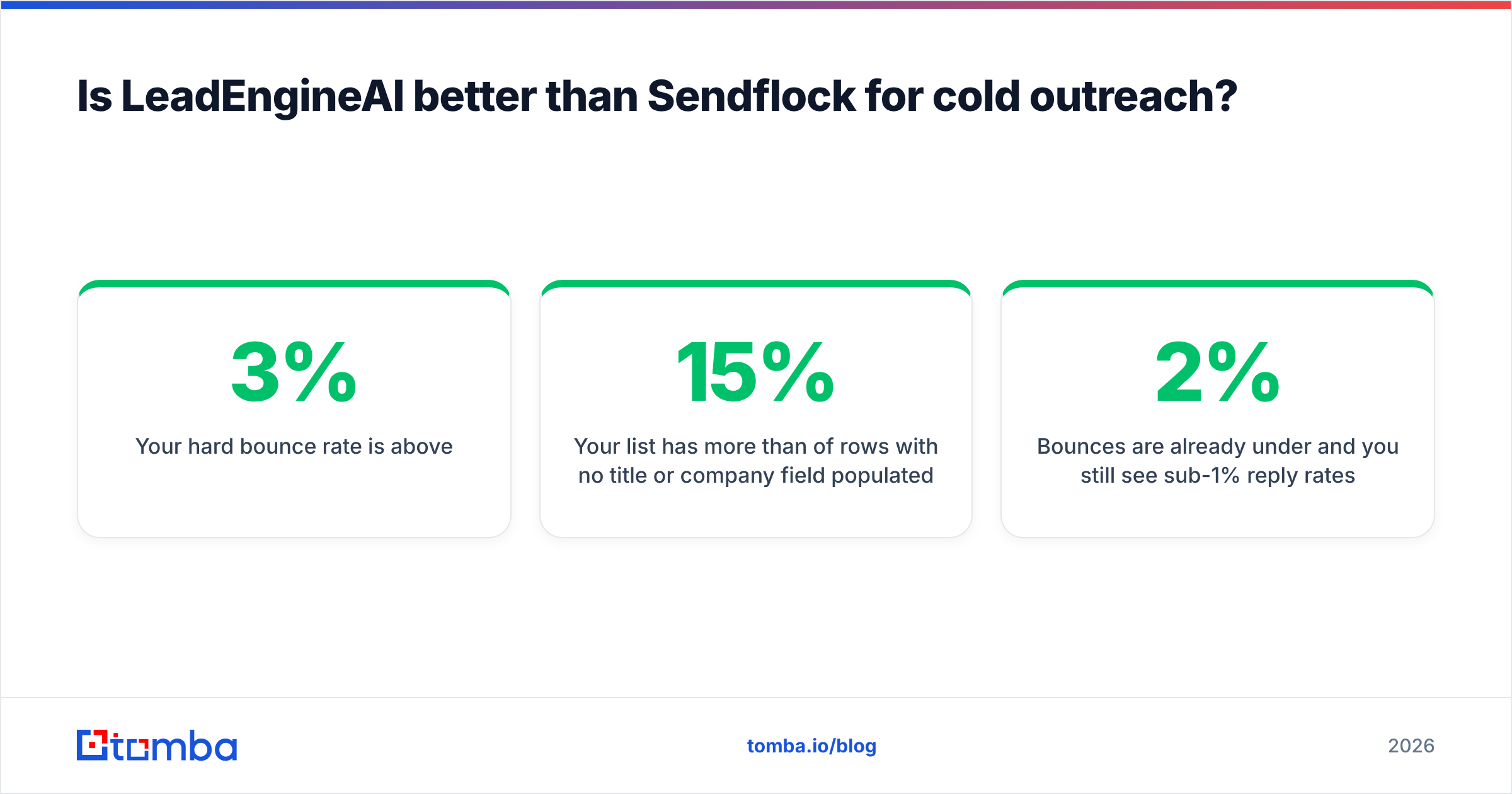
Is LeadEngineAI better than Sendflock for cold outreach?#
For cold outreach, that question is broken. You need both jobs done. The real call is the order: which do you fix first?
Fix data first if:
- Your hard bounce rate sits above 3%
- More than 15% of rows have no title or company
- Reps say "this person left the company" more than once a week
- Reps still guess emails by hand from LinkedIn
Fix sending first if:
- Bounces are under 2% and replies still sit below 1%
- Open rates fell sharply with no list change (that is a reputation problem)
- You run one inbox at more than 50 sends a day
- You have no SPF, DKIM, or DMARC set up
That last one is no longer optional. Google and Yahoo now expect bulk senders to line up DMARC. Miss it and you will not land in the main inbox at volume. No sending tool can fix a broken domain setup. Test yours with a free SPF checker before you blame either vendor.
What does each one cost?#
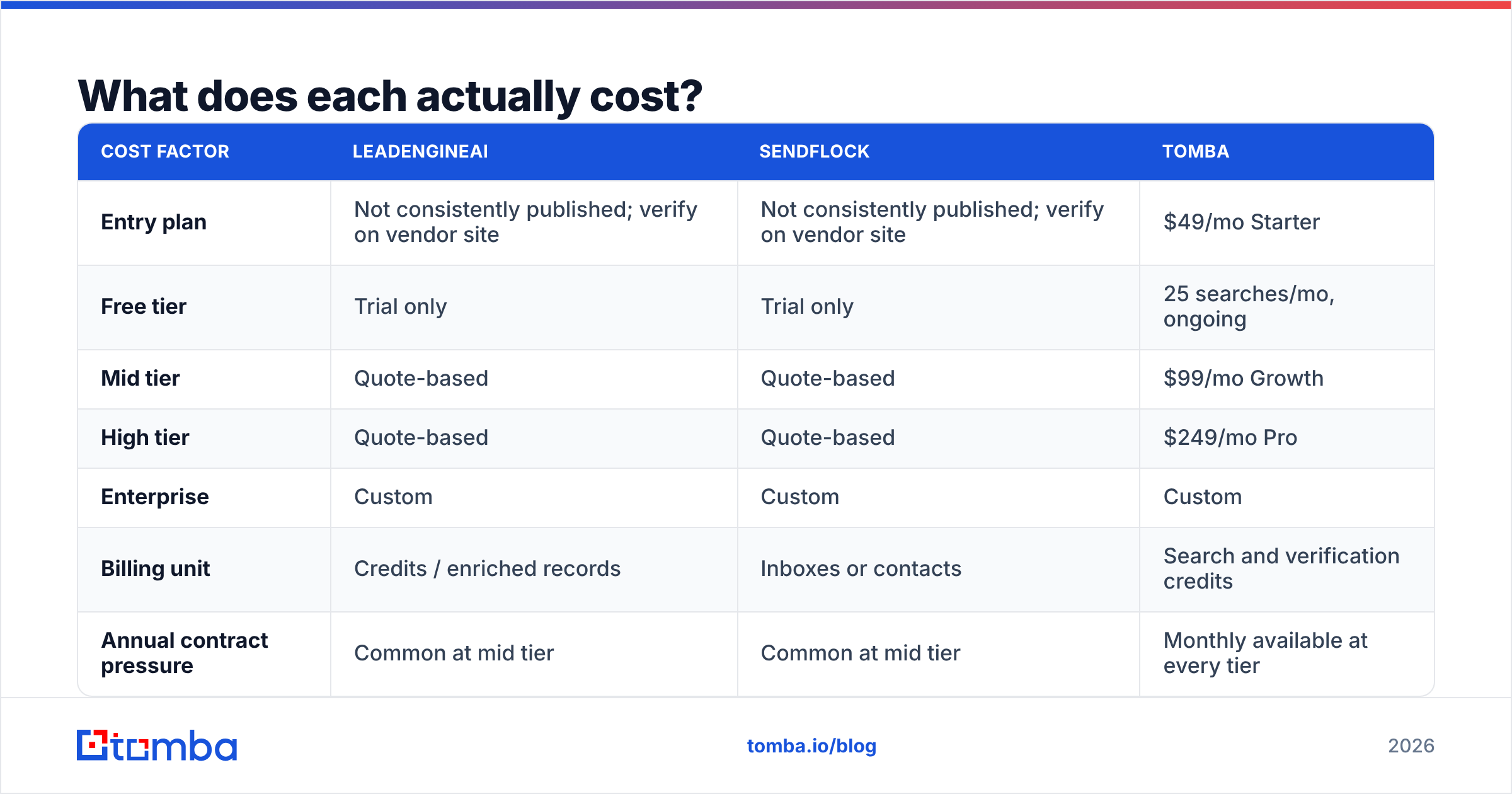
Pricing is the messiest part of the LeadEngineAI vs Sendflock debate. Neither vendor posts clear self-serve prices. So you cannot model the cost before you talk to sales. That is a data point on its own.
| Cost factor | LeadEngineAI | Sendflock | Tomba |
|---|---|---|---|
| Entry plan | Not consistently published; verify on vendor site | Not consistently published; verify on vendor site | $49/mo Starter |
| Free tier | Trial only | Trial only | 25 searches/mo, ongoing |
| Mid tier | Quote-based | Quote-based | $99/mo Growth |
| High tier | Quote-based | Quote-based | $249/mo Pro |
| Enterprise | Custom | Custom | Custom |
| Billing unit | Credits / enriched records | Inboxes or contacts | Search and verification credits |
| Annual contract pressure | Common at mid tier | Common at mid tier | Monthly available at every tier |
Two cost traps are worth naming.
The credit trap. "Credits" mean different things at different vendors. Some charge a credit for a search that finds nothing. Some charge twice for one contact: once to find it, once to verify it. Some charge per extra field. So before you weigh a $60 plan against a $99 plan, work out the cost per usable verified contact. That is the only number tied to pipeline. Tomba pricing does not burn a credit on a failed search, and that one rule often flips the ranking.
The inbox trap. Sending tools often charge per inbox. Three inboxes look cheap. Thirty hurt. And thirty is what a growing team needs. Model your cost at next year's volume, not today's.

What does the better stack look like?#
Most teams with steady outbound results in 2026 run two layers, not one blended platform:
- A data layer that finds and verifies contacts, with an API so records fill in as the list is built, not as a cleanup job later.
- A sending layer that owns warmup, sequencing, and inbox placement, and never touches sourcing.
- A CRM as the book of record. Both layers write to it, not to each other.
- A verify gate between the layers. Nothing enters a sequence unless it passed a check in the last 30 days. This is the highest-ROI rule in outbound ops.
- One owner for the bounce metric. If nobody owns it, it creeps up until a domain gets burned.
Item four is where most stacks leak. People change jobs all the time, so B2B data goes stale fast. A list you verified in January is much worse by June. Run it back through an email verifier on a schedule. That costs a fraction of what a burned domain costs to win back.
HubSpot's sales research library is a fair, vendor-neutral place to read more on job churn.
When should you pick LeadEngineAI over Sendflock?#
Pick LeadEngineAI-style tools when your problem is knowing who to contact. In a crowded market that is the harder half. Intent signals and scoring can save real rep hours, but only if the contact data is right. Score a bad list and you have just sorted the garbage faster.
Pick Sendflock-style tools when your problem is volume at good delivery. Inbox rotation, warmup, and reply handling are real work. Do it yourself with a script and a Gmail account and your domain gets flagged.
Pick neither at first if you reach fewer than 200 contacts a month. At that size, a good email finder, your own mailbox, and a steady follow-up habit will do. Buying an intent platform for 200 contacts is like buying a forklift to move a bookshelf.
What should you test before you buy?#
Run this list against both vendors in the same week, with the same data:
- Coverage on your ICP, not on a demo list
- Hard bounce rate on a live 100-contact send
- Catch-all handling, measured apart from normal domains
- API speed and rate limits, if you plan to automate
- Export freedom. Can you pull your data out as a CSV with no support ticket? If not, that is a lock-in tax you pay later.
- Contract terms. Monthly plan? Credit rollover? Can you downgrade mid-cycle?
If a vendor makes any of these hard to check before you sign, you have your answer. Open vendors publish their data sources and let you test before you pay.
The honest verdict#
LeadEngineAI vs Sendflock is the wrong fight for most teams. The two tools solve next-door problems. A sending tool cannot save bad data. A data tool cannot save a burned domain. So buy for the layer that is failing right now.
One thing holds either way: everything downstream rests on whether the address is real. Bounce rate drives sender reputation. Reputation drives inbox placement. Placement drives reply rate. Reply rate drives pipeline. That chain starts at the data layer, every time.
Want to fix that first link before you spend more? Start with the Tomba Email Finder. The free tier gives you 25 searches a month with no card. That is enough to run the 100-row test above against whatever you pay for now. Paid plans start at $49/mo, and credits are only spent on results you can use. The same engine runs through an API, a CLI, and spreadsheet add-ins, so checks sit inside your workflow instead of beside it. Run the test on your own list. Then decide which vendor earns your budget.
Related guides#
// get started
Find, verify and enrich your first contacts today
Start on the free plan with 25 searches a month, then scale when your team is ready.
Free plan · No credit card required · GDPR & CCPA
// about the author