LeadEnrich Alternatives: 7 Better Lead Enrichment Tools
LeadEnrich covers the basics, but coverage gaps and credit burn push teams to shop around. Here are seven LeadEnrich alternatives compared on accuracy, pricing, API depth, and the use case each one actually wins.
TL;DR
- LeadEnrich works for light, occasional enrichment, but teams outgrow it fast once they need verified emails at volume, API access, or predictable per-contact cost.
- The seven LeadEnrich alternatives worth testing in 2026: Tomba, Hunter, Apollo.io, Dropcontact, BookYourData, Clay, and ZoomInfo.
- Price per verified contact matters far more than the sticker price on a pricing page. A $49/mo plan that returns 60% deliverable emails is more expensive than a $99/mo plan returning 95%.
- If you need an email-finding and verification engine you can call from code, Tomba's $49/mo Starter plan and free 25-search tier make it the cheapest honest entry point.
- If you want prepaid, no-subscription contact lists with a bounce guarantee, BookYourData is the better structural fit — different model, different buyer.
What is LeadEnrich, and why do teams look for alternatives?#
LeadEnrich sits in the crowded middle of the B2B data market: upload a list of names and companies, get back emails, job titles, and firmographics. That is a real job to be done, and for a solo founder enriching 200 rows a month it is often enough.
The churn shows up at scale. Three patterns drive the search for LeadEnrich alternatives:
Coverage collapses outside the obvious accounts. Most enrichment vendors resell overlapping data pools. Hit a 2,000-employee US SaaS company and everyone returns a result. Hit a 40-person German manufacturer or a Gulf logistics firm and hit rates fall off a cliff. If your ICP is not mid-market North American tech, generic enrichment underdelivers.
Credits burn on failures. The single most expensive line item in enrichment is not the subscription. It is paying for rows that come back empty, guessed, or stale, then paying again to verify them somewhere else, then paying a third time in sender reputation when the guesses bounce.
The API is an afterthought. Plenty of tools are built as a dashboard first with an API bolted on later: no bulk endpoint, tight rate limits, inconsistent response schemas. Once you wire enrichment into a CRM sync or an internal scoring job, that becomes a daily tax.

None of this makes LeadEnrich a bad product. It makes it a product with a defined ceiling. The question is which tool sits above that ceiling for your workflow, not which tool wins a generic feature bake-off.
What should you actually compare in a lead enrichment tool?#
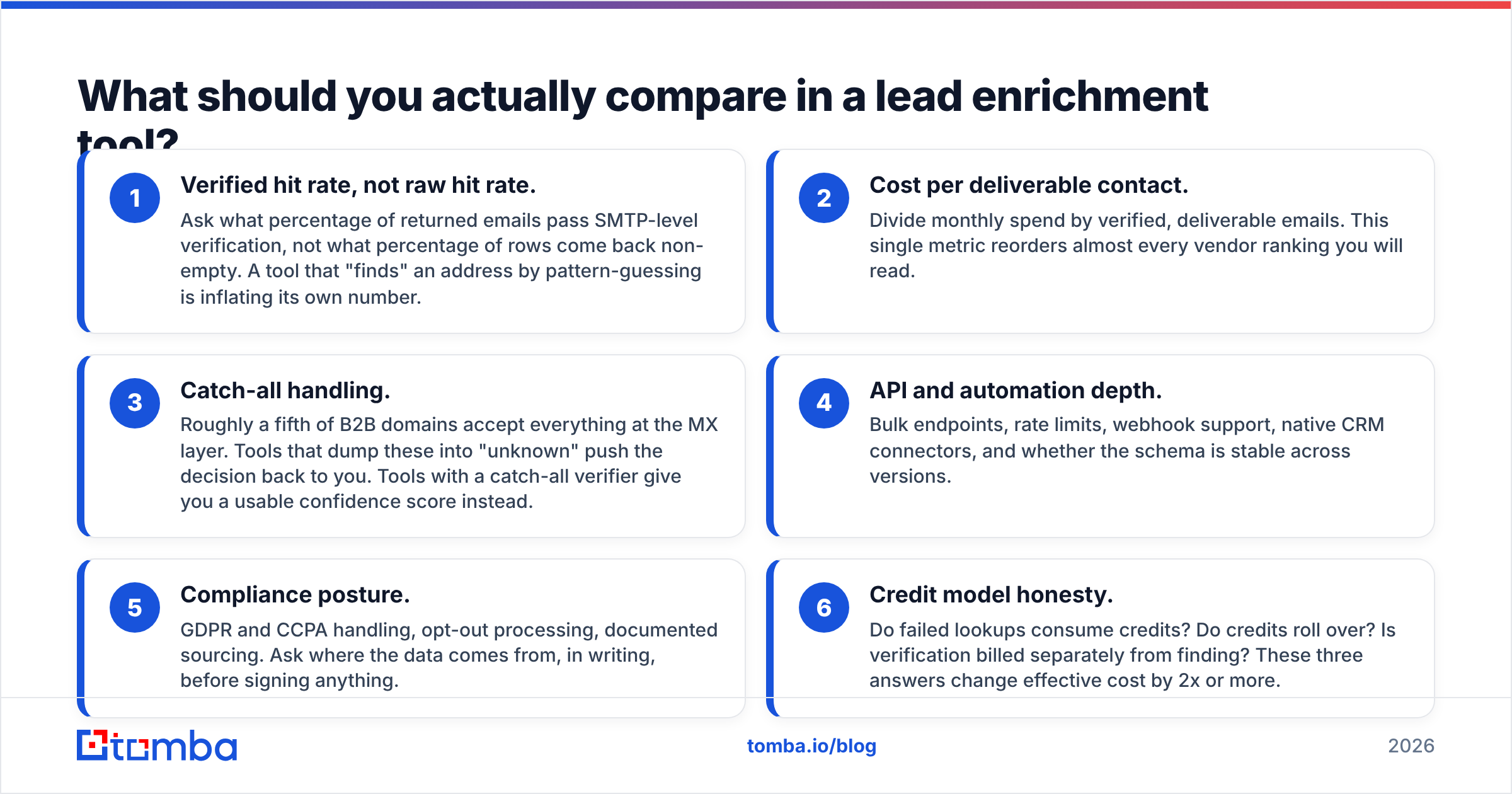
Before the vendor list, fix the evaluation criteria. Six things decide whether an enrichment tool pays for itself:
- Verified hit rate, not raw hit rate. Ask what percentage of returned emails pass SMTP-level verification, not what percentage of rows come back non-empty. A tool that "finds" an address by pattern-guessing is inflating its own number.
- Cost per deliverable contact. Divide monthly spend by verified, deliverable emails. This single metric reorders almost every vendor ranking you will read.
- Catch-all handling. Roughly a fifth of B2B domains accept everything at the MX layer. Tools that dump these into "unknown" push the decision back to you. Tools with a catch-all verifier give you a usable confidence score instead.
- API and automation depth. Bulk endpoints, rate limits, webhook support, native CRM connectors, and whether the schema is stable across versions.
- Compliance posture. GDPR and CCPA handling, opt-out processing, documented sourcing. Ask where the data comes from, in writing, before signing anything.
- Credit model honesty. Do failed lookups consume credits? Do credits roll over? Is verification billed separately from finding? These three answers change effective cost by 2x or more.
Score each candidate on those six. Most shortlist arguments dissolve once you do.
How accurate are these tools in practice?#
Accuracy is the axis vendors are vaguest about, because every vendor measures it differently. A "98% accuracy" claim usually means "98% of the emails we chose to return passed our own internal check" — which quietly excludes every row where the tool returned nothing.
The honest way to test is to build a 200-row control list drawn from your actual ICP, run it through every finalist on free or trial credits, and then send the results through one neutral third-party verifier. You are measuring two numbers: how many rows produced an address, and how many of those addresses survived independent verification.

In our own testing pattern, the ranking shifts a lot depending on ICP region and company size. Tools with heavy public-web crawling do better on companies with a real web footprint. Tools leaning on contributed CRM and extension data do better on enterprise accounts with high user overlap. Nobody wins everywhere, which is exactly why a control list beats a review-site average.
One more control: run a small holdout of addresses you already know are valid, plus a few you know are dead. Any tool that marks a known-dead address as deliverable is telling you something important about its verification layer.
Which LeadEnrich alternatives are worth testing in 2026?#
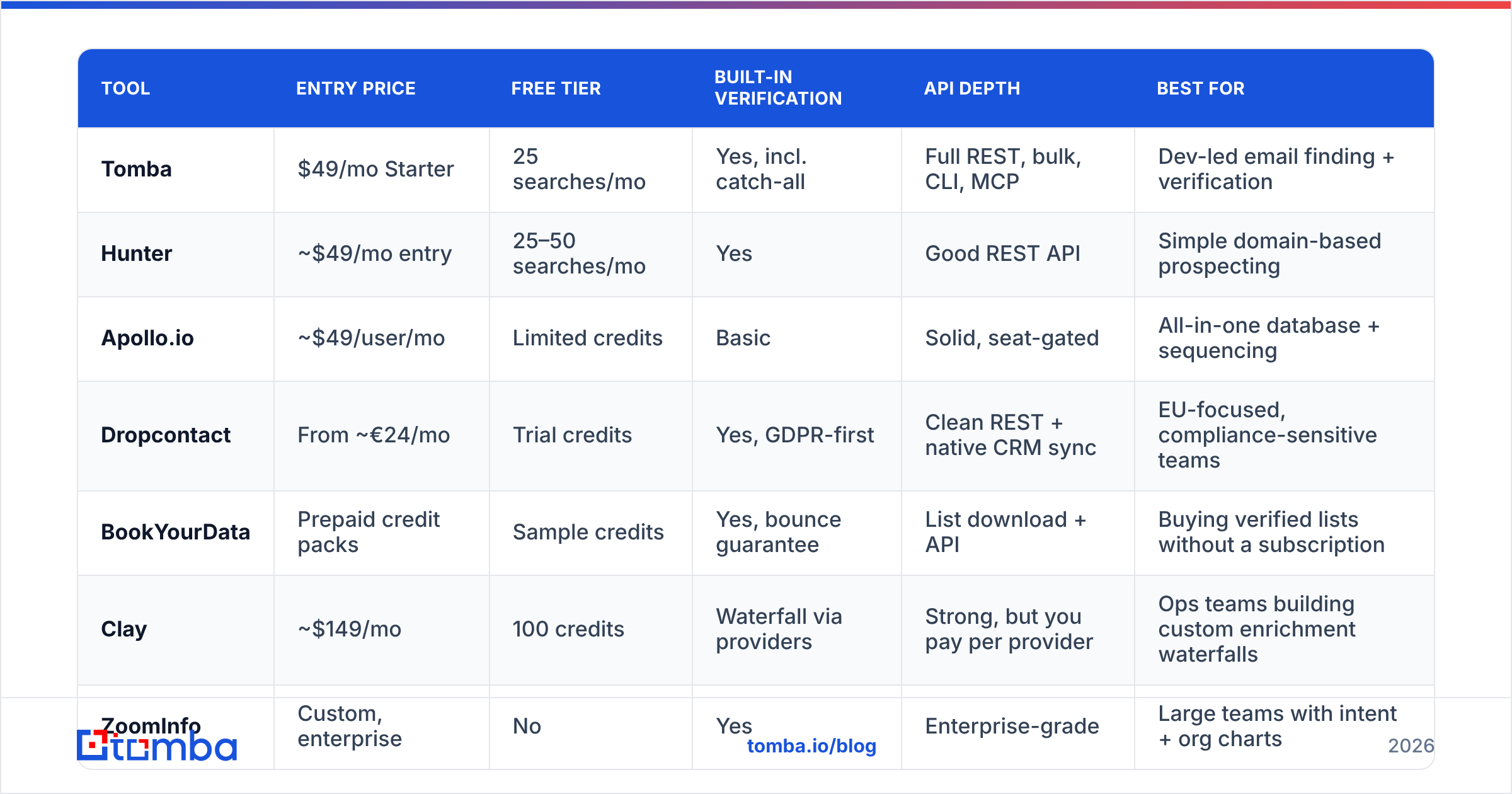
Here is the head-to-head on the attributes that actually decide the purchase.

| Tool | Entry price | Free tier | Built-in verification | API depth | Best for |
|---|---|---|---|---|---|
| Tomba | $49/mo Starter | 25 searches/mo | Yes, incl. catch-all | Full REST, bulk, CLI, MCP | Dev-led email finding + verification |
| Hunter | ~$49/mo entry | 25–50 searches/mo | Yes | Good REST API | Simple domain-based prospecting |
| Apollo.io | ~$49/user/mo | Limited credits | Basic | Solid, seat-gated | All-in-one database + sequencing |
| Dropcontact | From ~€24/mo | Trial credits | Yes, GDPR-first | Clean REST + native CRM sync | EU-focused, compliance-sensitive teams |
| BookYourData | Prepaid credit packs | Sample credits | Yes, bounce guarantee | List download + API | Buying verified lists without a subscription |
| Clay | ~$149/mo | 100 credits | Waterfall via providers | Strong, but you pay per provider | Ops teams building custom enrichment waterfalls |
| ZoomInfo | Custom, enterprise | No | Yes | Enterprise-grade | Large teams with intent + org charts |
Prices are list prices at the time of writing and change often. Verify on each vendor's own pricing page before you budget.
Tomba#
Tomba is an email-finding and verification engine rather than a general contact database. You give it a domain, a name, a LinkedIn profile, or a company, and it returns addresses with confidence scoring and source attribution. Verification is native, not a bolt-on: the email verifier and catch-all checks run on the same pipeline that finds the address.
Pricing is flat and public: a free tier at 25 searches/mo, Starter at $49/mo, Growth at $99/mo, Pro at $249/mo, and custom Enterprise. No per-seat multiplier, which matters when five people on the team all need occasional access. See Tomba pricing for the current credit allocations.
Where it wins: developer surface. REST API, CLI, Chrome extension, Google Sheets and Excel add-ins, Zapier/Make, and an MCP server for AI agents. If enrichment needs to run inside your own system rather than inside someone's dashboard, this is the shortest path.
Where it does not: it is not a prospecting database with intent signals and org charts. If you want to browse 200 million contacts by filter, look at Apollo or ZoomInfo.
Hunter#
The best-known name in domain-based email finding, and a fair comparison point for anyone leaving LeadEnrich. Hunter does domain search, email finding, and verification with a clean UI and a well-documented API. Its dataset skews toward companies with a visible web presence, which means strong results on tech and agency targets and thinner results on offline industries. Entry pricing lands in the same band as Tomba's Starter tier, so the decision usually comes down to hit rate on your specific list and how much you care about catch-all resolution.
Apollo.io#
Apollo is a database plus a sequencer plus a light CRM. If you want one login for prospecting and sending, that bundling is real value. The tradeoffs: per-seat pricing gets expensive across a team, data freshness varies because much of it is contributed, and export limits on lower tiers surprise people mid-campaign. Teams that want Apollo's data without the seat math often look at an Apollo alternative for the finding layer and keep their existing sending tool.
Dropcontact#
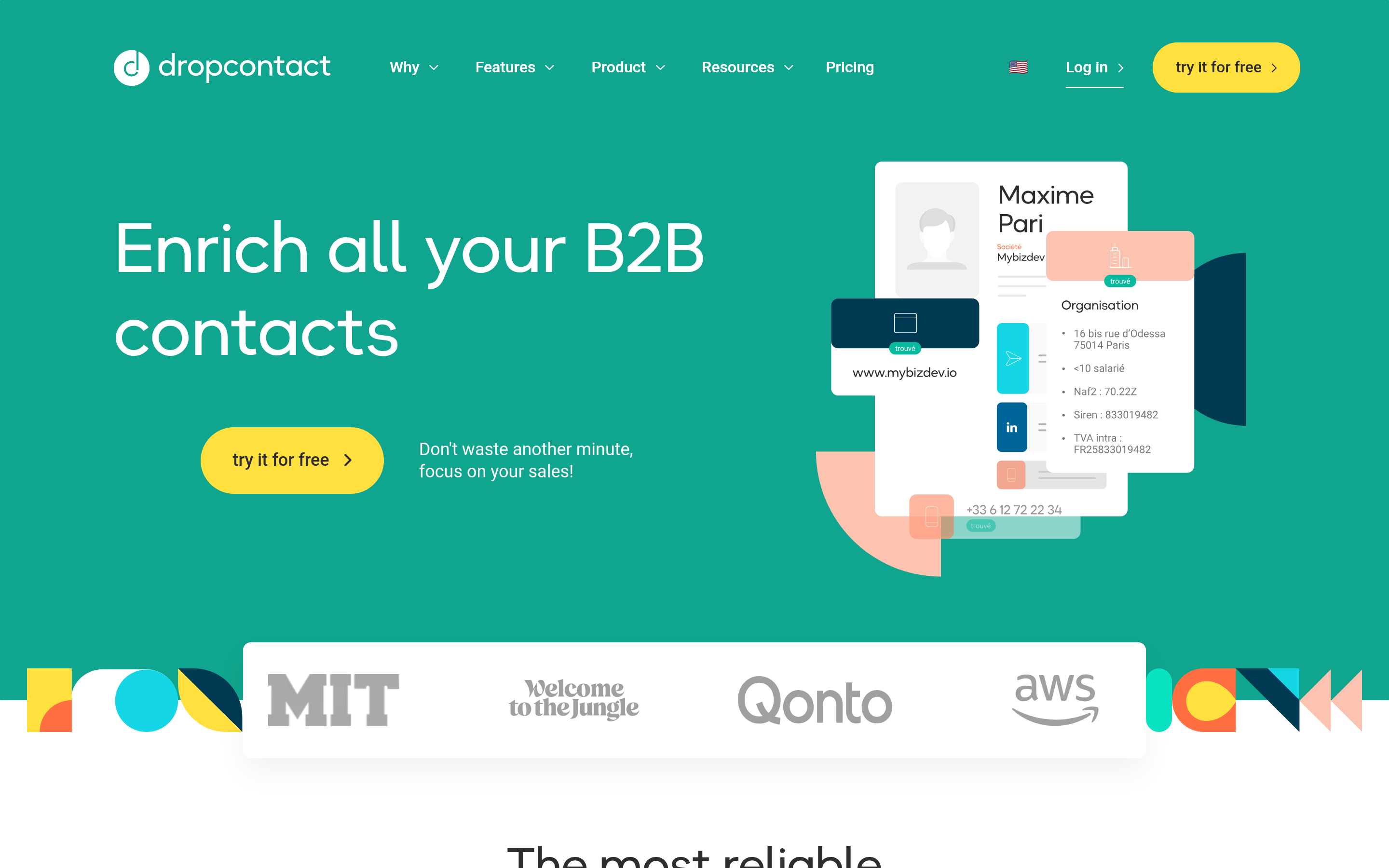
A European option built GDPR-first: it enriches from public and algorithmic sources rather than holding a scraped contact database, which changes the compliance story materially. Dropcontact is strong on French and broader EU data, integrates natively with Pipedrive and HubSpot, and cleans and deduplicates as it enriches. Coverage on US mid-market is usually thinner than the US-centric tools. If your legal team asks hard questions about data provenance, put this on the list.
BookYourData#
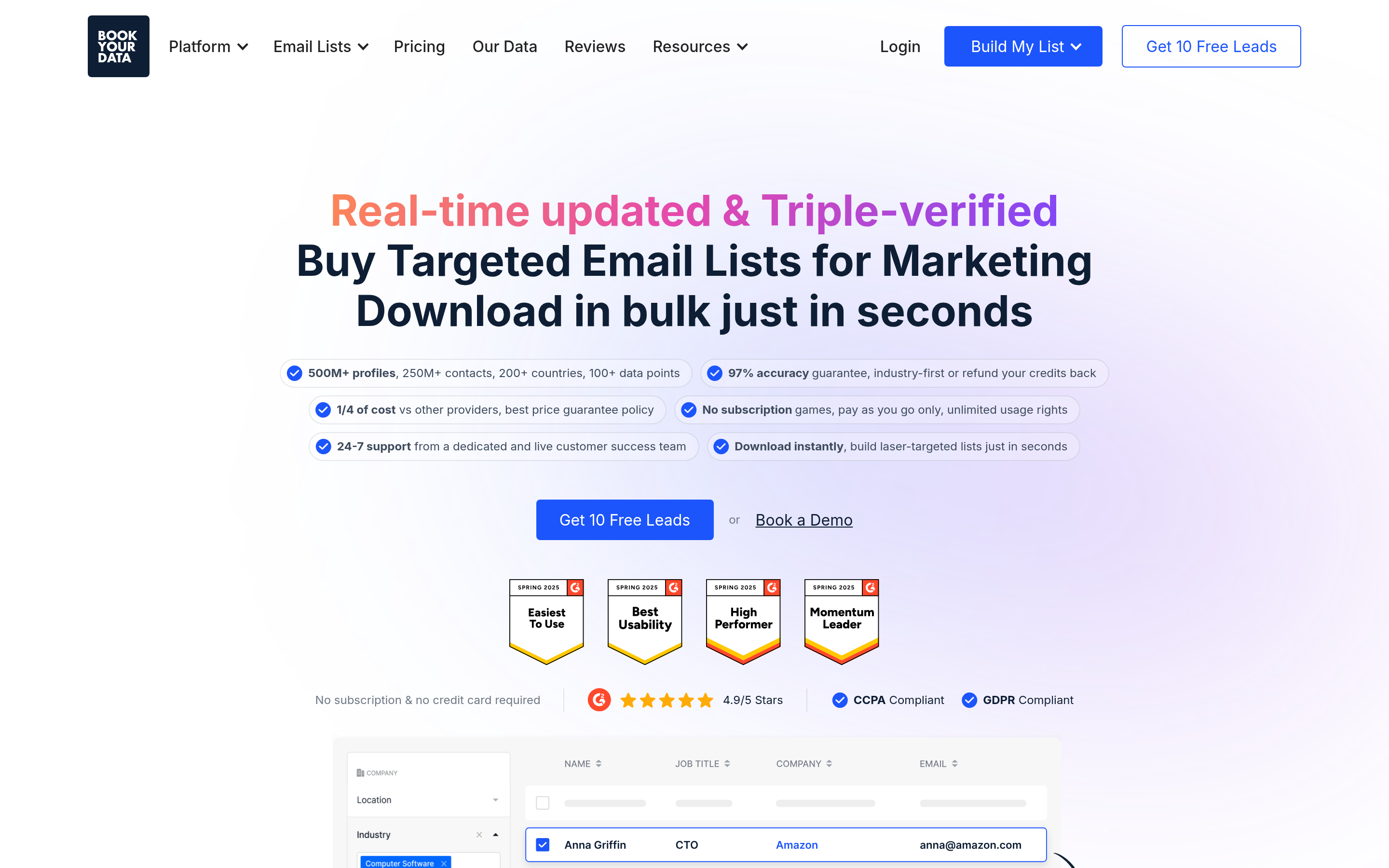
A different model worth understanding rather than dismissing. BookYourData sells prepaid, verified B2B contact lists with a bounce guarantee, no monthly subscription required. You filter by industry, title, geography, and company size, preview counts, and pay for what you download. For a team that needs 5,000 targeted contacts this quarter and nothing next quarter, that is a cleaner commercial fit than any subscription tool, and the bounce guarantee puts real money behind their accuracy claim. It is a complement to a finding API as much as a competitor: buy the list for breadth, run a finder for the specific named accounts you already care about.
Clay#
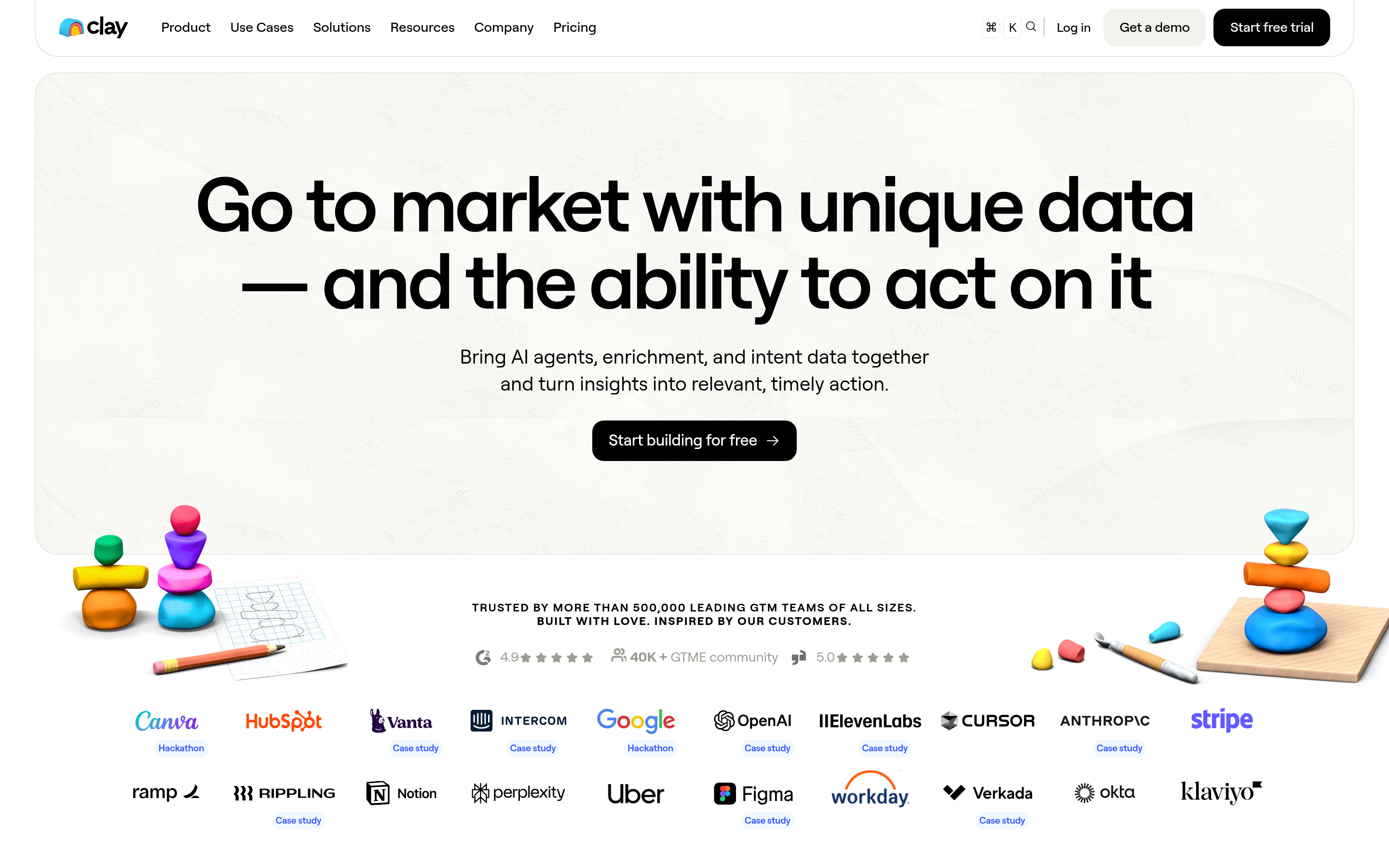
Clay is the power-user answer: a spreadsheet interface that chains dozens of data providers into waterfall enrichment. Row fails at provider one, it falls through to provider two, and so on. Hit rates can be excellent. The costs are learning curve and stacked provider fees — you are paying Clay and the underlying vendors. Below roughly 10,000 rows a month, a single good provider usually wins on cost per contact.
ZoomInfo#
The enterprise incumbent, with org charts, intent data, technographics, and the deepest US coverage in the category. It is also priced for enterprise: annual contracts, seat minimums, and a procurement cycle. Reviews on G2 consistently praise the data depth and criticize the contract terms. If you have a 20-rep team and a real budget, it is defensible. For anyone comparing $49/mo tools, it is not in the same conversation.

What does each tool actually cost per verified contact?#
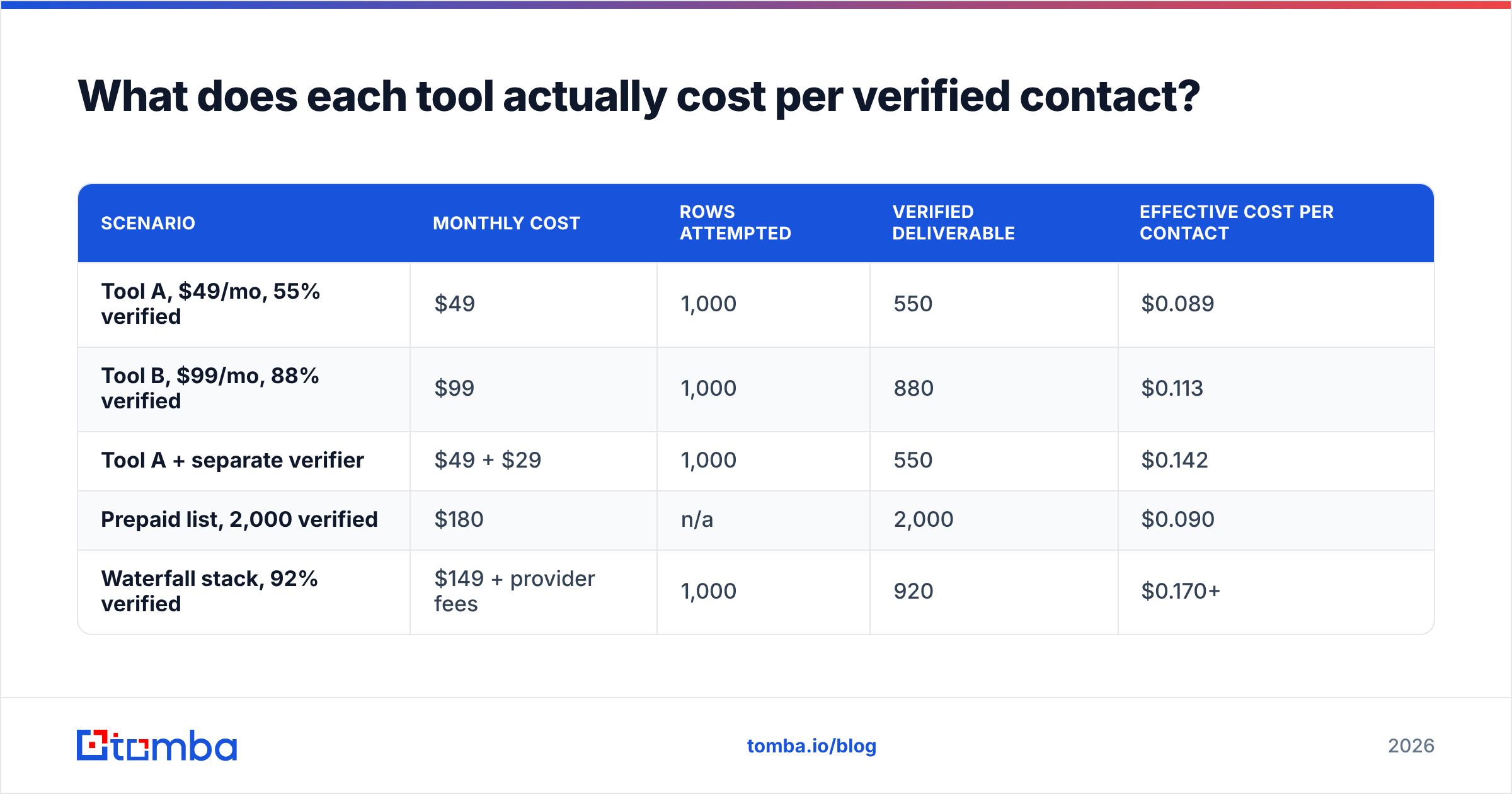
Sticker price lies. Run the arithmetic on a realistic month — say 1,000 enrichment attempts against your ICP.
| Scenario | Monthly cost | Rows attempted | Verified deliverable | Effective cost per contact |
|---|---|---|---|---|
| Tool A, $49/mo, 55% verified | $49 | 1,000 | 550 | $0.089 |
| Tool B, $99/mo, 88% verified | $99 | 1,000 | 880 | $0.113 |
| Tool A + separate verifier | $49 + $29 | 1,000 | 550 | $0.142 |
| Prepaid list, 2,000 verified | $180 | n/a | 2,000 | $0.090 |
| Waterfall stack, 92% verified | $149 + provider fees | 1,000 | 920 | $0.170+ |
Two things fall out of this table. First, bundled verification changes the ranking — the moment you bolt a separate verifier onto a cheap finder, the cheap finder stops being cheap. Second, prepaid list buying is genuinely competitive on unit cost when you need breadth rather than precision on named accounts.
The number this table cannot show you is the cost of a damaged sending domain. A 30% bounce rate does not just waste credits; it degrades email deliverability for every campaign that follows, including the ones with good data.
How should you run the evaluation without wasting a month?#
Keep it to five working days.
- Day 1 — build the control list. 200 rows from your real ICP, split across company sizes and regions. Include 10 addresses you already know are valid and 5 you know are dead.
- Day 2 — run every finalist on free or trial credits. Tomba's free tier, Hunter's free searches, Clay's 100 credits, BookYourData's sample credits. No sales calls yet.
- Day 3 — verify with a neutral third party. Not the vendor's own verifier. Record hit rate and verified rate separately.
- Day 4 — test the API. Authenticate, pull 50 rows through a bulk email finder endpoint, and check rate limits and error handling. Dashboard demos hide all of this.
- Day 5 — compute cost per verified contact for each tool at your actual monthly volume, then decide.
Teams that skip step 3 pick the tool with the highest raw hit rate and regret it within one sending cycle.
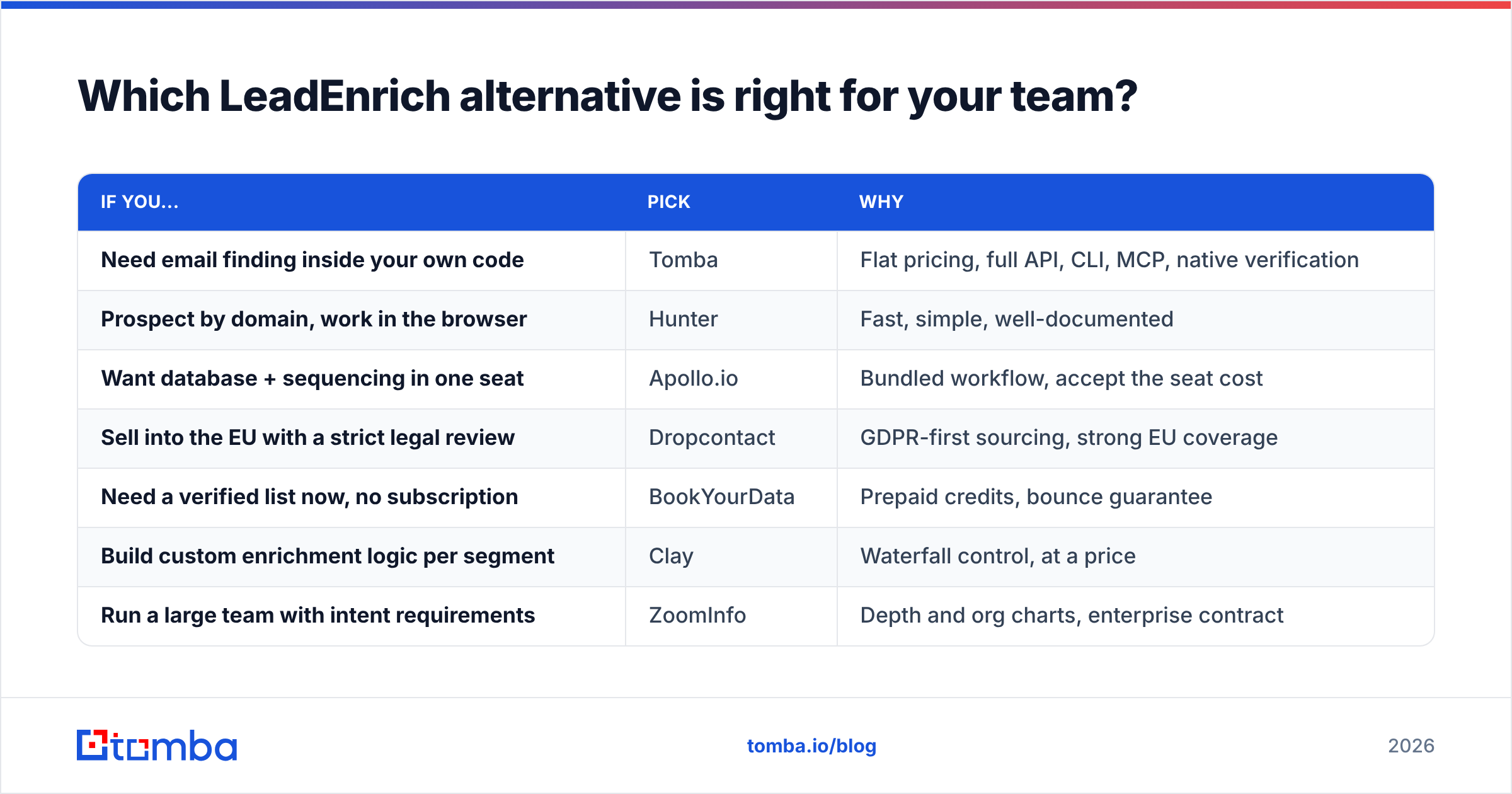
Which LeadEnrich alternative is right for your team?#
| If you... | Pick | Why |
|---|---|---|
| Need email finding inside your own code | Tomba | Flat pricing, full API, CLI, MCP, native verification |
| Prospect by domain, work in the browser | Hunter | Fast, simple, well-documented |
| Want database + sequencing in one seat | Apollo.io | Bundled workflow, accept the seat cost |
| Sell into the EU with a strict legal review | Dropcontact | GDPR-first sourcing, strong EU coverage |
| Need a verified list now, no subscription | BookYourData | Prepaid credits, bounce guarantee |
| Build custom enrichment logic per segment | Clay | Waterfall control, at a price |
| Run a large team with intent requirements | ZoomInfo | Depth and org charts, enterprise contract |
There is no single winner, and any article claiming one is selling something. The winner is the tool whose failure mode you can live with.
Ready to test a LeadEnrich alternative on your own list?#
Start with the free tier. The Tomba Email Finder gives you 25 searches a month at no cost, with verification and catch-all detection included rather than billed separately, so you can measure verified hit rate on your real ICP before you spend anything. If the numbers hold up, Starter is $49/mo and Growth is $99/mo, with no per-seat markup and the same REST API, bulk endpoints, and Sheets, Excel, and CRM integrations on every paid tier.
Run your 200-row control list through it this week. Whichever tool wins on cost per verified contact, you will at least know why.
Related guides#
// get started
Find, verify and enrich your first contacts today
Start on the free plan with 25 searches a month, then scale when your team is ready.
Free plan · No credit card required · GDPR & CCPA
// about the author