LeadFuze vs Apollo.io (2026): Which B2B Data Tool Wins?
LeadFuze and Apollo.io both promise contact data plus outreach, but they solve different problems. Here is the honest breakdown on pricing, data accuracy, credits, and which one actually fits your team.
LeadFuze vs Apollo.io comes down to one question: do you need a list, or a machine? Here is the short answer first.
TL;DR
- LeadFuze is a list-building engine: you describe an audience ("VPs of Marketing at 50–200 person SaaS companies in Texas"), it returns a list with emails and phones. It does not send sequences.
- Apollo.io is a full sales platform: database + sequencer + dialer + basic CRM. Broader, cheaper per contact, and noisier on data quality.
- Pricing gap is real. LeadFuze starts at $147/mo for 500 lead credits. Apollo's paid tiers start at $49/user/mo and include unlimited-ish email credits on higher plans.
- Neither is a verification layer. Both ship contacts you should re-verify before sending, especially catch-all domains.
- Pick LeadFuze if list-building accuracy and clean exports matter more than volume. Pick Apollo if you want one tool for prospecting and sending. Pick a dedicated finder/verifier (Tomba, and BookYourData for pre-built lists) if you already own your sequencer.
LeadFuze vs Apollo.io: what is each tool?#
They get compared constantly, but they were built for different jobs.
LeadFuze is a lead-list search engine. Its core feature is Fuzebot. You define an ideal customer profile with filters — role, industry, headcount, tech stack, hiring signals, ad spend. Fuzebot then adds new matching leads to your list every day. The output is a CSV or a push into your CRM. It is a sourcing tool, full stop. There is no sequencer, no dialer, no inbox.
Apollo.io is a go-to-market platform. It bundles a 270M+ contact database with an email sequencer, a power dialer, LinkedIn extension, meeting scheduler, deal pipeline, and conversation intelligence. You can prospect, enrich, sequence, call, and track pipeline without leaving it.
So the honest framing is not "which is better." It is: do you need a list, or do you need a machine?
That one question drives everything below. It sets your price per usable contact, how much you re-verify, and whether you end up paying for a second tool anyway.
LeadFuze vs Apollo.io: pricing and features#
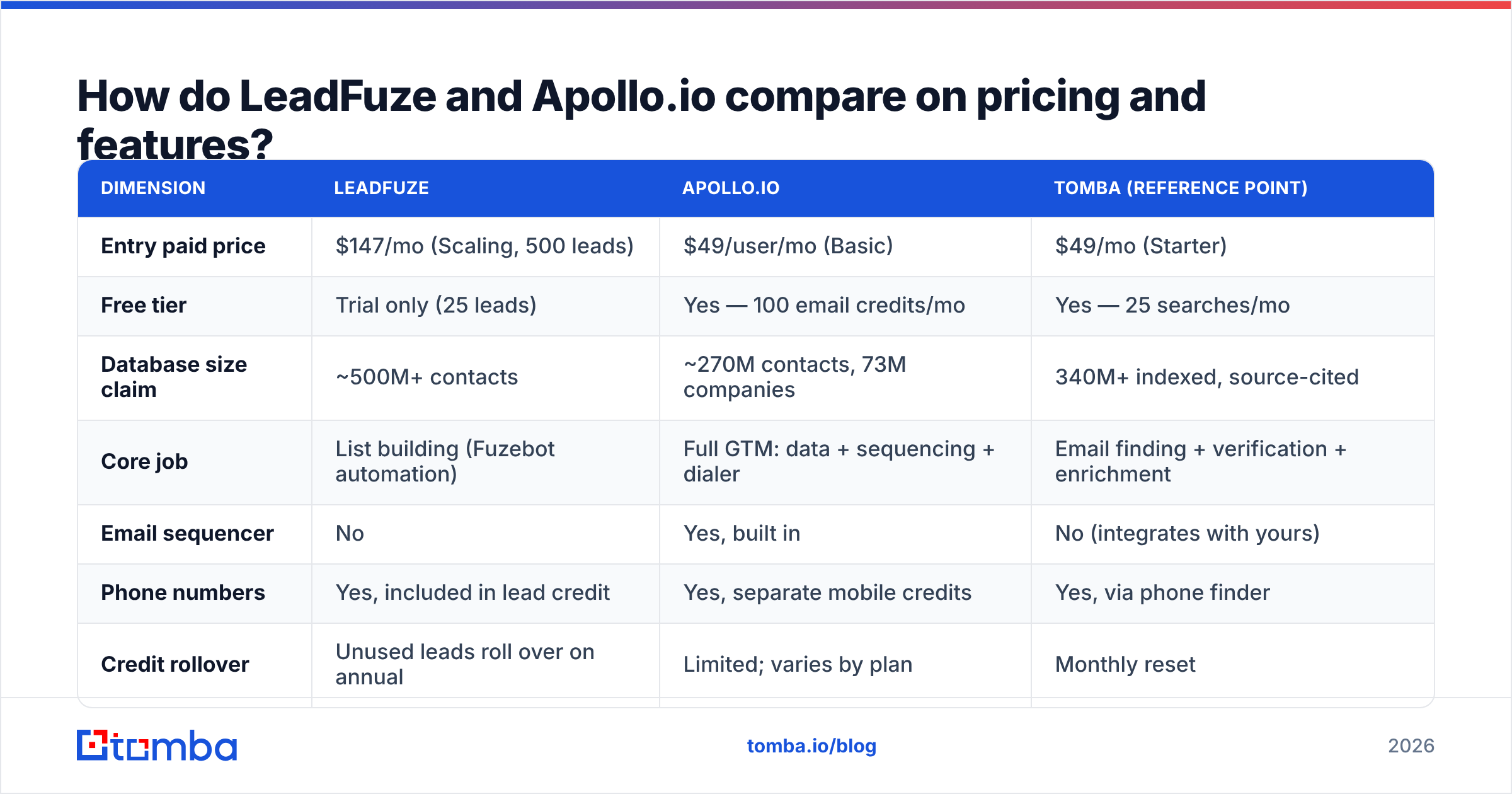
Here is the side-by-side. Prices are the publicly listed 2026 rates; annual billing discounts both.
| Dimension | LeadFuze | Apollo.io | Tomba (reference point) |
|---|---|---|---|
| Entry paid price | $147/mo (Scaling, 500 leads) | $49/user/mo (Basic) | $49/mo (Starter) |
| Free tier | Trial only (25 leads) | Yes — 100 email credits/mo | Yes — 25 searches/mo |
| Database size claim | ~500M+ contacts | ~270M contacts, 73M companies | 340M+ indexed, source-cited |
| Core job | List building (Fuzebot automation) | Full GTM: data + sequencing + dialer | Email finding + verification + enrichment |
| Email sequencer | No | Yes, built in | No (integrates with yours) |
| Phone numbers | Yes, included in lead credit | Yes, separate mobile credits | Yes, via phone finder |
| Credit rollover | Unused leads roll over on annual | Limited; varies by plan | Monthly reset |
| API access | Yes, higher tiers | Yes, rate-limited by plan | Yes, all paid tiers |
| Per-seat cost model | Flat, seats extra | Per user — scales fast | Flat, unlimited seats |
| Best for | Agencies, list resellers, ICP-driven sourcing | SMB/mid-market SDR teams wanting one tool | Teams that own their sequencer and need clean data |
The number that surprises people: at 5 reps, Apollo's Professional plan ($79/user/mo) is $395/mo. LeadFuze at the same spend gets you roughly 1,000–2,500 leads depending on tier. Apollo gets you five seats plus a sequencer. Which is better value depends entirely on whether those seats are actually sending.
Which one has better data accuracy?#
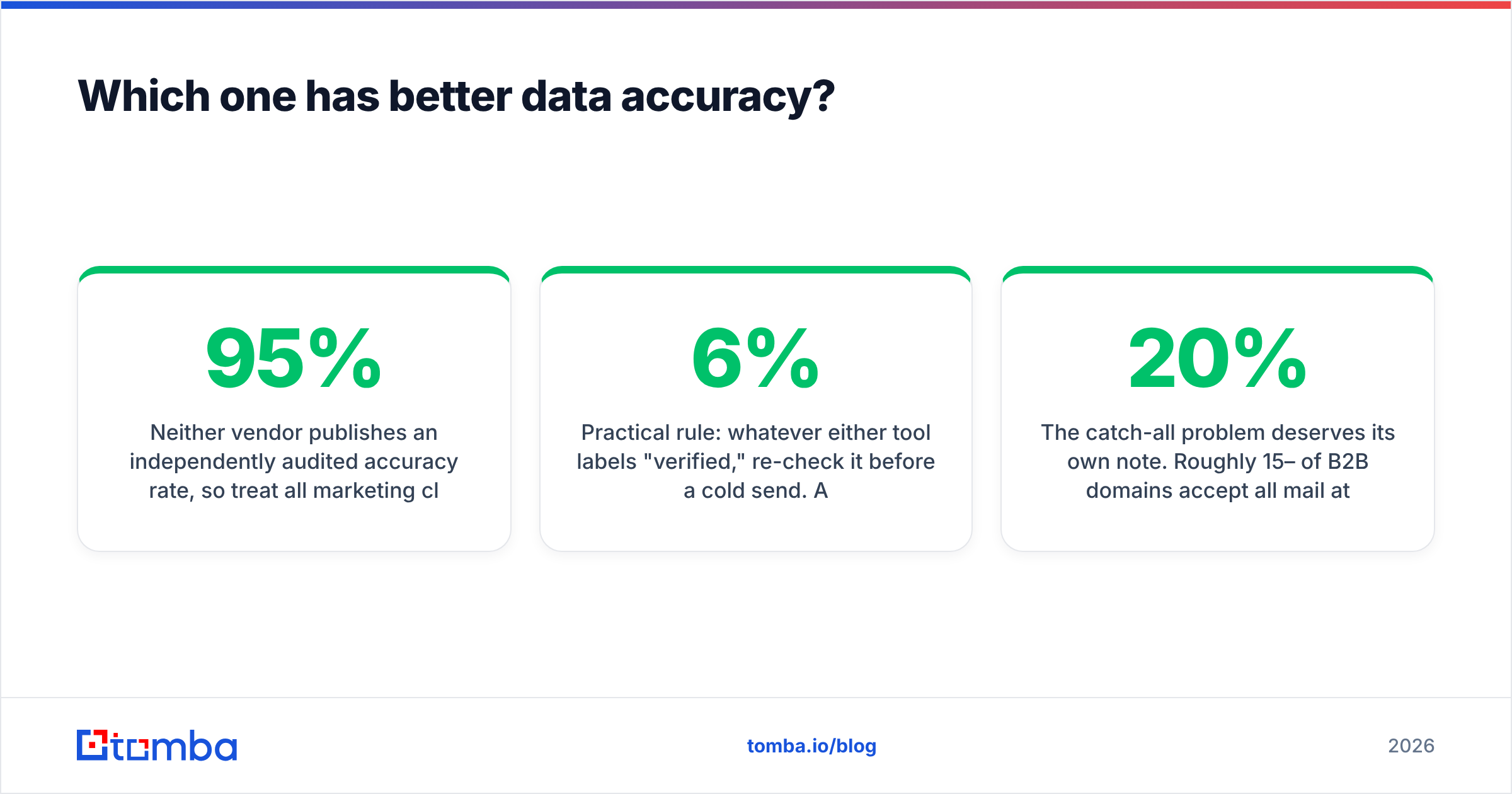
No vendor publishes an audited accuracy rate. So treat every claim — including "95% accurate" — as unproven until you test it on your own ICP.
What the patterns look like in practice, based on user reports across G2 and Capterra:
LeadFuze tends to produce cleaner, smaller lists. Fuzebot is filter-driven, and the platform charges per lead credit. That gives it a reason not to burn credits on junk. Users report solid title and company accuracy, with the usual weakness: contacts at companies that recently had layoffs or reorgs go stale fast.
Apollo.io has the volume advantage and the volume problem. Much of its data comes from users who sync their inboxes and CRMs. That model gives huge coverage but uneven freshness. You will find plenty of verified, current contacts. You will also find people who left the company in 2023. Apollo's own "verified" label is a useful filter but not a guarantee.
Practical rule: whatever either tool labels "verified," re-check it before a cold send. A 6% bounce rate hurts sender reputation faster than any subject-line test can help. Running exports through an independent email verifier costs cents. It also protects the domain you spent months warming.
The catch-all problem deserves its own note. Roughly 15–20% of B2B domains accept all mail at the SMTP layer. Standard verification returns "unknown" for those addresses. Both LeadFuze and Apollo will hand them to you without flagging the risk clearly. A dedicated catch-all verifier resolves a meaningful share of them instead of forcing you to guess.
When should you choose LeadFuze over Apollo.io?#
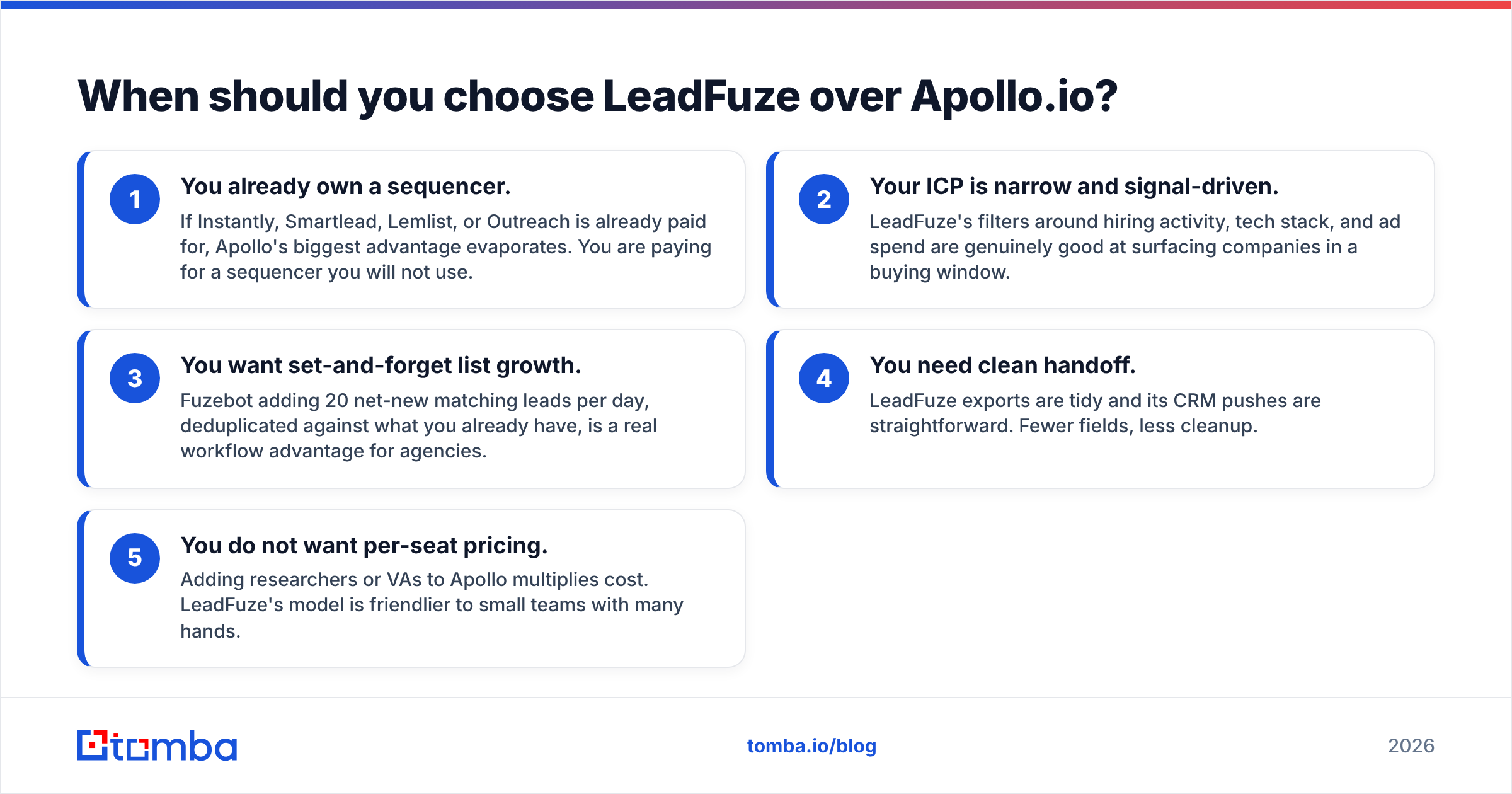
Pick LeadFuze when these are true:
- You already own a sequencer. If Instantly, Smartlead, Lemlist, or Outreach is already paid for, Apollo's biggest advantage evaporates. You are paying for a sequencer you will not use.
- Your ICP is narrow and signal-driven. LeadFuze's filters around hiring activity, tech stack, and ad spend are genuinely good at surfacing companies in a buying window.
- You want set-and-forget list growth. Fuzebot adds 20 net-new matching leads per day and dedupes them against what you already have. For agencies, that is a real workflow win.
- You need clean handoff. LeadFuze exports are tidy and its CRM pushes are straightforward. Fewer fields, less cleanup.
- You do not want per-seat pricing. Adding researchers or VAs to Apollo multiplies cost. LeadFuze's model is friendlier to small teams with many hands.
The counter-case is simple. Do you want one login, one bill, and reporting that links list to reply to meeting? LeadFuze cannot do that alone. You will add a sequencer, an enrichment tool, and probably a verifier. That stack often costs more than Apollo Professional.
When is Apollo.io the better buy?#
Apollo wins on consolidation. For a 3–10 person SDR team with no existing stack, it is hard to beat. You get a database, sequences, a dialer, and pipeline tracking in one subscription, starting at $49/user/mo.
It also wins on iteration speed. Build a list, sequence it, see reply rates, and refine your filters — all in one session. That feedback loop is worth real money early on, when you are still figuring out who actually answers.
Where Apollo gets expensive is the fine print:
- Mobile phone credits are separate and consume fast on a dialing team.
- Export limits on lower tiers cap how much data you can pull out, which matters if you want your data in your own warehouse.
- Per-user pricing means every seat added is a full platform license, even for someone who only builds lists.
- Deliverability is your problem. Apollo sends from your domain. Sending 3,000 unverified Apollo contacts through Apollo sequences is the fastest known way to torch a sending domain.
That last point is where teams get blindsided.
Are you buying Apollo mainly for the database, with your own sending setup already in place? Then compare it against the Apollo alternatives that price data separately from seats. You often cut cost by 60% for the same contact volume.
What does each tool actually cost per usable lead?#
This is the metric that should drive the decision, and almost nobody calculates it.
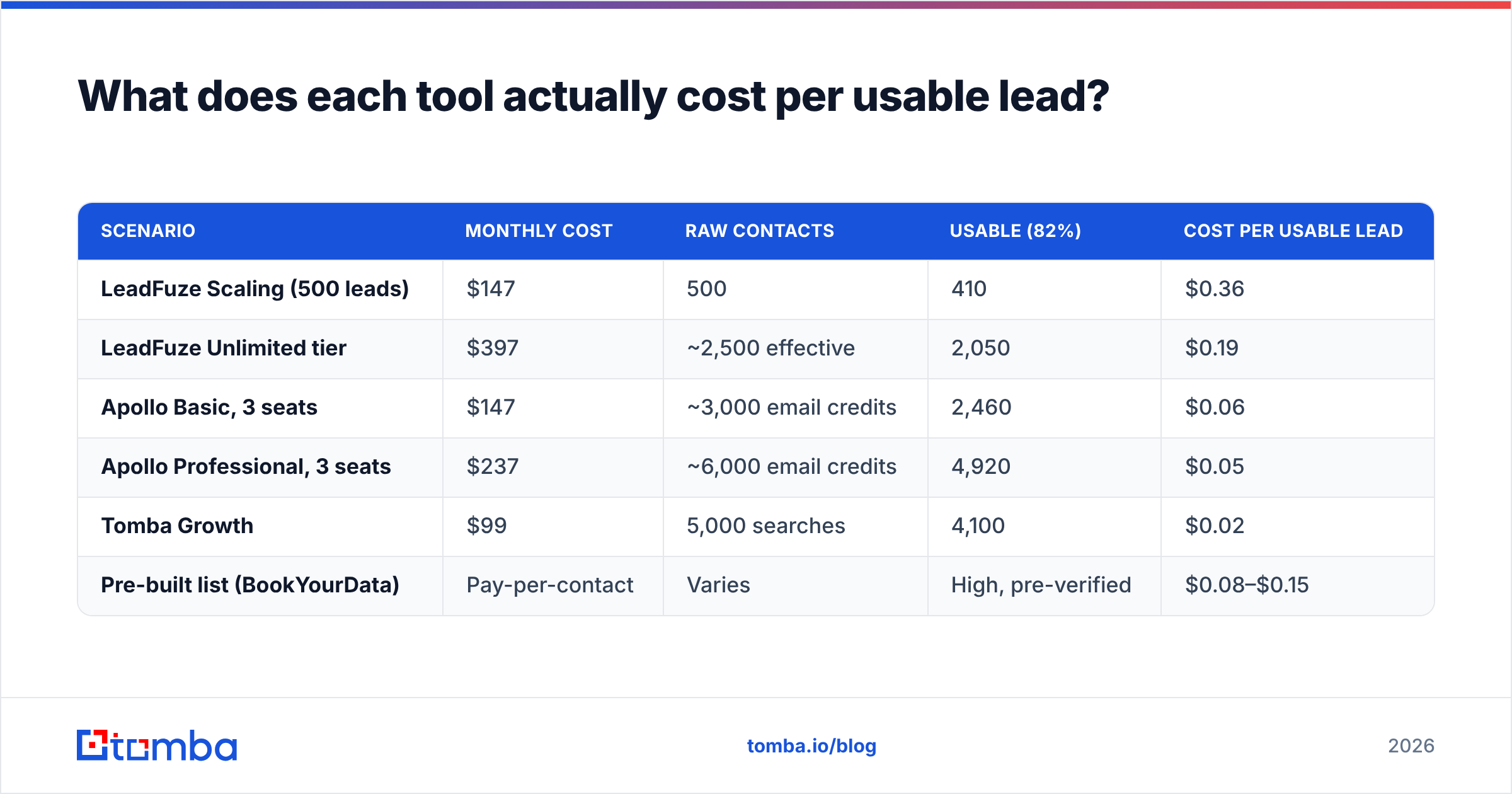
Take 1,000 raw contacts. Assume an 82% deliverable rate after independent verification on a mid-quality B2B list. That leaves 820 usable contacts.
| Scenario | Monthly cost | Raw contacts | Usable (82%) | Cost per usable lead |
|---|---|---|---|---|
| LeadFuze Scaling (500 leads) | $147 | 500 | 410 | $0.36 |
| LeadFuze Unlimited tier | $397 | ~2,500 effective | 2,050 | $0.19 |
| Apollo Basic, 3 seats | $147 | ~3,000 email credits | 2,460 | $0.06 |
| Apollo Professional, 3 seats | $237 | ~6,000 email credits | 4,920 | $0.05 |
| Tomba Growth | $99 | 5,000 searches | 4,100 | $0.02 |
| Pre-built list (BookYourData) | Pay-per-contact | Varies | High, pre-verified | $0.08–$0.15 |
Two honest caveats on that table. First, Apollo's credit counts include contacts you may not want. Raw volume is not targeted volume, and a sloppy Apollo export at $0.06 per lead is worse value than a precise LeadFuze list at $0.36. Second, per-contact vendors like BookYourData invert the model. You buy a verified list outright with no subscription. That fits one-off campaigns, or teams that prospect in bursts rather than year-round.
The takeaway is not "the cheapest wins." It is that cost per usable lead swings by more than 10x here. The sticker price tells you almost nothing about where you will land.
What about the stack approach instead of one platform?#
The fastest-growing pattern in 2026 outbound is unbundling. You pick the best tool for each layer instead of paying platform tax for five mediocre features.
A typical unbundled stack:
- Sourcing — LinkedIn Sales Navigator, a scraper, or a signal tool like LeadFuze for ICP-driven list building.
- Contact resolution — an email finder that takes a name plus domain and returns a verified work address, plus domain search when you want everyone at a target account.
- Verification — an independent verifier with catch-all handling, run right before send, not at list-build time.
- Enrichment — data enrichment to fill firmographics and technographics for personalization tokens.
- Sending — a dedicated sequencer with inbox rotation and warmup.
The reason this beats an all-in-one for many teams: each layer is independently replaceable. When your verifier degrades, you swap it in an afternoon instead of migrating an entire platform. And you stop paying per-seat for people who never send an email.
The counterargument is real too — more vendors, more integrations, more things that break at 2 a.m. Is your team under five people with nobody owning tooling? Then a single platform like Apollo is the lower-risk call. If you go unbundled, the Tomba API or a Zapier-style connector links the layers without engineering time.
LeadFuze vs Apollo.io: is there a clear winner?#
No single winner — but there is a clear decision rule.
Choose Apollo.io if outbound is new to your team, you have fewer than 10 reps, and you want one tool that takes you from search to sent. Accept that you will need to verify before sending and watch phone credit burn.
Choose LeadFuze if list quality and ICP precision matter more than volume, you already own your outreach stack, or you run an agency where per-seat pricing would be punishing. Accept that you are buying one layer, not a platform.
Choose neither if what you need is accurate contact data at low cost and you already have sending sorted. That is the largest group in practice, and it is the group that overpays most — buying a $400/mo platform to use 15% of it.
Before you sign an annual contract, run the same 50-contact test list through both free tiers plus one dedicated finder. Measure three things: match rate (how many contacts did it find?), bounce rate on a small warm send, and how many fields you had to clean by hand. That test costs an afternoon and routinely changes the decision. Check current Tomba pricing if you want a third data point that is not tied to seats.
How do you avoid burning your domain with either tool?#
Both platforms will happily hand you a list that destroys your sender reputation. The guardrails are on you.
- Verify at send time, not build time. A contact verified 60 days ago is a guess. B2B data decays at roughly 2.5% per month.
- Segment catch-all domains into their own low-volume campaign rather than mixing them into your main send.
- Cap daily volume per inbox at 30–50 cold sends regardless of what the platform allows.
- Watch bounce rate in real time and kill any campaign crossing 3%.
- Never import a purchased list straight into a sequencer without a verification pass — this single step prevents most deliverability disasters.
None of that is exotic. It is just the part that platform demos skip, and it matters more than which vendor you picked.
Final recommendation#
Choosing today? On LeadFuze vs Apollo.io, the rule is short. Take Apollo.io for consolidated outbound on a small team. Take LeadFuze for precision list building when your sending stack already exists. Take an unbundled data layer when neither bundle matches how you actually work.
Whichever you land on, the data layer is where campaigns live or die. Start with the Tomba Email Finder. The free tier gives you 25 searches a month to benchmark match rate against whatever LeadFuze or Apollo returns for the same accounts. Paid plans start at $49/mo with no per-seat charge. Run the same 50 names through all three, compare bounce rates, and let the numbers decide instead of the pricing page.
Related guides#
// get started
Find, verify and enrich your first contacts today
Start on the free plan with 25 searches a month, then scale when your team is ready.
Free plan · No credit card required · GDPR & CCPA
// about the author