LeadGenius Alternatives: 9 Better B2B Data Tools for 2026
LeadGenius sells managed, human-verified B2B data at enterprise prices and enterprise timelines. Here are nine alternatives that trade white-glove research for speed, self-serve access, and per-credit pricing you can actually forecast.
TL;DR
- LeadGenius is a managed B2B data service: human researchers build custom datasets to your spec. It is not a self-serve email finder, and it is not priced like one — expect annual contracts in the five figures.
- You should look for LeadGenius alternatives if you need data this week, if your spend has to be predictable per-record, or if your team is under ~20 reps and can't justify a dedicated research vendor.
- The nine tools below split into three buckets: managed/custom research (Clay, BookYourData), self-serve contact data + APIs (Tomba, Apollo, Cognism), and enrichment-first platforms (Clearbit/HubSpot Breeze, People Data Labs, Coresignal).
- Cheapest credible starting point: a self-serve finder with a real free tier — Tomba starts free at 25 searches/month and goes to $49/mo, versus a LeadGenius quote you have to book a call to see.
- Match the tool to the job: hard-to-find custom attributes → managed research. Volume email discovery and verification → API-first finder. Firmographic fill-in on existing records → enrichment platform.
What is LeadGenius and who actually uses it?#
LeadGenius is a managed data provider. Instead of handing you a search interface and letting you pull contacts, it assigns a blend of software and human researchers to build a dataset matching criteria you define — "SaaS companies in DACH running Shopify Plus, with a named head of e-commerce, plus their store's SKU count."
That last part is the whole pitch. LeadGenius competes on custom attributes that don't exist in any database, because a person went and found them. Their own site leans hard on this: bespoke fields, human verification, delivery into your CRM.
Who it fits:
- Enterprise ABM teams with a target account list already defined and budget for research headcount they'd rather outsource.
- RevOps at companies with unusual ICPs — industrial suppliers, healthcare networks, franchise operators — where standard firmographics are useless.
- Teams whose data needs are project-shaped, not continuous: one big list per quarter, not 400 lookups a day.
Who it does not fit: almost everyone else. If your ICP is "VP of Marketing at B2B SaaS, 50-500 employees," you are paying managed-research prices for data that sits in a dozen self-serve databases at a fraction of the cost.

Why do teams look for LeadGenius alternatives?#
Four reasons come up repeatedly in G2 reviews and buyer conversations:
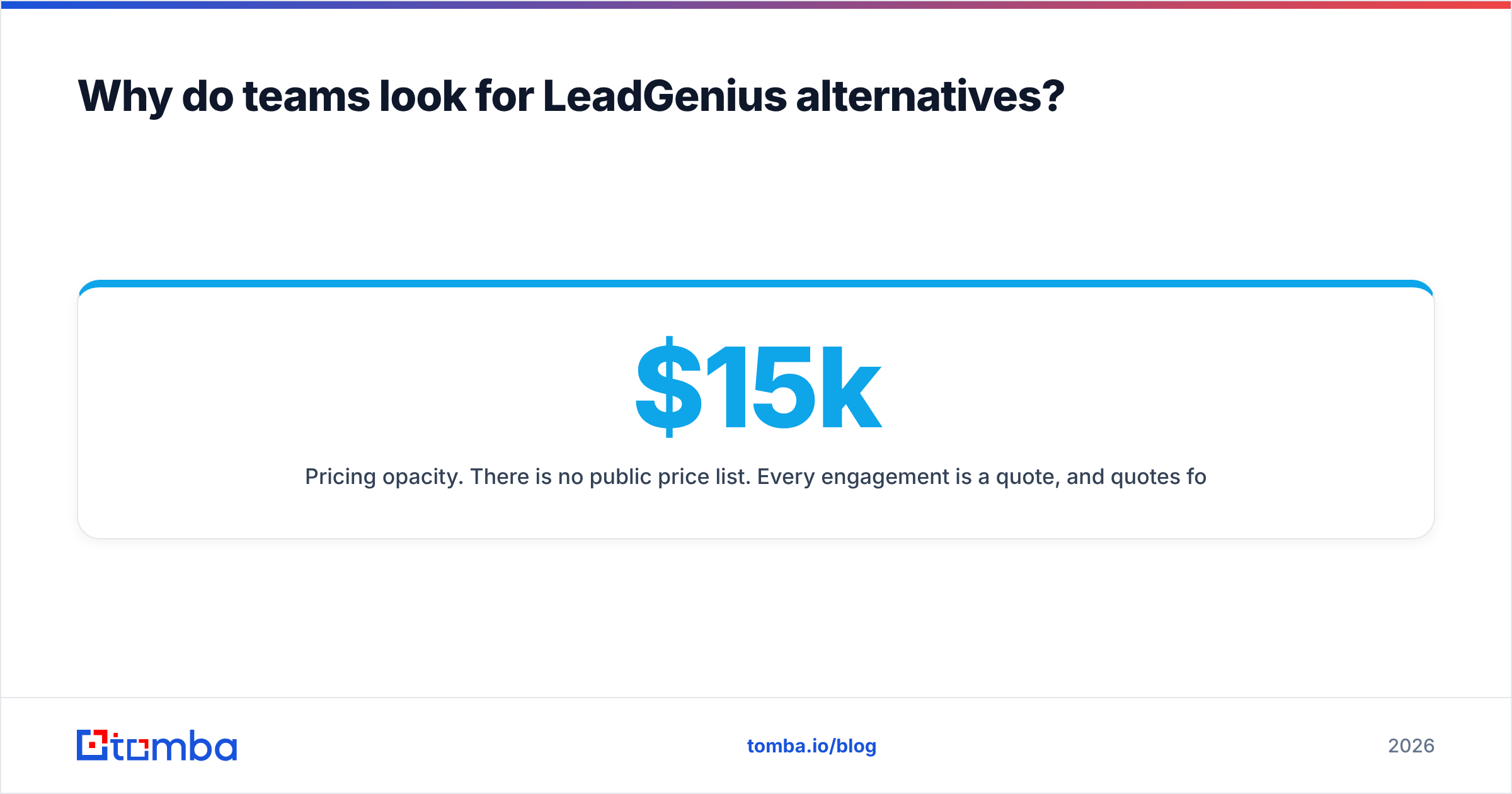
Pricing opacity. There is no public price list. Every engagement is a quote, and quotes for managed research land in the $15k-$50k/year range depending on volume and attribute complexity. You cannot pilot it for $99.
Turnaround time. Human research is measured in days and weeks, not milliseconds. If your SDR needs an email address right now because a prospect just replied on LinkedIn, a managed vendor is the wrong shape of tool.
No API-first workflow. Modern GTM stacks want programmatic enrichment — a webhook fires, a record gets filled, a sequence starts. Managed delivery into a CSV or a CRM sync is a batch model.
Minimum commitment. Annual contracts with minimums price out seed-stage and mid-market teams who need 5,000 verified contacts, not 500,000.
None of that makes LeadGenius bad. It makes it specific. The question is whether your problem is actually "I need bespoke research" or "I need contact data quickly and cheaply" — and most teams discover it's the second one.
What are the best LeadGenius alternatives in 2026?#
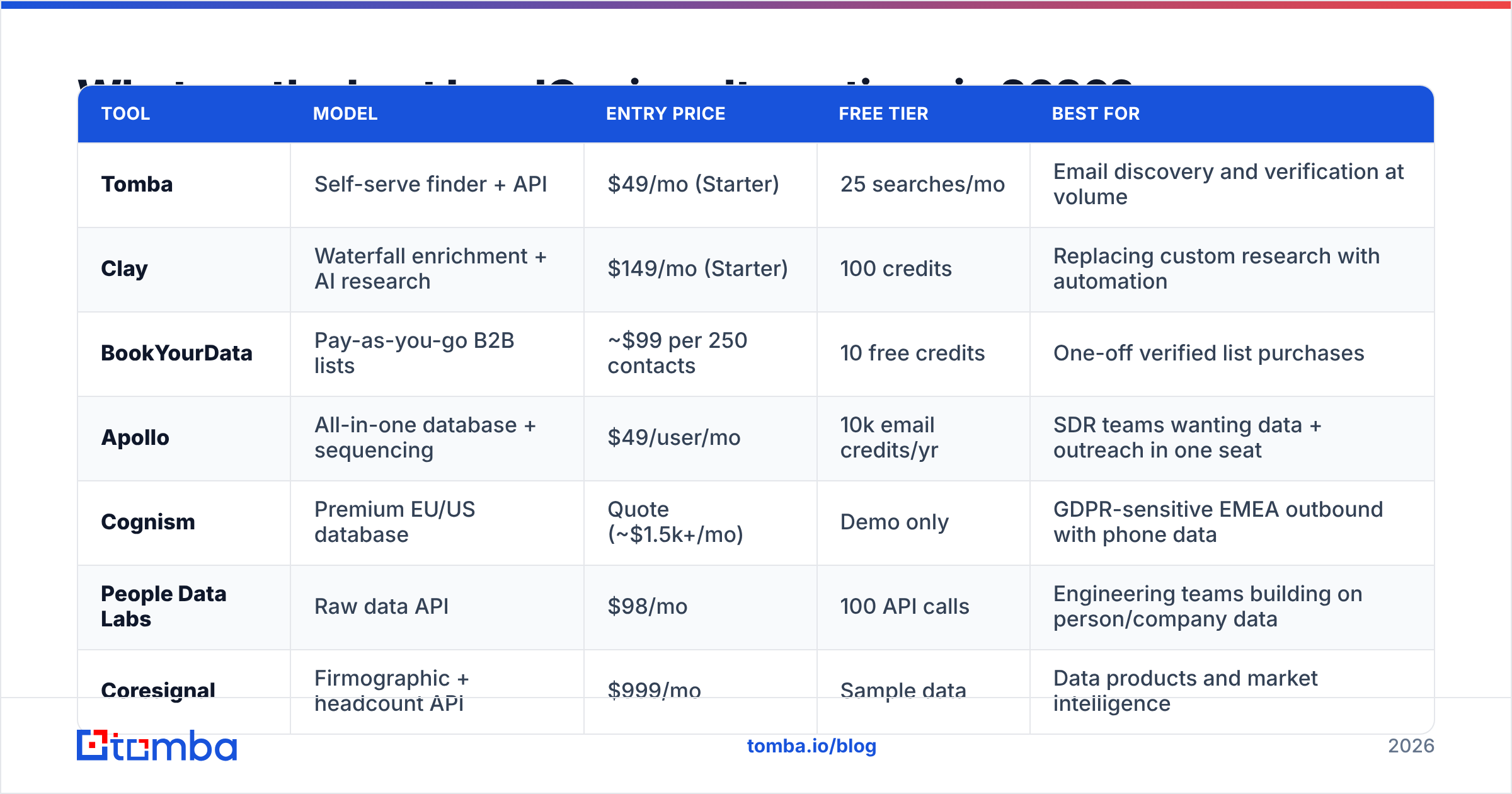
Here's the comparison across the dimensions that actually change your decision. Prices are list, as published by each vendor at time of writing.
| Tool | Model | Entry price | Free tier | Best for |
|---|---|---|---|---|
| Tomba | Self-serve finder + API | $49/mo (Starter) | 25 searches/mo | Email discovery and verification at volume |
| Clay | Waterfall enrichment + AI research | $149/mo (Starter) | 100 credits | Replacing custom research with automation |
| BookYourData | Pay-as-you-go B2B lists | ~$99 per 250 contacts | 10 free credits | One-off verified list purchases |
| Apollo | All-in-one database + sequencing | $49/user/mo | 10k email credits/yr | SDR teams wanting data + outreach in one seat |
| Cognism | Premium EU/US database | Quote (~$1.5k+/mo) | Demo only | GDPR-sensitive EMEA outbound with phone data |
| People Data Labs | Raw data API | $98/mo | 100 API calls | Engineering teams building on person/company data |
| Coresignal | Firmographic + headcount API | $999/mo | Sample data | Data products and market intelligence |
| Clearbit (HubSpot Breeze) | Enrichment in-CRM | Bundled with HubSpot | Limited | HubSpot-native enrichment |
| LeadGenius | Managed human research | Quote (annual) | No | Bespoke attributes, enterprise ABM |
Read that table as three lanes, not nine competitors. Pick your lane first.
Lane 1 — You need contact data fast and cheap#
Tomba. The closest thing to a direct swap if what you valued about LeadGenius was "verified contacts land in my CRM." Tomba's email finder resolves name + domain to a work address, domain search pulls every known contact at a company, and the email verifier runs SMTP-level checks before you send. Pricing is public and linear: free (25 searches/mo), Starter $49/mo, Growth $99/mo, Pro $249/mo, Enterprise custom — see Tomba pricing for credit allocations. The Tomba API covers the programmatic gap that managed research leaves open.
Where it doesn't replace LeadGenius: it won't tell you a prospect's Shopify app stack or how many retail locations they operate. It finds and verifies contacts. That's the scope.
Apollo. The default mid-market pick. A ~275M-contact database bundled with sequencing, dialer, and basic CRM. You get data and execution in one subscription, which matters when your budget is one line item. The tradeoff is data quality variance — Apollo's contributory data model means stale records surface more often than in curated databases, so pairing it with independent verification is standard practice. If you're evaluating it head-to-head, our Apollo alternative breakdown covers the credit-system gotchas.
BookYourData. Worth a serious look if your need is genuinely episodic — the same shape as a LeadGenius engagement, without the annual contract. You buy a list, you get verified contacts, you're done. Pay-as-you-go pricing with a stated accuracy guarantee makes it a clean fit for teams that run two or three campaigns a year and don't want a subscription sitting idle between them. It's a different philosophy from credit-based finders, and for low-frequency buyers it's often the cheaper total cost.
Lane 2 — You need the custom attributes, just automated#
Clay. The most direct conceptual replacement for managed research. Clay chains dozens of data providers into a "waterfall" — try provider A, fall through to B, then C — and layers AI agents that can browse a website and extract an answer to a prompt like "does this company run an affiliate program?" That is, functionally, what a LeadGenius researcher does, at software speed and software margins.
Cost reality check: Clay's credit model gets expensive fast at volume, and the platform has a genuine learning curve. Budget a week of setup before it produces anything useful. But for the "bespoke attribute" use case, it's the strongest 2026 answer.
People Data Labs / Coresignal. If you have engineers, buying raw data access and building your own enrichment logic beats paying for someone else's interface. PDL sells person and company records via API; Coresignal focuses on firmographics, headcount trends, and job-posting signals. Both are infrastructure, not products — no UI worth mentioning, no support hand-holding.
Lane 3 — You need to enrich records you already have#
Clearbit, now HubSpot Breeze Intelligence. Since the HubSpot acquisition, Clearbit's enrichment has folded into HubSpot's data layer. If you're already on HubSpot, this is the lowest-friction enrichment path available and it's partly bundled. If you're not, it's a reason to be. Standalone Clearbit as a product is effectively gone; our Clearbit alternative page tracks where its former users landed.
Cognism. Premium pricing, premium EMEA coverage, and the strongest compliance story in the category — notified-contact status against European DNC lists, which matters if you're cold calling in the UK or Germany. Their Diamond Data phone verification is the real differentiator. Expect quote-based pricing north of $1,500/month, which puts it closer to LeadGenius's tier than to the self-serve tools.
How do you choose between managed research and self-serve data?#
Run this decision in order. Stop at the first "yes."
- Do you need an attribute that no database contains? (SKU counts, equipment brands, store formats, whether they use a specific niche tool.) → Managed research or Clay. Everything else on this list will fail you.
- Is your data need under 10,000 contacts a year, in bursts? → Pay-as-you-go list purchase. Subscriptions are waste at that volume.
- Do you need contacts inside an automated workflow — CRM trigger, webhook, enrichment on form fill? → API-first finder. Managed delivery can't do this at all.
- Are you selling into EMEA with phone-heavy outbound? → Cognism or a specialist with verified mobile data and compliance flags.
- Is your ICP standard B2B (SaaS, agencies, services, 10-1,000 employees)? → Self-serve finder plus verification. You are overpaying for anything fancier.
- Do you already live in a CRM that sells enrichment? → Start with the native option before adding a vendor. The integration tax is real.
Most teams that arrive at LeadGenius's pricing page belong in bucket 5 or 6 and don't realize it.

What does data accuracy actually mean across these tools?#
Accuracy claims are the most abused number in this category, because every vendor measures it differently. Three definitions get used interchangeably:
- Deliverability rate — what percentage of emails don't bounce. This is the only number that affects your sender reputation, and it's the one you should demand.
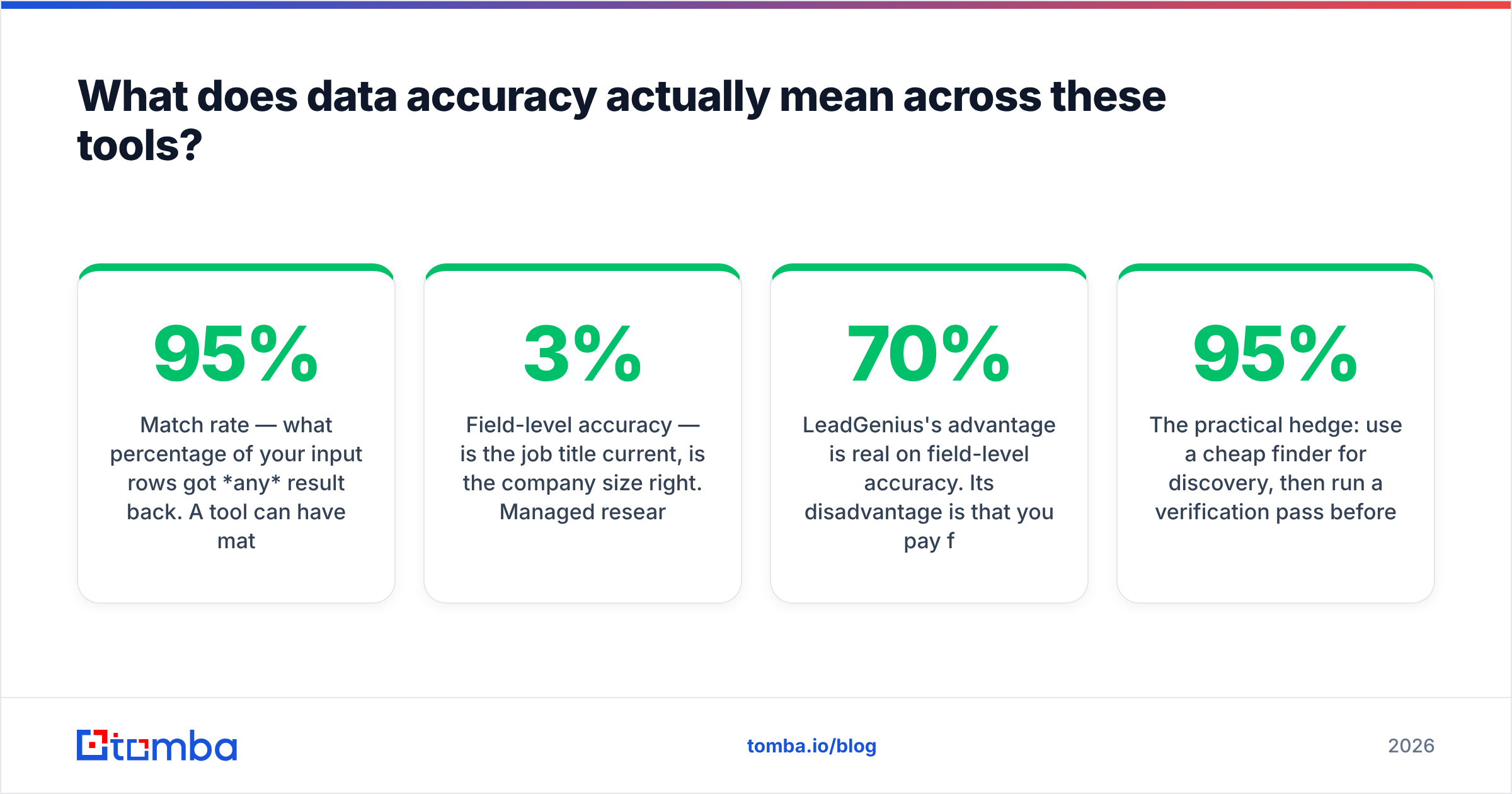
- Match rate — what percentage of your input rows got any result back. A tool can have 95% match rate and 60% deliverability if it's guessing patterns.
- Field-level accuracy — is the job title current, is the company size right. Managed research wins here because a human checked; databases decay at roughly 2-3% per month as people change jobs.
LeadGenius's advantage is real on field-level accuracy. Its disadvantage is that you pay for that verification on every record, including the 70% of records where a pattern-matched email would have worked fine.
The practical hedge: use a cheap finder for discovery, then run a verification pass before send. A catch-all domain — where the server accepts everything and tells you nothing — needs dedicated handling, which is why a catch-all verifier exists as a separate step. Skipping verification is how teams with "95% accurate" lists end up with 12% bounce rates and a burned domain.
If you're running volume, a bulk email finder workflow — upload, enrich, verify, export — reproduces most of the managed-delivery experience at per-credit cost.
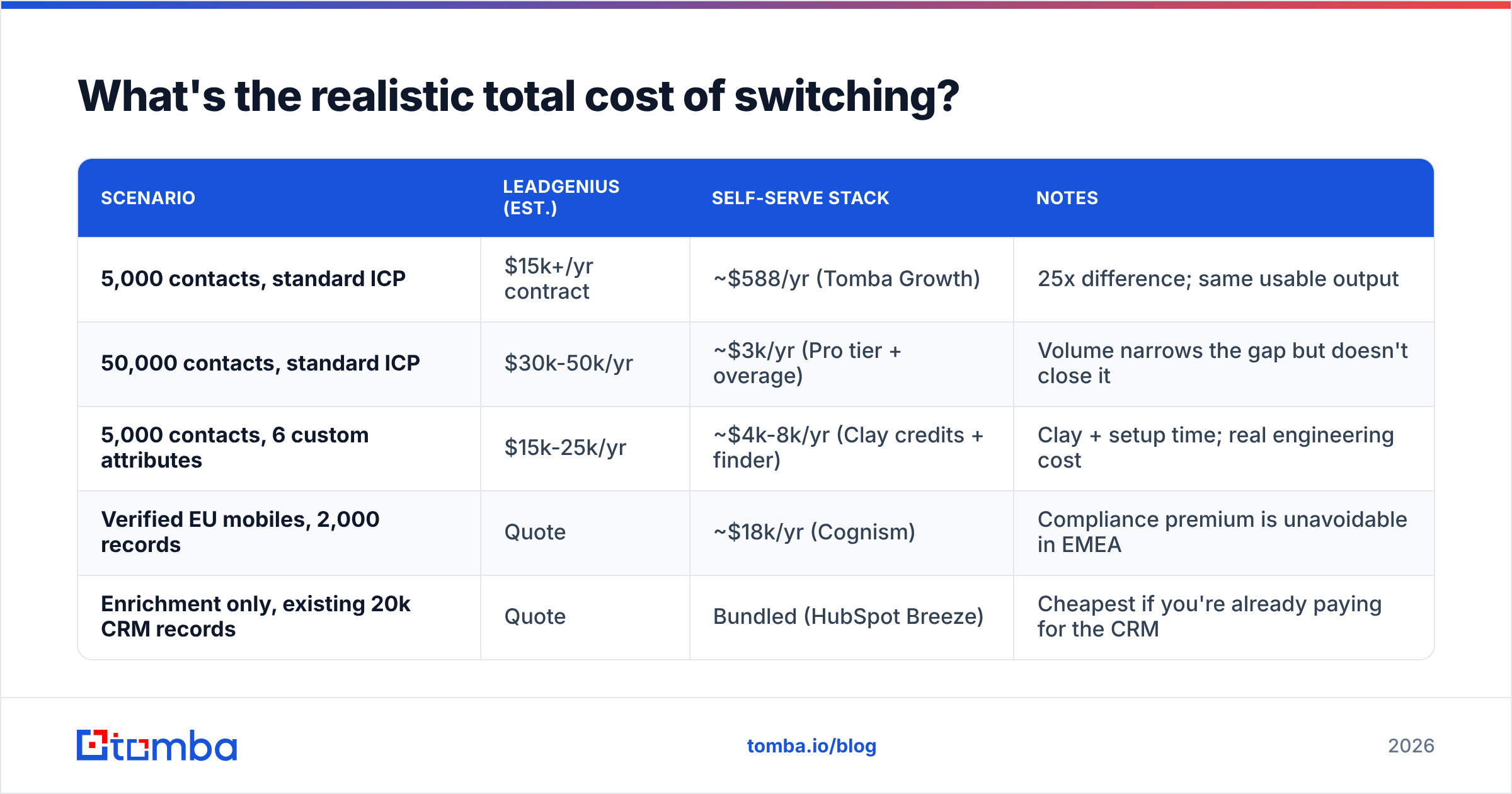
What's the realistic total cost of switching?#
| Scenario | LeadGenius (est.) | Self-serve stack | Notes |
|---|---|---|---|
| 5,000 contacts, standard ICP | $15k+/yr contract | ~$588/yr (Tomba Growth) | 25x difference; same usable output |
| 50,000 contacts, standard ICP | $30k-50k/yr | ~$3k/yr (Pro tier + overage) | Volume narrows the gap but doesn't close it |
| 5,000 contacts, 6 custom attributes | $15k-25k/yr | ~$4k-8k/yr (Clay credits + finder) | Clay + setup time; real engineering cost |
| Verified EU mobiles, 2,000 records | Quote | ~$18k/yr (Cognism) | Compliance premium is unavoidable in EMEA |
| Enrichment only, existing 20k CRM records | Quote | Bundled (HubSpot Breeze) | Cheapest if you're already paying for the CRM |
Two costs don't show up in that table. Switching cost: exporting your existing LeadGenius deliverables and remapping fields into a new schema takes a RevOps person a week. Learning cost: Clay in particular will eat more time than the license fee suggests.
And one cost that shows up on the other side: with self-serve tools, you own the quality gate. Nobody is checking the list before it reaches your sequencer. Build verification into the workflow or you'll pay for it in deliverability.
Which LeadGenius alternative should you actually pick?#
Short answers, by profile:
- Seed-stage startup, standard B2B ICP, tight budget → Tomba free tier, upgrade to Starter at $49/mo when you outgrow 25 searches. Add verification before every send.
- 20-person SDR org wanting one tool → Apollo, with an independent verifier layered on top. The bundled sequencer offsets the data quality variance.
- Two or three list-buys a year, no ongoing need → BookYourData. Pay per list, skip the subscription, done.
- RevOps team with genuinely unusual attributes → Clay, and budget real setup time.
- EMEA phone-heavy outbound with compliance exposure → Cognism. It's expensive because the compliance work is expensive.
- Engineering team building a data product → People Data Labs or Coresignal at the API layer.
- You genuinely need humans researching things software can't find → Stay on LeadGenius. It's the right tool for that job and nothing here replicates it.
The mistake is assuming the enterprise-priced option is the safe one. For a standard B2B ICP, managed research buys you verification you could get for a few cents a record, packaged in an annual contract you can't exit.
Ready to test the cheap end first?#
Before you renew a five-figure data contract, spend twenty minutes proving whether you actually need it. Run 25 of your hardest-to-find target contacts through the Tomba Email Finder on the free tier — no card, no call, no quote. If it resolves them, your data problem was never a research problem. If it doesn't, you've now got a concrete, evidence-backed case for what managed research is buying you.
Either way you learn something in an afternoon that a procurement cycle would take a quarter to tell you.
Related guides#
// get started
Find, verify and enrich your first contacts today
Start on the free plan with 25 searches a month, then scale when your team is ready.
Free plan · No credit card required · GDPR & CCPA
// about the author