LeadGenius vs Apollo.io: Data Quality, Pricing, and Fit
LeadGenius sells human-verified custom datasets. Apollo.io sells a 200M+ contact database with a sequencer attached. They are not the same purchase — here is how pricing, accuracy, and workflow actually compare in 2026.
TL;DR
- LeadGenius and Apollo.io are not competitors in the normal sense. LeadGenius sells managed, human-verified research against a custom spec. Apollo.io sells self-serve access to a very large contact database plus a built-in sequencer.
- Apollo wins on speed, price transparency, and workflow consolidation. At list price it starts free and runs roughly $49–$119 per user per month depending on tier.
- LeadGenius wins when your ICP is not in anyone's database — non-English markets, store-level retail data, headcount-by-department signals, custom web-sourced attributes. Expect a custom quote, typically annual and five figures.
- Neither is a great fit if all you need is a verified work email for a name and a domain. That job costs a fraction of either platform.
- The honest recommendation: run both against the same 500-row list, measure bounce rate and coverage yourself, and only pay for the layer you actually can't replicate.
What are LeadGenius and Apollo.io?#
LeadGenius is a data-as-a-service company. You bring a spec — "every DTC brand in Germany running Shopify Plus with 50–200 employees and a named head of ecommerce" — and a blended machine-plus-human research team builds that dataset for you, then keeps it refreshed. The output arrives as a feed into your CRM or warehouse. There is no self-serve search bar for you to poke at on a Tuesday afternoon.
Apollo.io is the opposite shape. It is a sales intelligence platform built around a shared database that the company advertises at north of 200 million contacts and 60 million companies, with filters, a Chrome extension, email sequencing, dialer, and basic CRM functionality layered on top. You sign up, filter, export, and start sending in the same session.
So the real question behind "LeadGenius vs Apollo.io" is not which tool is better. It is which failure mode is more expensive for you: paying for records you could have found yourself, or wasting a quarter because the records you needed didn't exist in any off-the-shelf database.
How do LeadGenius and Apollo.io actually differ?#
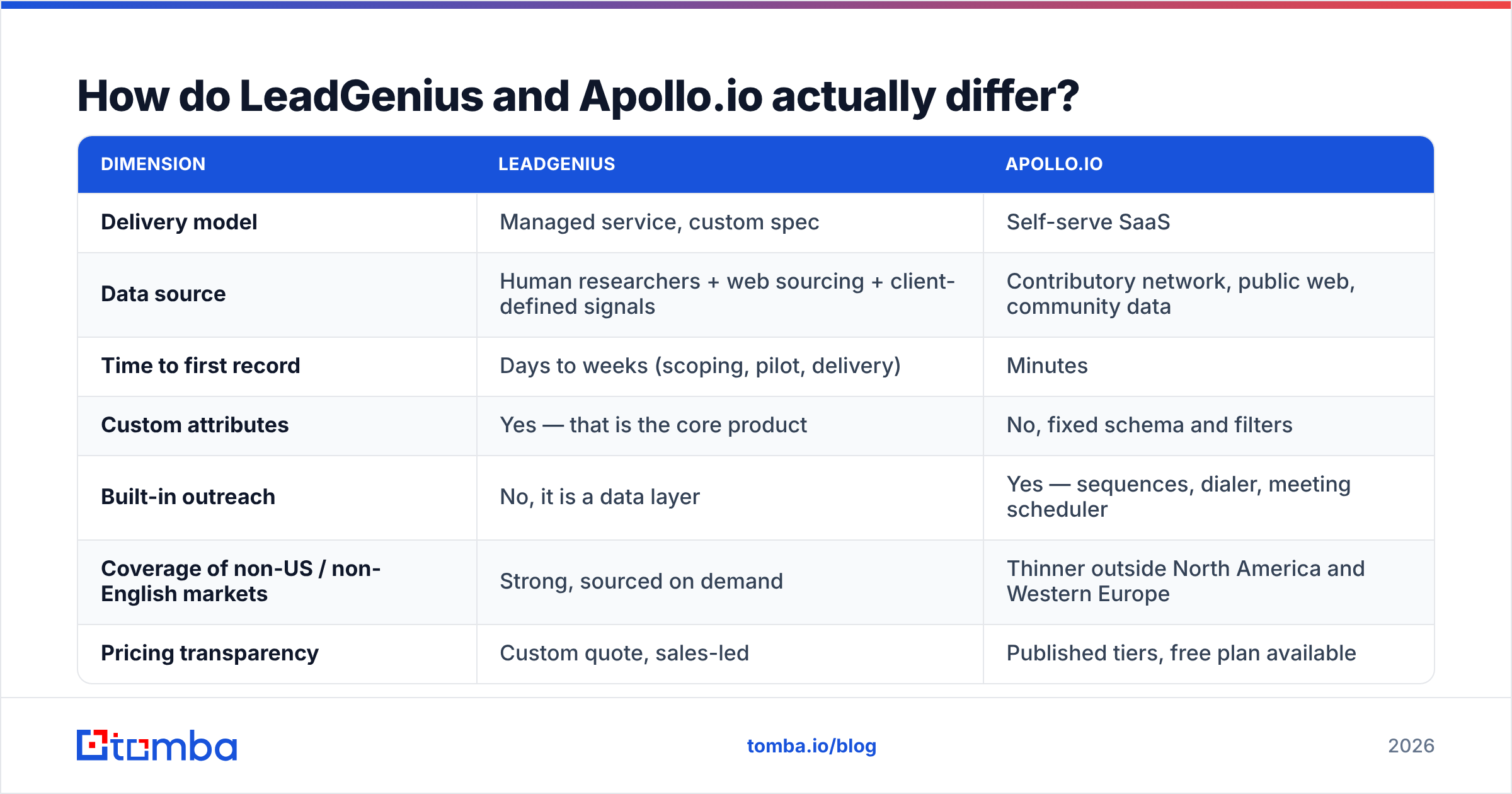
| Dimension | LeadGenius | Apollo.io |
|---|---|---|
| Delivery model | Managed service, custom spec | Self-serve SaaS |
| Data source | Human researchers + web sourcing + client-defined signals | Contributory network, public web, community data |
| Time to first record | Days to weeks (scoping, pilot, delivery) | Minutes |
| Custom attributes | Yes — that is the core product | No, fixed schema and filters |
| Built-in outreach | No, it is a data layer | Yes — sequences, dialer, meeting scheduler |
| Coverage of non-US / non-English markets | Strong, sourced on demand | Thinner outside North America and Western Europe |
| Pricing transparency | Custom quote, sales-led | Published tiers, free plan available |
| Typical buyer | RevOps / data team at a 200+ headcount company | SDR team, founder, agency, solo seller |
| Contract shape | Annual, project-scoped | Monthly or annual, per seat |
The pattern is consistent: LeadGenius optimises for precision on a schema nobody else has, Apollo optimises for volume and velocity on a schema everybody shares.
That second part matters more than vendors admit. If your competitors buy the same Apollo filters you do, you are emailing the same people on the same week with the same trigger. The database is a commodity; what you do downstream of it is not.

What does each one cost in 2026?#
Apollo publishes its pricing. LeadGenius does not. That single fact tells you most of what you need about how each company sells.
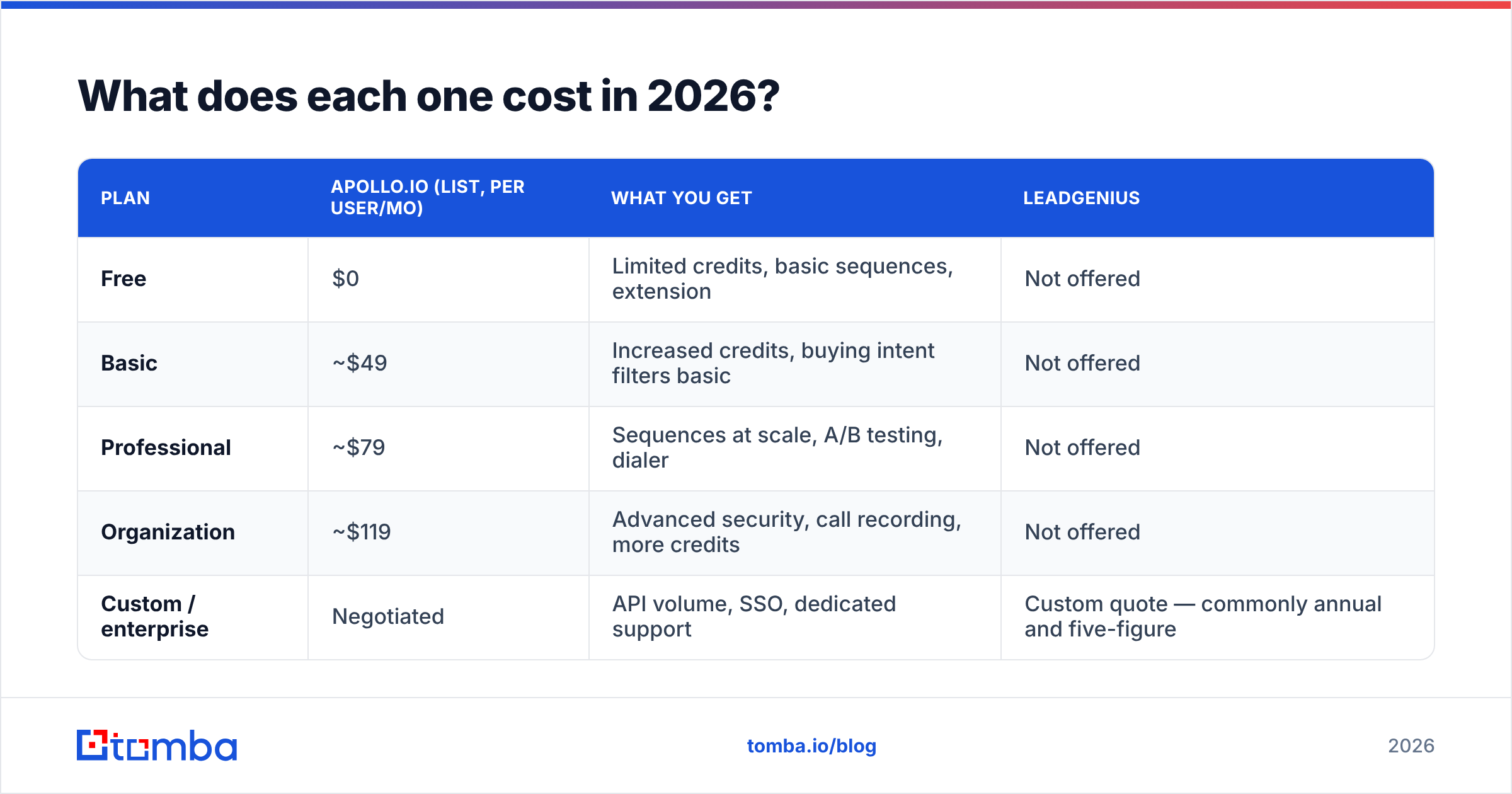
| Plan | Apollo.io (list, per user/mo) | What you get | LeadGenius |
|---|---|---|---|
| Free | $0 | Limited credits, basic sequences, extension | Not offered |
| Basic | ~$49 | Increased credits, buying intent filters basic | Not offered |
| Professional | ~$79 | Sequences at scale, A/B testing, dialer | Not offered |
| Organization | ~$119 | Advanced security, call recording, more credits | Not offered |
| Custom / enterprise | Negotiated | API volume, SSO, dedicated support | Custom quote — commonly annual and five-figure |
Two caveats before you budget from that table. First, Apollo's published rates are for annual billing; monthly billing costs more, and credit consumption is the variable that bites. Export limits, mobile-number reveals, and API calls all draw from the same pool, and teams routinely discover mid-quarter that "unlimited email credits" does not mean unlimited usable email credits. Check the current Apollo pricing page before you commit — tiers shift.
Second, LeadGenius pricing genuinely depends on the spec. A narrow list of 3,000 accounts with six custom attributes prices very differently from an always-on feed of 400,000 records refreshed quarterly. Buyers on review sites like G2 consistently describe it as an annual commitment, not a credit card purchase. Budget accordingly and ask for a paid pilot before the full contract.
Which one has better data quality?#
Wrong question, and it is the question most comparison posts answer badly. "Better data" is meaningless without naming the field.
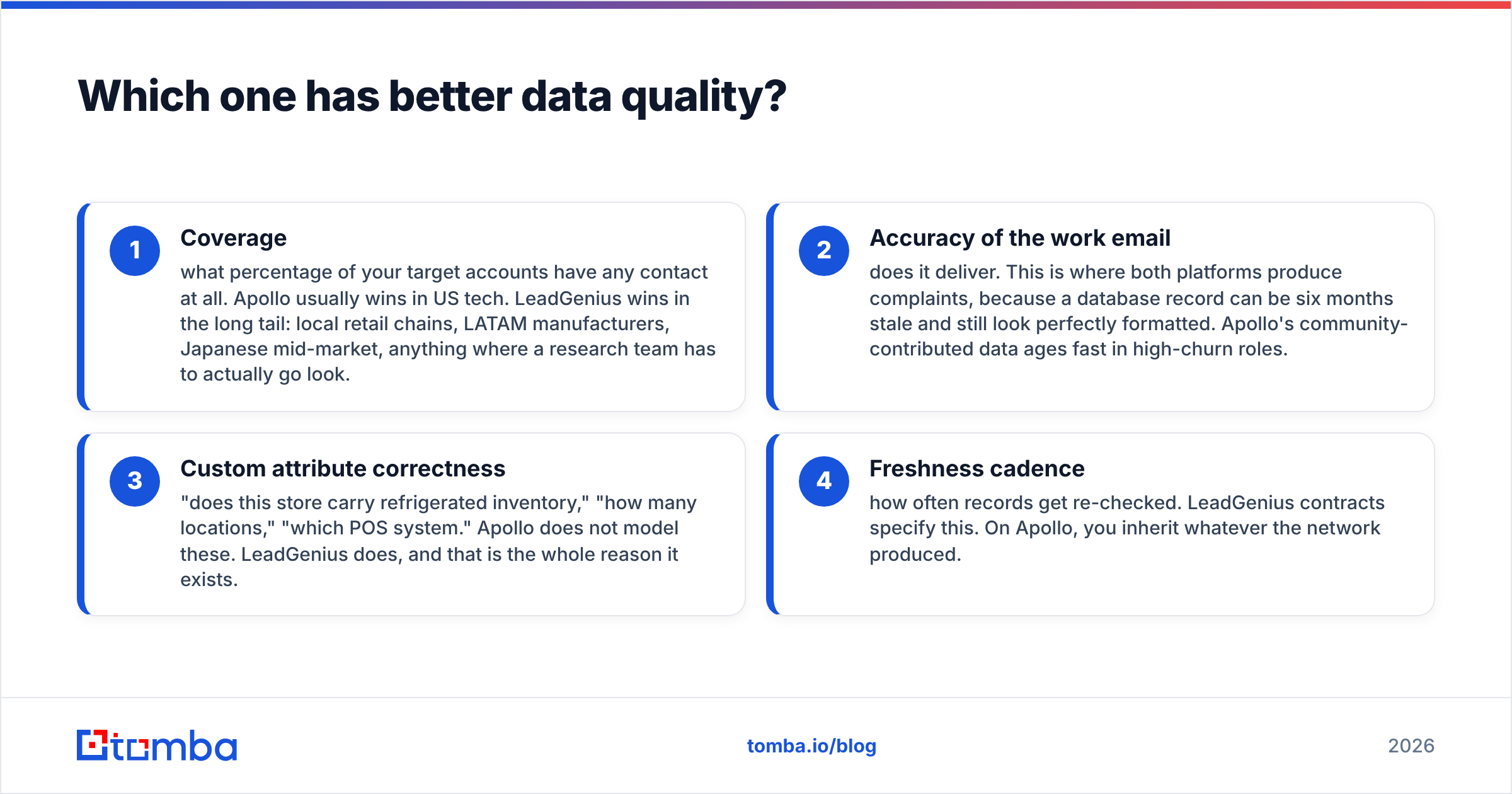
Break quality into four separate things:
- Coverage — what percentage of your target accounts have any contact at all. Apollo usually wins in US tech. LeadGenius wins in the long tail: local retail chains, LATAM manufacturers, Japanese mid-market, anything where a research team has to actually go look.
- Accuracy of the work email — does it deliver. This is where both platforms produce complaints, because a database record can be six months stale and still look perfectly formatted. Apollo's community-contributed data ages fast in high-churn roles.
- Custom attribute correctness — "does this store carry refrigerated inventory," "how many locations," "which POS system." Apollo does not model these. LeadGenius does, and that is the whole reason it exists.
- Freshness cadence — how often records get re-checked. LeadGenius contracts specify this. On Apollo, you inherit whatever the network produced.
The practical consequence: the accuracy problem you feel day to day is almost always #2, and #2 is a solvable problem independent of which database you buy. Running any exported list through a dedicated email verifier before it touches your sending domain routinely cuts bounce rates from the high single digits to under 2%. Vendors will tell you their data is verified. Verify it again anyway — the cost of a verification pass is measured in cents, and the cost of a burned sending domain is measured in weeks.
If your list contains a lot of ambiguous domains, add a catch-all verifier step too. Catch-all domains accept everything at the SMTP layer and tell you nothing, and they are the single biggest source of "verified" addresses that still bounce.
What are the hidden costs nobody quotes you?#
Both models have them, and they are different in kind.
With Apollo, the hidden cost is seats and credits. Pricing is per user, so a six-person SDR team on Professional is roughly $5,700 a year at list before anyone exports a single extra credit pack. Then the credit ceiling arrives, usually right when a campaign is working. Teams that plan for one number and pay another are not being scammed — they are being metered, and metering rewards the vendor when you succeed.
With LeadGenius, the hidden cost is time and scoping. A managed research engagement requires you to define the spec precisely, review a sample, iterate, and wait. If your GTM motion changes in month three, the dataset you scoped in month one may be partly wrong. That is not a defect of the vendor; it is the nature of bespoke work. It is also why the model suits stable, well-understood ICPs far better than experimental ones.

There is a third cost both models share: integration drag. Data that sits in a CSV produces zero revenue. Whatever you buy needs to land in the CRM, deduped and mapped, with enrichment running on new inbound records automatically. Apollo has native CRM sync. LeadGenius delivers via feed or API. Either way, budget for the RevOps hours — most teams underestimate this by a factor of three.
Who should choose LeadGenius?#
Pick LeadGenius when at least two of these are true:
- Your ICP is defined by an attribute no database carries. Square footage, franchise count, equipment type, regulatory license status, local-language job titles.
- You sell into geographies where community-sourced data is thin. Southeast Asia, Latin America, non-English EMEA.
- You have a data team to receive the feed. Managed data lands best in a warehouse, not an inbox.
- Your annual contract value justifies it. If your ACV is $60K and a correct list wins you three extra deals, a five-figure data contract pays for itself. If your ACV is $400/year, it never will.
- Compliance matters. Sourced-to-spec data with documented provenance is an easier conversation with legal than a community-contributed pool.
Who should choose Apollo.io?#
Pick Apollo when:
- You need to be sending this week. Nothing managed moves that fast.
- You want database plus sequencer in one bill. Consolidation is real value for small teams — fewer tools, fewer integrations, one login.
- Your ICP is mainstream US/EU B2B tech or services. This is where the database is densest.
- You are testing, not committing. The free tier is a genuinely useful way to validate whether your ICP even exists at volume.
- You are per-seat efficient. Two power users on Professional beat eight casual seats on Basic, every time.
Worth noting: if Apollo's pricing structure or export limits are the specific thing pushing you away, the market has narrowed considerably. Dedicated providers like BookYourData sell verified contacts on a pay-as-you-go basis with no seat tax, which suits teams that buy data in bursts rather than continuously. There is also a well-documented list of Apollo alternatives worth scanning before you renew.
Is there a cheaper middle path?#
Yes, and it is the option most teams skip because it doesn't come with a sales rep.
A large share of what companies buy database platforms for is a single operation: given a name and a company domain, return a deliverable work email. That job does not require a 200-million-record subscription or a managed research contract. It requires a finder API and a verification pass.
The assembled stack looks like this:
- Source the account list from whatever you already trust — a niche directory, LinkedIn Sales Navigator, an industry association roster, your own website traffic.
- Resolve contacts at each account using pattern detection and domain-level discovery rather than paid per-record reveals.
- Verify before sending, every time, with no exceptions for "premium verified" vendor labels.
- Enrich only what converts. Running data enrichment on every raw record is waste; run it on records that respond.
- Automate the whole chain via API so no human touches a CSV. A bulk email finder endpoint handles thousands of rows without a seat license.
That stack costs a fraction of either platform under discussion and removes the per-seat tax entirely. It will not replace LeadGenius if you need custom sourced attributes, and it will not replace Apollo's sequencer. It will absolutely replace the part of both bills you are paying for basic contact resolution.
How do you run a fair bake-off in 30 days?#
Don't take anyone's accuracy claim — including the ones in this post. Test it.
- Build a control list. Take 500 accounts you know well, ideally including 100 existing customers whose contact data you can verify against your own CRM.
- Request the same spec from both. For Apollo, run the filters yourself. For LeadGenius, ask for a paid pilot on the same 500 accounts.
- Measure coverage first. What percentage of accounts returned at least one decision-maker with a title you'd actually email?
- Measure deliverability second. Run every returned address through independent verification. Record hard-bounce rate and catch-all rate separately.
- Measure custom-attribute accuracy third — only relevant for LeadGenius, and only if custom attributes are why you're considering it. Spot-check 50 records manually.
- Price per usable record, not per record. Divide total cost by the count of addresses that were both correct and matched your ICP. That number is the only one worth comparing, and it usually reorders the ranking.
Most teams that run this exercise discover their real problem was never the database. It was that 30% of what they bought never should have been emailed, and nobody checked. Compare the Tomba pricing tiers against your per-usable-record math before you sign anything annual — the arithmetic tends to be clarifying.
The verdict#
If you need bespoke data that does not exist anywhere yet, LeadGenius is the right category of purchase and Apollo cannot substitute for it at any price. If you need volume, speed, and a sequencer in one subscription, Apollo is the stronger and dramatically cheaper choice, provided you go in clear-eyed about credit metering and per-seat costs.
And if what you actually need is deliverable work emails for people you can already identify, buy neither. Buy the finder-plus-verifier layer, keep the budget, and spend the difference on the message.
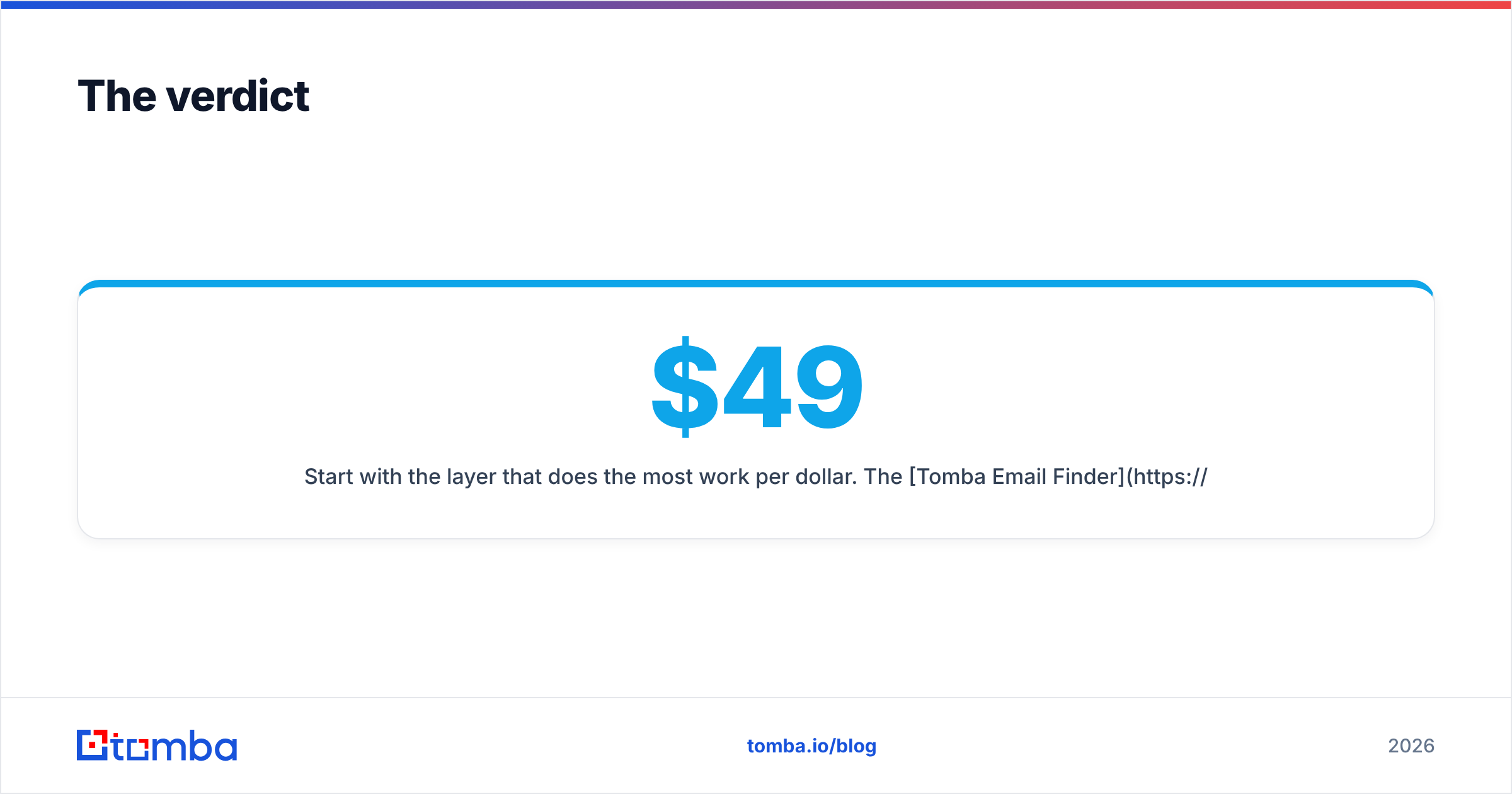
Start with the layer that does the most work per dollar. The Tomba Email Finder resolves verified professional addresses from a name and domain, with a free tier at 25 searches a month, Starter at $49/mo, Growth at $99/mo, and Pro at $249/mo — no per-seat tax, and API access on every paid plan. Test it against your own control list before your next data renewal and see how much of the contract you still need.
Related guides#
// get started
Find, verify and enrich your first contacts today
Start on the free plan with 25 searches a month, then scale when your team is ready.
Free plan · No credit card required · GDPR & CCPA
// about the author