LeadGenius vs Tomba: Which B2B Data Tool Wins in 2026?
LeadGenius sells managed, human-researched custom data. Tomba sells self-serve email finding at $49/mo. Here is the honest breakdown of who should buy which, and where each one falls apart.
TL;DR
- LeadGenius is a managed data service, not a tool. You describe the custom attributes you need, a human-plus-ML research team builds the dataset, and you pay an annual contract with a custom quote.
- Tomba is self-serve infrastructure. You search a domain or a name, get a verified email in seconds, and pay a published price starting at $49/mo after a free tier of 25 searches.
- The real question in LeadGenius vs Tomba is not "which has better data" — it is whether you need bespoke attributes no vendor sells off the shelf, or you need contact data at volume, today, without a procurement cycle.
- Budget gap is the deciding factor for most teams. LeadGenius deals are typically negotiated annual commitments; Tomba's top self-serve tier is $249/mo.
- Many teams run both. LeadGenius for hard-to-source firmographic signals, Tomba for the email and phone layer that sits on top of every record.
What is LeadGenius, and who is it built for?#
LeadGenius is a B2B data company that combines machine learning with a distributed human research workforce. Instead of selling you access to a fixed database, it builds datasets to spec.
That distinction matters more than any feature list. If you need to know which of 4,000 retail chains run more than 50 storefronts, which SaaS companies just posted a job for a Salesforce admin, or which manufacturers list a specific certification on their site, no standard database has that column. LeadGenius researchers go and build it.
The typical buyer is an enterprise RevOps, ABM, or data team with:
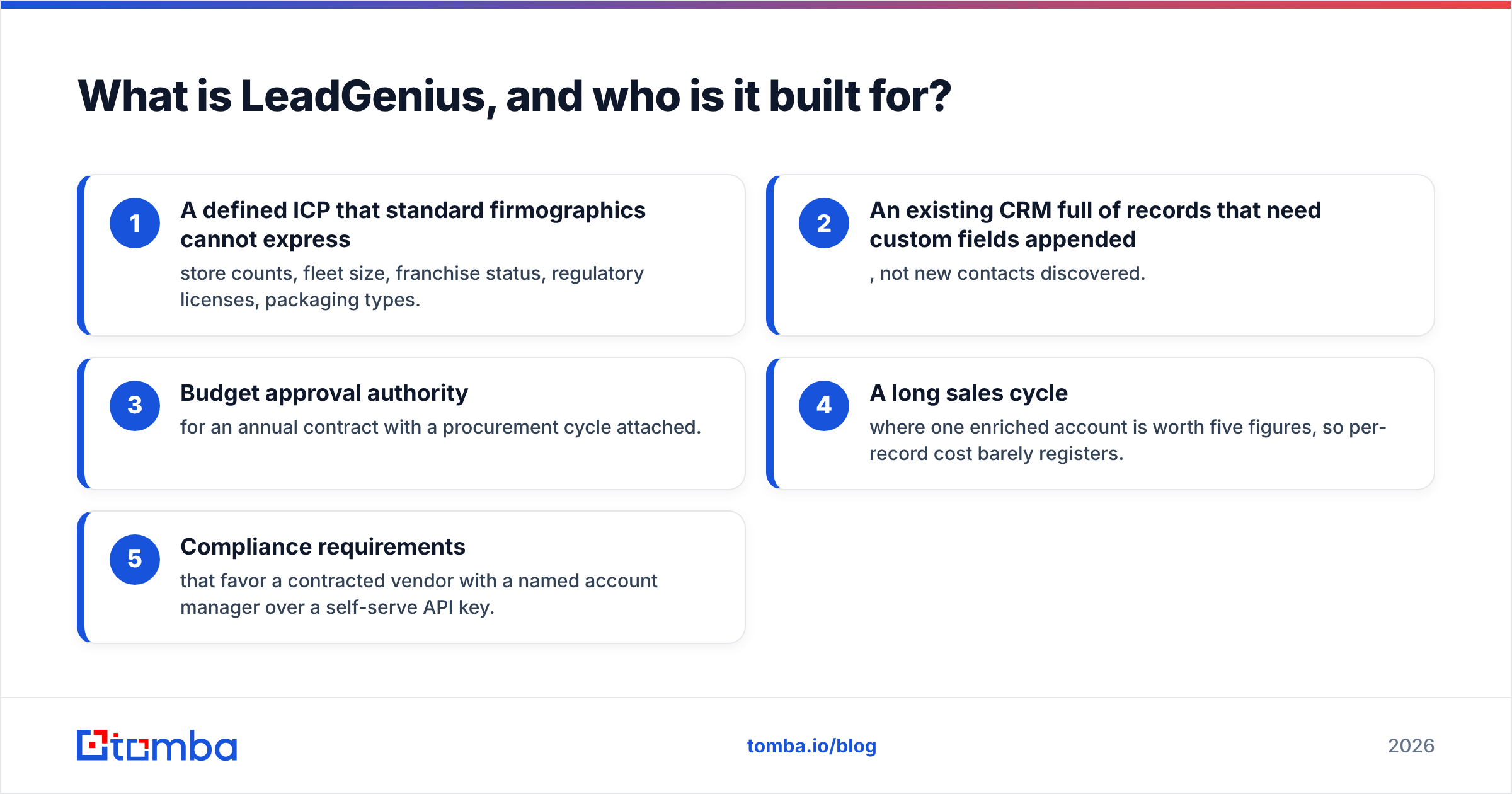
- A defined ICP that standard firmographics cannot express — store counts, fleet size, franchise status, regulatory licenses, packaging types.
- An existing CRM full of records that need custom fields appended, not new contacts discovered.
- Budget approval authority for an annual contract with a procurement cycle attached.
- A long sales cycle where one enriched account is worth five figures, so per-record cost barely registers.
- Compliance requirements that favor a contracted vendor with a named account manager over a self-serve API key.
LeadGenius does not publish pricing. Buyers on G2 consistently describe custom quotes and annual commitments rather than monthly plans. Onboarding is a scoping conversation, not a signup form.
What is Tomba, and how does it differ?#
Tomba sits at the opposite end of the spectrum: it is contact-data infrastructure you can start using in the next ten minutes.
The core product is the email finder — give it a domain plus a first and last name, or just a company domain, and it returns professional email addresses with a confidence score and the public sources it used. Around that core sit the email verifier, domain search, catch-all verification, phone finder, and data enrichment.
The operating model is different in three ways that matter:
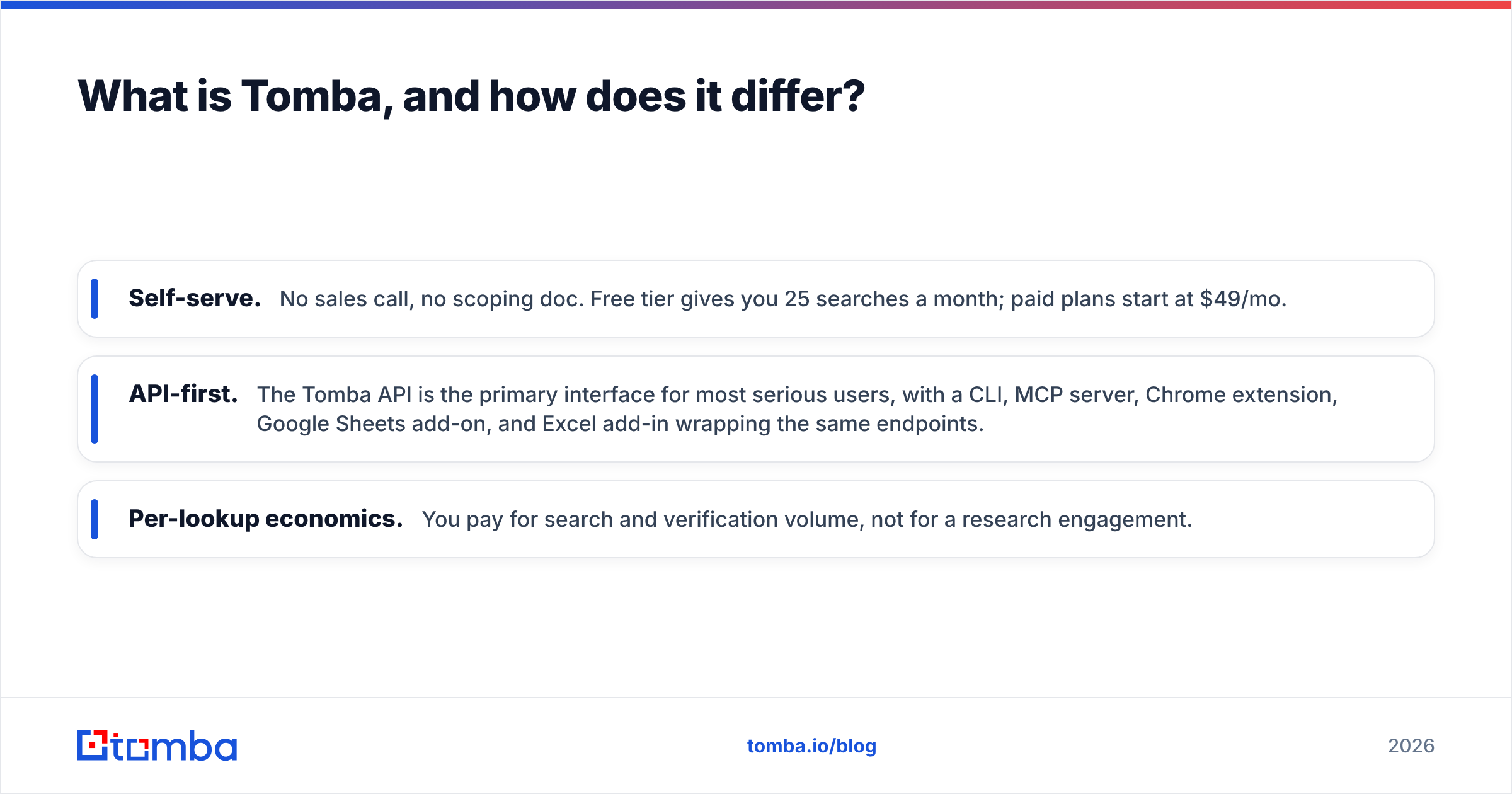
- Self-serve. No sales call, no scoping doc. Free tier gives you 25 searches a month; paid plans start at $49/mo.
- API-first. The Tomba API is the primary interface for most serious users, with a CLI, MCP server, Chrome extension, Google Sheets add-on, and Excel add-in wrapping the same endpoints.
- Per-lookup economics. You pay for search and verification volume, not for a research engagement.
Tomba will never build you a custom "number of retail locations" field. It will also never make you wait six weeks and sign an annual contract to find 10,000 verified work emails.
How do LeadGenius and Tomba compare head-to-head?#
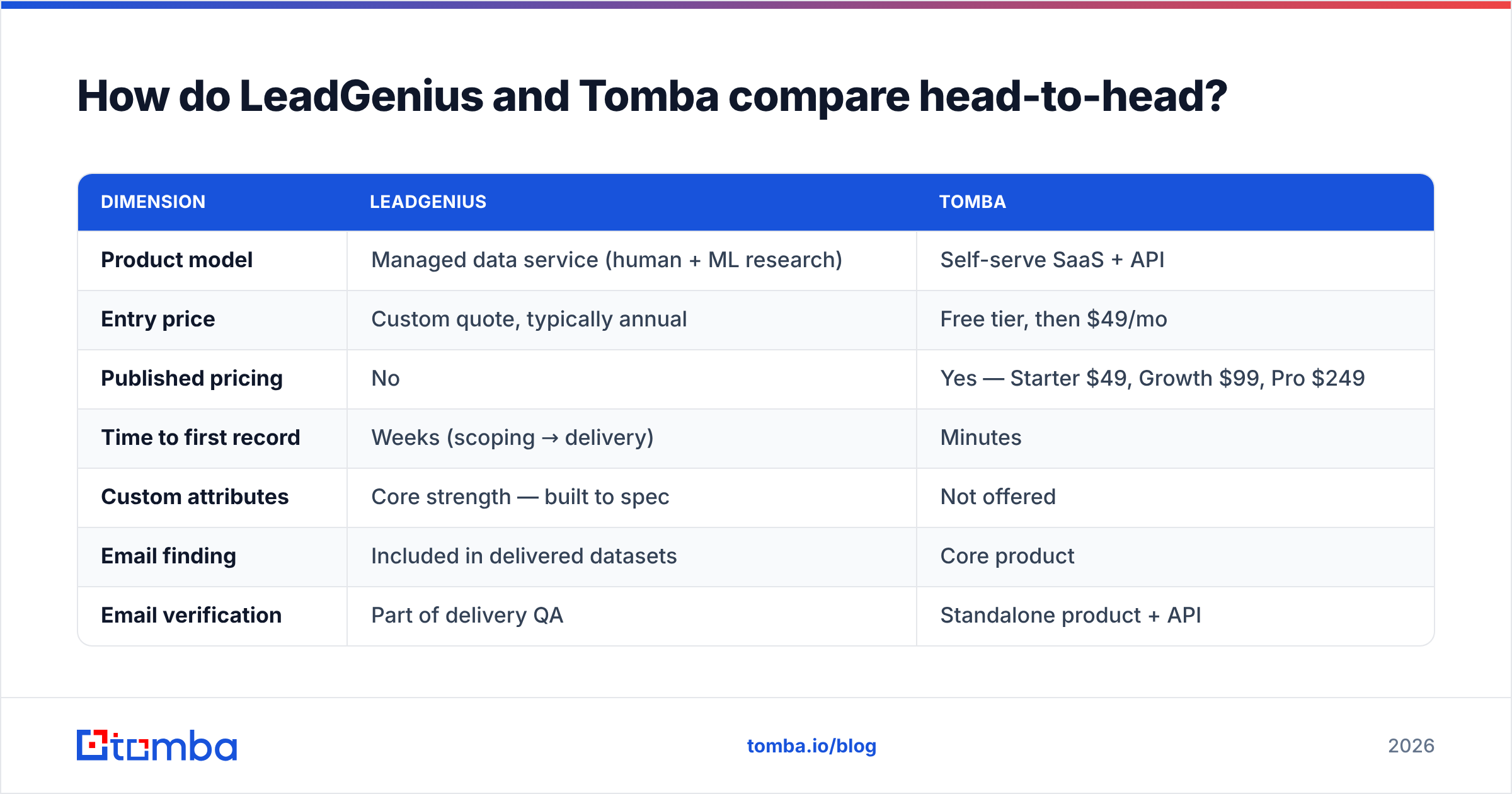
Here is the side-by-side on the dimensions that actually change a buying decision.
| Dimension | LeadGenius | Tomba |
|---|---|---|
| Product model | Managed data service (human + ML research) | Self-serve SaaS + API |
| Entry price | Custom quote, typically annual | Free tier, then $49/mo |
| Published pricing | No | Yes — Starter $49, Growth $99, Pro $249 |
| Time to first record | Weeks (scoping → delivery) | Minutes |
| Custom attributes | Core strength — built to spec | Not offered |
| Email finding | Included in delivered datasets | Core product |
| Email verification | Part of delivery QA | Standalone product + API |
| Phone data | Available in custom builds | Phone finder + validator |
| API access | Available, enterprise-oriented | Yes, on every paid plan |
| Free trial | No public self-serve trial | 25 free searches/mo, no card |
| Contract | Annual commitment typical | Monthly, cancel anytime |
| Best for | Enterprise ABM, custom datasets | SDR teams, agencies, developers |
Read that table as two different budget lines, not two competing tools. LeadGenius is a services spend. Tomba is a per-seat or per-API-call utility spend.
Which one gives you better data accuracy?#
Neither answer is universal, because they are measuring different things.
LeadGenius accuracy comes from human verification. A researcher confirms the attribute against a source. For an unusual field — "does this dealership sell EVs" — that human step is the only thing that produces a trustworthy answer at all. The trade-off is refresh rate: a human-verified custom field is accurate on the delivery date and decays from there unless you pay for re-runs.
Tomba accuracy comes from pattern intelligence plus live verification. Tomba derives the company's email pattern from public sources, applies it, then runs SMTP and syntax checks before returning a result with a confidence score. You can see where the data comes from and re-verify any address on demand, which is the part that matters for deliverability. A verified email checked this morning is worth more than a human-verified email from a Q1 dataset.
Practical rule: if the field you care about is a contact point, live verification wins. If the field is a business attribute, human research wins.
One caveat that applies to both — catch-all domains. Roughly a fifth of corporate domains accept everything at the SMTP layer, which makes standard verification useless. Tomba addresses this with a dedicated catch-all verifier; LeadGenius handles it inside its own QA process, which you do not control or see.
What does each actually cost?#
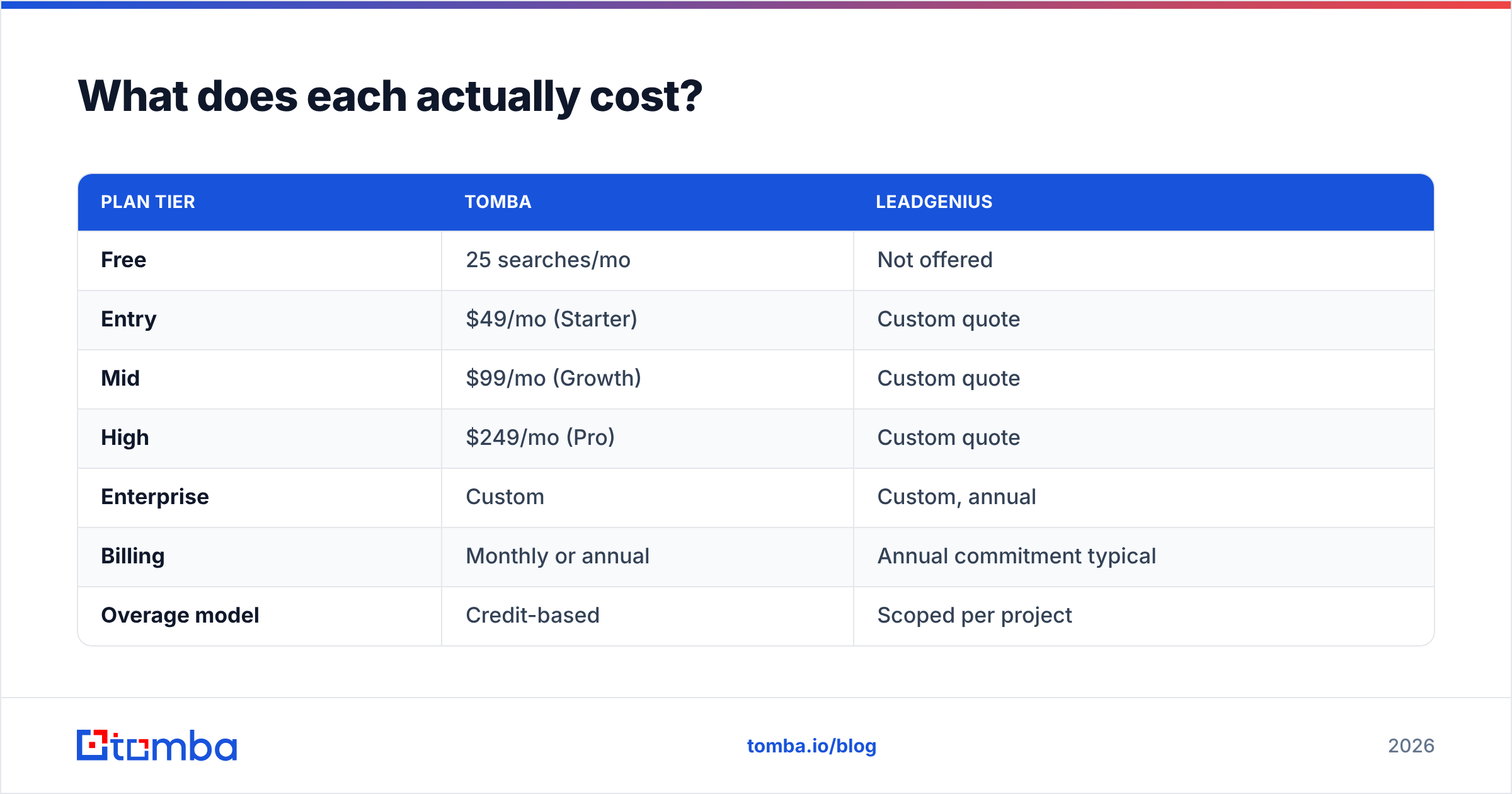
This is where most LeadGenius vs Tomba evaluations end, because the two price points are not in the same conversation.
| Plan tier | Tomba | LeadGenius |
|---|---|---|
| Free | 25 searches/mo | Not offered |
| Entry | $49/mo (Starter) | Custom quote |
| Mid | $99/mo (Growth) | Custom quote |
| High | $249/mo (Pro) | Custom quote |
| Enterprise | Custom | Custom, annual |
| Billing | Monthly or annual | Annual commitment typical |
| Overage model | Credit-based | Scoped per project |
Full Tomba pricing is public, which makes budgeting a five-minute exercise. LeadGenius requires a discovery call before you learn the number, which is normal for managed data but genuinely slows evaluation — expect two to four weeks from first contact to a quote you can take to finance.
The honest framing: if your annual data budget is under roughly $20K, LeadGenius likely will not be a fit and Tomba will cover the contact-data layer with room to spare. If your budget is six figures and your ICP depends on attributes nobody sells, the managed model earns its price.
Which fits your workflow: managed research or self-serve API?#
Ask three questions in this order.
- Is the missing data a contact point or an attribute? Emails, phones, and LinkedIn profiles are contact points — solve them with a tool. Store counts, equipment types, and hiring signals are attributes — solve them with research.
- How fast do you need it? If a campaign ships next week, a managed engagement cannot help you. Tomba's bulk email finder processes a list the same day.
- Who does the work? LeadGenius replaces headcount — it is an outsourced data team. Tomba replaces manual lookups but assumes someone on your side runs the process.
Teams that get this wrong usually pay an enterprise data vendor to do something a $99/mo API call would have done, or spend three months trying to reverse-engineer a bespoke attribute out of a standard database.

When should you pick LeadGenius?#
Choose LeadGenius when at least two of these are true:
- Your ICP is defined by attributes that do not appear in standard firmographic data.
- You have an account list already and need it appended, not expanded.
- Your buying committee prefers a contracted vendor with SLAs and an account manager.
- Your deal size justifies a high cost per enriched account.
- You lack internal data engineering capacity and want the work done for you.
Where it frustrates buyers: opacity of pricing, contract length, turnaround time, and the fact that refreshing a dataset is a new engagement rather than an API call. Analysts at Gartner have made the same point about managed data services generally — the value is real, but the refresh cadence rarely matches the pace of an outbound team.
When should you pick Tomba?#
Choose Tomba when at least two of these are true:
- You need verified emails and phone numbers at volume, continuously.
- You want to test before you commit — the free tier and published pricing let you do that in an afternoon.
- Your team is technical enough to hit an API, or wants a Chrome extension and Google Sheets workflow instead.
- You are running outbound sequences where deliverability depends on verification freshness.
- You want to enrich inbound signups in real time rather than in quarterly batches.
Where it frustrates buyers: Tomba will not invent custom attributes, will not run the research for you, and does not replace an intent-data platform. It is deliberately a sharp tool, not a suite.
What are the other options worth considering?#
The LeadGenius vs Tomba comparison is a spectrum, and other vendors sit at different points on it:
- Apollo.io — an all-in-one prospecting database plus sequencer; broadest feature set, but data depth varies by region. See the Apollo alternative breakdown for specifics.
- Clearbit (now part of HubSpot) — strong at real-time inbound enrichment and website visitor data; less suited to outbound list building. HubSpot has folded much of it into its own platform.
- BookYourData — a solid pay-as-you-go option if you want a pre-built list with an accuracy guarantee rather than a research engagement or a lookup API. Different model, genuinely useful for one-off campaigns.
- ZoomInfo — the enterprise default for breadth of contacts, priced accordingly, and closer to LeadGenius on the budget axis than to Tomba.
Most mature GTM stacks end up with one attribute source and one contact source. That is the stable configuration, and it is why "LeadGenius or Tomba" is often the wrong question — "LeadGenius and Tomba" is a coherent stack, while "two databases that both sell emails" is waste.
The verdict#
If your bottleneck is who to contact, and the definition of "who" is unusual, LeadGenius is the stronger answer and worth the procurement cycle.
If your bottleneck is how to reach them — verified emails, verified phones, fresh enough to protect your sender reputation — Tomba wins on speed, price transparency, and the fact that you can validate the claim yourself before spending anything.
For the overwhelming majority of SDR teams, agencies, and growth engineers, the second bottleneck is the real one. Start with the free tier of the Tomba Email Finder — 25 searches a month, no card, same API that powers the $249/mo Pro plan — and run it against 25 accounts you already know the answers for. You will know within an hour whether you need a managed data engagement at all.
Related guides#
// get started
Find, verify and enrich your first contacts today
Start on the free plan with 25 searches a month, then scale when your team is ready.
Free plan · No credit card required · GDPR & CCPA
// about the author