LeadGenius vs VC-Backed Lead Gen Tools: Which Fits 2026?
LeadGenius sells managed, human-verified B2B data on annual contracts. VC-backed platforms sell seats, credits, and scale. Here is how the two models compare on accuracy, cost per usable contact, and lock-in.
TL;DR
- LeadGenius is a managed data service: you brief a team, they build custom datasets with humans plus machine learning, and you sign an annual contract with no public price.
- "VC-backed lead gen" is not one product. It is a business model — Apollo, ZoomInfo, Cognism, Lusha and friends sell self-serve seats and credits, and their roadmaps follow funding pressure, not your ICP.
- LeadGenius wins on hard-to-source, non-standard attributes (store counts, SKU-level signals, headcount by function). VC-backed platforms win on breadth, speed, and the ability to start on Tuesday.
- Both models overcharge you for the boring part: finding and verifying business email addresses. That job costs cents through an API, not thousands through a seat licence.
- The honest 2026 stack for most teams is a thin layer: one broad database for coverage, one API-first finder/verifier for accuracy and volume, and a managed vendor only for the 5% of attributes nobody else sells.
What is LeadGenius, and who actually uses it?#
LeadGenius is a B2B data company that sells custom-built datasets rather than a generic contact database. You tell them the accounts and attributes you need, and a combination of automated collection and human researchers assembles and maintains the file. The company has been around since the early 2010s (it started life as MobileWorks) and today positions itself around "data you cannot buy off the shelf" — you can read their own framing on leadgenius.com.
The typical LeadGenius buyer is not a three-person SDR pod. It is a RevOps or data team at a company whose ICP is defined by something weird: number of physical locations, forklift fleet size, whether a site runs a specific payment processor, how many licensed hygienists a dental group employs. No self-serve platform sells those fields, because no self-serve platform can justify the collection cost across its whole customer base.
That is the entire thesis. You are buying research labour, not a search index.
What you get in practice:
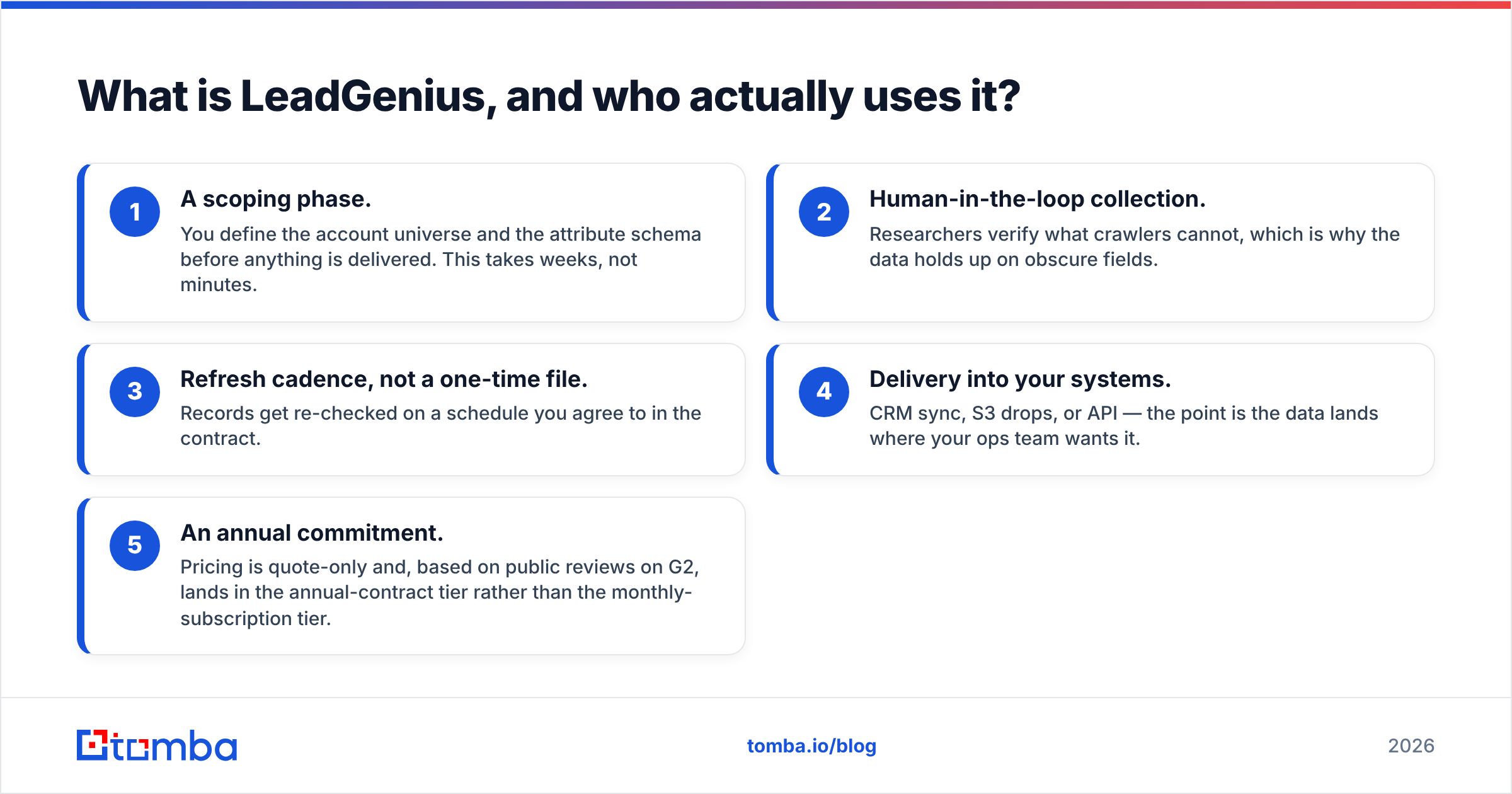
- A scoping phase. You define the account universe and the attribute schema before anything is delivered. This takes weeks, not minutes.
- Human-in-the-loop collection. Researchers verify what crawlers cannot, which is why the data holds up on obscure fields.
- Refresh cadence, not a one-time file. Records get re-checked on a schedule you agree to in the contract.
- Delivery into your systems. CRM sync, S3 drops, or API — the point is the data lands where your ops team wants it.
- An annual commitment. Pricing is quote-only and, based on public reviews on G2, lands in the annual-contract tier rather than the monthly-subscription tier.
What does "VC-backed lead gen" actually mean for you?#
It means the product you buy this year is optimised for a growth metric, not for your renewal.
Venture-funded data platforms — Apollo (which raised a $100M Series D in 2023), ZoomInfo (public since 2020), Cognism, Lusha, Seamless.AI and the rest — all run the same playbook: get as many seats as possible into as many companies as possible, then expand upward. That produces genuinely useful things. Self-serve signup. Chrome extensions. Sequences bolted onto the database. Aggressive free tiers. A search UI your reps will actually open.
It also produces predictable friction:
- Credit systems that reset. Unused credits usually expire monthly. You are paying for peak capacity all year.
- Seat-based pricing. Data is not consumed per seat, but it is billed per seat.
- Feature bundling. You want the database; you get a dialer, a sequencer, and an AI SDR you did not ask for, all priced in.
- Export caps. The contract often limits how much of "your" data you can take out — the single most common complaint in enterprise data reviews tracked by analysts like Gartner.
- Roadmap drift. When funding rounds demand a new category, the core data quality work is not what gets staffed.
None of that makes these tools bad. It makes them a different shape of purchase. You are renting breadth and speed.

How do LeadGenius and VC-backed platforms compare?#
Here is the head-to-head, with API-first tooling added as a third column because in practice most teams end up running two of the three.
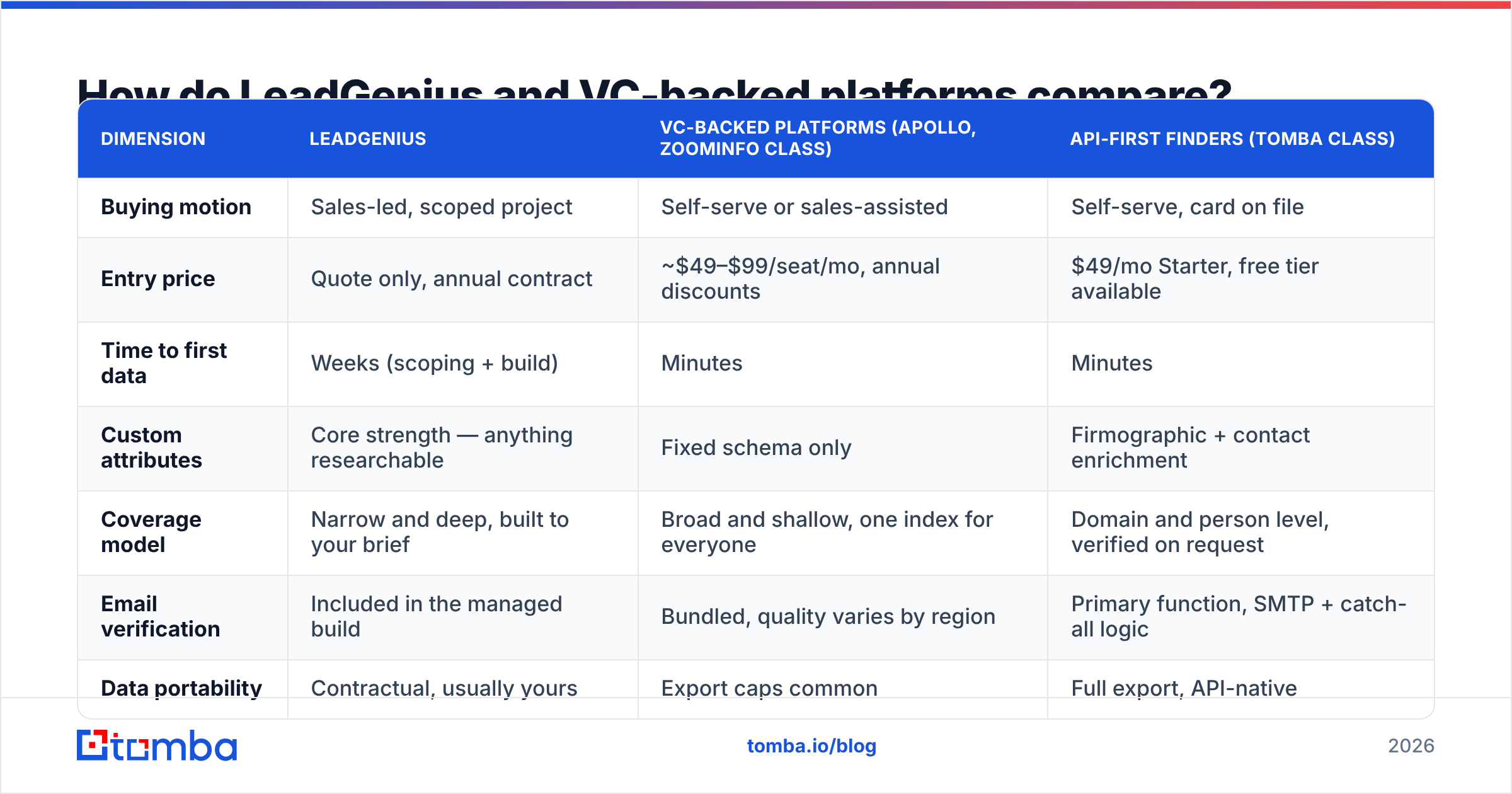
| Dimension | LeadGenius | VC-backed platforms (Apollo, ZoomInfo class) | API-first finders (Tomba class) |
|---|---|---|---|
| Buying motion | Sales-led, scoped project | Self-serve or sales-assisted | Self-serve, card on file |
| Entry price | Quote only, annual contract | ~$49–$99/seat/mo, annual discounts | $49/mo Starter, free tier available |
| Time to first data | Weeks (scoping + build) | Minutes | Minutes |
| Custom attributes | Core strength — anything researchable | Fixed schema only | Firmographic + contact enrichment |
| Coverage model | Narrow and deep, built to your brief | Broad and shallow, one index for everyone | Domain and person level, verified on request |
| Email verification | Included in the managed build | Bundled, quality varies by region | Primary function, SMTP + catch-all logic |
| Data portability | Contractual, usually yours | Export caps common | Full export, API-native |
| Best for | Non-standard ICP definitions | Volume prospecting, fast ramp | High-accuracy sending at scale |
Four rows in, the pattern is obvious: these are not substitutes. LeadGenius replaces an internal research team. A VC-backed platform replaces a list vendor. An API-first tool replaces the guesswork in your send.
Which model wins on data accuracy?#
Accuracy has to be measured per attribute, not per vendor. Nobody is "95% accurate" across everything.

On custom attributes — the ones that require a human to open a website and count something — LeadGenius is the strongest of the three by a wide margin, because it is the only one paying humans to check. A crawler cannot reliably tell you how many treatment rooms a clinic has.
On standard firmographics — industry, size band, revenue estimate, tech stack — the funded platforms are fine and cheap. They have scale advantages you cannot replicate, and the error bar on "51–200 employees" rarely breaks a campaign.
On email deliverability, everything flips. This is where large aggregated databases underperform their marketing, because a record can be perfectly correct about a person and still fail at the mailbox. The email was right in March; the person changed roles in July. A database built for breadth refreshes on a schedule; a verifier checks at the moment you ask.
That is why teams running serious volume separate the two jobs. Use the database to decide who to contact. Use a dedicated email verifier to decide whether the send will land, immediately before the send — including the messy catch-all verification cases that most bundled tools silently mark "unknown" and bill you for anyway.
Worth naming a peer here: BookYourData takes a third path — pay-as-you-go, pre-verified B2B lists with a bounce guarantee, no annual contract. For teams that want a clean file without a scoping call or a seat licence, it is a legitimate middle option and often a better fit than either extreme discussed above.
What does each option really cost per usable contact?#
Ignore sticker price. Compute cost per contact that (a) matches your ICP and (b) receives your email.
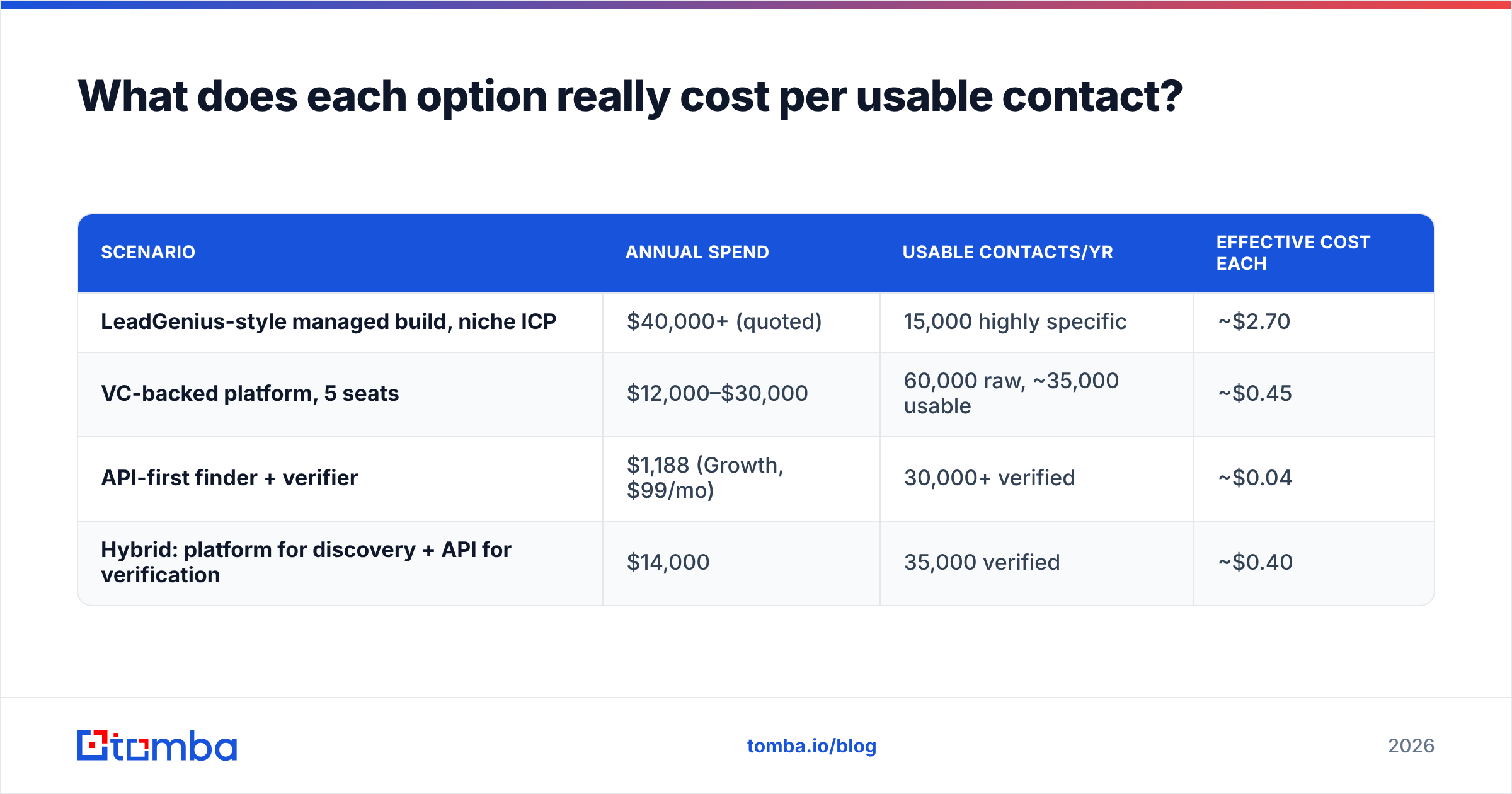
| Scenario | Annual spend | Usable contacts/yr | Effective cost each |
|---|---|---|---|
| LeadGenius-style managed build, niche ICP | $40,000+ (quoted) | 15,000 highly specific | ~$2.70 |
| VC-backed platform, 5 seats | $12,000–$30,000 | 60,000 raw, ~35,000 usable | ~$0.45 |
| API-first finder + verifier | $1,188 (Growth, $99/mo) | 30,000+ verified | ~$0.04 |
| Hybrid: platform for discovery + API for verification | $14,000 | 35,000 verified | ~$0.40 |
The arithmetic is not an argument for the cheapest row. It is an argument against paying managed-service rates for commodity work. If 80% of your data need is "find and verify the work email of this named person at this known company," that portion should cost pennies. Reserve the expensive vendors for the 20% they are uniquely good at.
Run your own version of this table before renewal. Pull last year's invoice, divide by the number of contacts that actually got a delivered email, and compare it to public Tomba pricing for the same volume. The gap is usually uncomfortable.
When should you choose LeadGenius?#
Pick the managed model when all three are true:
- Your ICP is defined by an attribute nobody sells. If you can describe your target list in an Apollo filter, you do not need LeadGenius.
- The list is worth five figures. Managed research pays off when each account is worth thousands in ACV, not when you are spraying 10,000 SMBs.
- You have someone to own the relationship. Scoped data projects fail without an internal owner who can specify the schema and QA deliveries.
Skip it if you are pre-product-market-fit, if your ICP changes quarterly, or if you need data this week.
When should you choose a VC-backed platform?#
Pick a funded platform when you need breadth now and can tolerate imperfect records. A new SDR team ramping into a broad market gets more value from 50,000 mediocre records today than 5,000 perfect records in six weeks. Just negotiate hard on three things: export rights, credit rollover, and a shorter term than the one they open with.
And know your exits. The alternatives market is mature — most teams comparing an Apollo alternative or a Clearbit alternative are not unhappy with the data, they are unhappy with the contract. Clearbit's 2023 acquisition by HubSpot is a useful reminder that the vendor you sign with may not be the vendor you renew with.

Where do API-first tools fit in this stack?#
They fit underneath both. An API-first finder does not try to be your CRM, your sequencer, or your research department. It answers one question fast and cheaply: what is this person's verified work email, and should you send to it?
That narrowness is the feature. A domain search returns every public address pattern at a company in one call. A bulk email finder runs a 50,000-row file overnight. The Tomba API drops the same logic into your own enrichment pipeline so records get re-verified at the moment of send rather than at the moment of purchase.
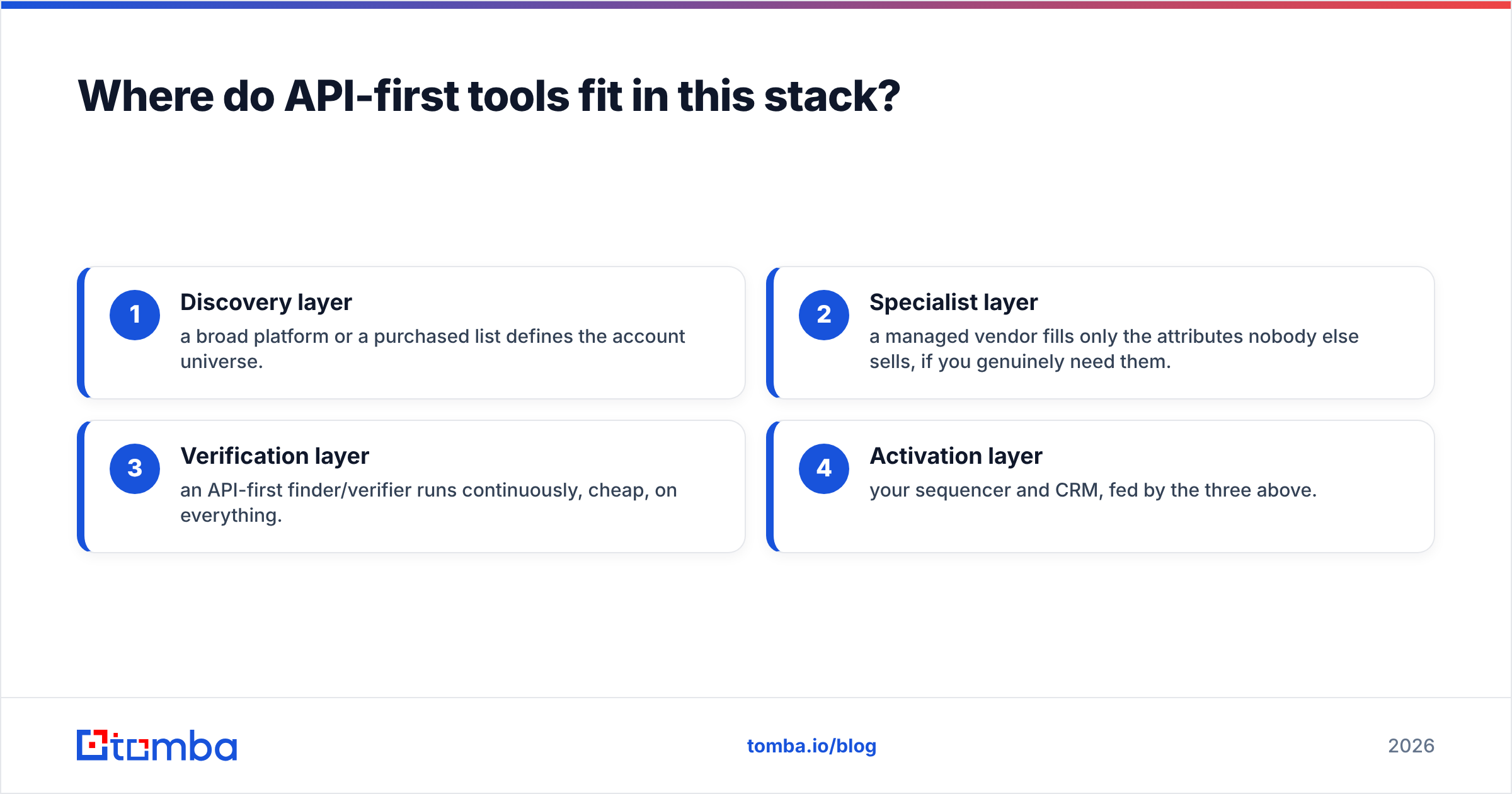
The practical 2026 architecture looks like this:
- Discovery layer — a broad platform or a purchased list defines the account universe.
- Specialist layer — a managed vendor fills only the attributes nobody else sells, if you genuinely need them.
- Verification layer — an API-first finder/verifier runs continuously, cheap, on everything.
- Activation layer — your sequencer and CRM, fed by the three above.
Teams that collapse layers two and three into one expensive contract are the ones that show up in renewal reviews complaining about cost per lead.
FAQ: LeadGenius vs VC-backed vendors#
Is LeadGenius more accurate than Apollo or ZoomInfo? On custom, human-researched attributes, yes. On standard firmographics, the difference is small enough not to justify the price gap. On email validity at send time, neither beats a dedicated verifier.
Does LeadGenius publish pricing? No. Expect a scoping call and an annual quote. If you need a number before a call, the managed model is probably not your fit.
Can I replace both with a cheap API tool? Only if your ICP is expressible with standard filters. You still need something to define the account universe.
What about GDPR and CCPA? Ask every vendor — managed or funded — for their lawful basis, data sources, and suppression process in writing. Tomba documents where its data comes from publicly; require the same transparency from anyone you sign with.
The short version#
LeadGenius and VC-backed platforms are answers to different questions. One buys you research you cannot automate. The other buys you scale you cannot build. Neither should be your answer to "find and verify this person's email," because that is now a solved, commodity problem priced accordingly.
Before you renew either contract, strip out the commodity work and price it separately. Run your next list through the Tomba Email Finder — the free tier covers 25 searches a month, Starter is $49/mo, and Growth at $99/mo handles most teams' entire verified-contact volume. Compare the cost per delivered email against your current invoice, then go into the renewal call with a number instead of a feeling.
Related guides#
// get started
Find, verify and enrich your first contacts today
Start on the free plan with 25 searches a month, then scale when your team is ready.
Free plan · No credit card required · GDPR & CCPA
// about the author