LeadGibbon vs Apollo.io (2026): Which B2B Data Tool Wins?
LeadGibbon sells lists. Apollo.io sells a sales platform. We compared data accuracy, export limits, real pricing and bounce rates to show which one actually earns a slot in your 2026 outbound stack.
TL;DR
- LeadGibbon is a list builder. Apollo.io is a sales platform. Comparing them feature-for-feature is misleading — one hands you a spreadsheet, the other tries to run your entire outbound motion.
- Apollo wins on breadth (database size, sequencing, dialer, CRM sync). LeadGibbon wins on simplicity — pick a filter, export a list, move on.
- Neither is a verification tool. Both ship contacts that look valid and bounce anyway. Budget for a separate verification layer regardless of which you pick.
- Apollo's real cost is per-seat and export-capped. A 5-person team on a mid tier routinely pays more than the sticker price suggests once credit top-ups land.
- The cheapest honest setup for most teams is a narrow, accurate email finder plus a verifier, layered on whichever list source you already trust.
What are LeadGibbon and Apollo.io?#
LeadGibbon is a B2B list-building tool. You filter a database by title, industry, company size and location, then export the matching contacts as a CSV or push them to Google Sheets. There is no sequencer, no dialer, no engagement layer. It does one job: turn a filter into a list of names and email addresses.
Apollo.io is a sales engagement platform with a database bolted to the front of it. You search the same kind of filters, but then you can enroll contacts into email sequences, call them from a built-in dialer, score them, sync them to HubSpot or Salesforce, and track replies — all without leaving the tool. Apollo's own positioning on G2 puts it in the sales intelligence and engagement category, not the list-vendor category.
That difference drives everything else. LeadGibbon competes on price per contact. Apollo competes on how much of your stack it can replace. If you evaluate them on the same scorecard you will pick wrong.
How do LeadGibbon and Apollo.io actually differ?#
Here is the head-to-head on the attributes that change your workflow, not the ones that fill a feature grid.
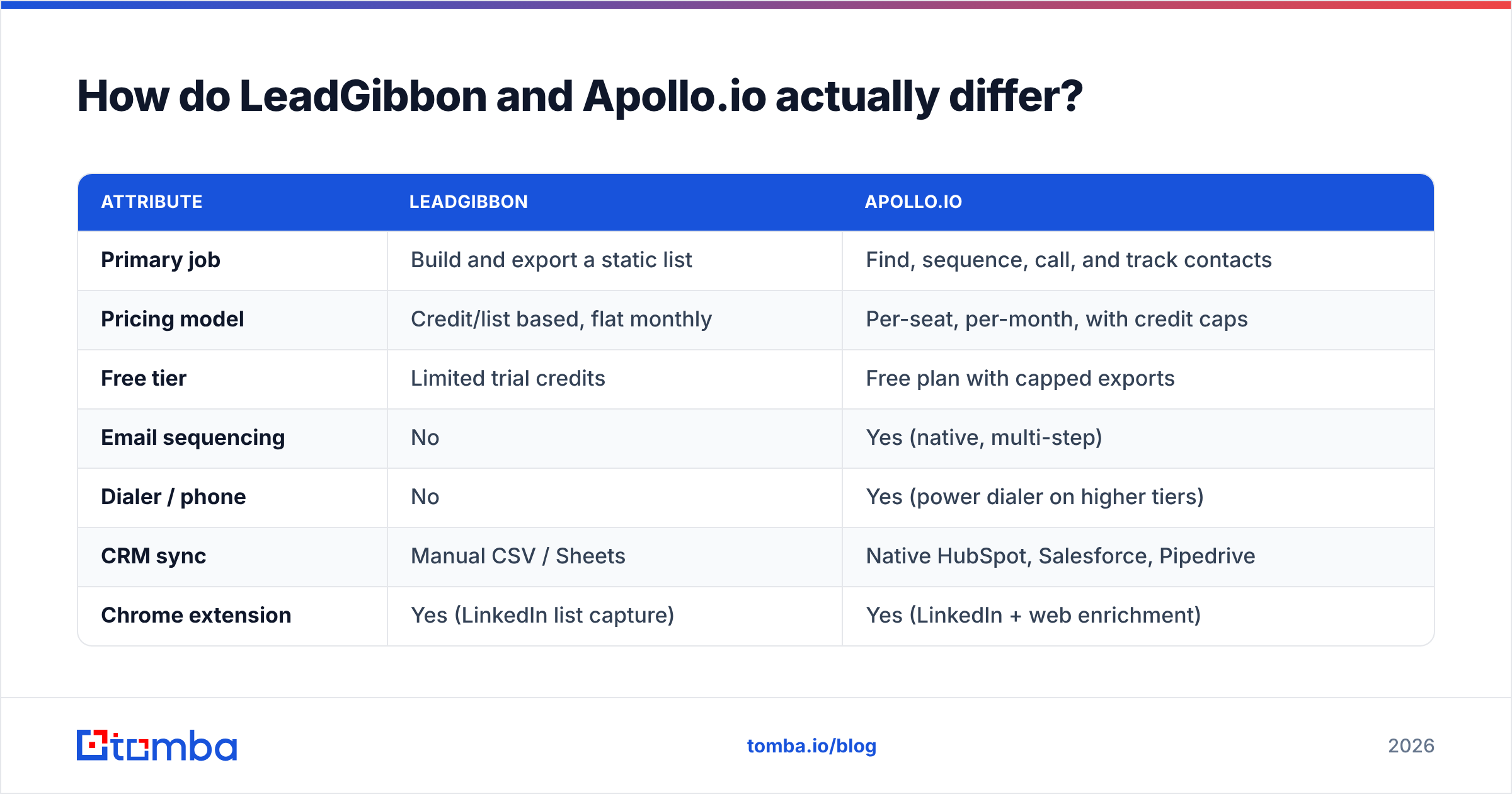
| Attribute | LeadGibbon | Apollo.io |
|---|---|---|
| Primary job | Build and export a static list | Find, sequence, call, and track contacts |
| Pricing model | Credit/list based, flat monthly | Per-seat, per-month, with credit caps |
| Free tier | Limited trial credits | Free plan with capped exports |
| Email sequencing | No | Yes (native, multi-step) |
| Dialer / phone | No | Yes (power dialer on higher tiers) |
| CRM sync | Manual CSV / Sheets | Native HubSpot, Salesforce, Pipedrive |
| Chrome extension | Yes (LinkedIn list capture) | Yes (LinkedIn + web enrichment) |
| Bulk export limits | Generous on list plans | Tiered — the real constraint on cheap plans |
| Built-in verification | Basic / none | Basic status flags, not true SMTP verification |
| Best for | Agencies and one-off campaigns | Full-cycle SDR teams |
| Worst for | Teams wanting engagement in one tool | Anyone who just wants a clean CSV |
Read that table as two different purchases. LeadGibbon is a raw-material supplier. Apollo is a factory that also happens to supply raw material. Buying the factory because you liked the raw material is how teams end up paying four figures a month for a CSV they could have bought for $49.
Which one has better data accuracy?#
Neither vendor publishes an independently audited bounce rate, and you should be suspicious of any comparison post that claims otherwise. What you can measure is your own bounce rate on your own ICP — which is the only number that matters.

A few patterns hold up across teams we have talked to:
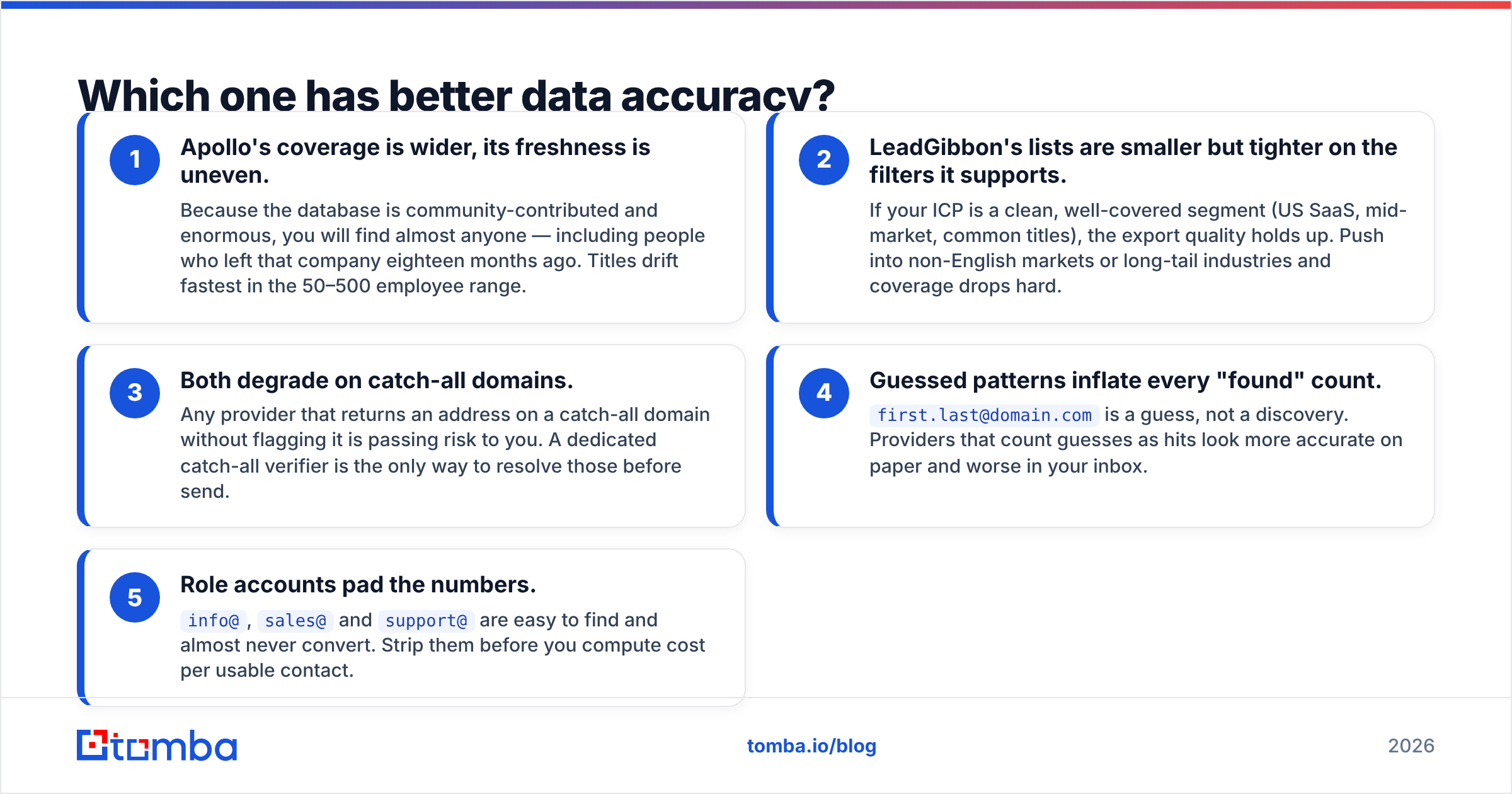
- Apollo's coverage is wider, its freshness is uneven. Because the database is community-contributed and enormous, you will find almost anyone — including people who left that company eighteen months ago. Titles drift fastest in the 50–500 employee range.
- LeadGibbon's lists are smaller but tighter on the filters it supports. If your ICP is a clean, well-covered segment (US SaaS, mid-market, common titles), the export quality holds up. Push into non-English markets or long-tail industries and coverage drops hard.
- Both degrade on catch-all domains. Any provider that returns an address on a catch-all domain without flagging it is passing risk to you. A dedicated catch-all verifier is the only way to resolve those before send.
- Guessed patterns inflate every "found" count.
first.last@domain.comis a guess, not a discovery. Providers that count guesses as hits look more accurate on paper and worse in your inbox. - Role accounts pad the numbers.
info@,sales@andsupport@are easy to find and almost never convert. Strip them before you compute cost per usable contact.
The practical move: pull 200 contacts from each tool against the same ICP, run both lists through an independent email verifier, and compare valid-rate. That test costs less than one month of either subscription and settles the argument with your own data.

How do LeadGibbon and Apollo.io pricing compare?#
This is where the comparison gets genuinely lopsided — not because one is cheap and one is expensive, but because they charge on different axes.
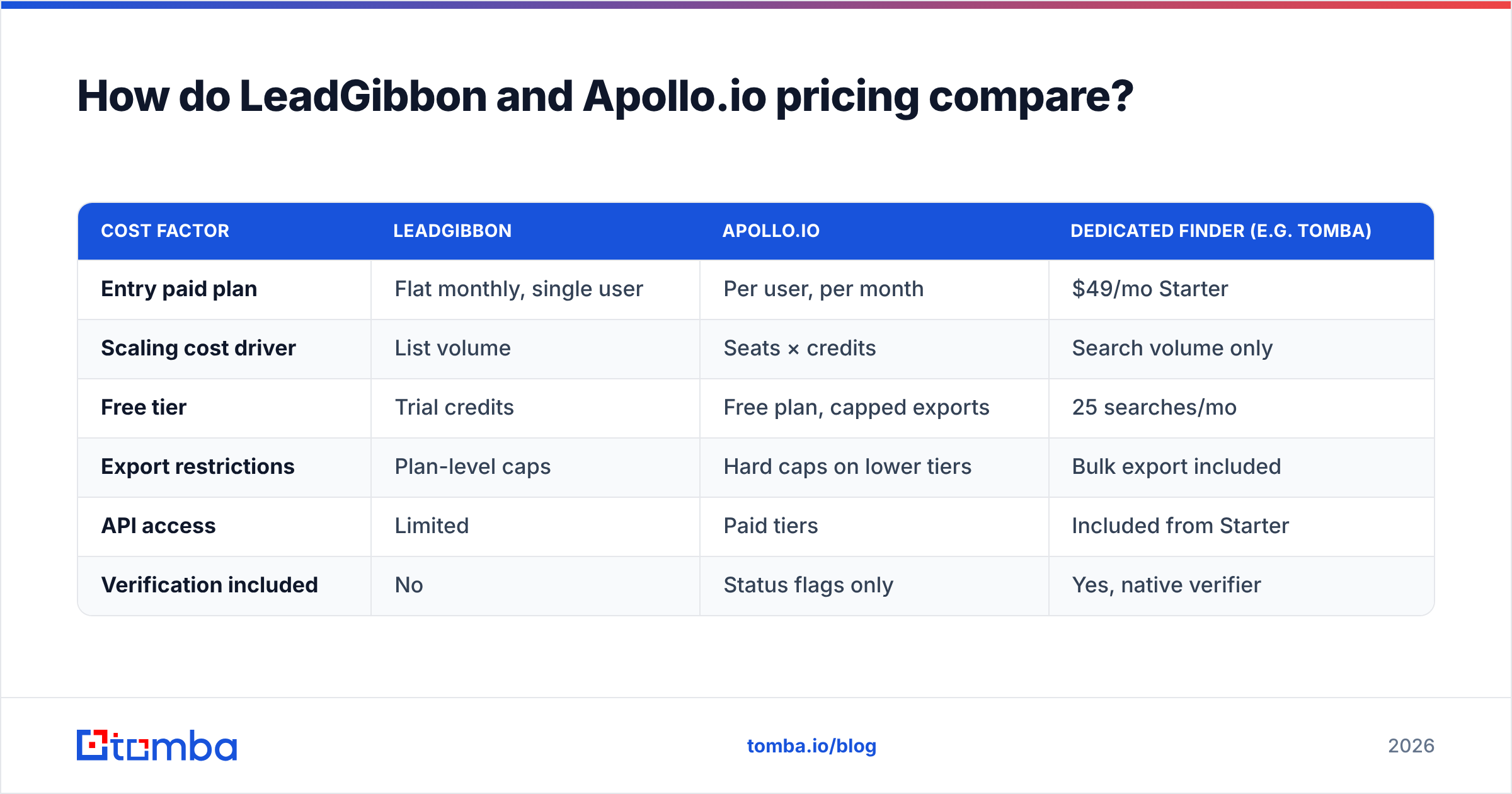
LeadGibbon charges roughly per list volume on a flat monthly plan. One person, one price, export what your plan allows. Apollo charges per seat, per month, with export and credit limits layered on top. Add three SDRs and your Apollo bill triples while your LeadGibbon bill stays flat.

| Cost factor | LeadGibbon | Apollo.io | Dedicated finder (e.g. Tomba) |
|---|---|---|---|
| Entry paid plan | Flat monthly, single user | Per user, per month | $49/mo Starter |
| Scaling cost driver | List volume | Seats × credits | Search volume only |
| Free tier | Trial credits | Free plan, capped exports | 25 searches/mo |
| Export restrictions | Plan-level caps | Hard caps on lower tiers | Bulk export included |
| API access | Limited | Paid tiers | Included from Starter |
| Verification included | No | Status flags only | Yes, native verifier |
Both vendors change pricing frequently, so treat any number you read in a blog post — including this one — as a prompt to check the live pricing page before you commit. For reference, Tomba pricing runs Free (25 searches/mo), Starter $49/mo, Growth $99/mo, Pro $249/mo, and Enterprise on request, with no per-seat multiplier.
The hidden cost nobody prices in is bounce cleanup. If a $99/month plan hands you 2,000 contacts and 18% bounce, you did not buy 2,000 contacts — you bought 1,640, plus a dent in your sender reputation that takes weeks to repair. Cost per usable, verified contact is the only number worth comparing.
Who should choose LeadGibbon?#
Pick LeadGibbon if three or more of these describe you:
- You already own a sequencer. Instantly, Smartlead, Lemlist, Salesloft — if engagement is handled, you are paying Apollo for features you will never open.
- You run campaign-shaped work, not always-on outbound. Agencies building a list per client, founders running a quarterly push, researchers assembling a market map.
- Your ICP is well-covered. English-speaking markets, common titles, mid-market company sizes.
- You want a CSV, not a workflow. The fastest path from filter to spreadsheet, with nothing in between.
- Headcount is growing but tool budget isn't. Flat pricing beats per-seat pricing the moment you add a second user.
Where it disappoints: no native engagement, thinner international coverage, and verification you will have to bolt on yourself. Budget for the latter — it is not optional.
Who should choose Apollo.io?#
Apollo earns its price when you genuinely use the platform, not just the database:
- You have 3+ SDRs working the same pipeline and need shared sequences, call recording and activity visibility in one place.
- You want prospect-to-reply in a single tool. Search, enroll, send, call, log to CRM — no CSV round trips.
- Your CRM sync matters more than data purity. Native HubSpot and Salesforce write-back saves real RevOps hours.
- You're consolidating tools. Killing three subscriptions to fund one is a legitimate reason to overpay per contact.
Where it disappoints: data freshness on the long tail, export caps that bite exactly when a campaign is working, and per-seat economics that punish growth. Plenty of teams end up evaluating an Apollo alternative within a year — not because Apollo is bad, but because they only ever used 20% of it.
What do both tools get wrong about email quality?#
Both platforms optimize for found, not deliverable. That is a rational product decision and a terrible outcome for your domain.

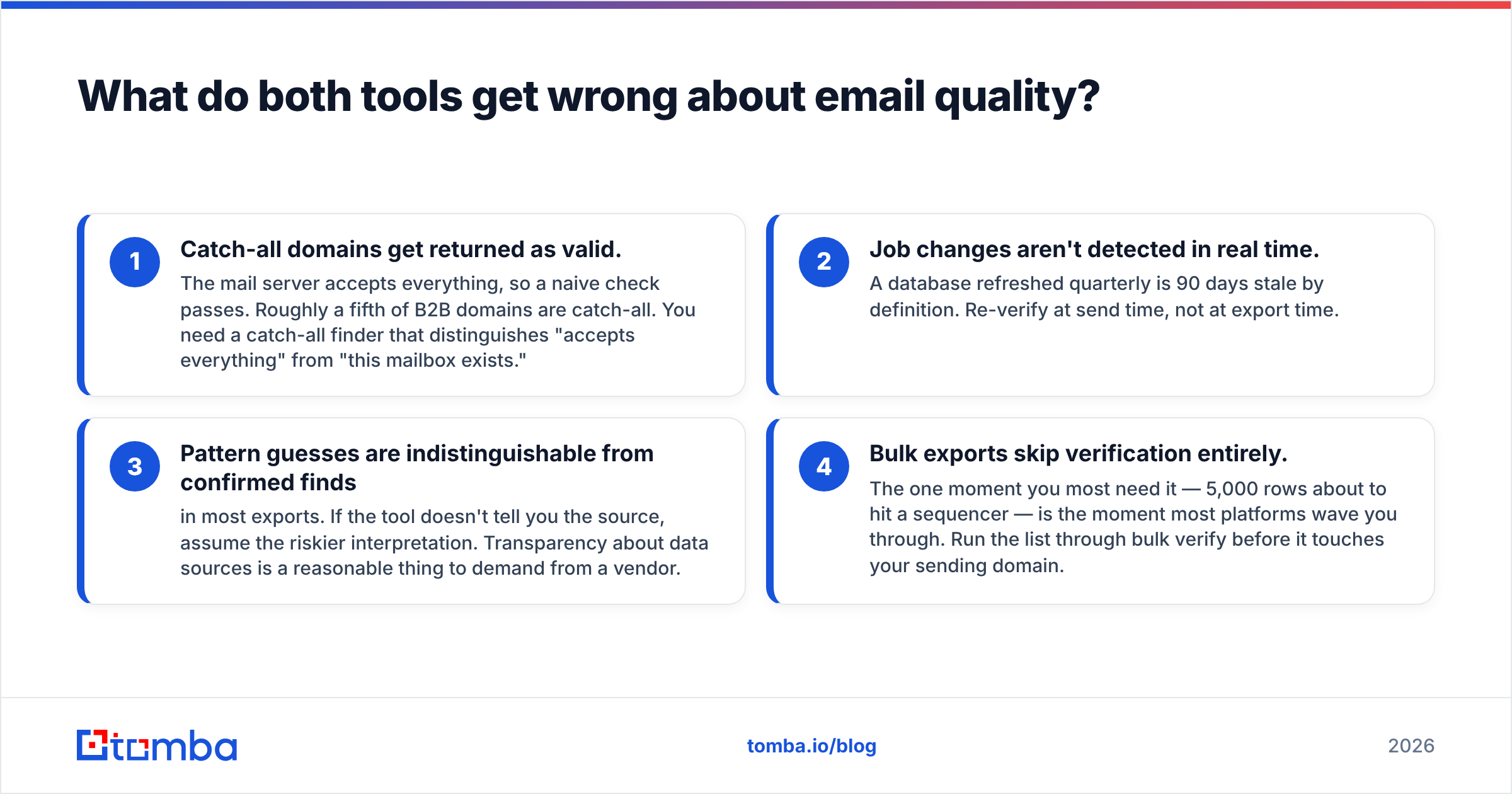
The gap shows up in four places:
- Catch-all domains get returned as valid. The mail server accepts everything, so a naive check passes. Roughly a fifth of B2B domains are catch-all. You need a catch-all finder that distinguishes "accepts everything" from "this mailbox exists."
- Job changes aren't detected in real time. A database refreshed quarterly is 90 days stale by definition. Re-verify at send time, not at export time.
- Pattern guesses are indistinguishable from confirmed finds in most exports. If the tool doesn't tell you the source, assume the riskier interpretation. Transparency about data sources is a reasonable thing to demand from a vendor.
- Bulk exports skip verification entirely. The one moment you most need it — 5,000 rows about to hit a sequencer — is the moment most platforms wave you through. Run the list through bulk verify before it touches your sending domain.
A 2% bounce rate is a healthy list. A 10% bounce rate gets you throttled. The difference between those two numbers is almost never the list vendor — it's whether anyone verified before sending.
Is there a third option worth considering?#
Yes, and it is the one most teams land on after a year of paying for platforms: unbundle.
Use a dedicated finder and verifier for the data layer, and keep your sequencer separate. The logic is simple — data quality and engagement are different engineering problems, and vendors who try to win both usually win neither convincingly.
A practical unbundled stack looks like this:
- Discovery — domain search to map every contactable person at a target account, or the LinkedIn finder when you're working from a Sales Navigator list.
- Verification — SMTP-level checks plus catch-all handling before anything enters a sequence.
- Enrichment — fill in title, company size and phone on the rows you actually plan to work, not all 10,000.
- Engagement — whichever sequencer your team already knows, with its own warmup and deliverability tooling.
- Automation — the Tomba API or a Sheets/CRM integration so the data layer runs without anyone opening a dashboard.
The math usually favors this. A $49/month finder plus your existing sequencer beats a $119/seat platform for a team of four, and you keep the freedom to swap any layer without a migration project.
Worth noting: list vendors like BookYourData occupy a legitimate middle ground here too — pre-verified, pay-as-you-go lists with no subscription commitment, which suits teams that buy data in bursts rather than continuously. The right answer depends on whether your prospecting is a steady drip or a periodic flood.
What's the verdict on LeadGibbon vs Apollo.io?#
If you need a platform, Apollo.io wins. Nothing LeadGibbon offers comes close to sequencing, dialing and CRM sync in one subscription. Accept the per-seat cost and the data freshness trade-off as the price of consolidation.
If you need a list, LeadGibbon wins. It is faster, flatter-priced, and doesn't charge you for a dialer you'll never open. Pair it with real verification and it holds up fine.
If you need accurate email addresses specifically — not a list, not a platform — neither one is the sharpest instrument. That job belongs to a tool built for it, priced for it, and transparent about where the data came from.
Start with the 200-contact test against your own ICP. Whichever tool returns more verified, in-role, non-role-account addresses per dollar is your answer, and it will not necessarily be the one with the better website.
Ready to fix the data layer first? The Tomba Email Finder returns verified professional addresses with source attribution, catch-all detection and bulk export included — no per-seat pricing, no export caps on paid plans. Start free with 25 searches a month, run it head-to-head against your current list vendor, and let your bounce rate pick the winner.
Related guides#
// get started
Find, verify and enrich your first contacts today
Start on the free plan with 25 searches a month, then scale when your team is ready.
Free plan · No credit card required · GDPR & CCPA
// about the author