LeadIQ vs Apollo.io in 2026: Which Sales Data Tool Wins?
LeadIQ and Apollo.io both promise clean B2B contact data, but they solve very different problems. Here is how they compare on accuracy, credits, pricing and CRM workflow in 2026 — plus when neither one is the right buy.
TL;DR
- LeadIQ is a capture-and-hygiene layer. It lives in your browser next to LinkedIn Sales Navigator, pushes contacts into Salesforce or Outreach in one click, and watches for job changes. It is not trying to be your sequencer.
- Apollo.io is an all-in-one platform. Database, sequences, dialer, intent signals and a light CRM in a single seat. Breadth is the selling point; depth per module is the trade-off.
- Pricing structures differ more than list prices. Both charge per seat, but Apollo gates exports and enrichment behind credit tiers while LeadIQ gates "verified work emails" and mobile numbers separately.
- Neither is the cheapest path to verified emails. If your actual need is "turn a list of names and domains into deliverable addresses," an API-first email finder costs a fraction of a full seat.
- Our pick: LeadIQ if your reps live in Sales Navigator and your CRM is the source of truth. Apollo if you want one tool for the whole motion. A dedicated finder if you only need the data layer.
What problem does each tool actually solve?#
Start here, because the "LeadIQ vs Apollo.io" question is usually asked at the wrong altitude. These are not two versions of the same product.
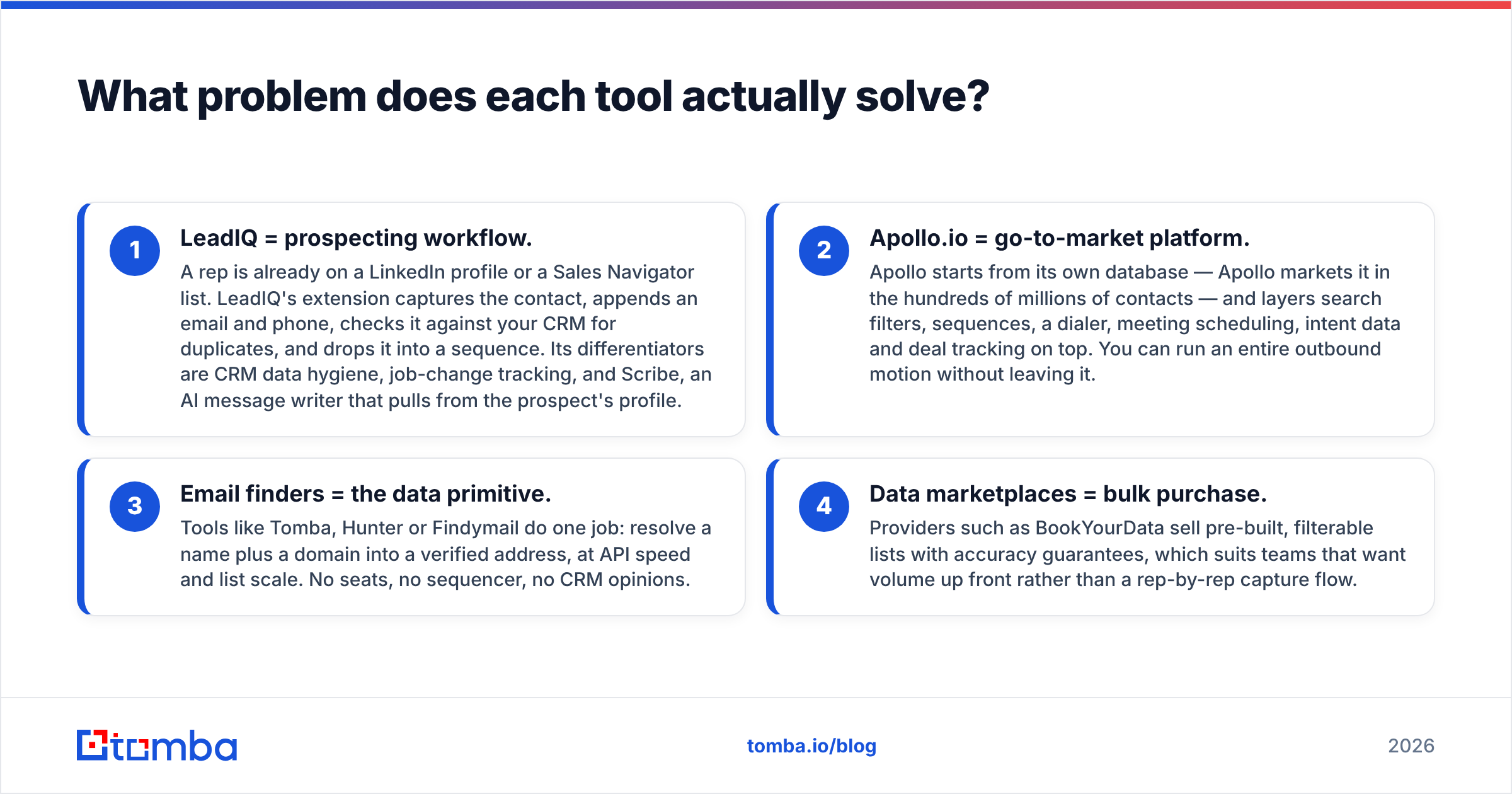
- LeadIQ = prospecting workflow. A rep is already on a LinkedIn profile or a Sales Navigator list. LeadIQ's extension captures the contact, appends an email and phone, checks it against your CRM for duplicates, and drops it into a sequence. Its differentiators are CRM data hygiene, job-change tracking, and Scribe, an AI message writer that pulls from the prospect's profile.
- Apollo.io = go-to-market platform. Apollo starts from its own database — Apollo markets it in the hundreds of millions of contacts — and layers search filters, sequences, a dialer, meeting scheduling, intent data and deal tracking on top. You can run an entire outbound motion without leaving it.
- Email finders = the data primitive. Tools like Tomba, Hunter or Findymail do one job: resolve a name plus a domain into a verified address, at API speed and list scale. No seats, no sequencer, no CRM opinions.
- Data marketplaces = bulk purchase. Providers such as BookYourData sell pre-built, filterable lists with accuracy guarantees, which suits teams that want volume up front rather than a rep-by-rep capture flow.
Picking wrongly between these four categories costs more than picking wrongly inside one of them.
How do LeadIQ and Apollo.io compare at a glance?#
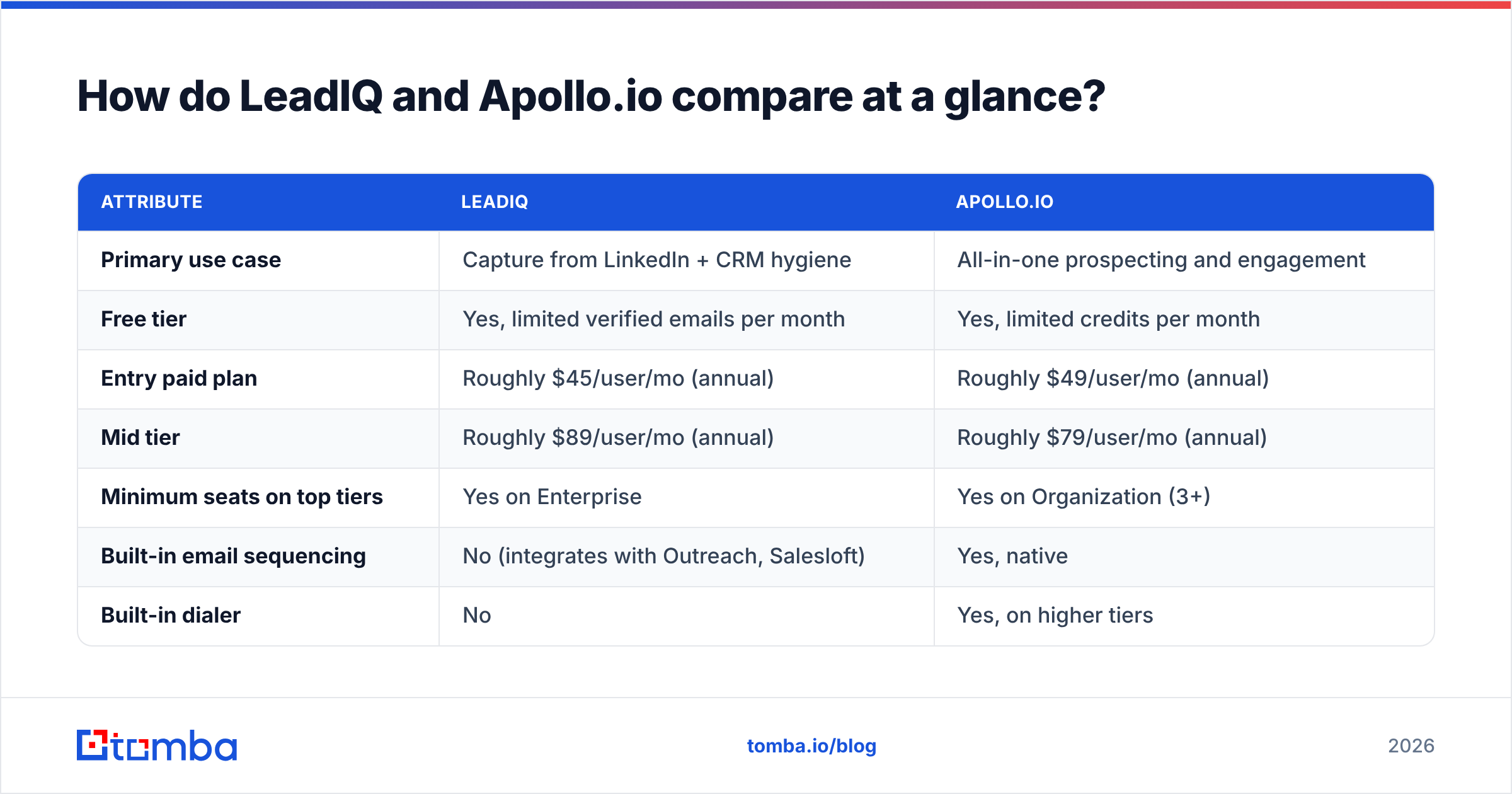
Here is the head-to-head on the attributes that actually change a buying decision. Prices reflect publicly listed plans at the time of writing; both vendors adjust tiers frequently, so confirm on their pricing pages before you sign.
| Attribute | LeadIQ | Apollo.io |
|---|---|---|
| Primary use case | Capture from LinkedIn + CRM hygiene | All-in-one prospecting and engagement |
| Free tier | Yes, limited verified emails per month | Yes, limited credits per month |
| Entry paid plan | Roughly $45/user/mo (annual) | Roughly $49/user/mo (annual) |
| Mid tier | Roughly $89/user/mo (annual) | Roughly $79/user/mo (annual) |
| Minimum seats on top tiers | Yes on Enterprise | Yes on Organization (3+) |
| Built-in email sequencing | No (integrates with Outreach, Salesloft) | Yes, native |
| Built-in dialer | No | Yes, on higher tiers |
| Job-change tracking | Yes, a core feature | Partial, via signals |
| Intent data | Limited, partner-sourced | Yes, native on higher tiers |
| CRM enrichment | Yes, strong Salesforce focus | Yes, with push/pull sync |
| API access | Yes, enterprise-leaning | Yes, credit-metered |
| Best for | Reps in Sales Navigator all day | Small teams wanting one platform |

The pattern is consistent: LeadIQ is narrower and deeper on the capture-to-CRM path, Apollo is wider and shallower across the full funnel. If you already own Outreach or Salesloft, half of Apollo's value is duplicate spend. If you own nothing, Apollo consolidates four line items into one.
Which one has better data accuracy?#
Neither wins outright, and anyone who tells you otherwise is quoting a vendor deck.
What we consistently see across B2B data tools:
- Apollo's coverage is broader, its precision is more variable. A huge contributor-sourced database means you will find something for almost any target. Whether that something is current is the open question, particularly for contacts who changed roles in the last 12 months.
- LeadIQ's coverage is narrower, its hit rate on captured profiles is strong. Because capture is triggered from a live LinkedIn profile, the source record is usually fresher than a database row that was written two years ago.
- Mobile numbers are the weakest field for both. Direct-dial coverage in the 20-40% range is normal across the category, and both vendors meter mobiles separately for that reason.
- Catch-all domains distort every accuracy claim. A meaningful share of enterprise domains accept all mail at the SMTP layer, so "valid" becomes a probabilistic label rather than a binary one. Read any published accuracy number with that asterisk in mind.

The practical move is to stop treating your provider's confidence score as final. Run exported lists through an independent email verifier before they hit a sending domain, and use a catch-all verifier for the domains that come back ambiguous. A second opinion on 10,000 addresses costs less than one week of a damaged sender reputation.

How does the pricing really work?#
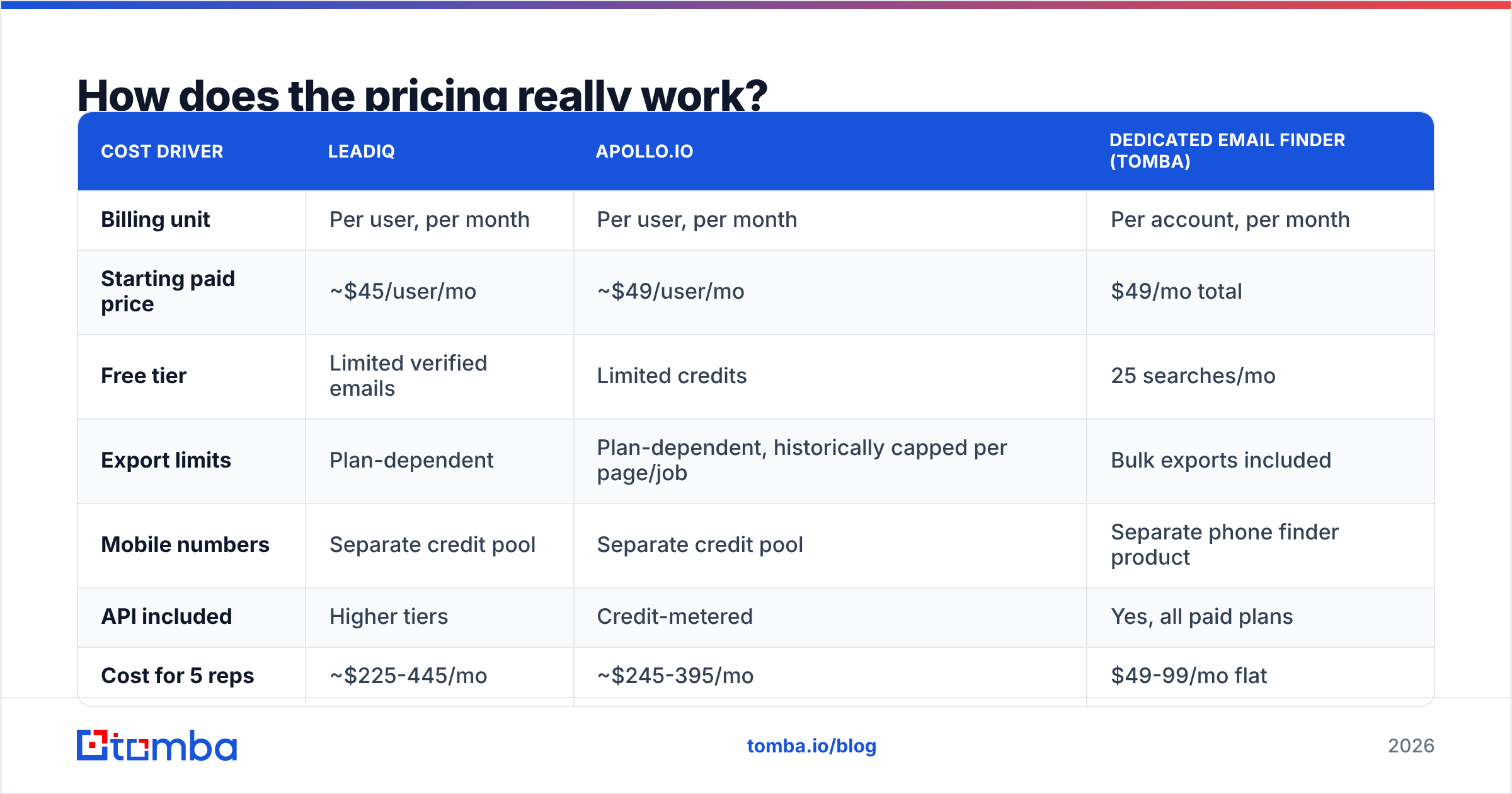
List price is the least interesting number on either pricing page. Both vendors sell seats, then meter the data inside the seat. That second layer is where budgets break.
| Cost driver | LeadIQ | Apollo.io | Dedicated email finder (Tomba) |
|---|---|---|---|
| Billing unit | Per user, per month | Per user, per month | Per account, per month |
| Starting paid price | ~$45/user/mo | ~$49/user/mo | $49/mo total |
| Free tier | Limited verified emails | Limited credits | 25 searches/mo |
| Export limits | Plan-dependent | Plan-dependent, historically capped per page/job | Bulk exports included |
| Mobile numbers | Separate credit pool | Separate credit pool | Separate phone finder product |
| API included | Higher tiers | Credit-metered | Yes, all paid plans |
| Cost for 5 reps | ~$225-445/mo | ~$245-395/mo | $49-99/mo flat |
| Annual commitment for best price | Yes | Yes | Not required |
Two things to check before you sign either contract:
- Export ceilings. Apollo has historically capped how many records a single export job can pull on lower tiers. If your plan is "export 50,000 contacts and enrich them in a warehouse," verify the cap in writing rather than assuming the credit balance is the only limit.
- Seat math. Five reps on a mid tier is $4,700-5,300 per year before overage. If only two of those reps prospect daily, you are paying full seat price for three people who need occasional enrichment. That is the exact scenario where a shared Tomba API key plus two seats beats five seats.
Compare that against Tomba pricing, where the Starter plan is $49/mo for the whole account rather than per user, Growth is $99/mo and Pro is $249/mo. Different shape of bill, different buying logic.
Is LeadIQ better than Apollo.io for outbound teams?#
It depends on one question: do you already own a sequencer?
Choose LeadIQ when:
- Salesforce is your system of record and CRM hygiene is a real, named problem — duplicates, stale titles, contacts who left six months ago.
- Your reps prospect inside Sales Navigator and you want capture to take one click, not a tab switch.
- You already pay for Outreach or Salesloft. LeadIQ complements them; Apollo competes with them.
- Job-change alerts matter to your motion. A champion moving to a new company is the highest-converting trigger most teams ignore. LeadIQ productises it.
Choose Apollo.io when:
- You have no sequencer, no dialer and no data vendor and want to consolidate the whole stack into one line item.
- Budget is tight and headcount is small. One Apollo seat replacing three tools is genuinely cheaper for a 2-5 person team.
- You want to search by filters, not capture by profile. Apollo's database-first workflow builds a 3,000-contact list in a session; LeadIQ's capture-first workflow does not.
- Intent and engagement data in one place is worth more to you than depth in any single module.
If you are actively evaluating replacements for either, we maintain breakdowns of the Apollo alternative landscape and the LeadIQ alternative options that cover the API-first side of the market these two do not serve well.
What do reviewers say about each?#
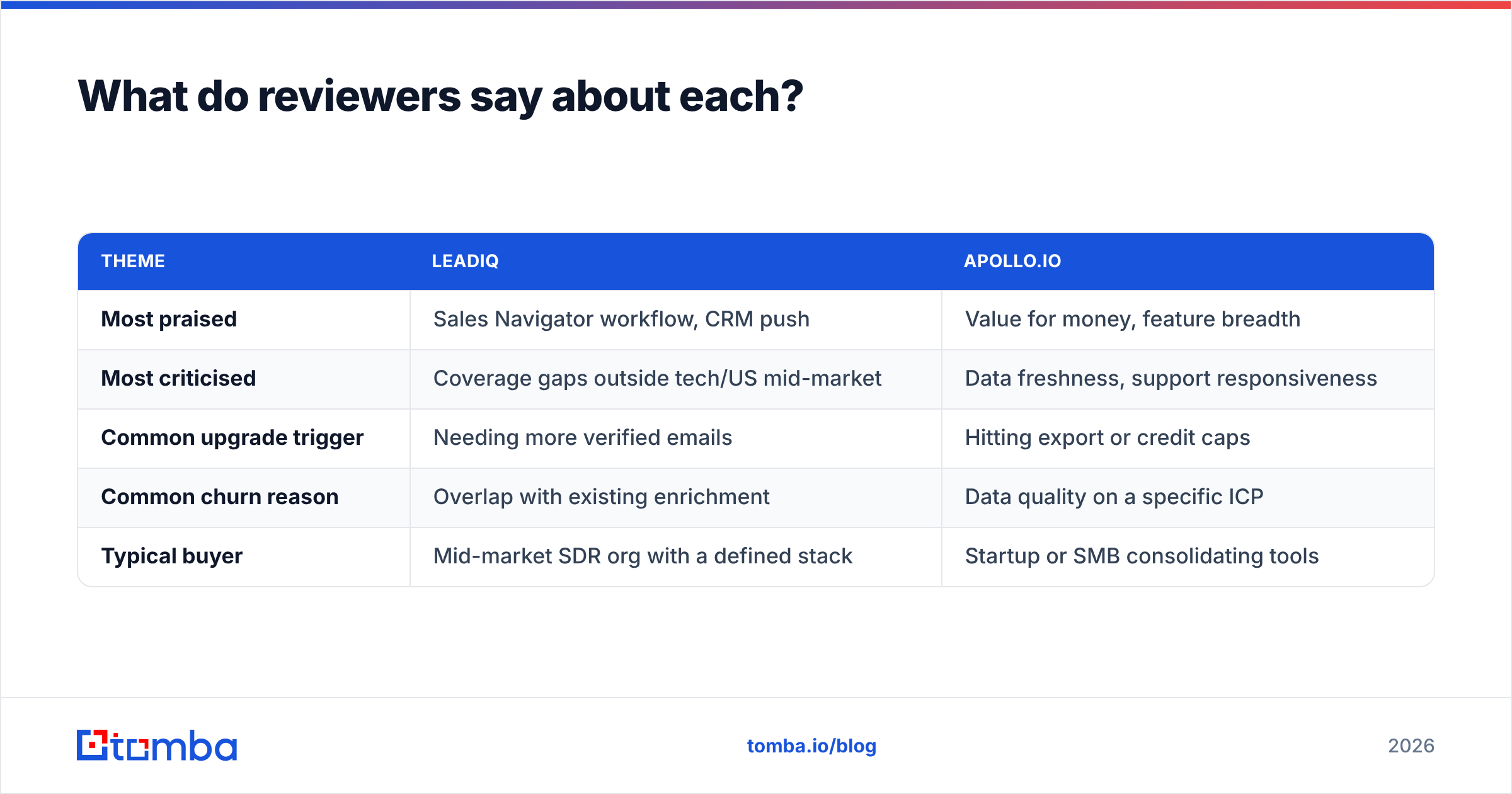
Third-party review sites are noisy but directionally useful. On G2, the recurring themes are stable across hundreds of reviews:
| Theme | LeadIQ | Apollo.io |
|---|---|---|
| Most praised | Sales Navigator workflow, CRM push | Value for money, feature breadth |
| Most criticised | Coverage gaps outside tech/US mid-market | Data freshness, support responsiveness |
| Common upgrade trigger | Needing more verified emails | Hitting export or credit caps |
| Common churn reason | Overlap with existing enrichment | Data quality on a specific ICP |
| Typical buyer | Mid-market SDR org with a defined stack | Startup or SMB consolidating tools |
Notice that both churn reasons point to the same underlying issue: the data layer, not the software layer. Nobody leaves these tools because the buttons are in the wrong place.

Do you actually need either tool?#
Run this test. Write down what your team does with the tool in a typical week. If more than 70% of the answer is "look up an email address for a person we already identified," you are paying platform prices for a lookup problem.
That workflow is served by a purpose-built stack:
- Name plus domain to address. An email finder resolves a known person at a known company, with a confidence score and the sources behind it.
- Company to contact list. Domain search returns the addresses associated with a domain plus the detected email pattern, which is how you build a list without a database subscription.
- List hygiene before sending. Verification and catch-all handling on every address, every time, regardless of which vendor supplied it.
- Programmatic access. A documented API and bulk endpoints so enrichment runs in your pipeline instead of in a rep's browser tab.
This is not an argument that platforms are bad. It is an argument that most teams buy a platform to solve one job, then pay per seat for the other eleven jobs forever. Price the job, not the category.
Where the platform genuinely earns its keep: intent signals, native dialing, sequence analytics, and account-level orchestration. If those show up in your weekly usage, buy the platform. If they do not, the data primitive plus your existing sequencer is a better-shaped bill.
What is the verdict on LeadIQ vs Apollo.io?#
Short version: Apollo.io wins on breadth and price-per-feature for small teams starting from zero. LeadIQ wins on workflow quality for mid-market SDR orgs that already own a sequencer and care about CRM data hygiene. Neither wins on being the cheapest source of verified email addresses, because that is not the business either one is in.
A sane 2026 stack for most outbound teams looks like this: one engagement tool your reps already know, one contact-data source you can call programmatically, and one verification step that runs on every list before it touches a sending domain. LeadIQ or Apollo can fill the first two slots. They should not be filling the third without a second opinion.
Run the trials in parallel on the same 100 target accounts. Measure hit rate, bounce rate after independent verification, and how many clicks it takes a rep to get a contact into a sequence. Those three numbers will settle the argument faster than any comparison post, including this one.
Need the data layer without the seat tax? Start with the Tomba Email Finder — free for 25 searches a month, $49/mo for the whole account on Starter, with verification, domain search and a documented API included rather than metered as an upsell. Point it at the same 100 accounts you are testing LeadIQ and Apollo against, and compare the bounce rates yourself.
Related guides#
Ready to find emails that actually work?
Join 150,000+ professionals who stopped guessing and started sending. Free credits on signup — no credit card required.
Get the Tomba newsletter
Practical outbound tactics and product updates — once every two weeks.
About the author