Leadlovers vs Apollo.io: Which Tool Wins for B2B Growth in 2026?
Leadlovers and Apollo.io both promise more pipeline, but they solve different problems. One runs inbound funnels for leads you already have; the other finds and sequences cold B2B prospects. Here's how to pick.
TL;DR
- Leadlovers is a marketing automation platform. It covers landing pages, email funnels, lead scoring and nurturing for leads who come to you. It is built mainly for the Brazilian market and digital-product sellers.
- Apollo.io is a sales intelligence and outbound platform. You get a large B2B contact database plus sequencing, a dialer and a Chrome extension for finding and contacting cold prospects.
- They rarely compete head to head. If you run inbound funnels in Portuguese, pick Leadlovers. If you run outbound to B2B buyers in the US, EU or globally, pick Apollo.
- Many teams need parts of both: a way to find and verify contacts, and a way to nurture them. Verified contact data is the input that decides whether either tool performs.
- Watch the hidden costs. Leadlovers prices by list size, while Apollo's credit limits and per-seat pricing grow quickly as you add reps.
What is the real difference between Leadlovers and Apollo.io?#
The short version is that Leadlovers helps you convert people who already raised their hand, and Apollo helps you find people who haven't yet.
Think of it like a restaurant. Leadlovers is the dining room: it greets guests who walked in, seats them, brings the menu and tries to get them to order dessert. Apollo is the street team handing out flyers and booking reservations. Both bring in revenue, but they do different jobs.
Leadlovers comes out of Brazil's infoproduct and digital-marketing scene. Its core pieces are a landing page and capture-form builder, email marketing, automated funnels (Leadlovers calls them "machines"), lead scoring, and integrations with the checkout and payment platforms popular in Latin America. The interface, support and billing are mostly in Portuguese and Brazilian reais.
Apollo.io is a US-based sales platform. It combines a B2B contact and company database with multichannel sequences (email, calls, LinkedIn tasks), a Chrome extension, a dialer, CRM sync and AI-assisted email writing. Its buyers are SDR teams, founders doing their own outbound, and RevOps teams that want prospecting and engagement in one place.
So the useful question isn't "which is better?" It's which motion drives your pipeline: inbound nurture or outbound prospecting.
How do Leadlovers and Apollo.io compare feature by feature?#
Here is the side-by-side, based on each vendor's public product pages at the time of writing.
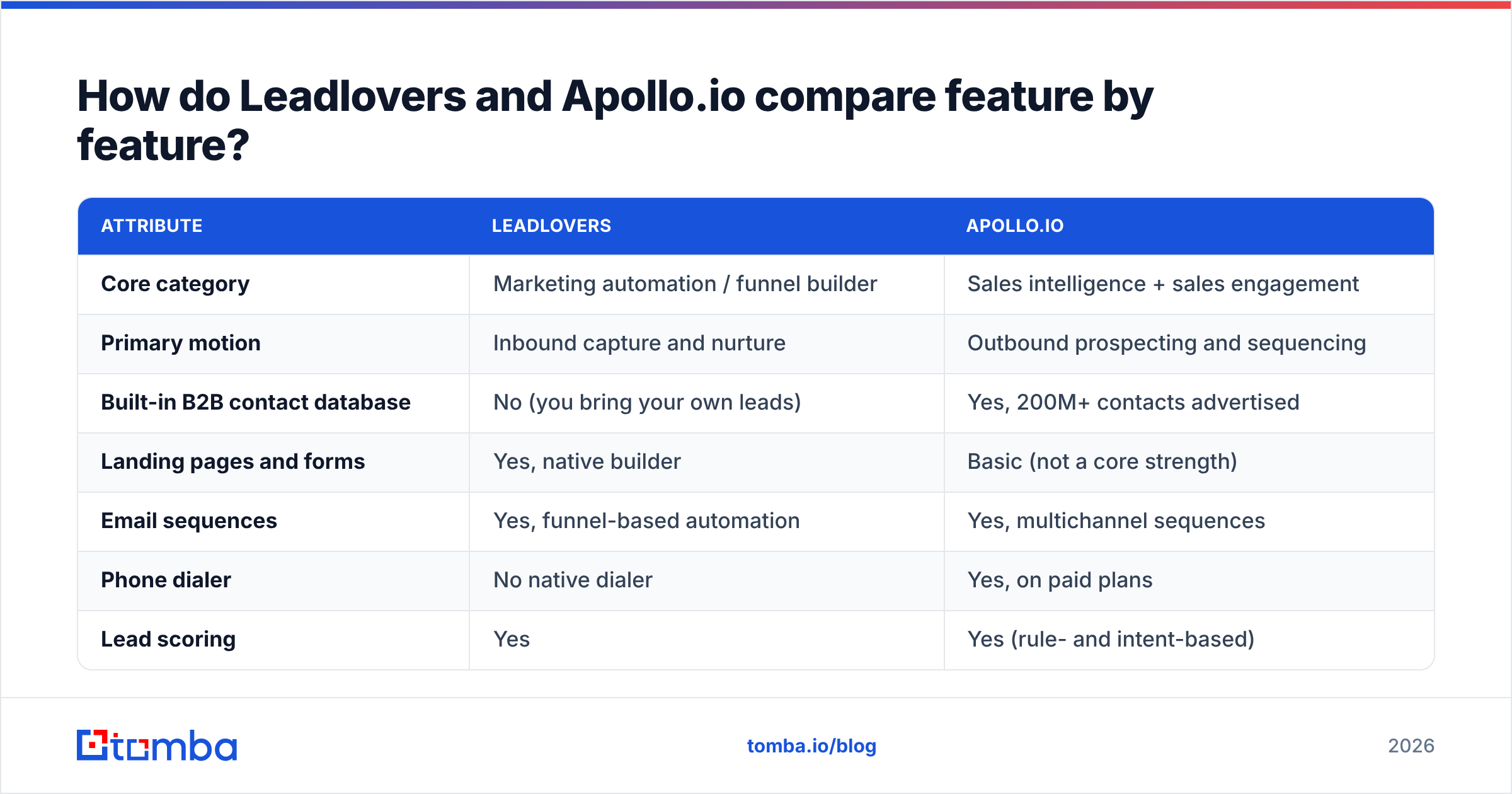
| Attribute | Leadlovers | Apollo.io |
|---|---|---|
| Core category | Marketing automation / funnel builder | Sales intelligence + sales engagement |
| Primary motion | Inbound capture and nurture | Outbound prospecting and sequencing |
| Built-in B2B contact database | No (you bring your own leads) | Yes, 200M+ contacts advertised |
| Landing pages and forms | Yes, native builder | Basic (not a core strength) |
| Email sequences | Yes, funnel-based automation | Yes, multichannel sequences |
| Phone dialer | No native dialer | Yes, on paid plans |
| Lead scoring | Yes | Yes (rule- and intent-based) |
| Chrome extension for prospecting | No | Yes (LinkedIn, Gmail, websites) |
| Language and market focus | Portuguese-first, Brazil/LatAm | English-first, global B2B |
| Pricing model | Tiered by lead/contact volume, billed in BRL | Per user per month, plus credit limits |
| Free option | Trial only, varies | Free plan with limited credits |
| Best fit | Infoproducers, agencies, B2C/B2B inbound in Brazil | SDR teams, founders, B2B outbound |
Your decision mostly comes down to two rows. If you need a built-in contact database, Leadlovers doesn't have one, so you'd have to bring leads from somewhere else. If you need landing pages and funnel automation in Portuguese, Apollo isn't built for that and you'd end up adding another tool.
Is Leadlovers better than Apollo.io for inbound marketing?#
Yes, and by a lot, if your audience is in Brazil or Portuguese-speaking markets.
Leadlovers' strengths are the pieces Apollo treats as add-ons:
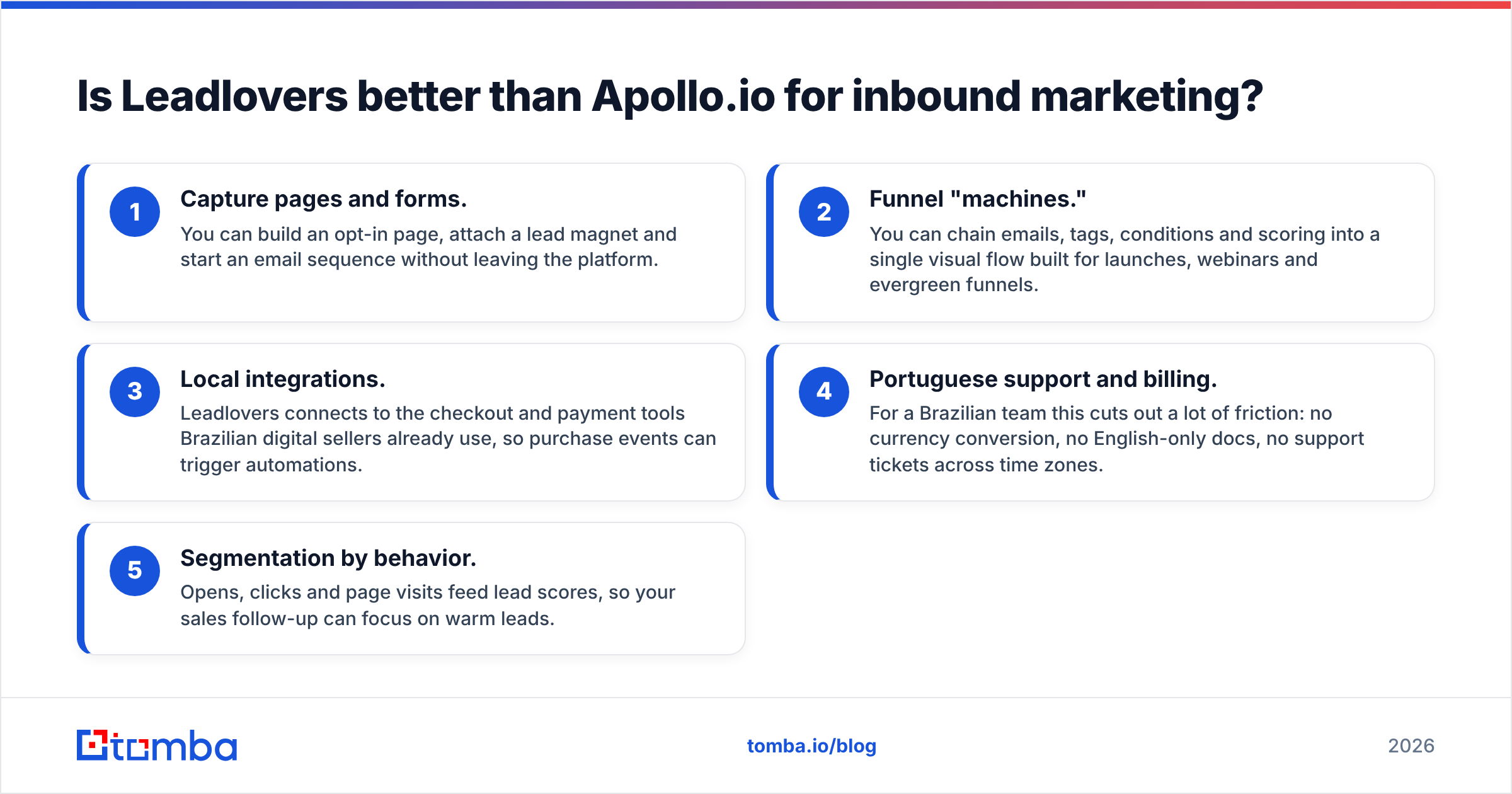
- Capture pages and forms. You can build an opt-in page, attach a lead magnet and start an email sequence without leaving the platform.
- Funnel "machines." You can chain emails, tags, conditions and scoring into a single visual flow built for launches, webinars and evergreen funnels.
- Local integrations. Leadlovers connects to the checkout and payment tools Brazilian digital sellers already use, so purchase events can trigger automations.
- Portuguese support and billing. For a Brazilian team this cuts out a lot of friction: no currency conversion, no English-only docs, no support tickets across time zones.
- Segmentation by behavior. Opens, clicks and page visits feed lead scores, so your sales follow-up can focus on warm leads.
Apollo does have sequences and some scoring. It doesn't try to be a landing page builder or a launch-funnel tool, and its templates and deliverability guidance are written for cold B2B email, not newsletter-style nurture.
Where Leadlovers falls short for B2B: it assumes you already have leads. If your pipeline depends on reaching VP-level buyers at companies that have never heard of you, Leadlovers can't find those people. You'd need a separate prospecting source, and the quality of that source decides how your emails perform.
Is Apollo.io better than Leadlovers for outbound sales?#
For cold B2B outbound, yes. Apollo was built for it.
The workflow looks like this: filter the database by title, industry, headcount, technology and location, then save a list. Enrich it and push it into a sequence that mixes emails, call tasks and LinkedIn steps. Reps work their day from a task queue, and replies, meetings and opportunities sync back to your CRM.
What Apollo does well:
- Database and sequencer in one place. You don't need a separate data vendor for most mid-market use cases.
- Chrome extension. Pull contact details while browsing LinkedIn or a company site.
- Filters and intent signals. Buying-intent topics and job-change alerts on higher tiers help with prioritization.
- A usable free plan. Solo founders can test outbound before paying.
Apollo's weak spots are well documented in reviews on G2. Data accuracy varies by region and seniority, bounce rates on raw exports can be higher than you'd like, and credit limits catch teams out once volume picks up. A large database is only useful if the emails actually get delivered.

That's why many Apollo users add a dedicated email verifier or a second data source before launching sequences, especially for catch-all domains and markets outside North America.
How much do Leadlovers and Apollo.io cost in 2026?#
The two tools price in different ways, so compare total cost at your actual volume rather than list prices.
Leadlovers prices by the number of leads or contacts in your account, with higher tiers adding features and sending capacity. Plans are billed in Brazilian reais, and the vendor adjusts them from time to time, so check leadlovers.com for current numbers. Your cost goes up as your list grows, whatever your team size.
Apollo.io prices per user. At the time of writing, its public pricing page lists:
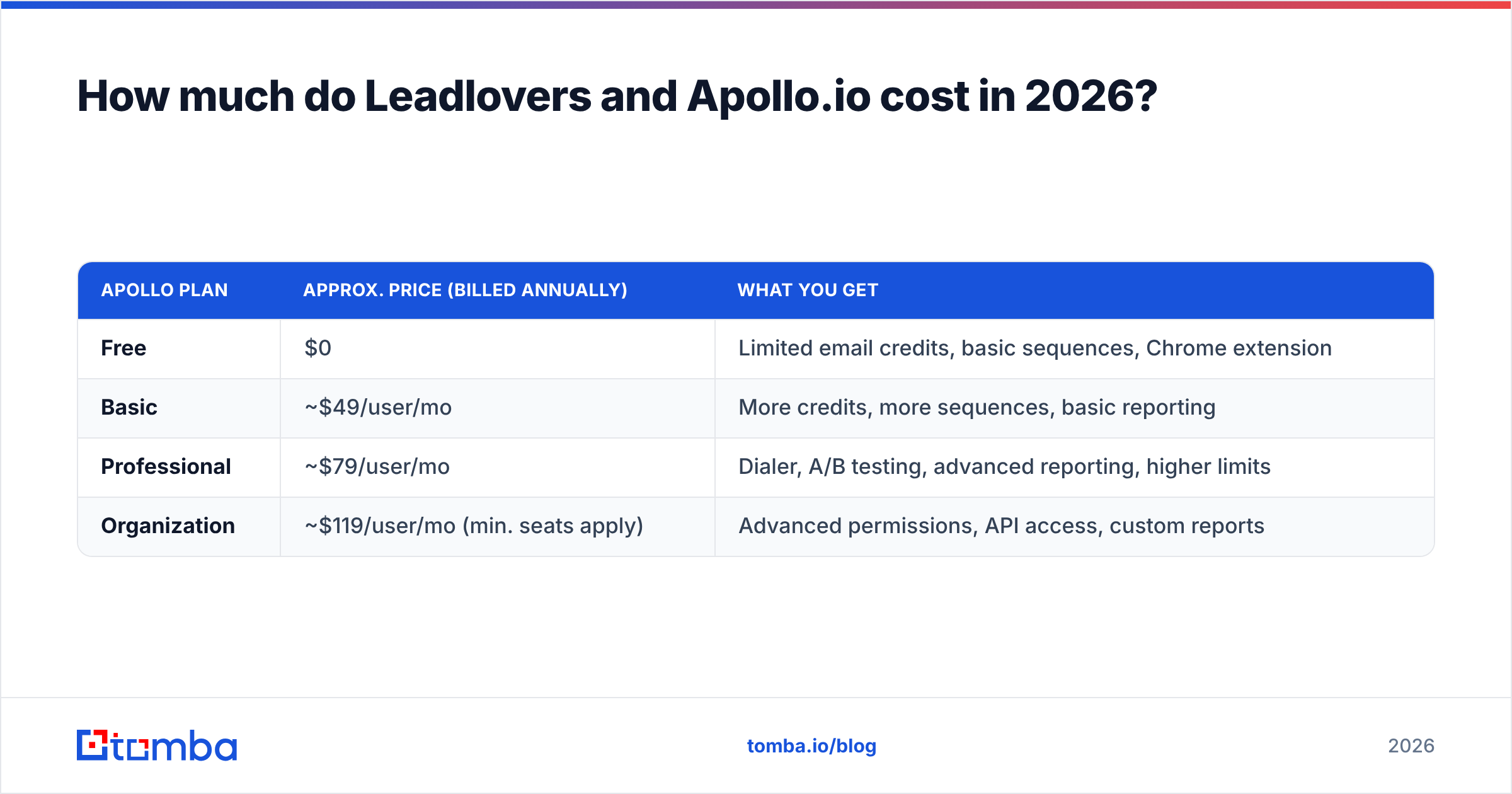
| Apollo plan | Approx. price (billed annually) | What you get |
|---|---|---|
| Free | $0 | Limited email credits, basic sequences, Chrome extension |
| Basic | ~$49/user/mo | More credits, more sequences, basic reporting |
| Professional | ~$79/user/mo | Dialer, A/B testing, advanced reporting, higher limits |
| Organization | ~$119/user/mo (min. seats apply) | Advanced permissions, API access, custom reports |
Monthly billing costs more than annual. Mobile and export credits are metered separately, and heavy users often buy add-on credits. Confirm the current numbers on Apollo's pricing page before you budget.
The hidden-cost pattern:
- With Leadlovers, costs grow with your list size. If you don't clean out inactive leads, you pay to store people who will never buy.
- With Apollo, costs grow with seats and credits. Five SDRs on Professional is already about $4,700/year before extra credits, and bounced emails waste credits and hurt your sender reputation.
In both cases, list hygiene pays for itself. Verifying before you import lowers your Leadlovers tier cost and your Apollo bounce rate.
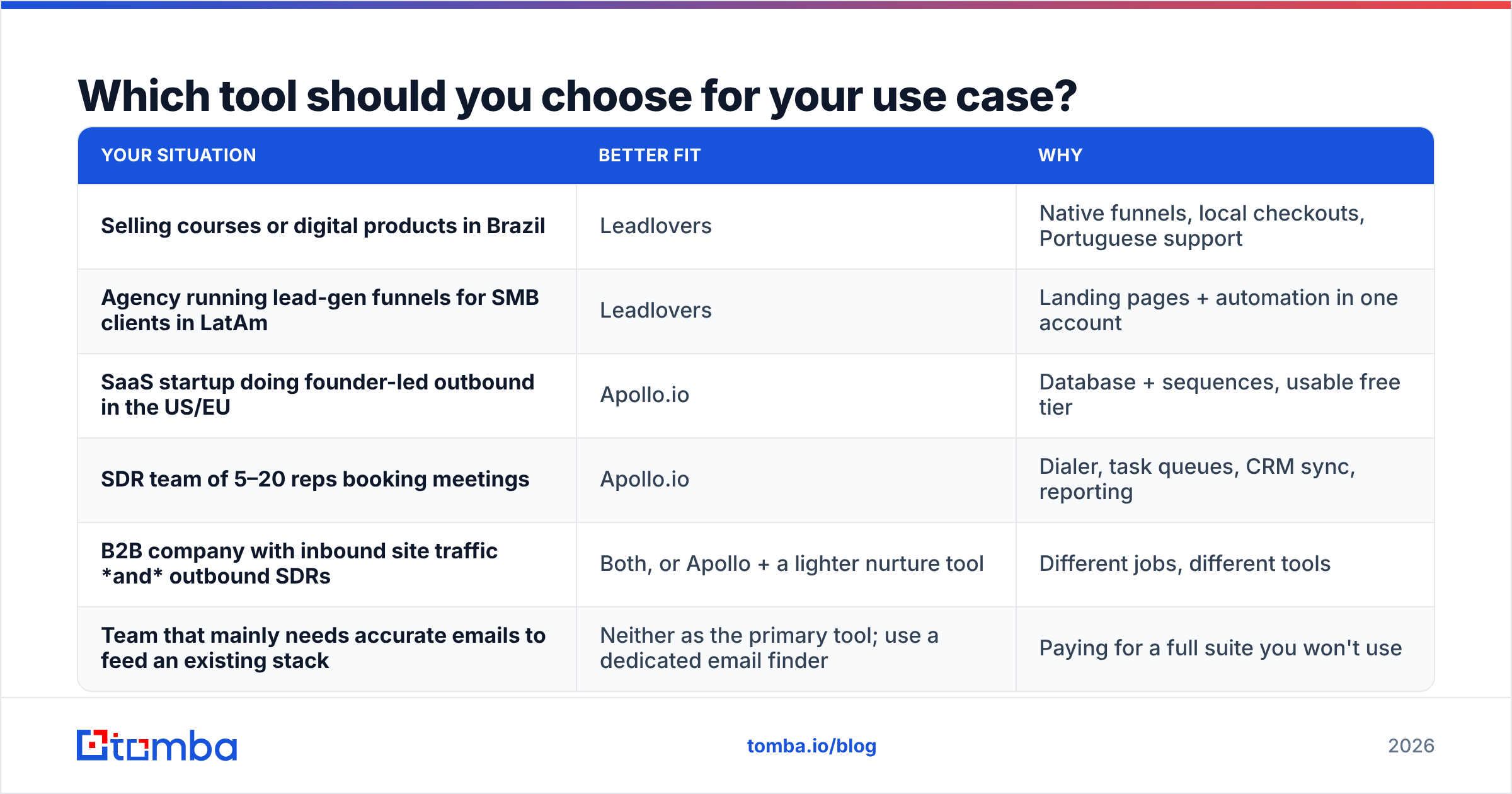
Which tool should you choose for your use case?#
Match the tool to your motion, not to the size of its feature list.
| Your situation | Better fit | Why |
|---|---|---|
| Selling courses or digital products in Brazil | Leadlovers | Native funnels, local checkouts, Portuguese support |
| Agency running lead-gen funnels for SMB clients in LatAm | Leadlovers | Landing pages + automation in one account |
| SaaS startup doing founder-led outbound in the US/EU | Apollo.io | Database + sequences, usable free tier |
| SDR team of 5–20 reps booking meetings | Apollo.io | Dialer, task queues, CRM sync, reporting |
| B2B company with inbound site traffic and outbound SDRs | Both, or Apollo + a lighter nurture tool | Different jobs, different tools |
| Team that mainly needs accurate emails to feed an existing stack | Neither as the primary tool; use a dedicated email finder | Paying for a full suite you won't use |
That last row matters more than most comparisons admit. Plenty of teams don't need an all-in-one platform. They already have a sequencer (Lemlist, Instantly, HubSpot) or a nurture tool (Leadlovers, RD Station, Mailchimp). What they're missing is reliable contact data. Buying Apollo only for its database, or trying to make Leadlovers do outbound, usually ends in paying for overlapping features.
Can you use Leadlovers and Apollo.io together?#
Yes. The combination makes sense for B2B companies in Brazil that run both motions.
A typical setup:
- Prospect in Apollo. Build account lists and send a short cold sequence to decision-makers.
- Route engaged prospects into Leadlovers. Anyone who replies, clicks or downloads content goes into a longer nurture funnel through a webhook or an automation platform.
- Score in Leadlovers, hand back to sales. When a lead crosses a score threshold, notify the rep or create a CRM deal.
The weak point in this chain is data quality at step one. If 10–15% of your Apollo exports bounce, those bad records get copied into Leadlovers. That hurts your email deliverability on both platforms and raises your Leadlovers bill for contacts who don't exist.

Put a verification step between the two tools. It's the cheapest insurance in the stack.
Where does contact data accuracy fit into the Leadlovers vs Apollo.io decision?#
It's the factor most comparisons leave out, and it matters more than any feature on the list.
- Leadlovers performs only as well as the leads you feed it. Clean opt-in lists do very well. Imported or bought lists hurt sender reputation and can get your account flagged.
- Apollo's database is broad but not uniformly accurate. Accuracy is usually strongest for North American tech companies and weaker for SMBs, non-English markets and senior executives whose emails sit on catch-all domains.
In practice, run any list, from either tool, through verification before you send. Sort results into valid, risky (catch-all) and invalid. Send to valid addresses, handle risky ones in smaller batches, and drop invalid ones.
If Apollo's coverage is thin for your market, or its credit limits keep capping you, a dedicated email finder can fill the gap without another per-seat subscription. Tomba's email finder looks up a professional address from a name and domain, and its domain search returns every public address tied to a company. It pairs with either platform: use it to enrich Apollo exports or to build B2B lists you'll nurture in Leadlovers. If you're already looking at other options, there's a full breakdown of Apollo alternatives too.
What are the pros and cons of each platform?#
Leadlovers: pros
- Landing pages, forms and funnels in one tool
- Strong fit for Brazilian digital-product and agency workflows
- Portuguese-language support and BRL billing
- Behavior-based lead scoring for nurture
Leadlovers: cons
- No built-in B2B prospecting database
- Less suited to English-language, global B2B outbound
- Costs rise with list size, so dirty lists cost you money
- Smaller international integration ecosystem than US-built suites
Apollo.io: pros
- Large B2B database plus sequencer in one platform
- Chrome extension, dialer and CRM sync for sales teams
- Free plan that's genuinely useful for testing
- Strong filtering, intent and job-change signals on higher tiers
Apollo.io: cons
- Data accuracy varies by region and seniority
- Per-seat pricing plus credits adds up fast
- Not a landing-page or inbound-funnel tool
- Raw exports usually need verification before sending
So, Leadlovers vs Apollo.io: which one wins?#
It depends on your motion, and the split is fairly clear:
- Choose Leadlovers if you sell mainly through inbound funnels, your audience speaks Portuguese, and you need capture pages, launch automation and nurture scoring in one place.
- Choose Apollo.io if you sell B2B through outbound, need a prospecting database, and want reps working sequences, calls and LinkedIn tasks from one queue.
- Choose a dedicated data layer if what you actually need is accurate emails to feed a stack you already have. That's usually cheaper than adopting a whole new suite.
Whichever you choose, it can only work with the contacts you give it. Before you commit a budget to either platform, check how much of your target list you can reach with a verified address.
If you want accurate B2B contacts without paying for seats you don't need, try the Tomba Email Finder. Search by name, company or domain, verify in the same workflow, and export clean lists into Apollo, Leadlovers or any other tool. There's a free tier of 25 searches a month so you can test it on your own market, and paid plans start at $49/mo. See the full Tomba pricing when you're ready to scale.
Related guides#
// get started
Find, verify and enrich your first contacts today
Start on the free plan with 25 searches a month, then scale when your team is ready.
Free plan · No credit card required · GDPR & CCPA
// about the author