Leadmine vs Apollo.io: Which Email Finder Wins in 2026?
Leadmine is a focused email finder. Apollo.io is a full sales platform with a contact database built in. Here's which one gets you more valid emails for your money, and when neither is the right choice.
TL;DR
- Leadmine is a lightweight email finder and verifier. It's built for people who already know which companies they want and just need working addresses fast.
- Apollo.io is a full sales platform. It combines a large B2B contact database, email sequencing, a dialer and CRM sync, and prices it per seat.
- If you only need emails, Apollo's per-seat pricing usually costs more than you need to spend. If you want one tool to handle list building and sending, Leadmine is too narrow.
- Accuracy varies with the market you sell into. Apollo is strongest on US tech contacts. Point-lookup finders do better on small companies and non-US domains.
- Whichever you choose, verify before you send. A finder that also verifies catch-all domains saves more bounces than any database size claim.
What is Leadmine?#
Leadmine is an email-finding tool. You give it a person's name and company domain, or just a domain, and it returns likely professional email addresses with a confidence signal. It includes a Chrome extension for pulling contacts from websites and LinkedIn profiles, bulk upload for CSV lists, and a built-in verifier that checks deliverability before you export.
Think of Leadmine as a locksmith rather than a building manager. It doesn't hand you a list of every door in the city. You point it at a specific door and it gets you in. That narrow focus is the main reason to buy it and also its main limitation.
Leadmine's pricing is credit-based rather than per-seat, so a small team can share one pool of lookups. Plans and credit allowances change, so check the current tiers on Leadmine's website before you budget.
Where Leadmine is strong:
- Fast single-contact lookups when you already have a target account list
- Simple interface with very little setup
- Verification sits alongside finding, so you're not exporting raw guesses
- Credit pricing that suits freelancers, agencies and small SDR teams
Where it's thin:
- No large searchable contact database for building lists from filters
- No native sequencing, dialer or deal tracking
- Fewer native CRM integrations than the bigger platforms
What is Apollo.io?#
Apollo.io is an all-in-one sales intelligence and engagement platform. At its core is a contact and company database you can filter by title, seniority, industry, headcount, technology, funding and buying-intent signals. On top of that sit email sequences, a calling tool, meeting scheduling, AI-written copy and two-way sync with Salesforce and HubSpot.
If Leadmine is the locksmith, Apollo is the property-management firm. It knows about thousands of buildings, gives you a key to many of them and runs the tenant mailing list too. The trade-off is that you pay for the whole firm even when all you wanted was one key.
Apollo has a free plan with limited credits. Paid plans are per user and billed at a discount if you pay annually. On Apollo's pricing page the tiers run from Basic through Professional to Organization, and Organization requires a minimum number of seats. Credits for exports and mobile numbers are metered separately, and heavy users often buy add-on credits.
Where Apollo is strong:
- Building prospect lists from scratch with detailed filters
- Running outreach without buying a separate sequencer
- Intent data and job-change alerts on higher tiers
- Mature CRM sync for teams that are already on Salesforce or HubSpot
Where it's thin:
- Per-seat pricing adds up quickly for teams of five or more
- Data quality drops outside North American tech and SaaS
- Sending from the same platform where you source contacts can put your sender reputation at risk if list hygiene is poor

How do Leadmine and Apollo.io compare side by side?#
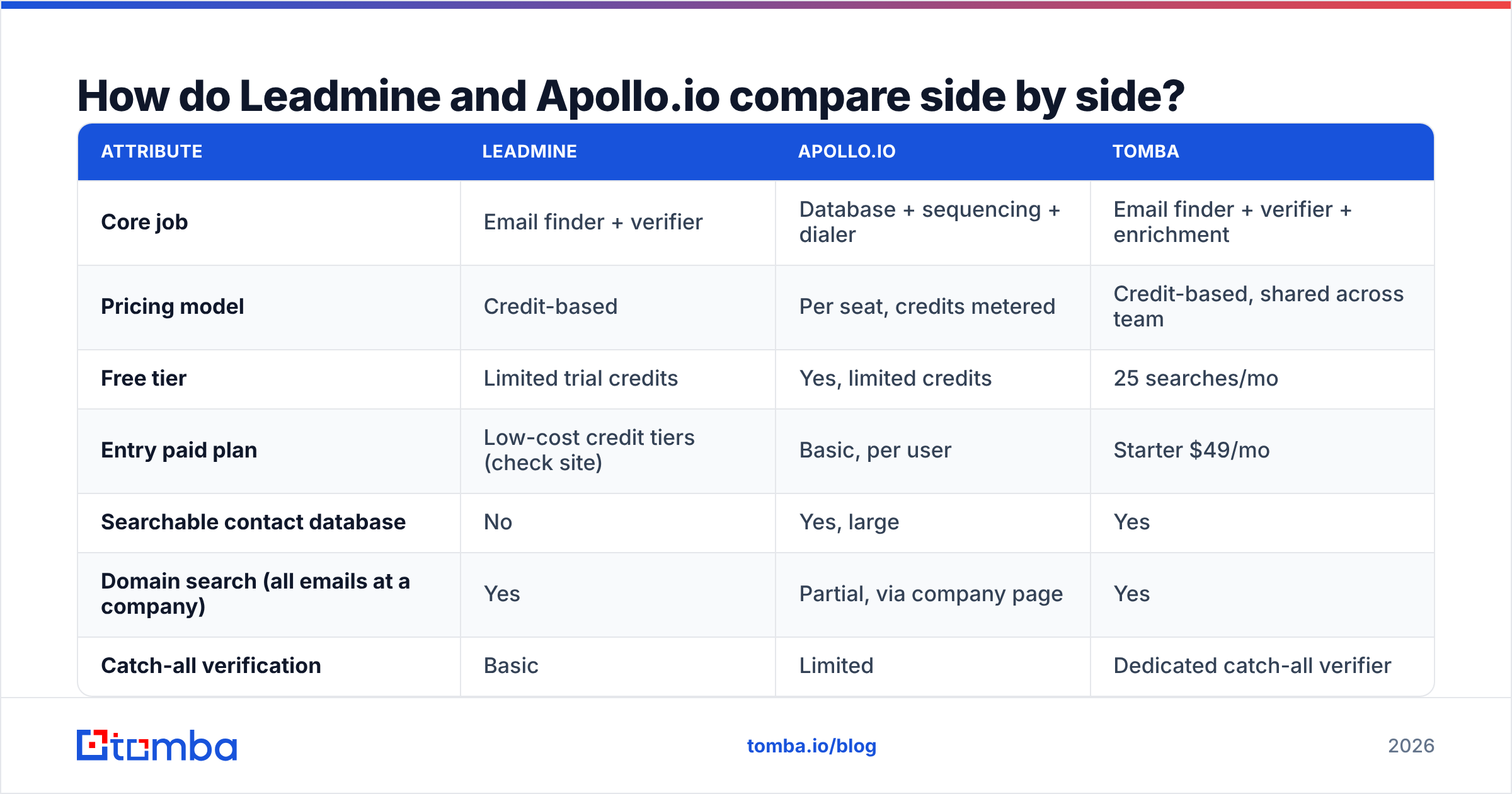
The table below compares the two tools on the attributes that actually change a buying decision. Tomba is included as a reference point for teams that want a focused finder with a deeper verification layer.
| Attribute | Leadmine | Apollo.io | Tomba |
|---|---|---|---|
| Core job | Email finder + verifier | Database + sequencing + dialer | Email finder + verifier + enrichment |
| Pricing model | Credit-based | Per seat, credits metered | Credit-based, shared across team |
| Free tier | Limited trial credits | Yes, limited credits | 25 searches/mo |
| Entry paid plan | Low-cost credit tiers (check site) | Basic, per user | Starter $49/mo |
| Searchable contact database | No | Yes, large | Yes |
| Domain search (all emails at a company) | Yes | Partial, via company page | Yes |
| Catch-all verification | Basic | Limited | Dedicated catch-all verifier |
| Built-in sequencing | No | Yes | No (integrates with sequencers) |
| Chrome extension | Yes | Yes | Yes |
| CRM integrations | Limited | Salesforce, HubSpot, many more | HubSpot, Salesforce, Pipedrive, Zapier, more |
| API access | Limited | Yes, on paid tiers | Yes, on all paid plans |
| Best for | Solo reps, agencies, targeted lookups | Teams that want one all-in-one tool | Teams that need accurate emails at a predictable cost |

Which tool finds more accurate emails?#
For most teams this question matters more than any other, and the honest answer is that it depends on who you're prospecting.
Apollo's database is large and refreshed continuously, partly from contributions by its own user base. For mid-market and enterprise contacts in US software, fintech and professional services, match rates are usually strong. Accuracy falls in three places:
- Small companies (under 50 employees). Fewer data points exist, so records go stale faster.
- Non-US markets. Coverage in DACH, the Nordics, LATAM and APAC is thinner, and the patterns are harder to guess.
- Recent job changes. Anyone who moved in the last 60 to 90 days may still show their old address.
Leadmine works differently. It doesn't pull a stored record. It works out and checks the address at the time you look it up, using the company's email pattern and a live SMTP check. That means results are often fresher for small or niche companies. The catch is that you need a name and domain to start with, and you get nothing when the domain is catch-all and the verifier can't confirm the mailbox.

The practical takeaway: don't trust any vendor's headline accuracy figure. Pull 200 contacts from your actual ICP, run them through each tool and send the results through an independent email verifier. Count valid, risky and invalid addresses. That 30-minute test tells you more than any review site will. G2's user reviews for Apollo.io are also worth reading. Filter them by company size and region to find complaints that match your situation.
How much do Leadmine and Apollo.io really cost?#
The sticker prices hide the part that matters, which is how cost grows as your team does.
Apollo scales with headcount. Every rep who needs to search or export needs a seat. A five-person team on Professional pays five seat fees before any extra credits. Mobile number reveals and large exports use up credits quickly, and teams that go over their allowance buy top-ups. On the Organization tier, the minimum seat count means a small team can end up paying for seats nobody uses.
Leadmine scales with volume. You buy lookups rather than logins. A three-person agency that finds 1,500 emails a month pays the same whether one person does the work or all three do. That's cheaper for small teams with modest volume. Once you need tens of thousands of verified contacts a month, compare the cost per valid email, not the cost per plan.
A useful way to compare costs:
- Cost per valid email. Take the monthly price, divide it by credits, then divide again by your measured valid rate from the test above.
- Cost per seat that actually uses the tool. Seats that sit idle make per-user pricing expensive.
- Cost of the tools you'd still need. Leadmine plus a sequencer can cost more or less than Apollo alone, depending on the sequencer.
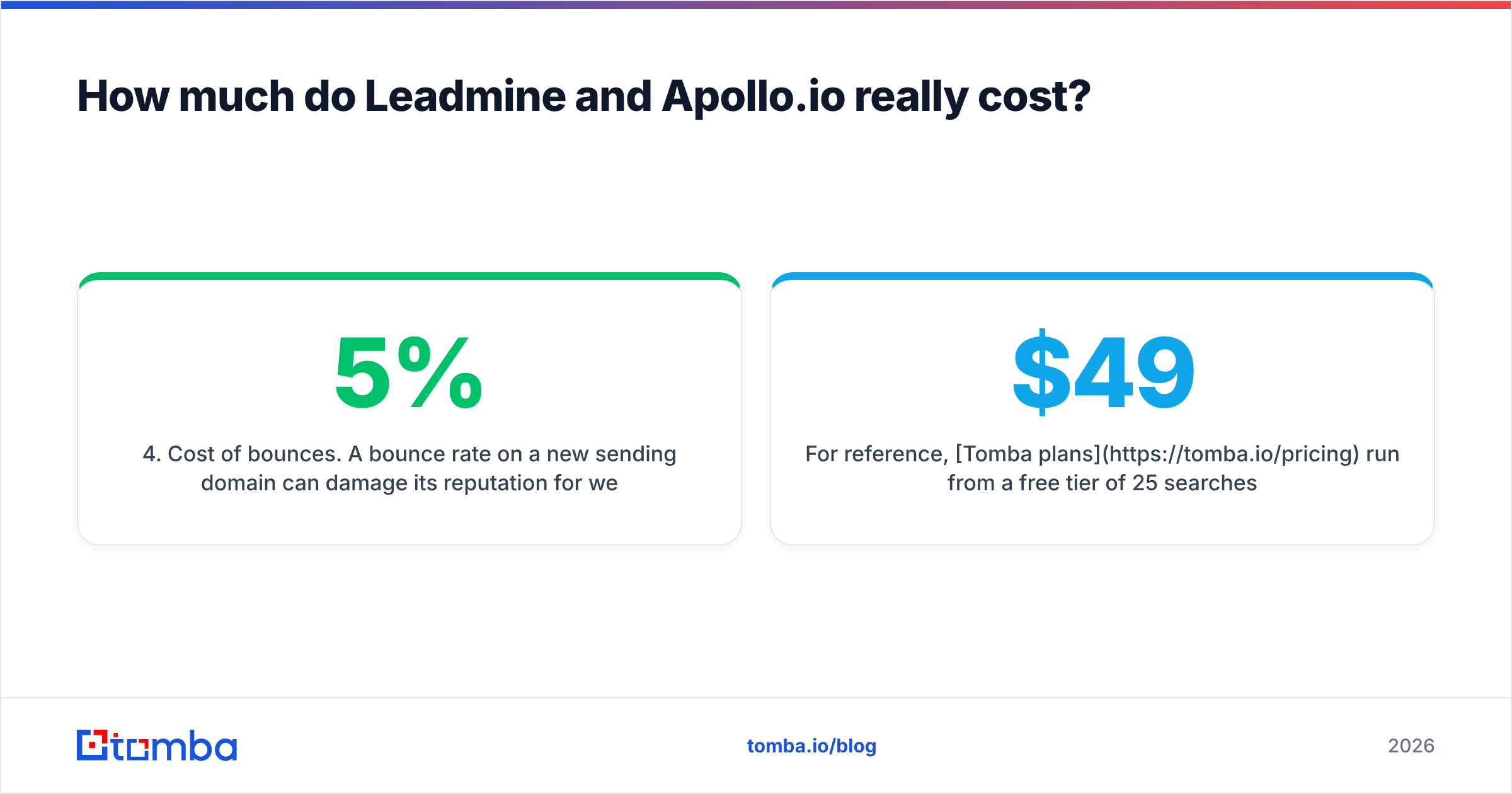
- Cost of bounces. A 5% bounce rate on a new sending domain can damage its reputation for weeks. You pay for that later in lost replies.
For reference, Tomba plans run from a free tier of 25 searches a month to Starter at $49/mo, Growth at $99/mo and Pro at $249/mo, with Enterprise priced on request. All plans are credit-based, so you don't pay per seat.
Which workflows does each tool fit best?#
Match the tool to how you actually work, not to the longest feature list.
Pick Leadmine if:
- You work from a named-account list (ABM, partnerships, recruiting, PR) and need addresses for specific people
- You already have a sequencer you like, such as Instantly, Lemlist or Smartlead
- Your team is one to three people and seat fees would be most of your budget
- You want a tool your team can learn in an afternoon
Pick Apollo.io if:
- You need to build lists from zero using firmographic and title filters
- You want sourcing, sequencing and calling in one login, and you'll accept a weaker version of each to get that
- Your ICP is mostly North American B2B tech, where Apollo's data is densest
- RevOps already runs on Salesforce or HubSpot and wants native sync
Consider neither, or a combination, if:
- Your bounce rate is already above 3%. Fix verification first. More data won't help.
- Most of your ICP is outside the US, or your targets use catch-all domains
- You need API-level enrichment inside your own product or data pipeline
Many teams end up with a hybrid. They use Apollo's filters to build a list, then re-find and re-verify each contact with a dedicated finder before sending. That second step catches stale records and confirms catch-all addresses, which is where most bounces come from.
Is Apollo.io better than Leadmine for cold email deliverability?#
Neither tool delivers your emails for you. Your domain setup, warmup, sending volume and list quality decide deliverability. The tools do affect list quality, though, and that's where they differ.
Apollo lets you source contacts and send to them from the same screen. That's convenient, but it also makes it easy to send to contacts you haven't re-verified. Apollo does flag verification status, but "likely valid" isn't the same as a confirmed mailbox, especially on catch-all domains.
Leadmine verifies each address as part of the lookup, so the list you export is cleaner by default. It doesn't send anything, so you still need a separate sequencer that handles throttling and warmup.
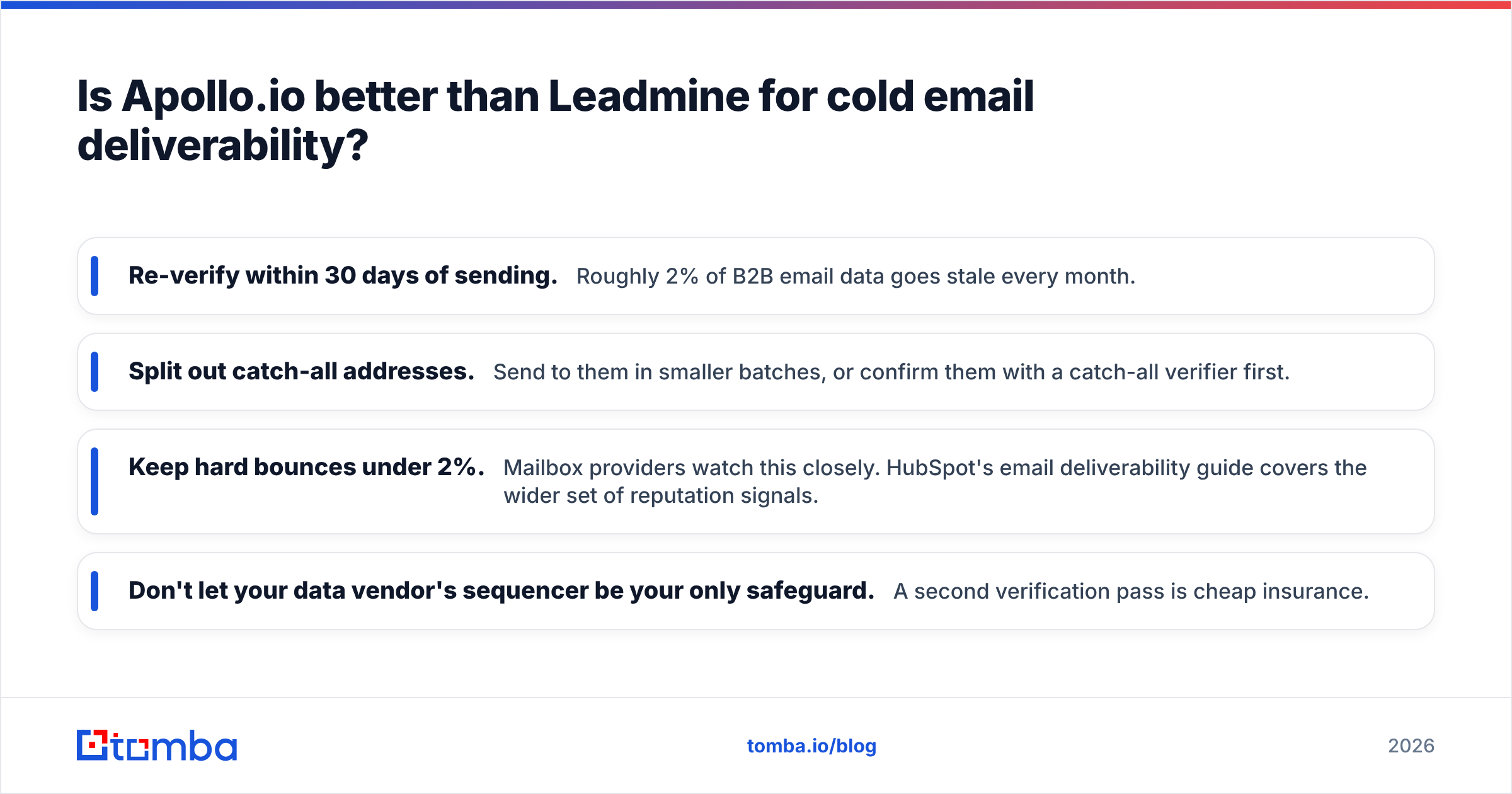
Whichever tool you choose, these rules keep you out of spam folders:
- Re-verify within 30 days of sending. Roughly 2% of B2B email data goes stale every month.
- Split out catch-all addresses. Send to them in smaller batches, or confirm them with a catch-all verifier first.
- Keep hard bounces under 2%. Mailbox providers watch this closely. HubSpot's email deliverability guide covers the wider set of reputation signals.
- Don't let your data vendor's sequencer be your only safeguard. A second verification pass is cheap insurance.

What do users say about Leadmine and Apollo.io?#
Review patterns are more useful than star ratings, so here's what comes up most.
Apollo.io, common praise: the size of the database, how much you get on the free tier, having everything in one tool, and filters that make list-building fast.
Apollo.io, common complaints: outdated or bounced emails in some regions, credit limits that run out sooner than expected, a dense interface with a learning curve, and billing surprises when seats or credits grow. If those complaints sound like your team, our Apollo alternative breakdown compares focused options.
Leadmine, common praise: simplicity, quick lookups, the Chrome extension, and fair pricing for low volume.
Leadmine, common complaints: no list-building database, a smaller integration ecosystem, and weaker results on catch-all domains.
Both sets of complaints make sense given what each product is trying to be. Apollo tries to do everything and does some of it unevenly. Leadmine does one thing and leaves the rest to you.
Leadmine vs Apollo.io: which one should you choose?#
Here's the short verdict:
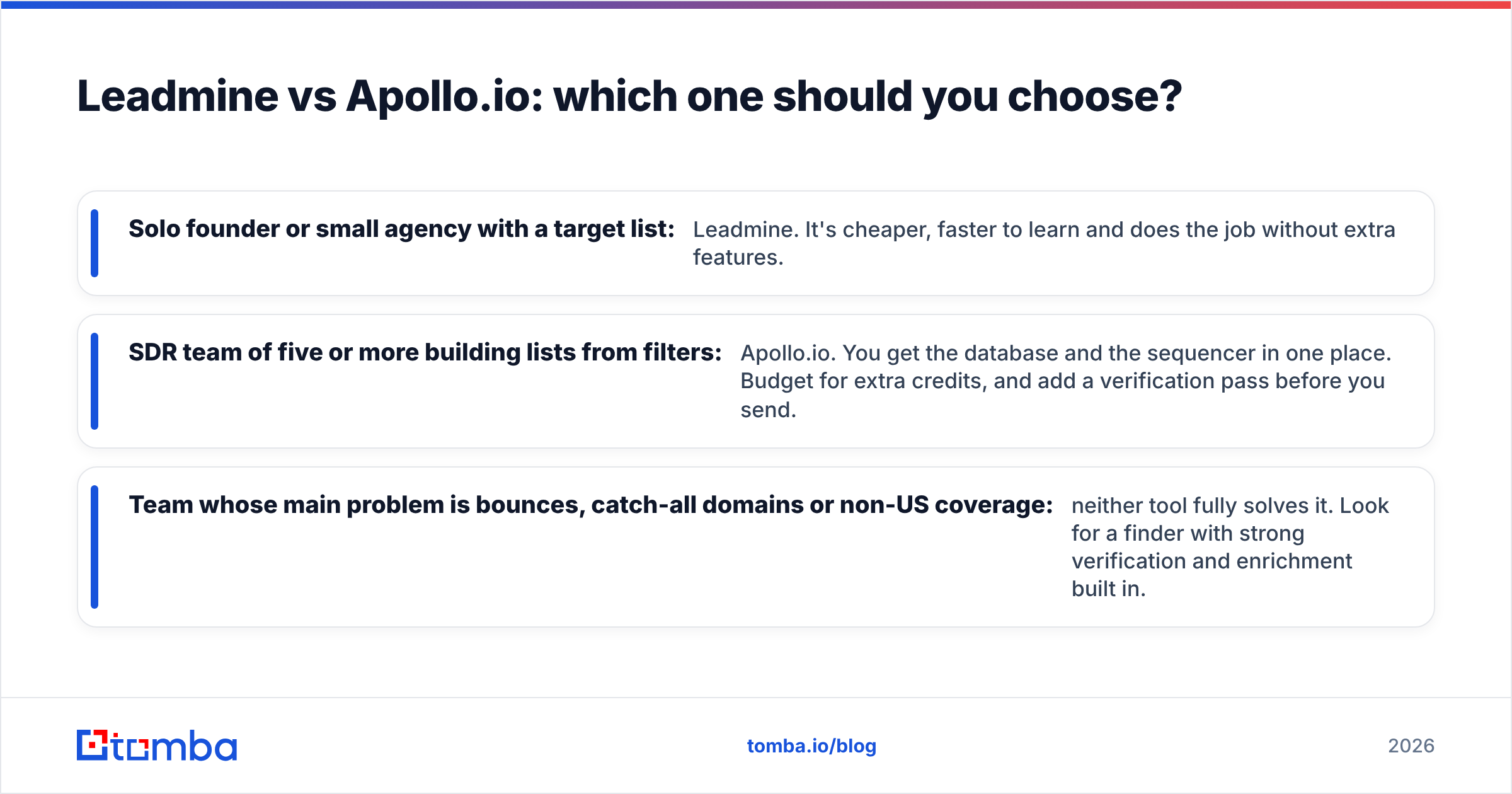
- Solo founder or small agency with a target list: Leadmine. It's cheaper, faster to learn and does the job without extra features.
- SDR team of five or more building lists from filters: Apollo.io. You get the database and the sequencer in one place. Budget for extra credits, and add a verification pass before you send.
- Team whose main problem is bounces, catch-all domains or non-US coverage: neither tool fully solves it. Look for a finder with strong verification and enrichment built in.
The biggest mistake is choosing on database size. A database of 275 million contacts doesn't help if 12% of the ones you export bounce. Measure valid emails per dollar on your own ICP, and choose the tool that wins that test.
Where does Tomba fit if neither is a perfect match?#
If you're comparing Leadmine and Apollo, you probably want Leadmine's focus with coverage closer to Apollo's, and without per-seat pricing. That's the gap the Tomba Email Finder is built to fill. You can find emails by name, domain or company, run every result through built-in verification (including dedicated catch-all checks), and push clean contacts to HubSpot, Salesforce, Pipedrive or your sequencer through native integrations and the API. Plans start with 25 free searches a month and go up to Starter at $49/mo, with credits shared across your whole team. Run the same 200-contact test described above on the free tier, and compare the valid-email rate against whatever you use today.
Related guides#
// get started
Find, verify and enrich your first contacts today
Start on the free plan with 25 searches a month, then scale when your team is ready.
Free plan · No credit card required · GDPR & CCPA
Get the Tomba newsletter
Product and data updates
// about the author