LeadRocks vs Apollo.io: Data, Pricing, and Which to Pick in 2026
LeadRocks is a lean, LinkedIn-first contact finder. Apollo.io is a full sales platform with a huge database and built-in sequencing. Here's how they compare on data quality, pricing, and daily workflow, and which one fits your team.
TL;DR
- Apollo.io is an all-in-one sales platform: a very large contact database, sequencing, a dialer, intent filters, and CRM sync, all behind per-seat pricing.
- LeadRocks is a narrower tool. It focuses on finding and exporting B2B contacts (mostly from LinkedIn-style profile data) and doesn't try to run your outreach.
- Pick Apollo if you want one tool for prospecting and sending. Pick LeadRocks if you already have a sequencer and just need contact data without paying for a platform.
- Neither database is fully accurate. Whichever you choose, verify emails before you send, especially on catch-all domains.
- For solo reps and small teams, the total cost usually comes down to how many seats you need versus how many credits you use. Model both before you commit.
What is the real difference between LeadRocks and Apollo.io?#
The short answer: Apollo is a platform and LeadRocks is a data tool. Most of the LeadRocks vs Apollo.io decision follows from that.
Apollo.io sells a full outbound workflow. You search its database, build lists, enrich them, sequence them over email and phone, and log activity back to your CRM without leaving the app. The data sits inside a larger system, and the price reflects that.
LeadRocks solves a smaller problem. You find people who match a role, company, or LinkedIn profile, reveal their business email, and export them. Sending, follow-ups, and reporting happen in whatever tool you already use, such as Instantly, Lemlist, HubSpot, or Outreach.
A kitchen analogy helps here. Apollo is a restaurant: ingredients, chefs, and service under one roof. LeadRocks is a specialty grocer: you get good ingredients and cook them in your own kitchen. If you already have a kitchen, paying for the restaurant makes less sense.
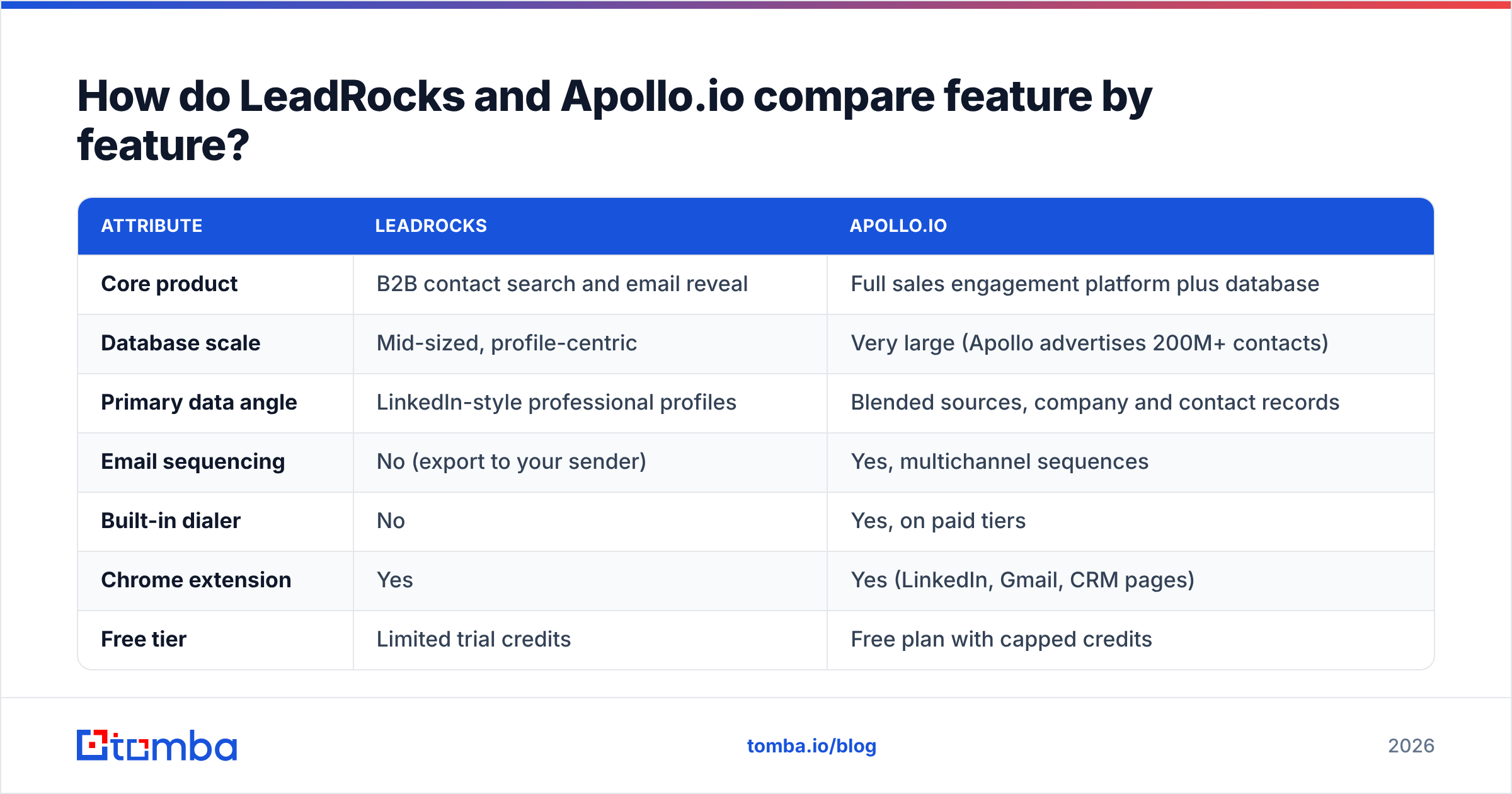
How do LeadRocks and Apollo.io compare feature by feature?#
Here's the side-by-side. Vendors change pricing and limits often, so treat the price rows as a guide and check each vendor's pricing page before you buy.
| Attribute | LeadRocks | Apollo.io |
|---|---|---|
| Core product | B2B contact search and email reveal | Full sales engagement platform plus database |
| Database scale | Mid-sized, profile-centric | Very large (Apollo advertises 200M+ contacts) |
| Primary data angle | LinkedIn-style professional profiles | Blended sources, company and contact records |
| Email sequencing | No (export to your sender) | Yes, multichannel sequences |
| Built-in dialer | No | Yes, on paid tiers |
| Chrome extension | Yes | Yes (LinkedIn, Gmail, CRM pages) |
| Free tier | Limited trial credits | Free plan with capped credits |
| Pricing model | Credit-based subscriptions | Per-seat subscriptions plus credits |
| Paid entry point | Low monthly tiers; check leadrocks.io | Basic around $49/user/mo (annual billing) |
| CRM sync | Export and basic integrations | Native Salesforce and HubSpot sync |
| Intent / buying signals | Minimal | Yes, on higher tiers |
| Learning curve | Low | Moderate to high |
| Best for | Lean teams that already have a sender | Teams that want one tool for everything |

Which tool has better data coverage?#
On raw volume, Apollo wins. Its database is one of the largest in B2B sales, and its filters (headcount, funding, technologies, job changes, department) let you slice it very finely. If you prospect across several verticals or regions, Apollo is more likely to already hold the account.
Coverage has two dimensions, though: breadth and depth.
- Breadth. Apollo covers more companies and more titles, especially mid-market and enterprise accounts in North America.
- Depth on a specific person. LeadRocks is built around individual professional profiles. When you already know who you want (a LinkedIn URL, a name at a known company), a profile-first tool can return a usable email in fewer clicks.
In practice, many teams pull the account list from Apollo, spot-check key people through a second source, and fill gaps with a dedicated email finder. Every provider has blind spots. Using two data sources is ordinary practice for a serious outbound team, not a sign of indecision.
Which is more accurate for email addresses?#
Neither vendor publishes independent, audited accuracy figures, so be skeptical of any "98% accurate" claim, including on review sites. What you can control is how you measure it.
Run the same test on both tools:
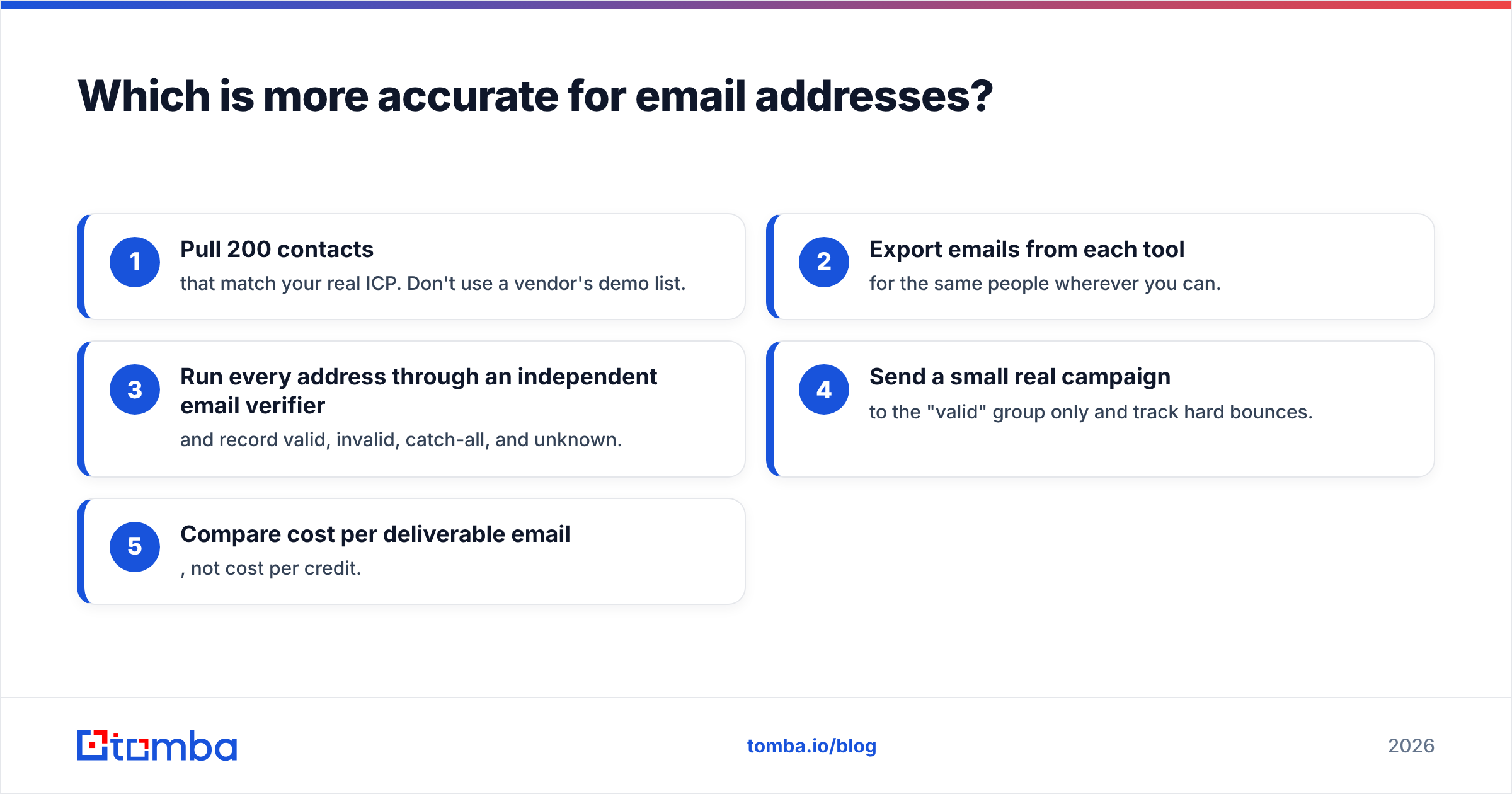
- Pull 200 contacts that match your real ICP. Don't use a vendor's demo list.
- Export emails from each tool for the same people wherever you can.
- Run every address through an independent email verifier and record valid, invalid, catch-all, and unknown.
- Send a small real campaign to the "valid" group only and track hard bounces.
- Compare cost per deliverable email, not cost per credit.

Some patterns show up repeatedly in user reviews on G2 and in our own testing of large databases:
- Apollo's accuracy depends on the segment. Well-known US tech companies tend to verify cleanly. Small businesses, non-US regions, and roles with high turnover decay faster.
- Profile-first tools like LeadRocks tend to be more current on job changes, because the lookup starts from the person's current profile rather than a stored record. They can still return guessed-pattern addresses that bounce.
- Catch-all domains are the weak spot for both. A catch-all server accepts every address during the SMTP check, so "verified" doesn't mean "delivers." You need a dedicated catch-all verifier or a very small test send to be confident.
The main point: verification is a separate job from finding. Budget for it whichever tool you pick.
How does pricing compare in 2026?#
Apollo and LeadRocks charge in structurally different ways, so a headline price comparison will mislead you.
Apollo.io uses per-seat plans. It has a free plan with capped monthly credits, then paid tiers (Basic, Professional, Organization). Each step adds higher credit limits, more sequences, the dialer, advanced filters, and reporting. Basic starts around $49 per user per month on annual billing, and the Organization tier has a minimum seat count. The current breakdown is on Apollo's pricing page.
LeadRocks is credit-based. You pay for how many contacts you reveal or export, and seats matter much less. For a solo founder or a two-person SDR team, that can be noticeably cheaper than several Apollo seats, especially if you'd never use the sequencer.
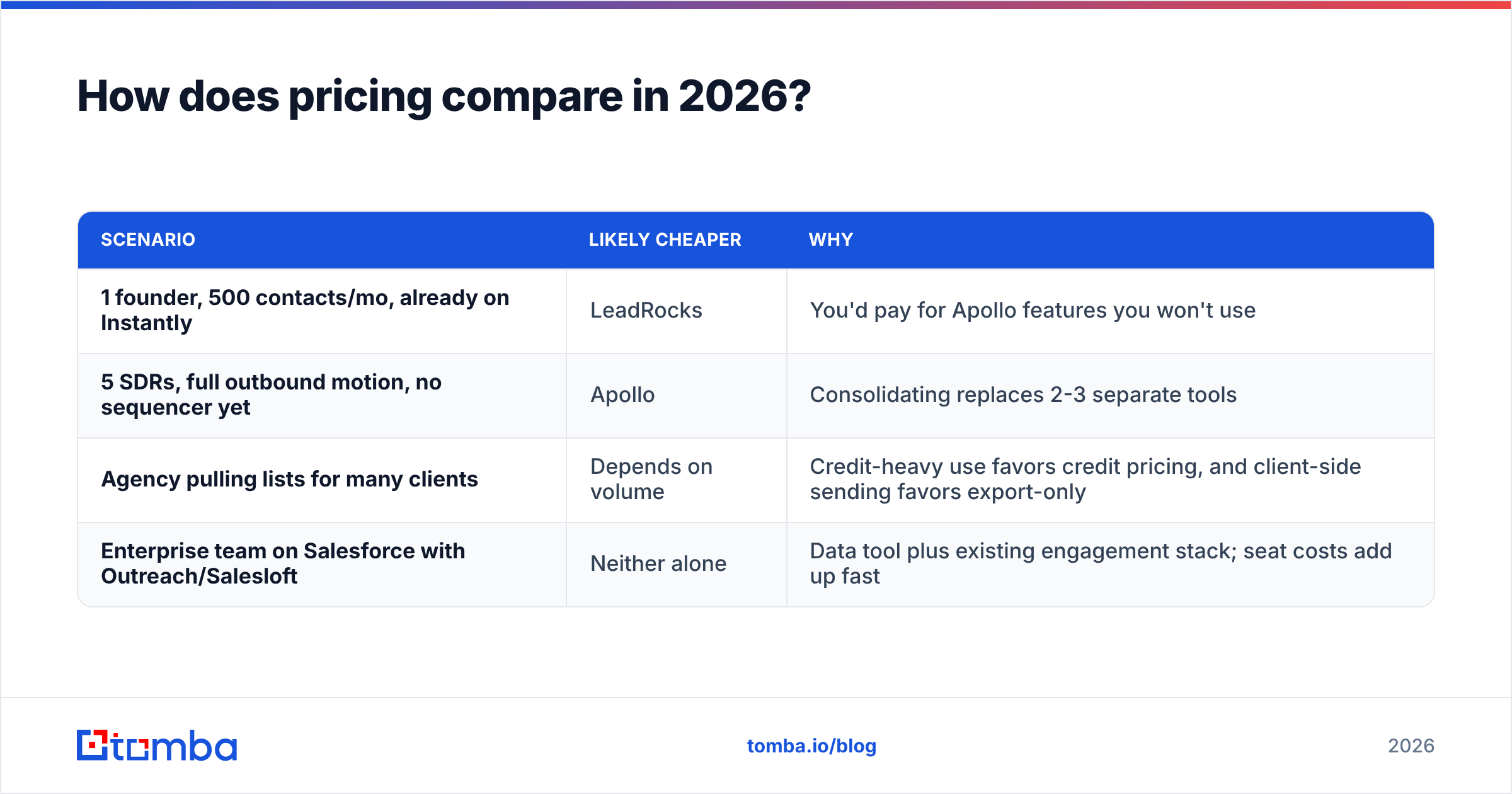
A quick way to model it:
| Scenario | Likely cheaper | Why |
|---|---|---|
| 1 founder, 500 contacts/mo, already on Instantly | LeadRocks | You'd pay for Apollo features you won't use |
| 5 SDRs, full outbound motion, no sequencer yet | Apollo | Consolidating replaces 2-3 separate tools |
| Agency pulling lists for many clients | Depends on volume | Credit-heavy use favors credit pricing, and client-side sending favors export-only |
| Enterprise team on Salesforce with Outreach/Salesloft | Neither alone | Data tool plus existing engagement stack; seat costs add up fast |
Look for these hidden costs: credit overages, export limits on lower tiers, charges for mobile numbers, and annual-only discounts. Apollo's free plan is generous for testing but restrictive at production volume. LeadRocks' trial is enough to test data quality, not to run a campaign.
Which one fits your daily workflow better?#
This question should decide it for most teams, because the tool you'll actually open every morning matters more than a feature checklist.
An Apollo day looks like this: You open a saved search, filter by new job changes and tech stack, add 50 contacts to a sequence, and let the platform send step one. You make calls from the dialer, then check the task queue. Everything logs to HubSpot or Salesforce. It works well when you commit to Apollo fully and poorly when you use a third of it.
A LeadRocks day looks like this: You browse LinkedIn or Sales Navigator, use the extension to reveal emails for the profiles you care about, export a CSV, and push it into your sender. There's less structure and more manual work, but also less software to maintain and nothing to migrate if you switch senders.
Ask yourself three questions:
- Do you already have a sequencer you like? If yes, Apollo's biggest advantage doesn't apply to you.
- Is LinkedIn your main source of prospects? If yes, a profile-first extension fits naturally.
- Do you need management reporting across reps? If yes, Apollo's platform view matters more than raw data.
What are the pros and cons of each?#
Apollo.io
- Huge, filterable database. Hard to beat for building accounts from scratch.
- All-in-one workflow. Sequences, dialer, tasks, and CRM sync in one place.
- Useful free plan. You can test it properly before paying.
- Per-seat costs grow quickly. Larger teams pay a lot for features some reps never touch.
- Data quality varies by segment. Non-US and SMB records need more verification.
- Complexity. New reps take time to learn the platform, and misconfigured sequences can hurt your sending domain.
LeadRocks
- Simple and focused. Find, reveal, export. Little to learn.
- Profile-first lookups. Strong when you already know who you want.
- Credit-based pricing. Friendlier for solo users and small teams.
- No outreach engine. You need a separate sender and CRM workflow.
- Smaller database. Weaker for building lists from scratch across broad markets.
- Lighter integrations. More CSV handling than native sync.
Is LeadRocks a good Apollo.io alternative?#
It's a good alternative for part of what Apollo does. If you mainly use Apollo as a very expensive email lookup, LeadRocks (or another focused finder) can cut your bill without changing how you send. If you rely on Apollo's sequences, dialer, and intent data, LeadRocks isn't a replacement. It's a data source you'd use alongside your stack.
If you're evaluating replacements more broadly, our Apollo alternative breakdown compares Apollo with finder-only tools, enrichment platforms, and full engagement suites so you can match the tool to the job instead of the marketing.
How should you decide between LeadRocks and Apollo.io?#
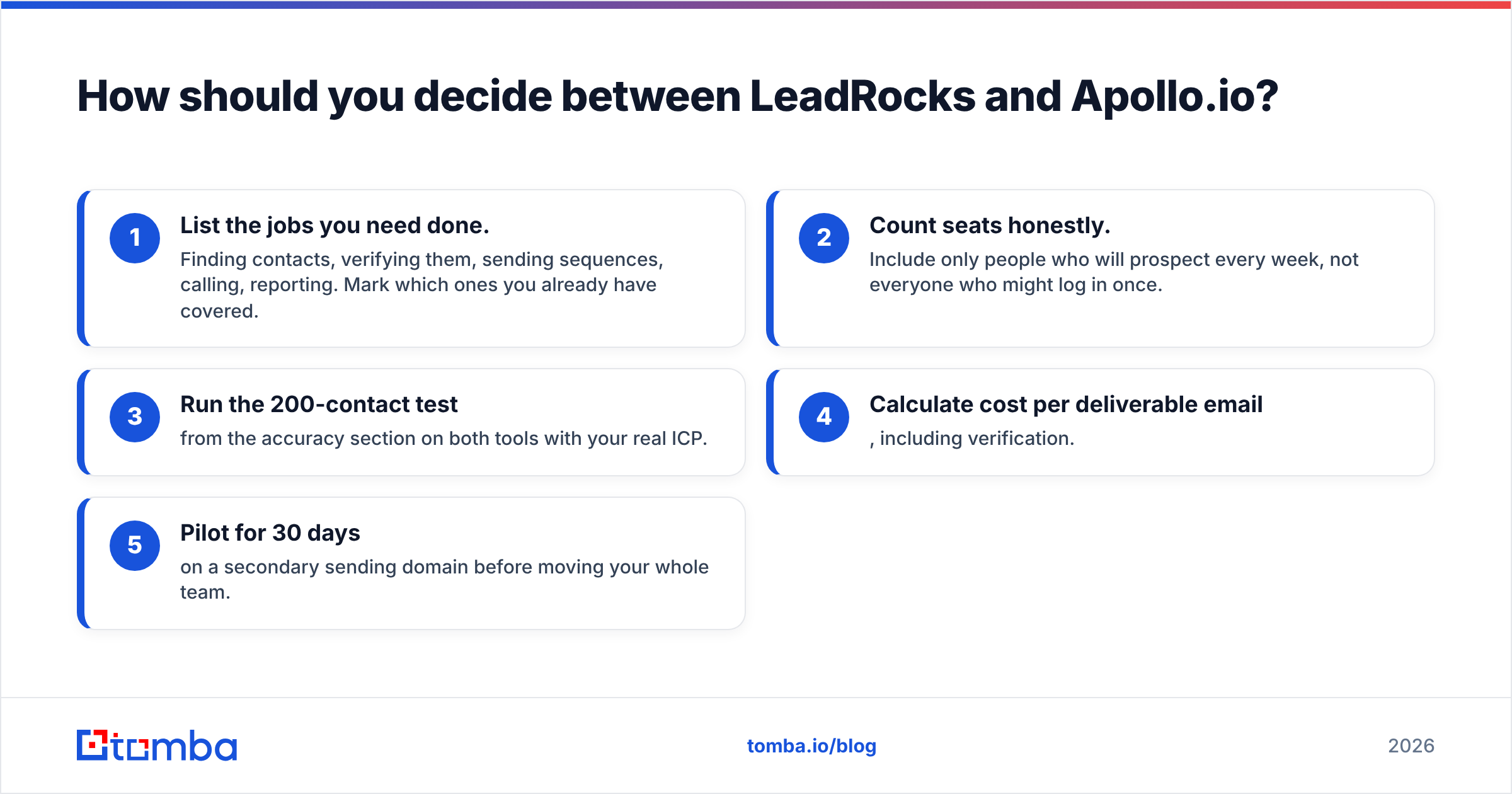
Use this framework:
- List the jobs you need done. Finding contacts, verifying them, sending sequences, calling, reporting. Mark which ones you already have covered.
- Count seats honestly. Include only people who will prospect every week, not everyone who might log in once.
- Run the 200-contact test from the accuracy section on both tools with your real ICP.
- Calculate cost per deliverable email, including verification.
- Pilot for 30 days on a secondary sending domain before moving your whole team.
The verdict: Apollo.io is the better pick for teams that want one platform to prospect and send from. LeadRocks is the better pick for lean teams that already own their outreach stack and just need reliable contact data at a lower cost. Test both with your own data, because the result depends on your market, not on the vendor's homepage.
Where does Tomba fit alongside LeadRocks or Apollo?#
Whichever you choose, you'll still hit the same gaps: contacts the database doesn't have, emails that fail verification, and catch-all domains that look valid until they bounce. That's the job Tomba Email Finder is built for. Search by domain, name, or company to fill the holes in your Apollo or LeadRocks exports, then run the list through verification before it reaches your sender. It works as a second source alongside either tool or as your main finder if you don't need a full platform, and plans start with a free tier and a $49/mo Starter plan on the Tomba pricing page. Test it on the same 200 contacts you used to compare LeadRocks and Apollo, and use cost per deliverable email to decide.
Related guides#
// get started
Find, verify and enrich your first contacts today
Start on the free plan with 25 searches a month, then scale when your team is ready.
Free plan · No credit card required · GDPR & CCPA
// about the author