Leadsrush vs Apollo.io (2026): Pricing, Data, and Which to Pick
Leadsrush sells email lookups by the search. Apollo.io sells a full prospecting platform by the seat. Here is how the two compare on price, data coverage, and workflow, and which kind of team each one suits.
TL;DR
- Leadsrush is a focused email finder. You get email search, domain search, verification, local business data, and technology lookups, all priced by searches per month. Plans start at $29/mo.
- Apollo.io is an all-in-one sales platform. It combines a large B2B contact database with sequencing, a dialer, and CRM sync. You pay per user, from $49/user/mo on annual billing.
- If all you need is verified emails for a list you already have, Leadsrush costs less per lookup.
- If you want to find prospects, email them, and track replies in one place, Apollo does more, but credit limits and per-seat pricing push up the real cost.
- Whichever you pick, verify emails before you send. No database stays accurate for long.
What is the real difference between Leadsrush and Apollo.io?#
These two tools solve different problems. On a pricing page they look like competitors, but they aren't really the same kind of product.
Leadsrush is a lookup utility. You already know who you want to reach, whether that's a name plus a company or a list of domains, and Leadsrush returns the email addresses. Its features page lists single and bulk email finding, bulk domain search, an email verifier, a local business database covering 9 countries, technology discovery (for example, "find stores running Shopify or WooCommerce"), and APIs for finding and verifying emails.
Apollo.io is a prospecting platform. You start with an empty search, filter a database of more than 200 million contacts by title, industry, headcount, tech stack, and intent signals, then push those contacts straight into email sequences, calls, and your CRM. Finding emails is one step in a larger workflow.
Think of it as a locksmith versus a building manager. The locksmith opens the one door you point at, quickly and cheaply. The building manager knows every tenant, but you pay a monthly fee whether or not you walk the halls.
So the question to ask is which job you're hiring the tool for.
How do Leadsrush and Apollo.io compare feature by feature?#
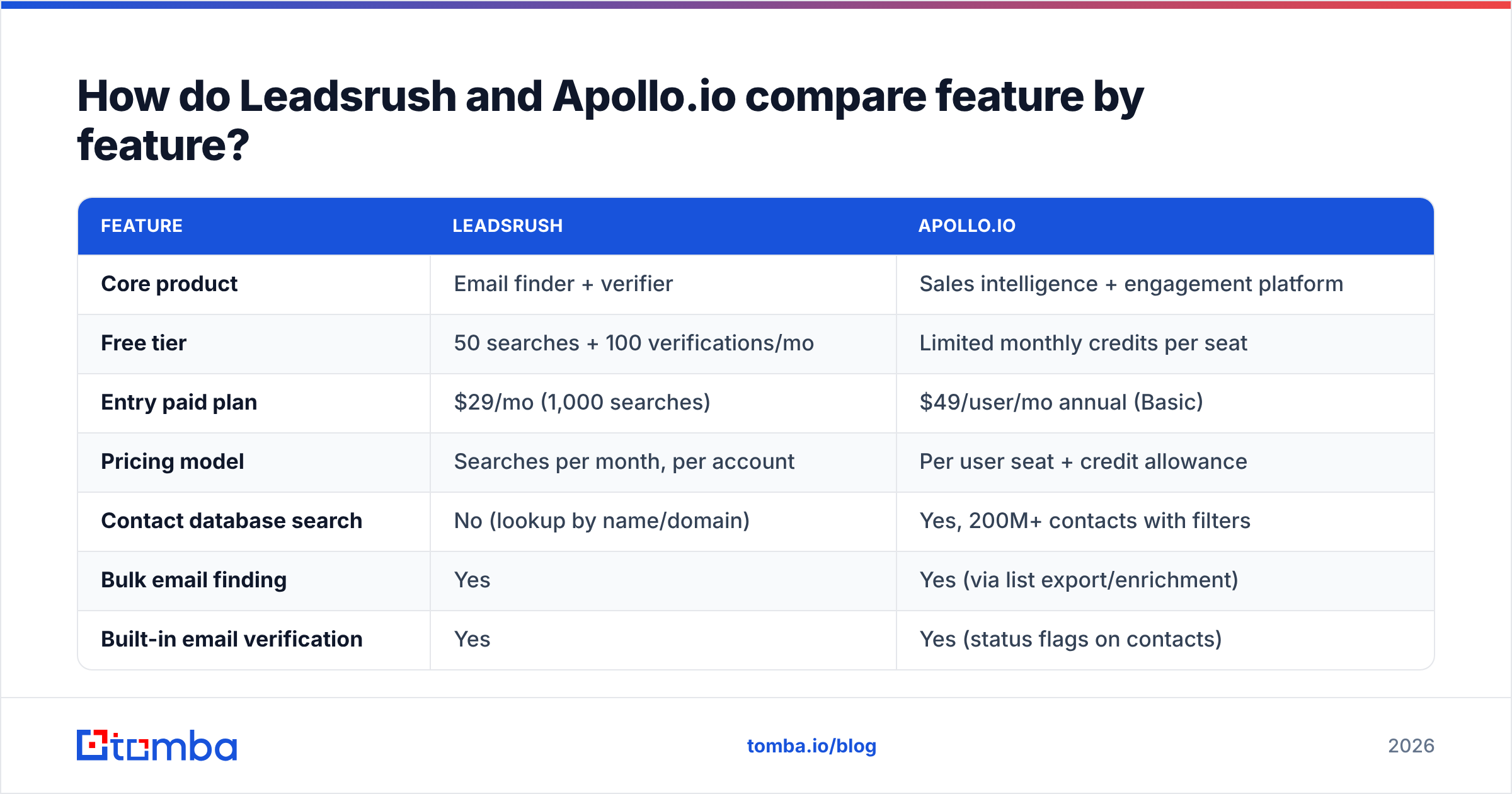
Here is a side-by-side view of what each tool offers in 2026, based on each vendor's public pages.
| Feature | Leadsrush | Apollo.io |
|---|---|---|
| Core product | Email finder + verifier | Sales intelligence + engagement platform |
| Free tier | 50 searches + 100 verifications/mo | Limited monthly credits per seat |
| Entry paid plan | $29/mo (1,000 searches) | $49/user/mo annual (Basic) |
| Pricing model | Searches per month, per account | Per user seat + credit allowance |
| Contact database search | No (lookup by name/domain) | Yes, 200M+ contacts with filters |
| Bulk email finding | Yes | Yes (via list export/enrichment) |
| Built-in email verification | Yes | Yes (status flags on contacts) |
| Email sequences | Not listed | Yes |
| Dialer / phone numbers | Not a focus | Yes, with separate mobile credits |
| Local business data | Yes, 9 countries | Limited, B2B-first |
| Technology lookup | Yes | Yes (technographic filters) |
| API | Email Finder + Verifier API | Full REST API on higher plans |
| Best for | Lean teams enriching known lists | SDR teams running full outbound |
Three things in this table matter more than the rest:
- Database search vs lookup. Apollo lets you discover people. Leadsrush expects you to arrive with names or domains.
- Pricing model. Leadsrush charges per account for a volume of searches. Apollo charges per user, so a five-person team pays five times over.
- Workflow depth. Apollo includes sequencing, which means you might be able to cancel a separate outreach tool. Leadsrush needs one alongside it.
How accurate is the email data from each tool?#
Accuracy is where comparisons between email finders tend to fall apart, because neither vendor publishes an independent, auditable bounce rate. Some things are still predictable.
Apollo's data comes from a huge shared database that is refreshed on a rolling basis. Large databases always have decay: people change jobs, and roughly a fifth to a third of B2B contact records go stale each year. Reviews of Apollo on G2 regularly mention outdated emails and bounces on some segments, especially in smaller companies and outside North America. Apollo marks emails as "verified", "guessed", or "unavailable", and you should take those labels seriously.
Leadsrush works more like a real-time finder: it combines a pattern guess with verification when you run the search. That approach usually holds up well for companies with a clear, consistent email format, and less well for catch-all domains, where the mail server accepts every address and verification can't confirm a specific inbox.

In practice, the workflow that works regardless of tool:
- Treat "verified" as a snapshot, not a guarantee. Re-check anything older than 30 to 60 days before a campaign.
- Separate catch-all results. Send to them in smaller batches, or run them through a dedicated catch-all check.
- Run a second-pass verification with an independent email verifier before large sends. A second opinion costs very little compared with a damaged sender domain.

How much do Leadsrush and Apollo.io actually cost?#
Sticker prices make these tools look close. The per-seat model makes them diverge quickly once your team grows.
Leadsrush pricing#
According to the Leadsrush pricing page:
- Free: $0/mo, 50 searches + 100 verifications
- Starter: $29/mo, 1,000 searches
- Professional: $59/mo, 5,000 searches
- Business: $129/mo, 20,000 searches
- Enterprise: $269/mo, 60,000 searches
Annual billing saves up to 30%. Plans also include monthly verifications and prospect storage. The price covers the account, not each user, so a small team can share one plan.
Apollo.io pricing#
According to Apollo's pricing page and several independent 2026 breakdowns:
- Free: $0, limited credits per seat
- Basic: $49/user/mo (annual), about $59 month-to-month
- Professional: $79/user/mo (annual), about $99 month-to-month
- Organization: $119/user/mo (annual), minimum 3 users
Credits reset each month with no rollover. Mobile phone numbers use a separate, smaller credit pool, and overages add up. Once you add phone reveals and a few extra seats, many teams report real costs well above the list price.
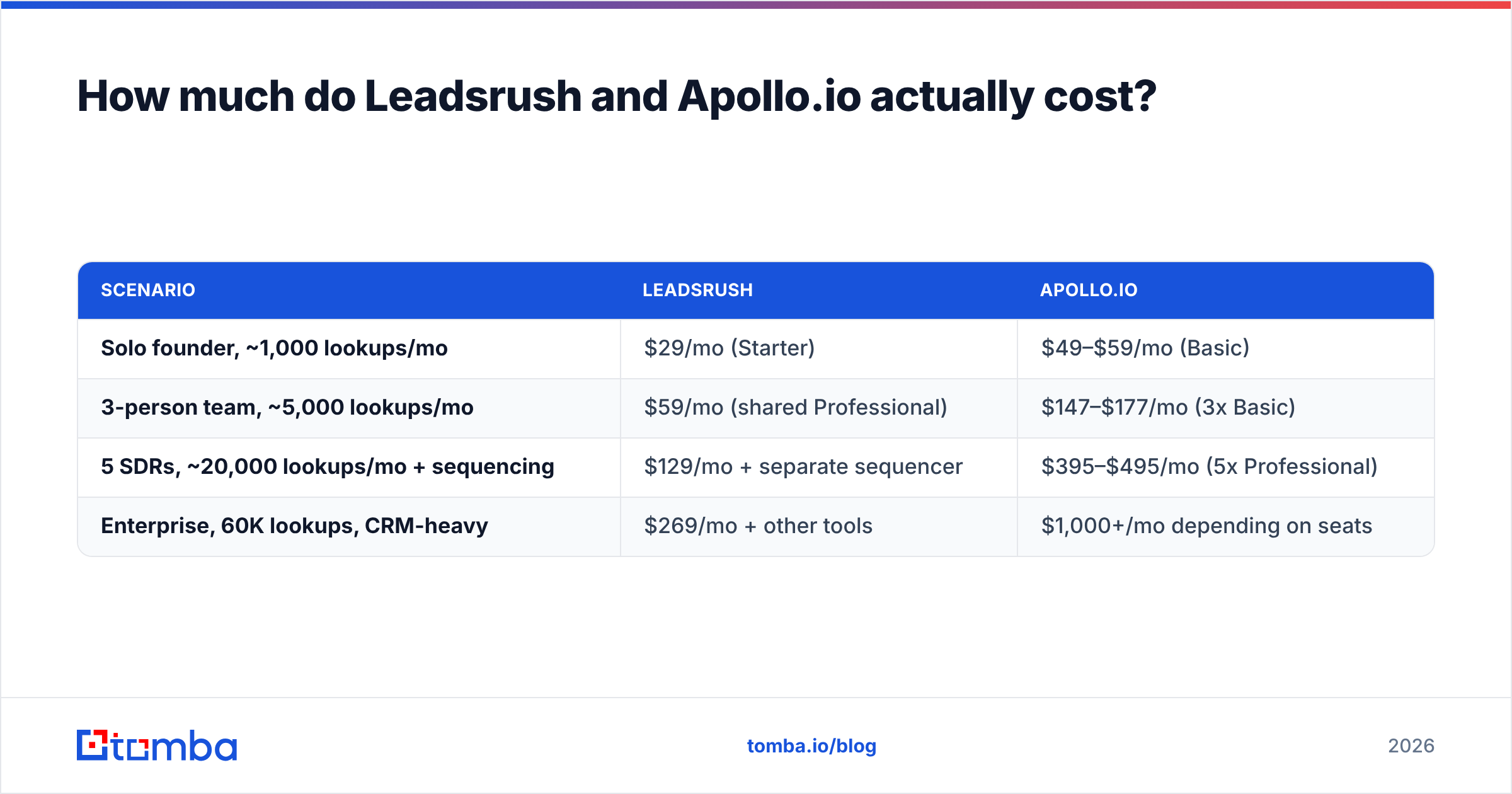
Cost scenarios#
| Scenario | Leadsrush | Apollo.io |
|---|---|---|
| Solo founder, ~1,000 lookups/mo | $29/mo (Starter) | $49–$59/mo (Basic) |
| 3-person team, ~5,000 lookups/mo | $59/mo (shared Professional) | $147–$177/mo (3x Basic) |
| 5 SDRs, ~20,000 lookups/mo + sequencing | $129/mo + separate sequencer | $395–$495/mo (5x Professional) |
| Enterprise, 60K lookups, CRM-heavy | $269/mo + other tools | $1,000+/mo depending on seats |
The pattern: Leadsrush wins on cost per email; Apollo wins on cost per workflow. If you would otherwise pay for a sequencer, a dialer, and a data tool separately, Apollo's per-seat price can come out ahead. If you already have outreach tooling, you are paying Apollo for features you won't use.
Which workflow suits each tool best?#
When Leadsrush makes more sense#
- You already have target lists. Conference attendee lists, CRM exports, lists of partner domains, scraped directories. Leadsrush fills in the emails.
- You sell to local or SMB businesses. The local business database (9 countries) and technology lookups (for example, Shopify merchants) fit agencies and SaaS companies selling to small businesses.
- You're building into your own stack. The Email Finder and Verifier APIs let you enrich leads inside your app, CRM, or no-code automations.
- Budget is tight. $29/mo for 1,000 searches is hard to beat for a solo operator.
When Apollo.io makes more sense#
- You need to find who to contact, not just their address. Apollo's filters (title, seniority, headcount, funding, tech stack) are its biggest strength.
- You want one tool for outbound. Sequences, tasks, calls, and CRM sync in one interface reduce context switching for SDR teams.
- You're consolidating vendors. RevOps teams replacing three point tools with one platform often come out ahead, even at per-seat pricing.
- You're North America–focused and mid-market or enterprise. Apollo's coverage is strongest here.
Where each one falls short#
Leadsrush limitations:
- No prospect-discovery database, so you need a separate source of names.
- No built-in sequencing listed, so you still need an outreach tool.
- A smaller brand with less third-party review volume, so you'll want to run your own test.
Apollo.io limitations:
- Per-seat pricing grows linearly with headcount.
- Monthly credits don't roll over, and phone credits are scarce.
- Data freshness varies by segment, which makes independent verification close to mandatory.
- Its breadth means a learning curve for teams that only wanted emails.
If Apollo's cost or data quality is what's driving your search, it's worth reading a wider roundup of Apollo alternatives before you commit to either tool.

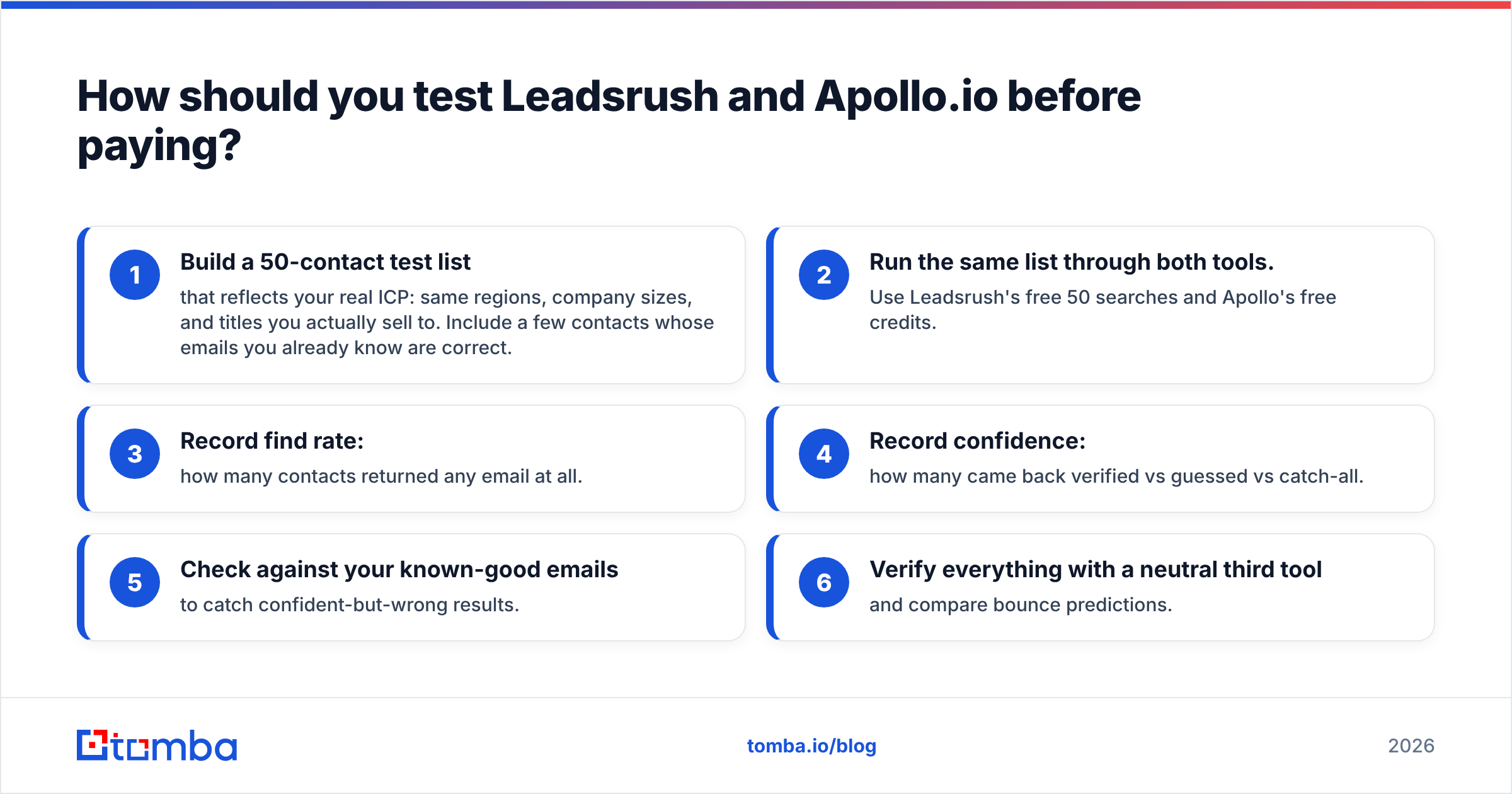
How should you test Leadsrush and Apollo.io before paying?#
Both tools have free plans, so skip the guesswork and run a controlled test. It takes about an hour and tells you more than any review.
- Build a 50-contact test list that reflects your real ICP: same regions, company sizes, and titles you actually sell to. Include a few contacts whose emails you already know are correct.
- Run the same list through both tools. Use Leadsrush's free 50 searches and Apollo's free credits.
- Record find rate: how many contacts returned any email at all.
- Record confidence: how many came back verified vs guessed vs catch-all.
- Check against your known-good emails to catch confident-but-wrong results.
- Verify everything with a neutral third tool and compare bounce predictions.
Find rate multiplied by verified accuracy gives you your real cost per usable email. That's the only number worth comparing across tools.

What about data privacy and compliance?#
Both tools deal in personal business data, so check compliance before you import anything into your CRM.
- GDPR (EU/UK): Cold B2B email can rely on legitimate interest, but you need a documented basis, a clear opt-out, and the ability to tell a prospect where you got their data.
- CAN-SPAM (US): Accurate headers, a physical address, and a working unsubscribe link in every message.
- Data source transparency: Ask each vendor how its data is collected and how often it's refreshed. Vague answers are a red flag.
Apollo publishes extensive compliance documentation, as you'd expect from a large platform. For smaller tools like Leadsrush, read the privacy policy and DPA before running large bulk jobs on EU contacts.
Is there a middle-ground option between Leadsrush and Apollo.io?#
Yes. Many teams end up in between: they want more than a bare lookup tool, including domain search, verification, enrichment, and integrations, but they don't want per-seat platform pricing.
That's where a dedicated email finder with a strong verification layer fits. Tomba, for example, covers finding emails by name or domain, bulk domain search, verification, catch-all checks, phone finding, and enrichment, with a Chrome extension, API, and native CRM integrations. Pricing is per account rather than per seat: a free tier with 25 searches per month, Starter at $49/mo, Growth at $99/mo, Pro at $249/mo, and custom Enterprise. See Tomba pricing for credit details.
It won't replace Apollo's sequencer or dialer. It's built for teams that pair a strong data layer with the outreach tool they already use, such as Instantly, Lemlist, Smartlead, or HubSpot sequences.
| Need | Best fit |
|---|---|
| Cheapest cost per lookup, simple lists | Leadsrush |
| Prospect discovery + sequencing in one seat | Apollo.io |
| Finding + verification + enrichment, no per-seat fees | Dedicated email finder (e.g., Tomba) |
| Local SMB / tech-stack targeting | Leadsrush |
| Enterprise RevOps consolidation | Apollo.io |
Leadsrush vs Apollo.io: which one should you choose?#
Choose Leadsrush if you're a solo operator, agency, or small team with lists already in hand, and you want the lowest cost per email with API access and local business data included.
Choose Apollo.io if you run an SDR team that needs to discover prospects and run multichannel sequences from one tool, and your budget can absorb per-seat pricing plus credit overages.
Consider neither on its own if data accuracy is your main concern. Apollo's shared database decays, and a lookup tool is only as good as its verification. Whichever you choose, add an independent verification step before every campaign.
If you'd like finding and verification in one place without paying per seat, try the Tomba Email Finder. Search by name, company, or domain, verify every result before it reaches your sequencer, and start on the free tier with 25 searches a month. Upgrade to Starter at $49/mo when you're ready to scale.
Related guides#
// get started
Find, verify and enrich your first contacts today
Start on the free plan with 25 searches a month, then scale when your team is ready.
Free plan · No credit card required · GDPR & CCPA
// about the author