Lessonly Seismic Learning Alternatives: 8 Sales Training Picks
Lessonly became Seismic Learning, and many teams now pay for a bigger suite than they use. Here are 8 sales training platforms worth shortlisting in 2026, and who each one fits.
- Lessonly is now Seismic Learning. Seismic bought Lessonly in 2021 and folded it into its Enablement Cloud, so a standalone "Lessonly" purchase increasingly comes packaged with the wider Seismic suite.
- Mindtickle and Allego are the strongest picks if you want deep readiness work: AI role-play, call coaching and skill scoring.
- Highspot and Showpad make sense if you're replacing all of Seismic (content plus training), not only the learning module.
- Trainual, WorkRamp and Spekit are lighter and quicker to roll out. They suit SMBs or teams that mainly need onboarding and in-workflow guidance.
- Training only pays off when reps have accurate prospect data to work with. Budget for both the enablement platform and the contact data it assumes you already have.
What happened to Lessonly, and why are teams looking for alternatives?#
Lessonly started as a simple, well-liked training tool. Its selling point was that anyone on the team could build a lesson in minutes, assign it, and check completion without an instructional designer. Seismic acquired the company in 2021. Since then the product has been rebranded as Seismic Learning and positioned inside the Seismic Enablement Cloud, next to content management, digital sales rooms and analytics.
That makes sense for Seismic's strategy. For some existing customers it's been a problem. The complaints we hear most from sales leaders and enablement managers in 2026 are:
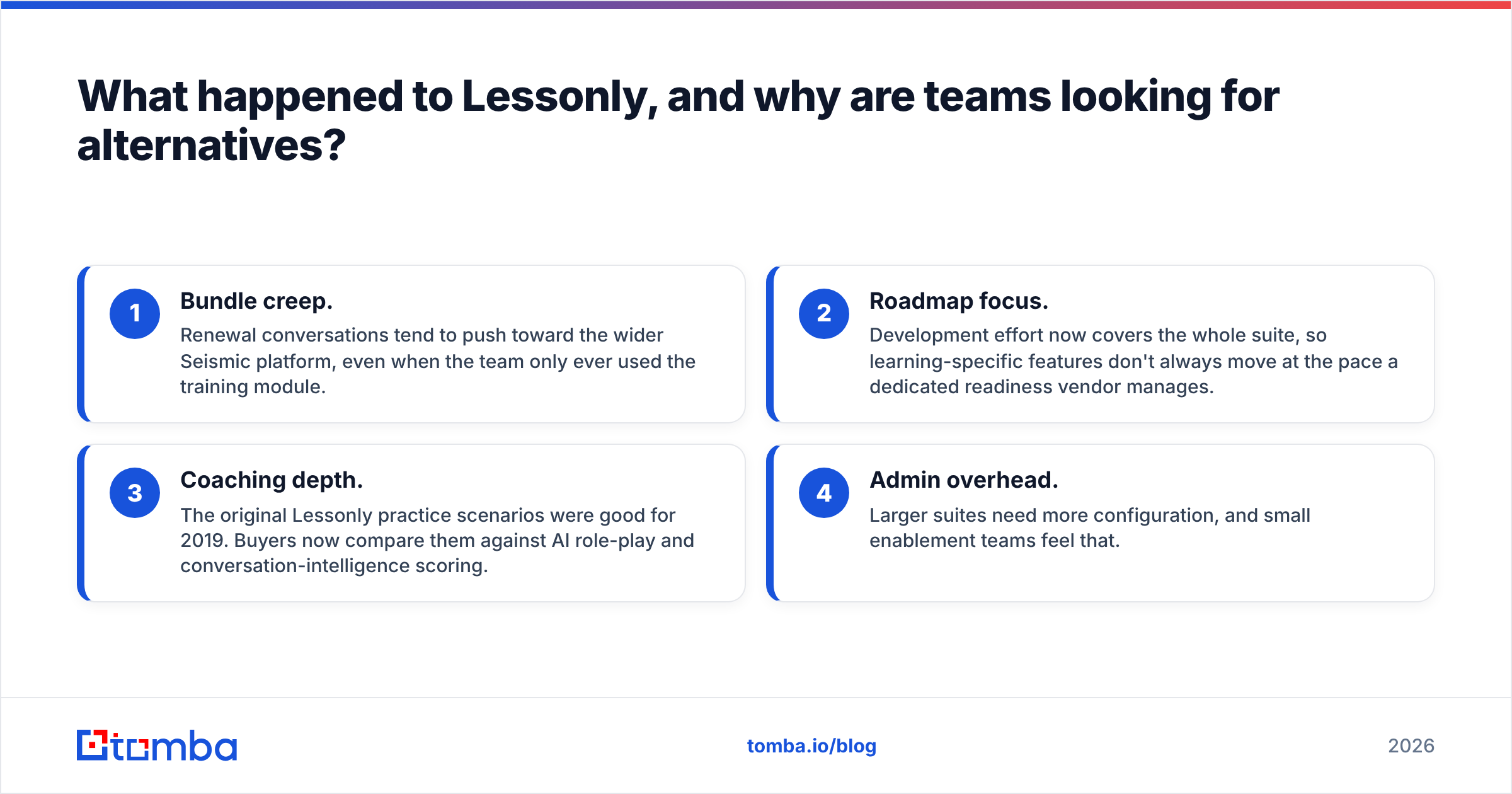
- Bundle creep. Renewal conversations tend to push toward the wider Seismic platform, even when the team only ever used the training module.
- Roadmap focus. Development effort now covers the whole suite, so learning-specific features don't always move at the pace a dedicated readiness vendor manages.
- Coaching depth. The original Lessonly practice scenarios were good for 2019. Buyers now compare them against AI role-play and conversation-intelligence scoring.
- Admin overhead. Larger suites need more configuration, and small enablement teams feel that.
None of this makes Seismic Learning a bad product. If you already run Seismic for content, keeping learning in the same stack is often the right decision. But if you only ever bought "Lessonly", it's worth pricing the alternatives before you sign another multi-year term.

What should you evaluate in a Lessonly replacement?#
Before you open ten vendor tabs, agree on your scoring criteria. These five cover most of what separates the platforms below:
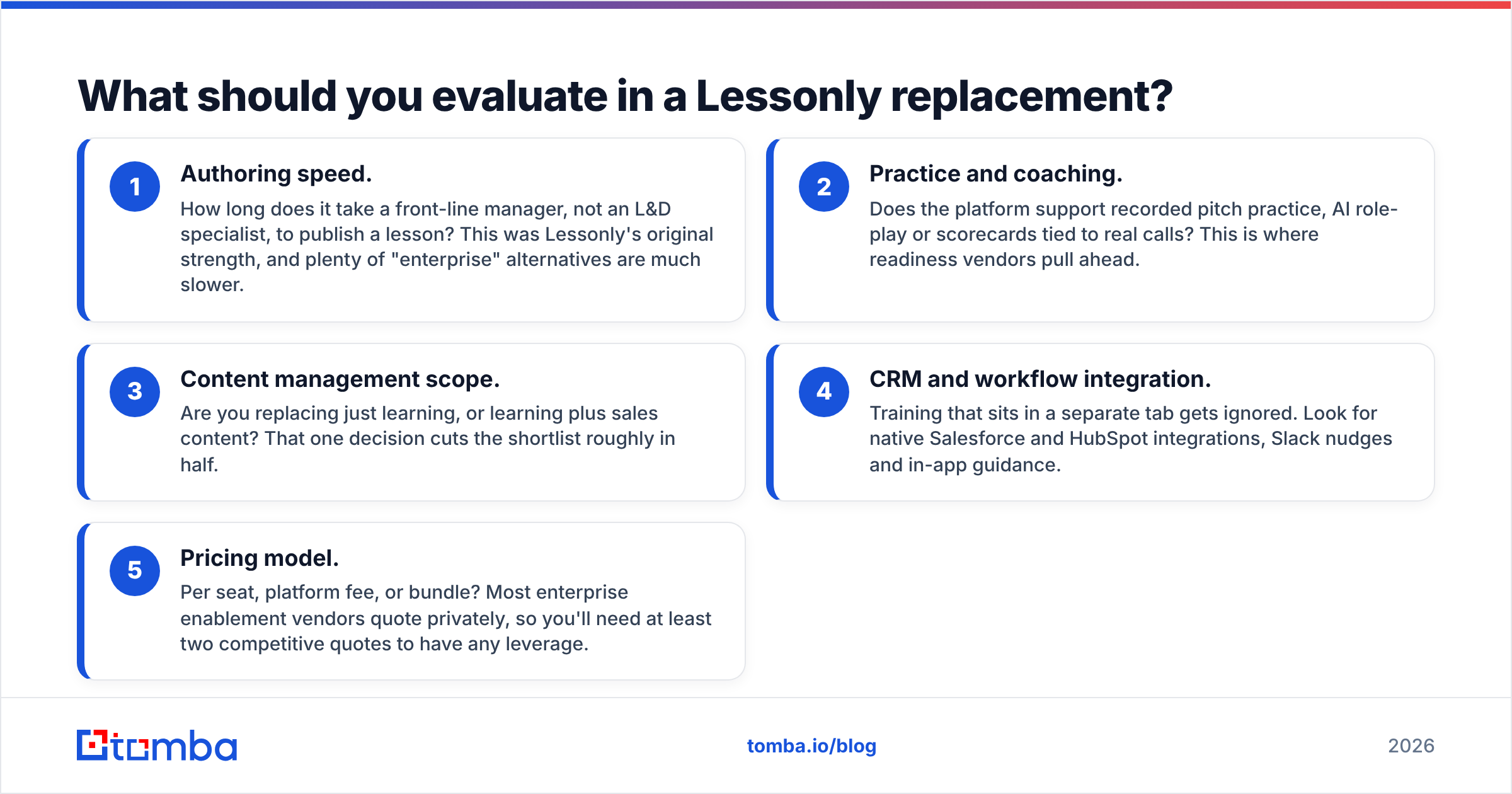
- Authoring speed. How long does it take a front-line manager, not an L&D specialist, to publish a lesson? This was Lessonly's original strength, and plenty of "enterprise" alternatives are much slower.
- Practice and coaching. Does the platform support recorded pitch practice, AI role-play or scorecards tied to real calls? This is where readiness vendors pull ahead.
- Content management scope. Are you replacing just learning, or learning plus sales content? That one decision cuts the shortlist roughly in half.
- CRM and workflow integration. Training that sits in a separate tab gets ignored. Look for native Salesforce and HubSpot integrations, Slack nudges and in-app guidance.
- Pricing model. Per seat, platform fee, or bundle? Most enterprise enablement vendors quote privately, so you'll need at least two competitive quotes to have any leverage.
If your team also runs a structured sales automation stack, add a sixth question: can the enablement tool trigger or read from your sequencing platform, so training links to what reps actually send?
How do the top Lessonly Seismic Learning alternatives compare?#
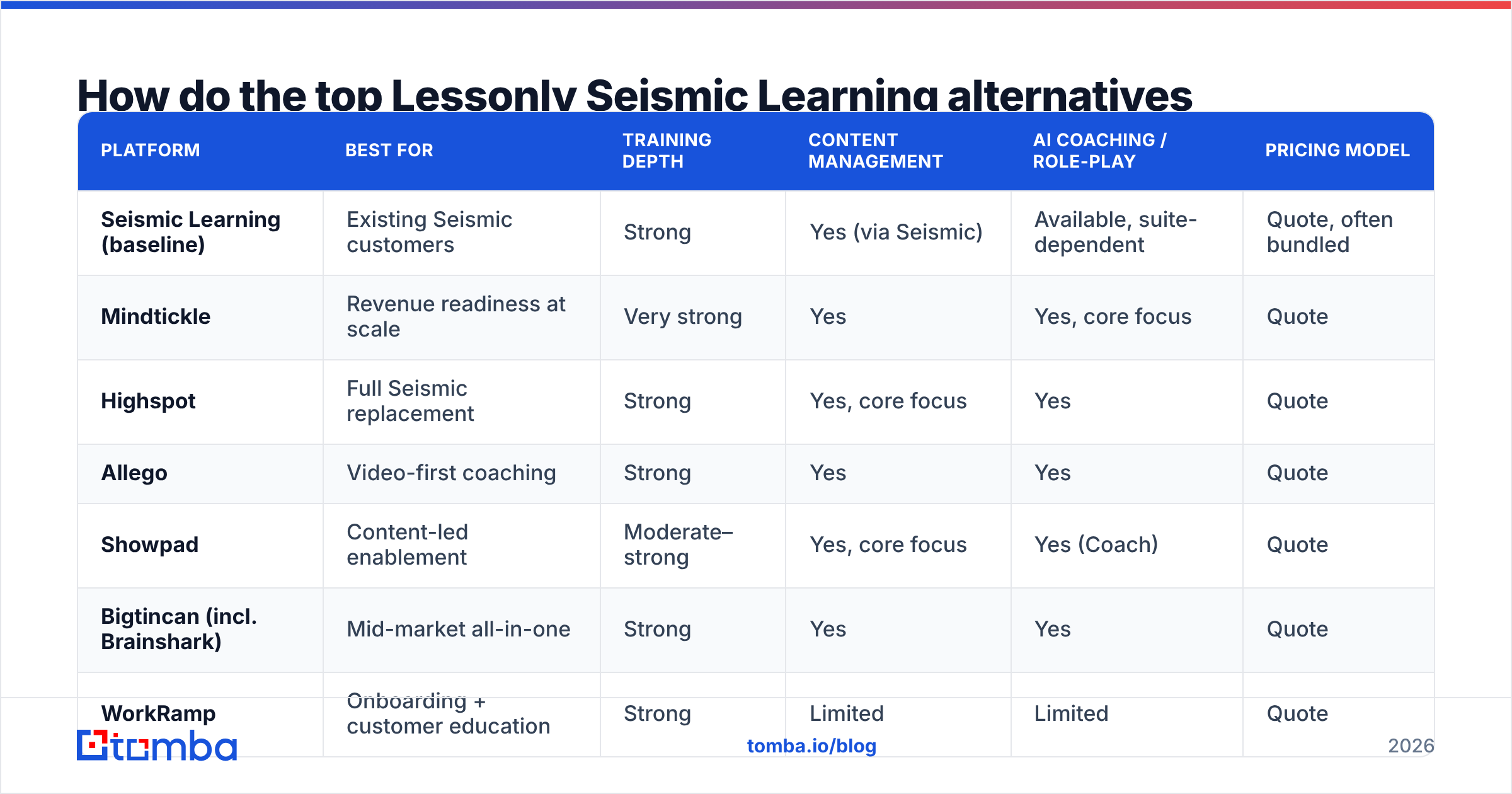
This table is a summary. Pricing for most vendors here is quote-based and depends on seat count and modules, so treat the "pricing model" column as a way to set expectations, not as a price list. Check current details on each vendor's site or on G2's sales enablement category.
| Platform | Best for | Training depth | Content management | AI coaching / role-play | Pricing model |
|---|---|---|---|---|---|
| Seismic Learning (baseline) | Existing Seismic customers | Strong | Yes (via Seismic) | Available, suite-dependent | Quote, often bundled |
| Mindtickle | Revenue readiness at scale | Very strong | Yes | Yes, core focus | Quote |
| Highspot | Full Seismic replacement | Strong | Yes, core focus | Yes | Quote |
| Allego | Video-first coaching | Strong | Yes | Yes | Quote |
| Showpad | Content-led enablement | Moderate–strong | Yes, core focus | Yes (Coach) | Quote |
| Bigtincan (incl. Brainshark) | Mid-market all-in-one | Strong | Yes | Yes | Quote |
| WorkRamp | Onboarding + customer education | Strong | Limited | Limited | Quote |
| Trainual | SMB playbooks and SOPs | Moderate | Docs-style | Basic AI authoring | Published tiers |
| Spekit | Just-in-time in-app training | Light, contextual | Knowledge cards | AI answers | Quote / published entry tier |
Which Lessonly alternatives are worth shortlisting?#
1. Mindtickle: best for sales readiness at scale#
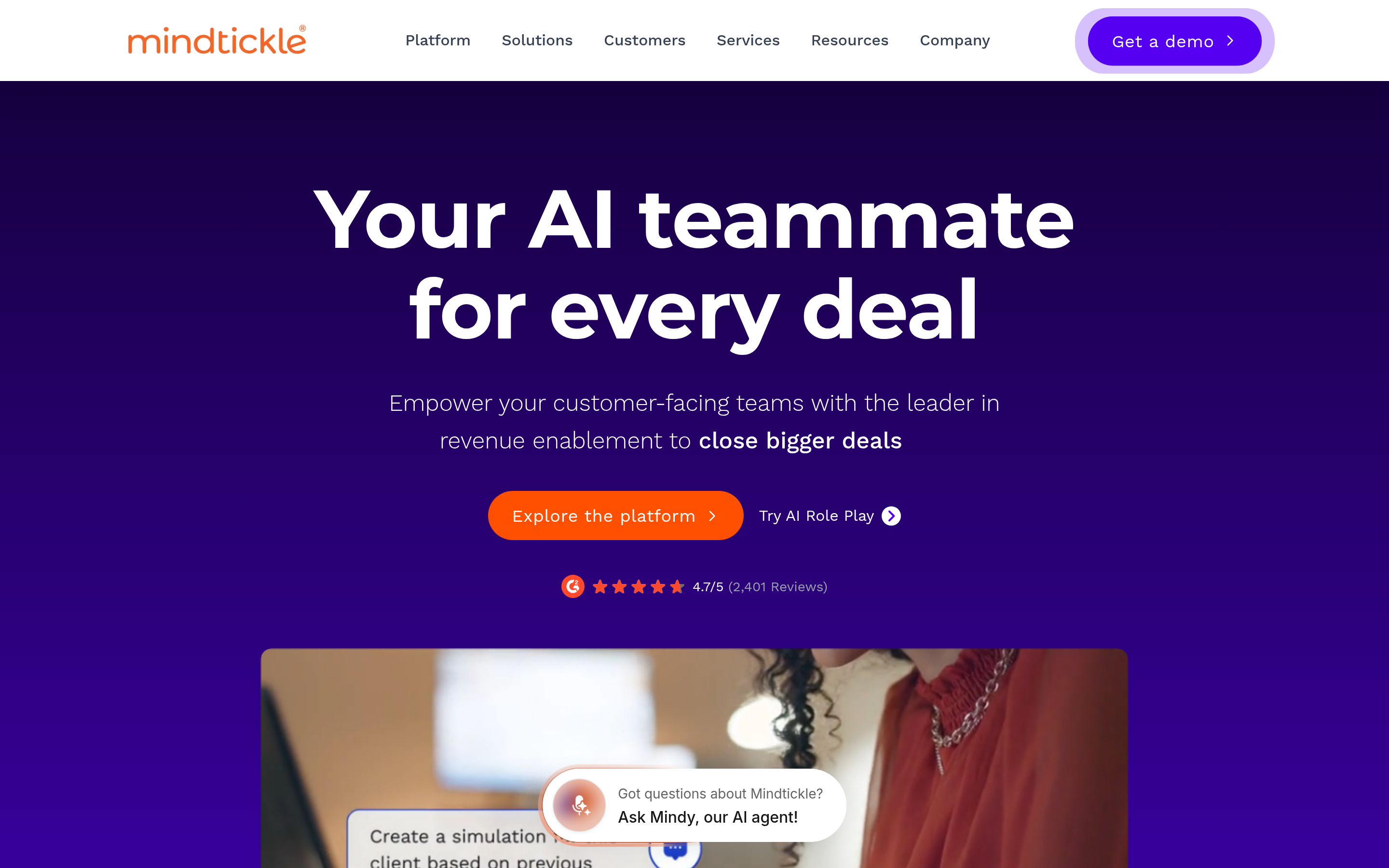
Mindtickle is the most direct "readiness-first" replacement. Seismic Learning is one module in a bigger suite. Mindtickle builds almost everything around one question: is this rep ready to sell? You get onboarding programs, certifications, AI role-play, call-scoring integrations and a skills-based readiness index that managers can filter by team or territory.
Pros: deep coaching, strong analytics that connect training to outcomes, mature enterprise admin. Cons: heavier implementation than Lessonly ever needed, and quotes land in enterprise territory. Choose it if: you have 50+ quota-carrying reps and an enablement lead who will own the program.
2. Highspot: best if you're replacing all of Seismic#
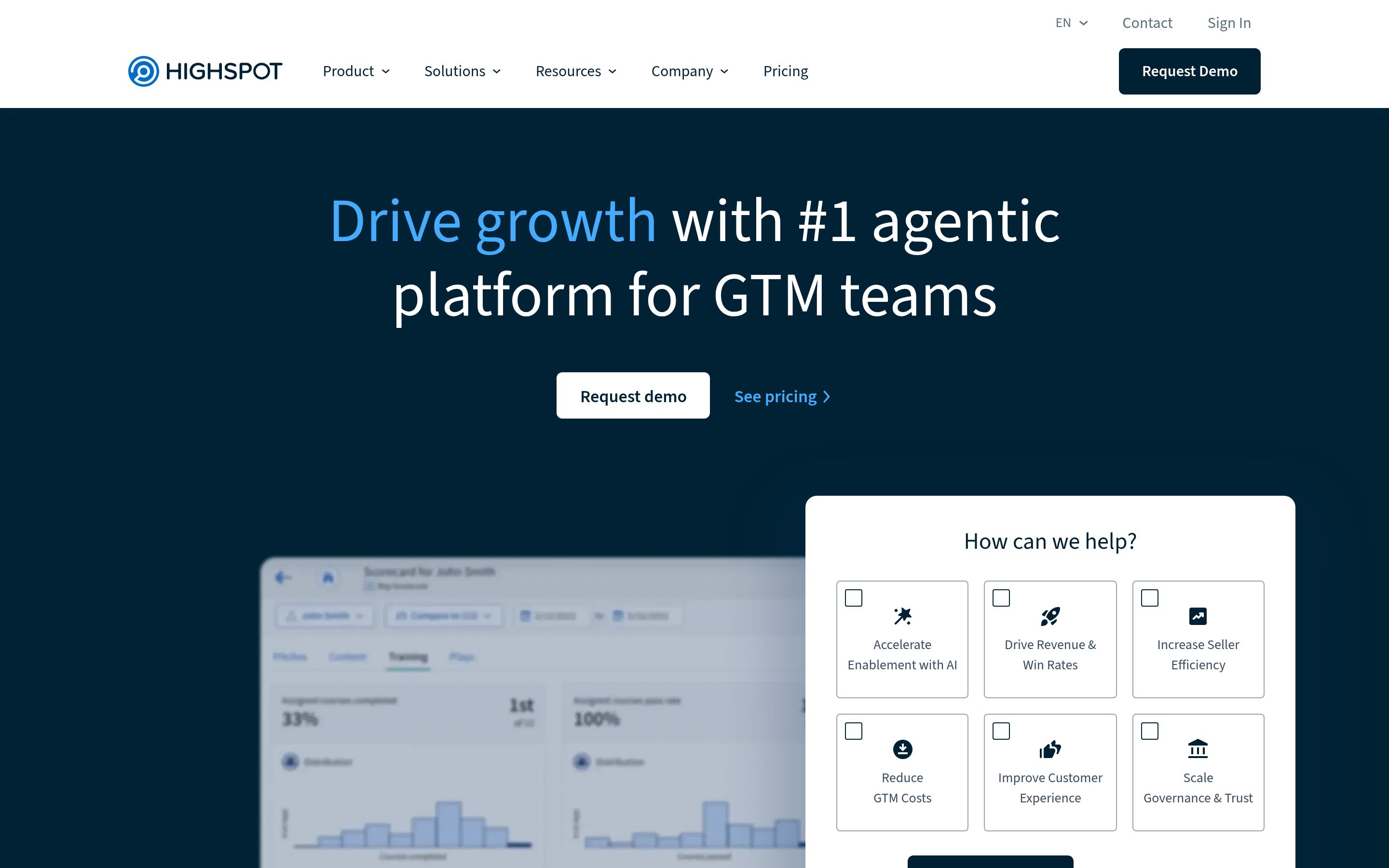
Highspot is Seismic's closest head-to-head competitor. If your frustration is with the whole Seismic relationship and not only the learning module, Highspot lets you move content, guided selling and training in one project. Its training and coaching features sit next to content, so a rep who finishes a lesson on a new product line can go straight to the approved deck.
Pros: excellent content UX, strong CRM embedding, coaching tied to real-world usage. Cons: it's a platform decision, not a quick tool swap, and migration takes planning. Choose it if: you want to consolidate enablement with a single vendor that isn't Seismic.
3. Allego: best for video-first coaching#
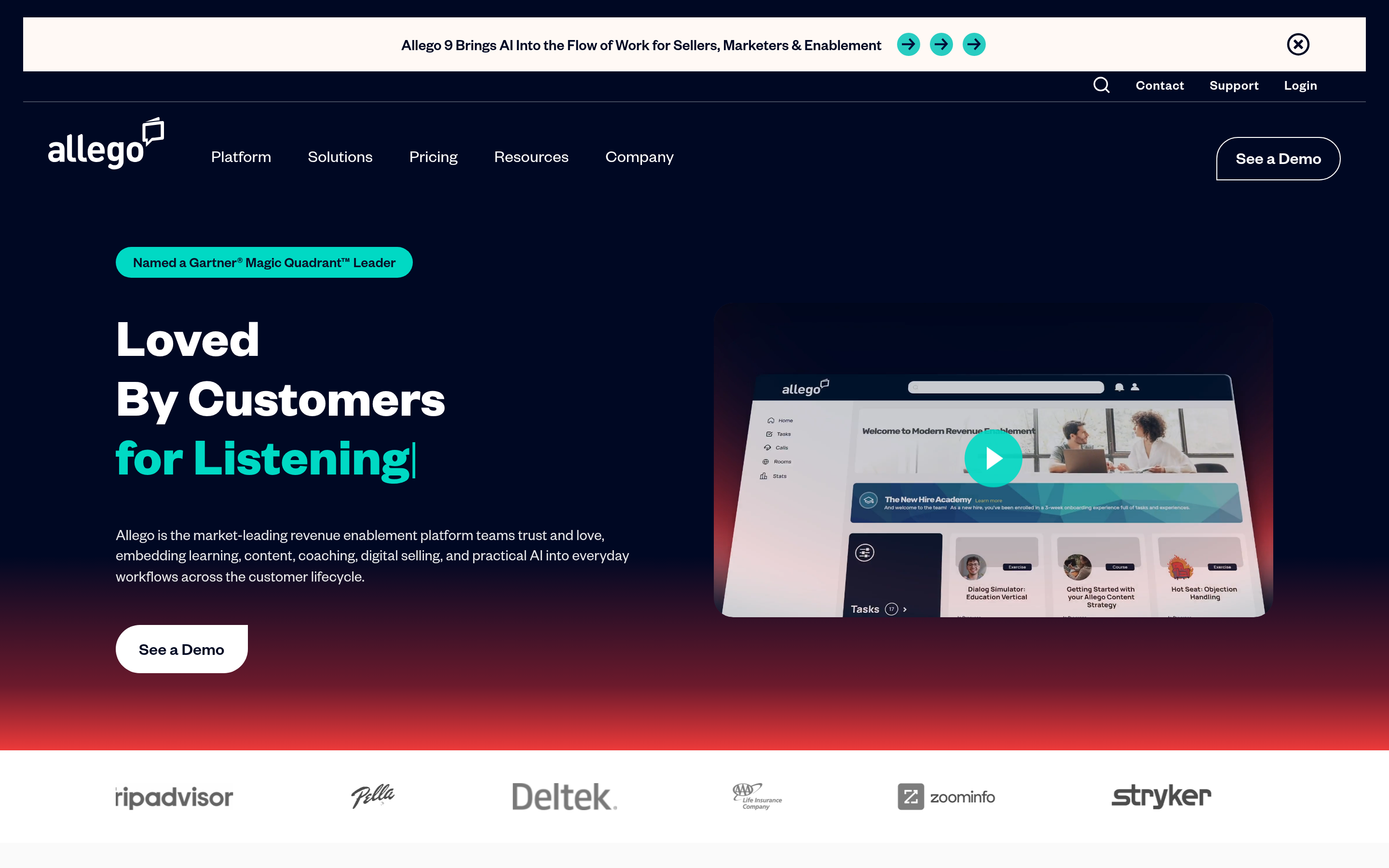
Allego grew out of video practice, and it shows. Reps record pitches, managers leave time-stamped feedback, and peers can review each other's recordings. Newer releases add AI role-play and conversation intelligence, so it's no longer a video-only tool.
Pros: great for distributed teams, low-friction mobile recording, and practice becomes a habit rather than an event. Cons: content management is decent but not the reason to buy it. Choose it if: your main gap is pitch practice and manager feedback, not courseware.
4. Showpad: best for content-led teams that also want coaching#
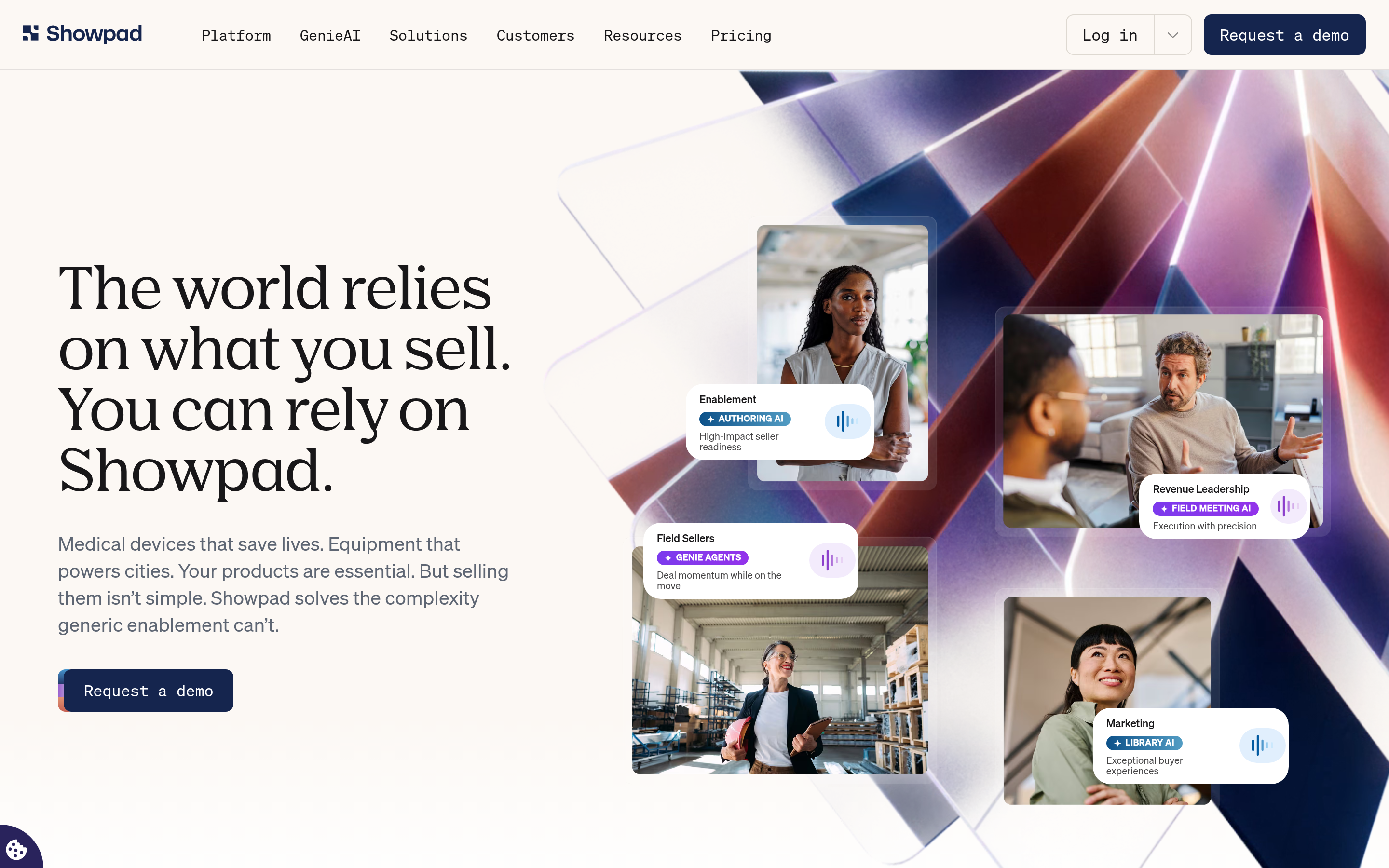
Showpad began as a content platform for field and channel sales, then added learning and coaching (Showpad Coach). It suits manufacturing, life sciences and other industries where reps present rich media in front of buyers and need certification on that material.
Pros: strong content presentation, good for complex product catalogs. Cons: the learning side is less deep than Mindtickle or Allego. Choose it if: content delivery is the priority and training supports it.
5. Bigtincan (with Brainshark): best mid-market all-in-one#
Bigtincan absorbed Brainshark, which was a well-known name in sales readiness. The combined product covers content, learning, coaching and video. It's often an easier conversation than Highspot or Seismic for mid-market teams that want an all-in-one without the top-tier enterprise footprint.
Pros: broad feature set, Brainshark's readiness pedigree. Cons: the UI and roadmap are still consolidating after a series of acquisitions, so ask for a live demo of the exact modules you'll use. Choose it if: you want suite breadth at a mid-market scale.

6. WorkRamp: best for onboarding across revenue and customer teams#
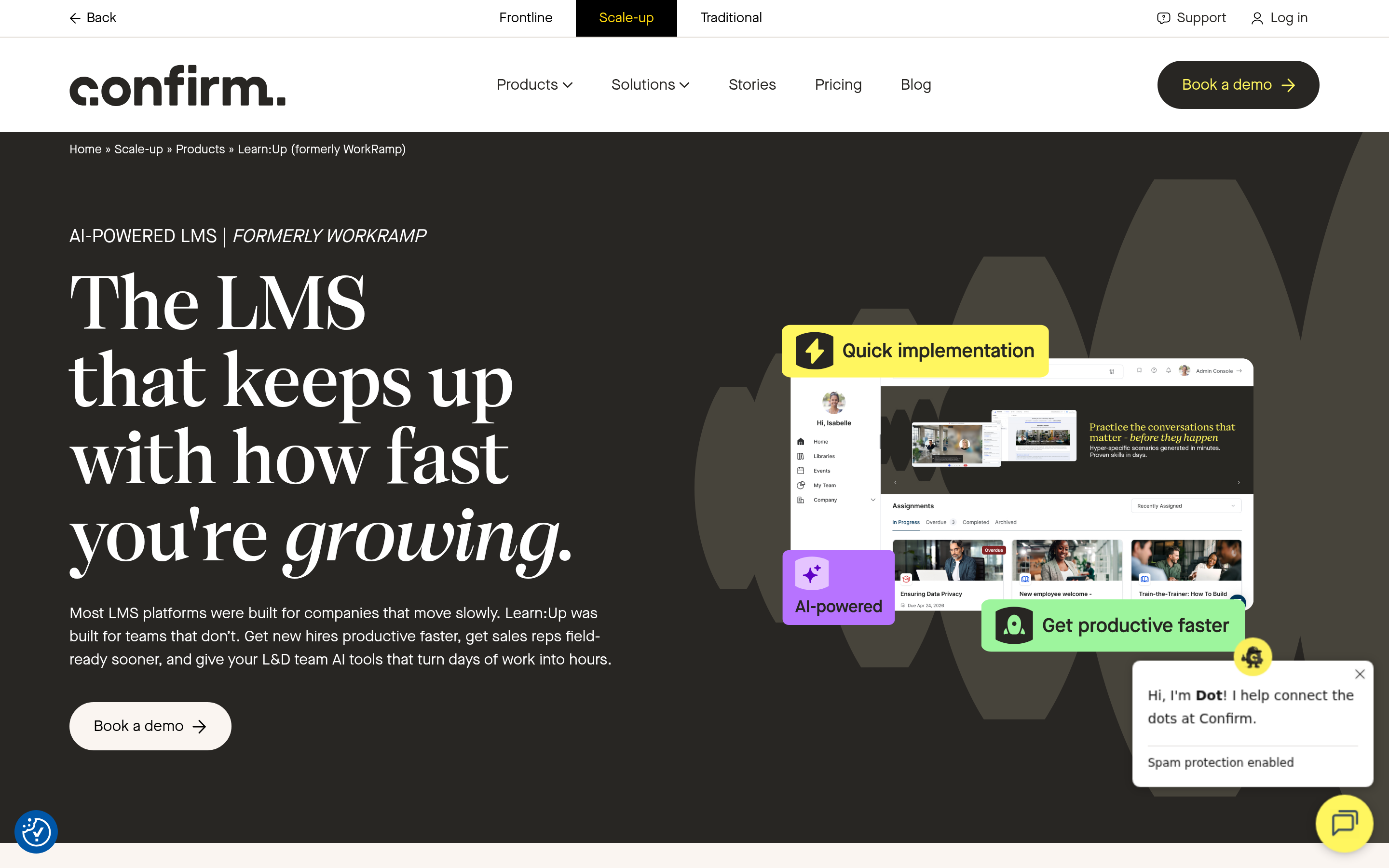
WorkRamp is a modern LMS with a revenue-team focus. It's also strong at customer and partner education. If your "Lessonly" use case was mostly onboarding new hires across sales, CS and support, WorkRamp covers it with less sales-specific overhead.
Pros: clean authoring, supports both internal and external academies, good certification paths. Cons: light on content management and live-call coaching. Choose it if: onboarding and certification matter more than deal-level coaching.
7. Trainual: best for SMB playbooks#
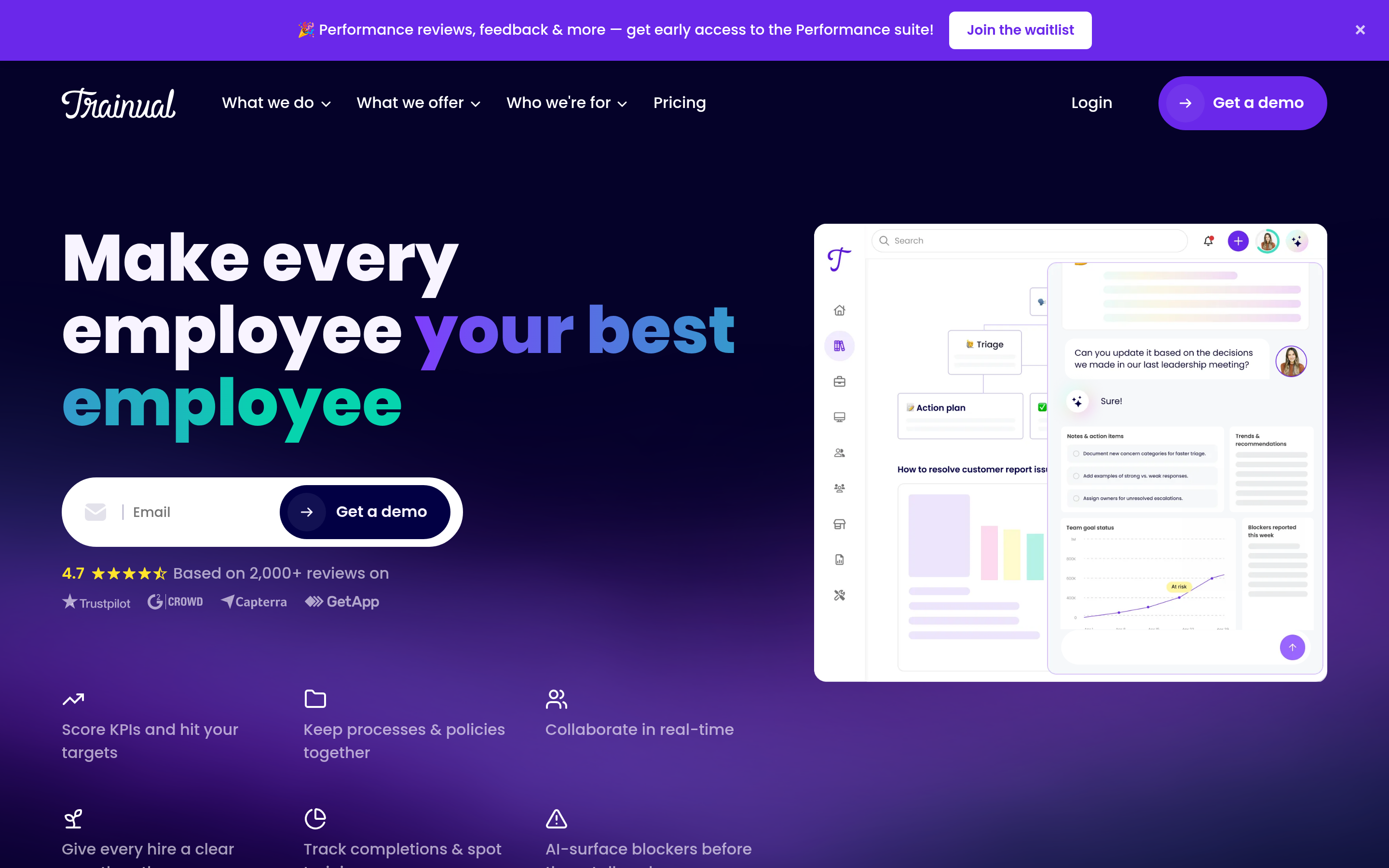
Trainual is the closest thing to "original Lessonly simplicity" on this list. It works as a playbook and SOP tool: document how you sell, assign it, quiz people and track completion. Pricing is published on the site, which is rare in this category.
Pros: fast to launch, transparent pricing, non-technical admins can own it. Cons: no real call coaching or role-play, and not built for enterprise sales orgs. Choose it if: you have under ~30 reps and just need your process written down and followed.
8. Spekit: best for just-in-time training inside your tools#
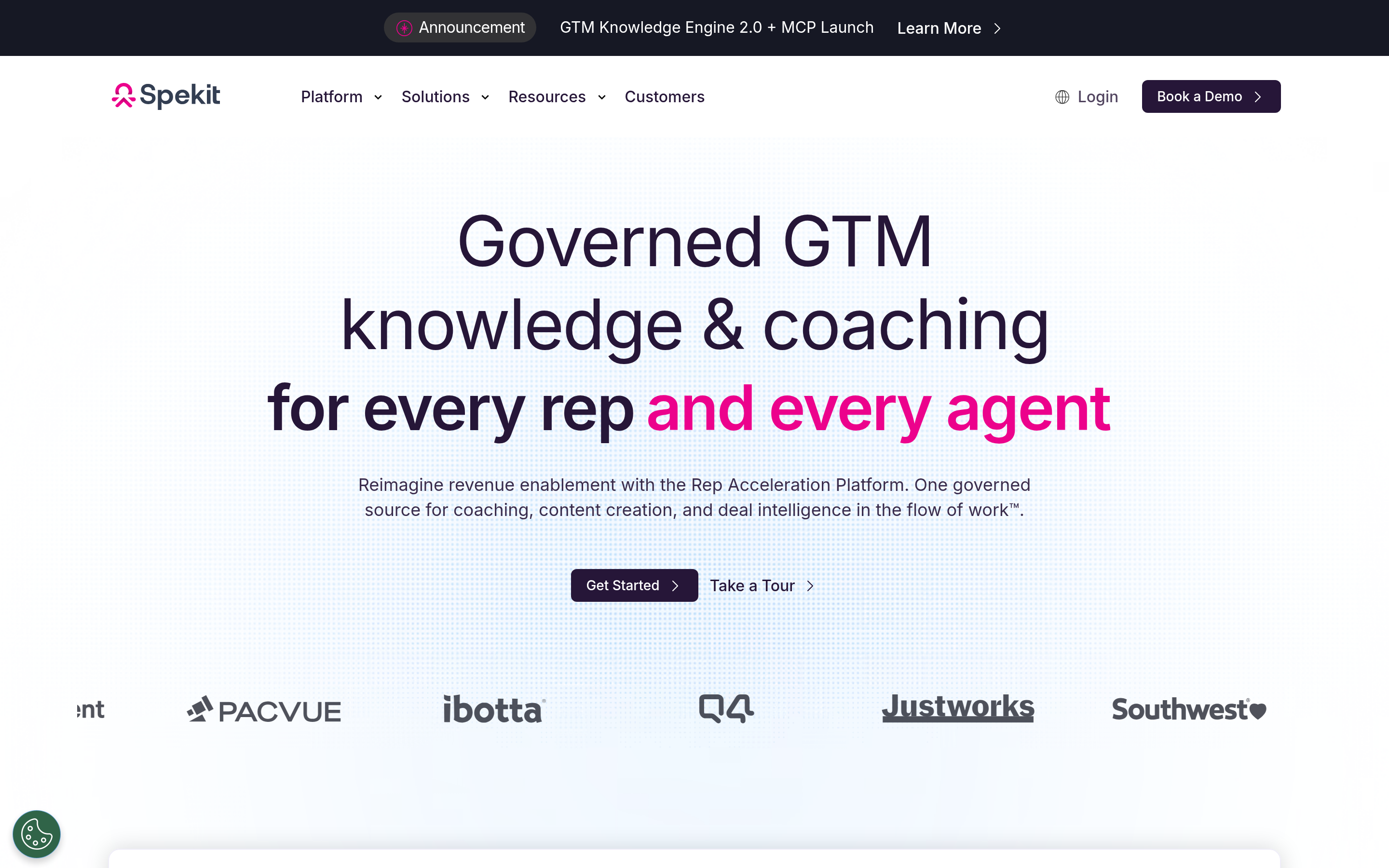
Spekit takes a different approach. It puts short knowledge cards and walkthroughs directly inside Salesforce, Gmail, Slack and other apps, instead of pulling reps into a course. Its AI can answer "how do I…" questions from your existing docs.
Pros: training shows up where the work happens, and adoption is usually high. Cons: it isn't a full LMS, so many teams pair it with something else. Choose it if: your reps already know how to sell and mainly forget process details.
Is Seismic Learning still the right choice for some teams?#
Yes, and it's worth being fair about it. Stay put if:
- You already use Seismic for content. Learning inside the same suite means shared analytics, a single login and one vendor to manage.
- Your enablement team is stretched. A migration costs months of admin work, and re-authoring courses is rarely as simple as an export/import.
- You have negotiating leverage. A credible alternative quote, especially from Highspot or Mindtickle, often brings a better renewal price without switching.
The worst outcome is renewing by default. Get at least two competitive quotes 90–120 days before renewal, even if you expect to stay.
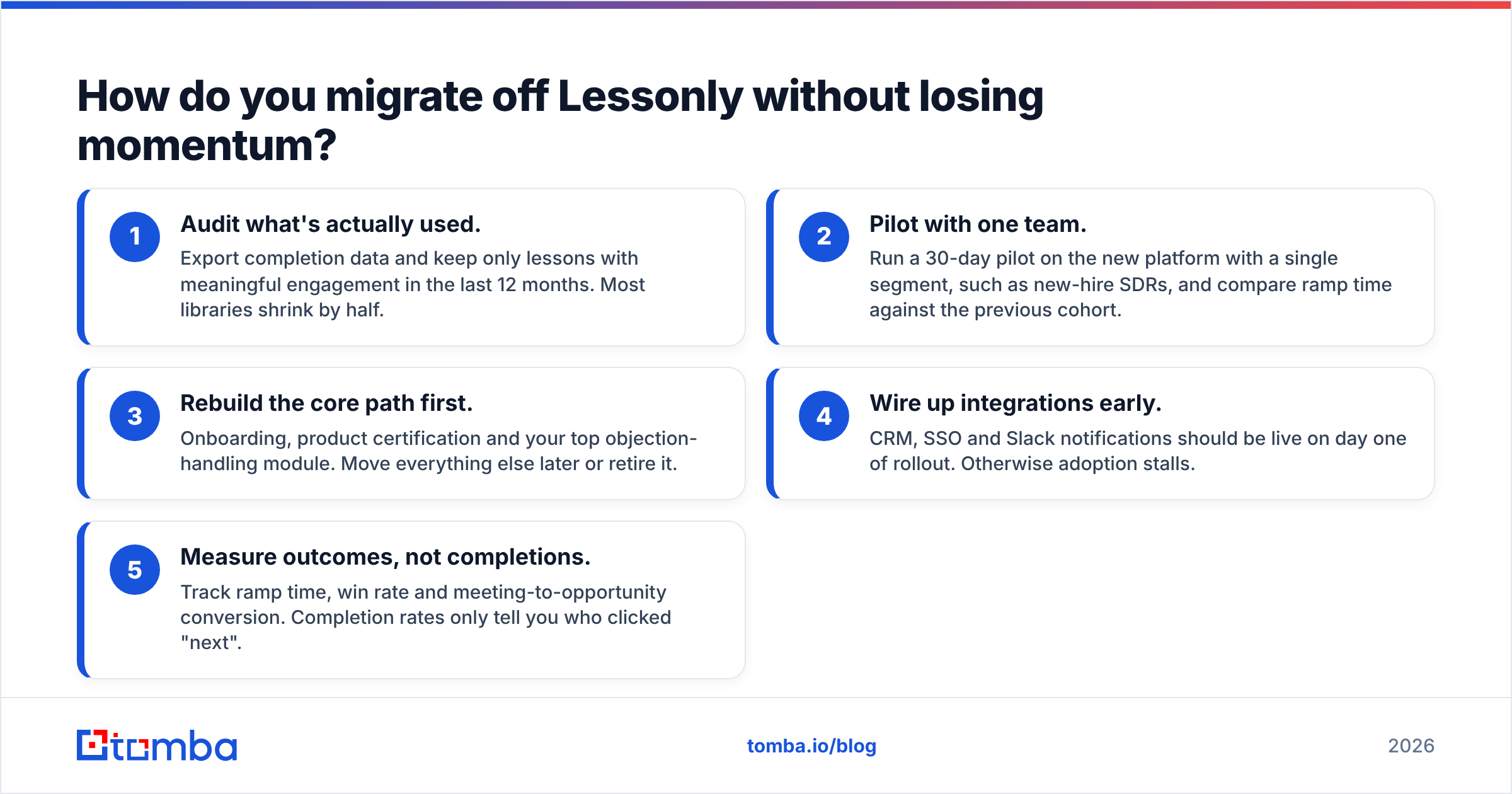
How do you migrate off Lessonly without losing momentum?#
A staged plan keeps reps productive:
- Audit what's actually used. Export completion data and keep only lessons with meaningful engagement in the last 12 months. Most libraries shrink by half.
- Pilot with one team. Run a 30-day pilot on the new platform with a single segment, such as new-hire SDRs, and compare ramp time against the previous cohort.
- Rebuild the core path first. Onboarding, product certification and your top objection-handling module. Move everything else later or retire it.
- Wire up integrations early. CRM, SSO and Slack notifications should be live on day one of rollout. Otherwise adoption stalls.
- Measure outcomes, not completions. Track ramp time, win rate and meeting-to-opportunity conversion. Completion rates only tell you who clicked "next".
Why does training fail without good prospect data?#
One pattern comes up again and again. A team rolls out a new enablement platform, reps pass every certification, and pipeline doesn't move. Often the problem sits downstream: reps are applying great messaging to bad lists. Bounced emails, outdated titles and generic info@ addresses make even the best-trained SDR look ineffective.
So pair any enablement investment with a data-quality check:
- Verify contacts before sequences go out. Run lists through an email verifier so trained reps aren't burning sender reputation on dead addresses.
- Give reps a fast way to find the right person. A good email finder lets reps go from "target account" to "named decision-maker" in seconds, which is exactly the motion your prospecting training teaches.
- Standardise templates alongside training. Pair lessons with approved cold email templates so certifications turn into consistent outbound.
Research firms like Gartner have long pointed out that enablement ROI depends on execution in the field, not course completion. Data quality is a big part of that field execution.
Which Lessonly alternative should you pick?#
A quick decision guide:
| If your main need is… | Shortlist |
|---|---|
| Deep readiness and AI role-play | Mindtickle, Allego |
| Replacing all of Seismic | Highspot, Bigtincan |
| Content-first field sales | Showpad, Highspot |
| Onboarding across GTM teams | WorkRamp, Mindtickle |
| SMB process documentation | Trainual |
| In-app, just-in-time help | Spekit |
| Minimal disruption, already on Seismic | Stay on Seismic Learning and negotiate |
Book two demos, run one pilot, and decide based on ramp-time data rather than feature checklists. Most of these tools handle the basics well. What separates them is fit with your team size, your content strategy and how much coaching your managers will actually do.
Ready to give trained reps better data?#
Whichever enablement platform you choose, it only pays off when reps are reaching real decision-makers. Tomba Email Finder lets your team find verified professional email addresses by name, domain or company, so the prospecting skills you train turn into conversations instead of bounces. Start on the free plan with 25 searches a month, or see Tomba pricing for Starter at $49/mo and Growth at $99/mo when your whole team is ready to scale.
Related guides#
// get started
Find, verify and enrich your first contacts today
Start on the free plan with 25 searches a month, then scale when your team is ready.
Free plan · No credit card required · GDPR & CCPA
// about the author