LetsExtract vs Apollo.io: Web Scraper or Sales Platform in 2026?
LetsExtract scrapes emails from the open web. Apollo.io sells you a database plus a whole outbound stack. Here's which one fits your pipeline, what each costs you, and where each one falls short.
TL;DR
- LetsExtract is mainly a desktop email and contact extractor. It crawls websites and search results and pulls out whatever addresses are publicly visible. It works for cheap, high-volume collection of generic and SMB contacts. It doesn't know who a person is or what they do.
- Apollo.io is a sales intelligence platform. It combines a large B2B contact database with sequencing, a dialer, CRM sync and AI features. It suits teams that want one tool for prospecting and outreach.
- The biggest difference is data type. LetsExtract gives you addresses it found on pages, often info@ and sales@ inboxes. Apollo gives you named decision-makers with titles, filtered by firmographics.
- Cost pattern: LetsExtract uses a license model that's cheap at the start. Apollo is billed per seat, and its credit and seat rules can push the real cost well above the list price.
- If you only need verified work emails for specific people, and not a scraper or a full outbound suite, a dedicated email finder is usually the cheaper and cleaner option.
What is LetsExtract, and what is it actually built for?#
LetsExtract is best known for its desktop software, which extracts email addresses, phone numbers and social links from web pages. You give it keywords, a list of URLs or search engine queries. It crawls the results and collects every contact string it finds, then deduplicates them into an export. Some versions also include basic email checks, so you can remove obviously dead addresses before you use the list.
Think of it as a harvester, not a database. It doesn't hold a pre-built index of professionals. It reads what's publicly posted on the pages you point it at, right now.
That design has clear effects:
- Coverage follows the open web. Local businesses, agencies, e-commerce stores, directories and niche communities publish contact details all the time, so LetsExtract picks up a lot there. Enterprise buyers rarely put their direct email on a page, so it picks up very little for them.
- You get addresses, not people. A crawl of 500 dental clinic websites gives you hundreds of
contact@andfrontdesk@inboxes. That's useful for SMB outreach, but you won't get "VP of Operations at a 300-person SaaS company." - You control the source list. That's powerful if you know your niche and its directories well. If you don't, it's a lot of setup.
LetsExtract appeals to agencies, local-lead resellers and solo marketers who want a lot of raw contacts and are fine doing cleanup themselves.
What is Apollo.io, and why do sales teams default to it?#
Apollo.io sits at the other end of the spectrum. It's a go-to-market platform built on a proprietary B2B database. Apollo advertises 200M+ contacts and tens of millions of companies. On top of that data it adds:
- Filters for title, seniority, department, headcount, industry, technology used, funding and buying intent
- A Chrome extension that works on LinkedIn and in Gmail
- Multi-step email sequences, a built-in dialer and task queues
- Two-way sync with CRMs like Salesforce and HubSpot
- AI-assisted research and email drafting
Apollo is less a tool that finds emails and more a tool that runs your outbound motion. You build a list of named buyers, enrich them, put them in a sequence and track replies without leaving the app.
That breadth is why Apollo is on so many SDR tech stacks, and it's also why people complain about it. You pay for, and have to learn, a whole platform, even if you mainly wanted contact data.
How do LetsExtract and Apollo.io differ in how they find contacts?#
Here are the five differences that matter most when you decide between them:
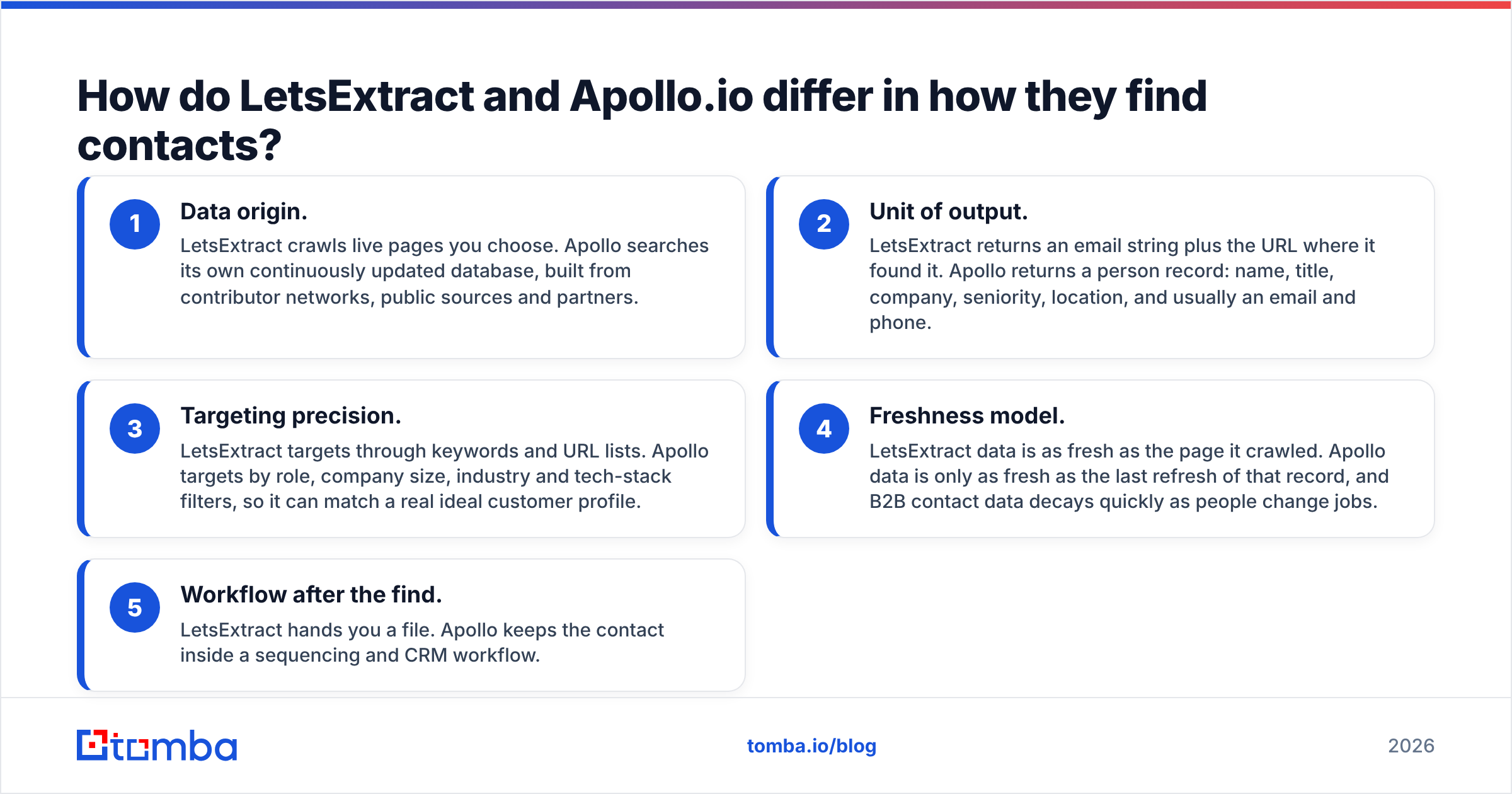
- Data origin. LetsExtract crawls live pages you choose. Apollo searches its own continuously updated database, built from contributor networks, public sources and partners.
- Unit of output. LetsExtract returns an email string plus the URL where it found it. Apollo returns a person record: name, title, company, seniority, location, and usually an email and phone.
- Targeting precision. LetsExtract targets through keywords and URL lists. Apollo targets by role, company size, industry and tech-stack filters, so it can match a real ideal customer profile.
- Freshness model. LetsExtract data is as fresh as the page it crawled. Apollo data is only as fresh as the last refresh of that record, and B2B contact data decays quickly as people change jobs.
- Workflow after the find. LetsExtract hands you a file. Apollo keeps the contact inside a sequencing and CRM workflow.
If your buyers are small businesses that publish their inbox on their homepage, the first approach often wins on cost. If your buyers are named people inside mid-market and enterprise companies, the second approach is the only one that reliably reaches them.

Which tool has better email accuracy?#
This is where you need to be careful. Neither vendor's marketing number tells you what bounce rate you'll get.
LetsExtract's accuracy is limited by what it scrapes. An address it found on a live page probably existed when it was published, but pages go stale. Generic inboxes also tend to be unmonitored or protected by aggressive filters. Scraped lists often include obfuscated or malformed strings, spam traps from old directories, and role accounts that some ESPs penalize heavily. Verifying before you send is required, not optional.
Apollo's accuracy is limited by how fresh each record is. Independent reviewers and user reports on G2 often praise Apollo's coverage and just as often complain about bounces on some segments, especially smaller companies and regions outside North America. Apollo labels emails by verification status, and you should filter to "verified" before exporting.
Here's how independent email-finder benchmarks compare the major tools on accuracy:

For either tool, the practical rule is the same. Run every list through a dedicated email verifier before it reaches your sending domain. Catch-all domains need extra care. Neither scraping nor database lookup can confirm that a mailbox exists on a server that accepts everything.
LetsExtract vs Apollo.io: how do they compare feature by feature?#
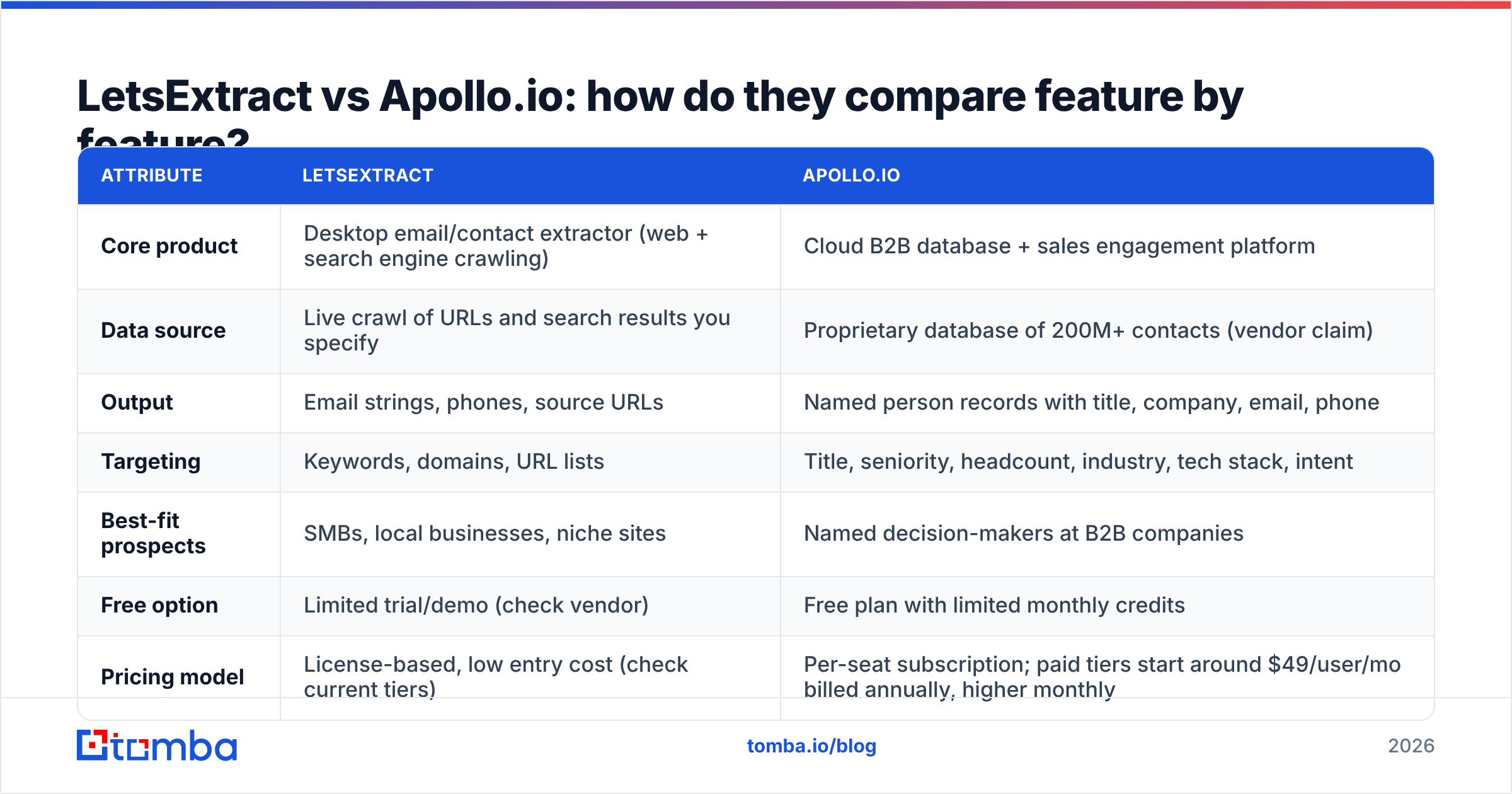
| Attribute | LetsExtract | Apollo.io |
|---|---|---|
| Core product | Desktop email/contact extractor (web + search engine crawling) | Cloud B2B database + sales engagement platform |
| Data source | Live crawl of URLs and search results you specify | Proprietary database of 200M+ contacts (vendor claim) |
| Output | Email strings, phones, source URLs | Named person records with title, company, email, phone |
| Targeting | Keywords, domains, URL lists | Title, seniority, headcount, industry, tech stack, intent |
| Best-fit prospects | SMBs, local businesses, niche sites | Named decision-makers at B2B companies |
| Free option | Limited trial/demo (check vendor) | Free plan with limited monthly credits |
| Pricing model | License-based, low entry cost (check current tiers) | Per-seat subscription; paid tiers start around $49/user/mo billed annually, higher monthly |
| Outreach built in | Minimal to none, so you export to another tool | Sequences, dialer, tasks, AI drafting |
| CRM integration | Manual CSV import | Native Salesforce, HubSpot and more |
| Learning curve | Moderate (crawl configuration) | Moderate to steep (full platform) |
| Main risk | Low-quality, role-based, stale addresses | Bounces on decayed records, cost creep from seats and credits |
For wider context, here's how the major dedicated email finders compare on price, accuracy and features:

How much do LetsExtract and Apollo.io really cost?#
Their pricing philosophies are very different, so compare what you'll pay over a year, not the list price.
LetsExtract has historically used a software-license model. You pay for the application, which may include time-limited updates or tier-based feature caps. Check the vendor's site for current tiers before you budget. The upfront cost is low compared with any seat-based SaaS. The hidden costs are:
- Verification credits. Scraped lists need heavy cleaning, and you'll usually pay a separate verifier for that.
- Proxies and infrastructure. Large search-engine scrapes can get rate-limited, so heavy users often end up buying proxies.
- Your time. You build source lists, tune crawls, deduplicate, and research who each generic inbox belongs to.
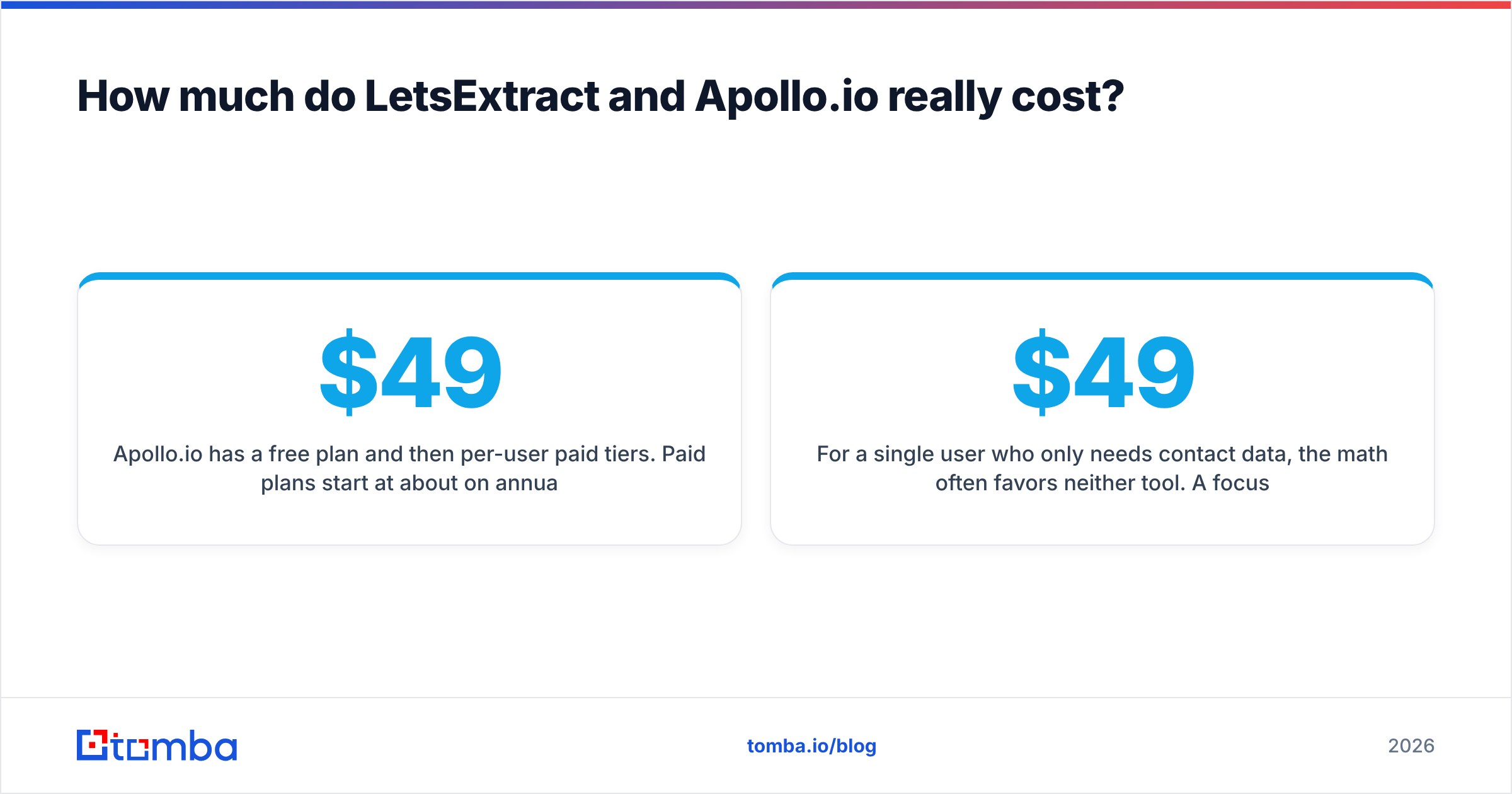
Apollo.io has a free plan and then per-user paid tiers. Paid plans start at about $49 per user per month on annual billing and go above $100 per user per month for higher tiers. Monthly billing costs noticeably more. Check Apollo's pricing page for current numbers, because tiers and credit allocations change often. The hidden costs are:
- Seat minimums on higher tiers. Some advanced plans require multiple seats, so a solo founder can't simply buy one.
- Credit consumption. Exports, mobile numbers and some enrichment actions draw from separate credit pools, and heavy users run out.
- Paying for features you don't use. If you already have a sequencer and a dialer, much of Apollo's value duplicates tools you already pay for.

For a single user who only needs contact data, the math often favors neither tool. A focused email finder with a free tier and flat monthly plans usually costs less than an Apollo seat and involves far less cleanup than a scraper. For comparison, see Tomba pricing: a free tier with 25 searches a month, then Starter at $49/mo, Growth at $99/mo and Pro at $249/mo, with no per-seat multiplier on the core finder.
Is LetsExtract better than Apollo.io for any use case?#
Yes. There are real situations where LetsExtract is the smarter buy:
- Local and SMB lead generation. Plumbers, restaurants, clinics, law offices and Shopify stores publish their inbox. A crawl of a directory or a location-plus-keyword search can pull thousands of relevant contacts that Apollo's B2B database covers poorly.
- Niche communities. Forums, association member directories, conference exhibitor lists and industry blogs are mostly absent from B2B databases.
- Tight budgets with lots of time. If you're a solo operator who would trade hours for dollars, a low-cost extractor beats a monthly seat.
- Research and link building. Marketers collecting outreach contacts for PR or backlinks often need site-level inboxes, not named executives.
And Apollo is clearly better when:
- You sell to named roles at companies with 50+ employees.
- You need firmographic filters such as headcount, funding or tech stack to define your ICP.
- You want one workflow from list-building to sequence to CRM, without juggling CSVs.
- You run a team. Shared lists, activity tracking and CRM sync matter more as headcount grows.
What are the compliance and deliverability risks with each?#
Scraping and database prospecting both have legal and reputational exposure. They just carry it differently.
Scraped lists carry higher risk. Under GDPR and similar frameworks, you still need a lawful basis to process personal data, even if it was publicly posted. Generic role inboxes are less sensitive than personal work emails, but "it was on a website" isn't a legal basis on its own. Scraped lists are also where spam traps and dead inboxes cluster, and both of those damage sender reputation quickly.
Database vendors take on some of the sourcing burden, but not all of it. Apollo publishes privacy and compliance documentation, and you're still responsible for how you contact people: opt-outs, suppression lists and regional rules. Bounces from stale records hurt deliverability too, just less sharply than trap-heavy scraped lists.
Whichever you choose, apply the same protections:
- Verify every address before sending, and handle catch-all domains separately.
- Warm up new sending domains and cap daily volume.
- Keep a global suppression list shared across every tool you use.
- Keep records of where each contact came from and your lawful basis for contacting them.
What should you use if you just need accurate work emails?#
LetsExtract and Apollo solve two problems that often get confused. One gets you as many addresses as possible from the open web. The other gives you a full sales operating system. Many teams only need a third thing: the verified email of a specific person at a specific company, on demand.
That's what a dedicated email finder does. You enter a name and a domain, or just a domain, and it returns the most likely professional address with a confidence score, source references and verification status. You don't configure crawls and you don't pay per seat.
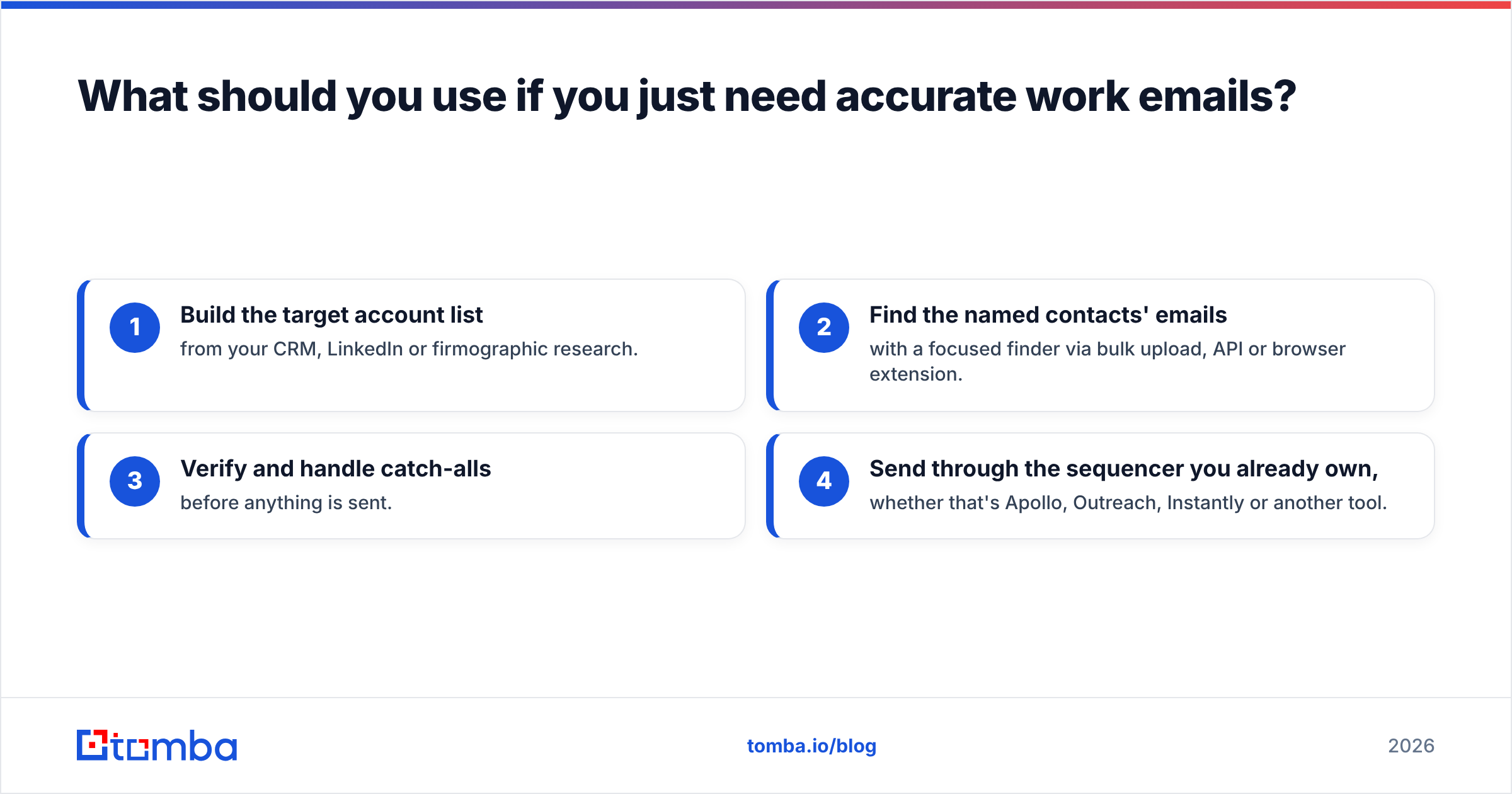
A practical stack for many B2B teams in 2026 looks like this:
- Build the target account list from your CRM, LinkedIn or firmographic research.
- Find the named contacts' emails with a focused finder via bulk upload, API or browser extension.
- Verify and handle catch-alls before anything is sent.
- Send through the sequencer you already own, whether that's Apollo, Outreach, Instantly or another tool.
If you're weighing Apollo mainly for its data, our breakdown of the best Apollo alternative options shows where a leaner data tool beats a full platform on cost per verified contact.
Which should you choose: LetsExtract or Apollo.io?#
Here's the short version of the LetsExtract vs Apollo.io decision:
- Choose LetsExtract if your prospects are small businesses or niche communities that publish their contact info, your budget is tight, and you're comfortable cleaning and verifying lists yourself.
- Choose Apollo.io if you sell to named decision-makers at B2B companies, need ICP filters, and want list-building, sequencing and CRM sync in one subscription, and you accept per-seat pricing and some bounce management.
- Choose neither if your real need is accurate, person-level work emails without scraping cleanup or platform lock-in. A dedicated email finder plus your existing outreach tool is usually the cheapest and most deliverable setup.
Most teams that switch away from either tool do so for the same reason: they were paying for a way of collecting data they didn't need. Pick the tool that matches who you're trying to reach, not the one with the longest feature list.
Ready to find verified emails without scraping or seat fees?#
If you want person-level work emails you can trust, without crawl setups, generic inboxes or per-seat bills, try the Tomba Email Finder. Search by name and company or by domain, and get a confidence score and verification status for every result. You can run lookups in the web app, in bulk, through the API or from the browser extension. The free tier includes 25 searches a month, so you can test it against your current source before you commit to a paid plan.
Related guides#
// get started
Find, verify and enrich your first contacts today
Start on the free plan with 25 searches a month, then scale when your team is ready.
Free plan · No credit card required · GDPR & CCPA
Get the Tomba newsletter
Product and data updates
// about the author