Listclean vs Apollo.io: Email Verifier or Sales Platform? (2026)
Listclean cleans email lists you already have. Apollo.io finds new leads and sequences them. Here's how to tell which one your bounce rate, budget and team actually need in 2026.
Listclean vs Apollo.io is a common search, but the two tools solve different problems. One cleans lists. The other finds leads.
TL;DR
- Listclean and Apollo.io do different jobs. Listclean is a pay-as-you-go email verification service. Apollo.io is an all-in-one sales platform with a contact database, email finder, sequencer and dialer.
- Pick Listclean if you already have contact lists (from events, a CRM, or old campaigns) and you need to cut bounces cheaply before sending.
- Pick Apollo.io if you need new prospects and want search, enrichment and outreach in one seat-based subscription.
- Many teams need both jobs done: finding addresses and then verifying them. Running two tools means two logins, two bills and a CSV export between them.
- The in-between option is a finder with verification built in, such as Tomba, which starts at $49/mo and has a free tier.
Listclean vs Apollo.io: what is the real difference?#
If you compare Listclean and Apollo.io feature by feature, it looks lopsided. Apollo has hundreds of features. Listclean has a handful. But they aren't competing for the same budget line. Listclean answers one question: "Will this email address bounce?" Apollo.io answers a different one: "Who should I sell to, and how do I contact them?"
Here's an analogy. Listclean is the mechanic who checks the car you already own. Apollo.io is the dealership that sells you a car, finances it, and throws in a GPS. If your car runs fine but you're worried about the brakes, the dealership is overkill. If you have no car, the mechanic can't help.
So the useful question is where your outbound workflow is actually broken:
- You have contacts but bounce rates are hurting deliverability. That's a verification problem, which is Listclean's territory.
- You don't have enough of the right contacts. That's a data and prospecting problem, which is Apollo's territory.
- You have both problems. You need a finder and a verifier, either as two tools or one.
What does Listclean actually do?#
Listclean is a bulk email verification platform. You upload a list (CSV, TXT, or through the API) and it checks each address. It flags syntax errors, missing MX records and disposable domains. It also flags role accounts, spam traps and mailboxes that don't exist. Each address comes back labeled roughly as clean, dirty or unknown/risky. You then export the segment you want to keep.
What stands out:
- Pay-as-you-go credits. No subscription is required, and credits don't expire. That suits teams that clean lists every few months rather than every day.
- Low per-email cost at volume. Listclean is one of the cheaper verifiers per thousand checks, which matters if you clean six-figure lists.
- Small free allowance. You can test accuracy on a sample before you buy.
- API access. You can verify at the point of capture, for example on signup forms, so bad data never reaches your CRM.
What it doesn't do: find new contacts, enrich records with job titles or company data, or send email. Listclean assumes the list already exists.
What does Apollo.io actually do?#
Apollo.io is a sales intelligence and engagement platform. Its core is a large B2B contact and company database. You can filter it by title, seniority, industry, headcount, technology, funding and buying intent. On top of that sit:
- An email finder and phone number reveals (credit-based)
- Email sequences, a dialer and task management
- A Chrome extension that works on LinkedIn and in Gmail
- CRM sync with HubSpot and Salesforce
- AI-assisted research and email writing
Apollo does verify the emails it returns and labels them with a status. But it is not built as a standalone cleaner for lists you bring from somewhere else. You can import contacts. Still, a verifier's list-hygiene workflow (upload 50,000 addresses, strip the bad ones, download the rest) isn't what Apollo is built around.
Listclean vs Apollo.io: how do they compare side by side?#
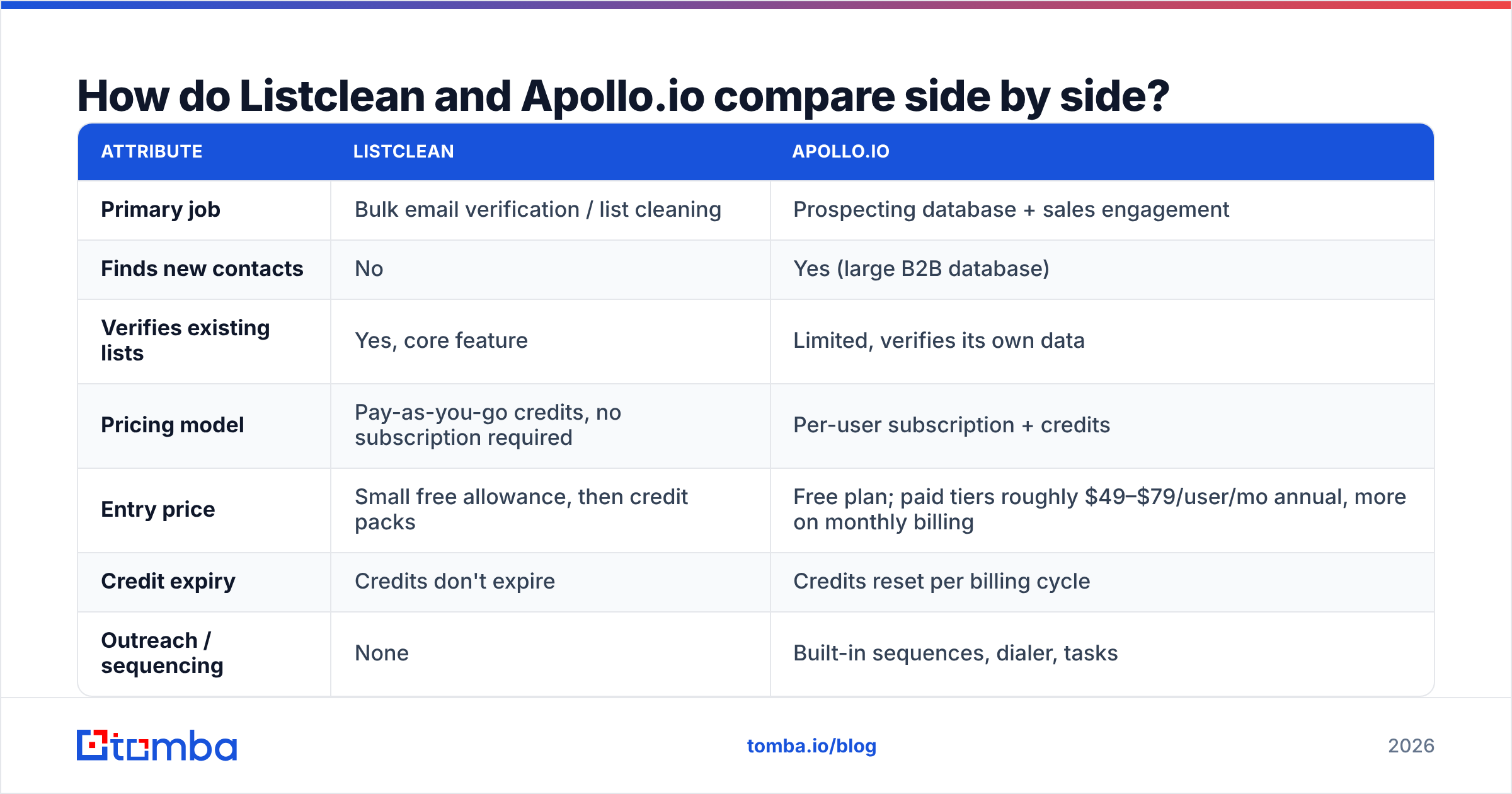
| Attribute | Listclean | Apollo.io |
|---|---|---|
| Primary job | Bulk email verification / list cleaning | Prospecting database + sales engagement |
| Finds new contacts | No | Yes (large B2B database) |
| Verifies existing lists | Yes, core feature | Limited, verifies its own data |
| Pricing model | Pay-as-you-go credits, no subscription required | Per-user subscription + credits |
| Entry price | Small free allowance, then credit packs | Free plan; paid tiers roughly $49–$79/user/mo annual, more on monthly billing |
| Credit expiry | Credits don't expire | Credits reset per billing cycle |
| Outreach / sequencing | None | Built-in sequences, dialer, tasks |
| Catch-all handling | Flags as risky/unknown | Labels status on its own records |
| API | Yes | Yes (higher tiers for full access) |
| Best for | Marketers, agencies, anyone with existing lists | SDR teams building pipeline from scratch |
| Main drawback | Doesn't generate leads | Cost scales per seat; credit limits add up |
Pricing for both tools changes often, and Apollo renamed and restructured its plans in early 2026. Check each vendor's pricing page before you budget.

Which one lowers your bounce rate more?#
For lists you already own, Listclean does. Verification is its whole product. It re-checks each address against the mail server at the moment you run it. That matters because B2B data decays fast. People change jobs, companies change domains, and mailboxes get shut down. A list that was clean nine months ago can easily be several percent invalid today.
Apollo's verification status reflects the last time Apollo checked that record. For contacts you pull from Apollo and email right away, that's usually fine. For a list you exported last quarter, or contacts that came from somewhere else, it's a snapshot, not a live check.
The practical rule most deliverability teams follow is simple: verify right before you send, whatever the source. That's why plenty of Apollo users still run exports through a separate verifier before loading them into a sequencer. If you're weighing the options, our email verifier guide covers what a proper SMTP-level check involves.
One caveat for both tools is catch-all domains. These servers accept mail for any address. So a standard verifier can't confirm whether a specific mailbox exists. Listclean marks them risky. Apollo labels them as well. Neither can give you certainty from a standard check. If catch-all domains make up a big share of your target accounts (common in enterprise and mid-market), test a dedicated catch-all verifier that uses extra signals.
How much does each tool really cost?#
The pricing models don't line up, so compare them by workflow, not by sticker price.
Listclean is cheap and predictable for list hygiene. You buy credits, spend them when you clean, and keep the rest. An agency that verifies a 20,000-contact list once a quarter pays for 80,000 checks a year, and that's all. With no seat fees, a whole team can share one account.
Apollo.io charges per user, and credits govern data actions like email and phone reveals. A 5-person SDR team on a mid-tier plan pays per seat every month, whether or not each rep is prospecting. Mobile numbers, higher export limits and advanced reporting usually sit in higher tiers or cost extra credits. Several independent breakdowns of Apollo pricing note that real spend often lands above the sticker price once you add credit top-ups.
To estimate your own cost, use this sequence:
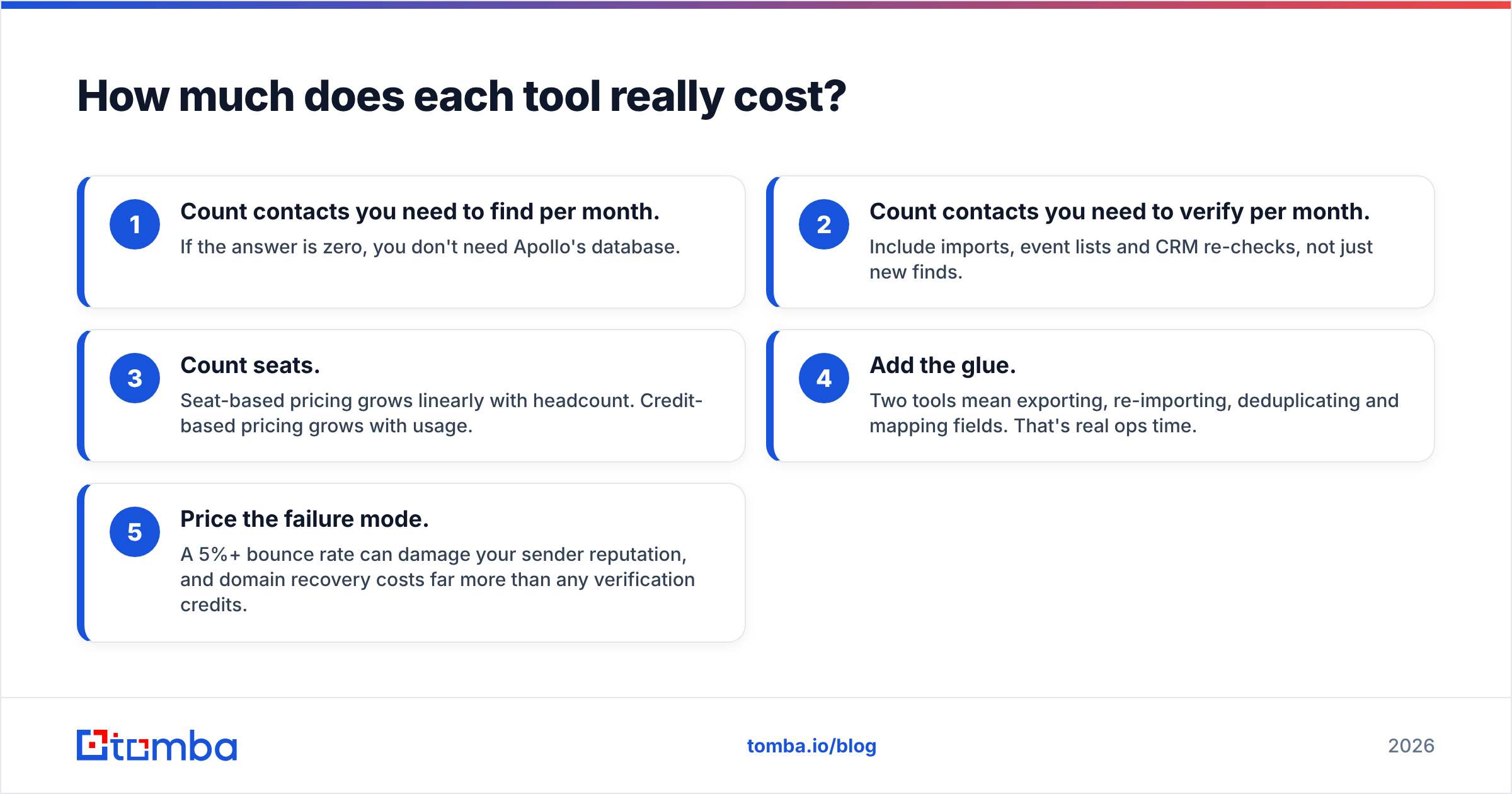
- Count contacts you need to find per month. If the answer is zero, you don't need Apollo's database.
- Count contacts you need to verify per month. Include imports, event lists and CRM re-checks, not just new finds.
- Count seats. Seat-based pricing grows linearly with headcount. Credit-based pricing grows with usage.
- Add the glue. Two tools mean exporting, re-importing, deduplicating and mapping fields. That's real ops time.
- Price the failure mode. A 5%+ bounce rate can damage your sender reputation, and domain recovery costs far more than any verification credits.
Who should choose Listclean?#
Listclean fits when you have the data and need it trustworthy:
- Email marketers with newsletter or customer lists that have built up over years
- Agencies cleaning client lists before campaign launches, where pay-per-use beats seats
- Event and webinar teams whose signup forms collect typos and throwaway addresses
- Teams already using another prospecting tool that want an independent verification pass before sending
- Low-frequency users who clean a few times a year and don't want a subscription
It's a poor fit if your real bottleneck is lead volume. Cleaning a thin list makes it more accurate, not longer.
Who should choose Apollo.io?#
Apollo fits when you're building pipeline from scratch and want one place to work:
- Early-stage startups doing founder-led outbound that need search, contact data and sequences without stitching tools together
- SDR teams that live in sequences and want activity tracking and CRM sync
- Teams targeting well-covered segments (US tech, SaaS, mid-market), where Apollo's database is strongest
- Buyers who value breadth over depth, since one subscription covers most outbound tasks
It's a weaker fit if you only need clean data. The same goes if you target regions or niches where its coverage is thinner, or if seat costs outgrow a small team's budget. If that sounds like you, compare Apollo alternatives that price by usage.
Is there a middle ground between a verifier and a full sales platform?#
Yes, and it's where many small and mid-sized teams end up. The workflow most outbound teams need is find, then verify, then send in whatever sequencer they already use. Listclean covers only the middle step. Apollo covers all three steps but bundles a lot you may not use. It also still leaves you verifying older exports.
A finder with verification built in covers the first two steps, and you keep your existing sequencer (Instantly, Lemlist, HubSpot, Outreach). Tomba works this way:
- Find addresses by name + company, by domain, or from LinkedIn through the Chrome extension
- Verify each result at SMTP level, with catch-all handling, in the same credit system
- Bulk-run both on CSVs, or pipe through the API, Google Sheets or Zapier
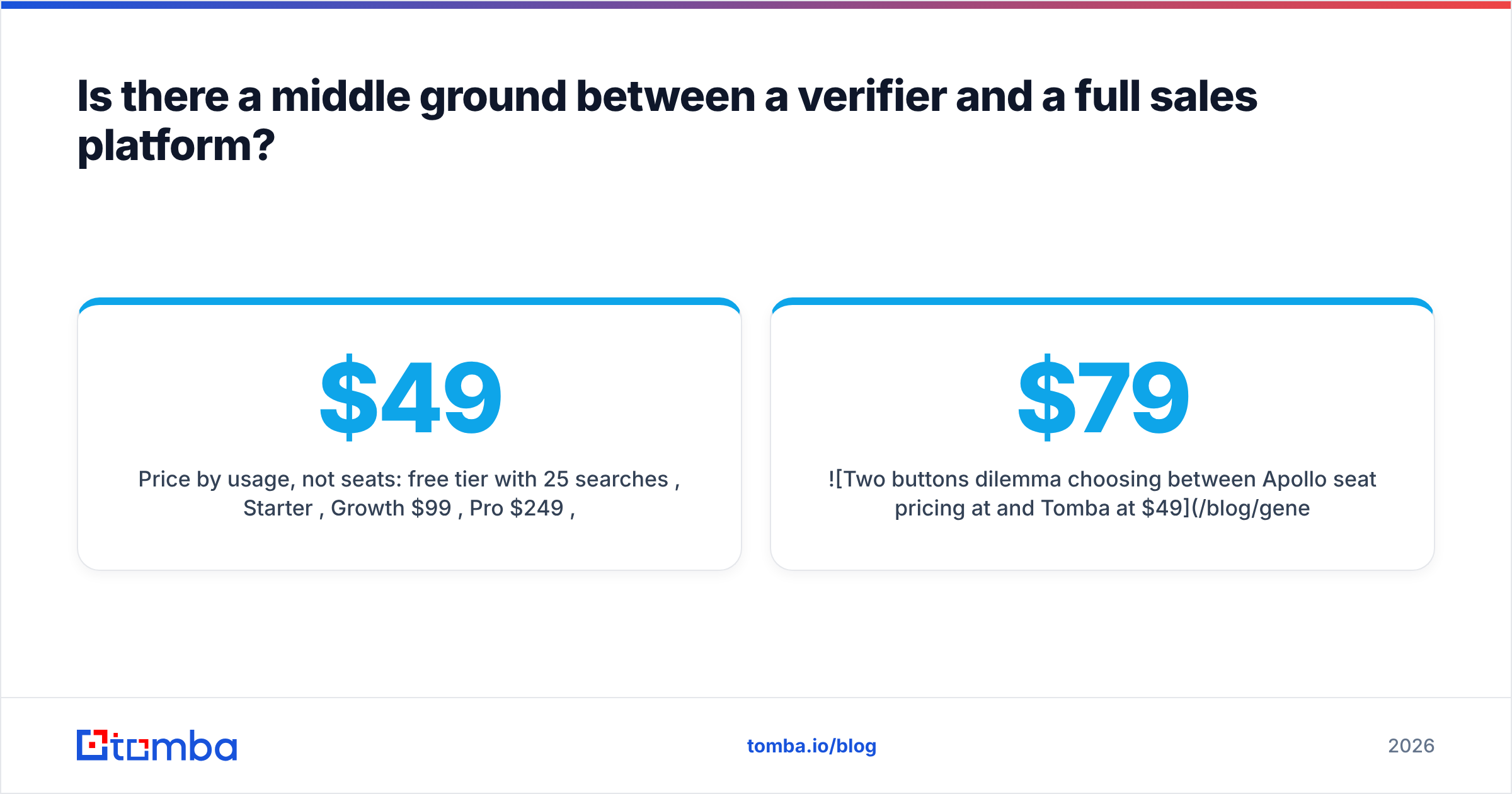
- Price by usage, not seats: free tier with 25 searches/month, Starter $49/mo, Growth $99/mo, Pro $249/mo, Enterprise custom
It doesn't replace Apollo's sequencer or dialer. It also doesn't match Listclean's per-check price for very large hygiene jobs. It does remove the export-verify-reimport loop for teams whose main need is accurate contacts. The full tier breakdown is on the Tomba pricing page.

Which should you pick: Listclean or Apollo.io?#
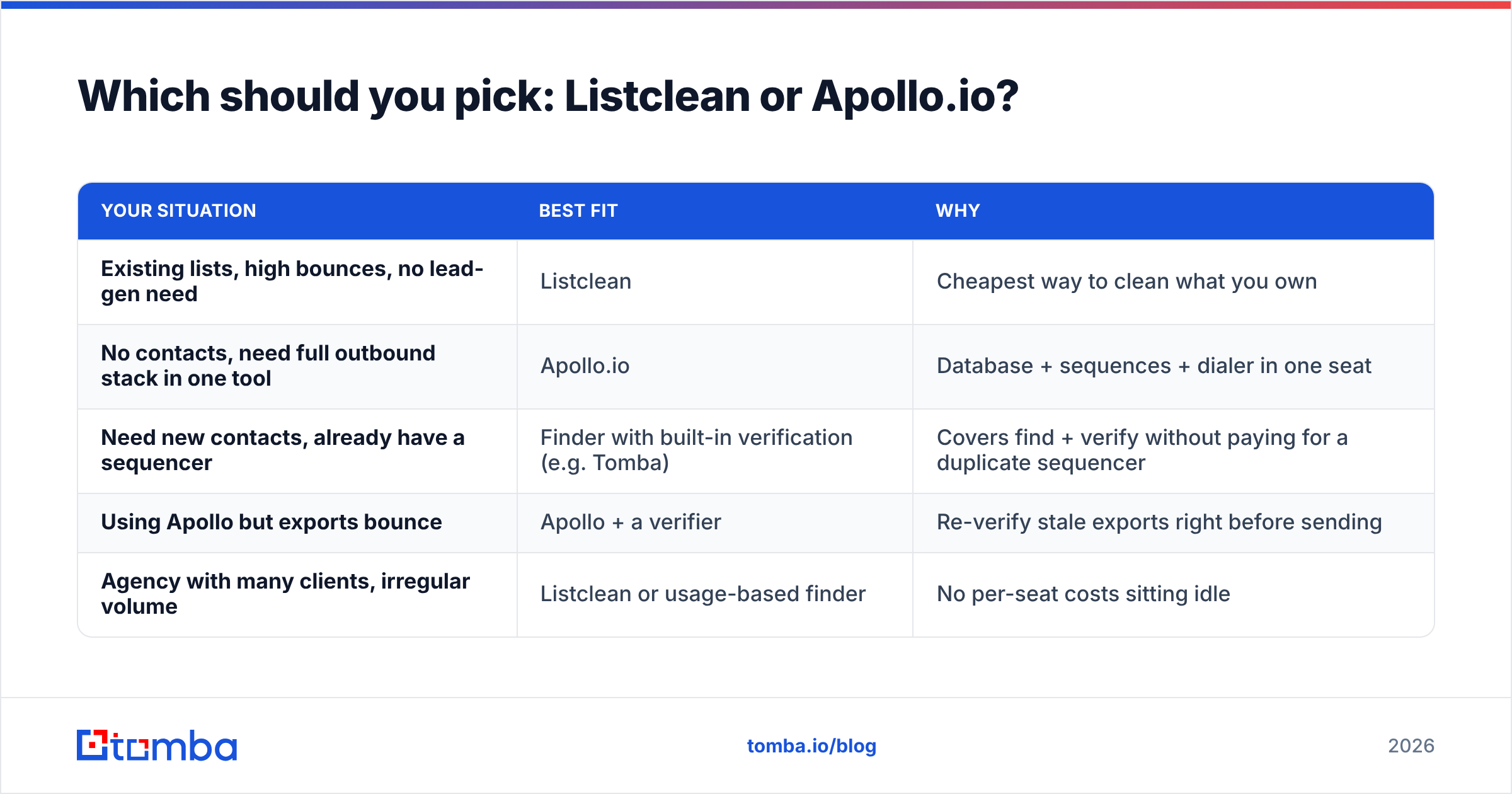
Use this decision shortcut:
| Your situation | Best fit | Why |
|---|---|---|
| Existing lists, high bounces, no lead-gen need | Listclean | Cheapest way to clean what you own |
| No contacts, need full outbound stack in one tool | Apollo.io | Database + sequences + dialer in one seat |
| Need new contacts, already have a sequencer | Finder with built-in verification (e.g. Tomba) | Covers find + verify without paying for a duplicate sequencer |
| Using Apollo but exports bounce | Apollo + a verifier | Re-verify stale exports right before sending |
| Agency with many clients, irregular volume | Listclean or usage-based finder | No per-seat costs sitting idle |
The honest verdict on Listclean vs Apollo.io: Listclean isn't a cheaper Apollo, and Apollo isn't a better Listclean. If you treat them as direct rivals, you'll pay for a product that doesn't fix your real bottleneck. Work out whether your problem is list quality, list quantity or both. Then buy for that.
For a lot of lean outbound teams the problem is both. A single tool that finds and verifies saves more time than the gap in per-credit cost.
Final take: which tool fits your outbound motion?#
If you've read this far and your answer is "I need accurate contact data without another seat-based platform," start with the Tomba Email Finder. Find professional email addresses by name, domain or company. Each one is verified in the same step. Then send the results to your existing sequencer or CRM. The free tier gives you 25 searches a month, so you can test it on your real target accounts before paying anything.
Related guides#
// get started
Find, verify and enrich your first contacts today
Start on the free plan with 25 searches a month, then scale when your team is ready.
Free plan · No credit card required · GDPR & CCPA
Get the Tomba newsletter
Product and data updates
// about the author