ListKit vs OutboundView: Self-Serve Lead Data or Done-for-You SDRs?
ListKit sells you verified lead lists and cold email infrastructure. OutboundView sells you booked meetings with HR buyers. Here's how to tell which one your pipeline actually needs.
TL;DR
- ListKit and OutboundView are different kinds of product. ListKit is a self-serve B2B lead database with an optional cold email infrastructure add-on. OutboundView is a sales development agency that books meetings for you, mostly with HR buyers.
- Pricing is on different scales. ListKit's paid plans start at $97/month for 2,000 credits with unlimited users. OutboundView works on retainers, with packages that third-party directories list at roughly $1,000 to $2,500 per month, and custom pricing for full SDR engagements.
- Pick ListKit if you have people to run outbound and mainly need contacts, verification, and sending infrastructure.
- Pick OutboundView if you sell into HR, have no SDR capacity, and would rather pay for meetings than for data.
- Whichever you choose, verify before you send. Contact data goes stale fast, and one bad export can damage your sender reputation for weeks.
What is the real difference between ListKit and OutboundView?#
Most "ListKit vs OutboundView" searches start from a wrong assumption: that these are two competing tools. They aren't. One is software you operate yourself. The other is a team of people you pay to operate outbound for you.
ListKit is a lead list builder. You search a large B2B contact database (the vendor claims 977M+ contacts), filter by firmographics and intent, and export leads that ListKit describes as "triple-verified." Over time it has also added what it calls an Email Engine, which gives you pre-warmed inboxes, private sending infrastructure, and deliverability monitoring. You still write the sequences, pick the targets, and handle the replies, unless you pay for extra services.
OutboundView is a B2B sales development and appointment-setting agency based in Franklin, Tennessee. Its niche is selling to HR leaders. According to its Clutch profile, it runs a proprietary platform called TalentView with a database of more than 550,000 HR professionals. It sells packages such as buyer-intent leads, content-led demand generation, and fully managed SDR and cold-calling programs.
So you aren't really choosing between two tools. You're deciding whether to build outbound in-house or outsource it. The vendors just happen to sit on either side of that decision.
How do ListKit and OutboundView compare side by side?#
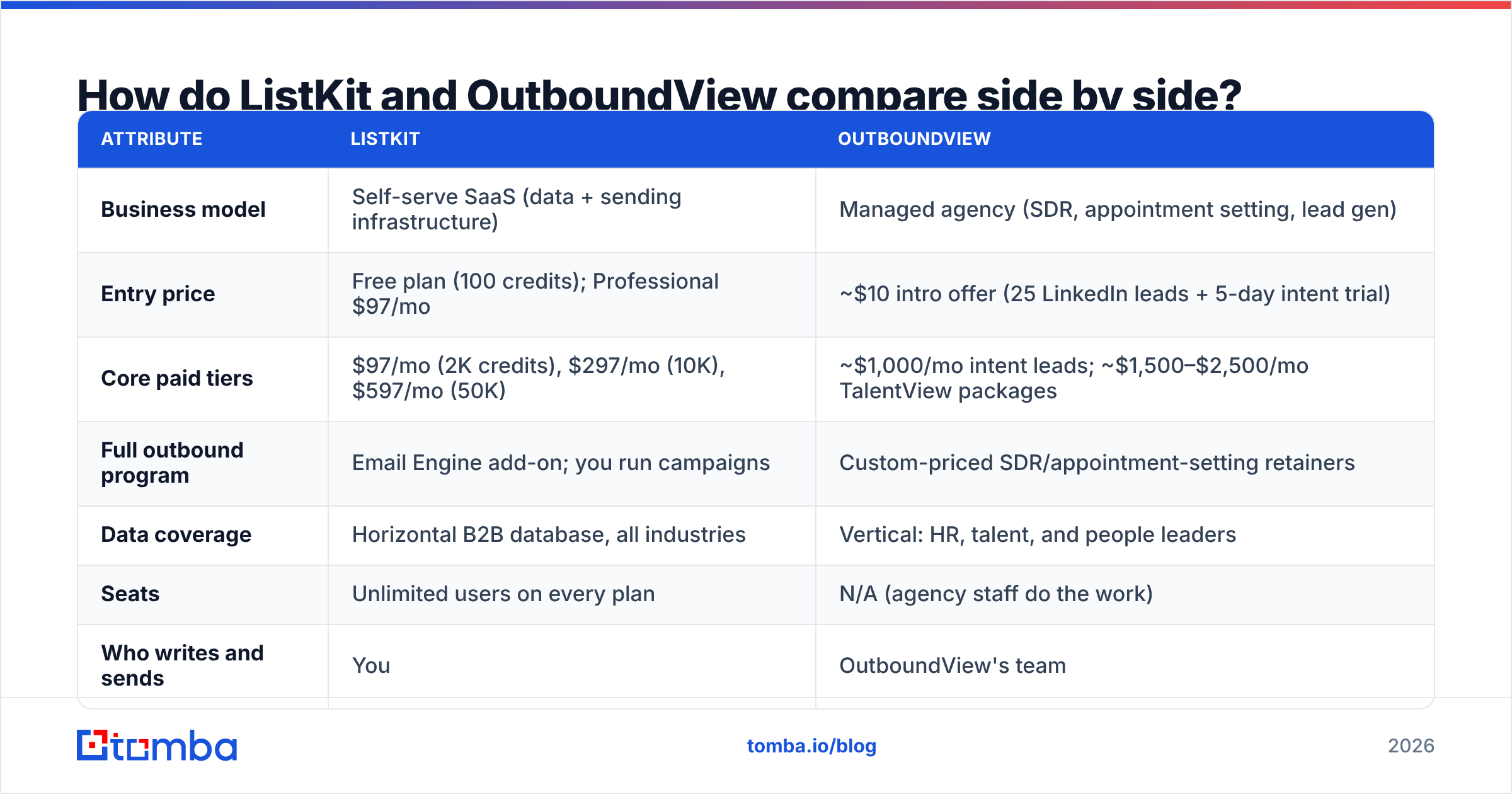
Here's the head-to-head view. Pricing reflects what was publicly listed or reported at the time of writing. Check each vendor's current page before you commit.
| Attribute | ListKit | OutboundView |
|---|---|---|
| Business model | Self-serve SaaS (data + sending infrastructure) | Managed agency (SDR, appointment setting, lead gen) |
| Entry price | Free plan (100 credits); Professional $97/mo | ~$10 intro offer (25 LinkedIn leads + 5-day intent trial) |
| Core paid tiers | $97/mo (2K credits), $297/mo (10K), $597/mo (50K) | ~$1,000/mo intent leads; ~$1,500–$2,500/mo TalentView packages |
| Full outbound program | Email Engine add-on; you run campaigns | Custom-priced SDR/appointment-setting retainers |
| Data coverage | Horizontal B2B database, all industries | Vertical: HR, talent, and people leaders |
| Seats | Unlimited users on every plan | N/A (agency staff do the work) |
| Who writes and sends | You | OutboundView's team |
| Cold calling | No | Yes (Dialworks, ~$1,500/user/mo reported) |
| Best for | Agencies, SDR teams, founders doing their own outbound | HR tech and HR services vendors with no SDR bandwidth |
| Main risk | Your team's time and deliverability discipline | Retainer cost and dependence on agency quality |
The table shows a spread of roughly 10 to 25 times in monthly spend, and that gap is the whole story. With ListKit, your cost is the subscription plus your own time. With OutboundView, you're paying for someone else's time.
How does ListKit work in practice?#
ListKit's pitch is that you get a large B2B dataset with one subscription and without per-seat fees. Its pricing page says every plan, including the free one, includes the same feature set: AI company search, triple verification, intent data, enrichment, and CRM integrations. The tiers differ only in credit volume.
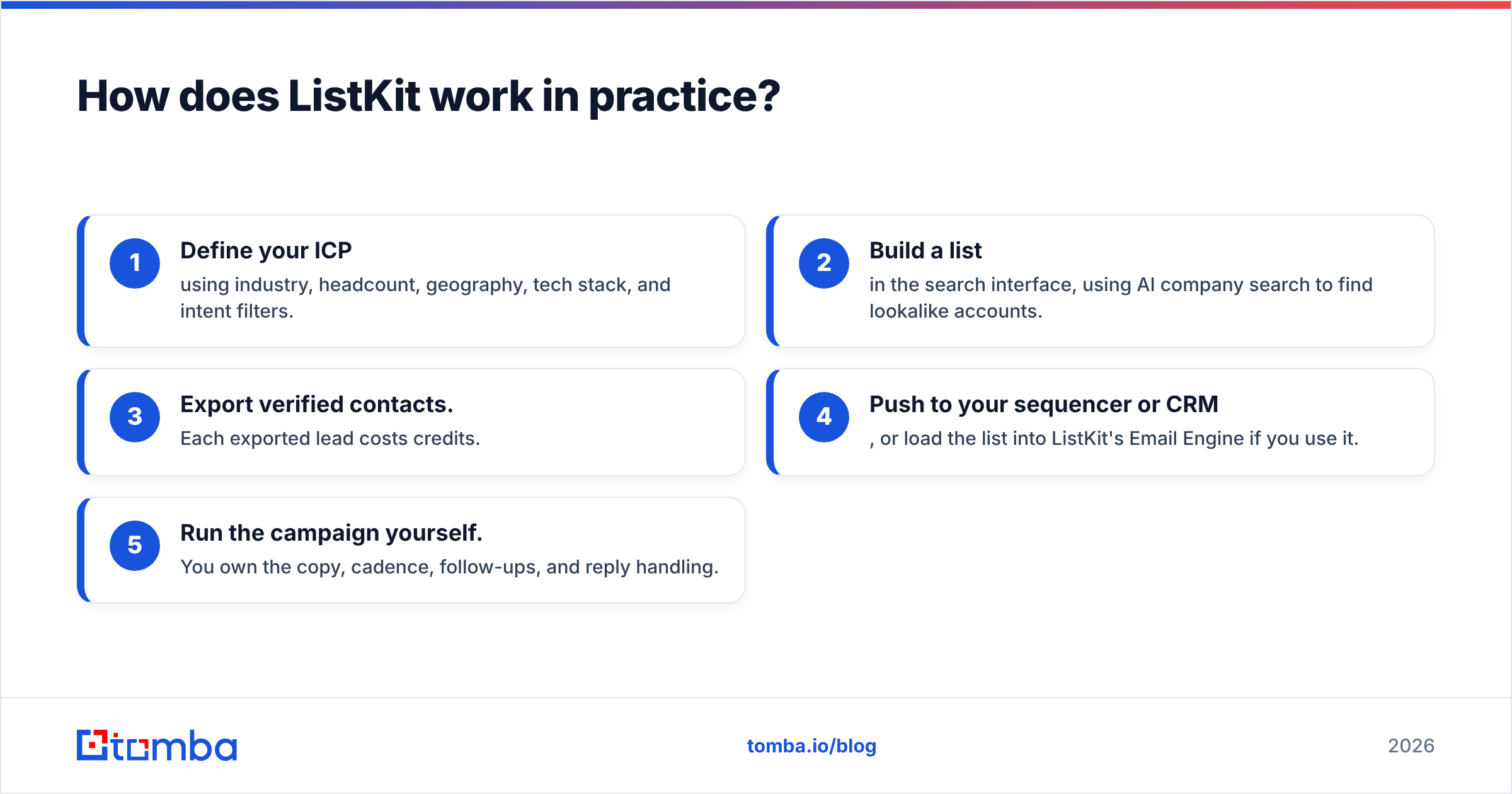
A typical ListKit workflow:
- Define your ICP using industry, headcount, geography, tech stack, and intent filters.
- Build a list in the search interface, using AI company search to find lookalike accounts.
- Export verified contacts. Each exported lead costs credits.
- Push to your sequencer or CRM, or load the list into ListKit's Email Engine if you use it.
- Run the campaign yourself. You own the copy, cadence, follow-ups, and reply handling.
Where ListKit is strong:
- Seat economics. Unlimited users make a real difference for agencies and growing SDR teams. A five-person team pays the same as a solo founder.
- Price per lead. At $297/month for 10,000 credits, the per-contact cost is low compared with legacy enterprise data vendors.
- Infrastructure in one place. If you don't want to buy domains, set up inboxes, and manage warmup yourself, the Email Engine removes a lot of setup work.
Where ListKit is weaker:
- It doesn't run outbound for you. A database won't write a good first line, and it won't follow up.
- Horizontal data can be thin in niches. Broad databases usually have gaps in narrow verticals, so spot-check coverage for your ICP before you buy a large plan.
- Credits push you to export. You'll be tempted to pull big lists so the credits don't go unused. Resist that. Smaller, tighter lists get better reply rates.
How does OutboundView work in practice?#
OutboundView sells an outcome instead of a dataset. According to its homepage, the core offer is B2B appointment setting and lead generation. Its positioning is built around reaching HR decision-makers.
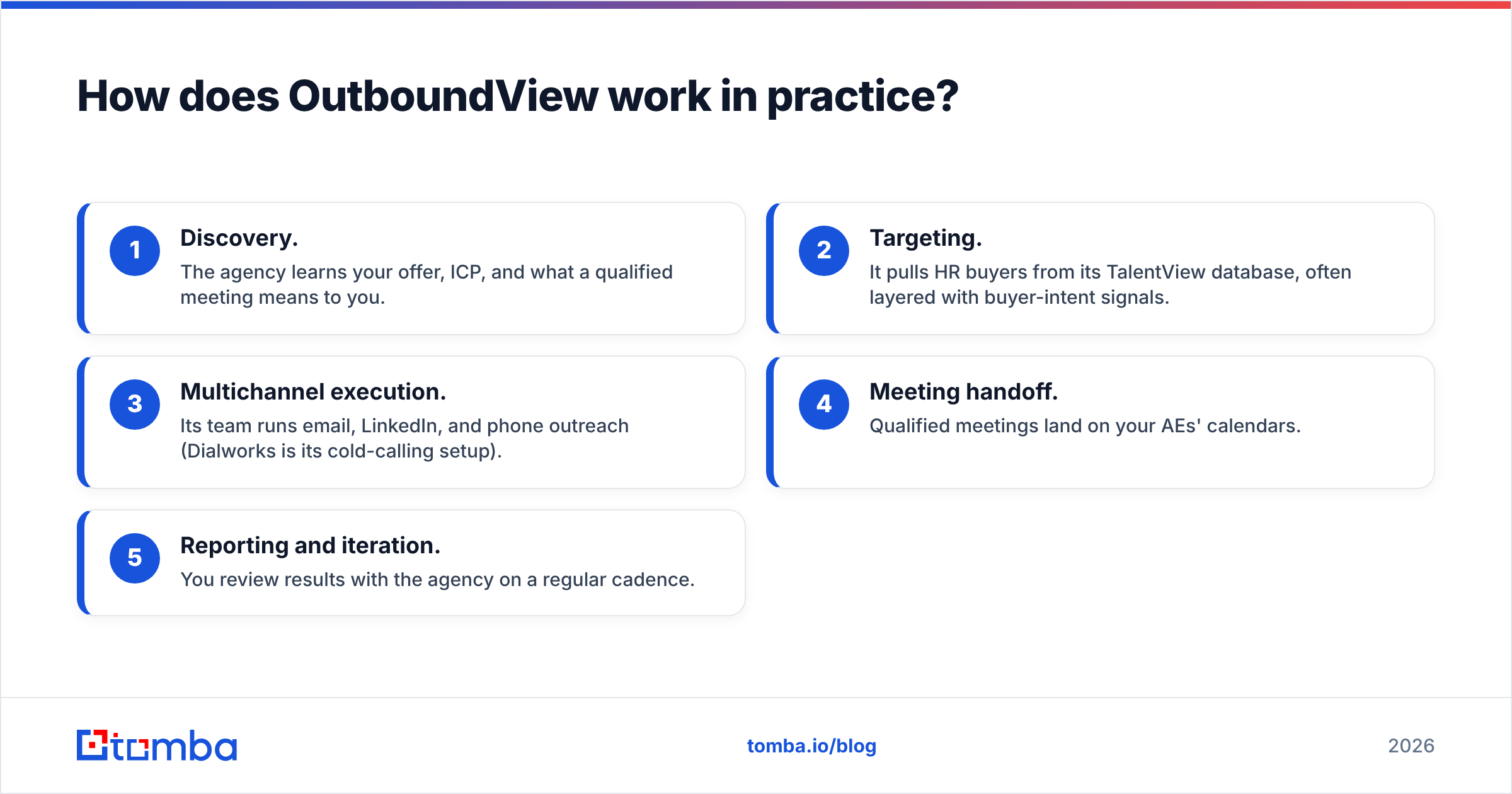
A typical OutboundView engagement:
- Discovery. The agency learns your offer, ICP, and what a qualified meeting means to you.
- Targeting. It pulls HR buyers from its TalentView database, often layered with buyer-intent signals.
- Multichannel execution. Its team runs email, LinkedIn, and phone outreach (Dialworks is its cold-calling setup).
- Meeting handoff. Qualified meetings land on your AEs' calendars.
- Reporting and iteration. You review results with the agency on a regular cadence.
Where OutboundView is strong:
- Vertical focus. A database and team built around HR buyers means less wasted outreach if HR is your market. Generalist agencies often struggle with narrow personas like CHROs and heads of talent acquisition.
- No hiring burden. You skip SDR recruiting, ramp time, turnover, and management overhead.
- Phone included. Many HR leaders still answer the phone or respond to a well-timed call. A self-serve email stack can't do that for you.
Where OutboundView is weaker:
- It only fits one vertical. If you don't sell into HR, the main advantage disappears.
- Retainer risk. You pay monthly regardless of results, so contract terms and meeting-quality definitions matter a lot.
- Less control. Messaging, pacing, and brand voice go through a third party. You also build less outbound knowledge in-house.
Is ListKit cheaper than OutboundView?#
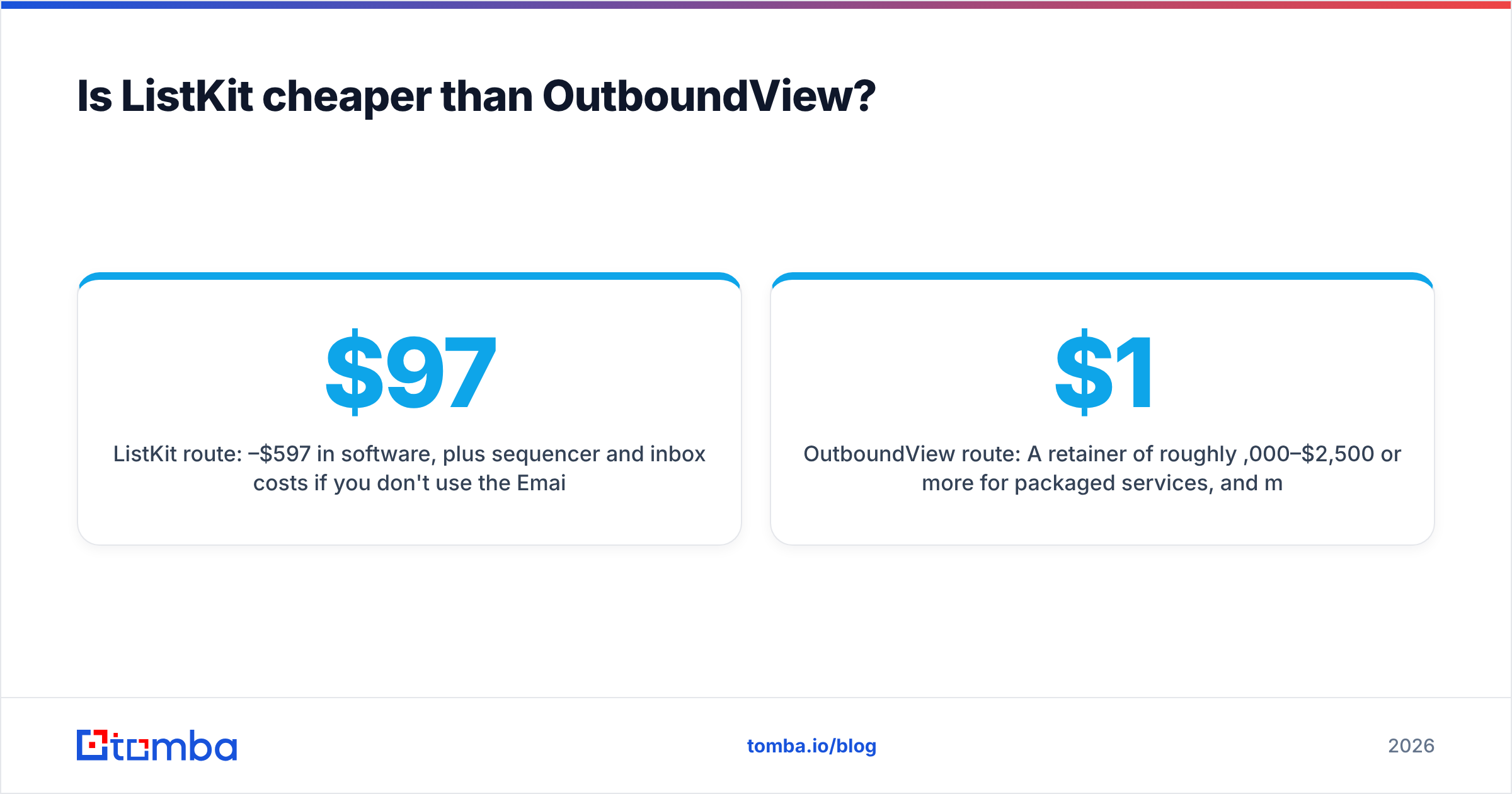
On sticker price, clearly yes. The honest comparison, though, is cost per qualified meeting, not cost per month.
A rough way to think about it:
- ListKit route: $97–$597/month in software, plus sequencer and inbox costs if you don't use the Email Engine, plus your team's time. Put a dollar value on that time. If a founder spends 15 hours a week on outbound, that's the real cost.
- OutboundView route: A retainer of roughly $1,000–$2,500/month or more for packaged services, and more for a full SDR program. In exchange, your internal time drops to reviewing meetings and giving feedback.
If you already have an SDR on payroll, ListKit is almost always cheaper per meeting because you're only adding data cost to labor you already pay for. If you have nobody, compare OutboundView's retainer with the fully loaded cost of hiring an SDR. Salary, tools, management time, and a three-month ramp usually add up to far more than an agency retainer in the first year.
Which data is more accurate?#
This is the part neither vendor can fully answer for you. Both depend on contact data, and all B2B contact data decays. People change jobs, companies rebrand domains, and mailboxes get shut down. HubSpot's guidance on email bounce rates is a good reminder of how quickly a few percent of hard bounces becomes a deliverability problem.
A few practical rules, whichever route you take:
- Re-verify before every send, not just when you export. A list pulled 60 days ago is not the same list today. A standalone email verifier is inexpensive insurance.
- Handle catch-all domains separately. Plenty of companies accept all mail at the server level, so "valid" doesn't always mean "deliverable." Put those contacts in a lower-volume segment.
- Cross-check key accounts. For your top 50 target accounts, run a domain search to confirm the email pattern and find additional stakeholders your main source missed.
- Ask agencies how they verify. If you go with OutboundView or any other agency, ask them directly how and when they verify contacts, and what bounce rate they hold themselves to.
Who should choose ListKit?#
ListKit is the better fit if most of these apply:
- You have outbound operators. You have SDRs, a growth marketer, or a founder who likes running campaigns.
- You sell horizontally. Your ICP covers several industries or roles, not only HR.
- You care about per-seat costs. You're an agency or a fast-growing team that would pay heavily for seats elsewhere.
- You want to own the playbook. You want your messaging, test results, and reply data to stay inside your company.
- You need sending infrastructure without an ops hire. The Email Engine covers domains, inboxes, and warmup.
Who should choose OutboundView?#
OutboundView is the better fit if most of these apply:
- You sell to HR. HR tech, benefits, payroll, recruiting software, L&D, and HR consulting are all in its sweet spot.
- You don't have SDR capacity, and you don't want to hire and ramp one right now.
- You need phone as a channel. HR leaders at mid-market companies often respond better to multichannel outreach than to email alone.
- You care more about speed to meetings than about building in-house skills. An agency can start producing meetings faster than a new hire can ramp.
- You can afford a retainer for at least a quarter. Agency programs rarely show their real performance in the first 30 days.
Can you use ListKit and OutboundView together?#
You can, and it isn't unusual. Some teams outsource one segment (for example, enterprise HR buyers to OutboundView) and run a self-serve motion for everything else with a data tool like ListKit. That lets you benchmark the agency's cost per meeting against your in-house number and decide with real data instead of a sales pitch.
If you run both, set a few ground rules:
- Deduplicate target accounts so the agency and your SDRs don't email the same VP twice in one week.
- Agree on one definition of a qualified meeting and apply it to both channels.
- Log everything in one CRM. Otherwise attribution becomes guesswork.
- Give it 90 days before you judge either channel.
What are the alternatives to both?#
If neither option quite fits, these are the usual alternatives:
- All-in-one prospecting platforms that combine a database with a built-in sequencer, for teams that want one login. See our Apollo alternative breakdown if you're weighing that category.
- Generalist appointment-setting agencies if you like the done-for-you model but don't sell into HR.
- A leaner in-house stack: an email finder plus a verifier plus the sequencer you already use. This is often the cheapest setup for teams that already know their ICP and only need accurate emails for specific accounts rather than a large database. Buyer-review sites like G2 are useful for checking current user feedback before you commit to any vendor.
So, ListKit vs OutboundView: which should you pick?#
If you have people who can run outbound, pick ListKit. It's the lower-cost, higher-control option, and unlimited seats make it especially good value for agencies and growing SDR teams. Put a verification step in front of every send and it can support a serious outbound program.
If you sell to HR and nobody on your team has time to prospect, pick OutboundView. You're paying for execution and vertical focus, not data. Measure it on cost per qualified meeting, not on the retainer amount.
If you're still unsure, start with the cheaper test. Run a ListKit free plan or a small paid month against a narrow ICP for 30 days. If you can't find the time to work the leads, that tells you an agency is the better model for you right now.
Whichever way you go, the most common failure is the same: sending to contacts nobody checked. If you'd rather build a precise target list account by account than export a broad one, Tomba Email Finder finds professional emails from a name plus a company or domain, and verifies each result before it reaches your sequencer. The free tier gives you 25 searches a month to test it against your own ICP, and paid plans start at $49/month. Compare the tiers on Tomba pricing and decide based on your actual volume.
Related guides#
// get started
Find, verify and enrich your first contacts today
Start on the free plan with 25 searches a month, then scale when your team is ready.
Free plan · No credit card required · GDPR & CCPA
Get the Tomba newsletter
Product and data updates
// about the author