Listmint vs Apollo.io: Catch-All Verifier or All-in-One Platform?
Listmint and Apollo.io both come up when bounce rates climb, but they do very different jobs. One is a verifier built to clear catch-all domains. The other is a full prospecting platform. Here's which one your outbound stack actually needs.
TL;DR
- Listmint is an email verifier and Apollo.io is a prospecting platform. Listmint cleans lists you already have. Apollo helps you build lists, enrich them, and run sequences to them.
- Listmint's main feature is catch-all verification. Most tools label catch-all addresses "risky" or "unknown." Listmint checks them more deeply, and it bills that work from a separate credit pool.
- Apollo is the cheaper way into outbound. Paid plans start at about $49/user/month billed annually, and you get a contact database, sequences, and a Chrome extension. Its verification is useful, but that isn't what Apollo was built around.
- Plenty of teams use both. They pull contacts from Apollo, run the catch-all segment through a dedicated verifier, and then send.
- If you need finding and verification in one place without paying for Apollo's sequencing, look at a finder that also verifies. Tomba is one example.
If you've ended up here, your bounce rate is probably climbing, or someone on your team said "just run it through Listmint" while someone else said "Apollo already verifies emails." Both can be true. The confusion comes from comparing two tools that sit at different stages of the outbound pipeline.
This guide explains what each tool does, where they overlap, what they cost in 2026, and which one should get your budget.
What is Listmint?#
Listmint is an email verification service built for B2B sales teams, agencies, and platforms that send cold email at volume. It runs the standard checks you'd expect from any serious verifier: syntax, DNS and MX records, SMTP handshake, role-based and disposable address detection, and spam-trap screening.
What sets it apart is catch-all verification. A catch-all domain (also called "accept-all") is configured to accept mail for any address at that domain. Standard SMTP verification can't distinguish jane.doe@company.com from nobody123@company.com on those domains, because the server says "yes" to both. Most verifiers give up and mark the address "unknown" or "risky." Listmint runs additional checks to classify those addresses as deliverable or not.
That matters more than it sounds. Catch-all domains are common among mid-market and enterprise companies, and the addresses on them often point at exactly the buyers you want to reach. If your verifier drops every catch-all result, you lose a large part of your list. If you send to all of them blind, you risk your domain's reputation.
Listmint's pricing reflects that focus. It sells two credit types:
- Standard credits for normal verification
- Catch-All credits for the deeper catch-all checks
It also offers an API, bulk file uploads, real-time verification, and a native integration with Clay.
What is Apollo.io?#
Apollo.io is a sales intelligence and engagement platform. It combines a large B2B contact and company database with prospect search filters, a Chrome extension for LinkedIn and Gmail, email sequencing, a dialer, CRM sync, and buying-intent signals on higher tiers.
Apollo does verify emails. Contacts in its database carry a verification status, and the platform won't let you sequence addresses it has flagged as invalid. But verification is one feature in a broad product. On catch-all domains in particular, Apollo tends to mark addresses as unverified or "accept-all" rather than resolving them.
Put simply, Apollo helps you find people and contact them. Listmint makes sure the addresses you send to are real.
How are Listmint and Apollo.io different at the core?#
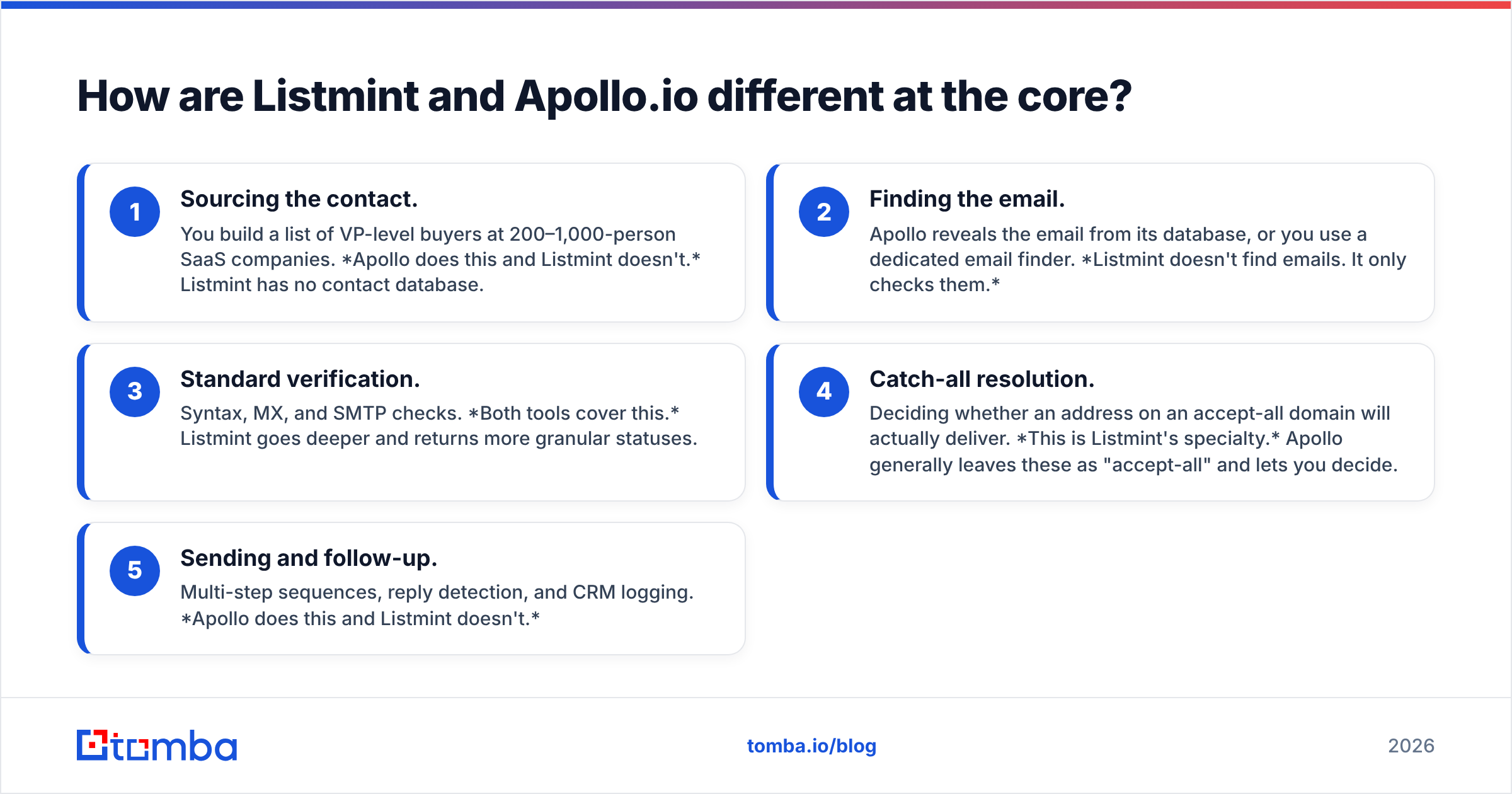
The easiest way to see the difference is to follow a single lead through a typical outbound workflow:
- Sourcing the contact. You build a list of VP-level buyers at 200–1,000-person SaaS companies. Apollo does this and Listmint doesn't. Listmint has no contact database.
- Finding the email. Apollo reveals the email from its database, or you use a dedicated email finder. Listmint doesn't find emails. It only checks them.
- Standard verification. Syntax, MX, and SMTP checks. Both tools cover this. Listmint goes deeper and returns more granular statuses.
- Catch-all resolution. Deciding whether an address on an accept-all domain will actually deliver. This is Listmint's specialty. Apollo generally leaves these as "accept-all" and lets you decide.
- Sending and follow-up. Multi-step sequences, reply detection, and CRM logging. Apollo does this and Listmint doesn't.
So Apollo covers steps 1, 2, 3, and 5, and does step 4 lightly. Listmint covers steps 3 and 4 in depth and nothing else. They are only competitors on step 3.
Listmint vs Apollo.io: how do the features compare side by side?#
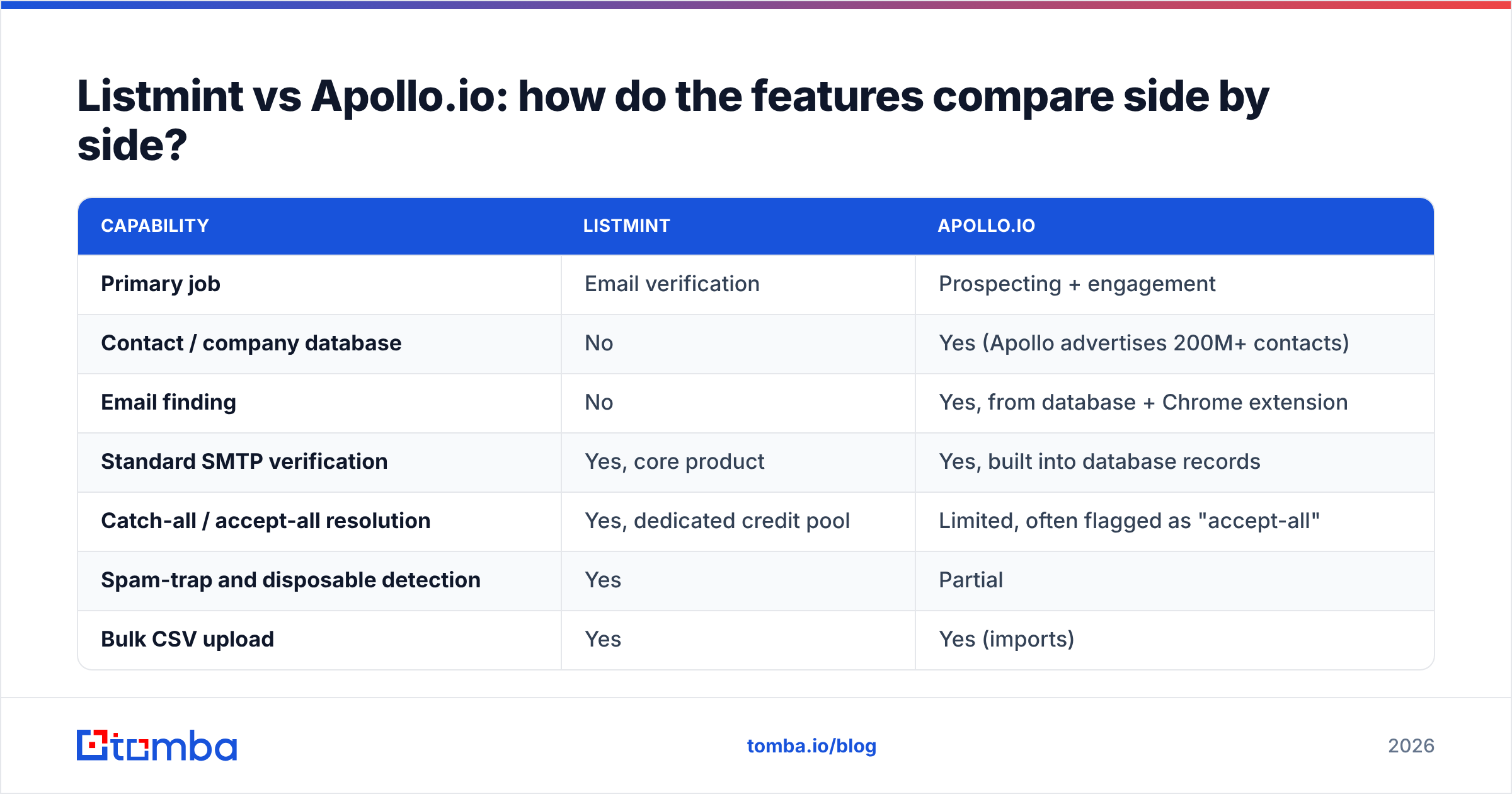
| Capability | Listmint | Apollo.io |
|---|---|---|
| Primary job | Email verification | Prospecting + engagement |
| Contact / company database | No | Yes (Apollo advertises 200M+ contacts) |
| Email finding | No | Yes, from database + Chrome extension |
| Standard SMTP verification | Yes, core product | Yes, built into database records |
| Catch-all / accept-all resolution | Yes, dedicated credit pool | Limited, often flagged as "accept-all" |
| Spam-trap and disposable detection | Yes | Partial |
| Bulk CSV upload | Yes | Yes (imports) |
| Real-time verification API | Yes | Via broader Apollo API |
| Email sequencing | No | Yes |
| Dialer / phone numbers | No | Yes (phone reveals use extra credits) |
| Chrome extension | No | Yes (LinkedIn, Gmail) |
| Clay integration | Yes, native | Yes |
| Best for | Cleaning lists before sending | Building and working lists end-to-end |
For verification alone, Listmint is the specialist. For everything around verification, Listmint doesn't compete.
How much do Listmint and Apollo.io cost in 2026?#
The two tools use different pricing models, which makes a direct comparison harder.
Listmint charges by verification volume, split across two credit pools. Its public plans (listed on G2's Listmint pricing page and Listmint's own site at the time of writing):
- Starter: $99/month, with 20,000 Standard credits and 5,000 Catch-All credits
- Agency: from $187/month, with 50,000 Standard credits and 10,000 Catch-All credits
- Enterprise: custom
- Pay-as-you-go credits are also available
Apollo.io charges per seat, and credits are included per user:
- Free: limited monthly credits, basic search and sequencing
- Basic: about $49/user/month billed annually (around $59 monthly)
- Professional: about $79/user/month billed annually (around $99 monthly)
- Organization: custom quote, with SSO, advanced controls, and a dedicated CSM
Apollo credits cover email reveals, mobile number reveals (which cost several credits each), and exports. Unused credits don't roll over.
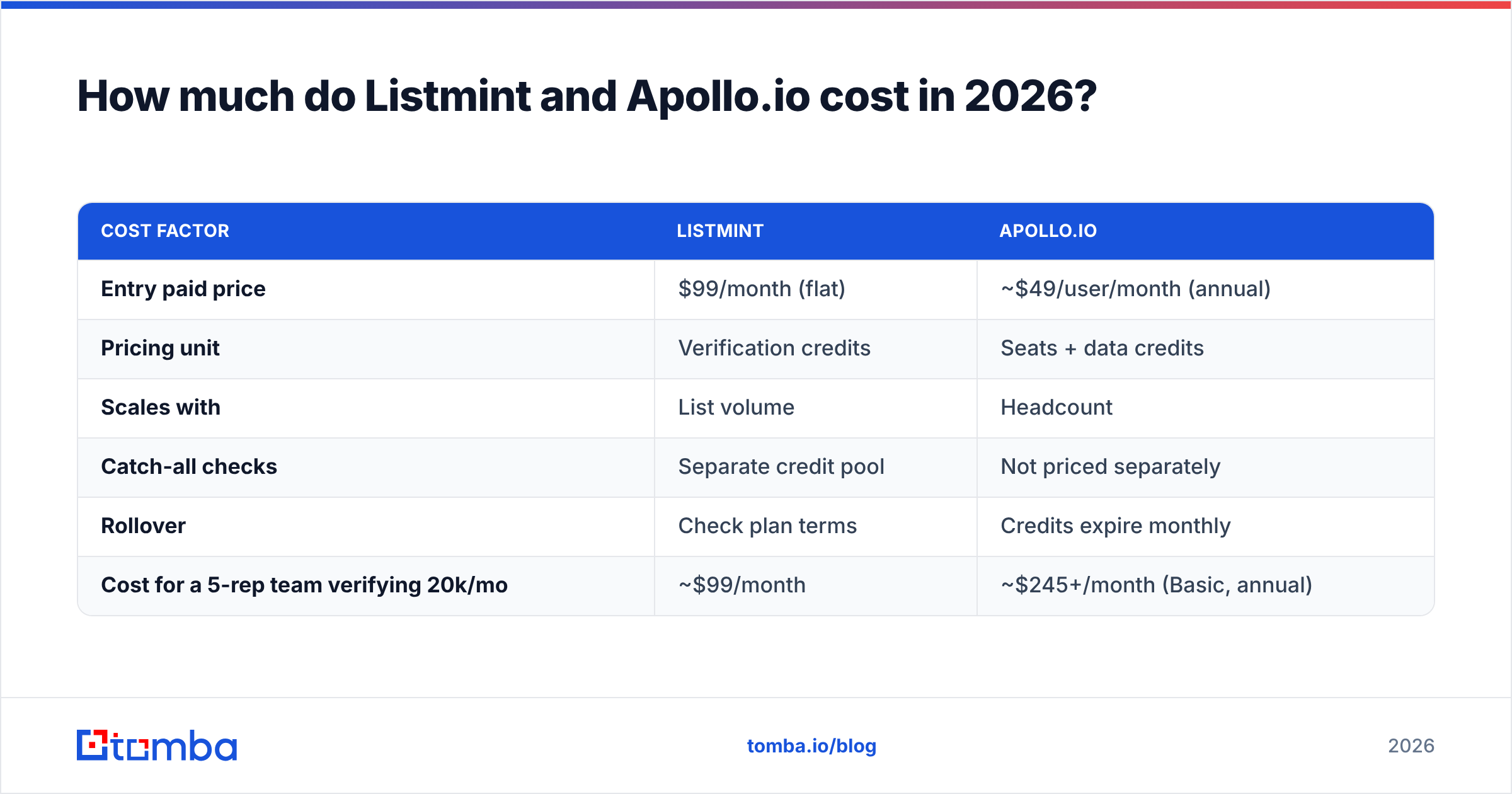
| Cost factor | Listmint | Apollo.io |
|---|---|---|
| Entry paid price | $99/month (flat) | ~$49/user/month (annual) |
| Pricing unit | Verification credits | Seats + data credits |
| Scales with | List volume | Headcount |
| Catch-all checks | Separate credit pool | Not priced separately |
| Rollover | Check plan terms | Credits expire monthly |
| Cost for a 5-rep team verifying 20k/mo | ~$99/month | ~$245+/month (Basic, annual) |
Always confirm current numbers on each vendor's pricing page before you buy. Both companies adjust plans often.
The main point about pricing is that Listmint costs the same whether one person or ten use it, while Apollo's cost grows with every seat you add. For an agency with two operators verifying 100,000 contacts a month for clients, Listmint's model is far more predictable. For a 10-rep sales team that needs data and sequencing, Apollo's per-seat cost buys much more than verification.
Is Listmint more accurate than Apollo.io's built-in verification?#
For catch-all addresses, a dedicated catch-all verifier will usually return a more decisive answer than Apollo's built-in status, simply because it spends more effort per address. That's the main reason Listmint exists. It reports 99%+ accuracy on over a billion verified emails. Treat that as a vendor claim and test it on your own data.
For standard, non-catch-all addresses, the gap narrows. Apollo's verification runs SMTP checks and refreshes records over time, so a "verified" Apollo email on a normal domain is usually safe to send to. Where Apollo users get into trouble is:
- Stale records. People change jobs. An email that verified six months ago may now hard-bounce.
- Sending to accept-all contacts in bulk. Apollo lets you include them, and many teams do, and bounce rates rise as a result.
- Imported lists. Contacts you upload from events, scrapes, or other tools don't get the same treatment as native Apollo records.
The practical test is to export 1,000 contacts from Apollo, including the "accept-all" segment, and run them through Listmint or any serious email verifier. If a large share of Apollo's accept-all bucket comes back undeliverable, adding a second verification layer will pay for itself in protected sender reputation. If most come back valid, you may be fine with Apollo alone.
When should you choose Listmint?#
Pick Listmint if most of these apply to you:
- You already have a data source. You pull contacts from Apollo, ZoomInfo, Clay, LinkedIn Sales Navigator, or client-supplied lists, and you only need them cleaned.
- Catch-all domains make up a large part of your list. Enterprise and mid-market targets often use accept-all configurations, and throwing those addresses away costs you pipeline.
- You run an agency. You're verifying lists for many clients, and volume-based pricing beats paying per seat.
- You work in Clay. Listmint's native integration makes it a simple step in a Clay waterfall.
- Deliverability is your bottleneck. Your copy and targeting are fine, but you keep burning domains on bounces.
What you won't get from Listmint: prospect data, email finding, sequencing, or phone numbers. You'll still need other tools for those.
When should you choose Apollo.io?#
Pick Apollo if most of these apply:
- You're starting outbound from scratch. You need a database, a way to find emails, and a way to send, all in one login.
- You're a small team on a budget. One or two reps on Basic cost less than most standalone data tools combined with a separate sequencer.
- Your reps prospect inside LinkedIn. Apollo's Chrome extension is a big part of its daily value.
- Your targets are mostly on standard domains. SMB and startup lists hit catch-all domains less often, so Apollo's built-in verification covers more of your list.
- You want sequences and data in one place. Keeping everything in one platform saves RevOps time on integrations.
If you're weighing Apollo against other prospecting platforms rather than against verifiers, see this breakdown of Apollo.io alternatives.
Can you use Listmint and Apollo.io together?#
Yes. For many outbound teams in 2026, this is the most common setup:
- Source and find in Apollo. Build your list with Apollo's filters and reveal emails.
- Export everything, including accept-all contacts. Don't filter them out yet.
- Run the export through Listmint. Standard credits cover the regular addresses, and Catch-All credits resolve the accept-all segment.
- Re-import only "valid" results into your sequencer. That can be Apollo's own sequences, or tools like Instantly or Smartlead.
- Re-verify before each new campaign. Anything older than about 60–90 days should go through verification again.
This gives you Apollo's data coverage with verification designed for catch-alls. The downside is cost and complexity. You pay two vendors, maintain an export/import loop, and have to decide who owns list hygiene.
Is there a simpler option that finds and verifies in one place?#
If the Apollo-plus-Listmint setup feels like too much, you have a middle option: a dedicated email finder that includes verification, including catch-all checks, without Apollo's per-seat sequencing platform.
Tomba is one such tool. It works on a different model from both products in this comparison:
- It finds emails by domain, name, or company, like Apollo's reveal, but as a standalone finder rather than a full engagement suite.
- It verifies them, with a dedicated catch-all verifier for accept-all domains.
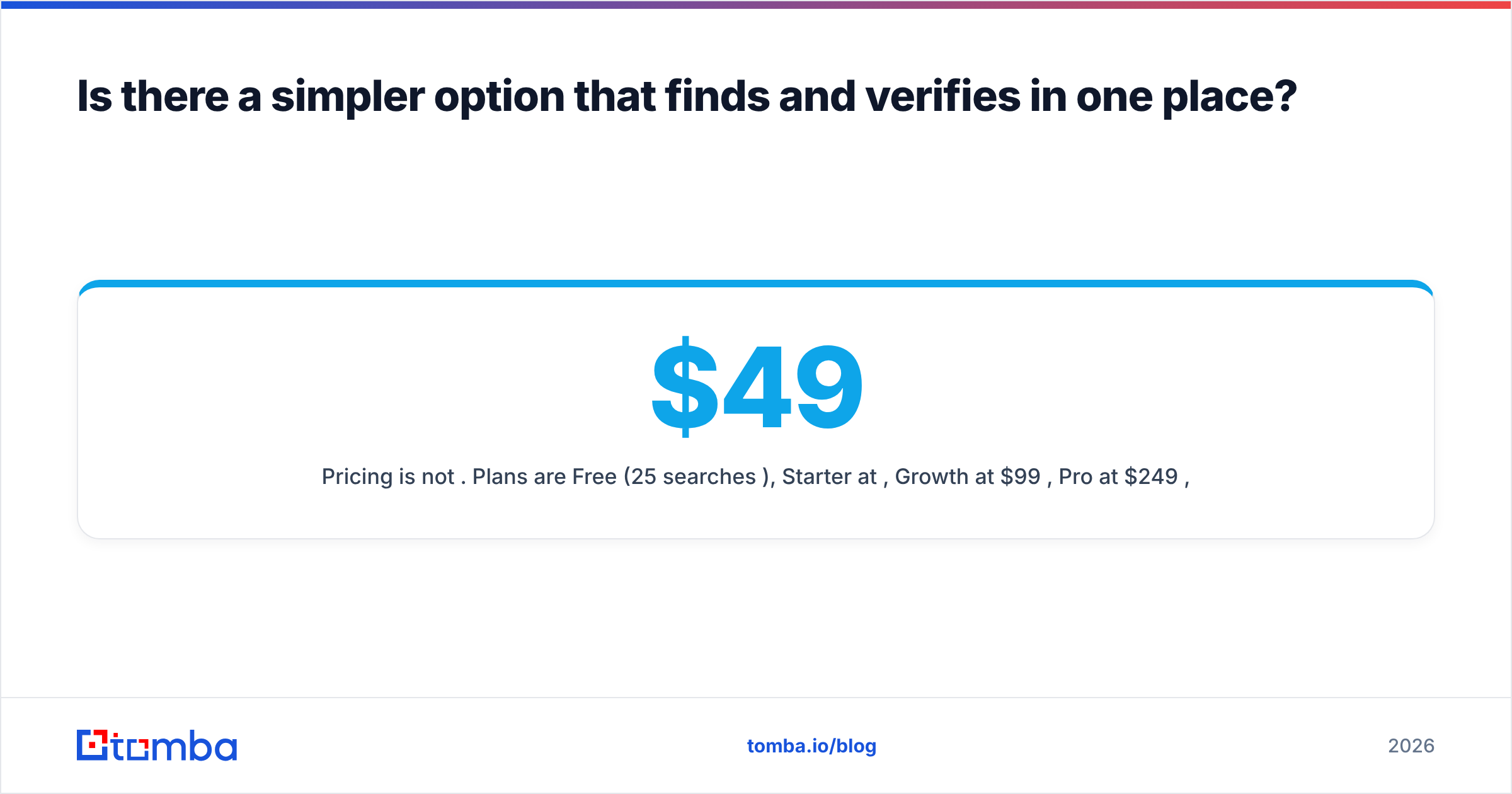
- Pricing is not per seat. Plans are Free (25 searches/month), Starter at $49/month, Growth at $99/month, Pro at $249/month, and Enterprise at a custom price.
This isn't a direct replacement for either tool. If you need a sequencer and a dialer, Apollo still does more. If you verify millions of addresses a month from outside sources, a volume-focused verifier like Listmint may still be the better fit. But for teams whose actual need is "find the right email and make sure it won't bounce," one tool can replace two.
Listmint vs Apollo.io: which should you pick?#
| Your situation | Best fit |
|---|---|
| New to outbound, need data + sending | Apollo.io |
| Agency cleaning client lists at volume | Listmint |
| Enterprise targets with many catch-all domains | Listmint (alongside a data source) |
| Small team, SMB targets, tight budget | Apollo.io Basic |
| Building enrichment waterfalls in Clay | Listmint |
| Need to find + verify emails without a full sales suite | A finder with built-in verification (e.g. Tomba) |
| High bounce rates from Apollo exports | Apollo + Listmint together |
Our pick: If you're choosing only one and you have no data source yet, choose Apollo.io, because you can't verify emails you don't have. If you already have plenty of contacts and bounces are hurting your domains, choose Listmint, because catch-all resolution is the gap Apollo leaves open. Mature outbound teams often end up running both.
Frequently asked questions#
Does Listmint find email addresses? No. Listmint only verifies addresses you give it. You need a separate source, such as Apollo, a database, or an email finder, to get the emails.
Does Apollo.io verify catch-all emails? Apollo flags catch-all addresses, usually as "accept-all" or unverified, but it doesn't resolve them as thoroughly as a dedicated catch-all verifier.
Is Listmint cheaper than Apollo.io? It depends on team size. Listmint starts at $99/month no matter how many people use it. Apollo starts at about $49 per user per month on annual billing. A single user is cheaper on Apollo, and a larger team verifying at volume is often cheaper on Listmint.
Can Listmint integrate with Apollo? There's no deep native sync. The usual workflow is export from Apollo, verify in Listmint (by CSV, API, or Clay), and re-import the valid contacts.
Ready to find and verify emails in one step?#
If what you actually need is accurate contact emails that won't bounce, without paying per seat for a full engagement platform, try Tomba Email Finder. Search by domain, name, or company, verify results in the same workflow (catch-all domains included), and start on the free plan with 25 searches a month. When you're ready to scale, compare Tomba plans against what you're paying for Apollo and a separate verifier today.
Related guides#
Ready to find emails that actually work?
Join 150,000+ professionals who stopped guessing and started sending. Free credits on signup — no credit card required.
Get the Tomba newsletter
Practical outbound tactics and product updates — once every two weeks.
About the author