Logvalid vs Apollo.io (2026): Email Verifier or Sales Platform?
Logvalid cleans email lists you already have. Apollo.io finds new contacts and sequences them. We compare pricing, data, verification depth and fit so you can pick the right tool, or the right pair.
TL;DR
- Logvalid and Apollo.io do different jobs. Logvalid is a pay-as-you-go email verifier. Apollo.io is a sales intelligence and engagement platform that finds contacts, enriches them, and runs sequences.
- Buy Logvalid if you already have a list and need to remove invalid, disposable and risky addresses before you send. Listed pricing starts at $1 for 2,000 credits, and there is a free plan with 500 credits.
- Buy Apollo.io if you need new leads plus outreach in one seat. Paid plans run from $49 to $119 per user per month on annual billing, and the credit limits cost more than the headline price suggests.
- Many teams use both: Apollo to source contacts, then a dedicated verifier to re-check the export before a cold campaign.
- Do you only need emails and verification, without a full sequencer? Then a focused finder-plus-verifier such as Tomba usually costs less than an Apollo seat.
What is Logvalid, and what is Apollo.io?#
Most "vs" comparisons put two tools with the same job side by side. This one doesn't, and that matters more than any single feature.
Logvalid is an email verification service. You upload a list or call its API, and it tells you which addresses are valid, invalid, disposable, or likely to hurt your sender reputation. Its Capterra listing describes real-time validation, spam-trap detection, free vs. professional email classification, and bulk import/export. It does not find new contacts.
Apollo.io is a B2B database with a prospecting and engagement layer on top. You search for people by title, industry, headcount and technology, reveal their emails and phone numbers, push them into sequences, and track replies. Apollo verifies emails as part of that workflow, but verification is one feature inside a much larger product.
So "Logvalid vs Apollo" usually comes down to one of three questions:
- Which one do I need at all?
- If I already pay for Apollo, do I still need a separate verifier?
- Is there a cheaper way to get Apollo's contact data without the full platform?
The rest of this post answers all three.
How do Logvalid and Apollo.io compare side by side?#
Here is the short version, based on public listings and vendor pricing pages as of 2026. Vendors change prices and credit rules often, so check both sites before you buy.
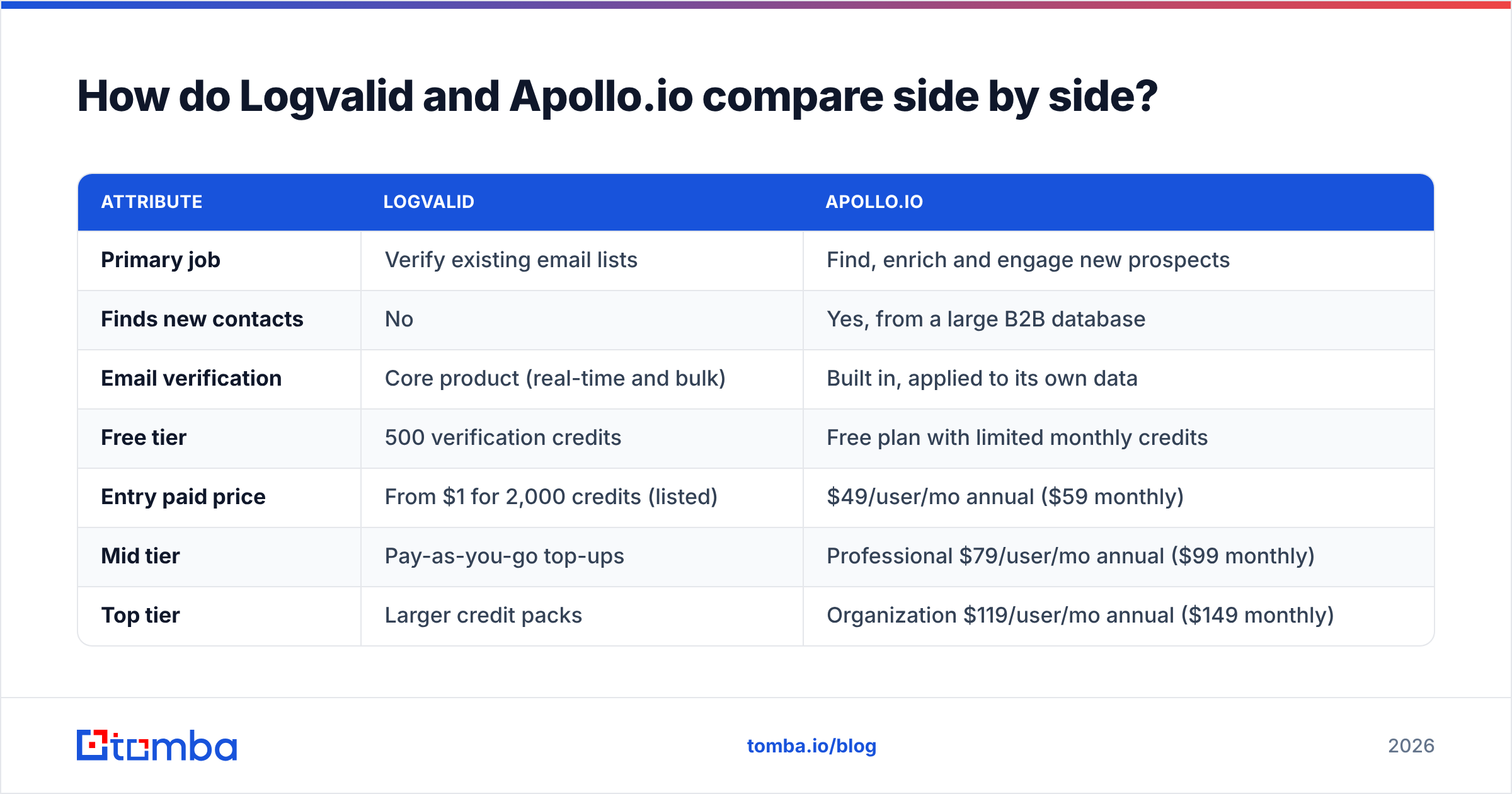
| Attribute | Logvalid | Apollo.io |
|---|---|---|
| Primary job | Verify existing email lists | Find, enrich and engage new prospects |
| Finds new contacts | No | Yes, from a large B2B database |
| Email verification | Core product (real-time and bulk) | Built in, applied to its own data |
| Free tier | 500 verification credits | Free plan with limited monthly credits |
| Entry paid price | From $1 for 2,000 credits (listed) | $49/user/mo annual ($59 monthly) |
| Mid tier | Pay-as-you-go top-ups | Professional $79/user/mo annual ($99 monthly) |
| Top tier | Larger credit packs | Organization $119/user/mo annual ($149 monthly) |
| Pricing model | Usage-based, per check | Per seat plus credits (email, mobile, export) |
| Sequencing / outreach | No | Yes, multichannel sequences and dialer |
| API | Yes, single and bulk validation | Yes, gated by plan |
| Best for | Marketers, ecommerce and SaaS cleaning lists | SDR teams that want one tool for data and outreach |
The table shows the main point. Logvalid charges you for checks. Apollo charges you for seats plus data access. They sit on different lines of the budget.
What problem does each tool actually solve?#
Consider the four jobs a B2B outbound motion needs done. Each tool covers some of them.
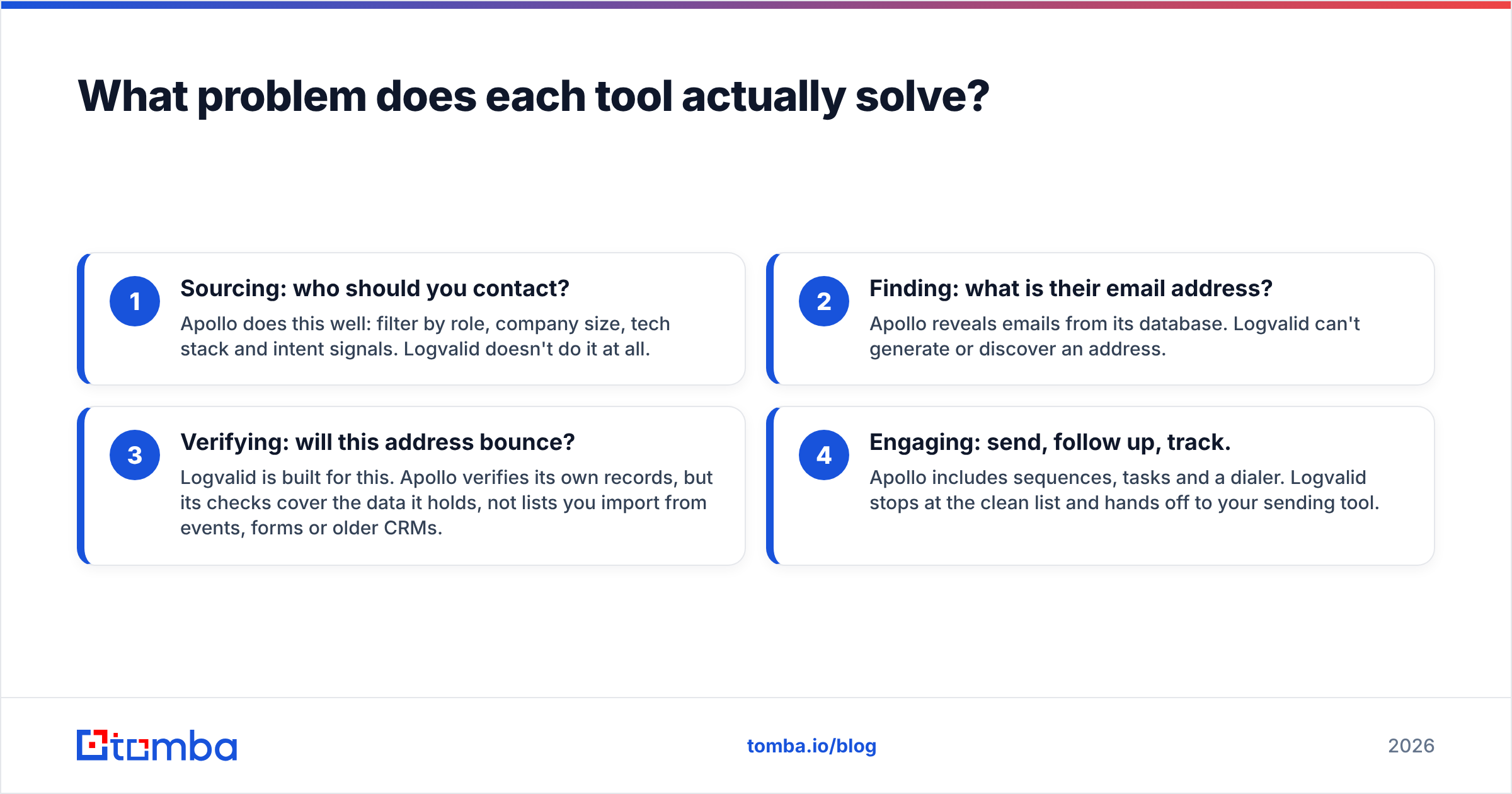
- Sourcing: who should you contact? Apollo does this well: filter by role, company size, tech stack and intent signals. Logvalid doesn't do it at all.
- Finding: what is their email address? Apollo reveals emails from its database. Logvalid can't generate or discover an address.
- Verifying: will this address bounce? Logvalid is built for this. Apollo verifies its own records, but its checks cover the data it holds, not lists you import from events, forms or older CRMs.
- Engaging: send, follow up, track. Apollo includes sequences, tasks and a dialer. Logvalid stops at the clean list and hands off to your sending tool.
If you need jobs 1, 2 and 4 in one login, Apollo is the obvious candidate. If you only need job 3, paying for an Apollo seat to clean a newsletter list makes no sense.

Is Logvalid more accurate than Apollo.io at verification?#
The honest answer is that nobody can give you a clean head-to-head number. Apollo doesn't sell verification as a standalone product, so no benchmark compares "Apollo verification" with "Logvalid verification" on the same list.
What you can compare is how each one verifies and when.
- Logvalid checks at send time. You run the list right before a campaign, so the result reflects the mailbox's state that day. That matters because B2B data decays quickly as people change jobs, and addresses that were valid last quarter start bouncing.
- Apollo checks at data time. An email marked "verified" in Apollo was verified at some point before you exported it. By the time it reaches your sequence, days or weeks may have passed.
- Catch-all domains are the hard case for everyone. When a company's mail server accepts every address, no SMTP check can confirm a specific mailbox. Look at how each tool labels these ("accept-all", "risky", "unknown") and decide whether you'll send to them. Logvalid's public materials focus on invalid, disposable and spam-trap detection. If catch-all handling matters to you, test it on a sample of your own list before committing.
The usual pattern among outbound teams: treat database "verified" labels as a starting signal, not a guarantee, and re-verify exports before any cold send. That's why so many Apollo users also pay for a standalone email verifier.
How much do Logvalid and Apollo.io really cost?#
Logvalid pricing#
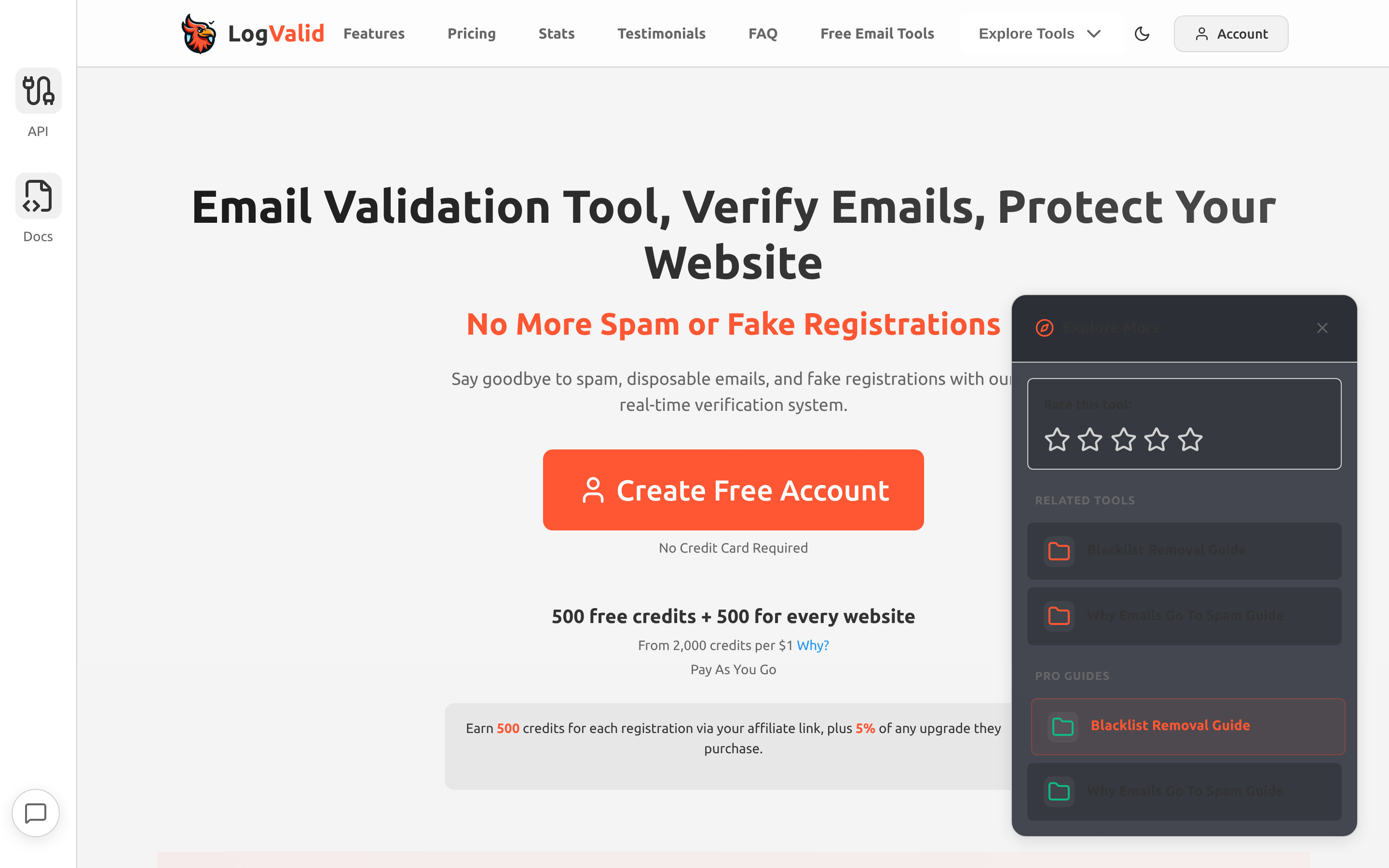
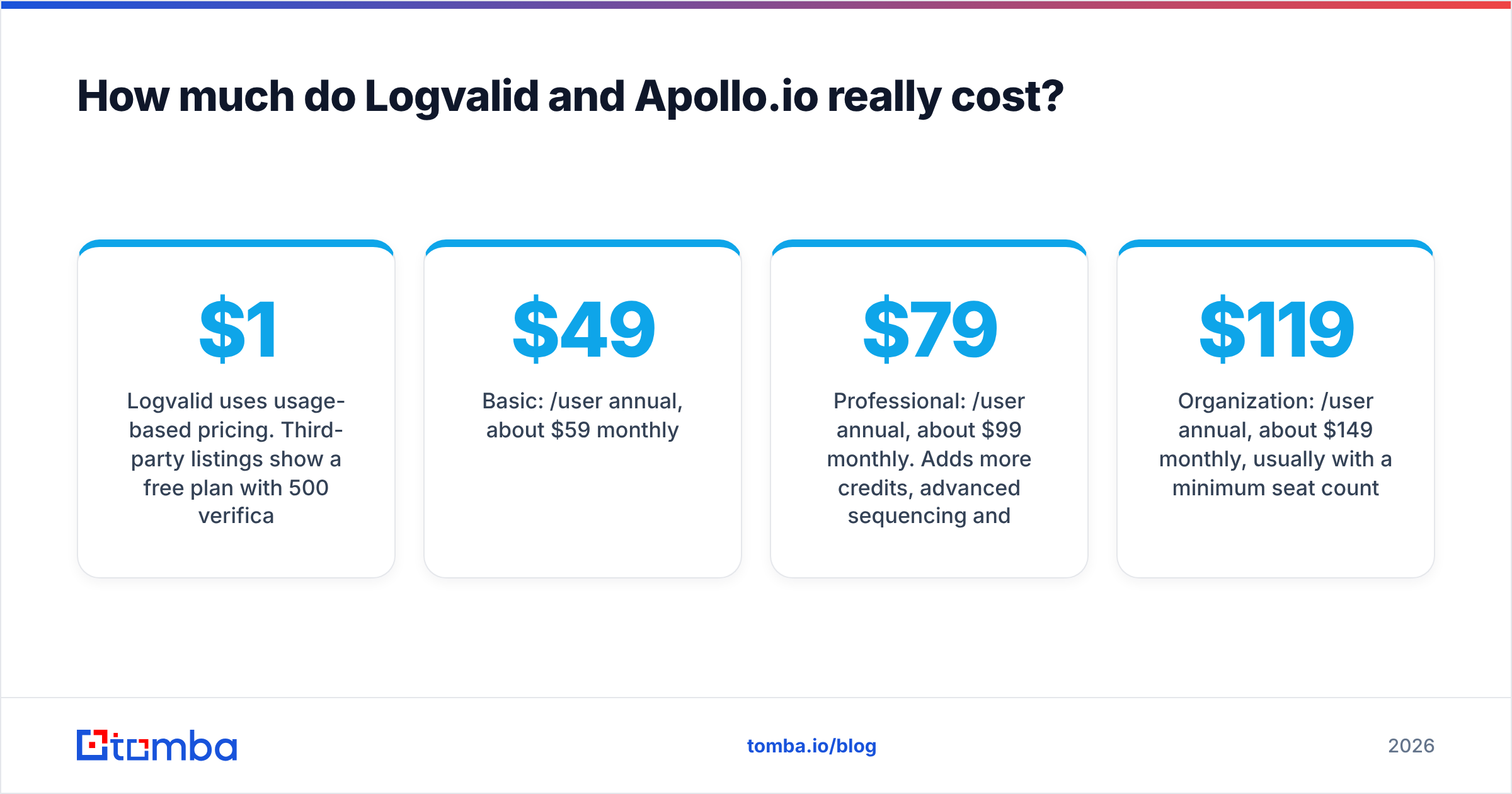
Logvalid uses usage-based pricing. Third-party listings show a free plan with 500 verification credits, and paid credits start at $1 for 2,000 checks. Per-check pricing like this scales with list size, not headcount, so a two-person marketing team and a 50-person sales team pay the same rate for the same volume.
Confirm the current price list on the vendor site. Pay-as-you-go verifiers adjust pack sizes and discounts often.
Apollo.io pricing#
Apollo's 2026 public tiers:
- Free: limited monthly credits, basic search and a capped number of sequences.
- Basic: $49/user/month annual, about $59 monthly.
- Professional: $79/user/month annual, about $99 monthly. Adds more credits, advanced sequencing and intent signals.
- Organization: $119/user/month annual, about $149 monthly, usually with a minimum seat count.
The headline number isn't the whole cost. Apollo meters email reveals, mobile numbers and exports through credits. Credits typically reset each month and don't roll over. Several features also sit behind the higher tiers. A five-rep team on Professional pays close to $4,800 a year before any extra credit purchases.
What does that mean for your budget?#
If your monthly need is "verify 20,000 addresses," Logvalid-style pricing costs single-digit dollars. If your need is "find 1,000 new decision-makers and email them," Logvalid can't do it at any price, and Apollo's per-seat model starts to make sense.
When should you choose Logvalid?#
Pick Logvalid, or a comparable standalone verifier, when:
- You already own the list. Webinar sign-ups, trade-show scans, a newsletter, or an old CRM export you're afraid to mail.
- You need to protect sender reputation cheaply. A bounce rate above roughly 2% can start to damage sender reputation, and a cheap verification pass prevents that.
- You need real-time validation on forms. Logvalid's API can check addresses at sign-up so bad data never enters your system.
- You're not running outbound prospecting. Ecommerce, SaaS onboarding and nonprofit lists need clean data, not a B2B contact database.
Where it falls short: it can't tell you who to contact or what their address is. If your pipeline depends on reaching people who aren't already on your list, you need something else upstream.
When should you choose Apollo.io?#
Pick Apollo when:
- You run outbound at volume and want sourcing, enrichment and sequencing under one login.
- Your reps live in the tool all day. Apollo's value grows with daily use: saved searches, sequence analytics, task queues.
- You want phone numbers and intent data alongside emails.
- You can afford per-seat pricing and have someone to manage credit consumption.
Where it falls short: you pay for the whole platform even if you only use the database. Its verification also reflects when the data was collected, not the moment you send. Reviewers on sites like G2 regularly mention credit limits and data freshness in certain regions and niches. If those limits are what's pushing you away, our breakdown of the Apollo alternative landscape covers other options.

Should you use Logvalid and Apollo.io together?#
For many small outbound teams, yes, and it's a reasonable setup:
- Build the target list in Apollo.
- Export the contacts.
- Run the export through Logvalid (or another verifier) the day before the sequence goes live.
- Drop anything invalid, suppress disposables, and send risky or catch-all addresses in a separate low-volume batch.
- Import the cleaned list back into Apollo or your sending tool.
The weakness is overhead. You're paying for two tools, moving CSVs between them, and reconciling two sets of statuses. Once a team grows past a couple of reps, the manual export-verify-reimport loop is often where data quality slips.
Is there a simpler option than Logvalid plus Apollo?#
It depends on how much of Apollo you actually use. Many teams find they use Apollo mostly to find emails and barely touch sequences, because they already send through Instantly, Lemlist, HubSpot or Outreach. In that case you're paying for a sales platform to get what is really an email-finder workflow.
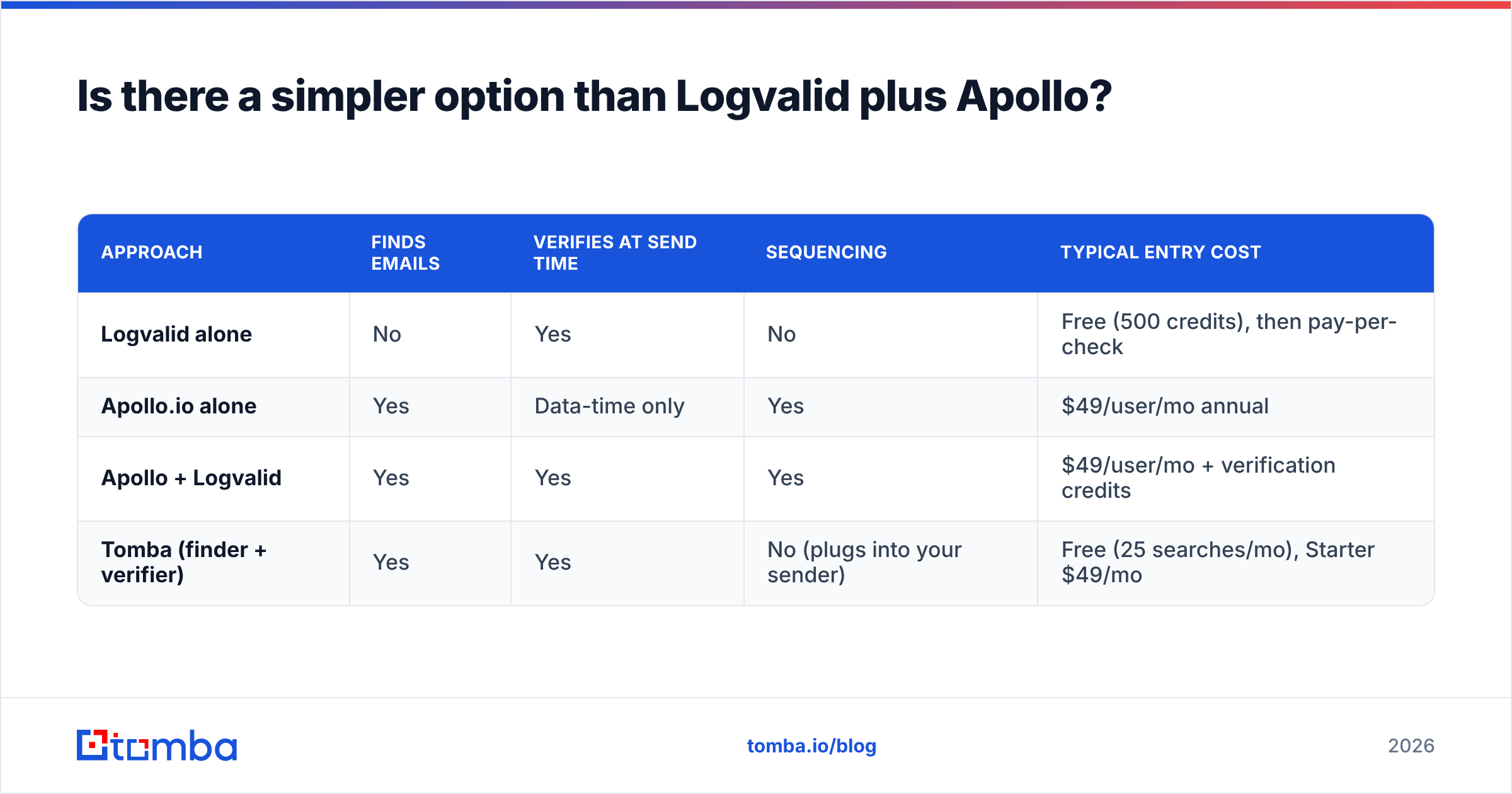
A focused tool that does both finding and verifying can cover most of that ground at lower cost. Here's how the three approaches compare:
| Approach | Finds emails | Verifies at send time | Sequencing | Typical entry cost |
|---|---|---|---|---|
| Logvalid alone | No | Yes | No | Free (500 credits), then pay-per-check |
| Apollo.io alone | Yes | Data-time only | Yes | $49/user/mo annual |
| Apollo + Logvalid | Yes | Yes | Yes | $49/user/mo + verification credits |
| Tomba (finder + verifier) | Yes | Yes | No (plugs into your sender) | Free (25 searches/mo), Starter $49/mo |
Tomba's pricing is per account, not per seat: Free (25 searches/month), Starter $49/month, Growth $99/month, Pro $249/month, and custom Enterprise. That's a different model from Apollo's per-user billing, so it tends to work out cheaper for teams where several people share a prospecting budget.
This doesn't mean Tomba replaces Apollo for everyone. If your reps need intent data, a dialer and multichannel sequences in one place, Apollo is built for that. But if your real workflow is "find the right address, confirm it won't bounce, send from the tool I already use," a finder-plus-verifier covers it.
Which should you pick in 2026?#
Use this quick decision guide:
- You have a list and need it clean → Logvalid. Cheap, usage-based, built for the job.
- You need new prospects and a full outreach stack for a sales team → Apollo.io. Budget for seats and credits, and re-verify exports before cold sends.
- You need both, and the team is small → Apollo plus a standalone verifier. Accept some CSV shuffling.
- You mostly need to find and verify B2B emails and already have a sending tool → a finder-plus-verifier like Tomba. Fewer tools, no per-seat cost, verification included.
It's a mismatch to compare Logvalid and Apollo as if they competed. The real question is which part of the workflow you're missing, and buying the tool for that part.
Ready to find and verify emails in one step?#
If your Apollo seat mostly turns into CSV exports that you then run through a separate verifier, try consolidating. Tomba Email Finder finds professional email addresses by name, domain or company and verifies them in the same workflow. You can then push clean contacts straight into the CRM or sequencer you already use. Start on the free plan with 25 searches a month and see how your bounce rate compares before you renew another seat.
Related guides#
// get started
Find, verify and enrich your first contacts today
Start on the free plan with 25 searches a month, then scale when your team is ready.
Free plan · No credit card required · GDPR & CCPA
// about the author