Mailead vs Apollo.io (2026): Which Outreach Stack Fits Your Team?
Mailead is a cheap, send-first cold email platform. Apollo.io is a contact database with outreach built on top. Here's how they compare on pricing, data, deliverability, and which team should buy which.
Mailead vs Apollo.io comes down to one question: do you need a cheap way to send, or a place to find leads? Here's the short answer, then the details.
TL;DR
- Mailead is mainly a cold email sending platform. It offers unlimited mailboxes, warmup, inbox rotation, and a shared inbox. Third-party listings put its entry plan at about $19/month. Its lead data is a small extra, not the core product.
- Apollo.io is mainly a B2B contact database. Sequences, a dialer, and enrichment sit on top. It costs $49 to $119 per user per month on annual billing, plus credits.
- If you already have lists and need cheap sending at volume, pick Mailead. If you need to build lists from scratch in one tool, pick Apollo.
- Neither tool removes the need to verify data. Apollo exports still bounce. Mailead can only deliver the addresses you give it.
- A common lean stack is an email finder and verifier for data, plus a flat-priced sender like Mailead. It often costs less than one Apollo seat per rep.
What is the real difference between Mailead and Apollo.io?#
In the Mailead vs Apollo.io debate, the two tools start the same job from opposite ends. That matters more than any feature list.
Mailead starts with the inbox. It's built to send cold email at volume across many mailboxes. The goal is to do that without burning them. So you get warmup, inbox rotation, a shared inbox for replies, and simple sequences. Lead search exists, but it plays a support role.
Apollo.io starts with the database. Its main value is a large set of B2B contacts and companies. You can filter them by title, industry, headcount, tech, and intent. Sequences, a dialer, and CRM sync came later. They keep you in the app once you've built a list.
So the question isn't "which one is better?" It's "which bottleneck do you have: data or delivery?"
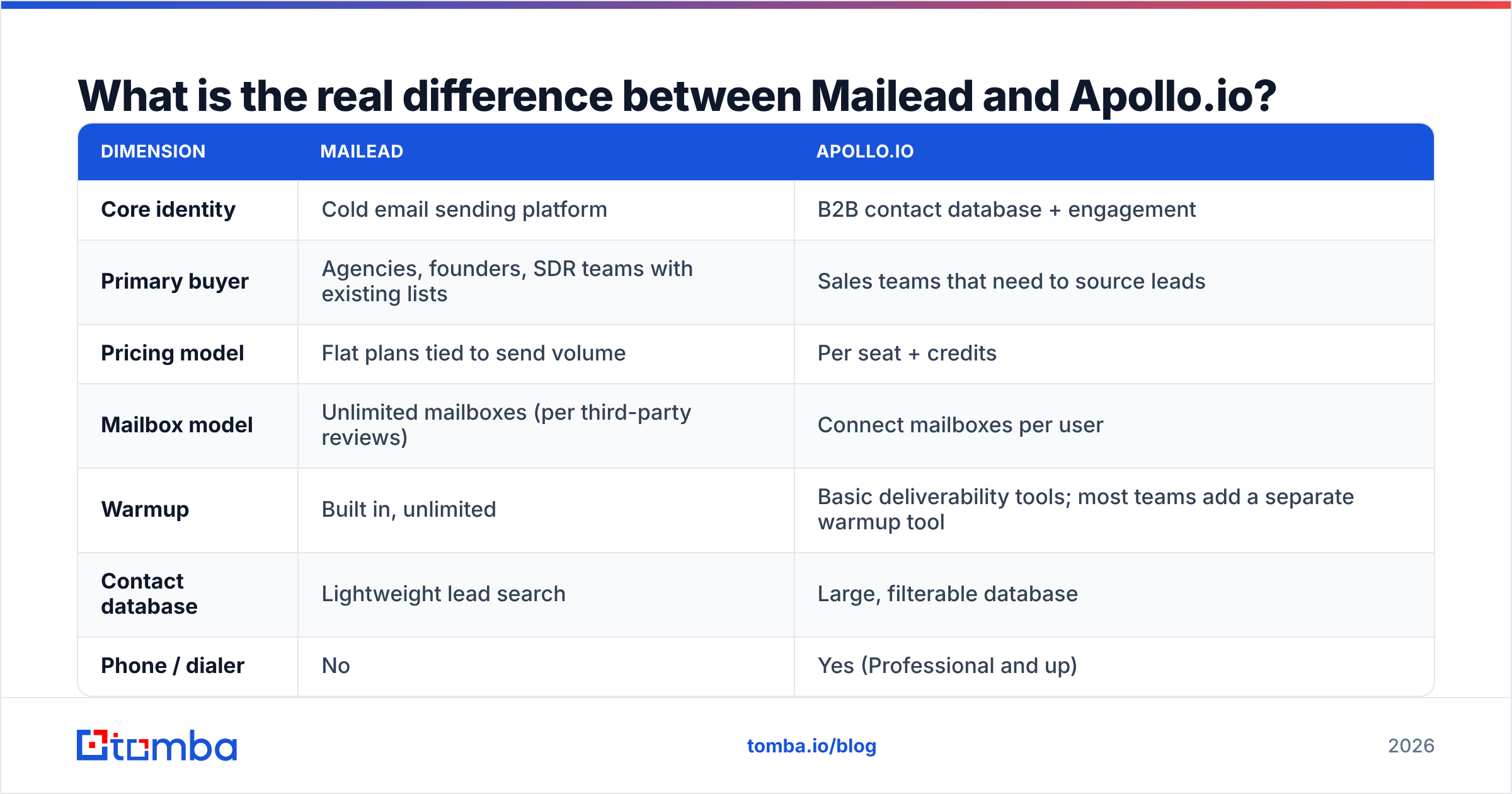
| Dimension | Mailead | Apollo.io |
|---|---|---|
| Core identity | Cold email sender | B2B contact database + outreach |
| Main buyer | Agencies, founders, SDR teams with lists | Sales teams that need leads |
| Pricing model | Flat plans by send volume | Per seat + credits |
| Mailboxes | Unlimited (per third-party reviews) | Per user |
| Warmup | Built in, unlimited | Basic; most teams add a tool |
| Contact data | Light lead search | Large, filterable database |
| Phone / dialer | No | Yes (Professional and up) |
| Best at | Cheap volume | Finding prospects |
How does Mailead pricing compare to Apollo.io pricing?#
Price is where Mailead vs Apollo.io splits the most. It's also where many teams get the math wrong.
Mailead charges by sending volume, not by user. A May 2025 review on Woodpecker's blog lists the plans below. Woodpecker is a rival, so read it with that in mind.
- Starter: around $19/month for about 2,000 emails. Unlimited mailboxes and warmup.
- Pro: around $52/month for about 10,000 emails. Adds a CRM.
- Growth: around $112/month for about 100,000 emails.
- Custom: quote-based.
One directory lists much higher prices for the same plan names. Plans in this space change often. Check mailead.io before you budget.
Apollo.io charges per seat. Credits add a second meter on top. Here's what Apollo's pricing page and several 2026 breakdowns show:
- Free: limited credits. Good for testing.
- Basic: $49/user/month annual ($59 monthly).
- Professional: $79/user/month annual ($99 monthly).
- Organization: $119/user/month annual ($149 monthly). Three-seat minimum.
Credits are the catch. Each mobile number reveal uses several credits. Extra packs cost more. Third-party reviews often say active teams pay well above list price. Phone reveals and bulk exports add up fast.
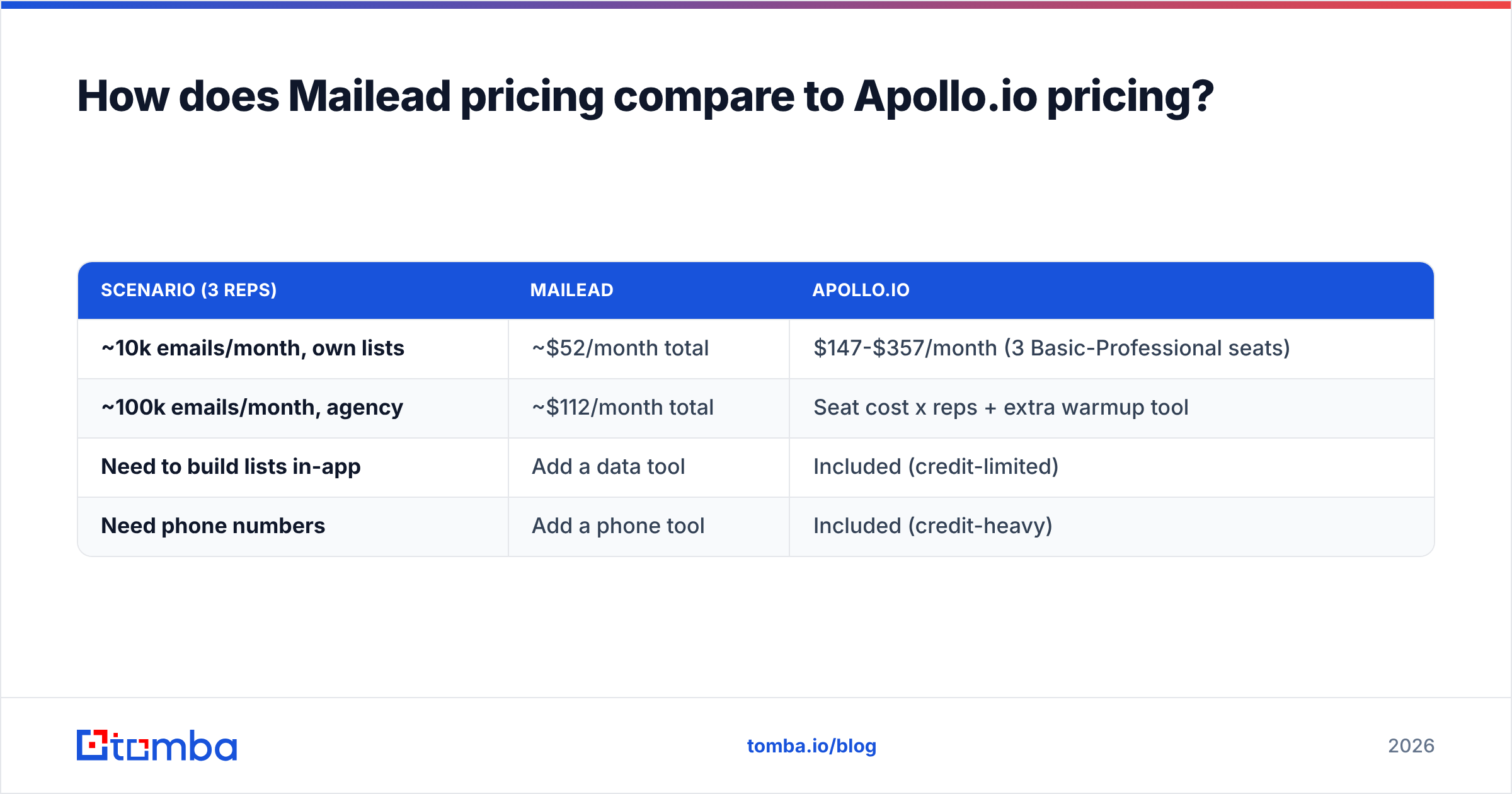
| Scenario (3 reps) | Mailead | Apollo.io |
|---|---|---|
| ~10k emails/month, own lists | ~$52/month total | $147-$357/month (3 seats) |
| ~100k emails/month, agency | ~$112/month total | Seats x reps + warmup tool |
| Build lists in the app | Add a data tool | Included (credit-limited) |
| Need phone numbers | Add a phone tool | Included (uses many credits) |
The pattern is simple. Mailead is cheaper per email sent. Apollo is cheaper per lead found, as long as you stay inside your credits.

Is Apollo.io's data good enough to send to without verifying?#
Usually not. That's no knock on Apollo. Any large, static B2B database decays. People change jobs. Companies rebrand. Catch-all domains accept every address at first, then bounce later. Reviewers on G2 often praise Apollo's reach and filters. Some also mention stale emails in certain segments.
In practice:
- Expect some "verified" contacts to be risky. This is common with startups, small firms, and high-turnover roles.
- Catch-all domains are the blind spot. Apollo may mark them "unverified" or "guessed." Sending to them blindly can hurt a new domain in its first week.
- Re-verify before every campaign. Do this if the list is more than 30 to 60 days old.
Teams that care about email deliverability run Apollo exports through a separate email verifier. They do it before importing into any sender, Apollo's own included.
Is Mailead good for deliverability?#
On paper, yes. That's what it's built for. Mailead's sending tools target the usual causes of cold email burnout:
- Unlimited mailboxes. You can spread volume thin, at 20 to 40 sends per inbox per day, instead of pushing one domain hard.
- Inbox rotation across those mailboxes in one campaign.
- Built-in warmup with no extra fee.
- A shared inbox, so replies from 30 mailboxes don't get lost.
What it can't do is fix bad data. Say you upload a list with an 8% bounce rate. Warmup and rotation will slow the damage, but they won't stop it. Mailbox providers like Google and Microsoft judge you on bounces, spam reports, and replies. They don't care how many inboxes you rotate.
Apollo's sequencer works for low to medium volume from each rep's own inbox. Agencies that send at scale usually pair Apollo data with a separate sender. Common picks are Instantly, Smartlead, Lemlist, or Mailead. Apollo's per-seat model wasn't built for 50-inbox setups.
Mailead vs Apollo.io on deliverability: Mailead has the stronger sending setup. Apollo has the stronger data. Neither covers both well on its own.
What does a typical workflow look like in each tool?#
Apollo.io workflow (all-in-one):
- Filter the database by your ideal customer: title, headcount, industry, tech.
- Reveal emails with credits. Phones cost more credits.
- Add contacts to a sequence with email steps, call tasks, and LinkedIn tasks.
- Sync activity to HubSpot or Salesforce.
- Track replies and meetings in Apollo's reports.
Mailead workflow (bring your own data):
- Build a list somewhere else. Use a database, a domain search on target accounts, LinkedIn, or event lists.
- Verify the list.
- Import it to Mailead. Set up the sequence and mailbox rotation.
- Let warmup and rotation spread the load.
- Work replies from the shared inbox. Move hot leads to your CRM.
Apollo takes fewer steps. Mailead gives you more control and a lower cost per send. But data quality is your job.
Which teams should choose Mailead?#
In a Mailead vs Apollo.io choice, Mailead fits best when:
- You're an agency. You run campaigns for several clients and need lots of mailboxes without paying per seat.
- You already have a data source. That could be a database deal, an email finder, or a client list.
- Volume matters more than features. You want to send 50k+ emails a month at a flat, known cost.
- You don't need a dialer. Your outreach is email-first, maybe with some LinkedIn.
Weak spots to plan for: the lead search is thin next to real databases. There's no built-in calling. The vendor is smaller, so its integrations and support won't match Apollo. Independent user reviews are also rare. Run a real trial before you commit volume.
Which teams should choose Apollo.io?#
On the other side of Mailead vs Apollo.io, Apollo fits best when:
- You're an in-house SDR or AE team. You need to find prospects and contact them in one place.
- You want phone numbers and a dialer next to email.
- CRM hygiene matters. Apollo's HubSpot and Salesforce sync is mature.
- Your target market is broad, mid-market, or enterprise. That's where Apollo's coverage tends to be strongest.
Weak spots to plan for: seat costs climb fast as you hire. Credit limits make phone-heavy prospecting costly. Sending at volume from many inboxes isn't its strength. If per-seat pricing is the dealbreaker, there are solid Apollo alternatives. They split data and sending into separate, cheaper parts.
Is there a cheaper way to get the best of both?#
Yes. Many teams have quietly moved to this setup: one tool for data, one tool for sending.
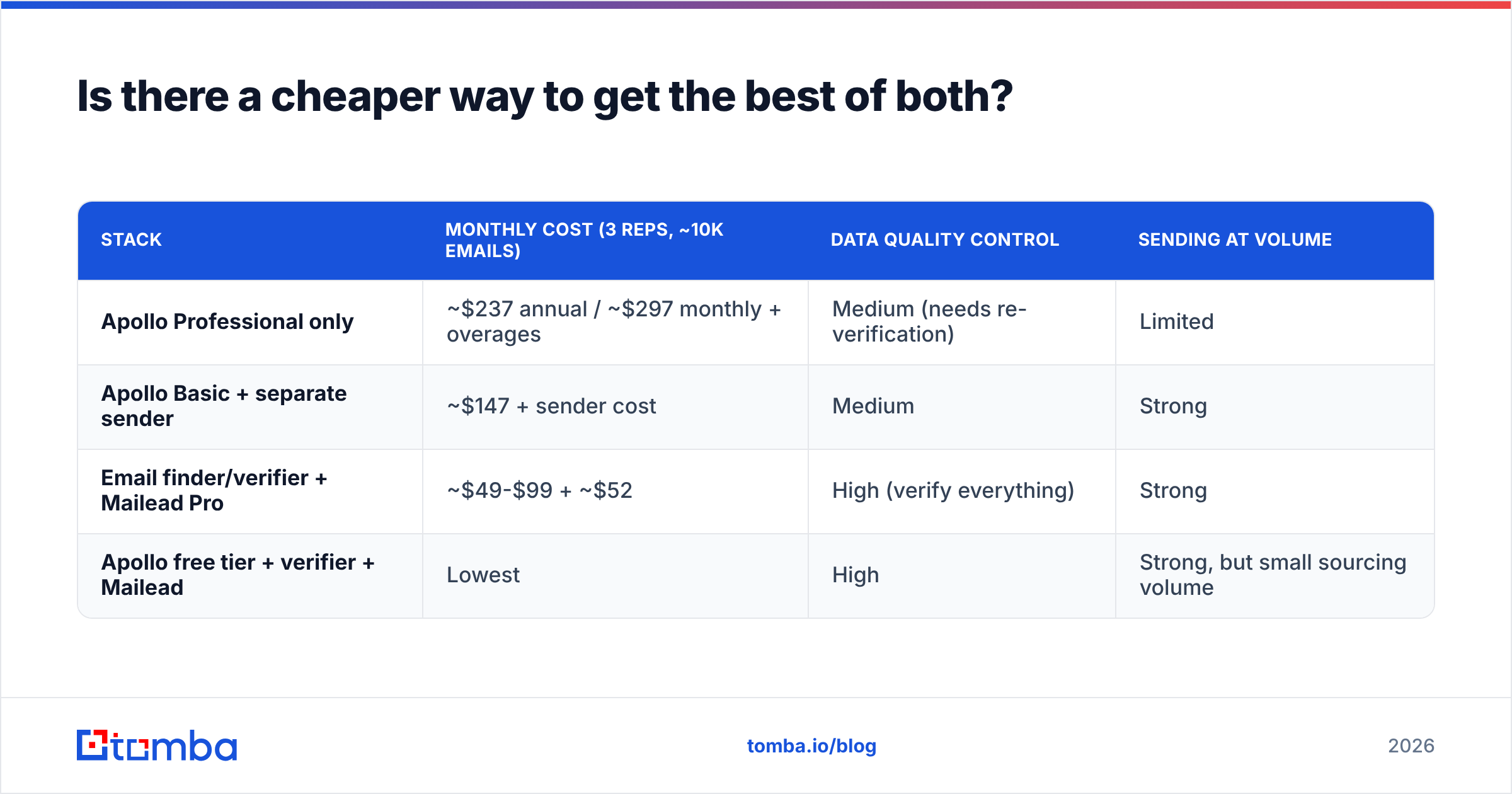
| Stack | Monthly cost (3 reps, ~10k emails) | Data quality | Volume sending |
|---|---|---|---|
| Apollo Professional only | ~$237 annual / ~$297 monthly + extras | Medium (re-verify) | Limited |
| Apollo Basic + sender | ~$147 + sender | Medium | Strong |
| Email finder/verifier + Mailead Pro | ~$49-$99 + ~$52 | High | Strong |
| Apollo free + verifier + Mailead | Lowest | High | Strong, low sourcing |
The third row is the lean option. You find contacts at your target accounts with an email finder. You verify them, catch-alls included. Then you send through a flat-priced tool. You give up Apollo's huge database. But every address you send to was checked that week.
The trade-off is real. Some teams rely on Apollo's filters to find accounts. Think "Series B fintechs using Snowflake with 50 to 200 staff." A domain-based email finder won't replace that. In that case, a hybrid works better. Use Apollo to find accounts, a verifier to clean the list, and a volume sender to deliver.

Mailead vs Apollo.io: what's the final verdict?#
Pick Mailead if delivery is your bottleneck. You have the data, or can buy it. You need to send a lot of email across many inboxes. And you don't want per-seat pricing to eat your margin. It's the pick for agencies and founders.
Pick Apollo.io if sourcing is your bottleneck. Your reps spend their mornings hunting for contacts. You need phone numbers. You'd rather pay per seat for one login than glue three tools together. It's the pick for in-house sales teams.
Pick neither on its own if you care about bounce rates. Apollo's data needs checks before you send. Mailead is only as good as the list you upload.
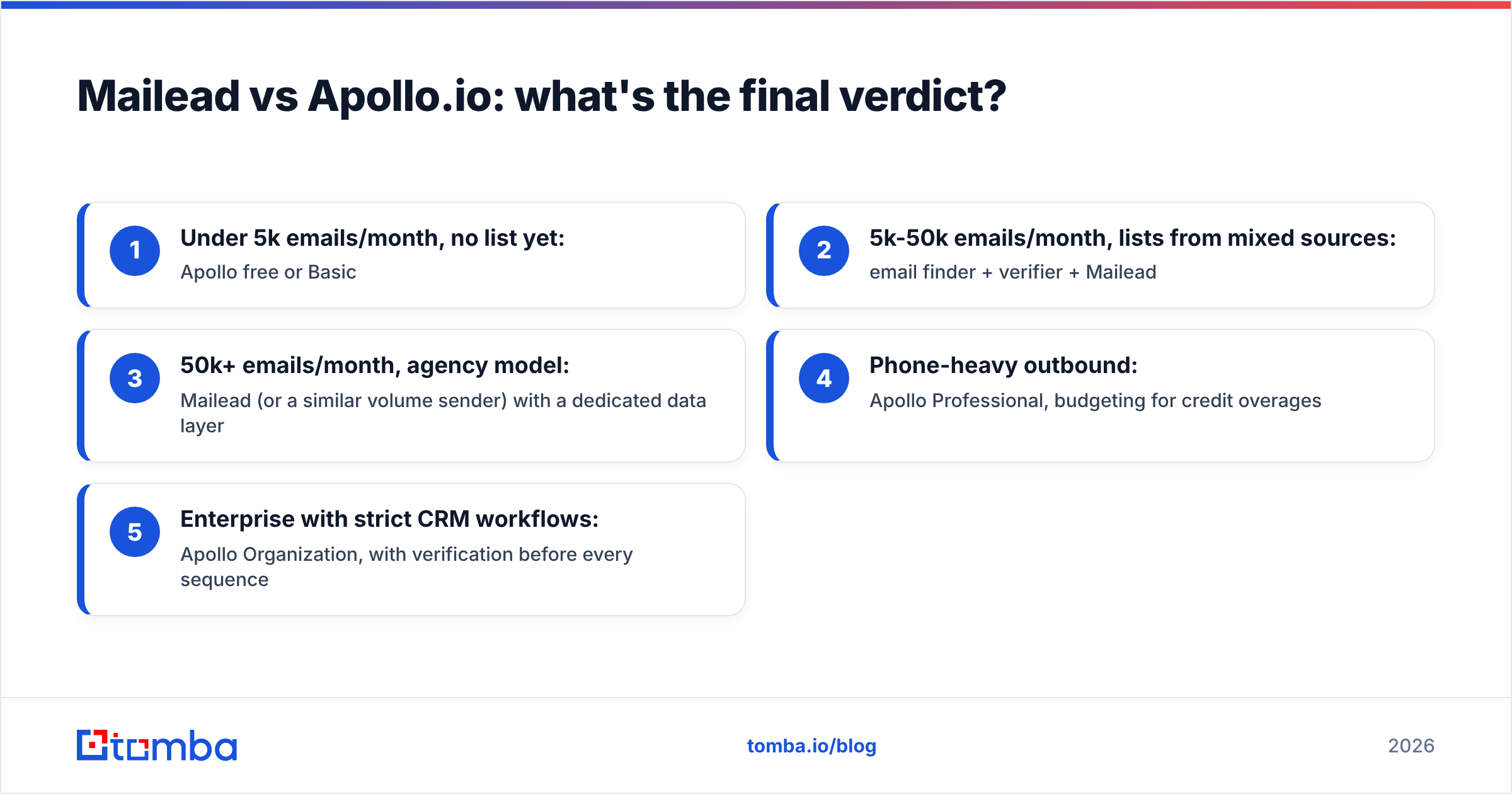
Here's a quick Mailead vs Apollo.io decision guide:
- Under 5k emails a month, no list yet: Apollo Free or Basic.
- 5k to 50k emails a month, lists from mixed sources: email finder + verifier + Mailead.
- 50k+ emails a month, agency model: Mailead or a similar sender, plus a data tool.
- Phone-heavy outreach: Apollo Professional. Budget for extra credits.
- Enterprise with strict CRM rules: Apollo Organization. Verify before every sequence.
Frequently asked questions#
Does Mailead have its own contact database? It has a lead search feature. But third-party listings call it a support tool, not a full B2B database. Most Mailead users bring their own data.
Can I use Apollo data inside Mailead? Yes. Export from Apollo as a CSV, verify the list, and import it into Mailead. This is a common hybrid setup.
Is Apollo.io cheaper than Mailead? Per lead found, often yes, as long as you stay within your credits. Per email sent, Mailead is much cheaper. It doesn't charge per seat.
Which wins on deliverability, Mailead vs Apollo.io? Mailead has the stronger sending setup: unlimited mailboxes, rotation, and warmup. But your real results depend mostly on list quality and domain setup. Neither tool handles that for you.
Whichever way you lean on Mailead vs Apollo.io, clean data is the piece most teams skip. They usually wish they hadn't. Tomba Email Finder finds work email addresses by name, domain, or company. It comes with built-in verification and catch-all checks. So your Mailead or Apollo sequences start with addresses that exist. There's a free tier with 25 searches a month. Paid plans start at $49/month. See the Tomba pricing page to match a plan to your volume.
Related guides#
// start free
See who Tomba finds at any company
Type a company's domain to see its people, their roles and verified work emails, each with the pages it was found on. Free account, no card.
Free plan · No credit card required · GDPR & CCPA
// about the author