C Suite Positions Explained: Roles, Duties, and Who to Reach
A plain-English breakdown of every major C-suite position — what each executive owns, how they make buying decisions, and how to reach the right one without wasting outreach.
The C suite is where budgets get approved and strategies get set. Most of your deals live or die there. Yet many sellers, marketers, and founders treat the C suite positions as one blob of important people. They are not. A CFO and a CTO share almost no goals. Pitch one as if they were the other, and you get ignored fast.
This guide breaks down the major C suite positions in 2026. You will see what each role owns, how each one weighs a purchase, and how to reach the right person. Building an account map? Writing cold email? Planning your own career? Either way, you will leave knowing who does what.
TL;DR#
- C-suite refers to the senior executives whose titles start with "Chief" — CEO, CFO, COO, CTO, CMO, and a growing list of specialists.
- Each executive owns a distinct domain, budget, and set of metrics — the CFO guards cash, the CTO owns the tech, the CMO owns pipeline and brand.
- Selling or reporting to the C-suite means matching your message to their metric, not blasting the same pitch at every "Chief."
- The roster keeps expanding: CRO, CPO, CISO, CDO, and CHRO are now common in mid-market and enterprise orgs.
- To reach them, you need accurate contact data — a verified email finder and phone finder beat scraping a generic
info@inbox every time.
What does "C-suite" actually mean?#
The C-suite is the top layer of management in a company. The "C" stands for "Chief." These leaders are accountable for the direction and results of a whole function — or the whole business.
Think of a company as a large ship. The CEO is the captain who sets the destination. But the captain does not run the engine room, the galley, and the navigation deck. A specialist officer runs each of those, and each one reports up. The C-suite is that group of officers. Each owns one critical system and answers for it.
Two things define a true C-suite position:
- Function-wide accountability — they own an entire domain (finance, technology, marketing), not a single team within it.
- A seat at the strategy table — they help set company direction and control a meaningful budget.
That second point matters if you sell into these accounts. A "VP of Marketing" and a "CMO" may sound alike. But the CMO holds the budget and the board-level accountability. According to Gartner, most executive buying decisions now involve a group of six to ten people. So knowing which chief leads that group is half the battle.

Who are the core C suite positions?#
Almost every company of scale has a handful of foundational roles. These are the ones you'll encounter in nearly every org chart.
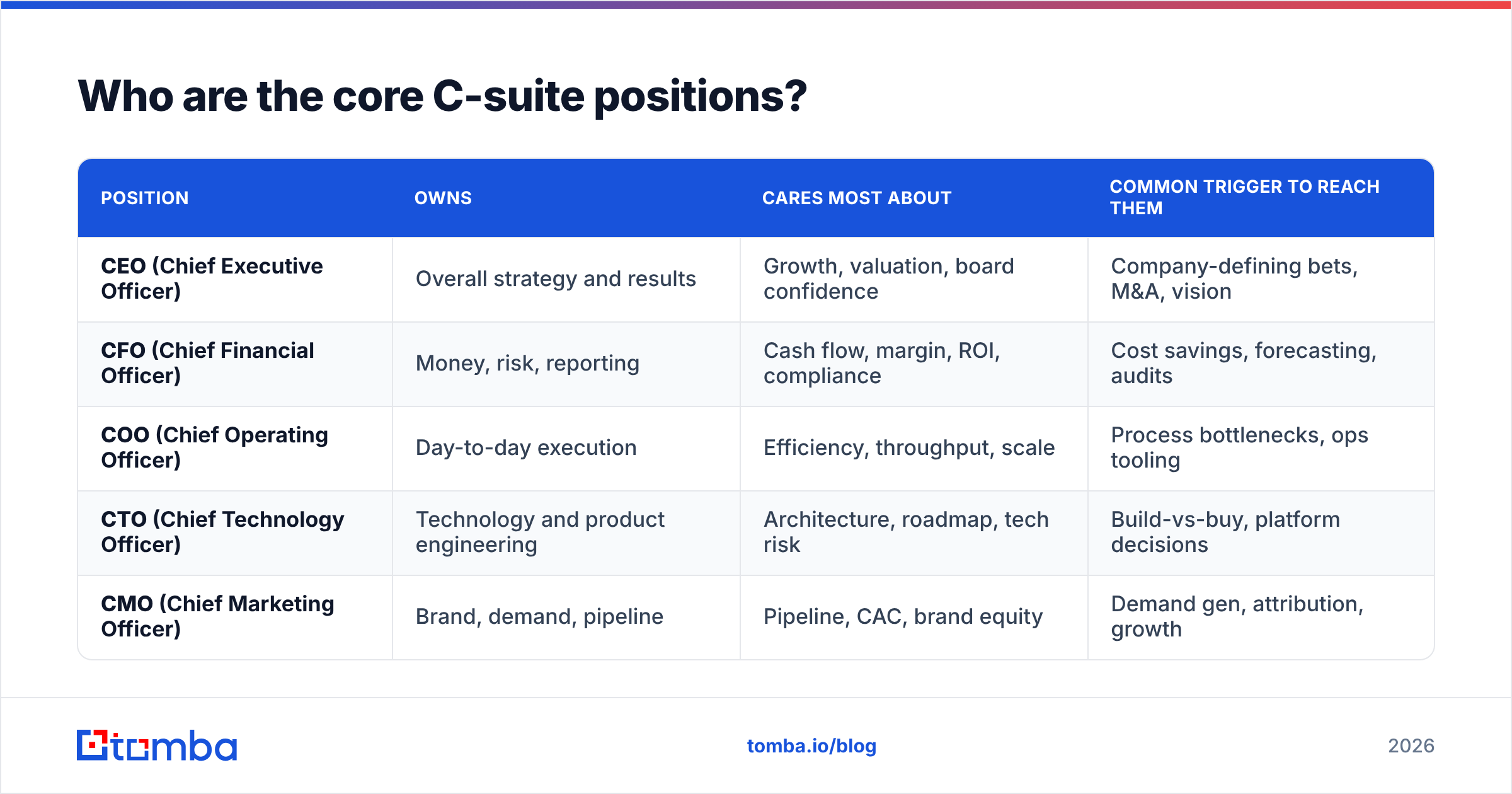
| Position | Owns | Cares most about | Common trigger to reach them |
|---|---|---|---|
| CEO (Chief Executive Officer) | Overall strategy and results | Growth, valuation, board confidence | Company-defining bets, M&A, vision |
| CFO (Chief Financial Officer) | Money, risk, reporting | Cash flow, margin, ROI, compliance | Cost savings, forecasting, audits |
| COO (Chief Operating Officer) | Day-to-day execution | Efficiency, throughput, scale | Process bottlenecks, ops tooling |
| CTO (Chief Technology Officer) | Technology and product engineering | Architecture, roadmap, tech risk | Build-vs-buy, platform decisions |
| CMO (Chief Marketing Officer) | Brand, demand, pipeline | Pipeline, CAC, brand equity | Demand gen, attribution, growth |
The CEO#
The Chief Executive Officer is the top decision-maker and the public face of the company. They set the vision, hire the rest of the C-suite, and answer to the board. CEOs rarely dig into a single purchase. Instead, they set the priorities that shape everyone else's budget. So reach a CEO only when your offer ties to a company-level outcome, such as revenue growth, market position, or real risk. Skip the feature list.
The CFO#
The Chief Financial Officer controls the money and the risk. Per HubSpot's research on the modern buying committee, finance now joins a growing share of B2B deals. That is true for almost any deal over a few thousand dollars a year. The CFO speaks in ROI, payback period, and total cost of ownership. If you cannot put your value in those terms, you lose the room.
The COO#
The Chief Operating Officer runs execution. The CEO decides what and why. The COO owns how: the systems, people, and processes that turn strategy into shipped work. The COO is your ally when your product removes friction, saves time, or helps the team scale without new headcount.
The CTO#
The Chief Technology Officer owns the technology stack. In many companies, they also own the product engineering team. They weigh build-versus-buy, watch security and technical debt, and guard anything that touches infrastructure. Sell to a CTO with clear docs, an email finder API or similar integration story, and honest talk about reliability. Drop the marketing gloss.
The CMO#
The Chief Marketing Officer owns brand, demand generation, and, more and more, the pipeline number. Modern CMOs are measured like revenue leaders. Their metrics are cost to acquire a customer, pipeline contribution, and payback. They buy tools that prove attribution and fill the funnel with qualified marketing qualified leads.
Which C suite positions are newer or specialized?#
A wave of specialist chiefs has joined the classic five as companies grow more complex. These roles are common in mid-market and enterprise firms. Knowing them helps you target the real budget owner instead of defaulting to the CEO.
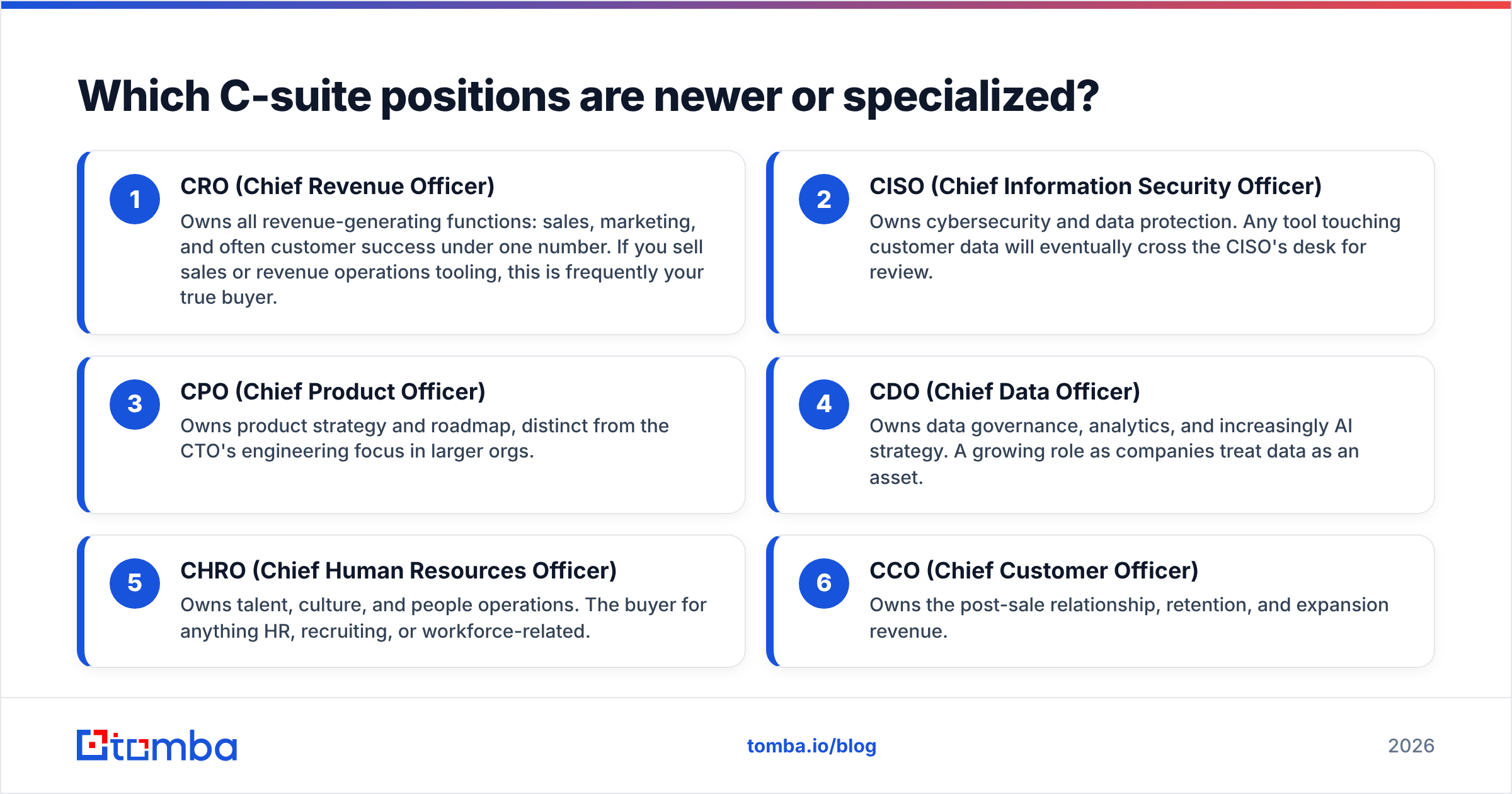
- CRO (Chief Revenue Officer) — Owns all revenue functions: sales, marketing, and often customer success, under one number. If you sell sales or revenue operations tools, the CRO is often your true buyer.
- CISO (Chief Information Security Officer) — Owns cybersecurity and data protection. Any tool touching customer data will eventually cross the CISO's desk for review.
- CPO (Chief Product Officer) — Owns product strategy and roadmap, distinct from the CTO's engineering focus in larger orgs.
- CDO (Chief Data Officer) — Owns data governance, analytics, and increasingly AI strategy. A growing role as companies treat data as an asset.
- CHRO (Chief Human Resources Officer) — Owns talent, culture, and people operations. The buyer for anything HR, recruiting, or workforce-related.
- CCO (Chief Customer Officer) — Owns the post-sale relationship, retention, and expansion revenue.
The lesson is not to memorize every acronym. Title inflation is real. The person with "Chief" in their title may not be the one who signs. Always map the role to the budget and metric your offer touches.

How do you sell to different C suite positions?#
Same product, different pitch. Most outbound teams write one generic executive email and fire it at every chief in the account. That is the mistake. Each role has a different metric, a different fear, and a different idea of "worth my time."
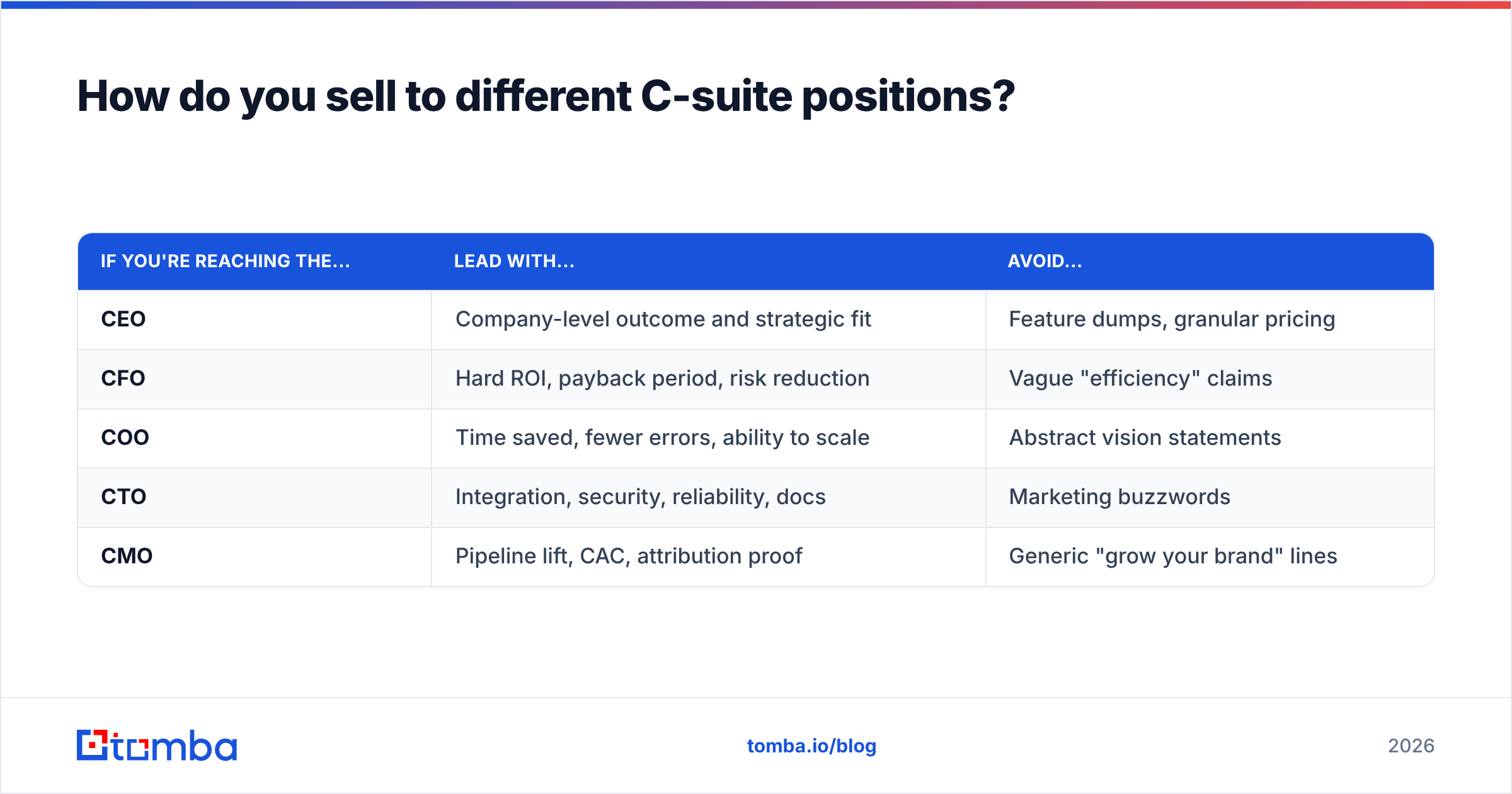
| If you're reaching the... | Lead with... | Avoid... |
|---|---|---|
| CEO | Company-level outcome and strategic fit | Feature dumps, granular pricing |
| CFO | Hard ROI, payback period, risk reduction | Vague "efficiency" claims |
| COO | Time saved, fewer errors, ability to scale | Abstract vision statements |
| CTO | Integration, security, reliability, docs | Marketing buzzwords |
| CMO | Pipeline lift, CAC, attribution proof | Generic "grow your brand" lines |
A few principles that hold across every role:
- Be brief. Executives skim. One clear outcome beats three paragraphs of context.
- Lead with their metric, not your feature. A CFO doesn't care that you have "AI-powered dashboards." They care that you cut reporting time 40%.
- Reference a trigger. New funding, a leadership change, or a hiring spree signals budget is moving. Enriched data enrichment records surface those triggers.
- Get the contact right. A perfect pitch to the wrong inbox is wasted. Verify the person, the title, and the email before you send.
That last point is where most campaigns quietly fail. You can craft the perfect angle for a CFO and still land in a finance@ catch-all that no human reads. To reach a specific executive, you need their direct, verified address. That is the gap a purpose-built finder fills.
How do you find and verify C-suite contact details?#
Reaching the right chief comes down to three steps: identify the person, find their contact info, and verify it before you send.
1. Identify the right role. Use the account's org chart and your offer's metric to pick the real budget owner, not just whoever ranks highest. LinkedIn, company about-pages, and press releases show who holds the title now. Executives change jobs often.
2. Find the contact. Here a dedicated tool beats manual guessing. A domain search pulls every email it can find at a company. It also shows the format the company uses, such as first.last@ or flast@. That lets you pinpoint the executive you want. For direct outreach, an email finder turns a specific name and company into a verified professional address.
3. Verify before you send. Strict spam filters and sender-reputation checks protect executive inboxes. Send to a stale or invalid address, and you burn your domain reputation and your shot at the account. Verification confirms the address is live and safe to contact.
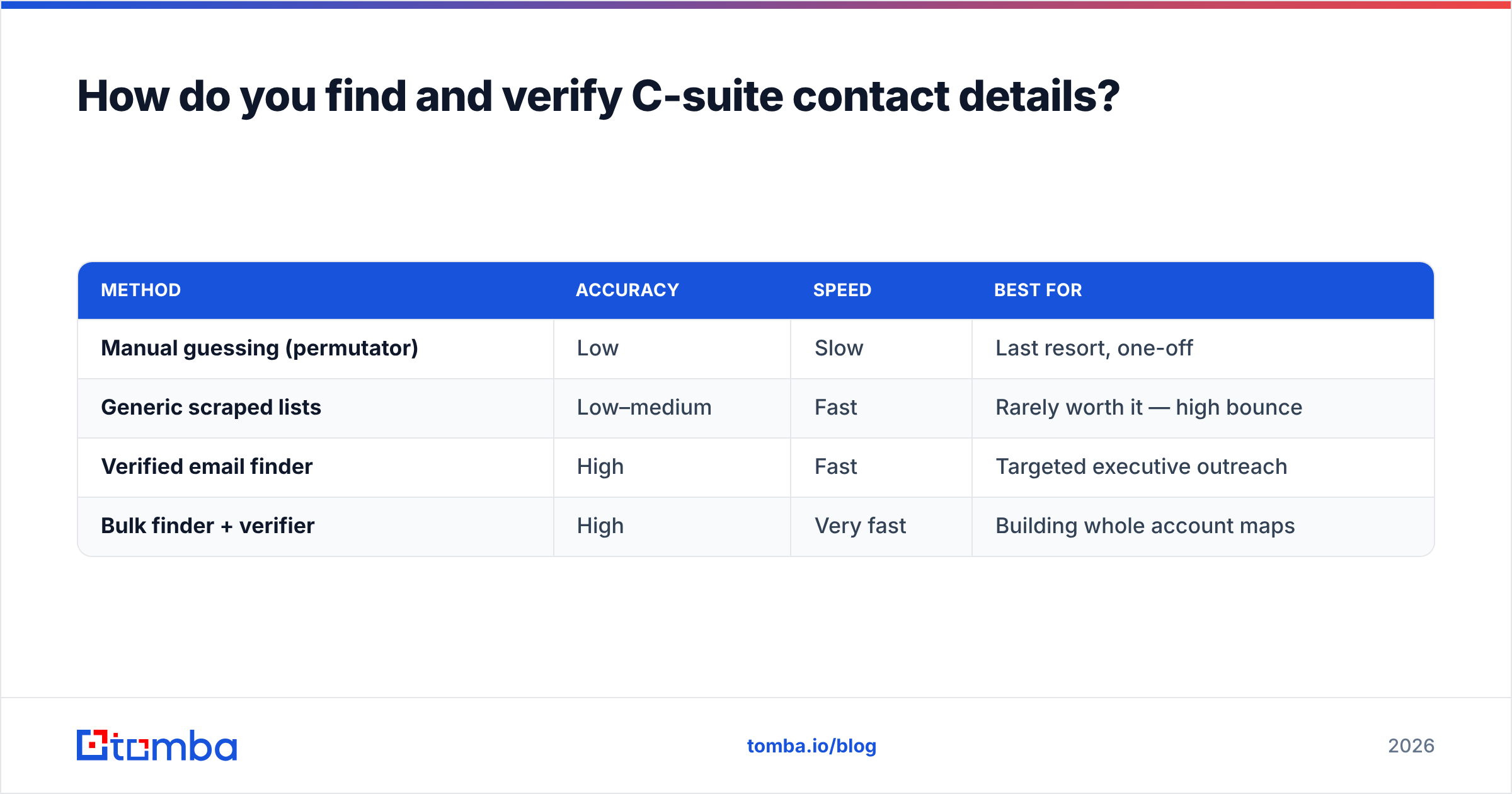
Here's how a few common approaches stack up for reaching C-suite contacts:
| Method | Accuracy | Speed | Best for |
|---|---|---|---|
| Manual guessing (permutator) | Low | Slow | Last resort, one-off |
| Generic scraped lists | Low–medium | Fast | Rarely worth it — high bounce |
| Verified email finder | High | Fast | Targeted executive outreach |
| Bulk finder + verifier | High | Very fast | Building whole account maps |
Building large account maps? Run names in batches through a bulk email finder. It turns a spreadsheet of target executives into a clean, verified contact list in one pass, instead of hunting each person by hand.
What metrics does each C-suite position live and die by?#
If you take one thing from this guide, take this. Every executive is measured. Their number tells you exactly how to sell to them.
- CEO — revenue growth, market share, valuation, board confidence.
- CFO — gross margin, cash runway, cost of capital, forecast accuracy.
- COO — operational efficiency, throughput, on-time delivery, unit economics.
- CTO — uptime, security posture, delivery velocity, technical debt.
- CMO — pipeline generated, customer acquisition cost, brand awareness, response rate on campaigns.
- CRO — total revenue, win rate, net revenue retention, quota attainment.
When your message speaks to one of those numbers, you stop being noise and start being relevant. That is the whole game in executive outreach.
Frequently asked questions#
What is the difference between the C-suite and senior management? The C-suite holds function-wide accountability and a board-level seat. Senior managers, such as VPs and directors, run teams inside a function and report up to a chief. A VP of Sales runs the sales team. The CRO owns the whole revenue number.
Is the CEO always the most important person to reach? No. The CEO sets priorities. But the person who owns the relevant budget and metric is usually your real buyer. For a security tool, that is the CISO. For finance software, it is the CFO. Default to the CEO, and you often land on the desk of someone who forwards you back down.
How many C-suite positions does a company typically have? It varies with size. A startup might have two or three: a CEO, a CTO, and a CFO or COO. A large enterprise can have a dozen or more, including specialist chiefs like the CISO, CDO, and CHRO.
Why do so many new "Chief" titles keep appearing? Some functions grow strategically important, such as data, security, and customer experience. Companies raise them to the C-suite to signal priority and centralize accountability. Title inflation plays a role too. That is why matching the role to real budget authority matters.
Reach the right chief with verified data#
Understanding the C-suite helps only if you can actually reach the right executive. The strategy falls apart the moment your pitch bounces off a guessed address or lands in a dead catch-all inbox.
That is where Tomba Email Finder fits. Give it a name and a company, or search a whole domain. You get verified, deliverable emails for the executives you target. A built-in email verifier keeps your sender reputation safe from stale addresses. Start free with 25 searches a month, then scale up through transparent Tomba pricing as your list grows.
Map the role, match the metric, and reach the person who actually signs. That is how C suite positions turn from a list of titles into real pipeline.
Related guides#
Ready to find emails that actually work?
Join 150,000+ professionals who stopped guessing and started sending. Free credits on signup — no credit card required.
Get the Tomba newsletter
Practical outbound tactics and product updates — once every two weeks.
About the author