Coaching Sales: The 2026 Playbook for Rep Performance
Coaching sales isn't pep talks and pipeline reviews. Here's the framework, cadence, and metrics that actually move rep win rates in 2026 — plus what to skip.
Most sales managers think they coach. What they actually do is inspect pipeline, ask "how's that deal looking?", and move on. That's not coaching sales — that's status reporting with extra steps.
Real coaching changes how a rep thinks, decides, and executes on the next call. It compounds. And in 2026, with buyers ghosting more and quotas rising, it's the single highest-leverage thing a frontline manager can do.
TL;DR#
- Coaching sales means changing rep behavior, not reviewing rep numbers. Pipeline inspection and coaching are different jobs — stop confusing them.
- Cadence beats intensity. A focused 30-minute weekly session per rep outperforms a quarterly "deep dive" every time.
- Coach one skill at a time. Reps can't fix eight things at once; pick the constraint that's actually capping their win rate.
- Data makes coaching objective. Call recordings, activity metrics, and clean pipeline data turn "I feel like you're rushing" into "at 4:12 you skipped the budget question."
- Coaching is worthless if reps work bad data. Great technique on wrong-fit, unverified contacts still loses. Fix the inputs first.
What does "coaching sales" actually mean?#
Coaching sales is the repeatable process of observing a rep in action, diagnosing the one thing holding them back, and helping them build a new habit that improves outcomes.
Think of it like a golf swing coach. They don't stand behind you reciting your handicap — that's the scoreboard, and you already know it. They watch the swing, spot that your grip is off, and drill that one fix until it's muscle memory. Then they move to the next thing. Sales coaching works the same way: observe, diagnose one constraint, drill, repeat.
Technically, effective coaching separates three activities that managers routinely blur together:
- Deal coaching — advancing a specific opportunity ("what's the next step to get legal engaged?").
- Skill coaching — improving a durable capability that helps every deal ("your discovery calls end before you've found real pain").
- Pipeline management — forecasting and inspecting the number.
All three matter. Only the middle one compounds. If 80% of your one-on-ones are deal coaching and forecasting, your reps get slightly better at closing this quarter's deals and no better as sellers. Skill coaching is the investment that pays down the road.
Why is coaching sales the highest-leverage management activity?#
Because it's the only activity that scales through other people. A manager can personally close a few deals a quarter. Or they can lift eight reps' win rates by three points each — which, across a full pipeline, dwarfs anything they'd close solo.
The research backs this up. Sales organizations that formalize coaching consistently report higher quota attainment and lower rep turnover than those that leave it to manager instinct. Gong's analysis of millions of sales conversations shows the behaviors that separate top performers are teachable and specific — not innate charisma. And HubSpot's sales research repeatedly ties structured coaching to improved win rate and ramp time for new hires.
The catch: coaching is a skill managers are rarely trained in. Most got promoted for being great reps, then were handed a team and a CRM login and told to "develop people." Selling and coaching are different jobs, the same way being a great player and a great coach are different jobs.
How often should you coach — and for how long?#
Weekly, for about 30 minutes per rep, protected on the calendar like a customer meeting.
Cadence beats intensity. A rep who gets a focused 30-minute session every week gets 50+ coaching touches a year, each reinforcing the last. A rep who gets a two-hour quarterly "development review" gets four disconnected lectures they forget by Monday. Habits form through repetition, not marathon sessions.
Here's a practical structure for the weekly session:
- Minutes 0–5: Wins and morale. What went well? Reps hear feedback better after they feel seen.
- Minutes 5–20: One skill. Review a call recording or role-play the constraint you're working on. One skill only.
- Minutes 20–28: Deal help. Now do the tactical pipeline stuff, time-boxed so it doesn't eat the session.
- Minutes 28–30: Commit. Rep states exactly what they'll practice before next week. You write it down.
The single biggest failure mode is letting deal help expand to fill the whole session because it feels urgent. Urgent and important aren't the same. Guard the skill block.
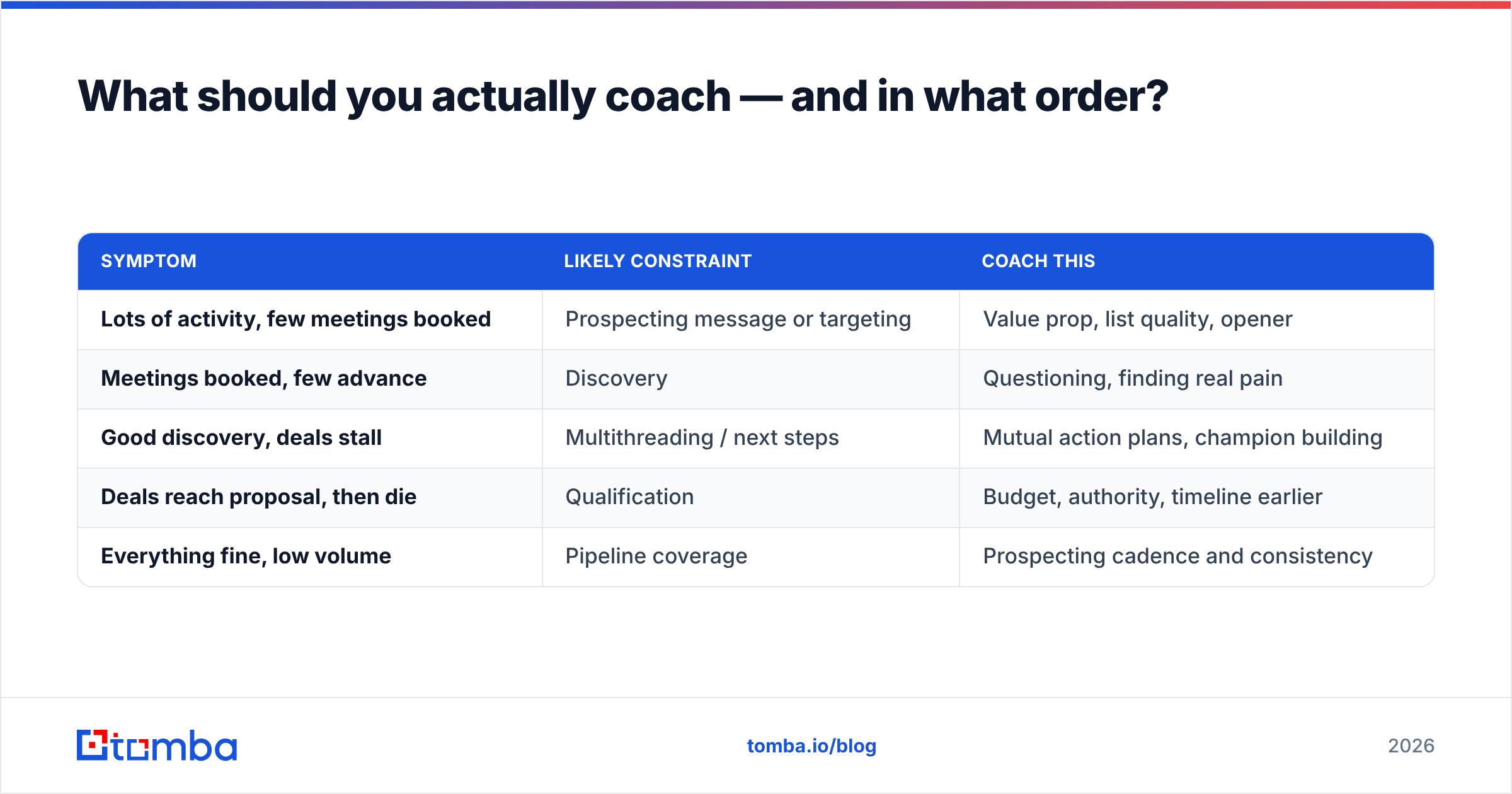
What should you actually coach — and in what order?#
Coach the constraint. Every rep has one thing most responsible for their gap to quota, and fixing that returns more than polishing five things they're already decent at.
To find the constraint, walk the funnel and look for the leak:
| Symptom | Likely constraint | Coach this |
|---|---|---|
| Lots of activity, few meetings booked | Prospecting message or targeting | Value prop, list quality, opener |
| Meetings booked, few advance | Discovery | Questioning, finding real pain |
| Good discovery, deals stall | Multithreading / next steps | Mutual action plans, champion building |
| Deals reach proposal, then die | Qualification | Budget, authority, timeline earlier |
| Everything fine, low volume | Pipeline coverage | Prospecting cadence and consistency |
Notice that two very different reps — one drowning in unqualified deals, one starved for meetings — need opposite coaching. Coaching them the same way is malpractice. Diagnose first.
A useful rule: coach upstream of the symptom. A rep losing deals at proposal usually has a discovery problem, not a closing problem. They "close" badly because they qualified badly three weeks earlier. Fix the root, not the crash.
How do you make coaching objective instead of opinion?#
Use evidence. The fastest way to lose a rep's trust is vague, feelings-based feedback: "I think you're being too pushy." The rep hears an insult, gets defensive, and changes nothing.
Compare that to: "At 4:12 on the Acme call, the prospect said 'we're evaluating a few options' and you jumped straight to your pricing. What were you feeling there?" Now it's specific, it's observable, and it invites the rep to self-diagnose. That's coaching.
Three evidence sources make this possible:
- Call recordings. Conversation intelligence tools (Gong, Chorus, and others) timestamp and transcribe calls so you can point to the exact moment. This is the closest thing to game film in sales.
- Activity and pipeline data. Clean CRM data tells you whether a rep's problem is skill or volume. A rep with a great response rate but low pipeline has an activity problem, not a messaging one.
- Deal reviews against a framework. Score deals against MEDDIC, BANT, or your own qualification rubric so gaps are visible and consistent across the team.
The subtext of all three: objective coaching depends on trustworthy inputs. If your CRM is full of stale contacts and unverified emails, the "activity data" you coach against is fiction. Which brings us to the part most coaching content ignores.
Can you coach your way out of bad data?#
No. This is the uncomfortable truth. A perfectly coached rep working a list of wrong-fit, unverifiable contacts will still miss quota — and you'll waste weeks coaching "skills" when the real problem is inputs.
Picture a rep with flawless discovery technique dialing a list where 30% of the emails bounce and half the titles are wrong. Their reply rate craters. If you coach their messaging, you're treating a symptom. The disease is the data. You can't out-coach a bad list any more than a chef can out-cook rotten ingredients.
This is why smart sales leaders coach the top of the funnel as rigorously as the close:
- Targeting — is the rep working accounts that actually fit ICP, or spraying?
- Contact quality — are they reaching real decision-makers at valid addresses?
- Enrichment — do they have the context (role, company signals, phone) to personalize?
Tools that supply clean, verified contact data remove an entire category of "rep problems" that were never rep problems. When your team uses a reliable email finder and verifies contacts before outreach, bounce rates drop and reply rates climb — without a single coaching session. Layer data enrichment on top and reps walk into every call with context, so your coaching time goes to technique instead of cleanup.
The principle: fix the system before you coach the person. Deming said 94% of problems are system problems, not people problems. Sales is no exception.
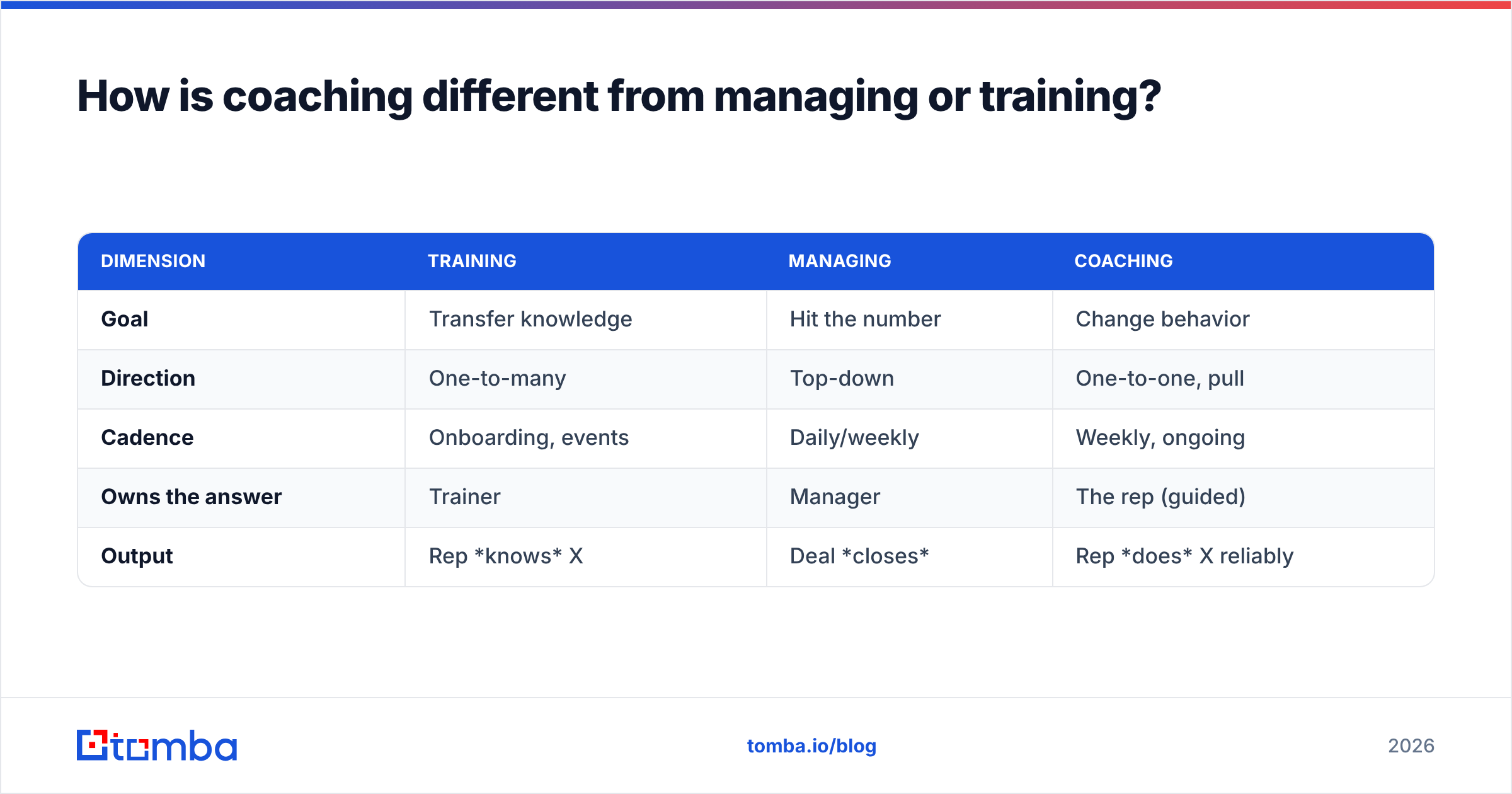
How is coaching different from managing or training?#
They overlap, but conflating them is why so many "coaching programs" fail. Here's the distinction:
| Dimension | Training | Managing | Coaching |
|---|---|---|---|
| Goal | Transfer knowledge | Hit the number | Change behavior |
| Direction | One-to-many | Top-down | One-to-one, pull |
| Cadence | Onboarding, events | Daily/weekly | Weekly, ongoing |
| Owns the answer | Trainer | Manager | The rep (guided) |
| Output | Rep knows X | Deal closes | Rep does X reliably |
Training teaches a rep what a good discovery call looks like. Managing pushes them to book more of them. Coaching sits with them after a real call and helps them see why theirs fell short — and builds the reflex to do it differently. You need all three, but you can't substitute one for another. A team that's over-trained and under-coached knows exactly what to do and doesn't do it.
The coaching mindset is "pull," not "push." Instead of telling the rep the answer, you ask questions that let them find it. Reps own what they discover; they resist what they're told. It's slower in the moment and far stickier over time.
What does a great coaching culture look like?#
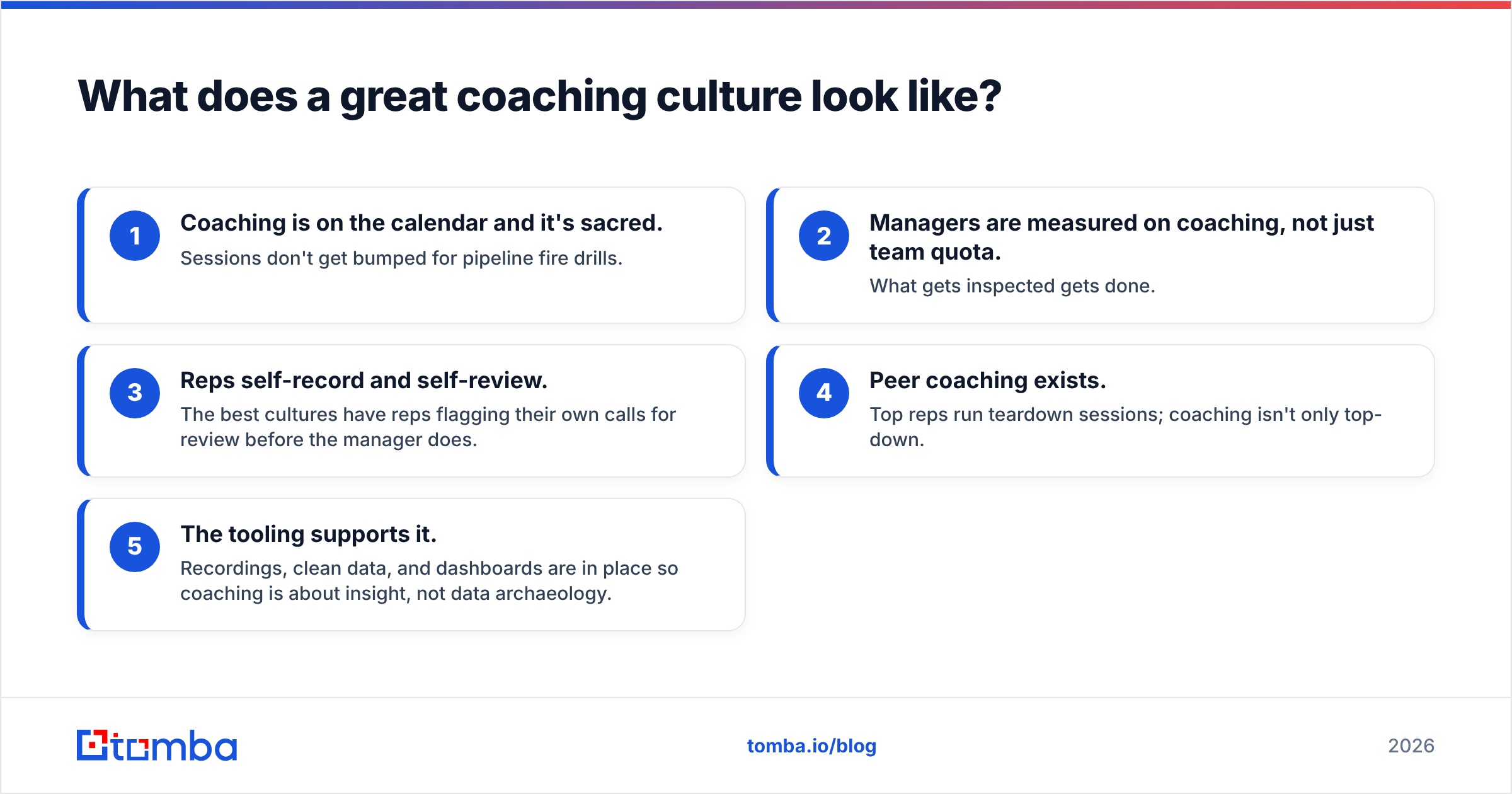
It's built, not declared. A few markers of teams that actually coach:
- Coaching is on the calendar and it's sacred. Sessions don't get bumped for pipeline fire drills.
- Managers are measured on coaching, not just team quota. What gets inspected gets done.
- Reps self-record and self-review. The best cultures have reps flagging their own calls for review before the manager does.
- Peer coaching exists. Top reps run teardown sessions; coaching isn't only top-down.
- The tooling supports it. Recordings, clean data, and dashboards are in place so coaching is about insight, not data archaeology.
You can measure whether coaching is working. Track ramp time for new hires, win-rate trend per rep, and the gap between top and bottom quartile. Coaching that works pulls the bottom quartile up and shrinks that gap. If the spread isn't closing, your "coaching" is probably disguised pipeline inspection.
Which metrics tell you coaching is working?#
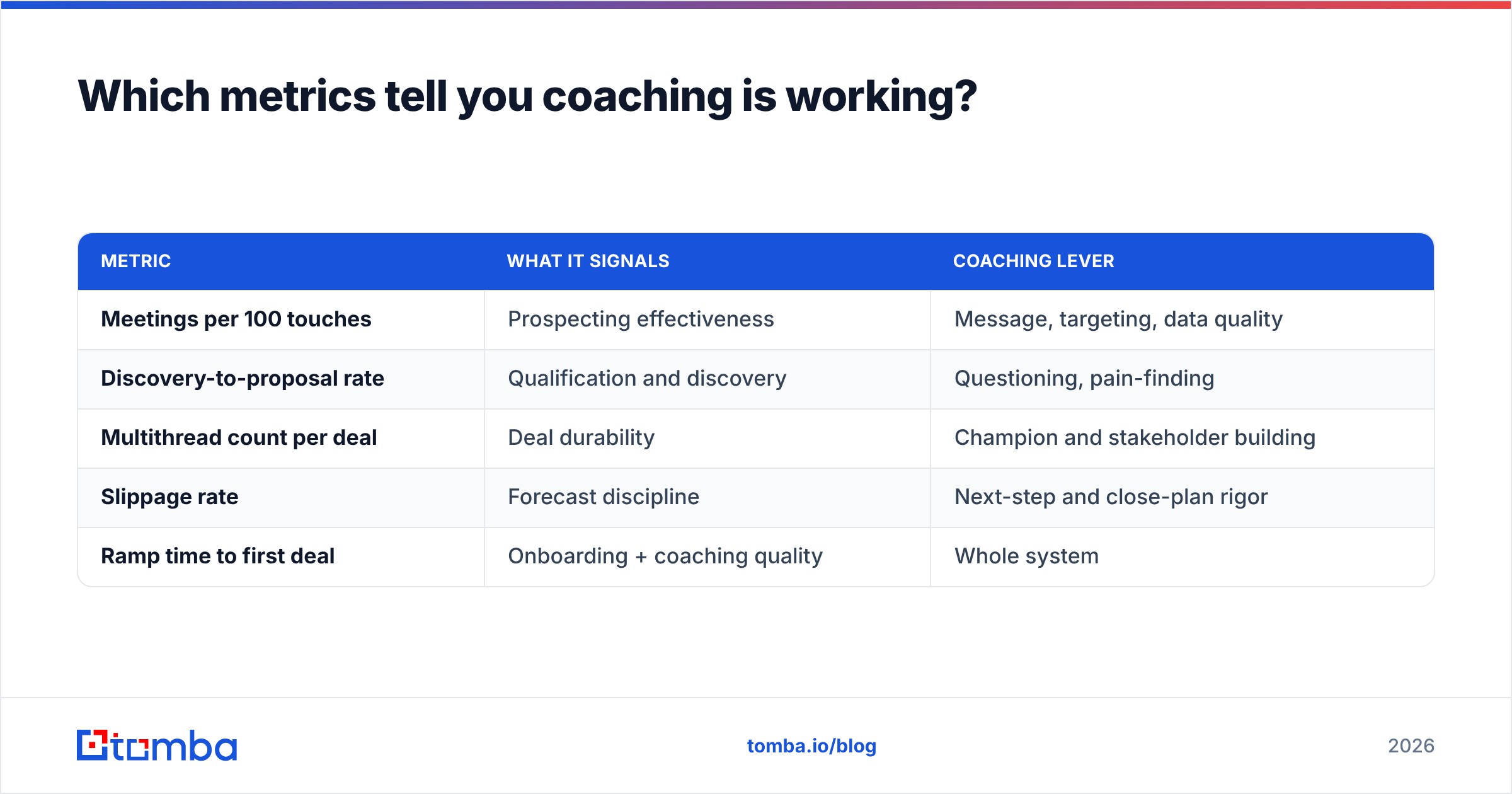
Lagging metrics like quota attainment are the scoreboard, but they move slowly and get muddied by market noise. Watch leading indicators tied to the specific skill you're coaching:
| Metric | What it signals | Coaching lever |
|---|---|---|
| Meetings per 100 touches | Prospecting effectiveness | Message, targeting, data quality |
| Discovery-to-proposal rate | Qualification and discovery | Questioning, pain-finding |
| Multithread count per deal | Deal durability | Champion and stakeholder building |
| Slippage rate | Forecast discipline | Next-step and close-plan rigor |
| Ramp time to first deal | Onboarding + coaching quality | Whole system |
Pick the one metric downstream of the skill you're coaching and watch it weekly. If you're coaching discovery, discovery-to-proposal rate should trend up within a few weeks. If it doesn't, either your diagnosis was wrong or the constraint is elsewhere — often, again, in the data feeding the top of the funnel.
For context on where these benchmarks sit across industries, G2's sales software category reviews and vendor benchmark reports are a reasonable neutral reference point, though your own baseline matters more than any industry average.
Common coaching mistakes to avoid#
- Coaching the deal, never the rep. Feels productive, builds nothing durable.
- Fixing everything at once. Eight pieces of feedback equals zero behavior change. One skill at a time.
- Feedback without evidence. "You seemed off" isn't coachable. Timestamp it.
- Skipping sessions when busy. The weeks you're too busy to coach are the weeks the team most needs it.
- Coaching skills when the problem is data. Auditing your list and contact quality first can save weeks of misdirected effort.
- No commitment, no follow-up. If the rep doesn't leave with a specific practice commitment you revisit next week, it was a chat, not coaching.
Bringing it together#
Coaching sales is a system, not a personality trait. Set a protected weekly cadence, diagnose the one constraint capping each rep, coach it with evidence instead of opinion, and secure a commitment you follow up on. Do that for a quarter and the bottom of your team stops looking like a lost cause.
But coaching only pays off when reps are working real, reachable, well-fit contacts. The best-coached rep on earth loses to a bad list. Before you spend another cycle coaching "reply rates," make sure your team isn't emailing dead addresses. Tomba's Email Finder surfaces verified, professional emails by name, domain, or company — so your reps reach real decision-makers and your coaching time goes to technique, not troubleshooting bounces. Start free with 25 searches a month, and check Tomba pricing when your team is ready to scale. Fix the inputs, then coach the craft — that's the order that actually moves the number.
Related guides#
Ready to find emails that actually work?
Join 150,000+ professionals who stopped guessing and started sending. Free credits on signup — no credit card required.
Get the Tomba newsletter
Practical outbound tactics and product updates — once every two weeks.
About the author