Coaching vs Mentoring in Sales: What Actually Grows Reps
Coaching and mentoring both develop reps, but they solve different problems. Here's when to coach, when to mentor, and how to run both without burning out your managers.
TL;DR
- Coaching is short-cycle and skill-specific: a manager watches a rep's live behavior (calls, demos, pipeline reviews) and corrects it against a defined standard. It's about this deal, this call, this quarter.
- Mentoring is long-cycle and career-specific: a more experienced seller shares judgment, context, and pattern recognition to grow the whole person over months or years.
- You need both. Coaching moves this quarter's number; mentoring keeps your best people from leaving and builds your next generation of leaders.
- The biggest failure mode is calling something "coaching" when it's really just deal inspection or a status update. Reps can tell the difference, and so can the forecast.
- Structure beats good intentions: fixed cadence, a scorecard, and rep-owned agendas turn both practices from vague vibes into measurable lift.
If you manage a sales team, you've probably been told to "coach more." You've also probably been told to "mentor your juniors." Those two instructions sound similar, get budgeted the same way, and are almost never the same activity. Confusing them is why so much development time produces so little movement on quota.
This guide breaks down coaching vs mentoring in sales — what each one actually is, when to reach for which, and how to run both so your managers aren't drowning and your reps are actually improving.
What is sales coaching, really?#
Sales coaching is the practice of observing a rep's actual selling behavior and closing the gap between what they did and what "good" looks like. Think of it like a batting coach standing behind a hitter: they're not talking about life goals, they're watching the swing and fixing the elbow.
Coaching is:
- Behavior-based — it works from evidence you can see: a recorded discovery call, a live demo, a written follow-up email, a pipeline review.
- Skill-specific — one session targets one thing (qualification, objection handling, multithreading), not "get better at sales."
- Short-cycle — the feedback loop is days or weeks, tied to deals currently in play.
- Standard-referenced — it assumes there's a defined right way (your methodology, your talk tracks, your ideal call flow) to measure against.
The best coaching is uncomfortable in a useful way. It names a specific gap, ties it to a specific rep behavior, and assigns a specific change to try before the next check-in. According to Gartner's sales research, effective managerial coaching is one of the highest-leverage activities a frontline sales leader can spend time on — yet most managers massively under-invest in it because deal firefighting always feels more urgent.

A quick gut-check: if a manager can't tell you the one behavior a rep should change after a coaching session, that wasn't coaching. It was a conversation.
What is sales mentoring, really?#
Mentoring is the transfer of judgment and context from someone who's been there to someone who hasn't — usually across a longer arc than any single deal. If coaching fixes the swing, mentoring is the veteran teammate explaining how to read the pitcher, handle a slump, and think about a whole career.
Mentoring is:
- Relationship-based — it depends on trust built over time, not on a scorecard.
- Person-specific — it's about this seller's growth, ambitions, blind spots, and confidence.
- Long-cycle — value shows up over months and quarters, not on Friday's forecast.
- Wisdom-referenced — there's rarely one "right" answer; the mentor shares how they'd think about it and lets the mentee decide.
A mentor helps a rep navigate the stuff no talk track covers: whether to chase the enterprise logo or the fast SMB win, how to recover after blowing a big deal, when to push back on a manager, whether to move toward management or stay an individual contributor. Mentoring is why your best AEs stay three years instead of eighteen months.
Crucially, a mentor often isn't the rep's manager — and shouldn't always be. The moment career advice comes from the person who signs your comp plan, honesty leaks out of the room.
Coaching vs mentoring in sales: what's the actual difference?#
Here's the head-to-head. Most of the confusion disappears once you see the two side by side.
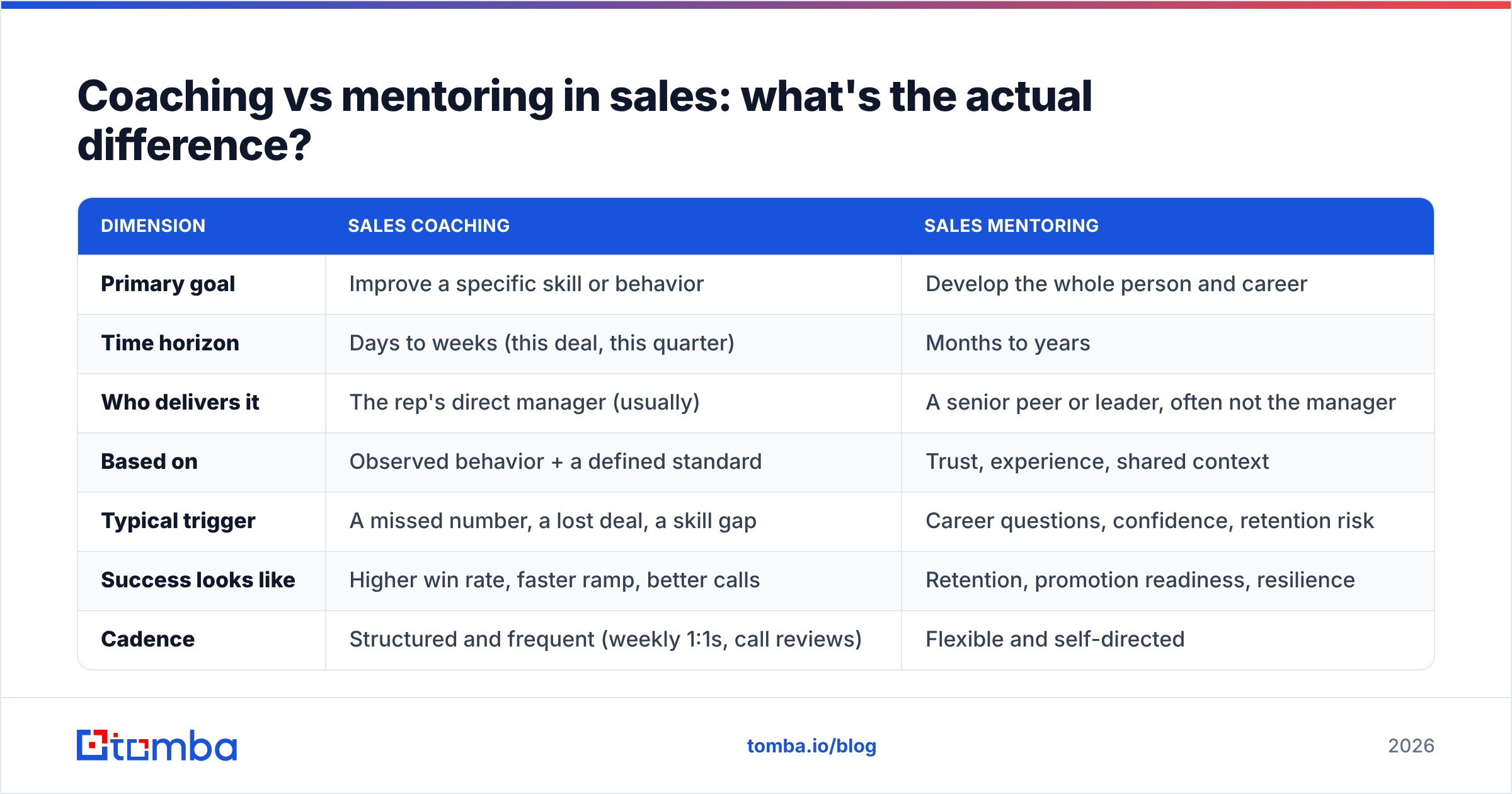
| Dimension | Sales Coaching | Sales Mentoring |
|---|---|---|
| Primary goal | Improve a specific skill or behavior | Develop the whole person and career |
| Time horizon | Days to weeks (this deal, this quarter) | Months to years |
| Who delivers it | The rep's direct manager (usually) | A senior peer or leader, often not the manager |
| Based on | Observed behavior + a defined standard | Trust, experience, shared context |
| Typical trigger | A missed number, a lost deal, a skill gap | Career questions, confidence, retention risk |
| Success looks like | Higher win rate, faster ramp, better calls | Retention, promotion readiness, resilience |
| Cadence | Structured and frequent (weekly 1:1s, call reviews) | Flexible and self-directed |
| Directive level | Higher — "try this next call" | Lower — "here's how I'd think about it" |
The simplest way to remember it: coaching is about the work; mentoring is about the worker. You coach a rep on their discovery call. You mentor a rep on their career.
They also fail differently. Bad coaching feels like micromanagement or nitpicking. Bad mentoring feels like an aimless coffee chat that never changes anything. Knowing which one you're trying to do keeps you from importing the wrong failure mode.
Is coaching better than mentoring — or do you need both?#
You need both, but they're not interchangeable, and the mix depends on where a rep is.
New reps and ramping reps need coaching-heavy support. They don't yet have the reps (pun intended) to benefit from abstract wisdom — they need concrete correction on specific behaviors, fast, before bad habits calcify. A brand-new SDR getting mentored on "long-term career strategy" is a nice gesture, but what they actually need is someone tearing apart their cold call opener line by line.
Tenured reps and high performers need mentoring-heavy support. They already know how to run a call. What threatens their performance is boredom, plateau, career ambiguity, and burnout — all of which mentoring addresses and coaching doesn't. Over-coaching a top AE is how you insult them into a competitor's Slack.
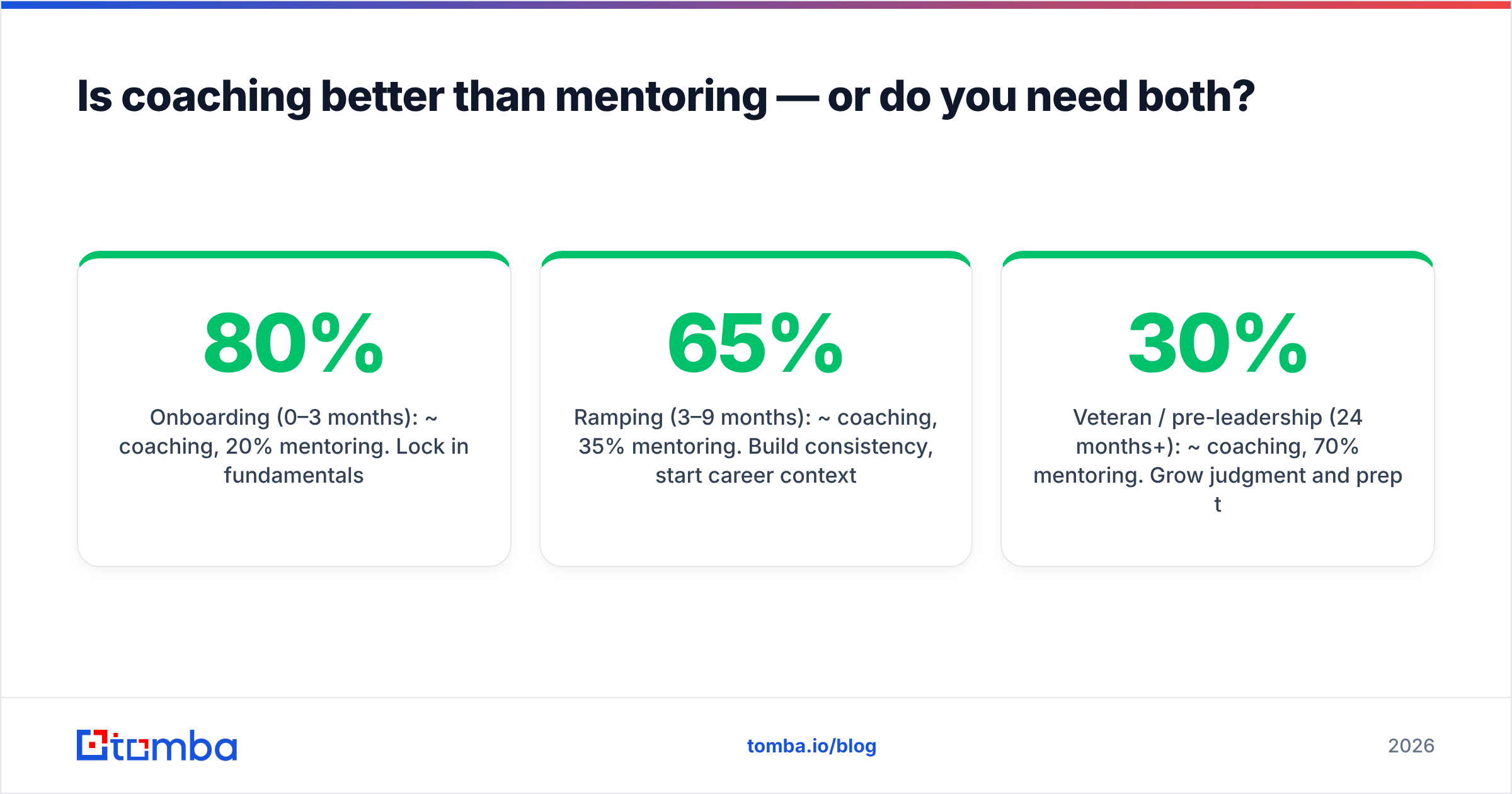
Here's a rough model for the mix by rep stage:
- Onboarding (0–3 months): ~80% coaching, 20% mentoring. Lock in fundamentals.
- Ramping (3–9 months): ~65% coaching, 35% mentoring. Build consistency, start career context.
- Performing (9–24 months): ~50/50. Sharpen advanced skills, deepen investment.
- Veteran / pre-leadership (24 months+): ~30% coaching, 70% mentoring. Grow judgment and prep the next role.
Notice that coaching never hits zero. Even Olympic athletes keep a coach. The idea that senior reps "don't need coaching anymore" is exactly how good sellers quietly drift into bad habits nobody's allowed to mention.
How do you run sales coaching without it becoming deal inspection?#
The number one killer of coaching is that it silently turns into pipeline review. The manager opens the CRM, walks the deals, asks "what's the next step," updates the forecast, and calls it coaching. The rep learned nothing about how to sell — they just reported status.
To keep coaching real, separate the two explicitly:
- Deal inspection answers: Will this deal close, and what's the forecast? It's about the outcome.
- Coaching answers: What skill does this rep need to build to close more deals like this? It's about the capability.
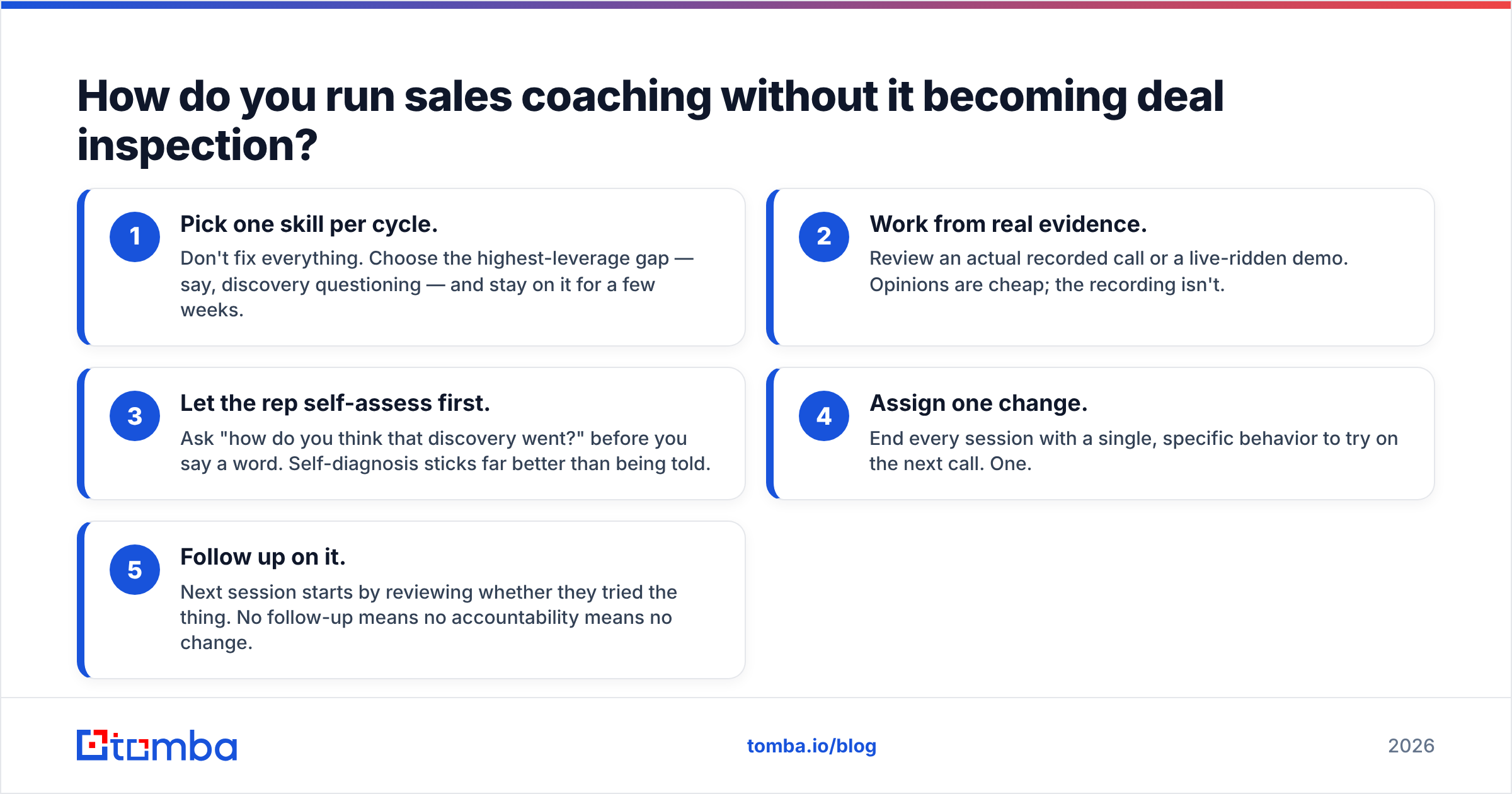
Run them as different meetings, or at least different halves of the same meeting with a clear line between them. A workable structure:
- Pick one skill per cycle. Don't fix everything. Choose the highest-leverage gap — say, discovery questioning — and stay on it for a few weeks.
- Work from real evidence. Review an actual recorded call or a live-ridden demo. Opinions are cheap; the recording isn't.
- Let the rep self-assess first. Ask "how do you think that discovery went?" before you say a word. Self-diagnosis sticks far better than being told.
- Assign one change. End every session with a single, specific behavior to try on the next call. One.
- Follow up on it. Next session starts by reviewing whether they tried the thing. No follow-up means no accountability means no change.
The evidence has to be good, and that starts with clean data feeding your pipeline. If reps are burning coaching-review time arguing over whether a contact is even reachable, you've got a data problem masquerading as a skills problem. Reliable contact data enrichment and verified contacts keep the conversation on selling behavior instead of list hygiene. For a deeper primer on the discipline itself, our sales-management glossary walks through how win rate ties back to coachable behaviors.
How do you build a mentoring program that doesn't fizzle?#
Most mentoring "programs" are a kickoff email and a spreadsheet pairing names together, followed by silence. They fizzle because mentoring feels optional and unstructured, so it loses every calendar fight against real work.
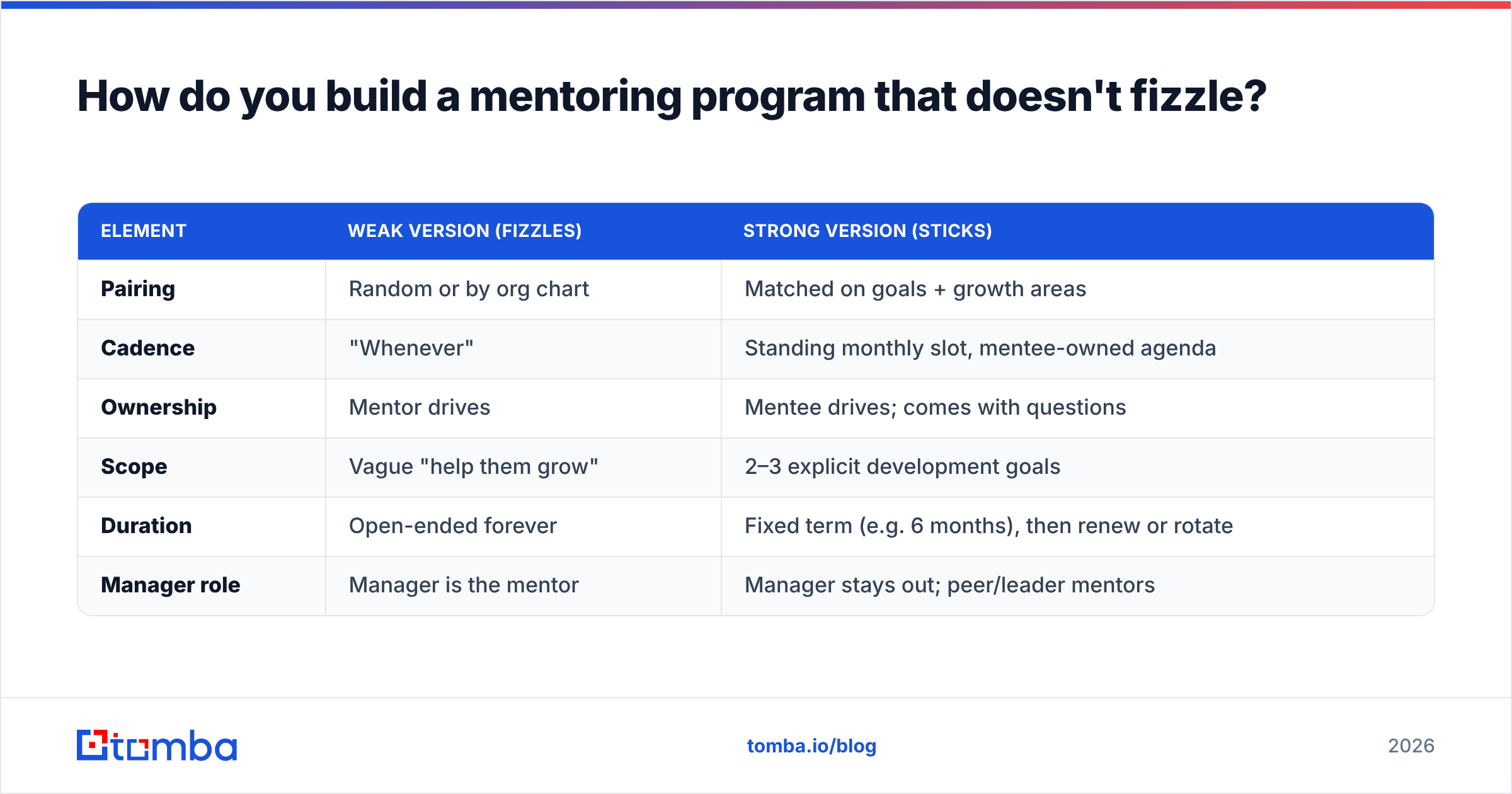
Fix that with just enough structure to create gravity — without over-engineering the relationship:
| Element | Weak version (fizzles) | Strong version (sticks) |
|---|---|---|
| Pairing | Random or by org chart | Matched on goals + growth areas |
| Cadence | "Whenever" | Standing monthly slot, mentee-owned agenda |
| Ownership | Mentor drives | Mentee drives; comes with questions |
| Scope | Vague "help them grow" | 2–3 explicit development goals |
| Duration | Open-ended forever | Fixed term (e.g. 6 months), then renew or rotate |
| Manager role | Manager is the mentor | Manager stays out; peer/leader mentors |
Two rules make or break it. First, the mentee owns the agenda. Mentoring is a pull, not a push — the mentee shows up with the questions and the mentor responds. A mentor chasing a passive mentee is a program on life support. Second, keep the mentor off the mentee's comp and performance decisions. Separation is what makes candor possible.
For distributed teams, mentoring doesn't require an office. Recorded calls, shared deal debriefs, and async voice notes work fine. What it does require is protected time that both people treat as non-negotiable.
What tools and data support both practices?#
Neither coaching nor mentoring is a "tool" problem — but bad infrastructure quietly sabotages both. Three things matter:
- Conversation intelligence — call recording and analysis (Gong, Chorus, or similar) so coaching works from evidence, not memory. You can't coach a call you only heard about secondhand. G2's category listings are a reasonable starting point for comparing options.
- Clean CRM and pipeline data — so pipeline reviews stay honest and coaching time isn't wasted reconciling records. Coaches need to trust the numbers on the screen.
- Reliable prospect data — because a big share of "rep performance" is really "rep territory quality." A rep working a list full of bounced emails and dead phone numbers looks like a coaching problem when it's a data problem.
That last point is where a lot of teams misdiagnose. Before you coach a rep on low connect rates, check whether their contacts are even valid. Tools like the Tomba Email Finder and a proper email verifier strip out the noise so that when a rep struggles, you know it's a skill gap worth coaching — not a garbage list worth replacing. Transparent Tomba pricing starts with a free tier (25 searches/mo) and a $49/mo Starter plan, which is enough for most managers to clean up a team's core account list before the next coaching cycle.
Common mistakes to avoid#
- Calling status updates "coaching." If no behavior changed, it wasn't coaching.
- Coaching everything at once. One skill per cycle or nothing sticks.
- Making the manager the mentor by default. Career candor dies when comp is in the room.
- Mentoring new reps who need coaching. Fundamentals first, philosophy later.
- No cadence. Both practices lose every calendar fight unless they're scheduled and protected.
- Ignoring data quality. You can't coach your way out of a bad list.
The bottom line#
Coaching and mentoring aren't competing philosophies — they're two levers on the same machine. Coaching moves this quarter's number by fixing specific behaviors against a standard. Mentoring protects your future by growing the person and keeping your best sellers invested. Great sales orgs run both, deliberately, with structure — and they know at every moment which one they're doing.
Start by auditing your last month of "coaching." How much of it was actually skill development versus deal inspection? Then check whether your reps are working clean, verified data before you grade their performance on it. Spin up a free Tomba Email Finder account, run your team's key account lists through it, and remove data quality from the equation — so the only thing left to coach is the selling.
Related guides#
// get started
Find, verify and enrich your first contacts today
Start on the free plan with 25 searches a month, then scale when your team is ready.
Free plan · No credit card required · GDPR & CCPA
// about the author