Cold Email in 2026: The Complete Guide to Getting Replies
Cold email still books meetings in 2026 — but only if you nail deliverability, targeting, and copy. Here's the no-fluff playbook that keeps you out of spam and gets replies.
Cold email is not dead — but the lazy version of it is. In 2026, mailbox providers score every message before your prospect ever sees it, buyers ignore anything that smells like a template, and a single misconfigured domain can torch your whole campaign. The good news: the fundamentals that actually work are simpler than the "growth hacks" crowd wants you to believe.
This guide is the honest, end-to-end playbook. No spray-and-pray. No magic subject lines. Just the sequence of decisions that separates cold email that books meetings from cold email that gets marked as spam.
TL;DR#
- Cold email is a permission-adjacent channel, not a broadcast channel. Small, targeted sends to verified addresses beat mass blasts every time.
- Deliverability is 60% of the battle. Authentication (SPF, DKIM, DMARC), a warmed domain, and clean lists decide whether you even reach the inbox.
- Targeting beats copy. A mediocre email to the right person outperforms a brilliant email to the wrong one.
- Follow-ups drive most replies. Roughly 50–70% of positive responses come after the first message, so a 3–5 step sequence is non-negotiable.
- Verify before you send. Bouncing on invalid addresses is the fastest way to wreck sender reputation — clean your list with an email verifier first.
What is cold email, and how is it different from spam?#
Cold email is a one-to-one business message sent to someone you have a legitimate reason to contact, but with whom you have no prior relationship. Think of it like knocking on a specific office door because you researched that the person inside has the exact problem you solve — not standing in the lobby shouting at everyone who walks by.
The legal and practical line between cold email and spam comes down to three things: relevance, honesty, and an easy exit. Spam is unsolicited, irrelevant, sent at massive scale, and often hides who it's from. Compliant cold email targets a narrow, relevant audience, uses your real identity and a real business address, and honors opt-outs. Regulations like the U.S. CAN-SPAM Act and the EU's GDPR don't ban cold outreach outright, but they do require truthful headers, a valid physical address, and a working unsubscribe path.
Here's the practical framing most people miss: mailbox providers don't read the law — they read behavior. Low open rates, high bounce rates, and spam complaints tell Gmail and Outlook you're a spammer regardless of your intent. So the whole game is sending messages that behave like wanted mail.
Why do most cold email campaigns fail?#
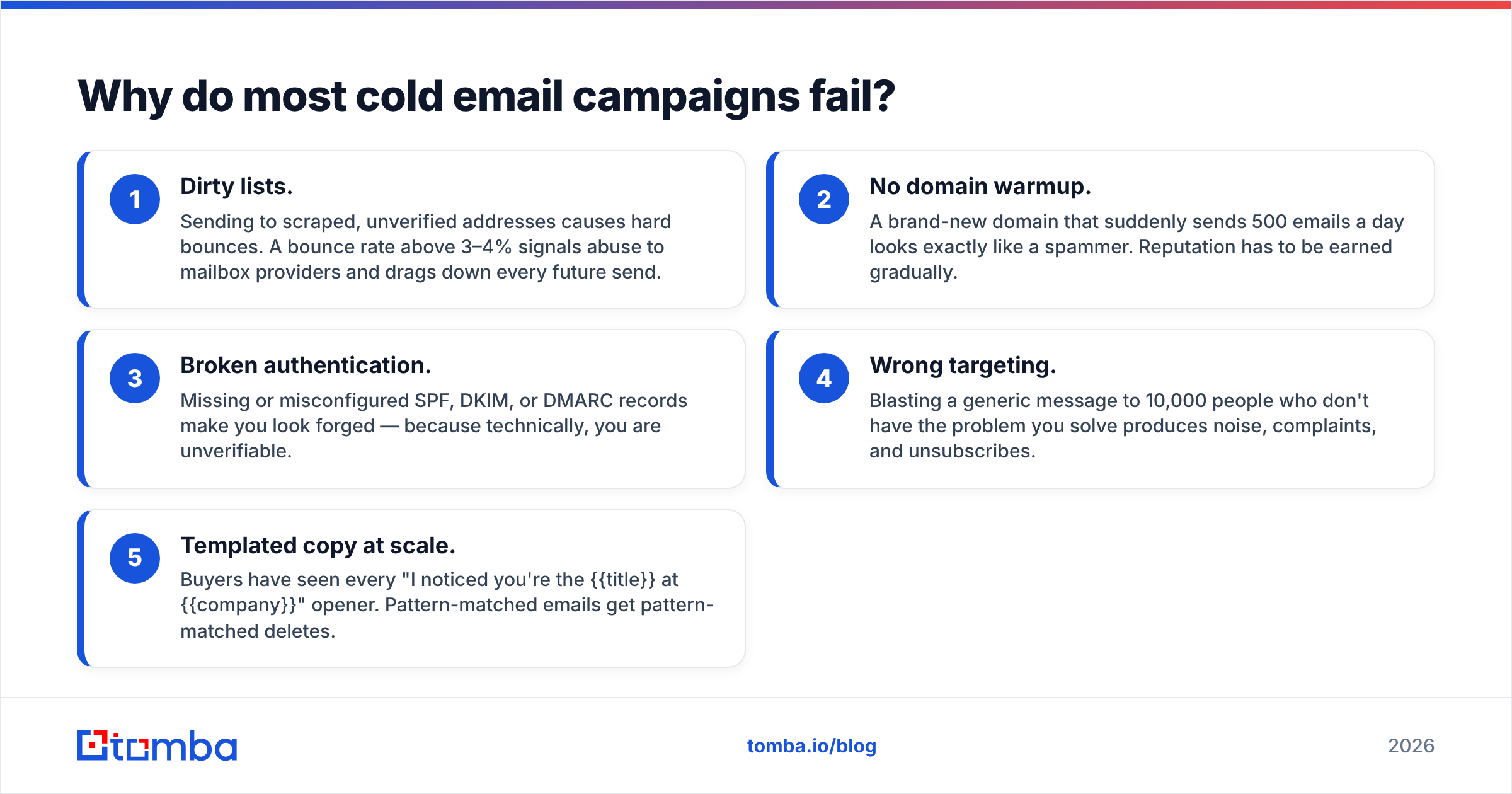
Most campaigns fail before the copy ever matters. When we break down underperforming programs, the same root causes show up over and over:
- Dirty lists. Sending to scraped, unverified addresses causes hard bounces. A bounce rate above 3–4% signals abuse to mailbox providers and drags down every future send.
- No domain warmup. A brand-new domain that suddenly sends 500 emails a day looks exactly like a spammer. Reputation has to be earned gradually.
- Broken authentication. Missing or misconfigured SPF, DKIM, or DMARC records make you look forged — because technically, you are unverifiable.
- Wrong targeting. Blasting a generic message to 10,000 people who don't have the problem you solve produces noise, complaints, and unsubscribes.
- Templated copy at scale. Buyers have seen every "I noticed you're the {{title}} at {{company}}" opener. Pattern-matched emails get pattern-matched deletes.
Notice how only one of those five is about writing. That's the point: cold email is an infrastructure and targeting problem first, and a copywriting problem second.
What does the anatomy of a high-performing cold email look like?#
A cold email that earns a reply has a predictable structure. Each part does one job, and every extra word works against you.
- Subject line — 2 to 5 words, lowercase or sentence case, curiosity or relevance over cleverness. It's the "should I open this" filter, nothing more.
- Opening line — About them, not you. A specific, researched observation proves you're not blasting a list.
- The problem/insight — One or two sentences naming a pain the prospect actually feels, framed in their language.
- The offer — What you do, stated as an outcome, not a feature list. One sentence.
- The ask (CTA) — A single, low-friction next step. "Worth a quick chat?" beats "Book a 30-minute demo via this Calendly link."
- Signature — Real name, real company, real physical address, working unsubscribe. Trust and compliance in one block.
Keep the whole thing under 120 words. If your prospect has to scroll on their phone, you've already lost. For proven structures you can adapt, start from a library of cold email templates rather than reinventing the wheel each time.
How do you make sure cold email lands in the inbox?#
Deliverability is where good campaigns die quietly. You can write the perfect email and never know it went straight to spam. Here's the non-negotiable checklist for 2026.
1. Authenticate your domain. Set up SPF, DKIM, and DMARC records before you send a single email. These prove to receiving servers that you are who you claim to be. Google's Postmaster guidelines now effectively require all three for bulk senders — and treat "bulk" as a lower threshold every year.
2. Use a separate sending domain. Never run cold campaigns from your primary domain. Buy a lookalike (e.g., getyourcompany.com instead of yourcompany.com) so a reputation hit never touches your main email or website.
3. Warm the domain up. Ramp from a handful of emails per day to your target volume over 3–6 weeks. Warmup tools exchange positive signals (opens, replies, moving out of spam) that teach providers you're legitimate. Estimate your ramp with a warmup calculator before you launch.
4. Verify every address. This is the single highest-ROI step most senders skip. Verifying removes invalid, catch-all, and risky addresses so your bounce rate stays under 2%. Learn more about protecting your email deliverability with clean data.
5. Keep volume per inbox low. Send 20–40 emails per inbox per day, not 500. Need more volume? Add more inboxes, not more sends per inbox.
Cold email tools compared: what do you actually need in 2026?#
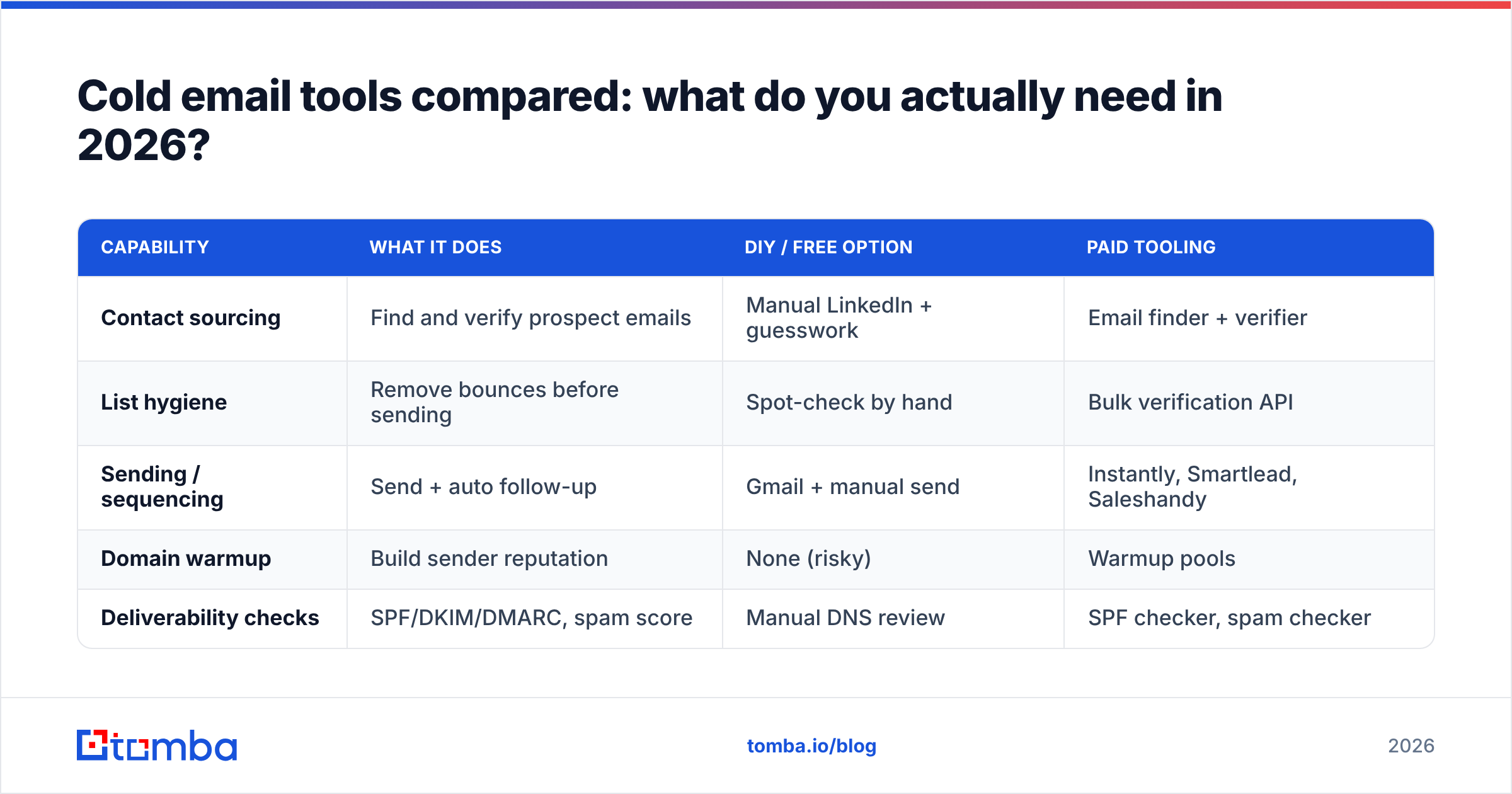
There's no single "cold email tool." A functioning stack has three jobs: finding and verifying contacts, sending sequences, and warming up domains. Some platforms bundle these; most don't do all three well. Here's how the core building blocks compare.
| Capability | What it does | DIY / free option | Paid tooling |
|---|---|---|---|
| Contact sourcing | Find and verify prospect emails | Manual LinkedIn + guesswork | Email finder + verifier |
| List hygiene | Remove bounces before sending | Spot-check by hand | Bulk verification API |
| Sending / sequencing | Send + auto follow-up | Gmail + manual send | Instantly, Smartlead, Saleshandy |
| Domain warmup | Build sender reputation | None (risky) | Warmup pools |
| Deliverability checks | SPF/DKIM/DMARC, spam score | Manual DNS review | SPF checker, spam checker |
The mistake beginners make is buying a shiny sequencing tool and feeding it garbage data. The order of investment should be: clean data → warmed domain → sequencing. A great sender with a bad list still bounces; a modest sender with a verified list still reaches the inbox.
Is buying a lead list a good idea?#
Short answer: usually no — with one important caveat. Most cheap, scraped lists are stale, full of role-based and invalid addresses, and shared with dozens of other buyers who already burned them out. Sending to a list like that is the single fastest way to a spam-folder reputation.
That said, reputable B2B data providers exist and can be a legitimate shortcut when you verify the data yourself. Vendors like BookYourData offer pay-as-you-go, quality-focused B2B contacts, which is a very different product from a $20 "50 million emails" torrent. The rule holds regardless of source: you verify before you send, every time. No provider's freshness guarantee replaces running the list through your own email verification pass, because addresses decay the moment they're delivered to you.
The higher-quality path for most teams is to build targeted lists on demand: identify the exact accounts and roles you want, then find and verify those specific people. It's slower per contact but produces dramatically better reply rates and near-zero bounce.
How many follow-ups should a cold email sequence have?#
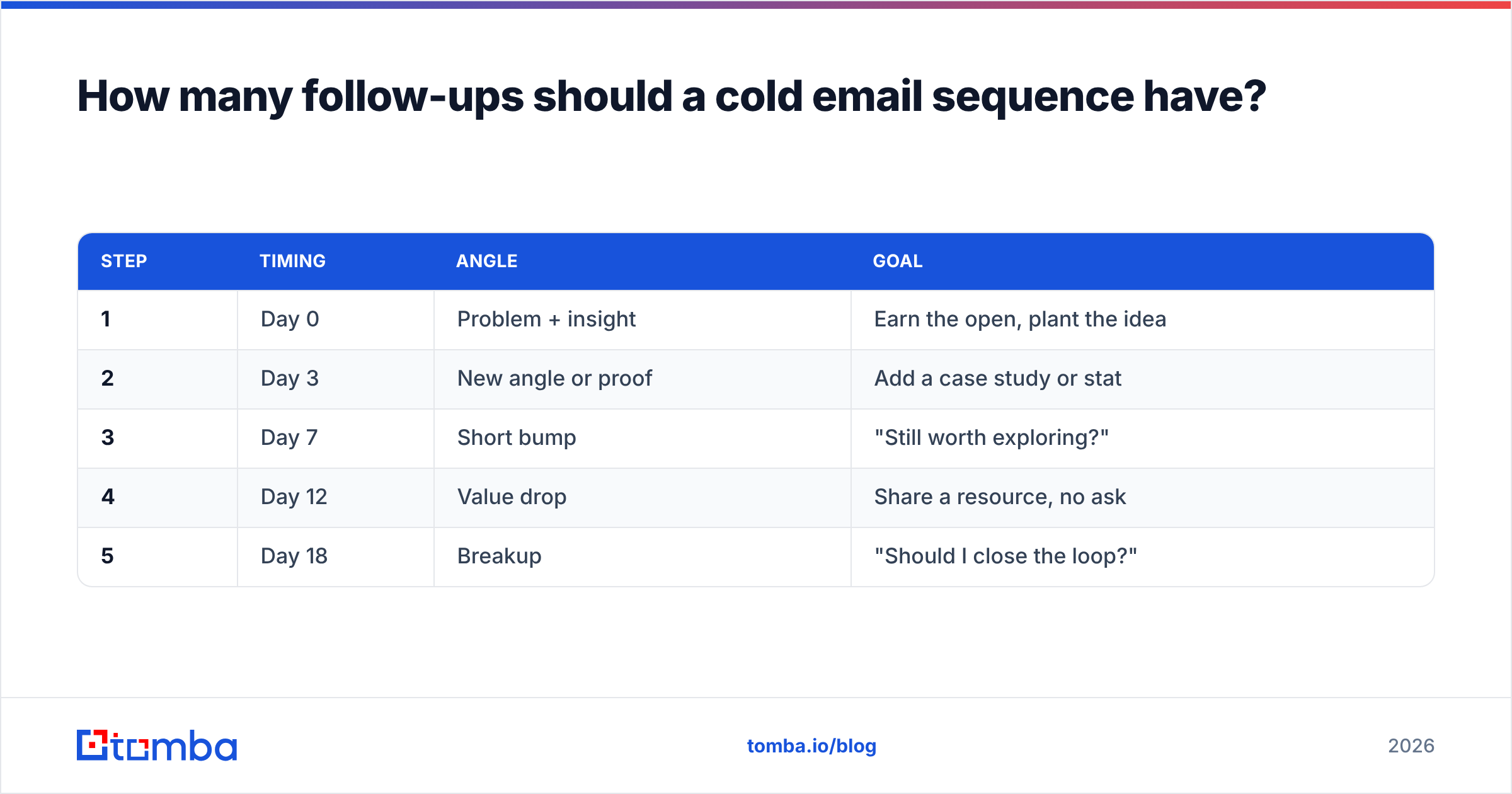
Three to five touches, spaced 2–4 days apart, is the sweet spot for most B2B outreach. The data is consistent across every serious study: the majority of positive replies arrive after the first email. People are busy, your message gets buried, and a gentle bump on day 3 catches them at a better moment.
Here's a sequence structure that works without being annoying:
| Step | Timing | Angle | Goal |
|---|---|---|---|
| 1 | Day 0 | Problem + insight | Earn the open, plant the idea |
| 2 | Day 3 | New angle or proof | Add a case study or stat |
| 3 | Day 7 | Short bump | "Still worth exploring?" |
| 4 | Day 12 | Value drop | Share a resource, no ask |
| 5 | Day 18 | Breakup | "Should I close the loop?" |
Two rules keep follow-ups from becoming spam. First, never just "bumping this to the top" — each touch should add a new reason to reply. Second, the breakup email works precisely because it removes pressure; the "should I close the loop?" message reliably surfaces the fence-sitters. And always stop the sequence the instant someone replies, positive or negative.
What metrics tell you a cold email campaign is working?#
Track leading and lagging indicators separately so you can diagnose where a campaign breaks. Open rate tells you about deliverability and subject lines. Reply rate tells you about targeting and copy. Positive reply rate tells you about fit and offer.
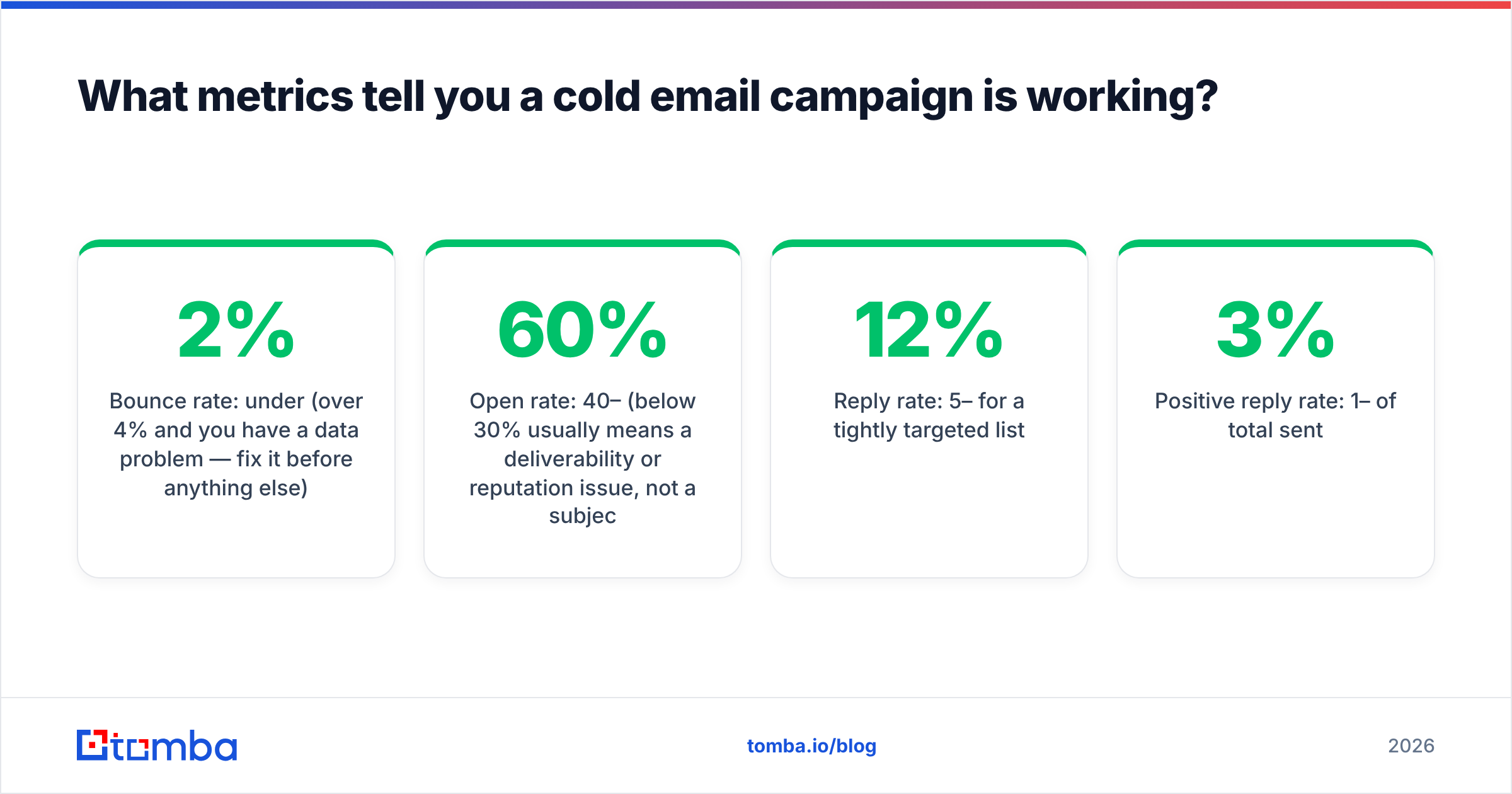
Realistic benchmarks for a well-run 2026 campaign look roughly like this:
- Bounce rate: under 2% (over 4% and you have a data problem — fix it before anything else)
- Open rate: 40–60% (below 30% usually means a deliverability or reputation issue, not a subject-line issue)
- Reply rate: 5–12% for a tightly targeted list
- Positive reply rate: 1–3% of total sent
- Meetings booked: the only number that actually matters
A note of honesty about open rates: Apple Mail Privacy Protection and similar features inflate opens with automated pixel fires. Treat open rate as a directional signal, not gospel, and anchor your decisions on replies and meetings. If your reply rate is healthy but opens look weird, trust the replies.
How does data quality connect to every part of cold email?#
Data quality is the thread running through this entire guide, so it's worth making explicit: your list is your ceiling. Deliverability, reply rate, and reputation all trace back to whether you're emailing real people who actually have the problem you solve.
That's why the smartest cold email operators front-load their effort into sourcing and verification. They use a domain search to map the right contacts at target accounts, find verified email addresses, and run everything through verification before the first send. It's less glamorous than testing subject lines, but it's the work that compounds. You can dig into where accurate contact data actually comes from on Tomba's data sources page.
The teams that win at cold email in 2026 aren't the ones with the cleverest copy. They're the ones who treat outreach as a data discipline: narrow targeting, verified addresses, warmed domains, relevant messages, and disciplined follow-up. Get those five right and the "secret" subject lines stop mattering — because you're simply sending wanted mail to the right people.
Start with the right data#
Everything in this guide compounds off one thing: a clean, targeted list of verified prospects. If you're spinning up cold outreach — or rescuing a campaign that's bouncing and landing in spam — start there. Use the Tomba Email Finder to find professional email addresses by name, domain, or company, verify them in the same workflow, and only feed real, deliverable contacts into your sequencing tool. You can test it on the free tier (25 searches/month), and scale up through Tomba's plans — Starter at $49/mo, Growth at $99/mo — as your outreach grows. Better data in, more meetings out.
Related guides#
Ready to find emails that actually work?
Join 150,000+ professionals who stopped guessing and started sending. Free credits on signup — no credit card required.
Get the Tomba newsletter
Practical outbound tactics and product updates — once every two weeks.
About the author