Cold Email in 2026: The Complete Playbook That Still Works
Cold email isn't dead — but the 2022 playbook is. Here's what actually books meetings in 2026: targeting, deliverability, copy, and the tools that make it work.
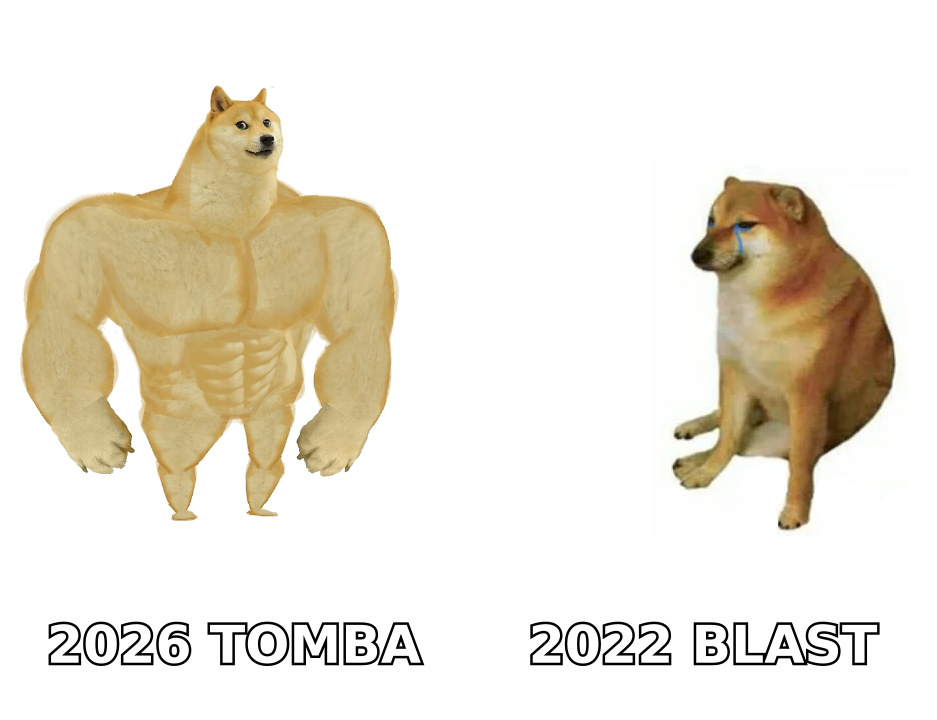
If you cut and pasted a cold email sequence from 2022 and hit send today, you would land in spam, get flagged by Google's bulk-sender rules, and watch your reply rate crater. The channel still works. The old playbook does not.
This guide separates what has aged badly from what still books meetings in 2026 — targeting, deliverability, copy, and the stack that ties them together.
TL;DR#
- Cold email is not dead — but the 2022 "blast 5,000 contacts" motion is. Volume without hygiene now triggers Google and Yahoo bulk-sender enforcement and kills your domain.
- Deliverability is the whole game. SPF, DKIM, DMARC, a warmed domain, and a verified list matter more than clever copy.
- Targeting beats volume. 200 well-researched, verified contacts outperform 5,000 scraped guesses.
- Copy got shorter and more specific. Relevance and a single clear ask win; "hope this finds you well" loses.
- The tooling changed. A verified email finder plus a verifier is now table stakes, not a nice-to-have.
Is cold email still worth it in 2026?#
Yes — when it is done right, cold email remains one of the cheapest ways to start a B2B conversation with someone who has never heard of you. There is no ad spend, no gatekeeper, and no algorithm deciding who sees your message.
The catch is that "done right" now means something very different than it did in 2022. Back then you could buy a list, load it into a sequencer, and send thousands of near-identical emails per day. Inbox providers tolerated it. Buyers half-tolerated it. That window has closed.
In February 2024, Google and Yahoo rolled out bulk sender requirements that made authentication and low spam-complaint rates mandatory for anyone sending volume. Enforcement has only tightened since. The senders who survived did not send more — they sent cleaner, to better lists, with real infrastructure behind them.
So the honest answer is: cold email is alive, but it now rewards operators and punishes spammers far more sharply than it used to. That is good news if you are willing to do the work.
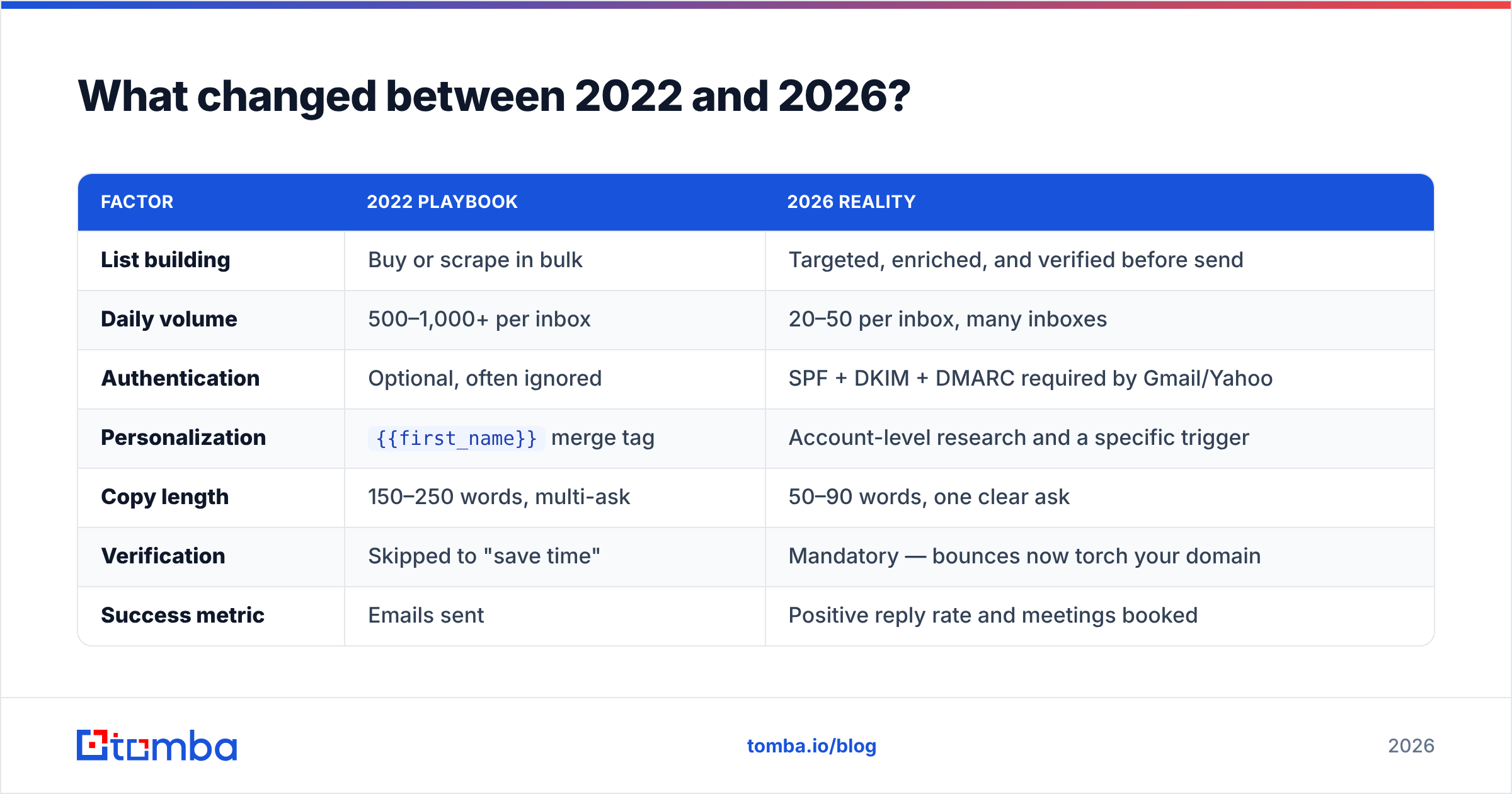
What changed between 2022 and 2026?#
The shift is easiest to see side by side. Almost every lever that mattered has moved.
| Factor | 2022 Playbook | 2026 Reality |
|---|---|---|
| List building | Buy or scrape in bulk | Targeted, enriched, and verified before send |
| Daily volume | 500–1,000+ per inbox | 20–50 per inbox, many inboxes |
| Authentication | Optional, often ignored | SPF + DKIM + DMARC required by Gmail/Yahoo |
| Personalization | {{first_name}} merge tag |
Account-level research and a specific trigger |
| Copy length | 150–250 words, multi-ask | 50–90 words, one clear ask |
| Verification | Skipped to "save time" | Mandatory — bounces now torch your domain |
| Success metric | Emails sent | Positive reply rate and meetings booked |
The through-line: every 2026 improvement trades raw quantity for quality and safety. If your process still optimizes for "how many can I send," you are running a strategy that inbox providers are actively working to block.
Why does deliverability matter more than copy now?#
Because the best-written email in the world earns you nothing if it lands in spam. Deliverability is the gate every other tactic sits behind.
Think of it like a nightclub. Your copy is how well you dress. But sender reputation is the bouncer at the door — if he does not like the look of your domain, your outfit never gets seen. In 2026, that bouncer is stricter and has a longer memory.
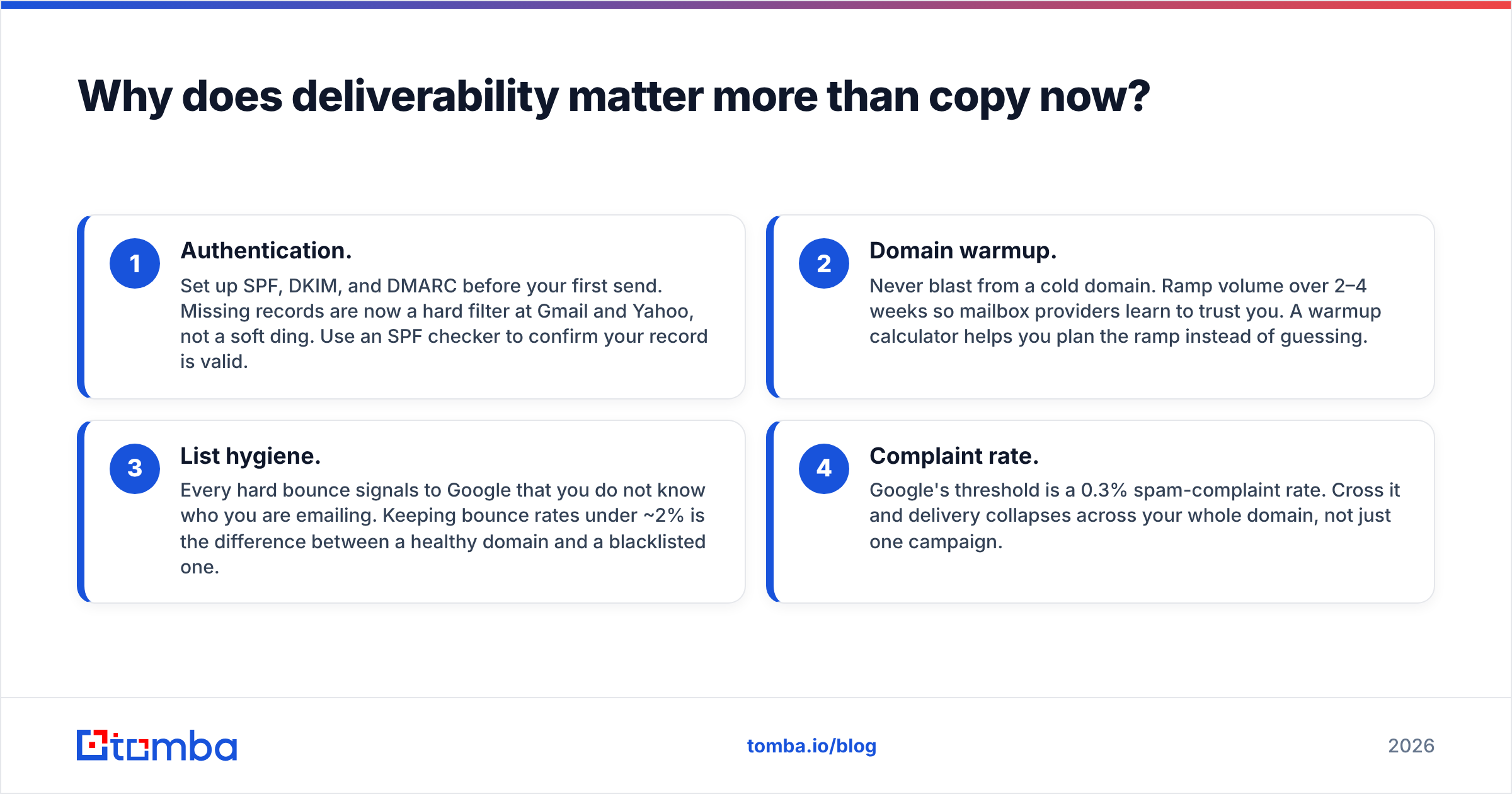
Four things keep you off the list:
- Authentication. Set up SPF, DKIM, and DMARC before your first send. Missing records are now a hard filter at Gmail and Yahoo, not a soft ding. Use an SPF checker to confirm your record is valid.
- Domain warmup. Never blast from a cold domain. Ramp volume over 2–4 weeks so mailbox providers learn to trust you. A warmup calculator helps you plan the ramp instead of guessing.
- List hygiene. Every hard bounce signals to Google that you do not know who you are emailing. Keeping bounce rates under ~2% is the difference between a healthy domain and a blacklisted one.
- Complaint rate. Google's threshold is a 0.3% spam-complaint rate. Cross it and delivery collapses across your whole domain, not just one campaign.
This is exactly why verification stopped being optional. Sending to unverified addresses is the fastest way to rack up bounces and complaints. Running your list through an email verifier before a campaign is now basic hygiene, like washing your hands before surgery.
How do you build a cold email list that actually converts?#
Start narrow and go deep, not wide and shallow. The single biggest upgrade you can make over the 2022 approach is to shrink your list and enrich it.
A high-converting list in 2026 has three properties:
- Tightly defined ICP. Every contact matches a specific title, company size, industry, and trigger — not a vague "decision-makers" bucket.
- Verified addresses. Each email is confirmed deliverable before it enters your sequencer, so bounces stay near zero.
- Enrichment context. You know something about the account — a recent hire, a funding round, a tech-stack signal — that gives you a reason to reach out now.
The workflow looks like this: define the account list, find the right person at each account, pull their verified work email, then enrich with a trigger you can reference in the first line. A good email finder collapses the middle two steps — you give it a name and domain, and it returns the verified professional address, so you are not guessing at firstname@company.com formats and eating the bounces when you get them wrong.
For teams building at scale, data enrichment layers firmographic and contact detail onto a raw account list so your reps open every email with relevance instead of a template.
What does a cold email that gets replies look like in 2026?#
Short, specific, and built around one ask. The modern high-reply email respects the reader's time and proves you did your homework in the first sentence.
Here is the anatomy that consistently works:
- Subject line: 2–4 words, lowercase, curiosity or relevance. No "Quick question re: your Q3 revenue growth strategy." Test variations before you commit — a subject line tester removes the guesswork.
- Opener: a specific, earned observation. Reference the trigger you enriched — "Saw you just opened a second office in Austin" — not "I hope this email finds you well."
- Body: one problem, one proof point. State the pain you solve and one credible number. Keep it to two or three sentences.
- CTA: a single, low-friction ask. "Worth a 15-minute call next Tuesday?" beats "Let me know your thoughts on scheduling a demo to discuss synergies."
- Signature: human and minimal. A real name, a title, and no ten-line HTML banner that trips spam filters.
The whole thing should read in under ten seconds. If you would not reply to it from a stranger, neither will your prospect. HubSpot's research on sales email benchmarks has consistently shown shorter, personalized messages outperform long pitches — and that gap has only widened as inboxes got busier.
If you are starting from scratch, a library of cold email templates gives you proven structures to adapt rather than reinventing the frame every time. Use them as scaffolding, then rewrite the opener for each account. Templates set the bones; your research supplies the muscle.
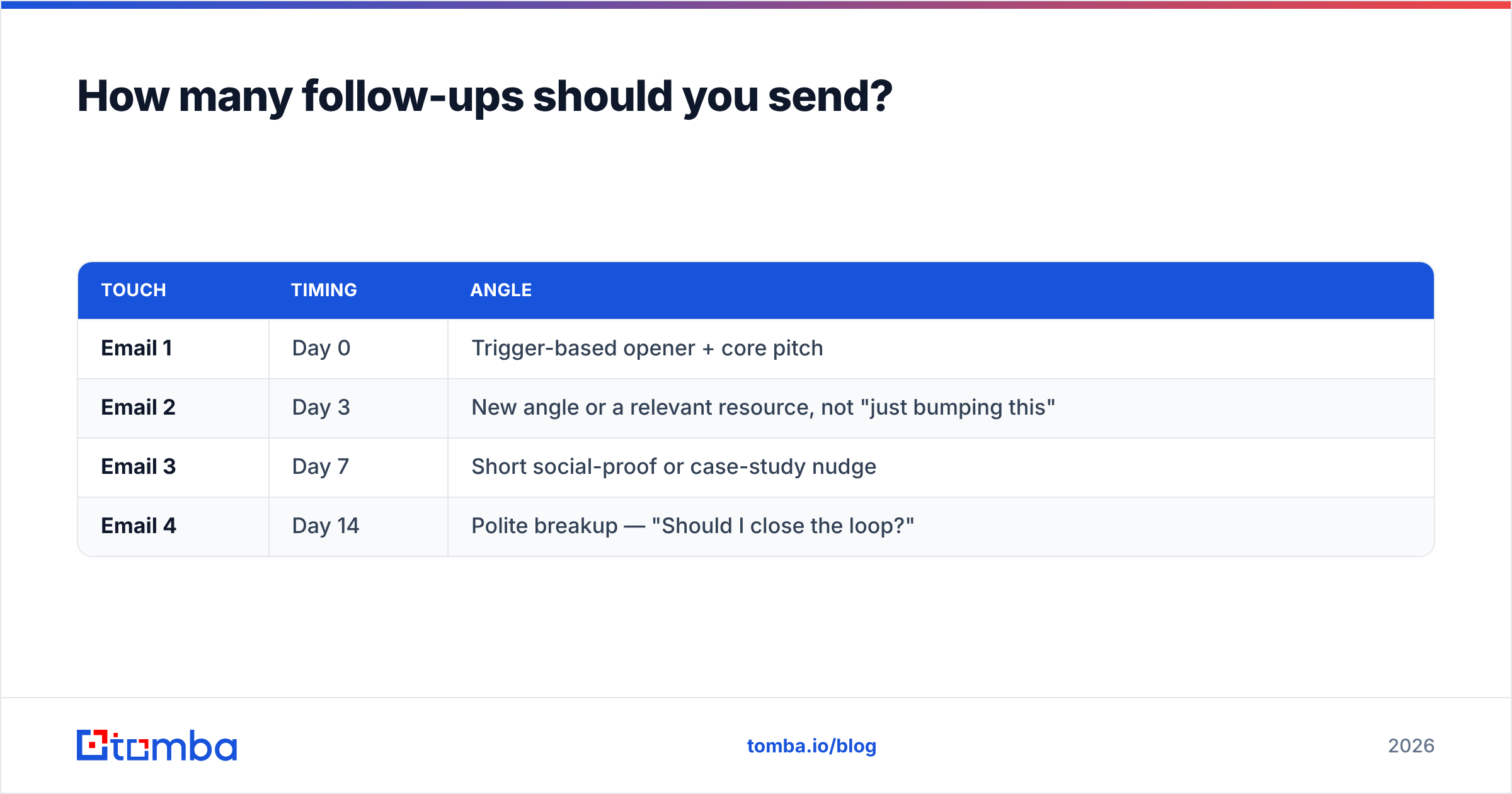
How many follow-ups should you send?#
Two to four, spaced out, each adding new value. Most positive replies come after the first email, not on it — but there is a hard limit past which follow-ups become nagging.
A sane 2026 cadence:
| Touch | Timing | Angle |
|---|---|---|
| Email 1 | Day 0 | Trigger-based opener + core pitch |
| Email 2 | Day 3 | New angle or a relevant resource, not "just bumping this" |
| Email 3 | Day 7 | Short social-proof or case-study nudge |
| Email 4 | Day 14 | Polite breakup — "Should I close the loop?" |
Notice what is missing: the "did you see my last email?" guilt-trip. Every follow-up should stand on its own and give the reader a fresh reason to respond. If you have nothing new to say, do not send.
Spacing matters as much as count. Same-day or next-day follow-ups read as desperate and increase complaint risk. Give people room to be busy.
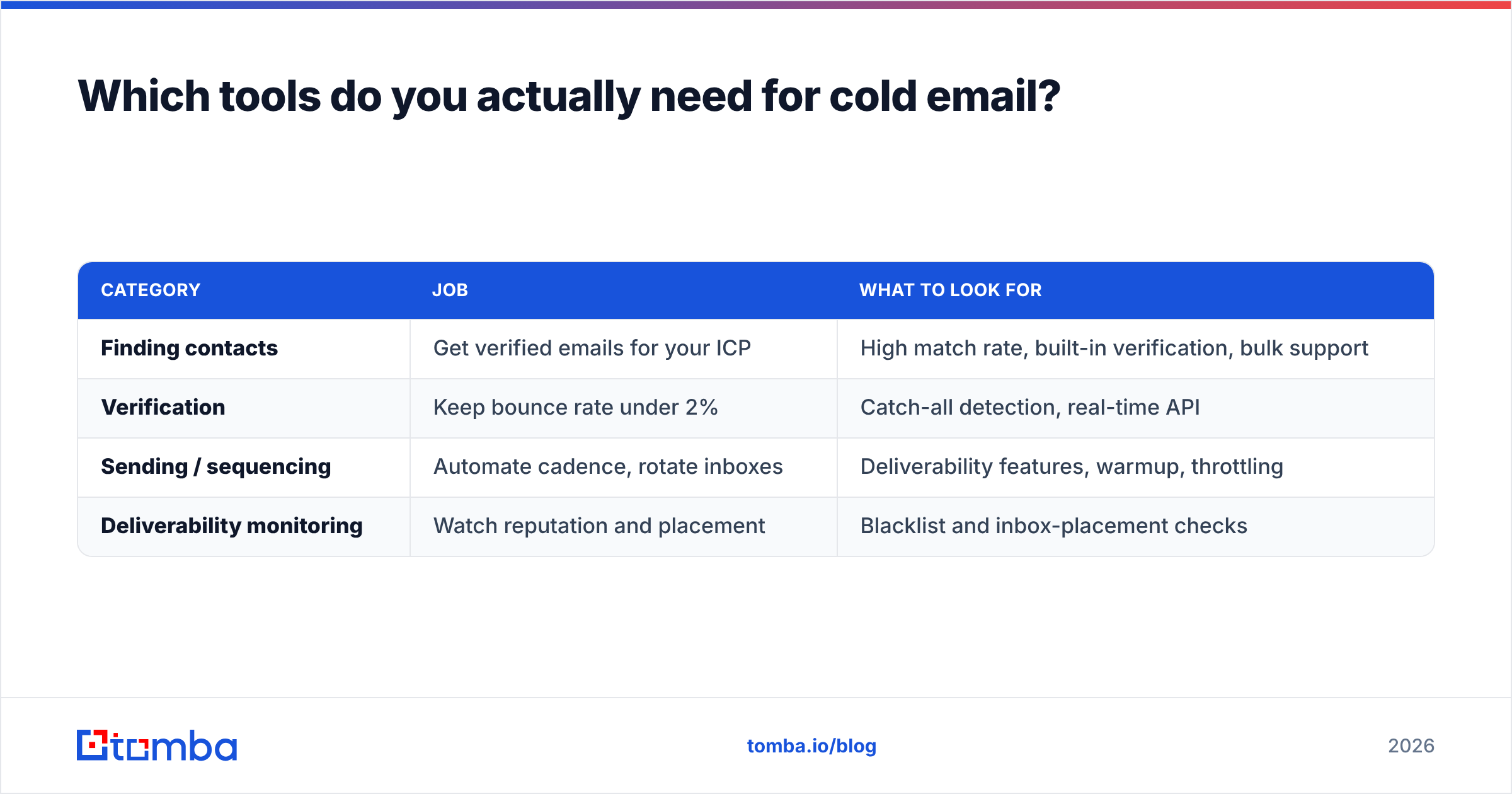
Which tools do you actually need for cold email?#
Fewer than the average "sales stack" listicle would have you believe, but the ones you need, you need to get right. The 2026 essentials fall into four buckets.
| Category | Job | What to look for |
|---|---|---|
| Finding contacts | Get verified emails for your ICP | High match rate, built-in verification, bulk support |
| Verification | Keep bounce rate under 2% | Catch-all detection, real-time API |
| Sending / sequencing | Automate cadence, rotate inboxes | Deliverability features, warmup, throttling |
| Deliverability monitoring | Watch reputation and placement | Blacklist and inbox-placement checks |
You do not need a $15,000-a-year all-in-one to start. What you cannot skip is the find-and-verify layer, because everything downstream depends on a clean list. Tomba covers that layer with an email finder, verifier, and bulk email finder on a single plan, starting free (25 searches a month) and scaling to a $49/mo Starter tier — you can see the full Tomba pricing breakdown before committing.
Pair that with a dedicated sending tool that handles inbox rotation and warmup, and a monitoring habit — checking your domain against a blacklist checker weekly — and you have a stack that holds up under 2026 enforcement without breaking the budget. For an outside benchmark on any tool you evaluate, cross-reference verified reviews on G2 rather than trusting vendor claims.
What mistakes still kill cold email campaigns?#
The failure modes are predictable, and most are holdovers from the 2022 mindset. Avoid these and you are ahead of most senders:
- Sending from your main domain. One bad campaign can poison the domain your whole company relies on. Use a separate sending domain.
- Skipping verification. The number-one cause of blacklisting. Non-negotiable in 2026.
- Volume before warmup. Blasting from a cold inbox is the fastest self-inflicted death.
- One-size-fits-all copy. Merge tags are not personalization. Account-level relevance is.
- No unsubscribe path. Google's bulk rules require one-click unsubscribe. Ignoring it is now a compliance problem, not just a courtesy.
- Measuring the wrong thing. "Emails sent" is a vanity metric. Track positive replies and meetings booked.
Every one of these traces back to treating cold email as a numbers game instead of a relevance game. The senders winning in 2026 flipped that assumption years ago.
The bottom line#
Cold email in 2026 is a precision channel, not a volume channel. Authenticate your domain, warm it up, target a narrow ICP, verify every address, write short and specific, and follow up with fresh value. Do that and the channel still delivers meetings at a cost per opportunity that paid ads cannot touch.
The foundation of all of it is a clean, verified list — and that starts with finding the right email addresses instead of guessing them. Try the Tomba Email Finder free, pull verified professional emails for your ICP, and give your 2026 campaigns the deliverability they need to actually land. Your domain reputation will thank you.
Related guides#
Ready to find emails that actually work?
Join 150,000+ professionals who stopped guessing and started sending. Free credits on signup — no credit card required.
Get the Tomba newsletter
Practical outbound tactics and product updates — once every two weeks.
About the author