Cold Email in 2026: The Complete Guide to Getting Replies
Cold email still books meetings in 2026 — but only if your list is clean, your domain is warm, and your copy respects the reader. Here's the full playbook.
Cold email is not dead. Bad cold email is dead — and there is a lot of it. In 2026, inbox providers filter harder, buyers ignore faster, and a sloppy campaign can torch a sending domain in a week. But a tight, well-targeted cold email still lands meetings that ads and content can't touch, at a fraction of the cost.
This guide is the practical version: what changed, what still works, and the exact sequence to send a cold email that gets opened, read, and answered.
TL;DR — Cold Email in 2026 at a Glance#
- Deliverability is the whole game. Verified lists, a warmed domain, and correct SPF/DKIM/DMARC matter more than clever copy.
- Volume is out; relevance is in. Google and Microsoft now throttle bulk senders aggressively — 20 sharp emails beat 2,000 blasts.
- One clear ask per email. No brochure, no five links, no "quick call?" with a Calendly wall.
- Personalization must be real. A merge tag with a first name is not personalization; a line about their actual role or company is.
- Measure replies, not opens. Apple and privacy proxies broke open tracking years ago. Positive reply rate is the only metric that pays.
What Is Cold Email, Really?#
Cold email is a one-to-one message sent to someone who hasn't asked to hear from you, with a specific, relevant reason for reaching out. That last clause is what separates it from spam.
Think of it like knocking on a stranger's door. If you knock, shout a script, and shove a flyer in their face, you get the door slammed. If you knock, say "I noticed your shop still uses paper invoices and I fix exactly that," you get a conversation. The email is the same — the difference is whether you did your homework before you knocked.
Legally, cold email is permitted in most B2B contexts under CAN-SPAM (US) and legitimate-interest provisions of GDPR (EU), provided you identify yourself, offer an opt-out, and target business addresses with a genuine reason. It is not the same as unsolicited consumer spam, and treating it that way — both legally and tonally — is where senders get burned.
Why Do Most Cold Emails Fail in 2026?#
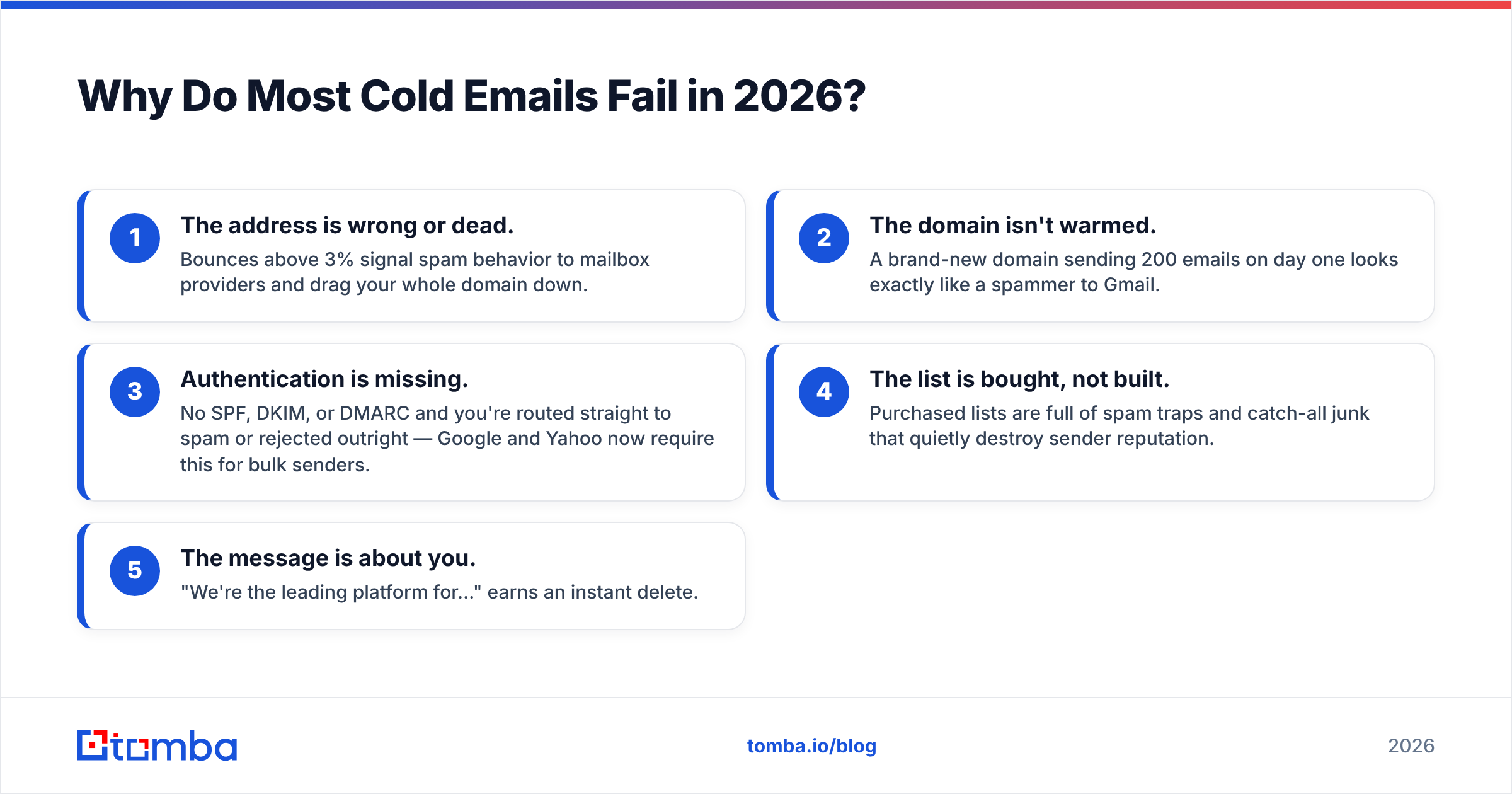
They fail before the copy is ever read. Here is the order in which things break:
- The address is wrong or dead. Bounces above 3% signal spam behavior to mailbox providers and drag your whole domain down.
- The domain isn't warmed. A brand-new domain sending 200 emails on day one looks exactly like a spammer to Gmail.
- Authentication is missing. No SPF, DKIM, or DMARC and you're routed straight to spam or rejected outright — Google and Yahoo now require this for bulk senders.
- The list is bought, not built. Purchased lists are full of spam traps and catch-all junk that quietly destroy sender reputation.
- The message is about you. "We're the leading platform for…" earns an instant delete.
Notice that four of the five failures happen before copywriting. That's the point most people miss. You can write like Ogilvy and still hit spam if the plumbing is broken. Start by making sure your list is real — run it through an email verifier before a single send, and confirm any risky domains with a catch-all verifier so you're not guessing.
What Does a Cold Email That Works Actually Look Like?#
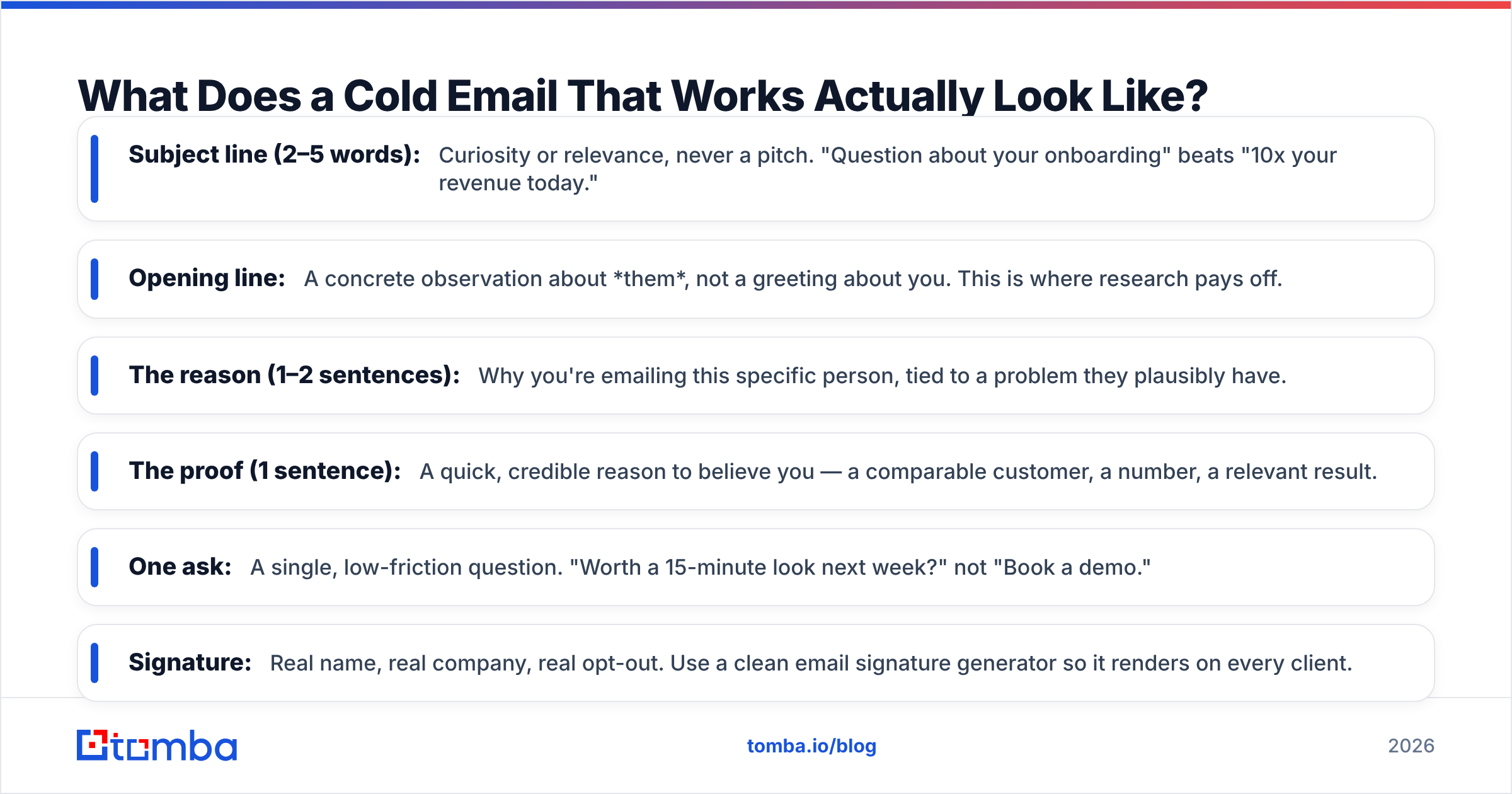
Short. Specific. Human. Here's the anatomy that consistently earns replies in 2026:
- Subject line (2–5 words): Curiosity or relevance, never a pitch. "Question about your onboarding" beats "10x your revenue today."
- Opening line: A concrete observation about them, not a greeting about you. This is where research pays off.
- The reason (1–2 sentences): Why you're emailing this specific person, tied to a problem they plausibly have.
- The proof (1 sentence): A quick, credible reason to believe you — a comparable customer, a number, a relevant result.
- One ask: A single, low-friction question. "Worth a 15-minute look next week?" not "Book a demo."
- Signature: Real name, real company, real opt-out. Use a clean email signature generator so it renders on every client.
The whole thing should fit on a phone screen without scrolling. If your draft has three paragraphs and a bulleted feature list, you've written a landing page, not a cold email.
How Do the Main Cold Email Approaches Compare?#
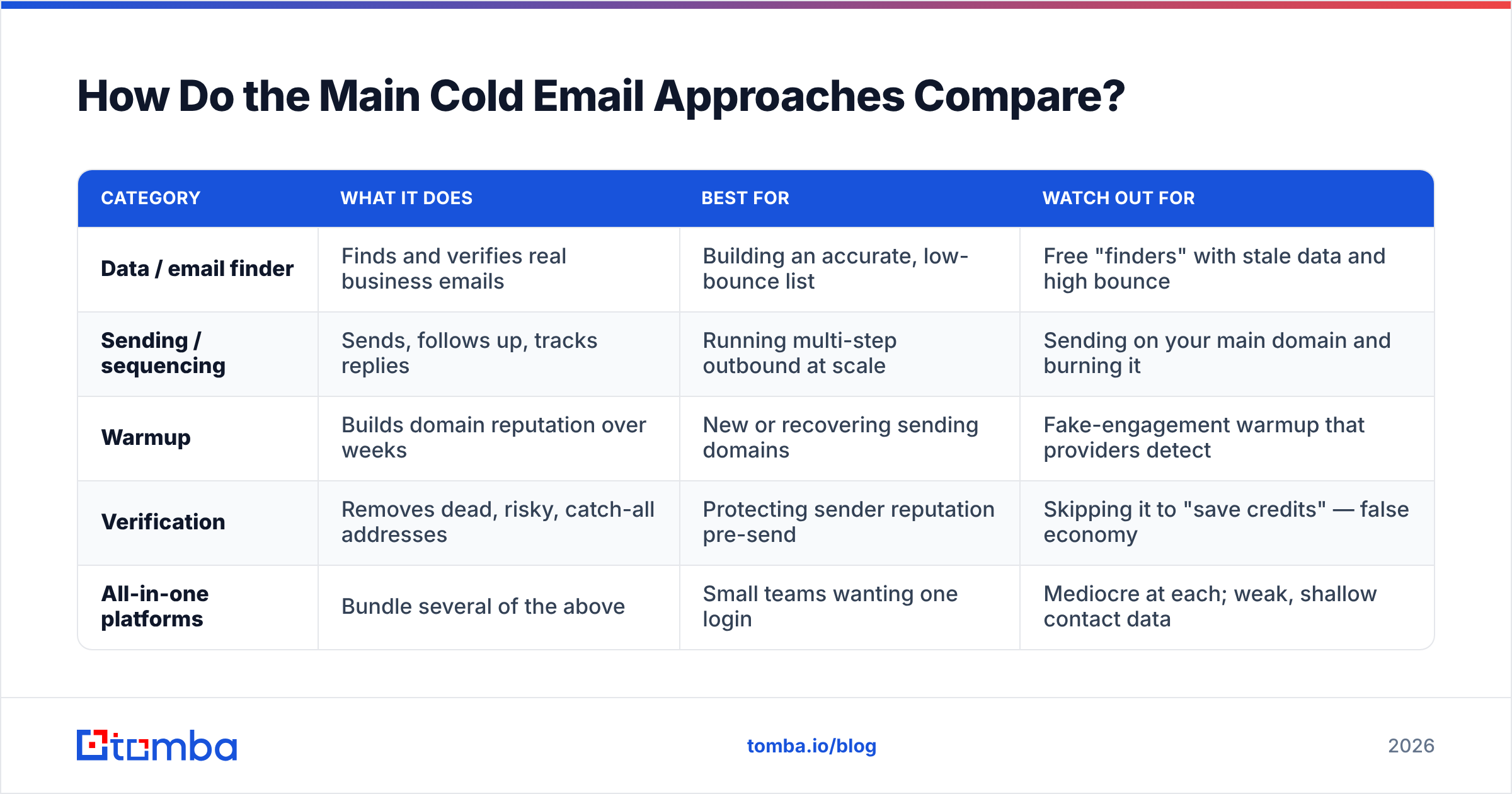
Not every "cold email tool" does the same job. Some find and verify contacts, some send and sequence, some do warmup. Mixing them up is why people overpay for one and skip the other. Here's how the categories stack up:
| Category | What it does | Best for | Watch out for |
|---|---|---|---|
| Data / email finder | Finds and verifies real business emails | Building an accurate, low-bounce list | Free "finders" with stale data and high bounce |
| Sending / sequencing | Sends, follows up, tracks replies | Running multi-step outbound at scale | Sending on your main domain and burning it |
| Warmup | Builds domain reputation over weeks | New or recovering sending domains | Fake-engagement warmup that providers detect |
| Verification | Removes dead, risky, catch-all addresses | Protecting sender reputation pre-send | Skipping it to "save credits" — false economy |
| All-in-one platforms | Bundle several of the above | Small teams wanting one login | Mediocre at each; weak, shallow contact data |
The takeaway: a great sequencing tool with a dirty list still fails, and a clean list sent from a cold domain still fails. You need the data layer and the sending layer working together. Most teams get the sending tool first and treat data as an afterthought — it should be the reverse.
How Do You Set Up Cold Email So It Lands?#
Do these in order. Skipping steps is the most common self-inflicted wound in outbound.
1. Use a separate sending domain. Never send cold email from your primary domain. Buy a lookalike (e.g. getcompany.com alongside company.com) so a reputation hit never touches your real business mail.
2. Authenticate it. Set up SPF, DKIM, and DMARC before sending anything. If you're unsure yours is correct, check the SPF record and confirm your DMARC policy is at least p=quarantine.
3. Warm the domain for 2–4 weeks. Ramp slowly — a handful of emails a day, climbing gradually. A simple email warmup calculator tells you how fast you can safely scale.
4. Build the list, then verify it. Pull targeted contacts with a real email finder, then verify every address so your bounce rate stays under 2%. This single step protects everything downstream — see why email deliverability lives or dies on list quality.
5. Cap volume and monitor reputation. Keep daily sends conservative per inbox, and watch your standing in Google Postmaster Tools. If spam complaints rise, stop and diagnose — don't push harder.
6. Write for one person. Draft each email as if it's going to a single named human. Then, and only then, scale.
What Should You Measure — and What Should You Ignore?#
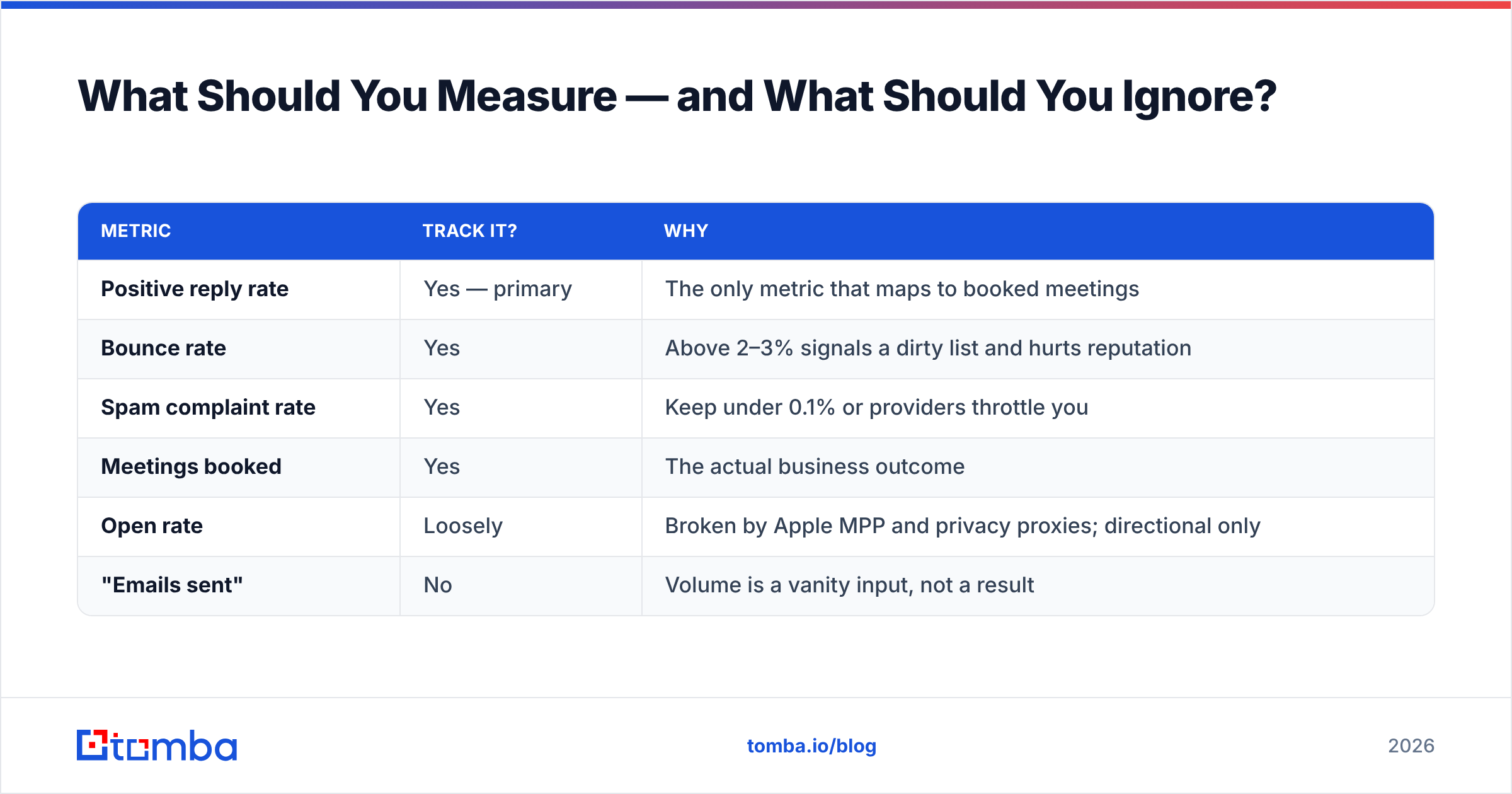
Measure the metrics that survive privacy changes and correlate with revenue:
| Metric | Track it? | Why |
|---|---|---|
| Positive reply rate | Yes — primary | The only metric that maps to booked meetings |
| Bounce rate | Yes | Above 2–3% signals a dirty list and hurts reputation |
| Spam complaint rate | Yes | Keep under 0.1% or providers throttle you |
| Meetings booked | Yes | The actual business outcome |
| Open rate | Loosely | Broken by Apple MPP and privacy proxies; directional only |
| "Emails sent" | No | Volume is a vanity input, not a result |
If your team still reports on open rate as a headline number, that's a 2019 dashboard. In 2026, opens are noise inflated by prefetching bots and privacy proxies. Anchor everything to replies and meetings. A campaign with a 4% open-rate drop but a higher reply rate is winning — the metric just can't see it.
How Many Follow-Ups Should a Cold Sequence Have?#
Two to four total touches, spaced 3–5 business days apart. More than that and you're pestering; fewer and you're leaving replies on the table — most positive responses come on the second or third email, not the first.
Each follow-up must add something: a new angle, a relevant resource, a shorter version of the ask. Never send "just bumping this to the top of your inbox" — it adds zero value and trains people to ignore you. If you need a starting structure, adapt proven cold email templates rather than writing from a blank page, and keep tightening based on what actually gets replies.
For a deeper look at sequencing benchmarks and what "good" response looks like, HubSpot's sales research and peer reviews on G2 are useful neutral references to calibrate against your own numbers.
Is Cold Email Still Worth It Compared to Ads and Content?#
Yes — for B2B, it remains the cheapest path to a qualified conversation, and it's the only channel where you choose exactly who you talk to. Ads rent attention and stop the moment you stop paying. Content compounds but takes months to rank. Cold email, done right, can book a meeting this week for the cost of a verified email and ten minutes of writing.
The catch is the phrase "done right." The reason cold email has a bad reputation is that the barrier to sending badly is near zero, so most of what lands in inboxes is garbage. That's actually good news for you: the bar is low, so a genuinely relevant, well-delivered message stands out immediately. When 95% of cold email is lazy spray-and-pray, the 5% that did their homework wins the reply by default.
The Bottom Line#
Cold email in 2026 rewards discipline, not volume. Verify your list, warm your domain, authenticate your sending, write one clear ask to one real person, and measure replies instead of opens. Do those things and cold email is still one of the highest-ROI channels in B2B. Skip them and you're just feeding the spam folder.
Everything downstream depends on the quality of the contacts you start with. If your emails are bouncing or landing in spam, the fix almost always begins with the data. Start there: use the Tomba Email Finder to build accurate, verified prospect lists by name, company, or domain — so every email you send has a real person on the other end and a real shot at a reply. Check the Tomba pricing plans, including a free tier of 25 searches a month, and clean up your list before your next send.
Related guides#
Ready to find emails that actually work?
Join 150,000+ professionals who stopped guessing and started sending. Free credits on signup — no credit card required.
Get the Tomba newsletter
Practical outbound tactics and product updates — once every two weeks.
About the author