Cold Email Agency vs In-House: The 2026 Buyer's Guide
Cold email agencies promise booked meetings on autopilot — but retainers run $2,000–$8,000/mo. Here's how to tell if an agency, a freelancer, or an in-house stack is the right call for your pipeline.
Hiring a cold email agency sounds like the shortcut every founder wants: hand off outbound, get meetings on the calendar, stop worrying about deliverability. Sometimes it works exactly like that. Often it doesn't — and you find out three months and $9,000 in retainers later.
This guide is the honest version. What a cold email agency actually does, what it costs in 2026, when it beats building in-house, and how to vet one so you don't buy a spray-and-pray operation dressed up as a "growth partner."
TL;DR#
- A cold email agency manages your outbound end to end: infrastructure, list building, copy, sending, and reporting — typically for a $2,000–$8,000/month retainer, often plus a per-meeting fee.
- Agencies win when you need speed, don't have an SDR, or lack deliverability expertise. In-house wins on cost, control, and long-term IP once your volume justifies it.
- The biggest risk is shared or low-quality data — bad lists tank your domain reputation no matter how good the agency's copy is.
- A hybrid setup (agency strategy + your own verified data via a tool like Tomba Email Finder) usually gives the best cost-to-control ratio.
- Vet on deliverability process, data sourcing, and reporting transparency — not on the number of "meetings booked" screenshots in their pitch deck.
What does a cold email agency actually do?#
A cold email agency runs the parts of outbound most teams get wrong. Think of it like hiring a general contractor instead of buying tools and framing the house yourself. You describe the outcome (booked demos with a specific buyer), and they assemble the pieces.
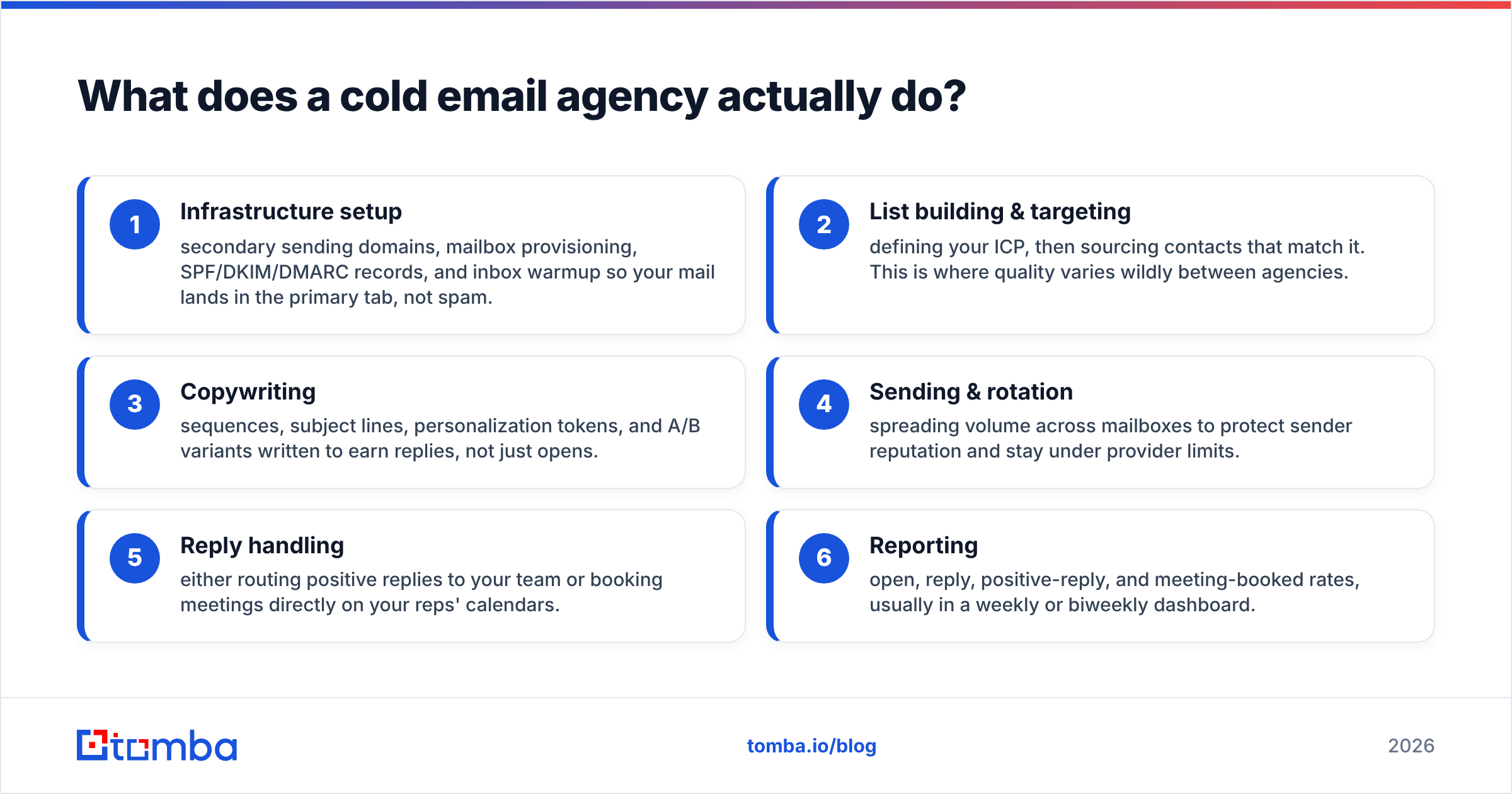
A full-service agency typically owns these six functions:
- Infrastructure setup — secondary sending domains, mailbox provisioning, SPF/DKIM/DMARC records, and inbox warmup so your mail lands in the primary tab, not spam.
- List building & targeting — defining your ICP, then sourcing contacts that match it. This is where quality varies wildly between agencies.
- Copywriting — sequences, subject lines, personalization tokens, and A/B variants written to earn replies, not just opens.
- Sending & rotation — spreading volume across mailboxes to protect sender reputation and stay under provider limits.
- Reply handling — either routing positive replies to your team or booking meetings directly on your reps' calendars.
- Reporting — open, reply, positive-reply, and meeting-booked rates, usually in a weekly or biweekly dashboard.
The value isn't any single task — it's that a good agency has already made the expensive mistakes (burned domains, blacklists, spam traps) on someone else's dime. You're paying to skip that learning curve.
How much does a cold email agency cost in 2026?#
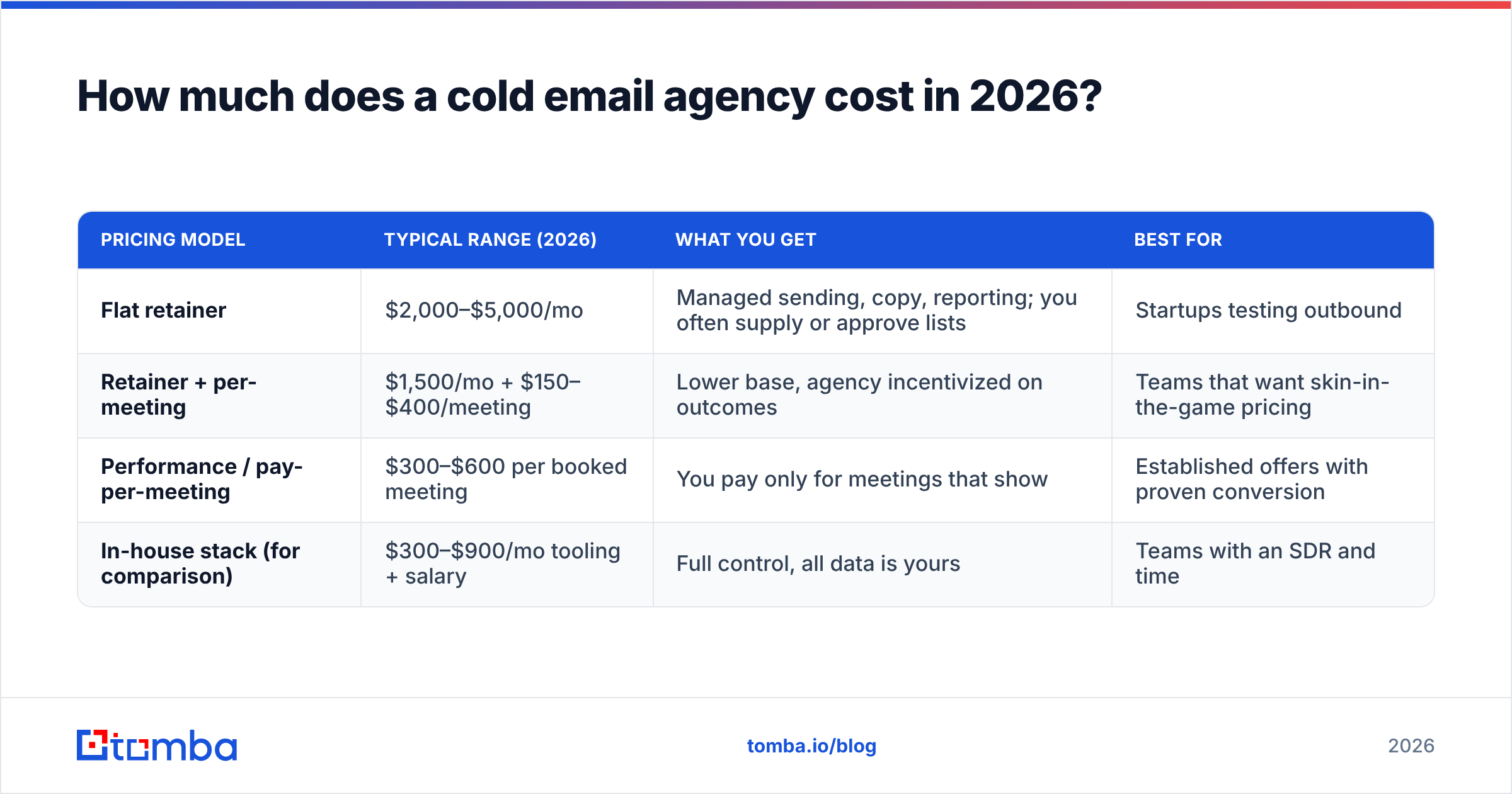
Pricing splits into three models, and the differences matter more than the headline number.
| Pricing model | Typical range (2026) | What you get | Best for |
|---|---|---|---|
| Flat retainer | $2,000–$5,000/mo | Managed sending, copy, reporting; you often supply or approve lists | Startups testing outbound |
| Retainer + per-meeting | $1,500/mo + $150–$400/meeting | Lower base, agency incentivized on outcomes | Teams that want skin-in-the-game pricing |
| Performance / pay-per-meeting | $300–$600 per booked meeting | You pay only for meetings that show | Established offers with proven conversion |
| In-house stack (for comparison) | $300–$900/mo tooling + salary | Full control, all data is yours | Teams with an SDR and time |
A few things the pricing pages won't shout about:
- Ramp time is real. Domains need 2–4 weeks of warmup before volume. Most agencies bill from day one, so month one is setup, not results.
- Performance pricing has a catch. "Per meeting" often means per booked meeting, not per held meeting. No-shows can still cost you.
- Data may be an add-on. Some agencies bundle contact data; others expect you to bring a verified list. If they're sourcing it, ask exactly how — this is the single biggest lever on your results.
For comparison, running outbound in-house with your own bulk email finder and an email verifier plus a sending tool lands well under $1,000/month in software. The difference is the labor and expertise you're replacing. See Tomba pricing to benchmark the data layer of a DIY stack against an agency retainer.
Is a cold email agency better than doing it in-house?#
Neither is universally better — it depends on three variables: your budget, whether you have someone to run outbound, and how fast you need pipeline.
Here's the honest trade-off:
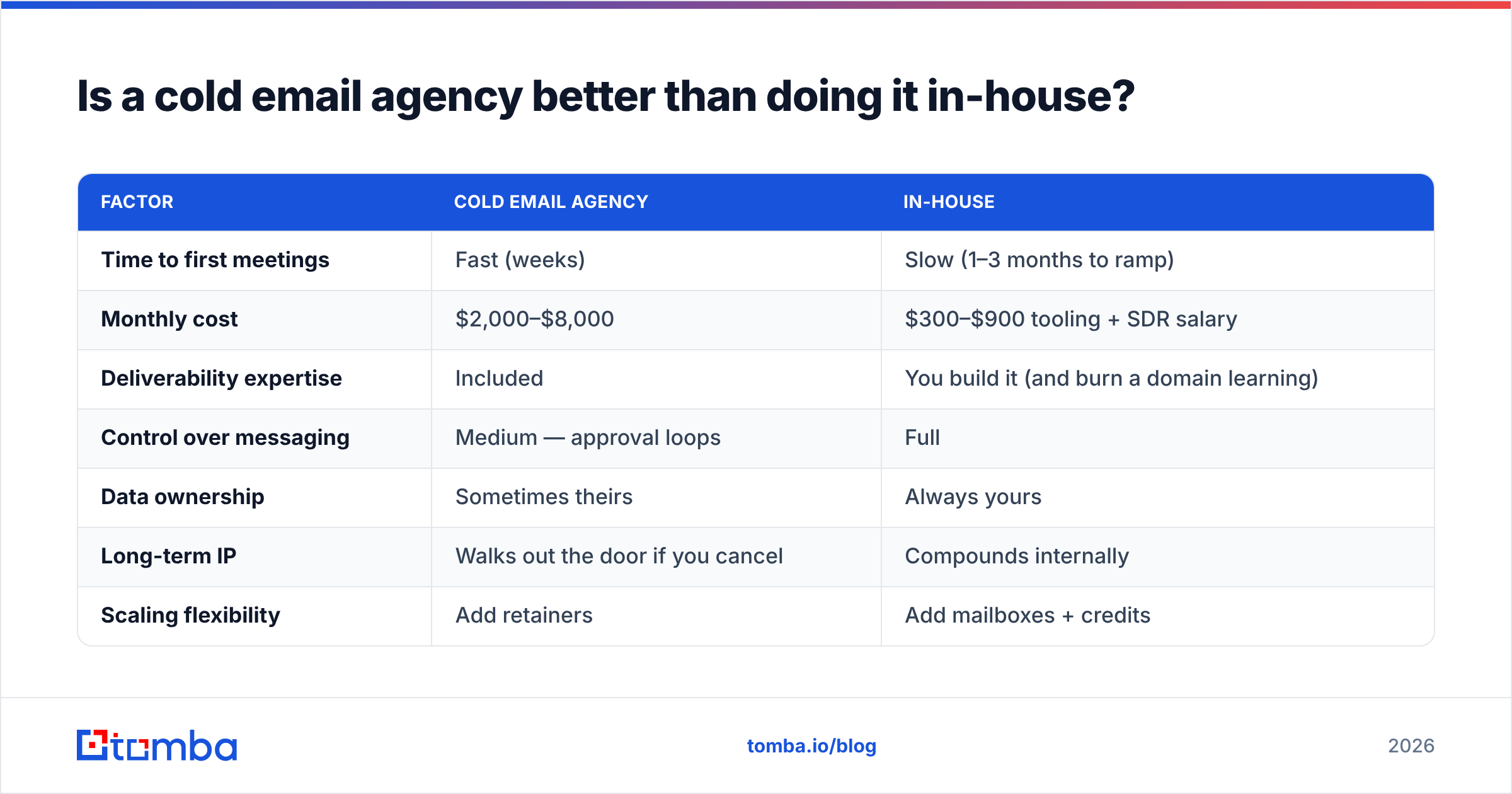
| Factor | Cold email agency | In-house |
|---|---|---|
| Time to first meetings | Fast (weeks) | Slow (1–3 months to ramp) |
| Monthly cost | $2,000–$8,000 | $300–$900 tooling + SDR salary |
| Deliverability expertise | Included | You build it (and burn a domain learning) |
| Control over messaging | Medium — approval loops | Full |
| Data ownership | Sometimes theirs | Always yours |
| Long-term IP | Walks out the door if you cancel | Compounds internally |
| Scaling flexibility | Add retainers | Add mailboxes + credits |
The pattern most successful teams follow: use an agency to learn, then bring it in-house once it works. An agency de-risks the first 90 days — you discover which segments respond, which offers convert, and what "good" deliverability feels like. Once that's proven, the economics flip. Paying $5,000/month indefinitely for something you now understand rarely makes sense.
The exception is teams that never want outbound as a core competency. If cold email is a channel you tolerate rather than own, keeping it fully outsourced is a legitimate choice.
What separates a good cold email agency from a spam factory?#
Most agencies pitch the same slide: reply-rate screenshots, a logo wall, a "proprietary" process. That tells you nothing. Here's what actually predicts results.
1. They interrogate your data sourcing. A serious agency asks where leads come from and insists on verification before sending. A red flag is any agency that scrapes giant lists and blasts them. Unverified sends produce bounces, and high bounce rates wreck email deliverability for every future campaign. Ask what their acceptable bounce rate is — under 3% is the honest answer.
2. They separate your sending domains. No competent agency sends cold volume from your primary domain. They register lookalike domains (yourbrand-mail.com) so a reputation hit never touches your real email. If they don't mention this unprompted, keep looking.
3. They report on replies, not opens. Since Apple Mail Privacy Protection made open rates unreliable, any agency still leading with "68% open rate" is selling a vanity metric. Positive reply rate and meetings held are the numbers that pay rent.
4. They own deliverability as a process, not a one-time setup. Warmup isn't "set and forget." Good agencies monitor blacklists, rotate mailboxes, and pull back volume when reputation dips. Ask how they respond when a domain starts landing in spam — the answer reveals whether they actually manage deliverability or just hope.
You can pressure-test any agency against public resources. HubSpot's cold email research and vendor reviews on G2 give you a baseline for realistic benchmarks, so you know when an agency's promised numbers are fantasy.
The data problem: why great agencies still fail#
Here's the part agencies underplay. Copy and infrastructure are commodities in 2026 — dozens of agencies do them competently. The variable that actually decides success is the quality of the list.
The math is unforgiving. If 20% of your contacts have invalid or outdated emails, one in five sends bounces. Mailbox providers read that bounce rate as a spam signal. Your placement drops, your good contacts stop seeing you, and no amount of clever subject-line testing recovers it. You paid for a campaign that poisoned its own well.
This is why the smartest arrangement is often a hybrid: let the agency handle strategy, copy, and sending, but control the data yourself. When you supply a verified list built from a source you trust, you remove the biggest failure point and you keep the asset — because those contacts stay in your CRM whether or not you renew the retainer.
Practical ways teams keep data ownership while still using an agency:
- Build targeted lists with a domain search to pull every relevant contact at an account, then verify before handoff.
- Run the full list through an email verifier so bounce rate stays under the 3% threshold agencies need.
- Enrich with direct dials via a phone finder so positive email replies can convert to calls fast.
Even fully outsourced, ask your agency to prove verification. "We verify all lists" should come with a bounce-rate guarantee in the contract, not a verbal promise.
When should you hire a cold email agency vs. a freelancer?#
Between "do it yourself" and "hire an agency" sits a third option: a specialist freelancer. Choosing among the three comes down to volume and complexity.
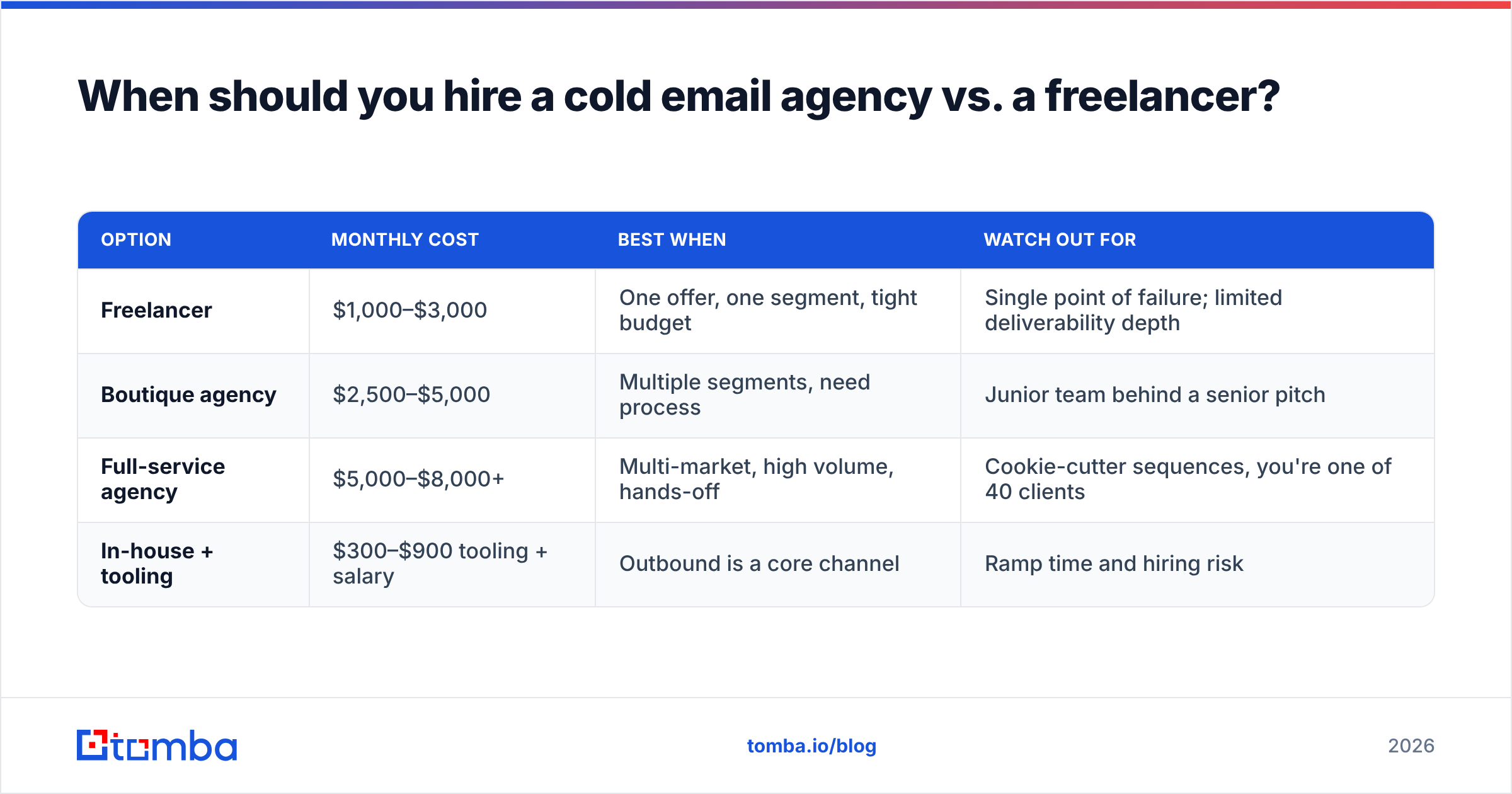
| Option | Monthly cost | Best when | Watch out for |
|---|---|---|---|
| Freelancer | $1,000–$3,000 | One offer, one segment, tight budget | Single point of failure; limited deliverability depth |
| Boutique agency | $2,500–$5,000 | Multiple segments, need process | Junior team behind a senior pitch |
| Full-service agency | $5,000–$8,000+ | Multi-market, high volume, hands-off | Cookie-cutter sequences, you're one of 40 clients |
| In-house + tooling | $300–$900 tooling + salary | Outbound is a core channel | Ramp time and hiring risk |
A freelancer is often the underrated pick for early-stage teams: cheaper than an agency, more focused than DIY, and you keep more control. The trade-off is bandwidth and redundancy — if your freelancer gets sick or busy, your pipeline stalls.
Whichever you choose, the underlying infrastructure — verified contacts, clean sending domains, warmed mailboxes — is identical. The only question is who operates it.
How do you vet a cold email agency before signing?#
Run this checklist before any contract. Skip it and you're gambling with your domain reputation.
- Ask for their bounce-rate standard. Under 3% signals disciplined verification. Vague answers signal spray-and-pray.
- Confirm domain separation. They should never send from your primary domain. Non-negotiable.
- Request a real reporting sample. Positive-reply and meetings-held numbers, not open rates. Redacted client data is fine; refusal is a flag.
- Clarify data ownership. Who owns the contacts and replies if you cancel? Get it in writing.
- Understand the ramp. A credible agency tells you month one is warmup, not results. Anyone promising meetings in week one is overselling.
- Check the escape hatch. Month-to-month or a short initial term beats a locked 12-month deal with an unproven partner.
Cross-reference their claims against neutral sources. Vendor comparison sites like Capterra and independent deliverability guides give you the benchmarks to spot inflated promises.
The bottom line: agency, hybrid, or in-house?#
Start with an agency or freelancer if you need pipeline now and lack in-house expertise — but treat it as a learning investment, not a permanent dependency. Move to hybrid the moment it works: keep the agency's operational muscle, but own your data and infrastructure. Go fully in-house once outbound proves itself as a core channel and the retainer stops making financial sense.
Across all three paths, the constant is data quality. The best copy in the world can't rescue a list full of dead addresses, and the cleanest infrastructure can't survive a 20% bounce rate.
That's the layer worth controlling yourself. Tomba's Email Finder lets you build verified, ICP-matched lists by domain, name, or company — with built-in verification so your bounce rate stays low and your sending reputation stays intact, whether you run outbound solo or hand a clean list to an agency. Start on the free tier (25 searches/month), scale to Starter at $49/month, and keep every contact you find. Because no matter who sends your cold email, the pipeline it produces is only as good as the data behind it.
Related guides#
// get started
Find, verify and enrich your first contacts today
Start on the free plan with 25 searches a month, then scale when your team is ready.
Free plan · No credit card required · GDPR & CCPA
// about the author