Cold Email AI Agent in 2026: How It Works and What to Use
A cold email AI agent promises to research, write, and send outreach for you. Here is how the technology actually works in 2026, where it breaks, and how to build a stack that books meetings instead of burning your domain.
TL;DR
- A cold email AI agent is software that chains together research, list building, copywriting, sending, and reply handling with minimal human input — it is autonomous outreach, not just a smarter template.
- The technology is real and useful, but the marketing is ahead of the results. An agent is only as good as the contact data and targeting you feed it.
- The biggest failure mode in 2026 is not bad copy — it is bad data. Guessed emails wreck deliverability faster than any AI can write your way out of it.
- The winning setup is hybrid: verified data + AI drafting + human review on the highest-value accounts.
- Build the stack in layers (data → sending infrastructure → agent logic), and treat the AI as one component, not the whole system.
Cold email AI agents are the loudest category in outbound right now. Every week another tool claims it will "run your entire pipeline while you sleep." Some of that is true. A lot of it is a mail-merge with a chatbot bolted on. This guide separates the two so you can decide what to actually adopt.
What is a cold email AI agent?#
A cold email AI agent is a system that performs multiple outreach steps on its own instead of waiting for you to click between tools. Think of it like a junior SDR who never sleeps: you give it an ideal customer profile, and it finds matching companies, pulls contacts, writes personalized first lines, schedules a sequence, sends from a warmed inbox, and drafts replies when prospects respond.
The key word is agent, not assistant. An assistant helps you write one email faster. An agent takes a goal ("book 10 demos with Series B fintech RevOps leaders") and decides which sub-tasks to run to get there. Under the hood, most of these products stitch together large language models with a set of tools — a data provider, an email-sending API, a CRM connector, and a scheduler — using a loop that plans, acts, checks the result, and adjusts.
Here is the practical breakdown of what a full agent does versus what a basic AI email writer does:
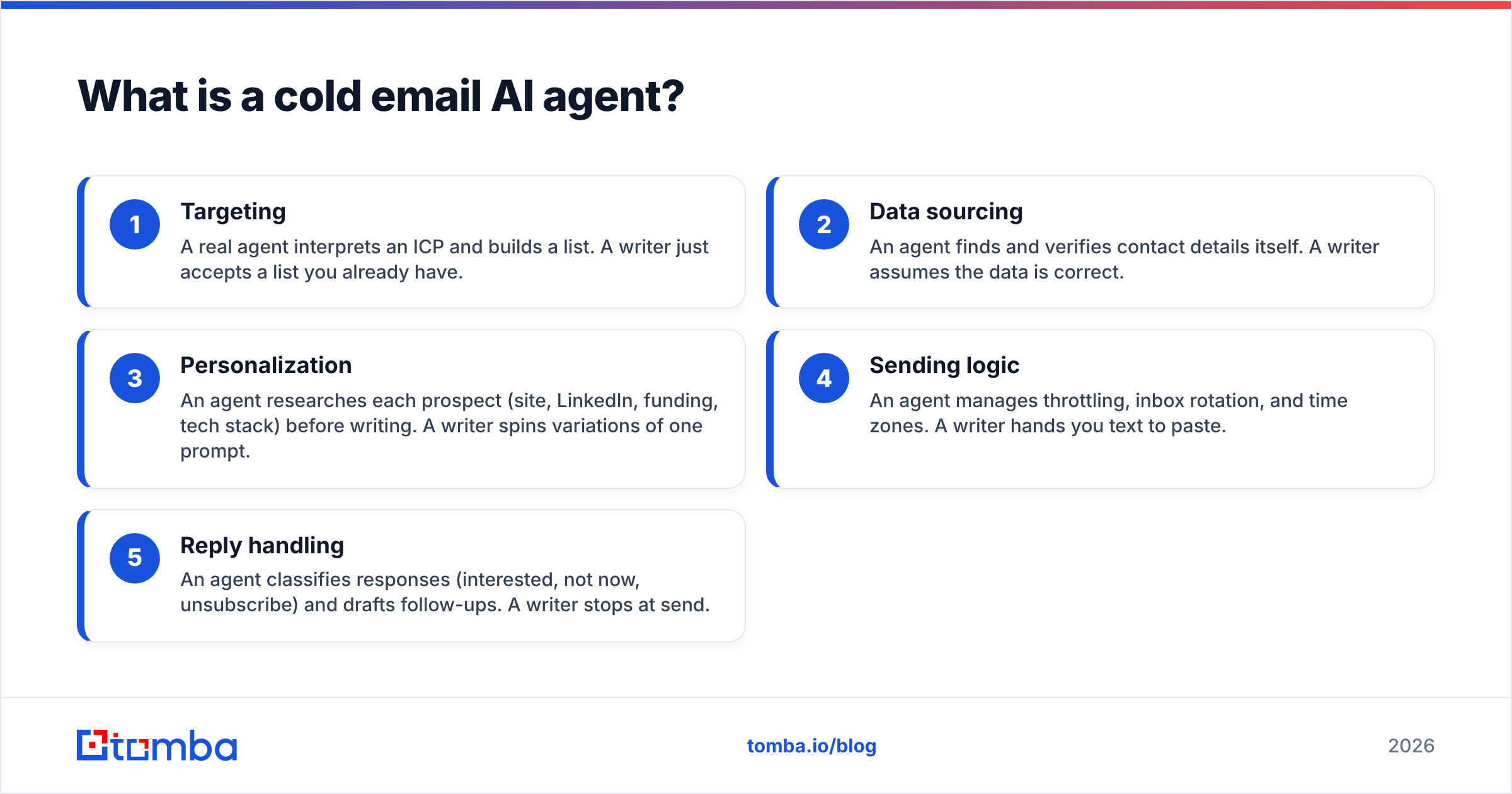
- Targeting — A real agent interprets an ICP and builds a list. A writer just accepts a list you already have.
- Data sourcing — An agent finds and verifies contact details itself. A writer assumes the data is correct.
- Personalization — An agent researches each prospect (site, LinkedIn, funding, tech stack) before writing. A writer spins variations of one prompt.
- Sending logic — An agent manages throttling, inbox rotation, and time zones. A writer hands you text to paste.
- Reply handling — An agent classifies responses (interested, not now, unsubscribe) and drafts follow-ups. A writer stops at send.
Most tools sold as "AI agents" only do steps 3 and 5 well. The steps that actually decide whether you book meetings — targeting and data — are where the category is weakest, and where you carry the most responsibility.
How does a cold email AI agent actually work?#
The workflow behind almost every cold email AI agent follows the same loop, whether the vendor calls it "autonomous," "agentic," or "AI SDR." Understanding the loop tells you exactly where quality leaks out.
First, the agent takes your instruction and turns it into a plan: define the segment, size the list, decide the sequence length. Next it calls a data source to build the list — this is where it needs an email finder and, critically, an email verifier so it does not send to addresses that will bounce. Then it enriches each contact with context, drafts copy per prospect, queues the sequence across warmed inboxes, and finally monitors replies to trigger the next action.
The reason data quality dominates everything is simple: an AI can write a beautiful email, but if 20% of the addresses are guessed or stale, mailbox providers see a spike in bounces and start routing you to spam. At that point your open rates collapse and no amount of clever copy recovers them. This is the single most common way AI outreach fails — the agent scales a data problem instead of a data solution.
The best-run agents solve this by treating verification as a hard gate. Every address is checked before it enters a send queue, catch-all domains are flagged, and risky contacts are dropped rather than gambled on. If a tool cannot show you how it verifies data, assume it does not — and assume your domain reputation is the collateral.
What can a cold email AI agent do well in 2026?#
Used correctly, these agents genuinely save hours and, in some workflows, improve results over manual outreach. Here is where the technology has earned its place:
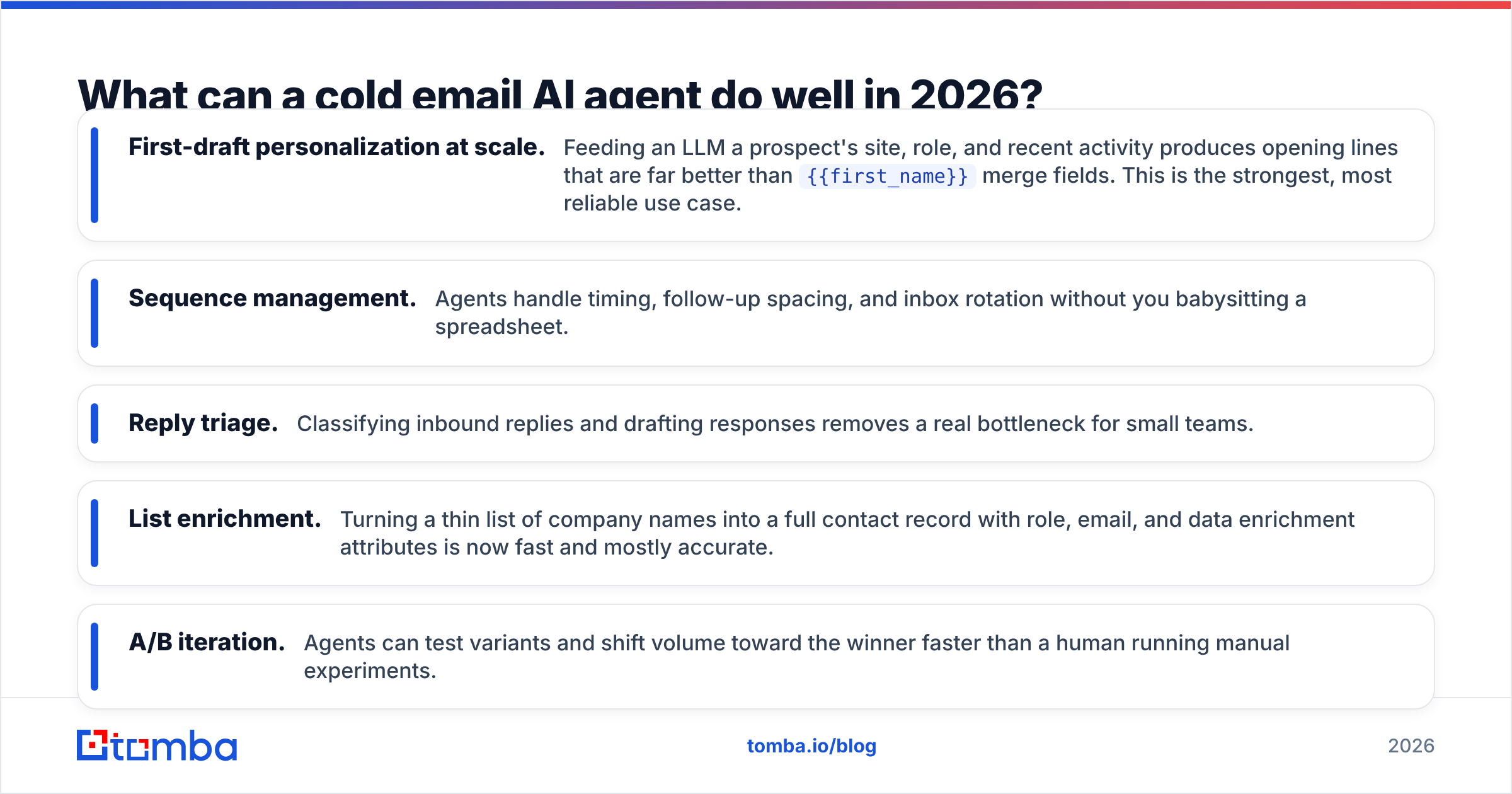
- First-draft personalization at scale. Feeding an LLM a prospect's site, role, and recent activity produces opening lines that are far better than
{{first_name}}merge fields. This is the strongest, most reliable use case. - Sequence management. Agents handle timing, follow-up spacing, and inbox rotation without you babysitting a spreadsheet.
- Reply triage. Classifying inbound replies and drafting responses removes a real bottleneck for small teams.
- List enrichment. Turning a thin list of company names into a full contact record with role, email, and data enrichment attributes is now fast and mostly accurate.
- A/B iteration. Agents can test variants and shift volume toward the winner faster than a human running manual experiments.
What they still cannot do well is judgment. An agent does not know that the CTO you targeted just posted about a layoff, or that "we're happy with our current vendor" from a specific account means "check back in Q3, not never." The 20% of accounts that matter most still need a human. Treat the agent as leverage on the routine 80%.
Cold email AI agent vs manual outreach vs AI writer: which wins?#
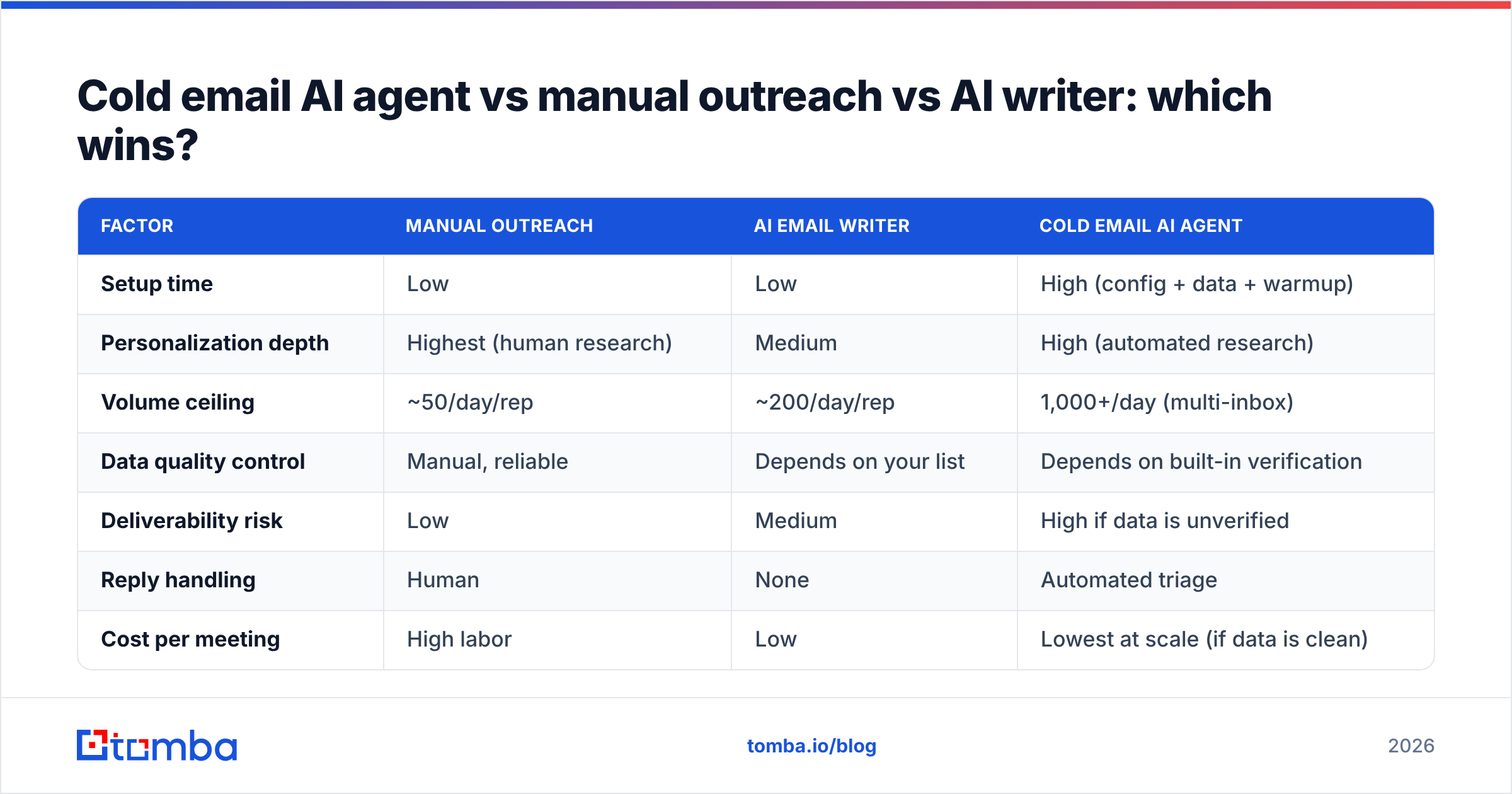
There is no single winner — the right choice depends on volume, deal size, and how much your domain reputation is worth. Here is an honest comparison of the three approaches most teams choose between.
| Factor | Manual outreach | AI email writer | Cold email AI agent |
|---|---|---|---|
| Setup time | Low | Low | High (config + data + warmup) |
| Personalization depth | Highest (human research) | Medium | High (automated research) |
| Volume ceiling | ~50/day/rep | ~200/day/rep | 1,000+/day (multi-inbox) |
| Data quality control | Manual, reliable | Depends on your list | Depends on built-in verification |
| Deliverability risk | Low | Medium | High if data is unverified |
| Reply handling | Human | None | Automated triage |
| Cost per meeting | High labor | Low | Lowest at scale (if data is clean) |
| Best fit | Enterprise, big deals | Solo founders | SMB/mid-market, high volume |
The pattern is clear. Agents win on cost-per-meeting only when the data feeding them is verified. Remove that condition and the volume advantage becomes a liability — you send more bad email faster and torch your sender reputation. Manual outreach still wins for six-figure enterprise deals where one prospect is worth days of research. The AI writer is the entry point for solo operators who are not ready to manage sending infrastructure.
According to outbound benchmarks compiled by tools like HubSpot and reviewed on G2, reply rates for cold email in 2026 sit in the low single digits for most industries — which means your gains come from targeting and deliverability long before they come from clever automation.
How do you build a reliable cold email AI agent stack?#
Build it in three layers, bottom-up. Skipping a layer is why most "AI outreach" projects stall after the first campaign.
Layer 1 — Data foundation. This is the non-negotiable base. You need accurate contacts, verified addresses, and enrichment attributes for personalization. Use a domain search to map decision-makers at target accounts, an email finder to resolve individual addresses, and verification to gate every send. Garbage in, spam-foldered out.
Layer 2 — Sending infrastructure. Separate sending domains, warmed inboxes, SPF/DKIM/DMARC configured, and conservative daily volumes per inbox. The best AI agent in the world cannot compensate for a cold, misconfigured domain. Budget two to four weeks of email warmup before real sending.
Layer 3 — Agent logic. Only now do you add the AI layer: ICP definition, research prompts, sequence design, and reply handling. This is the part vendors demo, but it sits on top of the two layers they rarely talk about.
A quick sanity checklist before you turn any agent loose:
- Is every address verified, with catch-alls flagged, before it enters a queue?
- Are you sending from dedicated domains, not your primary company domain?
- Do you have a human review step for tier-one accounts?
- Can you kill the campaign instantly if bounce or spam rates spike?
- Are unsubscribes and legal compliance (CAN-SPAM, GDPR) handled automatically?
If you cannot check all five, you are not running an agent — you are running a risk. For the rules behind that last point, the CAN-SPAM overview on Wikipedia is a reasonable starting reference before you consult counsel.
What are the risks and limits of cold email AI agents?#
The honest downsides matter as much as the upside, because they are what get teams in trouble.
Deliverability collapse. The number one risk. Unverified data plus high volume equals bounces, spam complaints, and blacklisting. Once your domain reputation is damaged, recovery takes weeks and sometimes requires a fresh domain. This alone justifies spending on verification before spending on the agent.
Generic-at-scale personalization. When every prospect gets an AI first line referencing "your impressive work at {{company}}," recipients notice the pattern. Personalization that is obviously templated performs worse than no personalization. The fix is depth — feed the agent real, specific signals, not surface fields.
Compliance exposure. Automated sending across regions means automated legal risk. GDPR, CAN-SPAM, and local anti-spam laws apply regardless of whether a human or an agent pressed send. You own the liability.
Over-trust. The most expensive mistake is assuming the agent is "handling it." Agents drift, data goes stale, and a prompt that worked last month underperforms this month. Someone has to watch the numbers.
None of these are reasons to avoid the category. They are reasons to keep a human accountable and to invest in the data layer first. The teams that win with AI outreach in 2026 are not the ones with the fanciest agent — they are the ones with the cleanest data and the tightest feedback loop.
Which tools fit into a cold email AI agent workflow?#
You will rarely find one tool that does everything well. Most high-performing stacks combine a dedicated data provider, a sending platform, and an AI layer. The mistake is buying an all-in-one that is mediocre at data because it spent its roadmap on the AI demo.
For the data layer specifically, the priorities are accuracy, verification, catch-all handling, and enrichment coverage. A platform like Tomba handles the find-and-verify foundation, then connects to your sequencing and CRM tools through integrations so the agent has clean inputs. You can compare capabilities and Tomba pricing against your volume — the Free tier gives 25 searches a month to test accuracy before you commit, Starter is $49/mo, and Growth is $99/mo.
The rule of thumb: buy your data layer for accuracy, buy your sending layer for deliverability, and let the AI agent be the orchestration on top. When the foundation is verified, the agent's output improves automatically — because you removed the failure mode that was quietly sinking every campaign.
The bottom line#
A cold email AI agent is a force multiplier, not a magic button. In 2026 the technology is mature enough to save real hours on personalization, sequencing, and reply handling — but every one of those gains rests on the quality of your contact data. Feed an agent verified, enriched, well-targeted contacts and it will book meetings. Feed it guessed emails and it will scale your way into the spam folder.
Start with the foundation. Before you automate a single send, make sure the addresses are real and verified. Tomba's Email Finder gives your AI agent accurate, verified contacts to work from — so the copy your agent writes actually reaches a human inbox. Start free with 25 searches, test the accuracy on your own target accounts, and build the outreach stack on data you can trust.
Related guides#
// get started
Find, verify and enrich your first contacts today
Start on the free plan with 25 searches a month, then scale when your team is ready.
Free plan · No credit card required · GDPR & CCPA
// about the author