Cold Email Automation for Lead Nurturing: 2026 Playbook
Cold email automation only nurtures leads when the sequence, timing, and data are right. Here's how to build sequences that turn cold prospects into booked replies without burning your domain.
Cold email automation and lead nurturing get lumped together, but they solve two different problems. Automation is the machine that sends. Nurturing is the strategy that decides what to send, to whom, and when. Bolt one onto the other badly and you get a spam cannon. Wire them together well and you get a pipeline that warms strangers into replies while you sleep.
This guide shows you how to combine the two in 2026 — the sequence structure, the timing logic, the data hygiene, and the tooling — without torching your sender reputation.
TL;DR#
- Automation without nurturing is spam. A tool that fires eight identical emails at a cold list will get you blocked, not booked. Nurturing decides the message; automation only delivers it.
- Build multi-touch sequences, not blasts. The best-performing cold campaigns use 5–8 touches spread across 3–4 weeks, each adding new value instead of repeating "just following up."
- Data quality is the whole game. Bounces above 3% wreck deliverability. Verify every address before it enters a sequence.
- Behavior beats calendars. Trigger the next touch on opens, clicks, and replies — not a fixed day count — and reply rates climb.
- Warm the domain first. New sending domains need 3–4 weeks of ramp-up before you scale volume.
What is cold email automation for lead nurturing?#
Think of it like a restaurant host who remembers every guest. A great host doesn't shout the same greeting at everyone who walks in — they recognize the regular, seat the newcomer, and check back at the right moment. Cold email automation for lead nurturing is that host at scale: software that remembers where each prospect is in the journey and delivers the next relevant message automatically.
Technically, it's the combination of three layers:
- A trigger layer — the rules that decide when a contact should receive the next message (time elapsed, an open, a click, a reply, a website visit).
- A sequencing layer — the ordered set of emails and follow-ups, each with its own copy and goal.
- A data layer — the verified contact records that feed the whole system, including name, role, company, and a valid email address.
Remove the nurturing intelligence and you're left with a mail merge. Remove the automation and you're left with a spreadsheet and a lot of manual copy-paste. You need both.

Why does manual cold outreach stop scaling?#
A single rep can hold maybe 40–50 personalized threads in their head before follow-ups start slipping. Past that, leads go cold not because the offer was wrong but because nobody circled back on day 4, day 9, and day 16. Studies from vendors like HubSpot consistently show most replies land after the second or third touch — exactly the touches a busy human forgets.
Automation fixes the forgetting problem. It guarantees the day-4 nudge fires whether or not the rep is in a meeting. But it introduces a new risk: it will forget just as reliably to stop when someone replies, or it will send a "quick follow-up" to a person who already booked a call. That's why the nurturing logic — the branching, the exit conditions, the personalization tokens — matters more than the send button.
How do you structure a cold email nurturing sequence?#
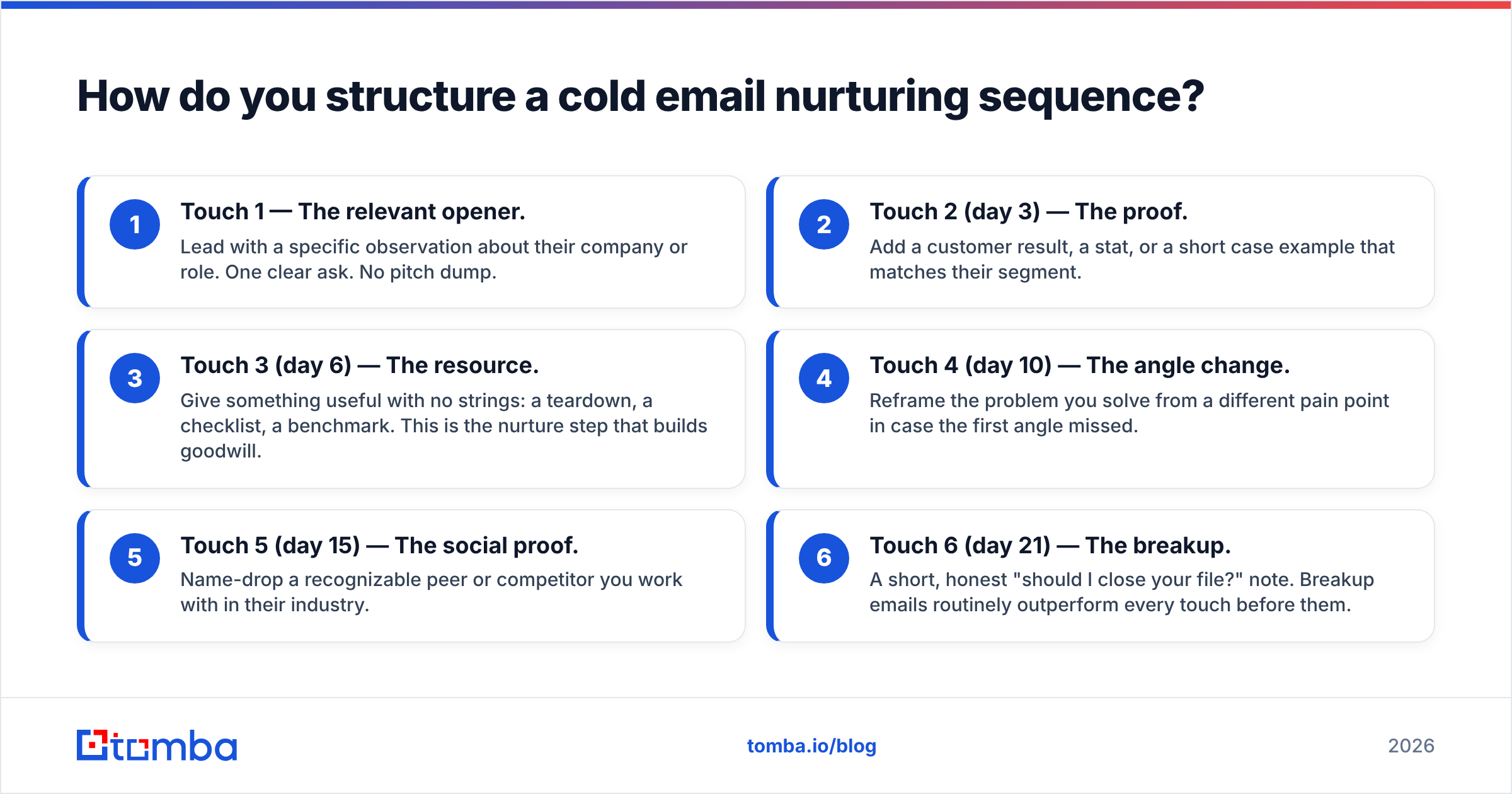
Here is a proven 6-touch skeleton you can adapt. Each touch has a distinct job; none of them says "just bumping this up."
- Touch 1 — The relevant opener. Lead with a specific observation about their company or role. One clear ask. No pitch dump.
- Touch 2 (day 3) — The proof. Add a customer result, a stat, or a short case example that matches their segment.
- Touch 3 (day 6) — The resource. Give something useful with no strings: a teardown, a checklist, a benchmark. This is the nurture step that builds goodwill.
- Touch 4 (day 10) — The angle change. Reframe the problem you solve from a different pain point in case the first angle missed.
- Touch 5 (day 15) — The social proof. Name-drop a recognizable peer or competitor you work with in their industry.
- Touch 6 (day 21) — The breakup. A short, honest "should I close your file?" note. Breakup emails routinely outperform every touch before them.
The structure works because each message earns the next open. Reply response rate rises when the reader learns something new every time instead of feeling nagged.
Which triggers should fire the next email?#
Time-based sequences ("send touch 2 exactly 72 hours later") are the default, but behavior-based triggers convert better because they meet the prospect where their attention actually is.
- Opened but didn't reply → send the value touch sooner, while you're top of mind.
- Clicked a link → branch into a warmer, more direct sequence; this person is signaling intent.
- Replied → immediately exit the automation and route to a human. Nothing kills trust faster than a bot "following up" on a live conversation.
- Bounced → suppress instantly and flag the record for re-verification.
- No engagement after the full sequence → drop to a low-frequency long-term nurture list, not the trash.
What does a good cold email automation stack look like?#
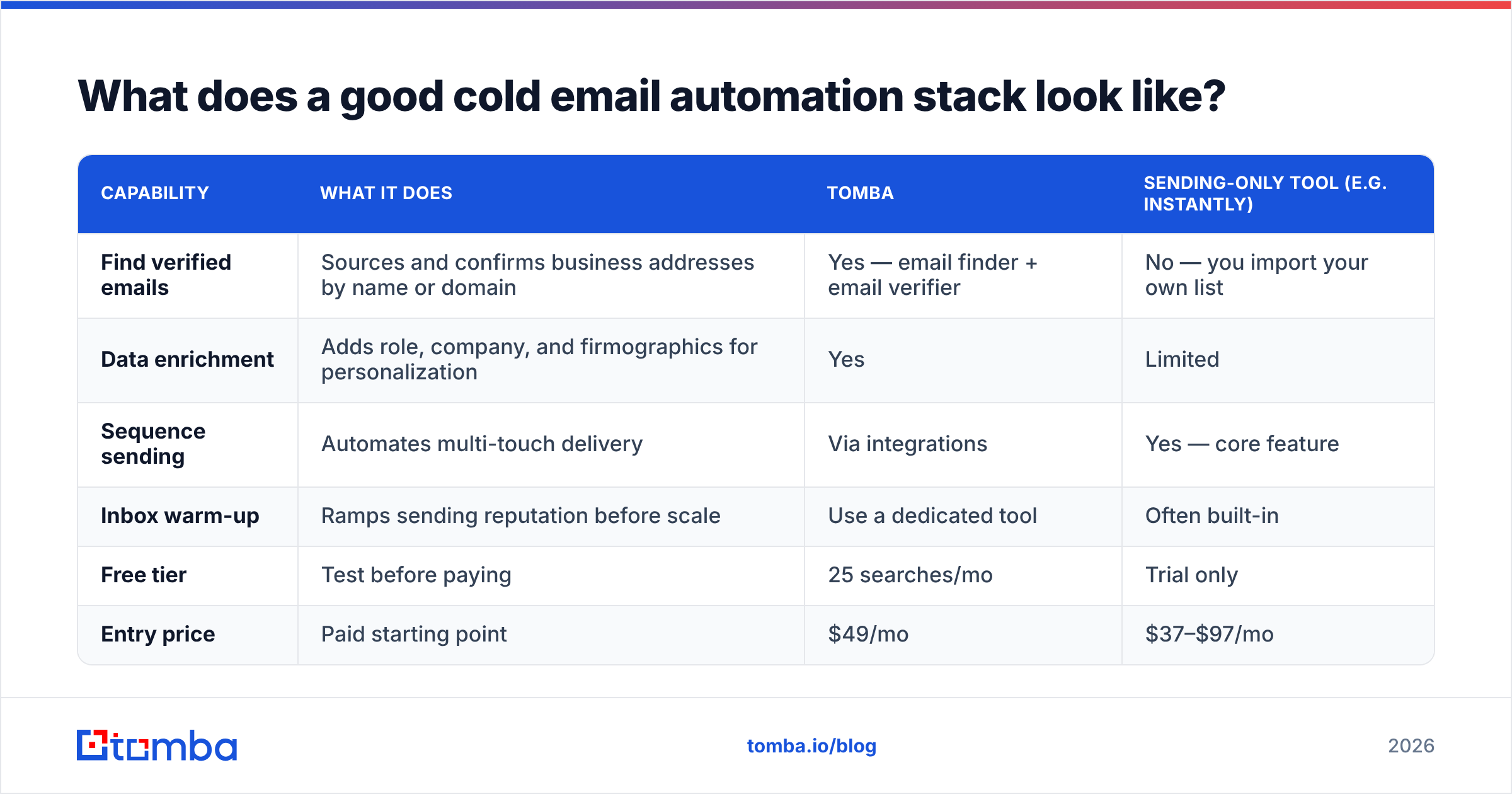
You need four capabilities, whether they live in one platform or several: find contacts, verify them, send sequences, and warm the domain. Here's how the common options compare.
| Capability | What it does | Tomba | Sending-only tool (e.g. Instantly) |
|---|---|---|---|
| Find verified emails | Sources and confirms business addresses by name or domain | Yes — email finder + email verifier | No — you import your own list |
| Data enrichment | Adds role, company, and firmographics for personalization | Yes | Limited |
| Sequence sending | Automates multi-touch delivery | Via integrations | Yes — core feature |
| Inbox warm-up | Ramps sending reputation before scale | Use a dedicated tool | Often built-in |
| Free tier | Test before paying | 25 searches/mo | Trial only |
| Entry price | Paid starting point | $49/mo | $37–$97/mo |
The honest takeaway: no single tool is best at everything. A sending platform handles the delivery cadence; a data platform like Tomba makes sure the addresses you're sending to are real and enriched enough to personalize. Pair them. Check the full Tomba pricing if you're costing out the data side.
How do you keep automated cold email out of spam?#
Deliverability is where most automated nurture programs quietly die. You can write perfect copy and still land in spam if the plumbing is wrong. Prioritize these, in order:
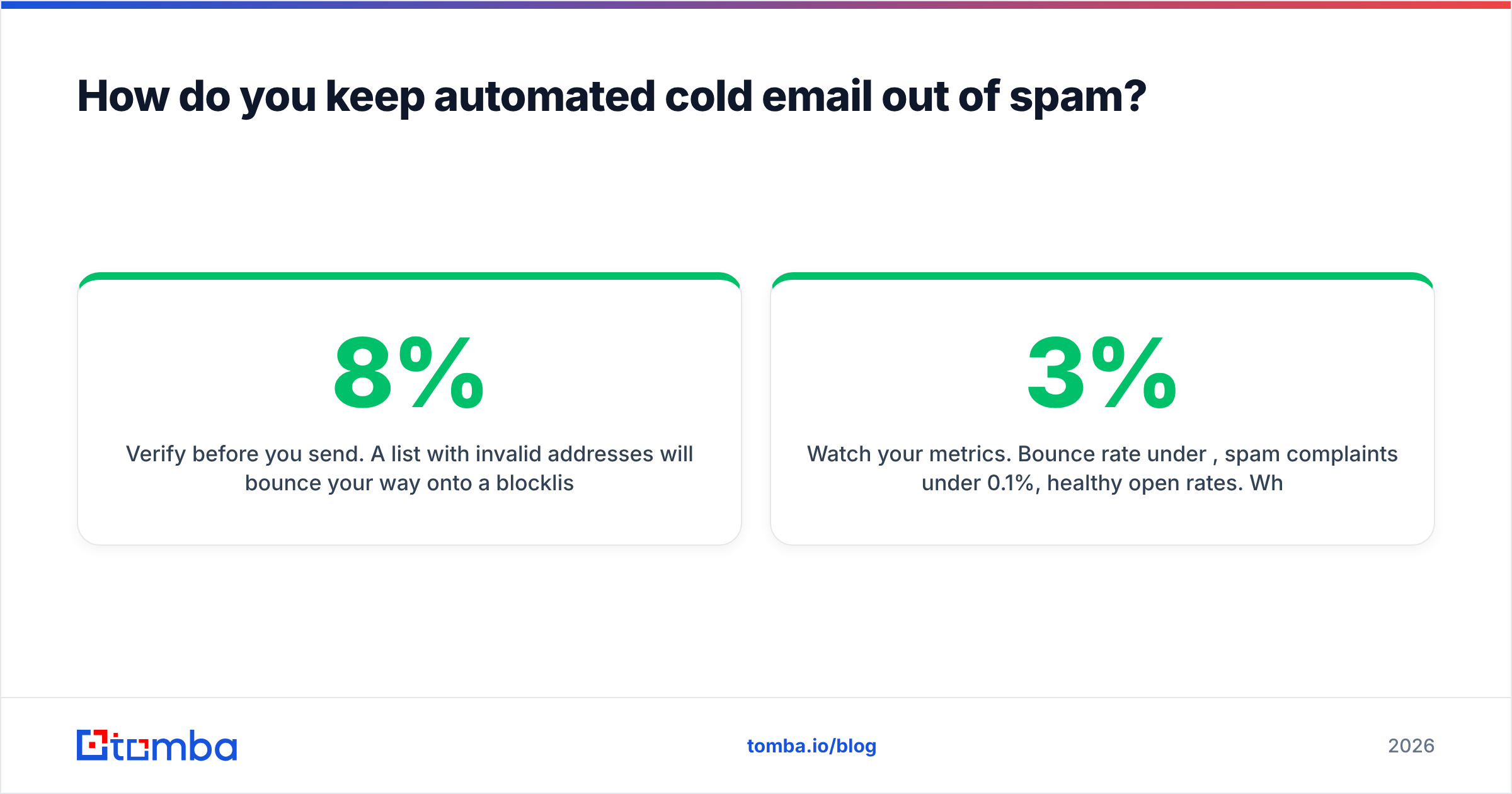
- Verify before you send. A list with 8% invalid addresses will bounce your way onto a blocklist within a week. Run every contact through an email verifier and remove risky and catch-all records before the first send.
- Warm the domain. New domains and inboxes need a gradual ramp. Use an email warmup calculator to plan realistic daily volume increases over 3–4 weeks instead of jumping to 200 sends on day one.
- Authenticate. SPF, DKIM, and DMARC must all pass. Google and Yahoo now enforce this for bulk senders, and Google Postmaster Tools will show you your reputation trend.
- Cap volume per inbox. Keep it under ~30–50 cold sends per inbox per day. Scale by adding inboxes, not by pushing one inbox harder.
- Watch your metrics. Bounce rate under 3%, spam complaints under 0.1%, healthy open rates. When any of those slip, pause and diagnose before sending more.
Personalization vs automation: can you have both?#
Yes — the trade-off is a myth if your data is good. The reason "personalization at scale" feels contradictory is that people equate personalization with hand-writing each email. It isn't. It's inserting specific, true details automatically: the prospect's role, a recent company event, the exact competitor they likely use.
That only works when the underlying record is complete and accurate. Garbage tokens ("Hi {{first_name}},") are worse than no personalization because they broadcast that you automated carelessly. This is why lead nurturing starts with clean data enrichment, not with the email editor. Enrich first, then let automation drop the right variables into a template that reads like you wrote it.
A practical rule: every merge field in your sequence must have a verified fallback. If company_milestone is empty, the sentence should still make sense. Test that before you launch, not after 500 sends go out with blank brackets.
How do you measure whether nurturing is working?#
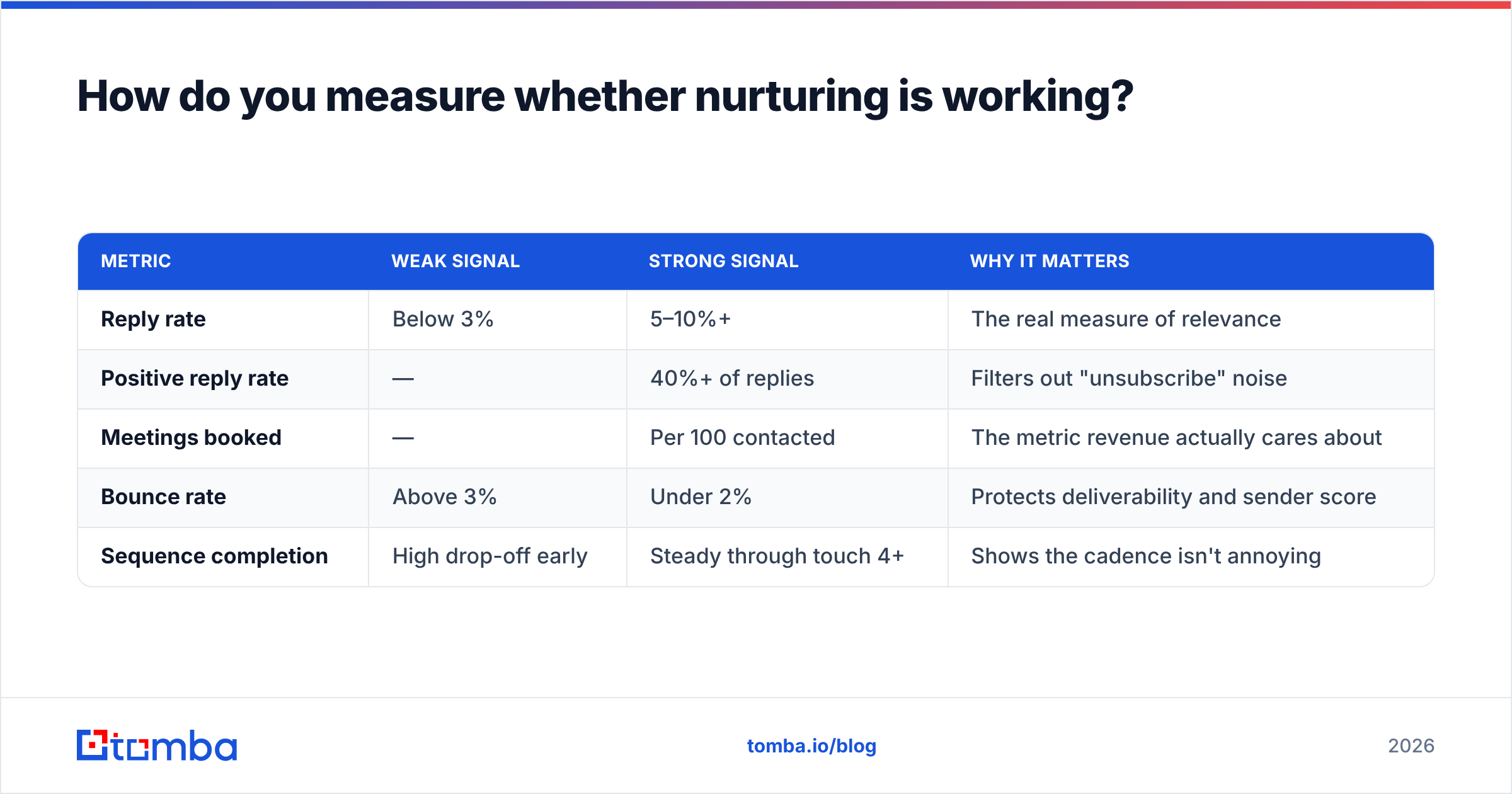
Vanity metrics lie. Open rate is increasingly unreliable thanks to privacy features that pre-fetch images. Anchor on outcomes instead:
| Metric | Weak signal | Strong signal | Why it matters |
|---|---|---|---|
| Reply rate | Below 3% | 5–10%+ | The real measure of relevance |
| Positive reply rate | — | 40%+ of replies | Filters out "unsubscribe" noise |
| Meetings booked | — | Per 100 contacted | The metric revenue actually cares about |
| Bounce rate | Above 3% | Under 2% | Protects deliverability and sender score |
| Sequence completion | High drop-off early | Steady through touch 4+ | Shows the cadence isn't annoying |
Review these per segment, not just in aggregate. A 6% reply rate that hides a 1% rate for one industry and 11% for another is telling you to double down on the second and rewrite the first.
What are the most common cold email automation mistakes?#
- Sending before verifying. The single fastest way to get blocklisted. Non-negotiable fix: verify first.
- Identical follow-ups. "Just bumping this" adds no value and trains people to ignore you.
- No reply detection. Automations that keep firing after someone responds destroy trust instantly.
- Over-automating the human moment. Once a prospect is warm, a real person should take over. Automation opens the door; it shouldn't try to close the deal.
- Ignoring segmentation. One sequence for every industry, seniority, and company size will underperform three tailored ones.
For a deeper vendor-neutral view of the tooling landscape, G2's sales engagement category is a useful place to compare platforms on verified reviews before you commit.
Put it together: your first 30 days#
Week 1: pick a tight segment, find and verify 200–300 contacts, enrich them. Week 2: warm your sending domain and write a 6-touch sequence with real value in every step. Week 3: launch to a small cohort, watch bounce and reply rates daily. Week 4: cut the touches that underperform, scale the ones that reply, and add a second segment.
The engine only runs on good fuel. Every automated nurture sequence lives or dies on whether the addresses are real and the records are rich enough to personalize. Start there: use the Tomba Email Finder to source verified, enriched business contacts, run them through verification, and feed a clean, deliverable list into your sequences. Get the data right and automation does exactly what you hoped — it nurtures cold leads into conversations, at scale, without the spam.
Related guides#
Ready to find emails that actually work?
Join 150,000+ professionals who stopped guessing and started sending. Free credits on signup — no credit card required.
Get the Tomba newsletter
Practical outbound tactics and product updates — once every two weeks.
About the author