Cold Email Campaign Management: A 2026 Playbook That Works
Most cold campaigns fail on process, not copy. Here's a practical 2026 framework for cold email campaign management — from list building and warmup to sequencing, deliverability, and the metrics that actually predict replies.
Cold email campaign management is the boring machinery behind every outbound program that actually books meetings. Not the clever subject line. The system: how you source contacts, verify them, warm your domains, sequence your sends, route replies, and read the numbers well enough to fix what's broken before it torches your sender reputation.
Most teams obsess over copy and ignore the machine. Then they wonder why a "great" campaign produced 0.4% replies and a spam folder full of bounces. This guide fixes that. It walks the full lifecycle — with a workflow you can copy, a tool comparison, and the handful of metrics that predict whether a campaign will work.
TL;DR#
- Cold email campaign management is a process, not a tool. The winning teams standardize six stages: source → verify → warm → sequence → route replies → measure.
- Data quality beats copy quality. A verified list at 98%+ deliverability out-performs clever writing on a dirty list every time. Bounces above 3% throttle everything downstream.
- Warmup and volume discipline protect the asset. New domains ramp slowly; mature domains cap daily sends and spread them across mailboxes.
- Reply routing is where revenue leaks. Positive replies that sit unanswered for 24+ hours lose most of their value.
- Track leading indicators (bounce rate, open rate, positive-reply rate), not just meetings booked — they tell you what to fix while the campaign is still live.
What is cold email campaign management?#
Cold email campaign management is the end-to-end operating system for sending unsolicited-but-relevant outbound email at scale without wrecking your deliverability or your brand.
Think of it like running a restaurant, not cooking one dish. The recipe (your email copy) matters, but the restaurant fails on logistics: sourcing fresh ingredients (clean data), keeping the kitchen sanitary (deliverability), timing the courses (sequencing), and handling the dining room (reply management). A brilliant dish served on a dirty plate still makes people sick.
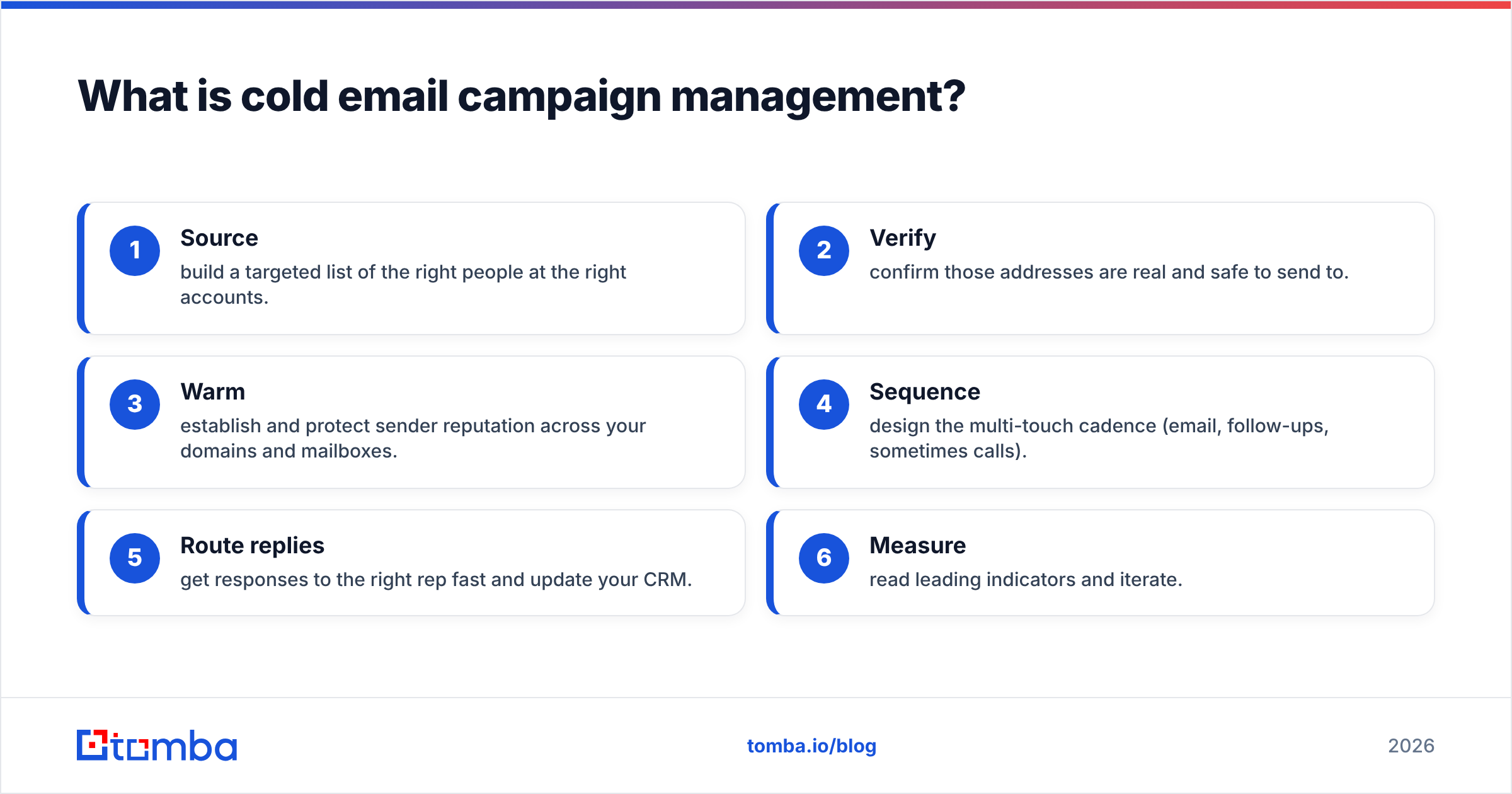
Concretely, campaign management spans six repeatable stages:
- Source — build a targeted list of the right people at the right accounts.
- Verify — confirm those addresses are real and safe to send to.
- Warm — establish and protect sender reputation across your domains and mailboxes.
- Sequence — design the multi-touch cadence (email, follow-ups, sometimes calls).
- Route replies — get responses to the right rep fast and update your CRM.
- Measure — read leading indicators and iterate.
Skip any stage and the others compensate poorly. You can't out-copy a dirty list, and you can't out-warm a spammy offer.
Why do most cold email campaigns fail?#
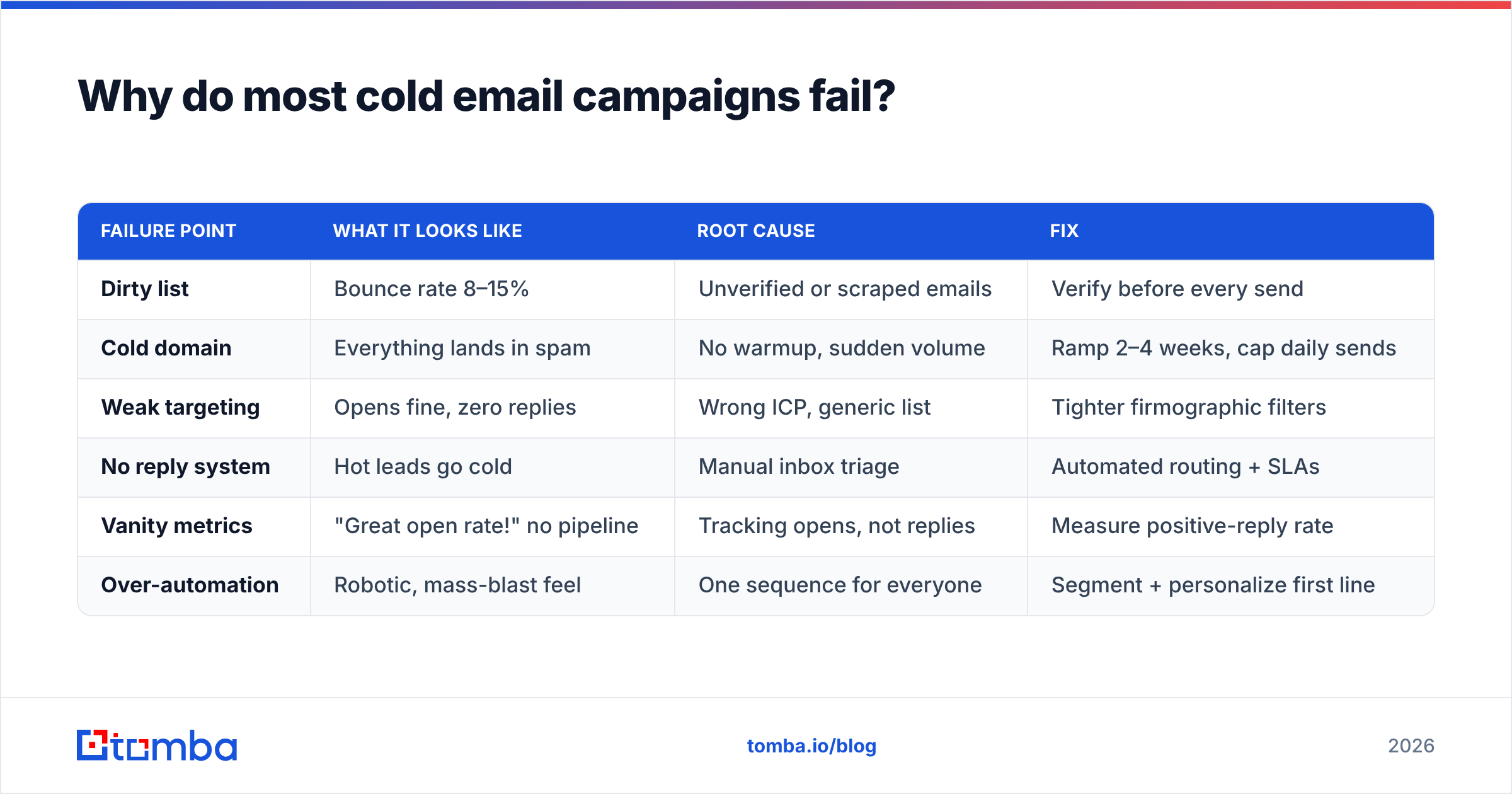
They fail on inputs and infrastructure, not creativity. Here's the honest breakdown of where campaigns die, roughly in order of frequency.
| Failure point | What it looks like | Root cause | Fix |
|---|---|---|---|
| Dirty list | Bounce rate 8–15% | Unverified or scraped emails | Verify before every send |
| Cold domain | Everything lands in spam | No warmup, sudden volume | Ramp 2–4 weeks, cap daily sends |
| Weak targeting | Opens fine, zero replies | Wrong ICP, generic list | Tighter firmographic filters |
| No reply system | Hot leads go cold | Manual inbox triage | Automated routing + SLAs |
| Vanity metrics | "Great open rate!" no pipeline | Tracking opens, not replies | Measure positive-reply rate |
| Over-automation | Robotic, mass-blast feel | One sequence for everyone | Segment + personalize first line |
The pattern is clear: the two biggest killers — dirty lists and cold domains — are both upstream of the email itself. That's why campaign management, not copywriting, is the higher-leverage skill.
How do you build a cold email campaign workflow?#
Start with the list, because everything compounds from there. A repeatable workflow looks like this.
Stage 1 — Source your list. Define the ICP first (industry, headcount, role, region, trigger events), then pull contacts that match. Use a domain search to grab the right people at each target account instead of buying a bulk list of strangers. Precision here shrinks every downstream cost.
Stage 2 — Find and verify emails. Turn names and companies into deliverable addresses, then check each one. An email finder resolves the address; an email verifier confirms it's live before you risk your reputation on it. For unknown catch-all domains, run a catch-all verifier so you're not guessing. This single discipline is what separates a 2% bounce rate from a 12% one.
Stage 3 — Warm your domains. Never send cold volume from a fresh domain. Ramp gradually with a warmup routine and keep daily volume per mailbox modest. Use a free email warmup calculator to plan the ramp, and check your SPF record and DKIM are set before the first send.
Stage 4 — Build the sequence. A typical high-performing cadence is a first touch plus 2–3 spaced follow-ups over 10–14 business days, each adding a new angle (value, social proof, a soft breakup). Personalize at least the opening line per prospect.
Stage 5 — Route replies. The moment someone replies positive, a rep should own it. Automate the hand-off into your CRM and set a response SLA.
Stage 6 — Measure and iterate. Read the numbers weekly (next section) and cut what's not working.
What tools do you need to manage cold email campaigns?#
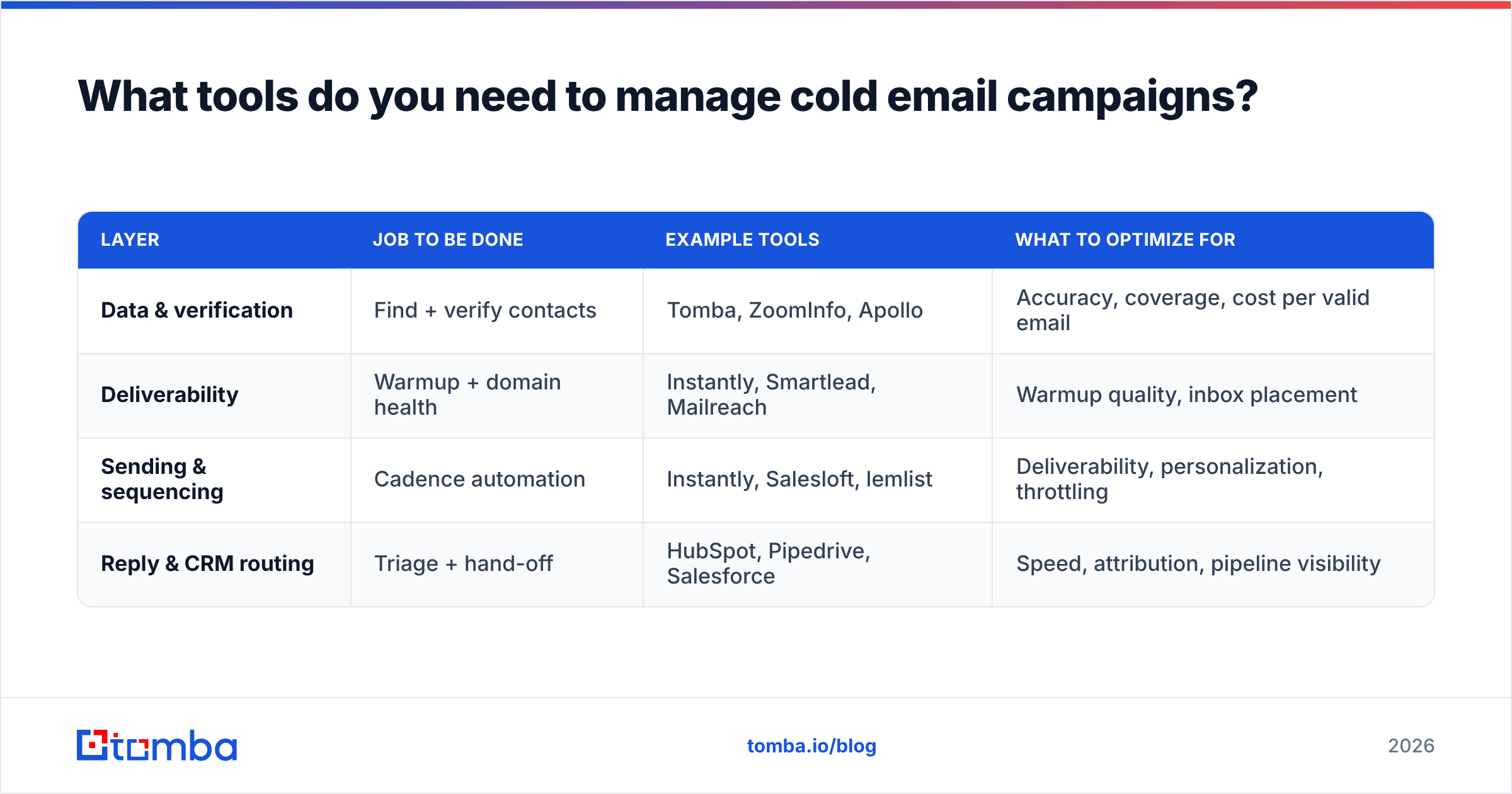
You need coverage across four jobs: data, deliverability, sending, and routing. Some platforms bundle several; most teams stitch a small stack together. Here's how the layers compare.
| Layer | Job to be done | Example tools | What to optimize for |
|---|---|---|---|
| Data & verification | Find + verify contacts | Tomba, ZoomInfo, Apollo | Accuracy, coverage, cost per valid email |
| Deliverability | Warmup + domain health | Instantly, Smartlead, Mailreach | Warmup quality, inbox placement |
| Sending & sequencing | Cadence automation | Instantly, Salesloft, lemlist | Deliverability, personalization, throttling |
| Reply & CRM routing | Triage + hand-off | HubSpot, Pipedrive, Salesforce | Speed, attribution, pipeline visibility |
You don't need the most expensive option in each row — you need the layers to work together. A common, cost-effective 2026 stack pairs a strong data-and-verification source (so lists start clean) with a mid-market sending tool and your existing CRM.
If you're comparing vendors, check independent review sites like G2 and Capterra rather than trusting vendor claims — and always test with your own list before committing.
For the data layer specifically, look at Tomba pricing: a Free tier gives 25 searches/month to trial accuracy, Starter is $49/mo, Growth $99/mo, and Pro $249/mo. Run a small verified batch through your sequence and measure the bounce rate before scaling spend. If you send at volume, a bulk email finder plus verification keeps large lists clean without manual checking.
How do you keep cold emails out of spam?#
Deliverability is a reputation game, and reputation is earned slowly and lost fast. The mechanics matter more than the message.
- Authenticate everything. SPF, DKIM, and DMARC must pass. Use an SPF checker and a blacklist checker before you launch.
- Warm up, then throttle. Ramp new domains over 2–4 weeks and cap daily sends per mailbox (many teams stay under ~40–50 cold sends per mailbox per day). Spread volume across multiple mailboxes rather than blasting from one.
- Keep bounces under 3%. High bounce rates are the fastest signal to mailbox providers that you're a spammer. This is entirely a data-quality problem — solved upstream with email verification.
- Protect sender reputation. Monitor your sender reputation and overall email deliverability with a tool like Google Postmaster Tools and a reputation checker.
- Write like a human. Avoid spammy trigger words, heavy HTML, and multiple links in a first touch. Plain text pulls better and lands better.
Google and Yahoo tightened bulk-sender requirements in 2024, and enforcement has only gotten stricter since. Their official sender guidelines are the source of truth — read them, don't guess.
The uncomfortable truth: no clever workaround beats clean data plus patient warmup. Deliverability problems are almost always inputs problems wearing a costume.
Which metrics actually predict campaign success?#
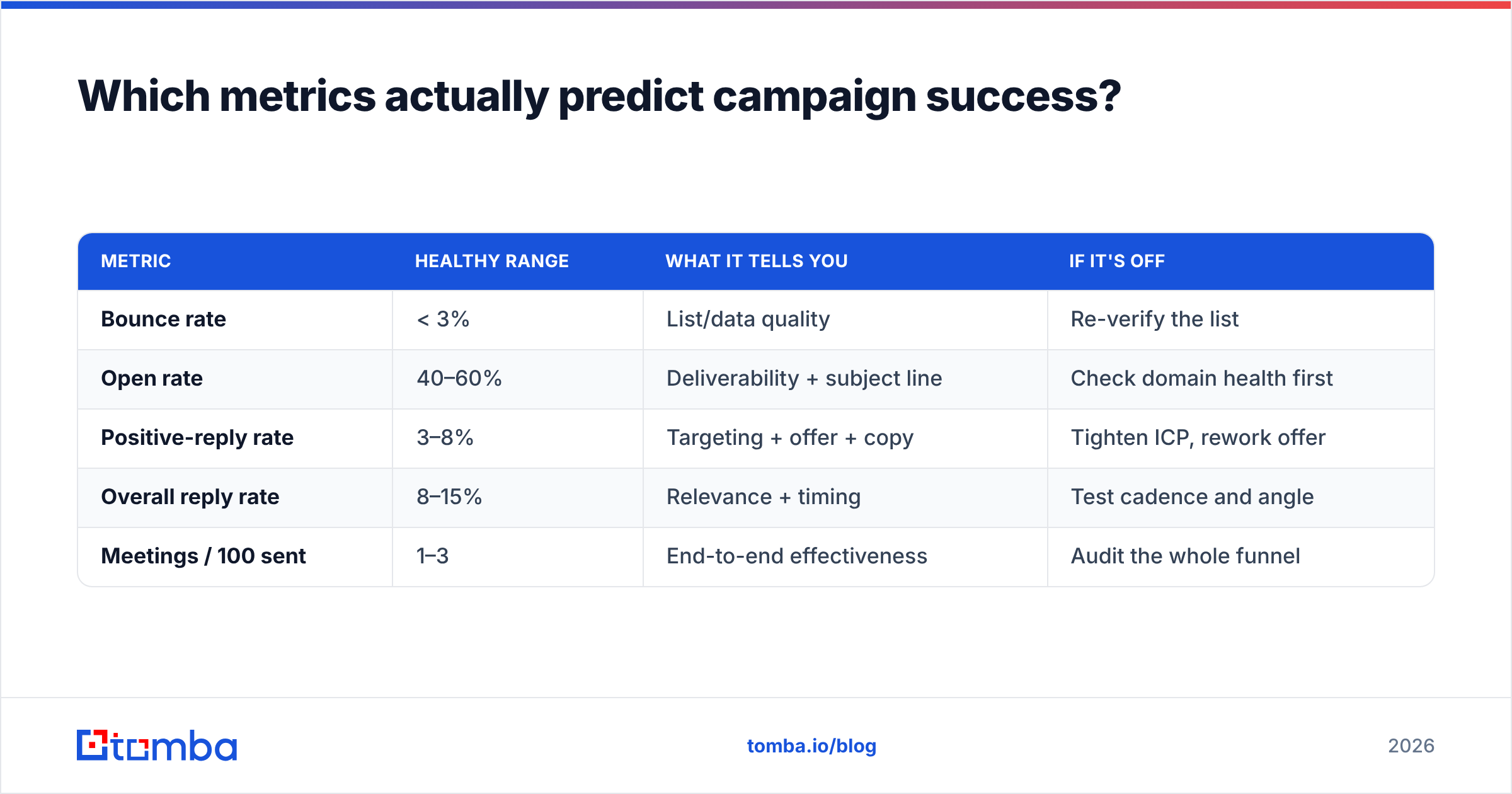
Track leading indicators that tell you what to fix mid-flight — not lagging vanity metrics you can only admire after the fact.
| Metric | Healthy range | What it tells you | If it's off |
|---|---|---|---|
| Bounce rate | < 3% | List/data quality | Re-verify the list |
| Open rate | 40–60% | Deliverability + subject line | Check domain health first |
| Positive-reply rate | 3–8% | Targeting + offer + copy | Tighten ICP, rework offer |
| Overall reply rate | 8–15% | Relevance + timing | Test cadence and angle |
| Meetings / 100 sent | 1–3 | End-to-end effectiveness | Audit the whole funnel |
Two rules make these numbers useful. First, diagnose top-down: a bad reply rate might be a copy problem, but if opens are also low, it's really a deliverability problem masquerading as a copy problem. Fix the upstream metric first. Second, compare cohorts, not campaigns — segment by ICP and list source so you learn which inputs produce replies, then double down on those.
Open rate deserves a caveat in 2026: privacy features inflate and obscure it, so treat it as directional, not precise. Reply rate and positive-reply rate are your ground truth.
How is cold email campaign management changing in 2026?#
Three shifts are worth planning around.
- Data quality is now table stakes, not an edge. With stricter sender rules, a dirty list doesn't just underperform — it gets your domain throttled. Verification moved from "nice to have" to a hard prerequisite.
- Fewer, better emails beat volume. Deliverability caps and buyer fatigue reward tight targeting and genuine personalization over spray-and-pray. Smaller verified lists with a sharp offer win.
- AI helps with drafting, not deciding. AI speeds up first-line personalization and variant testing, but it can't fix bad targeting or a cold domain. Tools like a cold email AI writer accelerate the copy step — they don't replace the management discipline around it.
The teams that win in 2026 treat cold email as an operations problem with a creative layer on top, not a creative problem with some plumbing underneath.
Where should you start?#
Start where the leverage is highest: your list. A perfectly written campaign to unverified contacts is a fast way to burn a domain, while a plain, honest email to a clean, well-targeted list quietly books meetings. Get the inputs right first, then optimize the message.
Build your verified list in minutes with the Tomba Email Finder — search by domain, name, or company, verify each address before you send, and start your next campaign on data you can trust instead of data you hope is right. Try it free with 25 searches, run a small batch through your sequence, and watch your bounce rate settle where it should: near zero.
Related guides#
// get started
Find, verify and enrich your first contacts today
Start on the free plan with 25 searches a month, then scale when your team is ready.
Free plan · No credit card required · GDPR & CCPA
// about the author