Cold Email Campaign Strategy: A 2026 Playbook That Books Meetings
A step-by-step cold email campaign strategy for 2026: list building, deliverability, sequencing, and copy that actually gets replies instead of spam folders.
Cold email still works in 2026 — but the version that worked in 2019 will get your domain blacklisted today. Gmail and Microsoft now enforce authentication, spam-rate thresholds, and one-click unsubscribe. The senders winning meetings are the ones treating cold email as a system: clean data in, warmed infrastructure, tight targeting, and copy written for a human who owes you nothing.
This guide walks the whole system, in order, with the numbers and frameworks you need to run it.
TL;DR#
- A cold email campaign strategy is a repeatable system, not a one-off blast: data → infrastructure → targeting → copy → sequence → measure → iterate.
- Deliverability comes before creativity. Authenticate (SPF, DKIM, DMARC), warm up, and keep spam complaints under 0.3% or nothing else matters.
- Verified, well-targeted lists beat big lists. A 500-contact list with the right ICP outperforms 5,000 scraped guesses every time.
- One idea, one CTA, one problem per email. Short, specific, and relevance-first wins replies.
- Sequences of 3–5 touches over 2–3 weeks capture most positive replies; measure reply and meeting rates, not opens.
What is a cold email campaign strategy?#
A cold email campaign strategy is the end-to-end plan for reaching people who have never heard of you and converting a slice of them into conversations. Think of it like planting a field, not buying a lottery ticket. You prepare the soil (infrastructure), plant the right seeds in the right plot (targeting), water on a schedule (sequencing), and measure the yield (replies and meetings) so next season is better.
The "spray and pray" era is over. Mailbox providers score your sender reputation continuously, and a single sloppy campaign can poison a domain you spent months building. So the strategy isn't just about writing a clever line — it's about every step feeding the next.
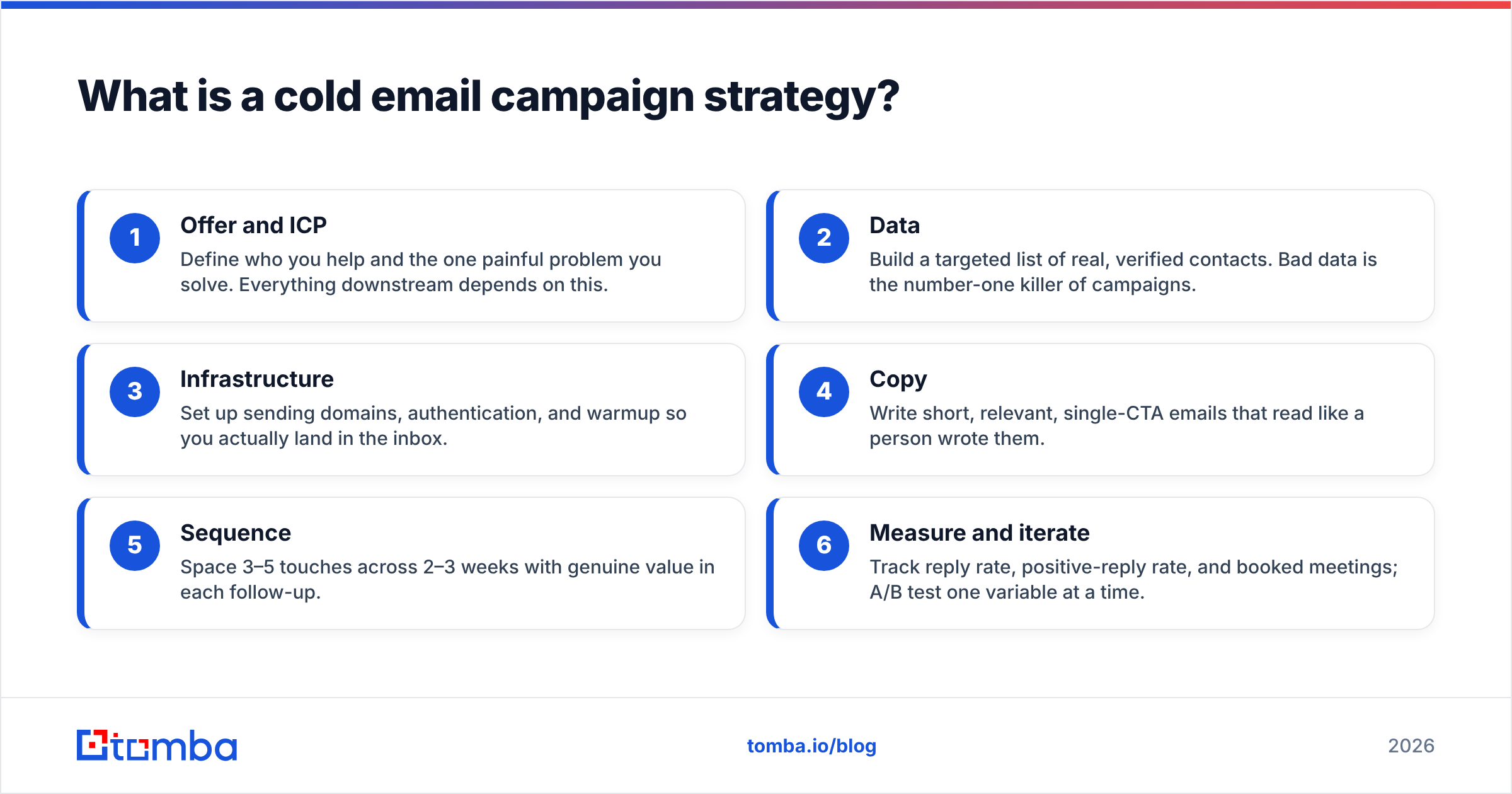
Here is the full pipeline, in the order you should build it:
- Offer and ICP — Define who you help and the one painful problem you solve. Everything downstream depends on this.
- Data — Build a targeted list of real, verified contacts. Bad data is the number-one killer of campaigns.
- Infrastructure — Set up sending domains, authentication, and warmup so you actually land in the inbox.
- Copy — Write short, relevant, single-CTA emails that read like a person wrote them.
- Sequence — Space 3–5 touches across 2–3 weeks with genuine value in each follow-up.
- Measure and iterate — Track reply rate, positive-reply rate, and booked meetings; A/B test one variable at a time.
Skip any step and the rest wobbles. Great copy on a burnt domain never gets read. A warmed domain mailing garbage data still tanks.
Why does deliverability come before copywriting?#
Because an email in the spam folder converts at zero, no matter how good the writing is. In 2024 Google and Yahoo rolled out sender requirements that Microsoft has since tightened, and they are now the baseline. If you fail them, you don't get a lower open rate — you get filtered entirely.
Nail these before you send a single campaign:
- Authenticate everything. Publish SPF, DKIM, and DMARC records on every sending domain. Use a free SPF checker to confirm your record resolves.
- Send from a separate domain. Never run cold campaigns from your primary domain. Buy lookalike domains (e.g.
try-yourbrand.com) so a reputation hit never touches your main mail. - Warm up gradually. New mailboxes should start at 10–20 sends a day and ramp over 3–4 weeks. A warmup calculator tells you the safe daily ceiling.
- Watch the complaint rate. Google's Postmaster Tools flags you above a 0.3% spam rate; stay under 0.1%. Monitor it at Google Postmaster Tools.
- Cap volume per mailbox. 30–50 cold sends per mailbox per day is the sane ceiling in 2026. Need more? Add mailboxes, not volume.
If you want the deeper mechanics, Tomba's glossary entry on email deliverability breaks down every signal providers score. The short version: earn the inbox first, then worry about wit.
How do you build a targeted list that converts?#
Start narrow, verify hard, and enrich. A precise 500-contact list beats a scraped 5,000-contact dump because relevance drives replies and irrelevance drives spam complaints — and complaints kill the whole domain.
Your list-building loop looks like this:
- Define the ICP tightly. Industry, company size, region, and the specific role that feels your pain. "VP of Sales at 50–200-person B2B SaaS in North America" beats "salespeople."
- Find the right people. Use a domain search to pull the email pattern for a target company, then an email finder to get named contacts by role.
- Verify before you send. Run every address through an email verifier. Bounces above 2–3% wreck sender reputation faster than almost anything else.
- Handle catch-all domains. Many B2B domains accept everything, so a standard check says "unknown." A dedicated catch-all verifier reduces the guesswork.
- Enrich for personalization. Pull the data points — role, recent hire, tech stack — that let you write a first line that couldn't apply to anyone else.
The discipline here is emotional as much as technical: it's tempting to keep the big scraped list because it feels like more pipeline. It isn't. It's more bounces, more complaints, and a shorter domain lifespan.
What does a high-reply cold email actually look like?#
Short, specific, and about them. The reader owes you nothing and will decide in about three seconds whether to keep reading. Respect that with one idea, one call-to-action, and zero fluff.
A reliable structure:
- Subject line: 2–5 words, lowercase, curiosity or relevance — not hype. Test variants with a subject line generator if you're stuck.
- First line: About the prospect, not you. Reference their role, company move, or a specific problem. This is where enrichment pays off.
- Body: 2–4 sentences. Name the problem, hint at the outcome you deliver, keep it skimmable.
- CTA: One low-friction ask. "Worth a quick look?" beats "Do you have 30 minutes Tuesday at 3pm PST to discuss synergies?"
- Signature: Real name, real company, physical address, one-click unsubscribe. Required, and it builds trust.
Avoid the classic mistakes: multiple links, image-heavy HTML, walls of text, and the "just following up" filler that adds nothing. If a sentence doesn't help the prospect decide, cut it. HubSpot's ongoing sales email research is a solid outside benchmark for what personalization actually moves.
How many follow-ups should a sequence have?#
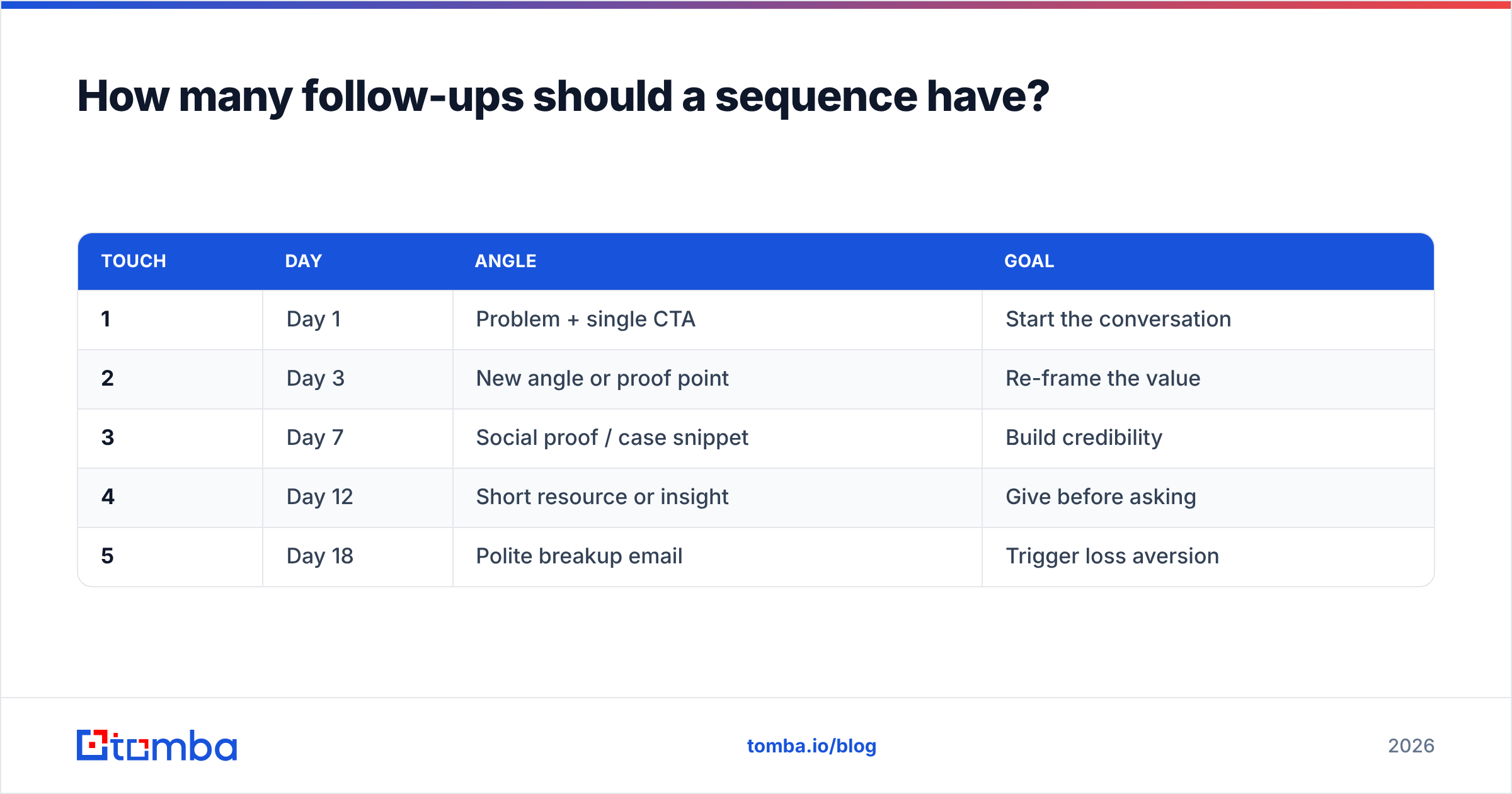
Three to five touches over two to three weeks captures the majority of positive replies without becoming a nuisance. Most replies come from follow-ups, not the first email — but "follow-up" doesn't mean "did you see my last email." Each touch should add a new angle or a new piece of value.
A proven cadence:
| Touch | Day | Angle | Goal |
|---|---|---|---|
| 1 | Day 1 | Problem + single CTA | Start the conversation |
| 2 | Day 3 | New angle or proof point | Re-frame the value |
| 3 | Day 7 | Social proof / case snippet | Build credibility |
| 4 | Day 12 | Short resource or insight | Give before asking |
| 5 | Day 18 | Polite breakup email | Trigger loss aversion |
The breakup email — "I'll close the loop on my end, but happy to reconnect if timing changes" — often outperforms every earlier touch because it removes pressure and creates a small deadline. Stop the sequence the instant someone replies or books; nothing reads as more robotic than an automated follow-up after a human already answered.
Which tools does a cold email strategy need?#
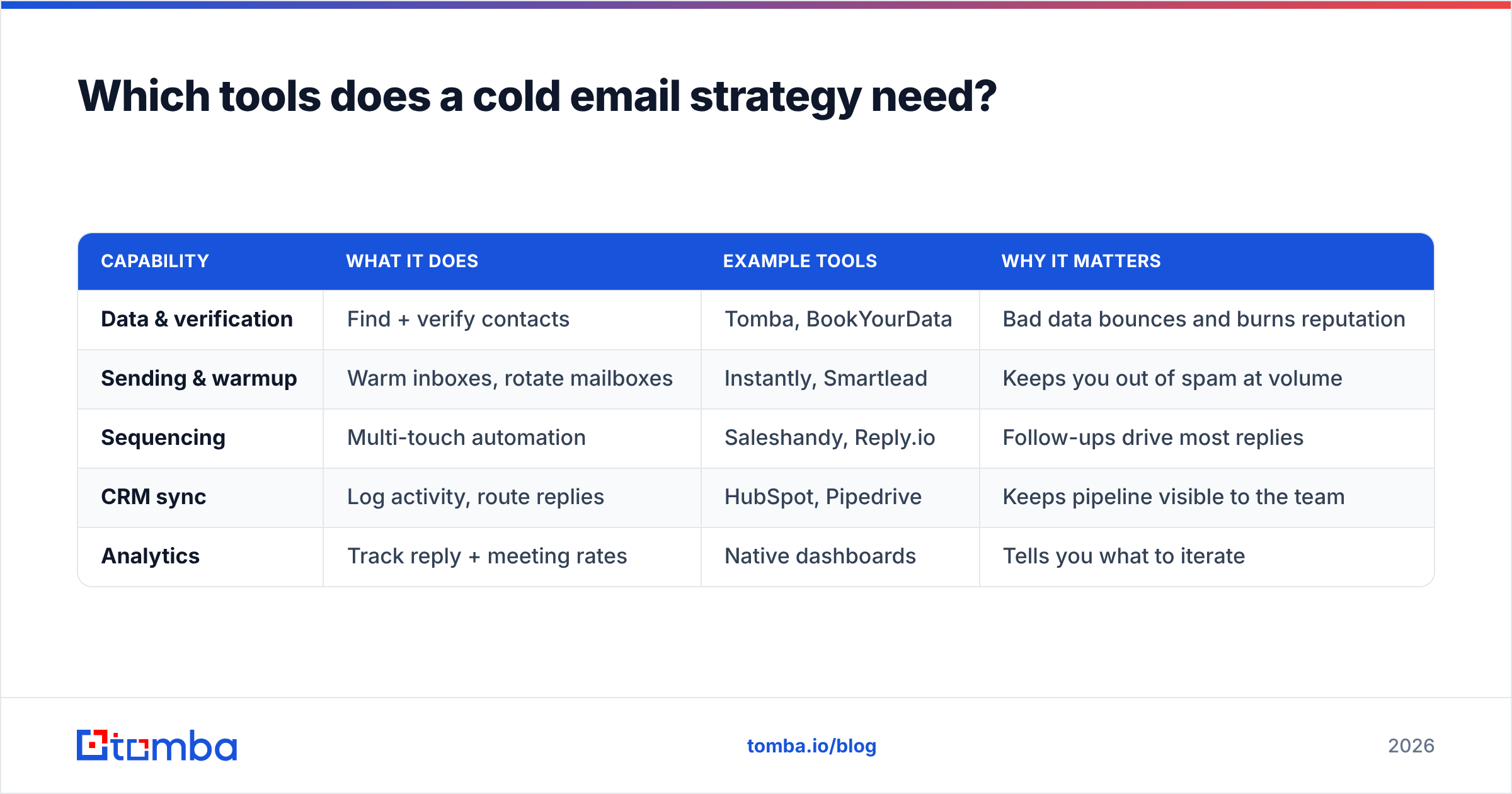
You need three capabilities: find and verify data, send and warm, and sequence and track. Some platforms bundle these; most teams mix a best-in-class data source with a sending tool. Here's how the core pieces compare by job.
| Capability | What it does | Example tools | Why it matters |
|---|---|---|---|
| Data & verification | Find + verify contacts | Tomba, BookYourData | Bad data bounces and burns reputation |
| Sending & warmup | Warm inboxes, rotate mailboxes | Instantly, Smartlead | Keeps you out of spam at volume |
| Sequencing | Multi-touch automation | Saleshandy, Reply.io | Follow-ups drive most replies |
| CRM sync | Log activity, route replies | HubSpot, Pipedrive | Keeps pipeline visible to the team |
| Analytics | Track reply + meeting rates | Native dashboards | Tells you what to iterate |
You don't need all five vendors on day one. A lean 2026 stack is often: Tomba for verified data and enrichment, one warmup-plus-sending tool, and your existing CRM. Compare full feature sets on a neutral marketplace like G2 before you commit budget — the right mix depends on your volume and how much you can spend.
On price, data quality is where cutting corners costs the most. Tomba's plans start free (25 searches/mo) and scale from Starter at $49/mo to Growth at $99/mo, so you can verify a real list before you ever pay for a sending tool.
What metrics tell you the strategy is working?#
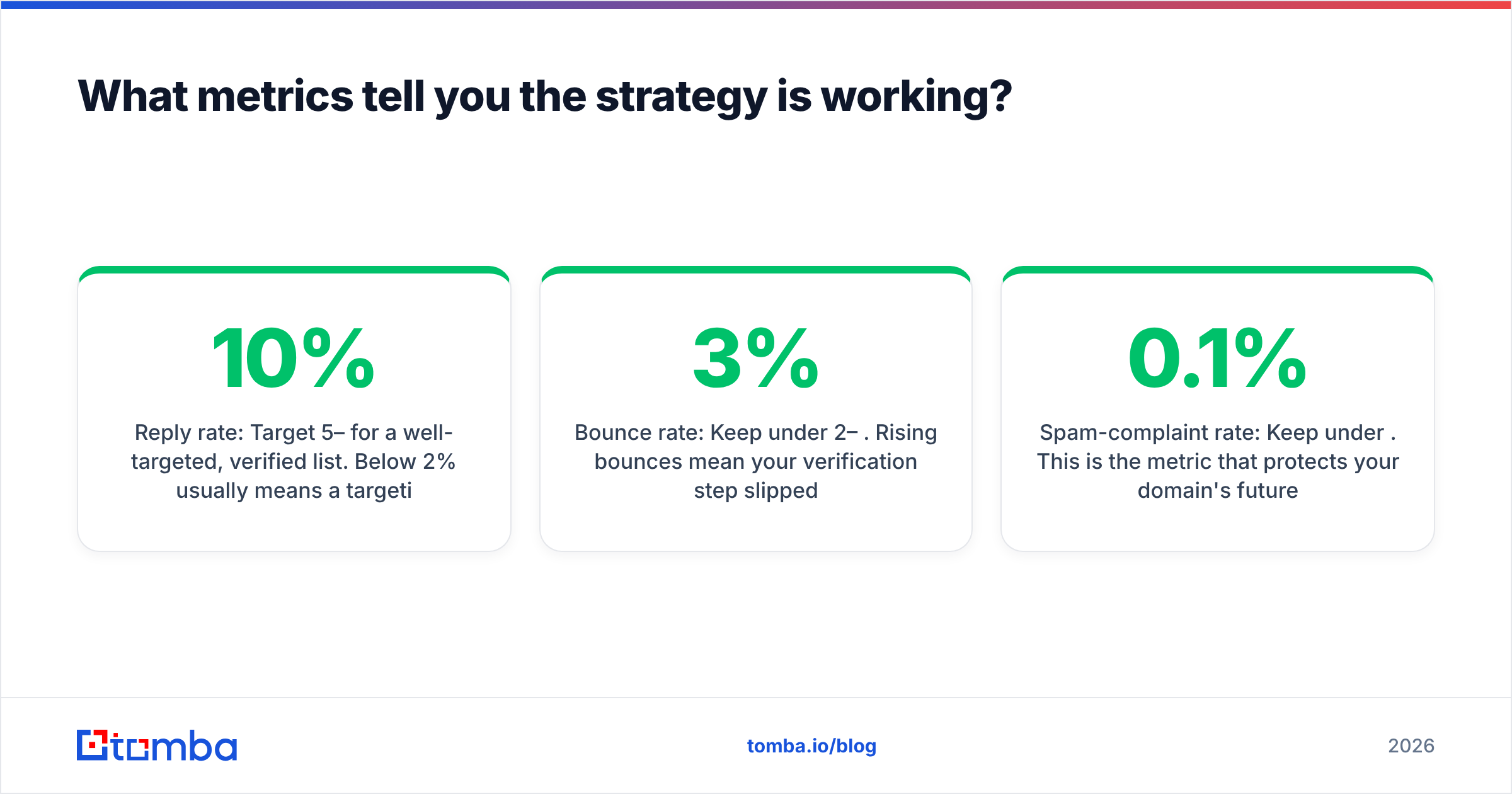
Ignore open rates — Apple Mail Privacy Protection and image-blocking have made them nearly meaningless. Track outcomes instead:
- Reply rate: Target 5–10% for a well-targeted, verified list. Below 2% usually means a targeting or deliverability problem, not a copy problem.
- Positive-reply rate: The share of replies that are actually interested. This is your real quality signal.
- Meetings booked: The number that pays rent. Everything else is a proxy.
- Bounce rate: Keep under 2–3%. Rising bounces mean your verification step slipped.
- Spam-complaint rate: Keep under 0.1%. This is the metric that protects your domain's future.
Iterate one variable at a time — subject line, first line, or CTA — so you actually learn what moved the number. Change three things at once and a lift tells you nothing. Give each test enough volume (a few hundred sends minimum) before you trust the result.
How is cold email different from spam?#
Legally and practically, the line is relevance, honesty, and an easy exit. Legitimate B2B cold email under regulations like CAN-SPAM requires a truthful subject, a real physical address, and a working one-click unsubscribe. Spam ignores all three and blasts anyone. Wikipedia's overview of CAN-SPAM is a useful primer, though you should confirm the rules for every region you mail into — GDPR in the EU is stricter.
The practical test is simpler: would this specific person, in this specific role, plausibly find this useful? If yes, and you've made leaving easy, you're doing cold outreach. If the same email could go to anyone with an inbox, you're spamming — and providers will treat you accordingly.
Put the strategy into motion#
A cold email campaign strategy is only as strong as the data feeding it. Warmed domains and clever copy can't rescue a list full of bounces and wrong contacts — but verified, well-targeted data makes every other step easier. Start there.
Use the Tomba Email Finder to build and verify your ICP list by domain, name, or company, so your first campaign lands in real inboxes instead of the void. Pull the contacts, run them through verification, and only then hit send. That order — clean data first — is the difference between a strategy that compounds and one that burns a domain in a month. Build the list right, and the meetings follow.
Related guides#
Ready to find emails that actually work?
Join 150,000+ professionals who stopped guessing and started sending. Free credits on signup — no credit card required.
Get the Tomba newsletter
Practical outbound tactics and product updates — once every two weeks.
About the author