Cold Email for Marketing Agency: The Complete 2026 Playbook
A step-by-step 2026 playbook for running cold email at a marketing agency: list building, deliverability, copy that books calls, and the metrics that actually matter.
Cold email is still the cheapest way for a marketing agency to start conversations with the exact companies it wants as clients. But it's also the easiest channel to ruin: one burned domain, one bought list, one "just checking in" template, and your reply rate flatlines. This playbook shows you how to run cold email for a marketing agency the way the good shops do it in 2026 — where every send is deliberate, every address is verified, and every email earns the reply.
TL;DR#
- Cold email for a marketing agency works when it's precise, not loud. A tightly targeted list of 300 verified contacts beats a scraped list of 30,000 every time.
- Deliverability is the whole game. Warm your domain, authenticate it (SPF, DKIM, DMARC), and keep bounce rate under 3% or you never reach the inbox.
- Verify before you send. Bounces above 5% tank your sender reputation; a good email verifier and clean sourcing keep you safe.
- Copy sells the meeting, not the service. One relevant observation plus one soft ask outperforms feature lists.
- Track replies and booked calls, not opens. Open tracking is unreliable in 2026 — measure what actually drives revenue.
Why is cold email still worth it for a marketing agency?#
Because it's the only outbound channel where you control targeting, timing, and message — at near-zero marginal cost. Paid ads make you rent attention. Referrals make you wait. SEO makes you compete. Cold email lets you pick 200 dream-fit accounts this morning and be in their inbox this afternoon.
For agencies specifically, cold email has an edge most SaaS companies don't get: you can show the work. A three-line audit of a prospect's Google Ads account, a screenshot of a broken meta description, a note that their competitor just launched a campaign you'd counter — these are proof of skill, delivered before you've charged a cent. That's why a well-run agency cold campaign routinely books calls at 2–5% of contacts reached, while a generic "we do marketing" blast books almost none.
The catch: the bar is higher than it used to be. Inbox providers filter aggressively, buyers get dozens of pitches a week, and "spray and pray" now actively damages your domain. Winning takes a system.
What does a cold email system for an agency actually look like?#
Think of it like running a restaurant, not a food truck at a festival. You're not trying to feed everyone who walks by — you're trying to seat the right guests, serve them something they'll remember, and get them to book a table again. Every cold email system has four stations working in sequence.
- Targeting — Define the exact company profile and role you can help, then build a finite list of accounts. Not "SaaS companies," but "Series A B2B SaaS with 20–80 employees running Google Ads but no dedicated PPC lead."
- Sourcing and verification — Find the decision-maker's real, current email address and confirm it's deliverable before it enters a sequence.
- Infrastructure and deliverability — Use a separate sending domain, authenticate it, warm it up, and cap daily volume so you look like a human, not a machine.
- Copy and cadence — Write short, specific, one-idea emails and follow up two or three times with new value, not "bumping this to the top."
Skip any one station and the whole line breaks. Great copy on an unverified list still bounces. A perfect list on an unwarmed domain still lands in spam. Treat these as a pipeline, not a menu.
How do you build a clean list for agency cold email?#
Start narrow and go by account, not by volume. The single biggest mistake agencies make is buying a giant list and treating reach as the goal. Reach is not the goal — relevant replies are.
Here's the sourcing order that keeps your list clean:
- Define the ICP in one sentence you could hand to a stranger and have them build the same list.
- Find companies that match, using tools like LinkedIn outreach research, industry directories, or G2 category pages to spot companies using tools you complement.
- Find the right person's email with an email finder — search by name and company domain to get the decision-maker, not
info@. - Pull emails for a whole company at once with domain search when you want every marketing contact at a target account.
- Verify every address with an email verifier before it enters a sequence.
Buying pre-built lists is tempting when you're scaling, and reputable data vendors like BookYourData sell verified B2B contacts that can jump-start a campaign. Even then, run the list through your own verification pass — data decays roughly 2–3% every month as people change jobs, so yesterday's "verified" is not today's.
Why does deliverability matter more than your copy?#
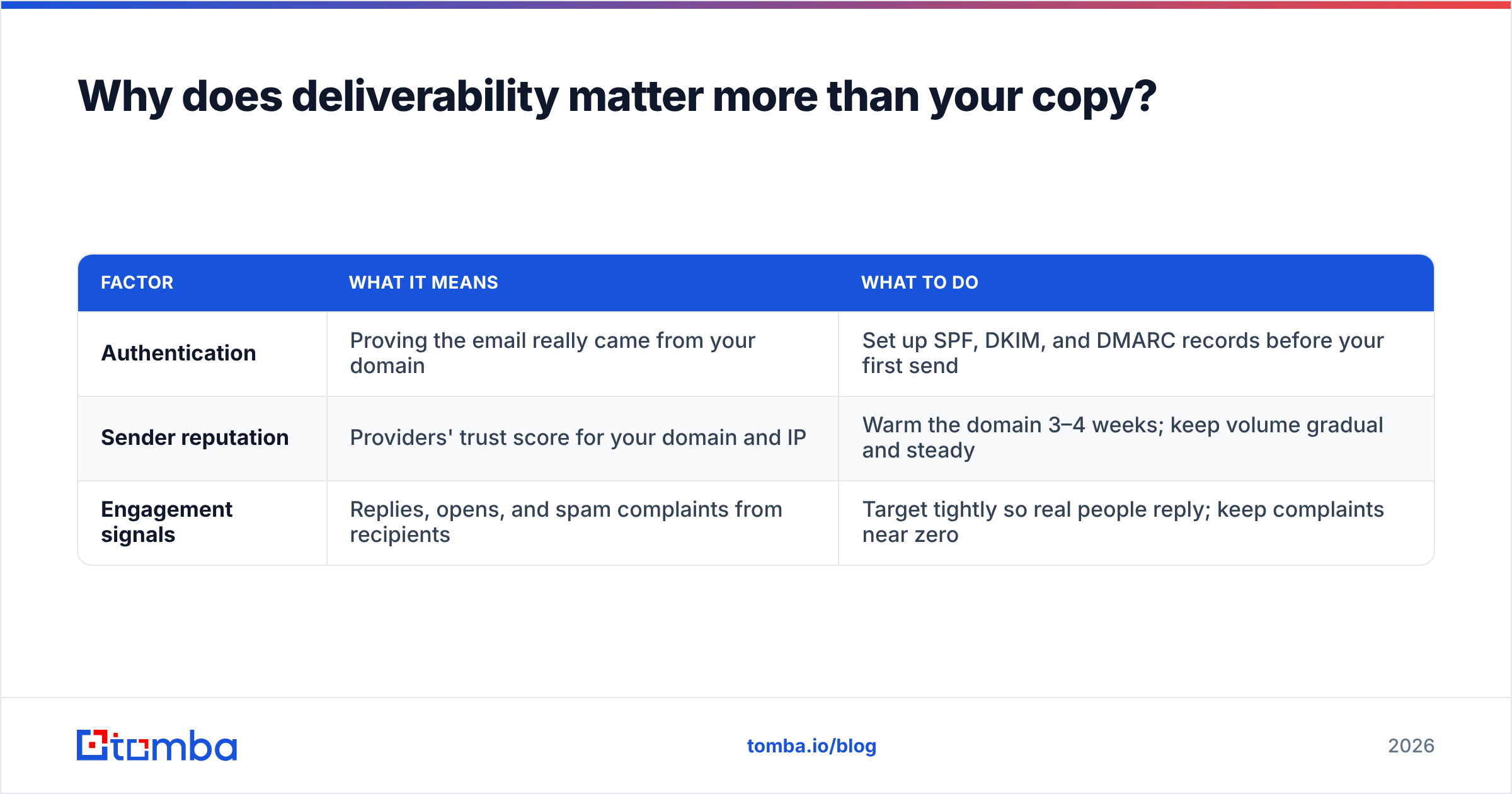
Because the best email in the world scores zero replies from the spam folder. Deliverability is the invisible layer that decides whether your message is even eligible to be read. Get it wrong and nothing else you do matters.
Three things determine whether you reach the inbox:
| Factor | What it means | What to do |
|---|---|---|
| Authentication | Proving the email really came from your domain | Set up SPF, DKIM, and DMARC records before your first send |
| Sender reputation | Providers' trust score for your domain and IP | Warm the domain 3–4 weeks; keep volume gradual and steady |
| Engagement signals | Replies, opens, and spam complaints from recipients | Target tightly so real people reply; keep complaints near zero |
Set up email deliverability fundamentals first. Use a dedicated sending domain (like getagencyname.com) separate from your primary brand domain, so a reputation hit never touches your main email. Authenticate it, then warm it: send small, human-looking volumes that ramp over three to four weeks. A warmup calculator helps you plan the ramp so you don't spike volume and trip filters.
Keep a close eye on sender reputation throughout. Free tools like Google Postmaster Tools show your domain reputation and spam rate directly from Gmail — the single most important inbox to monitor for B2B.
What happens if you skip email verification?#
Your bounce rate climbs, your reputation collapses, and providers start routing you to spam within days. This is the failure mode that kills more agency campaigns than bad copy ever will.
Here's the chain reaction. You send to a list you didn't verify. Ten, twenty, thirty percent of the addresses are dead — people left, domains changed, catch-alls swallowed the message. Each hard bounce is a signal to Gmail and Outlook that you don't know who you're emailing, which is exactly what spammers look like. Once your bounce rate crosses roughly 3–5%, providers throttle you. Cross it hard and they blacklist the domain. Now even your verified contacts stop getting through.
Verification breaks the chain. Before any address enters a sequence:
- Remove hard bounces — addresses that don't exist.
- Flag risky catch-all domains with a catch-all verifier so you can send to them cautiously or skip them.
- Deduplicate the list with a tool like remove duplicates so you never hit the same person twice from two sources.
For agencies sending hundreds of new contacts a week, a bulk email finder and verifier pass turns a raw scrape into a clean, safe-to-send list in one step.
How do you write cold email copy that books agency calls?#
Lead with something only you would have noticed about their business, then make one small, specific ask. The email is not a brochure. It's the first line of a conversation, and its only job is to earn a reply.
The structure that works for agencies in 2026:
- Trigger line — a real, specific observation: a campaign they just launched, a page that's underperforming, a competitor's move. This proves you did homework.
- Relevance bridge — one sentence connecting that observation to a result you've driven for a similar company. Use a number.
- Soft ask — a low-friction question, not a demo request. "Worth a quick look?" beats "Can we book a 30-minute discovery call?"
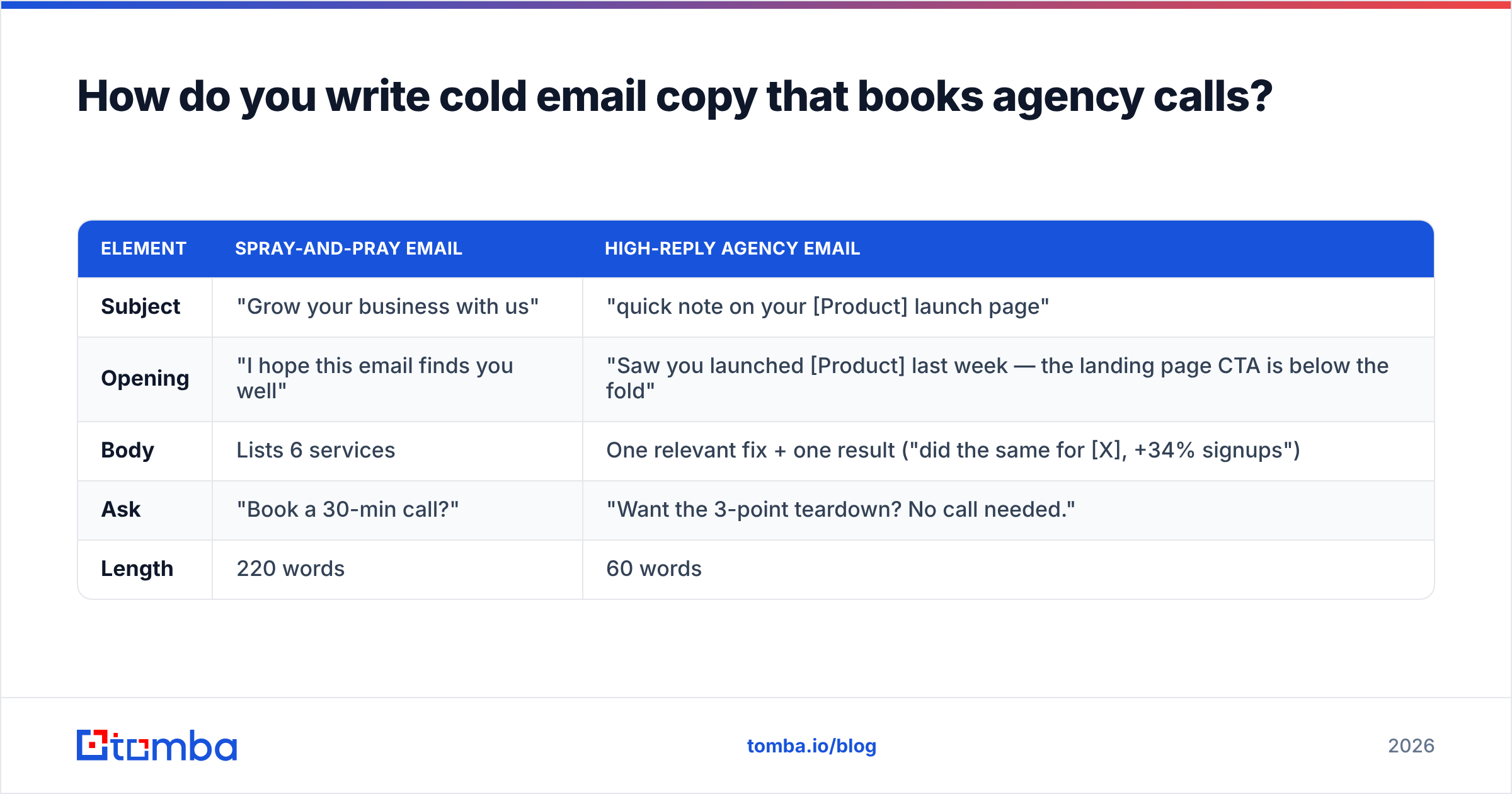
Compare the two approaches side by side:
| Element | Spray-and-pray email | High-reply agency email |
|---|---|---|
| Subject | "Grow your business with us" | "quick note on your [Product] launch page" |
| Opening | "I hope this email finds you well" | "Saw you launched [Product] last week — the landing page CTA is below the fold" |
| Body | Lists 6 services | One relevant fix + one result ("did the same for [X], +34% signups") |
| Ask | "Book a 30-min call?" | "Want the 3-point teardown? No call needed." |
| Length | 220 words | 60 words |
Keep it under 75 words. Write like a person emailing a person. If you need a starting point, adapt proven cold email templates rather than writing from scratch — but always swap in a real trigger line per prospect, or you're back to spraying.
Follow up two or three times, spaced three to four business days apart, and make each follow-up add something new: a relevant case study, a second observation, a genuinely useful resource. Never send "just bumping this up." The response rate on value-added follow-ups is often higher than the first email.
What metrics should an agency track?#
Track replies and booked calls — not opens. Apple Mail Privacy Protection and similar features inflate open rates with machine-triggered pixels, so a "60% open rate" in 2026 tells you almost nothing. Measure the numbers that map to revenue.
- Bounce rate — keep under 3%. Above that, stop and re-verify your list.
- Reply rate — the honest engagement signal. Aim for 5%+ on a tight list.
- Positive reply rate — replies that want to talk. This is your real pipeline signal.
- Booked calls — the only metric your agency's revenue actually depends on.
- Spam complaint rate — keep near zero; even 0.1% sustained will hurt you.
If reply rate is healthy but booked calls are low, your copy is fine and your ask is wrong. If bounce rate is high, your list is dirty — go back to verification. The metrics tell you which station on the line needs work.
Cold email vs. LinkedIn vs. cold calling for agencies#
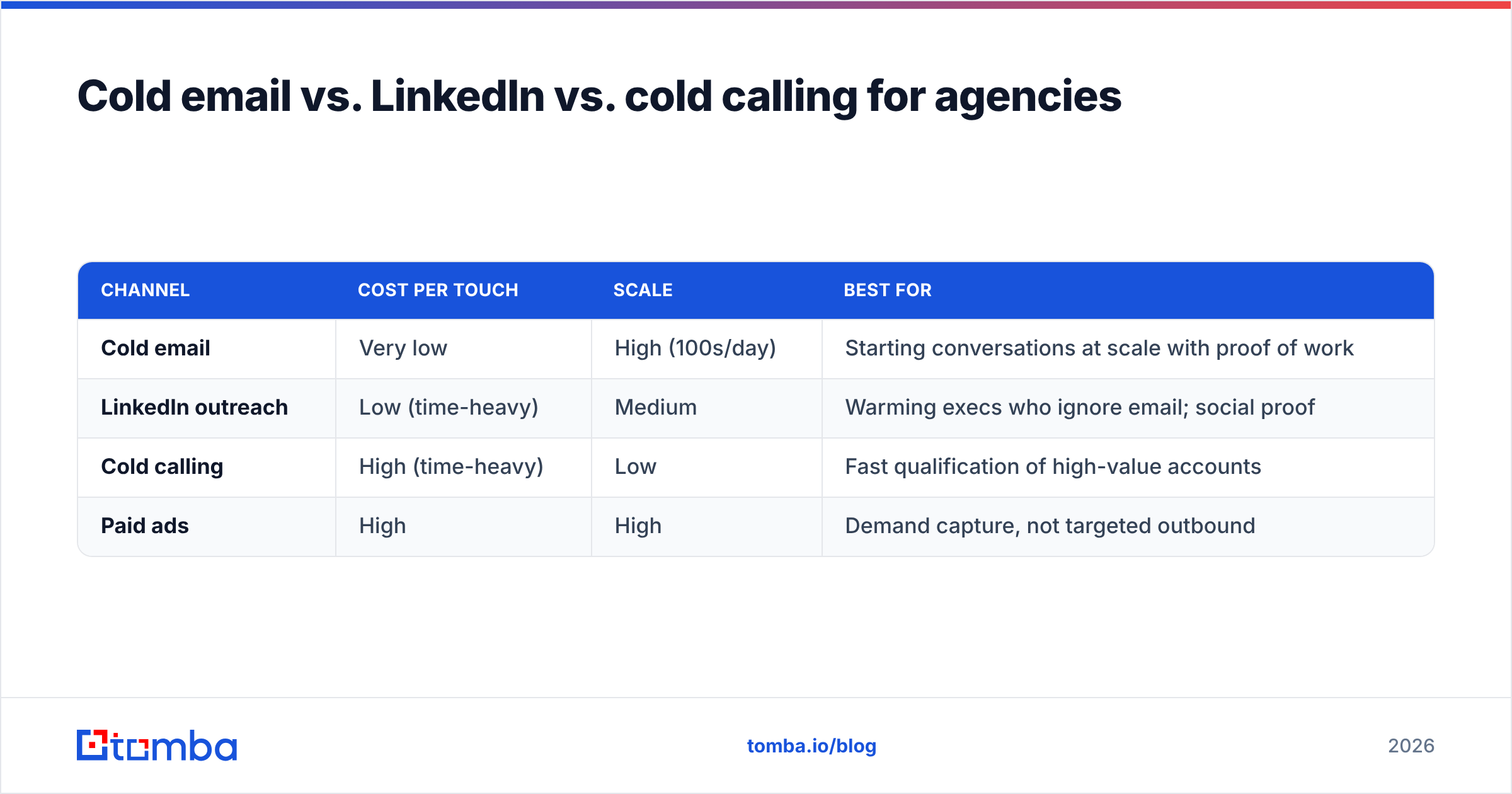
Cold email isn't the only outbound channel, and the best agencies stack it with others. Here's how it compares for a marketing agency specifically:
| Channel | Cost per touch | Scale | Best for |
|---|---|---|---|
| Cold email | Very low | High (100s/day) | Starting conversations at scale with proof of work |
| LinkedIn outreach | Low (time-heavy) | Medium | Warming execs who ignore email; social proof |
| Cold calling | High (time-heavy) | Low | Fast qualification of high-value accounts |
| Paid ads | High | High | Demand capture, not targeted outbound |
The winning play is a sequence, not a single channel: a verified cold email opens the door, a relevant LinkedIn touch adds a face, and a call closes the highest-fit accounts. For the phone step, a phone finder gets you direct dials so you're not stuck at the switchboard.
How much should an agency budget for cold email tools?#
Less than one hour of a freelancer's time, if you buy the right stack. The tooling is cheap; the expensive part is a burned domain. Here's a lean 2026 stack and where the money goes:
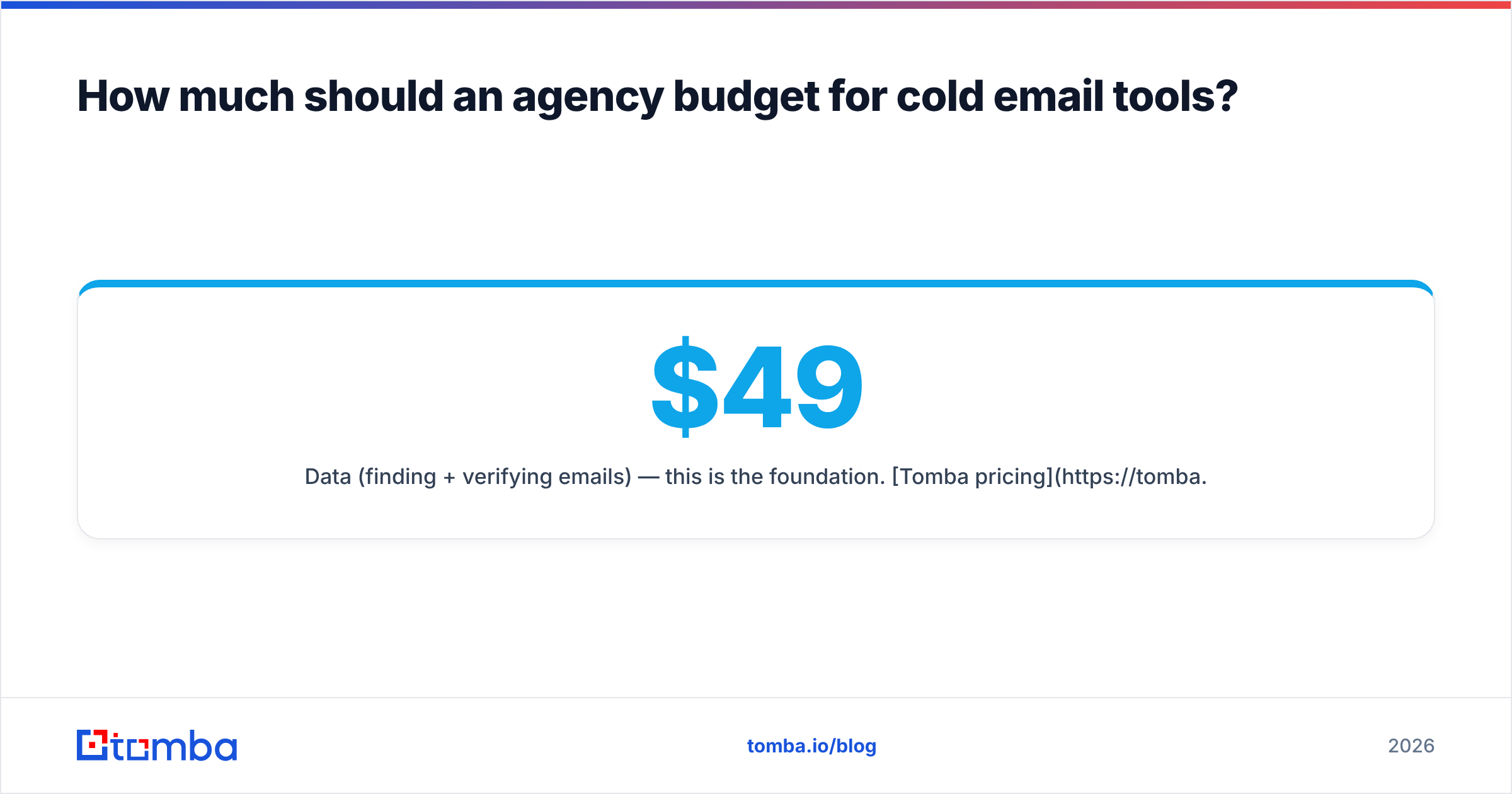
- Data (finding + verifying emails) — this is the foundation. Tomba pricing starts with a free tier (25 searches/month) to test, then a Starter plan at $49/month, Growth at $99/month, and Pro at $249/month as your volume grows.
- Sending + sequencing — a dedicated cold email platform with warmup built in.
- Monitoring — free Google Postmaster Tools plus your platform's deliverability dashboard.
Start on the free tier to validate your ICP and copy against a small verified list. Once you're booking calls, upgrade to match your monthly contact volume. Spending on clean data early is what protects the domain you'll be sending from for years.
Common mistakes that kill agency cold email#
- Sending from your main domain. One bad campaign and your client emails start landing in spam too. Always use a separate sending domain.
- Skipping the warmup. A brand-new domain blasting 200 emails on day one is the clearest spam signal there is.
- Buying volume over relevance. 10,000 unverified contacts will book fewer calls than 300 verified, well-targeted ones — and cost you your reputation.
- Pitching the service instead of the meeting. Nobody buys "SEO services" from a cold email. They agree to a 15-minute look because you noticed something specific.
- Measuring opens. Chase replies and booked calls; opens are noise in 2026.
Frequently asked questions#
Is cold email legal for agencies? Yes, when done right. In the US, CAN-SPAM requires accurate headers, no deceptive subject lines, a physical address, and a working opt-out. B2B cold email to business addresses is generally permitted; GDPR applies for EU recipients and leans on legitimate interest — keep records and honor opt-outs. Check HubSpot's cold email guidance for a plain-English overview, and consult counsel for your markets.
How many emails a day can I safely send? On a warmed domain, 30–50 per inbox per day is a safe steady state. Use multiple inboxes across your sending domain to scale volume without spiking any single sender.
How do I find the decision-maker's email? Use an email finder with the person's name and company domain, or a domain search to pull all contacts at the company, then verify before sending.
Ready to run cold email the right way?#
The whole system stands or falls on one thing: are you emailing real, current, verified people who fit your ICP? Everything else — copy, cadence, follow-ups — only pays off once that foundation is solid.
Start there. Use the Tomba Email Finder to build a precise, verified list of the exact decision-makers your agency can help, then confirm every address before it enters a sequence. Spin up the free tier, load your first 25 dream-fit accounts, and send cold email that actually reaches the inbox — and books the call.
Related guides#
// get started
Find, verify and enrich your first contacts today
Start on the free plan with 25 searches a month, then scale when your team is ready.
Free plan · No credit card required · GDPR & CCPA
// about the author