Cold Email for Restaurants: A 2026 Playbook That Books Meetings
Selling to restaurants over email is brutal unless you do it right. Here's a 2026 playbook for cold email for restaurants that gets replies, not spam flags.
Selling software, supplies, delivery, or services to restaurants is one of the hardest cold email games there is. Owners are on the floor, not in their inbox. Generic info@ addresses swallow your pitch. And one sloppy send can torch your domain reputation for weeks.
But cold email for restaurants still works in 2026 — if you treat it like a precise, permission-adjacent channel instead of a spray-and-pray blast. This playbook shows you how to find the right inboxes, write openers a busy operator actually reads, and keep your emails out of the spam folder.
TL;DR#
- Restaurant owners live on the floor, not in email — so timing, brevity, and hyper-local relevance beat volume every time.
info@is where pitches go to die. Use a real email finder to reach the owner, GM, or franchisee directly.- Verify before you send. Restaurant contact data decays fast; a bad list will wreck your deliverability.
- One clear ask, one local hook, one line of proof is the winning structure — not a three-paragraph feature dump.
- A 3–4 email sequence over 10–14 days outperforms any single "perfect" email.
Does cold email still work for selling to restaurants in 2026?#
Yes — but only when it's targeted and verified. The restaurant industry runs on thin margins and constant turnover, which means operators are genuinely hungry for tools that cut costs or drive covers. The problem isn't demand; it's reach. The average owner ignores anything that smells like a mass blast.
The operators who win are the ones who send fewer, sharper emails to the right person. Think 40 well-researched sends a day to verified owner inboxes, not 4,000 to scraped info@ addresses.
Here's the reality check most vendors miss: a restaurant is a local business with a public footprint. You can see their menu, their reviews, their reservation system, their delivery partners, and their staffing gaps before you ever hit send. That context is your unfair advantage — and it's what separates a cold email from spam.
Who should you actually email at a restaurant?#
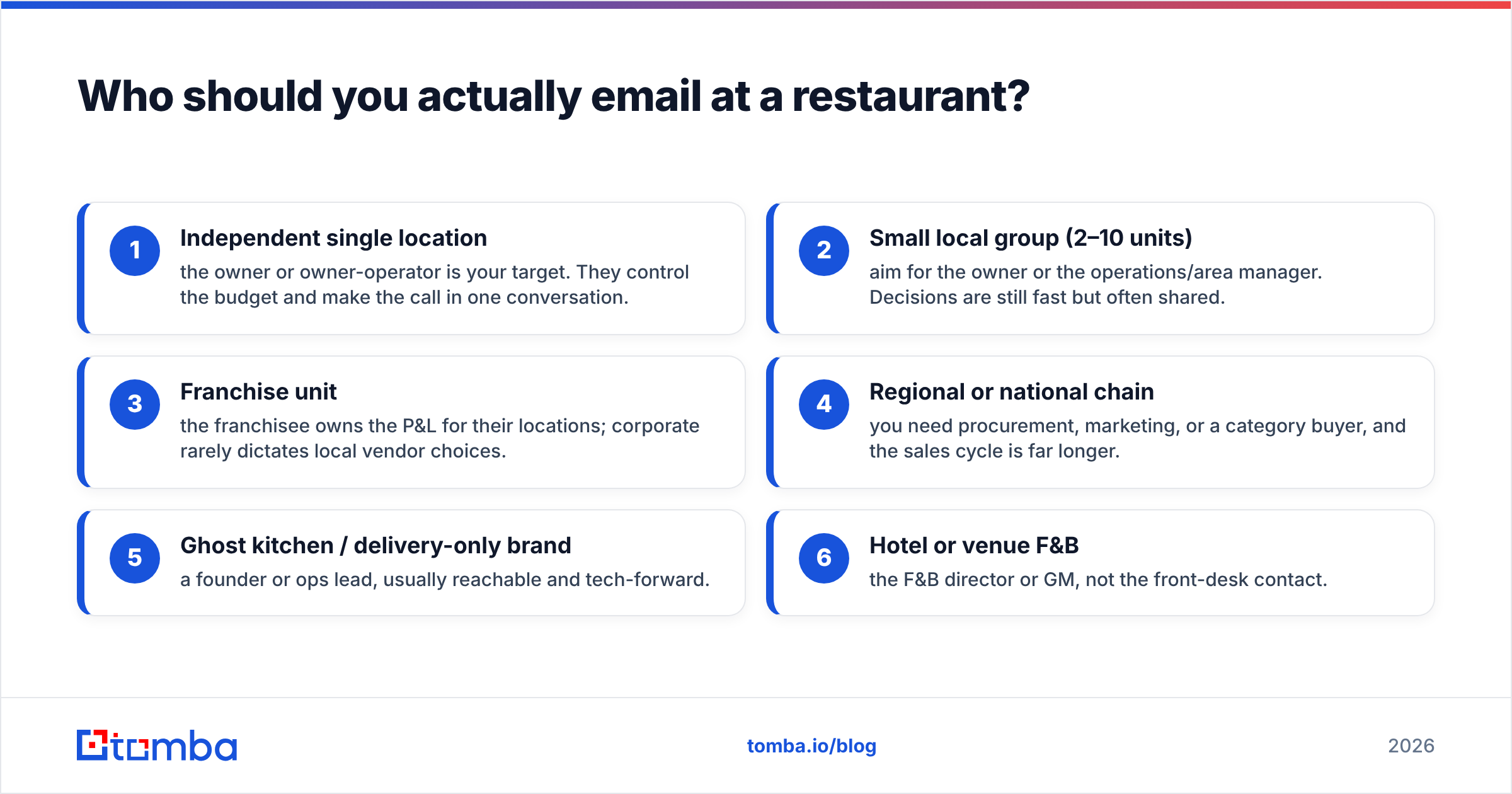
The single most common mistake is emailing the wrong person or a dead-end alias. Your message needs to reach a decision-maker, and who that is depends on the type of operation.
- Independent single location — the owner or owner-operator is your target. They control the budget and make the call in one conversation.
- Small local group (2–10 units) — aim for the owner or the operations/area manager. Decisions are still fast but often shared.
- Franchise unit — the franchisee owns the P&L for their locations; corporate rarely dictates local vendor choices.
- Regional or national chain — you need procurement, marketing, or a category buyer, and the sales cycle is far longer.
- Ghost kitchen / delivery-only brand — a founder or ops lead, usually reachable and tech-forward.
- Hotel or venue F&B — the F&B director or GM, not the front-desk contact.
Once you know the role, you need the actual email — not contact@therestaurant.com. This is where a proper email finder earns its keep: feed it the restaurant's domain and the person's name, and you get a verified professional address to work with. For multi-location groups, a domain search surfaces every named inbox on the company domain at once, so you can spot the owner or ops manager instead of guessing.
How do you build a clean restaurant prospect list?#
Garbage in, spam folder out. Restaurant contact data ages faster than almost any other vertical because ownership changes hands, managers rotate seasonally, and websites go stale. A list you scraped six months ago is already partly dead.
Follow this order of operations:
- Source the businesses by geography, cuisine, price tier, or the tech they already run (a Toast POS or an OpenTable widget tells you a lot).
- Identify the decision-maker by name using LinkedIn, the restaurant's "About" page, or local press.
- Find the email with a lookup tool rather than guessing patterns by hand.
- Verify every address with an email verifier before it enters your sequence — restaurants often use catch-all domains that quietly accept and then drop mail.
- Enrich with local signals (recent opening, new location, award, bad-review theme) you can reference in the first line.
That verification step is non-negotiable. Sending to unverified restaurant lists is the fastest way to rack up bounces, and bounces are what mailbox providers use to decide you're a spammer. Protect your sender reputation like it's your revenue, because it is.
What does a cold email to a restaurant owner look like?#
Short, local, and about them. An owner reading on their phone between a lunch rush and a supplier call will give you about three seconds. Your entire email should be readable in that window.
The winning anatomy:
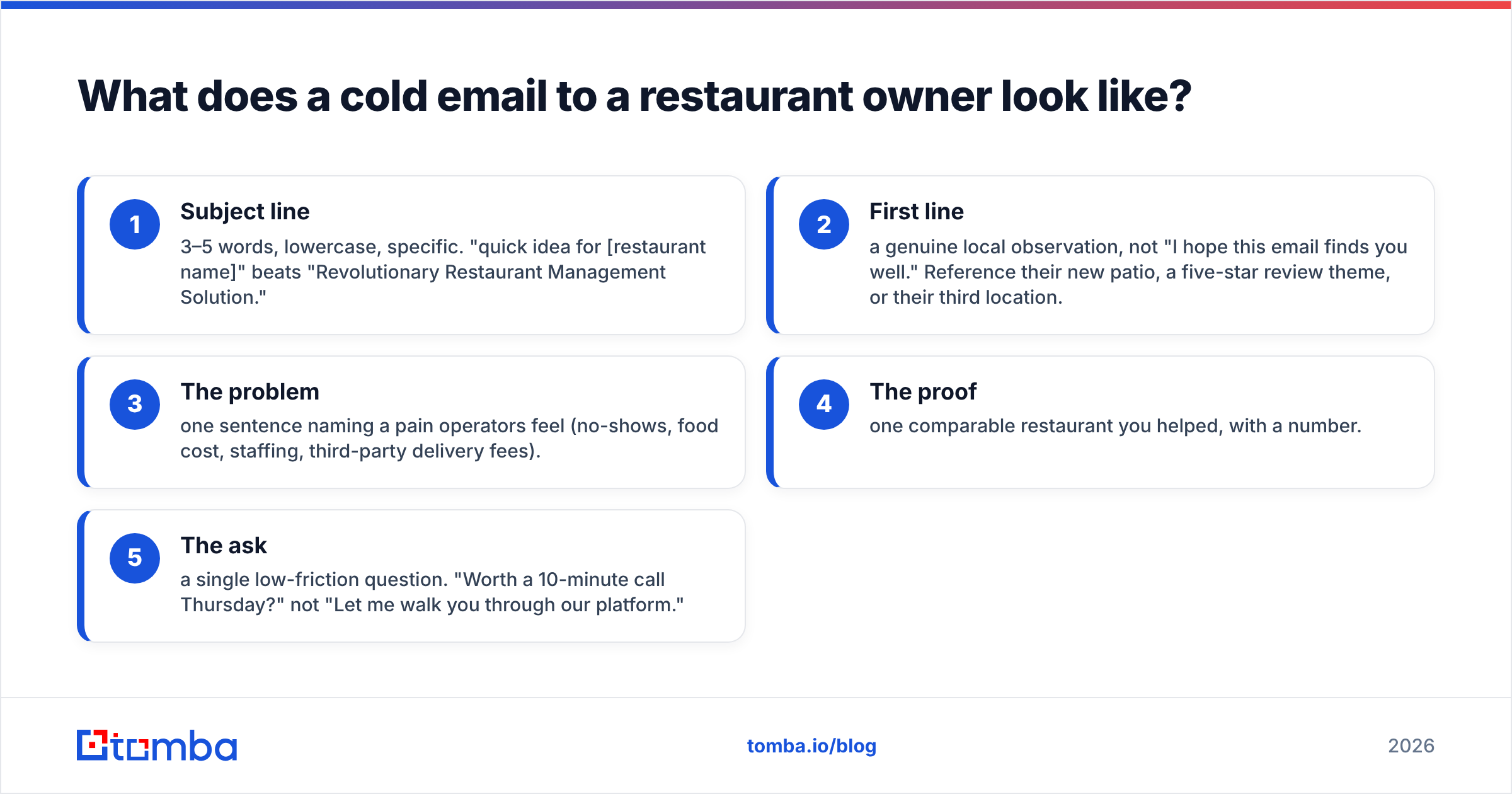
- Subject line — 3–5 words, lowercase, specific. "quick idea for [restaurant name]" beats "Revolutionary Restaurant Management Solution."
- First line — a genuine local observation, not "I hope this email finds you well." Reference their new patio, a five-star review theme, or their third location.
- The problem — one sentence naming a pain operators feel (no-shows, food cost, staffing, third-party delivery fees).
- The proof — one comparable restaurant you helped, with a number.
- The ask — a single low-friction question. "Worth a 10-minute call Thursday?" not "Let me walk you through our platform."
Here's a template you can adapt:
Subject: cutting no-shows at [restaurant]
Hi [First name],
Saw [restaurant] just added Friday reservations on OpenTable — congrats on the demand.
A lot of the owners I talk to lose 8–12% of covers to no-shows on busy nights. We helped [comparable local spot] cut that nearly in half with automated deposit reminders.
Worth a 10-minute call next week to see if it'd move the needle for you?
[Your name]
Notice what's missing: no feature list, no "synergy," no calendar link wall. If you want more starting points, a library of cold email templates can save you from reinventing every opener.
How many follow-ups should a restaurant sequence have?#
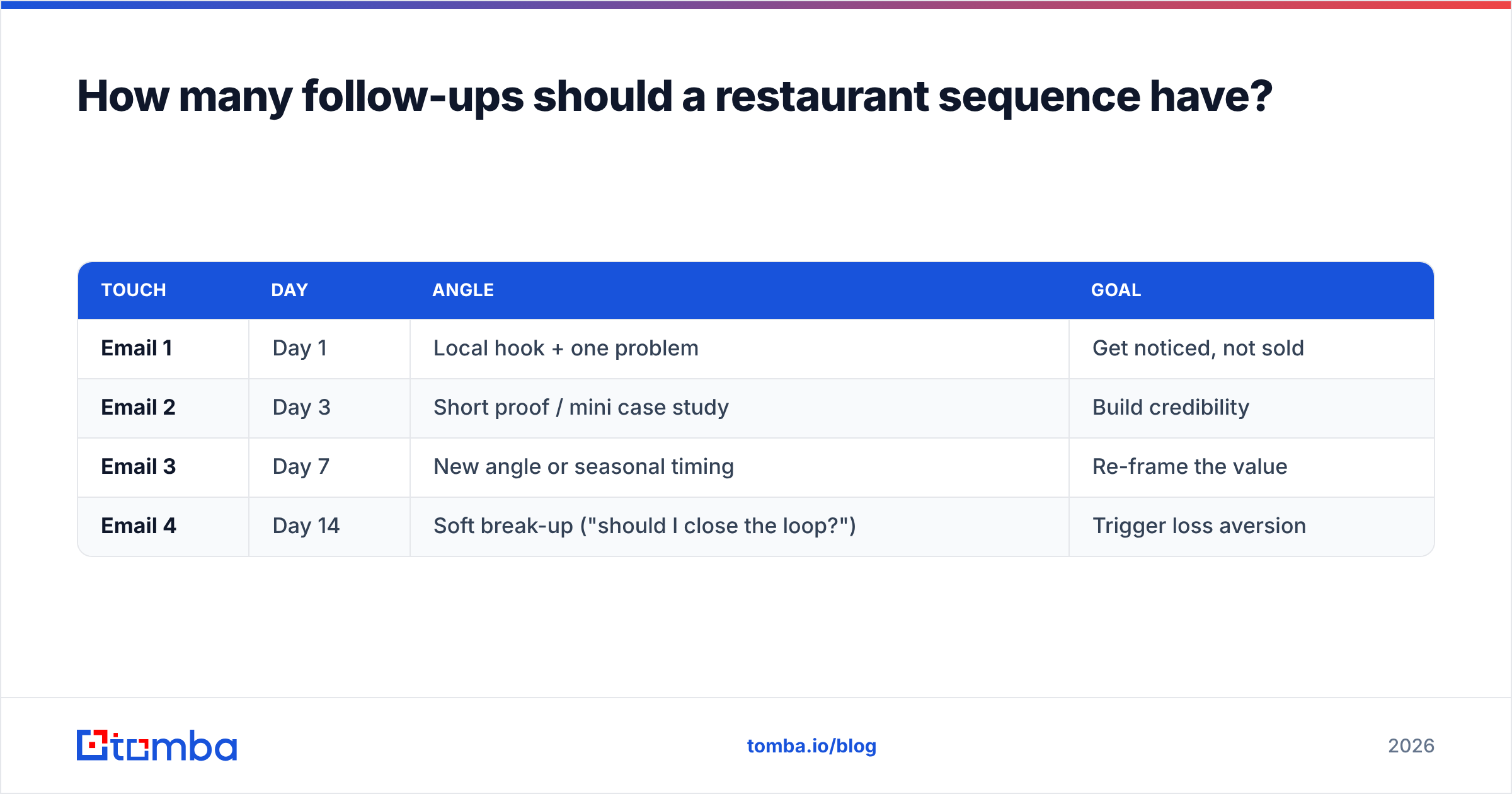
Three to four emails over 10–14 days is the sweet spot. Owners aren't ignoring you out of disinterest — they're slammed. The follow-up is where most restaurant deals actually get booked, because your second or third touch happens to land on a slow Tuesday.
| Touch | Day | Angle | Goal |
|---|---|---|---|
| Email 1 | Day 1 | Local hook + one problem | Get noticed, not sold |
| Email 2 | Day 3 | Short proof / mini case study | Build credibility |
| Email 3 | Day 7 | New angle or seasonal timing | Re-frame the value |
| Email 4 | Day 14 | Soft break-up ("should I close the loop?") | Trigger loss aversion |
Keep each follow-up shorter than the last, and change the angle every time — don't just "bump" the same message. Send in the mid-morning lull (10–11 a.m.) or mid-afternoon (2–4 p.m.), never during service. Avoid Monday (recovery day) and Friday afternoon (pre-weekend chaos).
What tools do you need for restaurant cold email?#
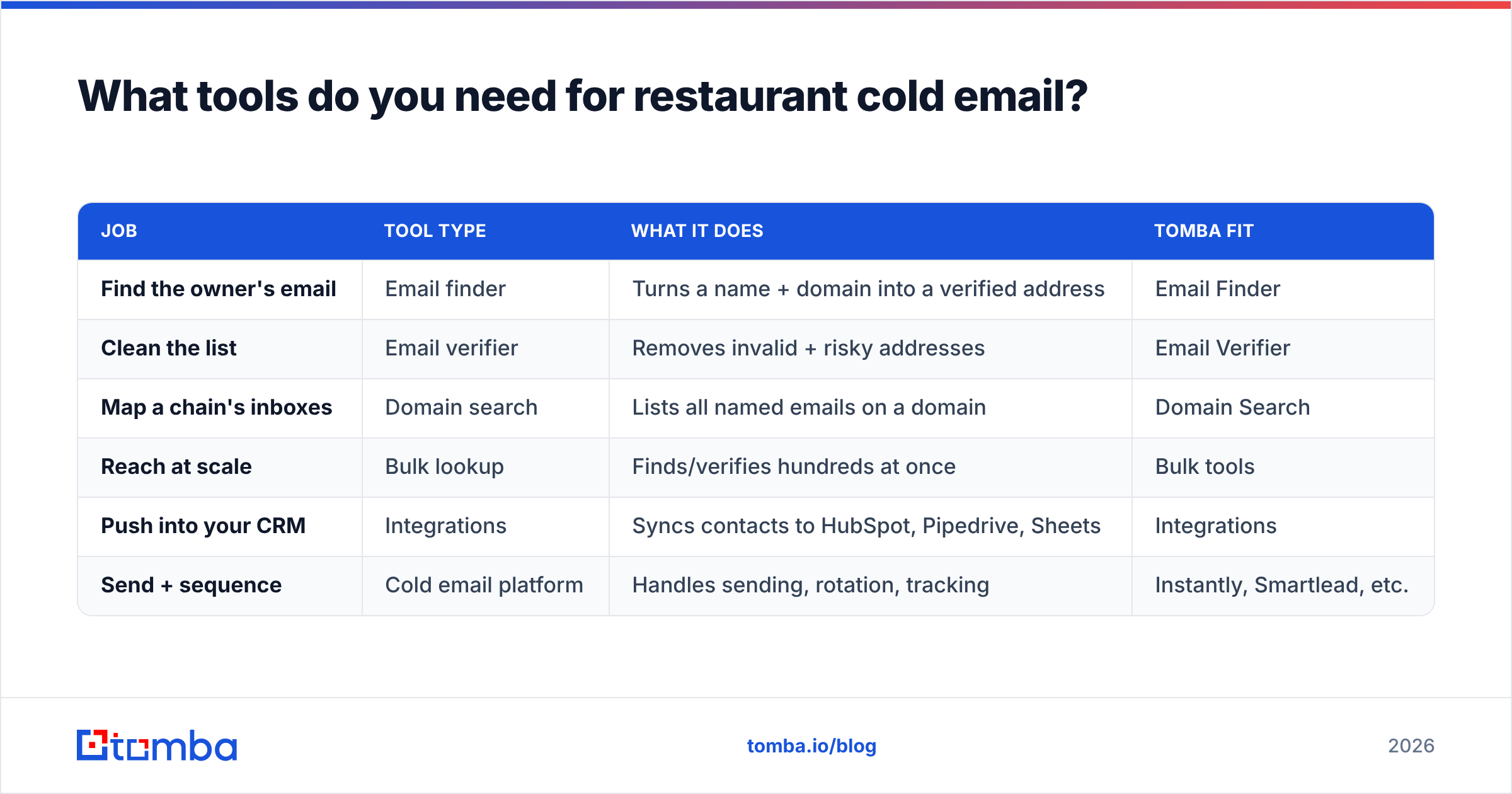
You can start lean. Here's how the core stack compares by job to be done.
| Job | Tool type | What it does | Tomba fit |
|---|---|---|---|
| Find the owner's email | Email finder | Turns a name + domain into a verified address | Email Finder |
| Clean the list | Email verifier | Removes invalid + risky addresses | Email Verifier |
| Map a chain's inboxes | Domain search | Lists all named emails on a domain | Domain Search |
| Reach at scale | Bulk lookup | Finds/verifies hundreds at once | Bulk tools |
| Push into your CRM | Integrations | Syncs contacts to HubSpot, Pipedrive, Sheets | Integrations |
| Send + sequence | Cold email platform | Handles sending, rotation, tracking | Instantly, Smartlead, etc. |
For finding and verifying contacts, Tomba covers the top of the funnel. Its pricing starts with a free tier (25 searches/month), then Starter at $49/mo, Growth at $99/mo, and Pro at $249/mo — so you can validate the channel before scaling spend. For the sending layer, pair it with a dedicated cold-email platform that manages inbox rotation and warmup.
If your targets skew toward pre-built restaurant lists, a data provider like BookYourData is a solid complement for buying verified industry contacts in bulk — a good option when you'd rather buy a list than build one, then verify it before sending.
How do you keep restaurant cold emails out of spam?#
Deliverability is where campaigns quietly die. You can write the perfect email and never know it landed in Junk. Protect the fundamentals before you scale.
- Authenticate your domain. Set up SPF, DKIM, and DMARC. Run an SPF checker to confirm your record is valid — misconfigured auth is a top reason restaurant sends bounce or filter.
- Warm up the sending inbox for 2–4 weeks before real outreach so providers trust your volume. A warmup calculator helps you ramp safely.
- Use a separate sending domain (like
getyourbrand.co) so a bad campaign never damages your primary domain's email deliverability. - Cap daily volume at 30–50 per inbox and add more inboxes to scale, rather than blasting one address.
- Verify every send and remove catch-alls with a catch-all verifier — restaurant domains are notorious for accept-all setups that inflate your bounce risk.
Google and Microsoft have tightened bulk-sender rules, and their guidance is worth reading straight from the source — see Google's sender guidelines for the current bar on authentication and spam rates. Stay under a 0.3% spam-complaint rate and you'll keep the door open.
What mistakes kill restaurant cold email campaigns?#
Most failures trace back to a short list of avoidable errors:
- Emailing
info@and hoping. These aliases are monitored by whoever's least busy, which is usually no one who can say yes. - Ignoring local context. A template with no mention of their actual restaurant reads as spam instantly.
- Pitching features, not outcomes. Owners care about covers, cost, and labor — translate every feature into one of those.
- Skipping verification. Unverified lists tank deliverability and burn your domain.
- Giving up after one email. The money is in follow-up three, not email one.
- Sending during service. Nobody books a demo at 7 p.m. on a Saturday.
Fix these and you're already ahead of 90% of the vendors clogging that owner's inbox.
The bottom line#
Cold email for restaurants isn't dead — lazy cold email is. When you reach the actual decision-maker, lead with a real local hook, keep it short, verify every address, and follow up with patience, restaurants become one of the most responsive verticals you can sell into. They're busy, not unreachable.
Start where the leverage is highest: getting verified, direct contact details for the owners and operators you want to reach. Tomba's Email Finder turns a restaurant name and domain into a confirmed inbox — and its built-in email verification keeps your list clean so your best pitch actually lands. Spin up the free tier, build your first 25-contact test list this week, and let the replies tell you the channel works.
Related guides#
// get started
Find, verify and enrich your first contacts today
Start on the free plan with 25 searches a month, then scale when your team is ready.
Free plan · No credit card required · GDPR & CCPA
// about the author