Cold Email for Selling Products: A 2026 Playbook That Converts
Cold email still sells products in 2026 — but only when targeting, copy, and follow-ups work together. Here's the full playbook, with a channel comparison and templates you can steal.
Cold email for selling products has a reputation problem. Half the internet says it's dead; the other half is quietly booking demos with it every week. Both can be true — because the difference between a campaign that sells and one that gets you blocked isn't the channel. It's the list, the copy, and the follow-up discipline behind it.
This is the playbook: who to target, what to write, how to stay out of spam, and how to measure whether it's working.
TL;DR#
- Cold email still sells products in 2026 — but volume-for-volume "spray and pray" is what actually died, not the channel.
- Your list is 80% of the result. A verified, well-targeted list of 200 people beats a scraped list of 20,000 every time.
- Sell the outcome, not the feature. One clear problem, one line of proof, one low-friction ask.
- The money is in the follow-up. Most replies come from emails 2–4, not the first send.
- Protect your domain. Warm up, verify addresses, and keep bounce rates under 3% or deliverability collapses.
Does cold email still work for selling products in 2026?#
Yes — for the right products, sold to the right people, in the right way. Cold email works best when your product solves a specific, expensive, or urgent problem for a business, and you can reach the person who owns that problem directly.
Think of cold email like knocking on doors in a neighborhood. If you knock on every door selling snow tires in July, you're a nuisance. If you knock on the three houses with cracked driveways offering resealing — in October, before winter — you're welcome. The channel didn't change. Your targeting did.
Where cold email struggles:
- Low-ticket B2C products where the math never works against inbox limits.
- Products with no clear buyer — if you can't name the job title that feels the pain, you can't target.
- Commodity offers with no differentiation and no reason to reply.
Where it still shines: B2B software, agencies, professional services, high-margin physical products sold to businesses, and anything where a single closed deal is worth hundreds or thousands of dollars.
What makes cold email different from spam?#
The legal and practical line comes down to relevance and honesty. Spam is unsolicited, irrelevant, and often deceptive. A good cold email is unsolicited but relevant, honest, and easy to opt out of. Regulations like CAN-SPAM and GDPR don't ban cold outreach outright — they demand accurate headers, a real physical address, a working unsubscribe, and (in the EU) a lawful basis for contacting a business.
Here's the mindset shift that separates sellers from spammers:
- You researched this person. The email could not have been sent to anyone else without edits.
- You lead with their problem, not your product.
- You make the ask small — a reply, a question, 15 minutes — not "buy now."
- You take no for an answer and remove them cleanly on request.
Which channel should you use to sell your product?#
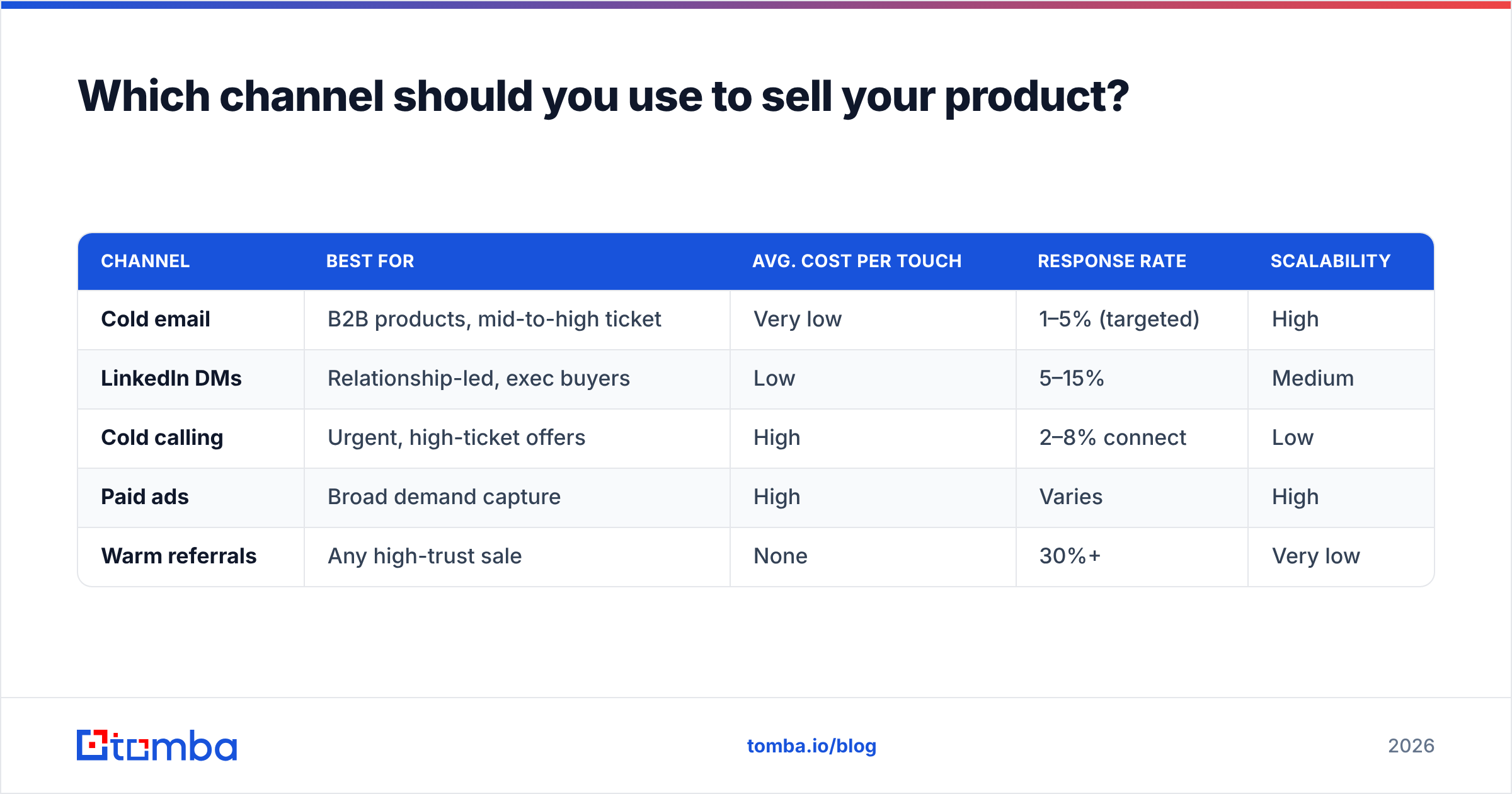
Cold email is powerful, but it's rarely the only tool. Picking the right primary channel — and the right supporting ones — depends on deal size, buyer, and volume. Here's how the main outbound channels compare for selling products.
| Channel | Best for | Avg. cost per touch | Response rate | Scalability |
|---|---|---|---|---|
| Cold email | B2B products, mid-to-high ticket | Very low | 1–5% (targeted) | High |
| LinkedIn DMs | Relationship-led, exec buyers | Low | 5–15% | Medium |
| Cold calling | Urgent, high-ticket offers | High | 2–8% connect | Low |
| Paid ads | Broad demand capture | High | Varies | High |
| Warm referrals | Any high-trust sale | None | 30%+ | Very low |
For most product sellers, the winning combination is cold email as the scalable core, LinkedIn as the warm-up layer, and calling reserved for high-intent replies. Email gives you reach and automation; the other channels add trust where email alone falls short. If your buyers live on LinkedIn, a LinkedIn finder that pulls verified work emails from profiles lets you run both channels off the same list.
How do you build a list worth emailing?#
Your list is the single biggest lever in cold email for selling products. A perfect email sent to the wrong person converts at zero. Build the list in three layers:
- Define the ICP first. Company size, industry, geography, and the specific job title that owns the problem you solve. Write it down before you touch any tool.
- Source the accounts. Pull target companies from a B2B database, industry lists, event attendees, or your own site's anonymous traffic.
- Find and verify the contacts. Use an email finder to get the decision-maker's professional address, then run every address through an email verifier before it enters a sequence.
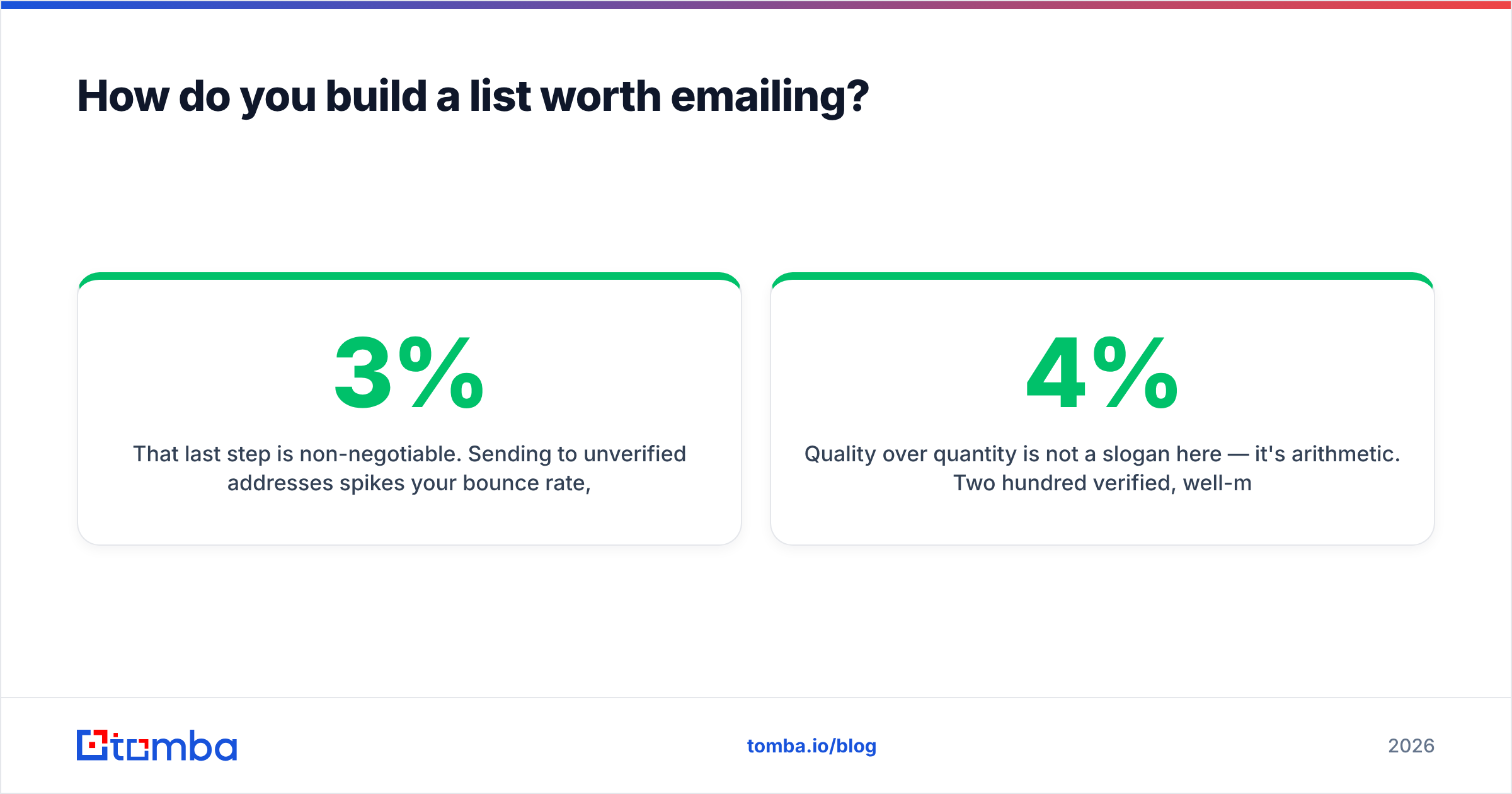
That last step is non-negotiable. Sending to unverified addresses spikes your bounce rate, and mailbox providers read high bounces as a spam signal. Keep bounces under 3%, ideally under 1%. Verifying up front is the cheapest insurance you can buy for your sending domain.
Quality over quantity is not a slogan here — it's arithmetic. Two hundred verified, well-matched prospects at a 4% reply rate produce eight conversations. Twenty thousand scraped addresses at 0.1% (after half of them bounce and torch your domain) produce a suspended account.
What does a cold email that sells actually look like?#
A high-converting cold email is short, specific, and built around one idea. The structure that works consistently:
- Subject line: 2–5 words, lowercase, no hype. It should read like an internal note, not a billboard. ("quick question about {{company}} onboarding")
- Opening line: About them, not you. Reference a trigger — a hire, a launch, a review, a stat.
- The problem: One sentence naming the pain your product removes.
- The proof: One line of evidence — a result, a comparable customer, a number.
- The ask: One low-friction question. "Worth a quick look?" beats "Can we schedule a 30-minute demo this week?"
Here's a template you can adapt:
Subject: {{company}} + [outcome]
Hi {{first_name}},
Noticed {{company}} just [trigger — expanded the SDR team / launched in the EU]. Usually that means [specific problem your product solves] gets painful fast.
We helped [comparable company] cut [metric] by [number] in [timeframe] without [common objection].
Worth a two-line reply on whether this is on your radar?
[Your name]
Want more starting points? Grab proven structures from a library of cold email templates and rewrite them in your own voice — never send a template verbatim.
How many follow-ups should you send?#
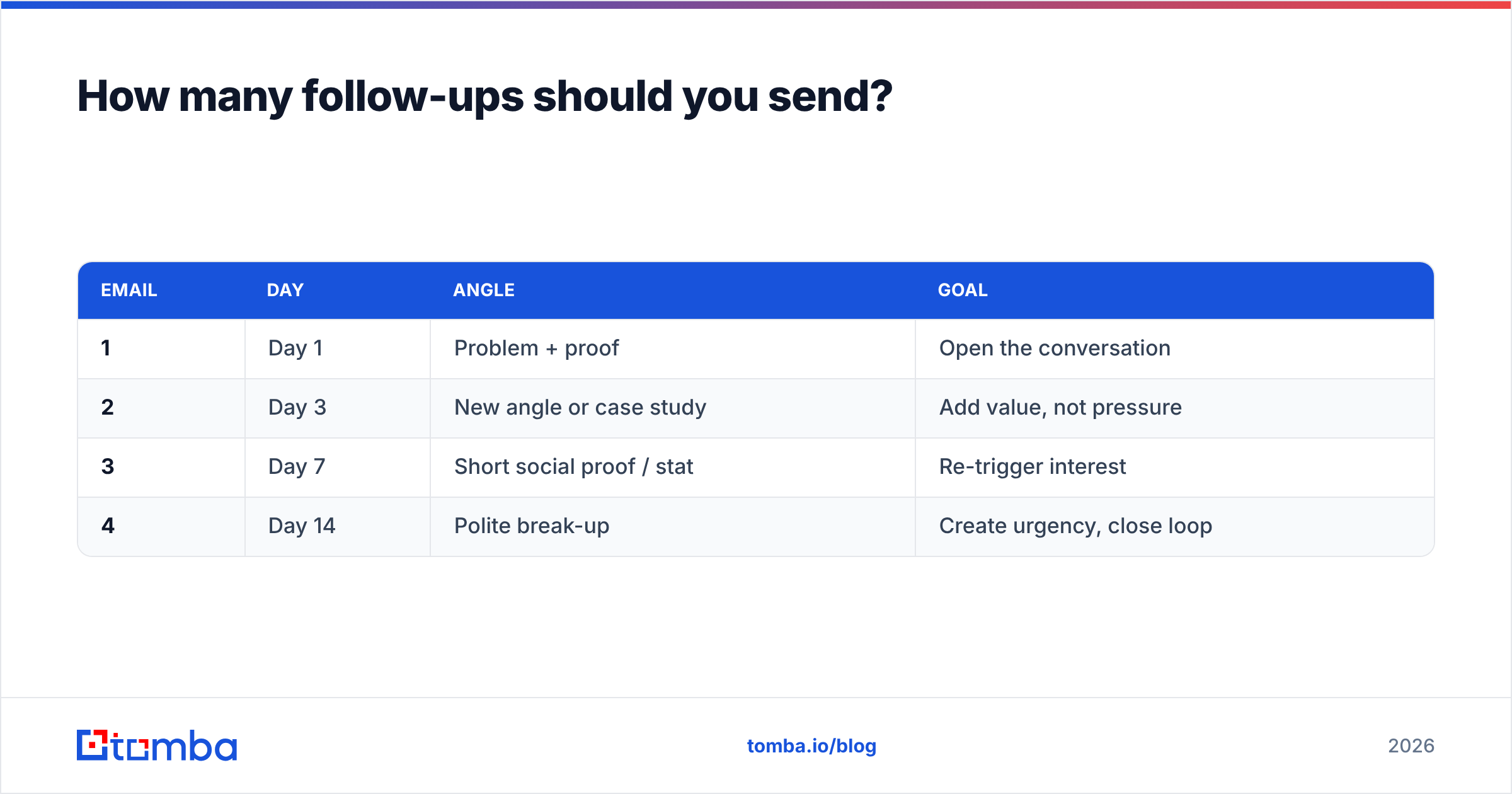
Plan for three to four follow-ups over two to three weeks. Data from outreach platforms consistently shows the majority of positive replies arrive after the first email — people are busy, your first message lands at a bad moment, and persistence (done politely) reads as confidence.
A simple cadence that works:
| Day | Angle | Goal | |
|---|---|---|---|
| 1 | Day 1 | Problem + proof | Open the conversation |
| 2 | Day 3 | New angle or case study | Add value, not pressure |
| 3 | Day 7 | Short social proof / stat | Re-trigger interest |
| 4 | Day 14 | Polite break-up | Create urgency, close loop |
Each follow-up must add something — a new insight, a different use case, a customer story. Never send "just bumping this to the top of your inbox" with nothing new. The break-up email ("I'll assume the timing isn't right and close this out — happy to reconnect later") is often the highest-replying message in the sequence because it removes pressure and prompts a decision.
How do you keep your emails out of spam?#
Deliverability is where most product-selling campaigns quietly die. You can write the perfect email, but if it never reaches the inbox, none of it matters. Protecting email deliverability comes down to a few disciplines:
- Authenticate your domain. Set up SPF, DKIM, and DMARC records. Providers like Google Postmaster Tools will show you exactly how your domain is being treated.
- Warm up new domains and inboxes. Ramp sending volume gradually over 2–4 weeks. A warmup calculator helps you plan the ramp so you don't send 500 cold emails from a week-old address.
- Use a separate sending domain. Never run cold campaigns from your primary company domain — isolate the risk on a lookalike domain.
- Keep lists clean. Verify before every send, remove hard bounces immediately, and honor unsubscribes within hours.
- Watch your volume per inbox. Stay under ~30–50 cold sends per mailbox per day. Scale by adding inboxes, not by blasting one.
Bounce rate, spam-complaint rate, and reply rate are your early-warning system. If replies drop and bounces climb, stop, diagnose, and clean before you send another batch.
Cold email vs. other prospecting methods: which wins?#
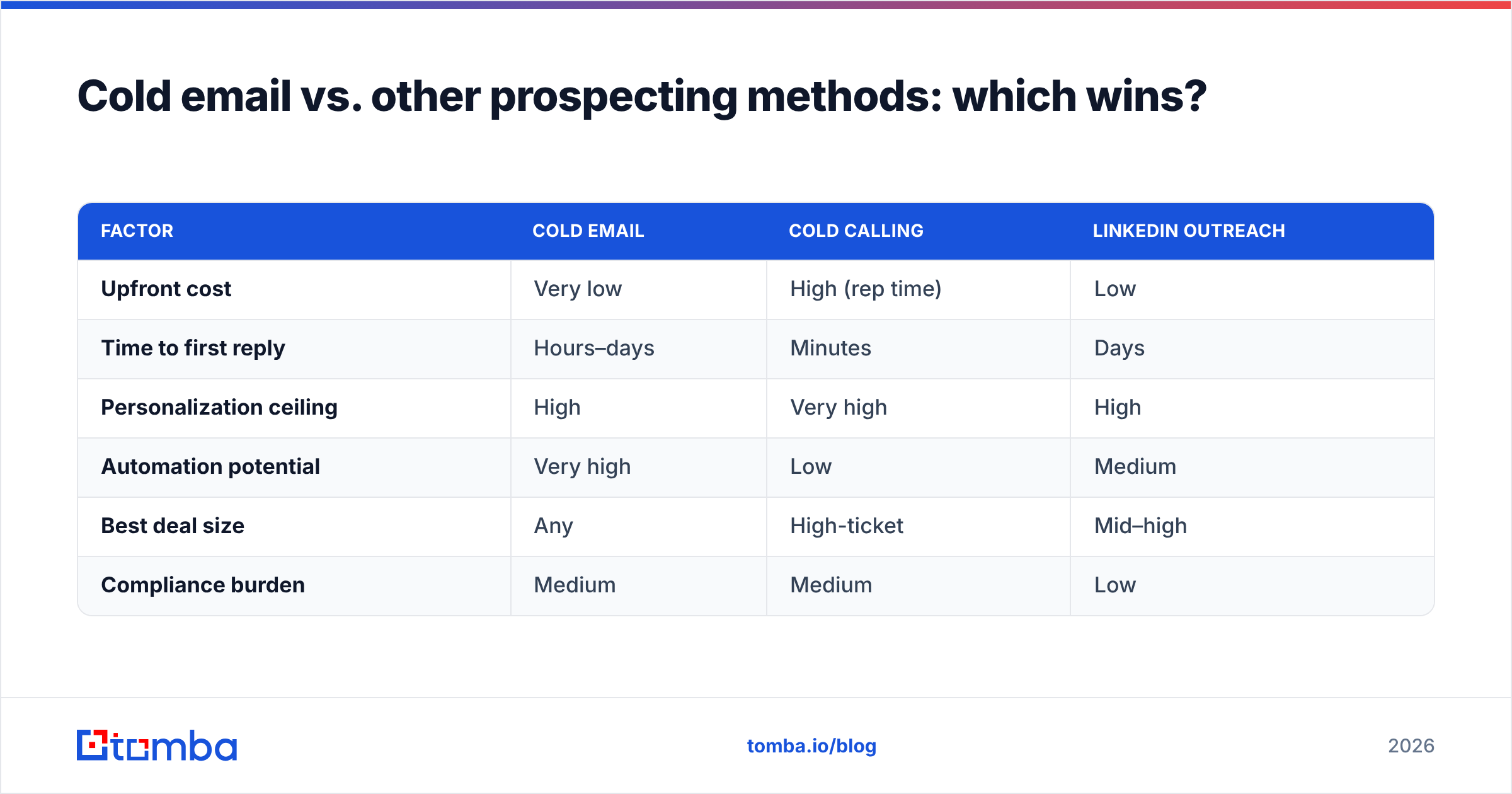
There's no single winner — there's a right tool for the deal. Cold email wins on cost and scale, cold calling wins on immediacy, and referrals win on trust. The best product sellers layer them:
| Factor | Cold email | Cold calling | LinkedIn outreach |
|---|---|---|---|
| Upfront cost | Very low | High (rep time) | Low |
| Time to first reply | Hours–days | Minutes | Days |
| Personalization ceiling | High | Very high | High |
| Automation potential | Very high | Low | Medium |
| Best deal size | Any | High-ticket | Mid–high |
| Compliance burden | Medium | Medium | Low |
The practical answer for most teams: start with cold email because it scales and costs almost nothing, then route warm replies to calls and LinkedIn. Email finds the interested; humans close them.
How do you measure if it's working?#
Track the funnel, not just opens. With Apple Mail Privacy and similar features inflating open rates, opens are now a vanity metric. The numbers that matter:
- Bounce rate (target < 3%) — health of your list.
- Reply rate (target 1–5%+ on targeted campaigns) — quality of targeting and copy.
- Positive reply rate — replies that are actually interested, not "no thanks."
- Meetings booked — the real leading indicator of revenue.
- Closed deals per 1,000 sends — the number that tells you if the whole engine is profitable.
If reply rates are low, the problem is almost always targeting or offer, not clever copy tweaks. If replies are decent but nothing closes, the problem is qualification or the sales conversation after the reply. Diagnose which stage leaks before you rewrite anything.
Common mistakes that kill product-selling campaigns#
- Buying giant unverified lists. High bounces, wrecked domain, banned account.
- Talking about yourself. "We're the leading platform for…" — nobody cares in line one.
- Asking for too much too soon. A 30-minute demo from a stranger is a big ask; a two-line reply isn't.
- No follow-up. Sending once and giving up leaves most of your pipeline on the table.
- One inbox, huge volume. The fastest way to a spam folder.
- No personalization at all. If it could go to anyone, it converts like it went to no one.
Put the playbook to work#
Cold email for selling products still works in 2026 — the sellers winning with it just do the unglamorous parts right: a tight ICP, a verified list, one clear message, disciplined follow-ups, and protected deliverability. Nail those and the channel does exactly what it's always done: turn strangers into conversations, and conversations into revenue.
Everything downstream depends on reaching the right person at a real, deliverable address. Start there. Use the Tomba Email Finder to pull verified professional emails for your exact ICP, run them through verification before they hit a sequence, and build campaigns on a foundation that actually lands in the inbox. You can test it on the free tier (25 searches a month) and scale up on a plan that fits — see Tomba pricing when you're ready to go bigger. Better lists, better deliverability, better numbers — that's where selling by cold email begins.
Related guides#
Ready to find emails that actually work?
Join 150,000+ professionals who stopped guessing and started sending. Free credits on signup — no credit card required.
Get the Tomba newsletter
Practical outbound tactics and product updates — once every two weeks.
About the author