Cold Email Lead Gen Agency vs In-House: 2026 Cost Guide
A cold email lead gen agency runs $3,000-$10,000/month. Here's what that buys, where the margin actually hides, and the in-house math that beats it for most teams under 20 reps.
TL;DR#
- A cold email lead gen agency typically charges $3,000-$10,000/month on a 3-6 month minimum, and most of that retainer is labor, not technology.
- The actual tool stack an agency runs — data provider, verifier, inbox infrastructure, sending platform — costs $200-$600/month. You can rent the same stack yourself.
- Agencies earn their fee on three things: sending infrastructure they've already burned in, positioning/copy iteration, and the discipline to run 40 experiments instead of 4.
- The break-even is roughly 20 reps or 5,000 sends/month. Below that, an agency usually wins on speed. Above it, in-house wins on cost per meeting.
- The single biggest driver of results is not the agency. It's list quality. A 38% bounce rate kills a $6,000 retainer faster than bad copy ever will.
What is a cold email lead gen agency, actually?#
A cold email lead gen agency is an outsourced outbound team. You give them an ideal customer profile and a calendar link. They build the list, buy and warm the sending domains, write the sequences, run the sends, handle replies up to the point of interest, and drop qualified meetings into your reps' calendars.
That's the pitch. Under the hood, nearly every agency in this category is running the same four-layer stack:
- A data layer — where contacts come from. Some agencies license a database (Apollo, ZoomInfo, BookYourData), some run an email finder against scraped company lists, most do both and stitch the results.
- A verification layer — every address gets checked before it enters a sequence. This is non-negotiable and the step cheap agencies skip. An email verifier is what stands between you and a Google Postmaster spam-rate spike.
- A sending layer — secondary domains, dozens of mailboxes, warmup schedules, and a sequencer (Instantly, Smartlead, Lemlist, Saleshandy).
- A human layer — copywriter, list builder, inbox manager, account strategist. This is 70-80% of what you're paying for.
Once you see the stack laid out, the pricing conversation changes. You are not buying software access. You're buying the four people who operate it and the six months of domain reputation they've already built.
What does a cold email lead gen agency cost in 2026?#
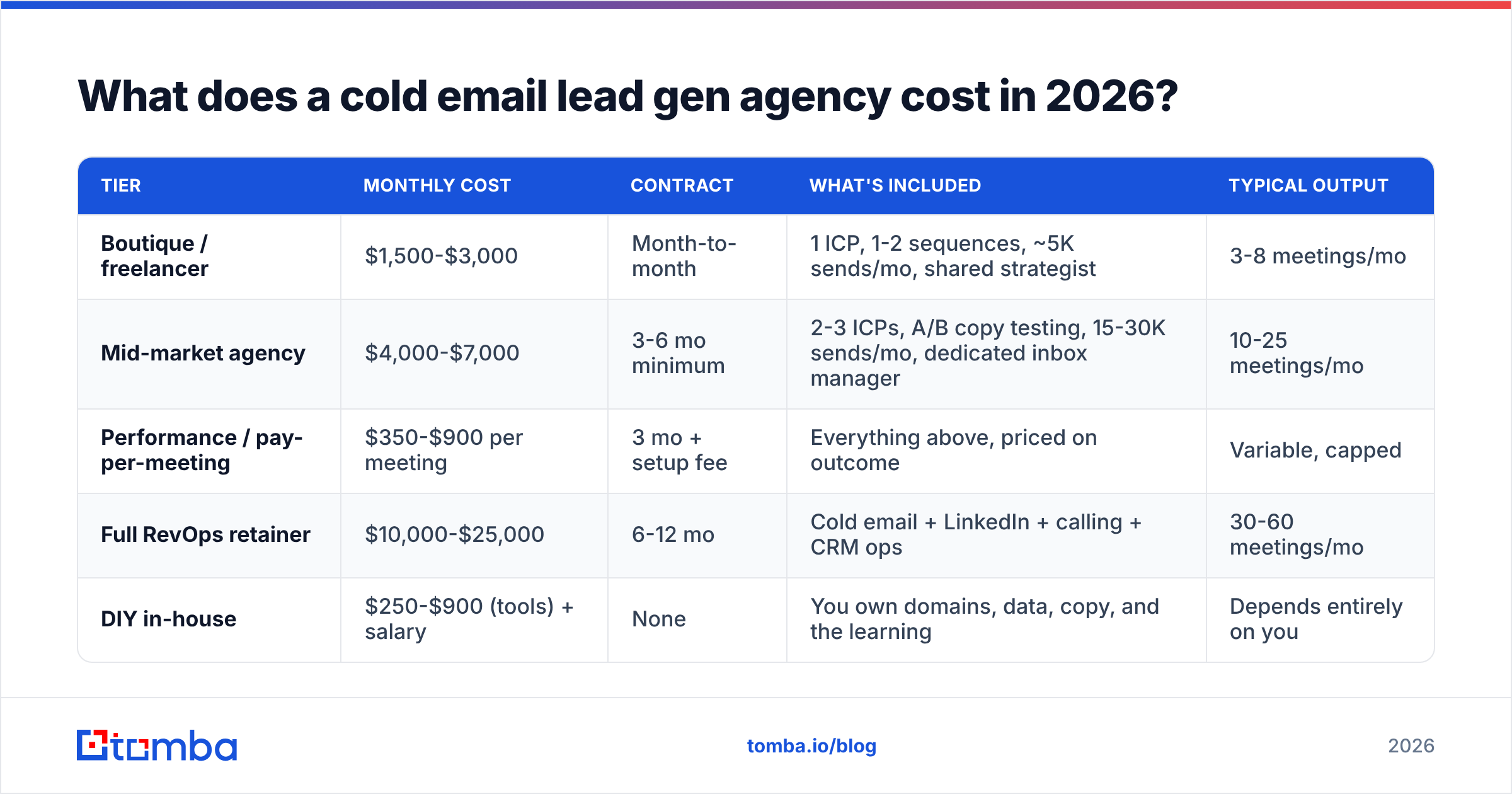
Pricing clusters into three bands, and the band determines what you actually get.
| Tier | Monthly cost | Contract | What's included | Typical output |
|---|---|---|---|---|
| Boutique / freelancer | $1,500-$3,000 | Month-to-month | 1 ICP, 1-2 sequences, ~5K sends/mo, shared strategist | 3-8 meetings/mo |
| Mid-market agency | $4,000-$7,000 | 3-6 mo minimum | 2-3 ICPs, A/B copy testing, 15-30K sends/mo, dedicated inbox manager | 10-25 meetings/mo |
| Performance / pay-per-meeting | $350-$900 per meeting | 3 mo + setup fee | Everything above, priced on outcome | Variable, capped |
| Full RevOps retainer | $10,000-$25,000 | 6-12 mo | Cold email + LinkedIn + calling + CRM ops | 30-60 meetings/mo |
| DIY in-house | $250-$900 (tools) + salary | None | You own domains, data, copy, and the learning | Depends entirely on you |
Two things jump out.
First, the pay-per-meeting model looks like risk transfer and mostly isn't. Read the definition of "meeting" in the contract. If a no-show counts, if a 12-minute intro call with a marketing coordinator counts, if a rescheduled meeting counts twice — you're paying for calendar events, not pipeline. Ask for a held, qualified, ICP-matching definition in writing before you sign.
Second, notice how small the tool line is. That's the whole argument for going in-house, and it's also the trap.
Where does the agency margin actually hide?#
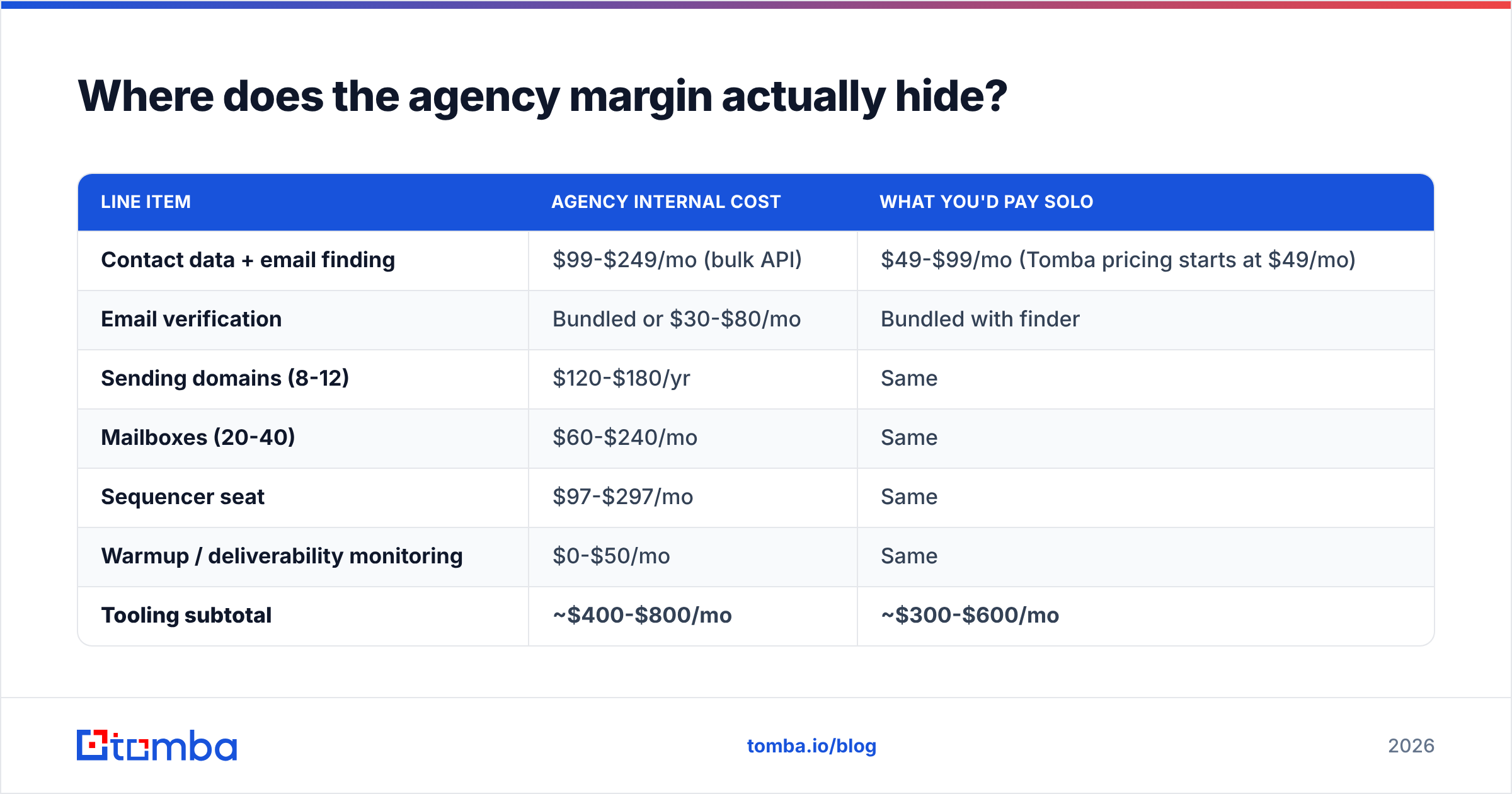
Let's price out the stack an agency runs on your behalf, at a realistic 20,000 sends/month volume.
| Line item | Agency internal cost | What you'd pay solo |
|---|---|---|
| Contact data + email finding | $99-$249/mo (bulk API) | $49-$99/mo (Tomba pricing starts at $49/mo) |
| Email verification | Bundled or $30-$80/mo | Bundled with finder |
| Sending domains (8-12) | $120-$180/yr | Same |
| Mailboxes (20-40) | $60-$240/mo | Same |
| Sequencer seat | $97-$297/mo | Same |
| Warmup / deliverability monitoring | $0-$50/mo | Same |
| Tooling subtotal | ~$400-$800/mo | ~$300-$600/mo |
| Labor (strategist, copywriter, list builder, inbox manager) | ~$3,500-$6,000/mo allocated | Your time, or a $65K SDR |
So on a $6,000 retainer, roughly $5,300 is people and process. That is not a scam — it's a service business with normal gross margin. But it tells you exactly what question to ask on the sales call: what do your people do that mine can't?
Good answers: "We've run 400 campaigns in your vertical and we know which three subject-line angles clear a CISO's filter." "We keep 60 aged domains in rotation so your primary domain never carries send volume." "We rewrite the offer, not just the email."
Bad answers: "We have access to a 200 million contact database." So does everyone. Databases are a commodity. Anyone can buy B2B database access.
Is an agency better than building outbound in-house?#
Depends on one variable: how many outbound experiments you can afford to run per quarter.
Cold email is not a copywriting problem. It's a search problem. You are searching a space of (segment × trigger × offer × channel × timing) for the handful of combinations that convert. An agency's real product is throughput through that search space. They can run 30 variants in six weeks because they've done it 300 times. A first-time in-house SDR runs four, gets a 0.4% reply rate, and concludes cold email is dead.
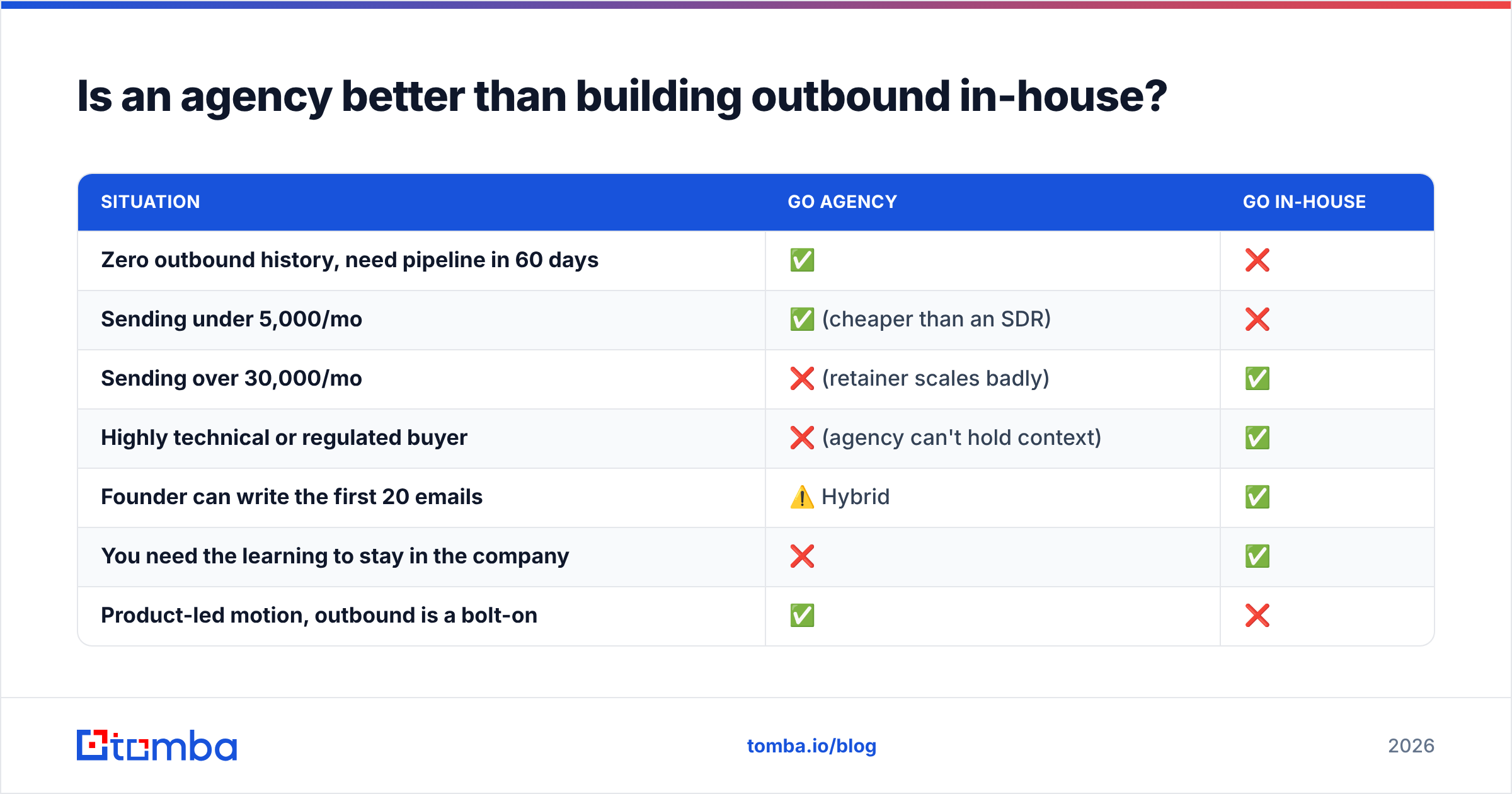
Here's the honest decision matrix:
| Situation | Go agency | Go in-house |
|---|---|---|
| Zero outbound history, need pipeline in 60 days | ✅ | ❌ |
| Sending under 5,000/mo | ✅ (cheaper than an SDR) | ❌ |
| Sending over 30,000/mo | ❌ (retainer scales badly) | ✅ |
| Highly technical or regulated buyer | ❌ (agency can't hold context) | ✅ |
| Founder can write the first 20 emails | ⚠️ Hybrid | ✅ |
| You need the learning to stay in the company | ❌ | ✅ |
| Product-led motion, outbound is a bolt-on | ✅ | ❌ |
The hybrid — agency runs infrastructure and copy testing while your team owns data and replies — is underrated and rarely offered, because it compresses agency margin. Ask for it anyway.
How do you tell a real agency from a churn shop?#
Churn shops exist because outbound has a 90-day feedback lag and a plausible excuse for every failure. Six questions separate the two.
- "Show me your bounce rate across all clients last month." Anything above 3% means they're not verifying. Above 5% and they're actively torching sender reputation — yours and everyone else's on their shared infrastructure. A serious agency verifies every address, catch-all included, using a catch-all verifier rather than guessing.
- "Whose domains am I sending from?" The correct answer is yours — secondary domains you own, registered to your entity. If the agency owns them, you lose the reputation asset the day you leave, and you have no visibility into what else those domains sent.
- "Who writes the replies?" Inbox management is where agencies quietly cut corners. Ask to see three real reply threads (redacted). If a positive reply took 19 hours to answer, your conversion is leaking.
- "What's your list-build methodology?" "We pull from our database" is a red flag. "We build from triggers — job postings, tech-stack changes, funding — then enrich and verify" is the answer. Trigger-based lists outperform static ICP lists consistently.
- "What happens to the data when we part ways?" Get list ownership and export rights in the contract. Some agencies treat the enriched list as their IP.
- "How many clients do you run in my exact ICP?" Two is fine. Nine means you're all emailing the same 4,000 people, and the third agency client in the sequence is getting a spam complaint on your behalf.
That first question is the one that ends deals. Bounce rate is the closest thing outbound has to an honest metric — it can't be spun, and it predicts everything downstream. According to HubSpot's email benchmarks, sender reputation damage from high bounce rates compounds across the sending domain for months after the offending campaign stops.

What does the in-house alternative actually look like?#
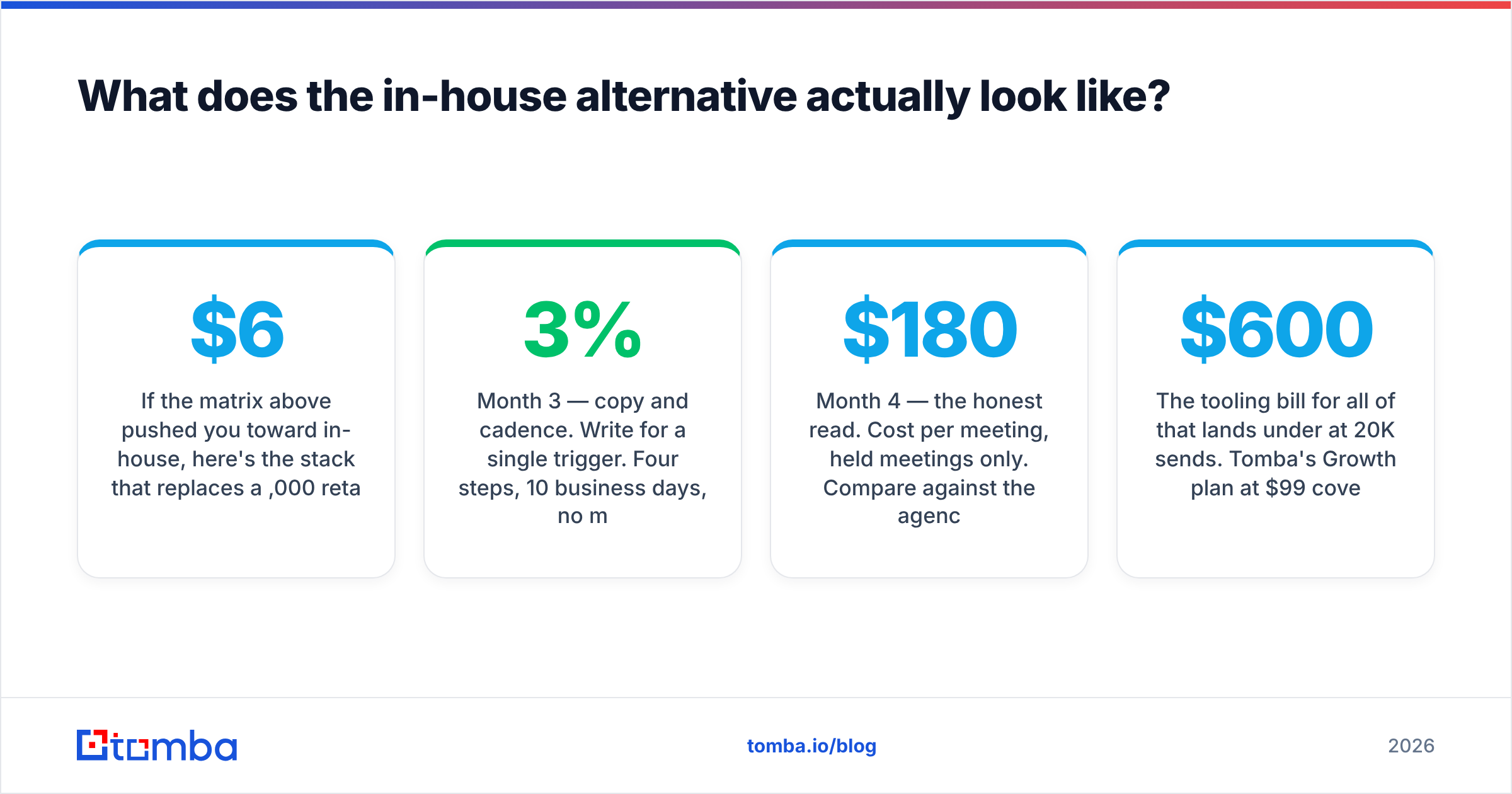
If the matrix above pushed you toward in-house, here's the stack that replaces a $6,000 retainer, in build order.
Month 1 — infrastructure. Register 4-8 secondary domains (get{brand}.com, try{brand}.com). Set up SPF, DKIM, and DMARC on each. Provision 3 mailboxes per domain. Start warmup at 5 sends/day per mailbox and ramp over 4 weeks. Do not send a single cold email during this month. This is the step in-house teams skip and the reason their first campaign lands in spam. Run each domain through an SPF checker before you touch a sequencer.
Month 2 — data. Build lists from triggers, not from filters. Then find and verify. This is where a purpose-built finder beats a bundled database: you want to go from company list → decision-maker → verified address without paying for 200M records you'll never touch. Domain search turns a list of 500 target companies into named contacts with role filtering; the verifier drops the risky ones before they cost you reputation. Budget one afternoon per 1,000 contacts if you're doing it manually, or five minutes with the bulk email finder.
Month 3 — copy and cadence. Write for a single trigger. Four steps, 10 business days, no more than 90 words in the first email. Test one variable at a time. Reply rate under 3% means the segment or offer is wrong — do not fix it with a better subject line.
Month 4 — the honest read. Cost per meeting, held meetings only. Compare against the agency quote you didn't sign. Most teams landing between 8 and 15 meetings a month in-house are doing it at $180-$400 per meeting, all-in with SDR salary. That beats every performance-priced agency on the market — but only after the three months of setup you just paid for in time instead of cash.
The tooling bill for all of that lands under $600/month at 20K sends. Tomba's Growth plan at $99/mo covers finding and verification for most teams at this volume; Pro at $249/mo covers agencies running it for multiple clients.
What about compliance and deliverability rules in 2026?#
Two things changed the math since 2023, and any agency that hasn't adapted is selling you a 2022 playbook.
Google and Yahoo's bulk-sender requirements now enforce a spam-complaint rate ceiling of 0.3% and mandate DMARC alignment for anyone sending over 5,000 messages a day to their users. Cross it and you don't get a warning — you get silent filtering. Deliverability is no longer a nice-to-have layer; it is the gate. Read the CAN-SPAM Act and, if you touch EU contacts, get counsel on GDPR legitimate-interest documentation before your first send. Agencies will tell you they handle compliance. The fine lands on your entity, not theirs.
The second change: verification stopped being optional. Catch-all domains — where the mail server accepts everything and bounces later — now make up a meaningful share of enterprise targets. Sending blind into catch-alls is how a clean list turns into a 12% bounce rate two weeks in. If your agency's answer to catch-alls is "we skip them," they're throwing away a third of your enterprise TAM. If it's "we send anyway," they're gambling your domain.
You can sanity-check any agency's list before it ships. Take a 200-contact sample, run it through a free email checker, and compare their claimed deliverability to what you measure. It takes 20 minutes and it has ended more bad agency relationships than any reference call.
How should you decide?#
Run the numbers on your own volume, not on a case study.
Take the agency quote. Divide by their promised held meetings. That's your agency cost per meeting — and discount their promise by 40%, because everyone's case study is their best client. Then price the in-house path: $600/month tooling, plus whatever fraction of a salary you'll spend, plus 90 days of no pipeline while domains warm.
If you need pipeline before that 90 days is up, hire the agency and use the retainer period to build your own domains in parallel. That's the move nobody tells you: the agency buys you time, and you spend that time building the asset — warmed domains, a verified list, a copy library — that lets you fire them in month seven at a lower cost per meeting. Agencies that object to this arrangement are telling you something about how they see the relationship. Good ones will help; several of the better shops on G2 explicitly offer transition-out support.
And if you're already sending 30,000 a month through an agency, the retainer is almost certainly the most expensive line in your outbound P&L. Price the swap.
Build the list before you buy the labor. Whether you sign an agency or run it yourself, every cold email campaign lives or dies on whether the address is real and the person is the right one. Tomba's Email Finder finds verified professional addresses by domain, name, or company — with verification built into the same call, so nothing enters a sequence unchecked. Start free with 25 searches a month, or run a full 20,000-send program on the $49/mo Starter plan. Then decide what the agency is really adding.
Related guides#
Ready to find emails that actually work?
Join 150,000+ professionals who stopped guessing and started sending. Free credits on signup — no credit card required.
Get the Tomba newsletter
Practical outbound tactics and product updates — once every two weeks.
About the author