Cold Email Real Estate: The 2026 Playbook That Books Calls
Real estate inboxes are the most crowded in B2B. Here's what still gets replies in 2026: list sources ranked, segment-specific angles, deliverability rules, and the templates that survive a broker's 6am inbox triage.
TL;DR
- Cold email to real estate works, but the median reply rate (1.2–2.8%) is roughly half what you'd see in SaaS. The gap is almost entirely list quality and timing, not copy.
- Scraped MLS and county-record lists bounce at 20–35%. Verified, permission-adjacent B2B data bounces under 3%. That single variable decides whether your domain survives month two.
- Segment before you write. A commercial broker, a residential team lead, a property manager, and a PropTech founder have nothing in common except a
.realtordomain. - Send between 6:00 and 7:30 a.m. local. Agents triage their inbox before showings, not after.
- Three sentences, one ask, no attachment, no calendar link in email one. Everything else is optional.
Why is cold email real estate outreach harder than most B2B?#
Because you're emailing people who are themselves professional cold outreachers. A residential agent sends 40 emails, 15 texts, and a dozen DMs before lunch. They recognize a merge tag from across the room. They know what {{first_name}} looks like when it fails.
That changes the math. In standard B2B SaaS outreach, a well-built sequence lands 4–8% replies. Against real estate professionals, the same sequence lands 1.2–2.8%. The drop isn't because the industry is unreachable — it's because three things go wrong more often here than anywhere else:
1. The data is unusually dirty. Real estate has extreme churn. Roughly 20% of licensed agents change brokerage in a given year, and their email goes with them. A list scraped eight months ago is not a stale list — it's a different list.
2. Everyone is selling to them. Lead-gen platforms, CRM vendors, photography services, transaction coordinators, iBuyers, mortgage partners. The average agent inbox receives dozens of vendor pitches weekly. Your email is not competing with silence.
3. The buying committee is one person, and they're in a car. No procurement, no security review — just a broker checking mail on a phone between showings. Your first line either works on a 4-inch screen or it doesn't work.
None of that makes the channel dead. It makes it a precision channel. Volume strategies that work against 5,000 SaaS ops managers actively destroy your sender reputation when pointed at real estate.
What does a real estate cold email list actually cost?#
Here's where most campaigns are lost before a single word is written. The list you choose sets your bounce rate, and your bounce rate sets your deliverability ceiling.
| Source | Typical cost | Bounce rate | Coverage | Best for |
|---|---|---|---|---|
| Scraped MLS / county records | $0 (your time) | 20–35% | Very broad, very stale | Nothing. Skip it. |
| Marketplace list purchase | $0.02–$0.10/record | 8–20% | Broad, unverified | Never, unless verified first |
| BookYourData | ~$0.08–$0.15/record | 3–6% | Strong US commercial + brokerage coverage | Buying a defined vertical slice fast |
| Tomba Email Finder + Verifier | From free (25/mo), $49/mo Starter | Under 3% | Domain-first, real-time | Targeted brokerage/PropTech lists |
| Manual LinkedIn → email lookup | ~$0 + heavy labor | 2–5% | Narrow, very fresh | Sub-100 named-account lists |
The pattern is obvious once you see it in a table: you either pay for accuracy up front, or you pay for it later in domain reputation. There is no third option. A 25% bounce rate on 2,000 sends means 500 hard bounces, which means Google and Microsoft start filtering you inside 72 hours. The list was free. The recovery costs you six weeks.
BookYourData is a reasonable choice when you want a pre-assembled commercial real estate slice and don't want to build the list yourself — their brokerage coverage is genuinely deep. The workflow most teams land on: source from a provider, then run the whole file through an email verifier before it ever touches your sending tool. Verification is cheap. Reputation repair is not.
If you're building rather than buying, the fastest path for real estate is domain-first. You already know the brokerages you want — Compass, Marcus & Millichap, a regional CRE shop, a 40-agent independent. Run each domain through domain search to pull the full contact map with roles attached, then verify. You'll finish with a smaller list than a marketplace dump and a reply rate three times higher.
How should you segment real estate prospects?#
"Real estate" is not a segment. It's four industries sharing a license type. Sending one message across all of them is why generic campaigns die.
- Residential agents & team leads — Solo operators or 3–15 person teams. Care about: lead volume, cost per closing, time saved. Buy on emotion and social proof. Reachable 6–7:30 a.m. and 8–10 p.m.
- Commercial brokers (CRE) — Longer cycles, larger deal sizes, more analytical. Care about: deal flow, market data, tenant intelligence. They'll read a 120-word email if the first line names a comp they recognize.
- Property managers — Operations-brained, chronically understaffed. Care about: turnover cost, maintenance workflow, resident retention. Nearly immune to hype; extremely responsive to a specific inefficiency.
- Brokerage owners & principal brokers — P&L owners. Care about: agent recruiting, retention, tech consolidation, split economics. The only segment where an ROI claim in email one is not immediately discounted.
- PropTech operators — Founders, RevOps, growth leads at real estate software companies. These behave like ordinary B2B SaaS buyers. Standard playbooks apply.
- Investors & syndicators — Deal-driven. Only respond to deal-adjacent value: off-market inventory, capital, underwriting speed.
Pick one. Write to one. The difference between a 1.1% and a 3.4% reply rate is usually that the sender stopped hedging across segments.
What does a cold email that works on a broker look like?#
Short. Concrete. Zero setup. Here is the structural difference between what gets deleted and what gets a reply.
What gets deleted:
Hi Sarah,
I hope this email finds you well! I came across your profile on LinkedIn and was really impressed by your work at Coldwell Banker. I wanted to reach out because we help real estate professionals like yourself streamline their lead generation process and close more deals.
Would you be open to a quick 15-minute call this week to discuss how we might be able to help? Here's my calendar link: [...]
Four failures: a greeting with no information, a compliment that could be pasted onto anyone, an unsubstantiated capability claim, and a calendar link before any value has moved in the prospect's direction.
What gets a reply:
Sarah — saw your team closed 14 units in Bucktown last quarter, mostly listing-side.
Most listing-heavy teams we talk to are losing 30–40% of inbound seller leads to response lag over 5 minutes.
Worth a look at what your lag is? I can pull it in about a minute.
Twenty-eight words to a specific ask. It names a real, checkable fact. It states a problem in the prospect's own operating language. It offers a diagnostic, not a demo. And it lets the prospect say "yeah, what is it" — the lowest-friction reply in cold email.
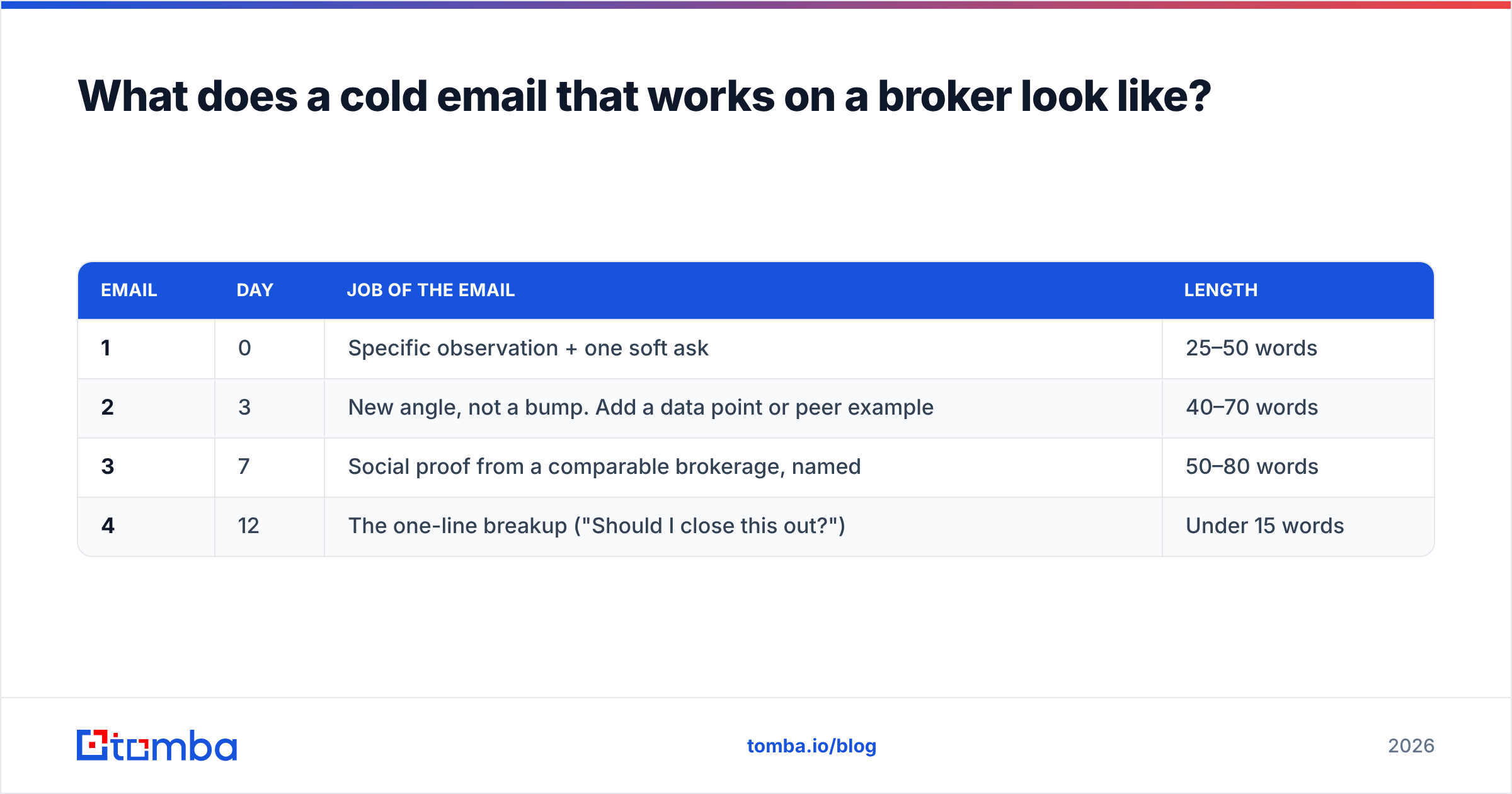
The follow-up sequence matters less than people think, but the shape is stable:
| Day | Job of the email | Length | |
|---|---|---|---|
| 1 | 0 | Specific observation + one soft ask | 25–50 words |
| 2 | 3 | New angle, not a bump. Add a data point or peer example | 40–70 words |
| 3 | 7 | Social proof from a comparable brokerage, named | 50–80 words |
| 4 | 12 | The one-line breakup ("Should I close this out?") | Under 15 words |
Four emails. Twelve days. Stop. A fifth touch to a real estate professional converts at under 0.2% and materially raises your spam-complaint rate. The response rate curve flattens hard after touch three.
Does deliverability work differently for real estate outreach?#
Somewhat — and it's the part most teams get wrong.
Real estate prospects are disproportionately on Gmail-backed custom domains and Microsoft 365. Both providers weight engagement heavily. That means the same technical setup produces different results depending on who you're mailing. A campaign that reaches SaaS ops leaders can quietly land in Promotions for realtors because realtors mark vendor mail as spam at a much higher rate.
Non-negotiables before you send a single email:
- SPF, DKIM, and DMARC configured and passing. Verify with an SPF checker before launch, not after your first bounce wave. Google and Yahoo now enforce DMARC on bulk senders; this is table stakes.
- Separate sending domain. Never cold email from your primary domain. Buy
getcompanyname.com, warm it for 3–4 weeks. - Under 40 emails/day per mailbox. Add mailboxes, not volume per mailbox.
- Zero images, zero tracking pixels, zero attachments in email one. Every one of these is a spam signal, and open-rate tracking is now unreliable enough that you're trading deliverability for a number you can't trust anyway.
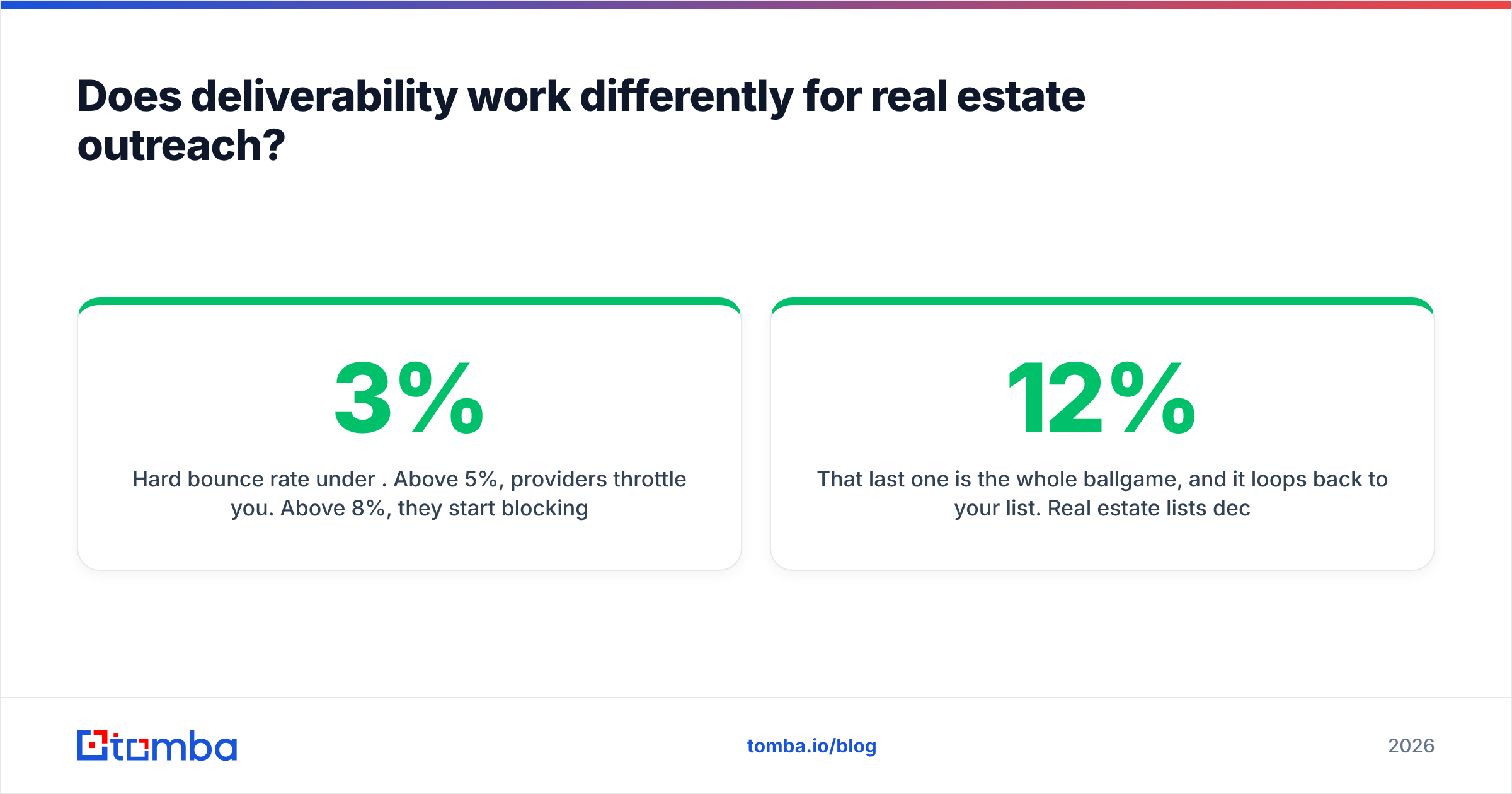
- Hard bounce rate under 3%. Above 5%, providers throttle you. Above 8%, they start blocking.
That last one is the whole ballgame, and it loops back to your list. Real estate lists decay faster than any other B2B vertical — agents move brokerages, teams dissolve, brokerages get acquired. A list that verified clean in January can bounce at 12% by August. Re-verify before every campaign, not once at import.

If your list contains catch-all domains — and brokerage domains often do — a standard verifier will return "unknown" and you'll be tempted to send anyway. Don't guess. A dedicated catch-all verifier resolves a meaningful share of those, and the ones it can't resolve should be quarantined into a low-volume test batch rather than dumped into your main send. See email deliverability for the underlying mechanics.
When should you send cold email to real estate prospects?#
The conventional B2B answer — Tuesday through Thursday, 10 a.m. — is wrong here.
Real estate professionals are not desk workers. Their inbox behavior is bimodal: an early-morning triage before the day's showings, and a late-evening cleanup after. Testing across real estate sequences consistently shows:
- 6:00–7:30 a.m. local time is the strongest window. Emails that land here sit at the top of the morning triage.
- 8:00–10:00 p.m. local is second-best, especially for residential agents.
- 10 a.m.–4 p.m. is dead. They're in a car, at a closing, or on a walkthrough.
- Sunday evening outperforms Monday morning for residential — the week is being planned.
- Commercial brokers track closer to standard business hours. Tuesday–Thursday, 7:30–9 a.m. works.
Local time matters more than day of week. If your tool can't schedule per-recipient timezone, that's a bigger gap than any copy tweak you're considering.
What about compliance — can you legally cold email realtors?#
Yes, in the US, with conditions. The CAN-SPAM Act permits unsolicited commercial email to business addresses provided you include a valid physical postal address, honor opt-outs within 10 business days, don't use deceptive subject lines or headers, and identify the message as an advertisement where required. No prior consent is needed.
Outside the US it tightens considerably. Canada's CASL requires consent or a demonstrable existing business relationship, with penalties that make sloppiness expensive. GDPR permits B2B outreach under legitimate interest but demands you document the assessment and honor objections immediately. If you're mailing agents in Toronto or Berlin, get a lawyer's read — not a blog's.
Practical rule: keep a one-click unsubscribe in the footer, suppress every opt-out permanently and globally across all your sending domains, and never re-import a purchased list that includes anyone who previously opted out. That last mistake — re-adding suppressed contacts via a fresh list import — generates more spam complaints than any copy decision you'll ever make.
How do you actually build the list?#
The workflow that produces sub-3% bounce rates and 3%+ reply rates on real estate has four steps, and none of them are "buy 50,000 records."
Step 1 — Define the account list, not the contact list. Fifty to three hundred brokerages, property management firms, or PropTech companies. Pull them from local MLS board rosters, CRE association member directories, or a filtered B2B database query. Accounts first. Always.
Step 2 — Map contacts per account. Run each domain through domain search to return every discoverable address with title and department attached, then filter to the roles that match your segment. A 40-agent brokerage might yield three people worth emailing: the principal broker, the ops manager, and the marketing lead. Not forty.
Step 3 — Verify, then verify catch-alls separately. Everything that returns valid goes into the main send. Everything that returns catch-all goes into a small test batch. Everything else gets dropped, no exceptions, no "it's probably fine."
Step 4 — Enrich for personalization inputs. You need one specific, checkable fact per contact: recent transaction volume, a listing they closed, a market they dominate, a tool visible on their site. Data enrichment at the account level plus 30 seconds of manual work per contact beats any AI personalization variable ever generated. If you can't find a fact worth naming, that contact doesn't belong on the list.
For teams running this at scale, the API route is faster than the UI route — the Tomba API handles find-then-verify in a single pipeline step, so your list is clean before it ever reaches your sequencer. And if you're evaluating sequencing tools to sit downstream of the data layer, the sales engagement category on G2 is a more honest starting point than any vendor comparison page, including this one.
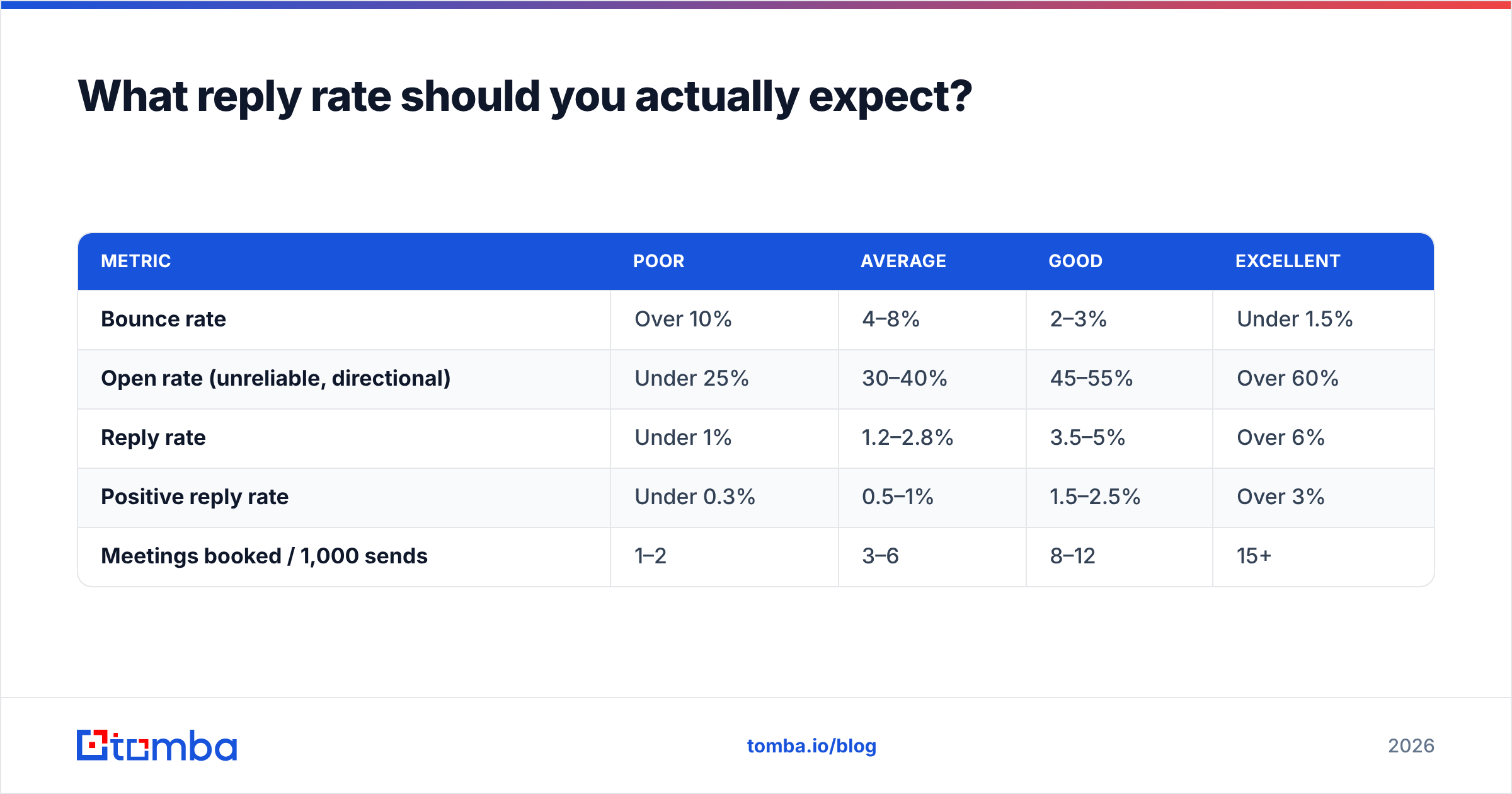
What reply rate should you actually expect?#
Set the benchmark honestly, because the wrong benchmark makes you change the wrong variable.
| Metric | Poor | Average | Good | Excellent |
|---|---|---|---|---|
| Bounce rate | Over 10% | 4–8% | 2–3% | Under 1.5% |
| Open rate (unreliable, directional) | Under 25% | 30–40% | 45–55% | Over 60% |
| Reply rate | Under 1% | 1.2–2.8% | 3.5–5% | Over 6% |
| Positive reply rate | Under 0.3% | 0.5–1% | 1.5–2.5% | Over 3% |
| Meetings booked / 1,000 sends | 1–2 | 3–6 | 8–12 | 15+ |
If your bounce rate is above 5%, fix the list. Nothing else matters yet. If your bounce rate is clean but replies sit under 1%, fix the segment and the first line — in that order. If replies are healthy but nothing converts to a meeting, your ask is too big; drop the calendar link and ask a question instead.
The teams that beat these numbers aren't writing better copy. They're emailing 200 accurately targeted people instead of 8,000 approximately targeted ones. HubSpot's marketing research has been saying a version of this for a decade, and real estate is where it's most obviously true.
Where should you start?#
Start with the list. Not the copy, not the sequencer, not the AI personalization layer.
Pick twenty brokerages you could realistically serve. Find the three right people at each. Verify all sixty addresses. Write sixty emails that each name one real thing about that specific company. Send them at 6:15 a.m. local. Follow up three times, then stop.
Sixty emails, done properly, will out-produce six thousand done carelessly — and they won't cost you a domain.
When you're ready to build that list, Tomba Email Finder is built for exactly this shape of work: domain-first discovery, role filtering, real-time verification, and a catch-all resolver for the brokerage domains that break other tools. The free tier gives you 25 searches a month to test the workflow on a handful of accounts before you commit; Starter runs $49/mo when you're ready to scale, with full pricing details laid out plainly. Build the list right, and the copy gets a lot easier.
Related guides#
// get started
Find, verify and enrich your first contacts today
Start on the free plan with 25 searches a month, then scale when your team is ready.
Free plan · No credit card required · GDPR & CCPA
// about the author