Cold Email Tactics That Book Meetings in 2026 (Field Guide)
Volume-first cold email stopped working when Google and Yahoo tightened bulk sender rules. Here are the cold email tactics that still book meetings in 2026 — with the numbers, the tradeoffs, and the mistakes that quietly kill deliverability.
TL;DR
- The tactics that worked in 2021 — big lists, heavy personalization tokens, five-touch sequences — now underperform because inbox providers changed the rules, not because buyers changed.
- Spam complaint rate is the single metric that decides whether your cold email tactics survive. Google enforces a 0.3% ceiling. Everything else is downstream of that.
- List quality beats copy quality. A 90-word email to 200 verified, well-targeted contacts outperforms a brilliant email to 2,000 scraped ones, every time.
- Sequence length has an optimal point around 3-4 touches. Touch five and beyond mostly generates complaints, not replies.
- The highest-leverage change most teams can make this quarter: verify before you send, and cut send volume per mailbox to under 50/day.
What changed about cold email tactics in the last two years?#
The short answer: the inbox got a bouncer.
In February 2024, Google and Yahoo began enforcing bulk sender requirements — SPF, DKIM, DMARC alignment, one-click unsubscribe, and a hard spam complaint threshold of 0.3%. Microsoft followed with its own tightening for high-volume senders. What used to be a soft signal is now a gate.
Think of it like a nightclub that used to let anyone in and just threw out the troublemakers. Now there's a guest list, an ID check, and a rule that if more than three people in every thousand you bring complain about you, you're barred at the door — not just for that night, for weeks.
That single change invalidates most of the cold email playbooks still circulating. The "spray, measure, iterate" approach assumed sending was cheap and failure was silent. It isn't anymore. Every bad send now costs you future inbox placement. Sending to a dead address costs you. Sending to someone who doesn't recognize your category costs you.
So the modern question isn't "what's the best cold email template?" It's "what's the highest-value message I can send to the fewest possible people without burning the domain?"
What are the cold email tactics that still work in 2026?#
Here's what survives, ranked by leverage — the first item moves the needle more than the last three combined.
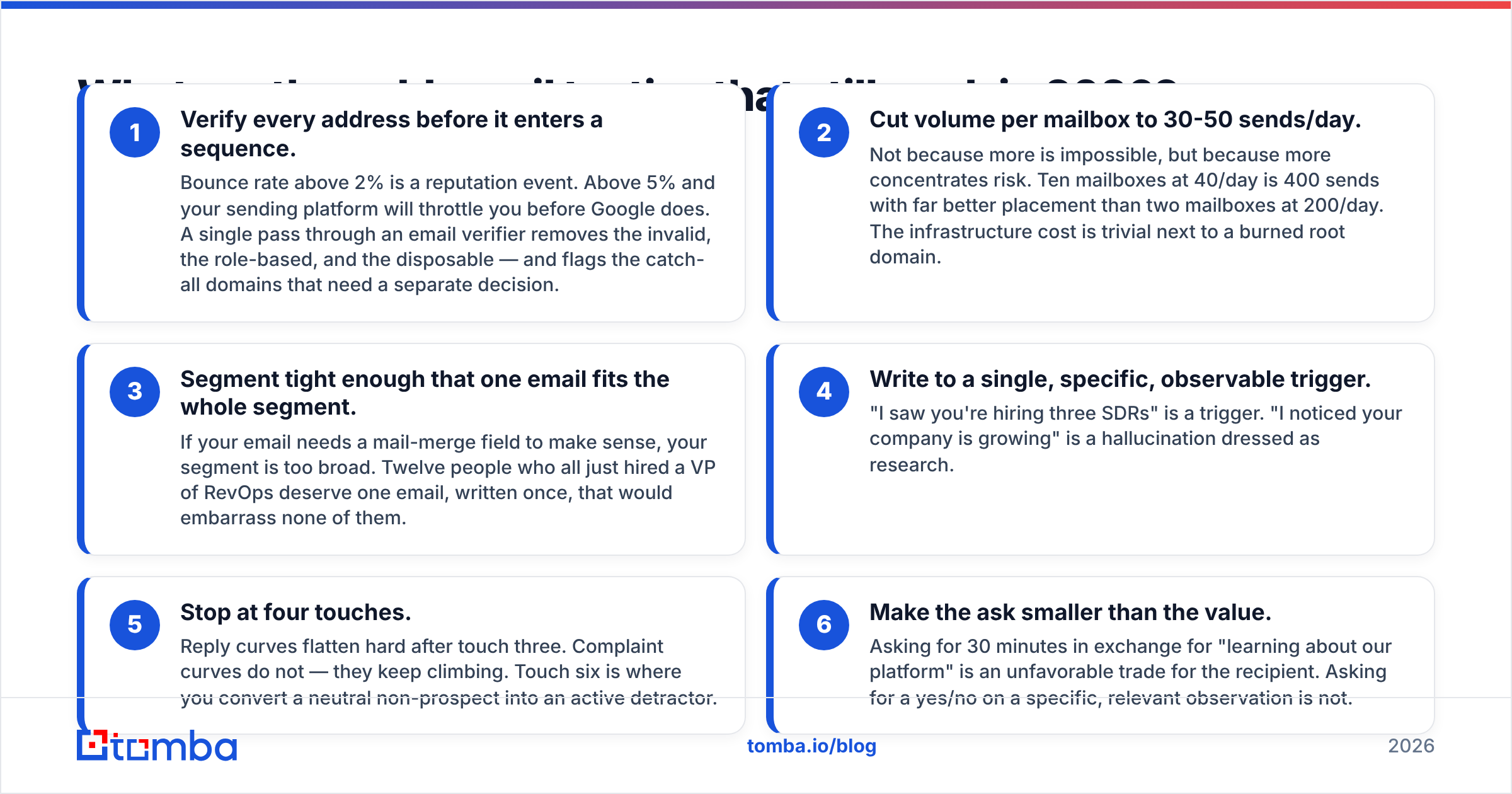
Verify every address before it enters a sequence. Bounce rate above 2% is a reputation event. Above 5% and your sending platform will throttle you before Google does. A single pass through an email verifier removes the invalid, the role-based, and the disposable — and flags the catch-all domains that need a separate decision.
Cut volume per mailbox to 30-50 sends/day. Not because more is impossible, but because more concentrates risk. Ten mailboxes at 40/day is 400 sends with far better placement than two mailboxes at 200/day. The infrastructure cost is trivial next to a burned root domain.
Segment tight enough that one email fits the whole segment. If your email needs a mail-merge field to make sense, your segment is too broad. Twelve people who all just hired a VP of RevOps deserve one email, written once, that would embarrass none of them.
Write to a single, specific, observable trigger. "I saw you're hiring three SDRs" is a trigger. "I noticed your company is growing" is a hallucination dressed as research.
Stop at four touches. Reply curves flatten hard after touch three. Complaint curves do not — they keep climbing. Touch six is where you convert a neutral non-prospect into an active detractor.
Make the ask smaller than the value. Asking for 30 minutes in exchange for "learning about our platform" is an unfavorable trade for the recipient. Asking for a yes/no on a specific, relevant observation is not.
None of this is clever. It's the boring end of the discipline, which is exactly why most teams skip it and then blame the copy.
Is personalization still worth the effort?#
Yes — but not the kind most tools sell you.
There are three tiers of personalization, and they are wildly different in cost and effect.
Token personalization ("Hi {{first_name}}, I saw {{company}} is doing great things") costs nothing and returns nothing. Buyers pattern-match it instantly. It may even hurt: it signals automation without signaling relevance.
Segment personalization writes one genuinely specific email for a group that shares a real attribute — same role, same recent event, same tech stack, same funding stage. Cost is moderate, and it scales. This is where nearly all the ROI lives.
Individual personalization — reading someone's last three LinkedIn posts and referencing them — has the highest reply rate per email and the worst reply rate per hour. Reserve it for a named list of accounts where a single meeting is worth four figures or more.
The mistake is treating these as a spectrum where more is always better. They're three different jobs. A 500-contact campaign should use segment personalization exclusively. A 20-account list should use individual. Nothing should use token personalization, ever.
If you're building segments from firmographic attributes, a data enrichment pass at the list stage is worth more than any amount of writing time at the copy stage. You cannot write your way out of a badly cut segment.
How do the main cold email approaches compare?#
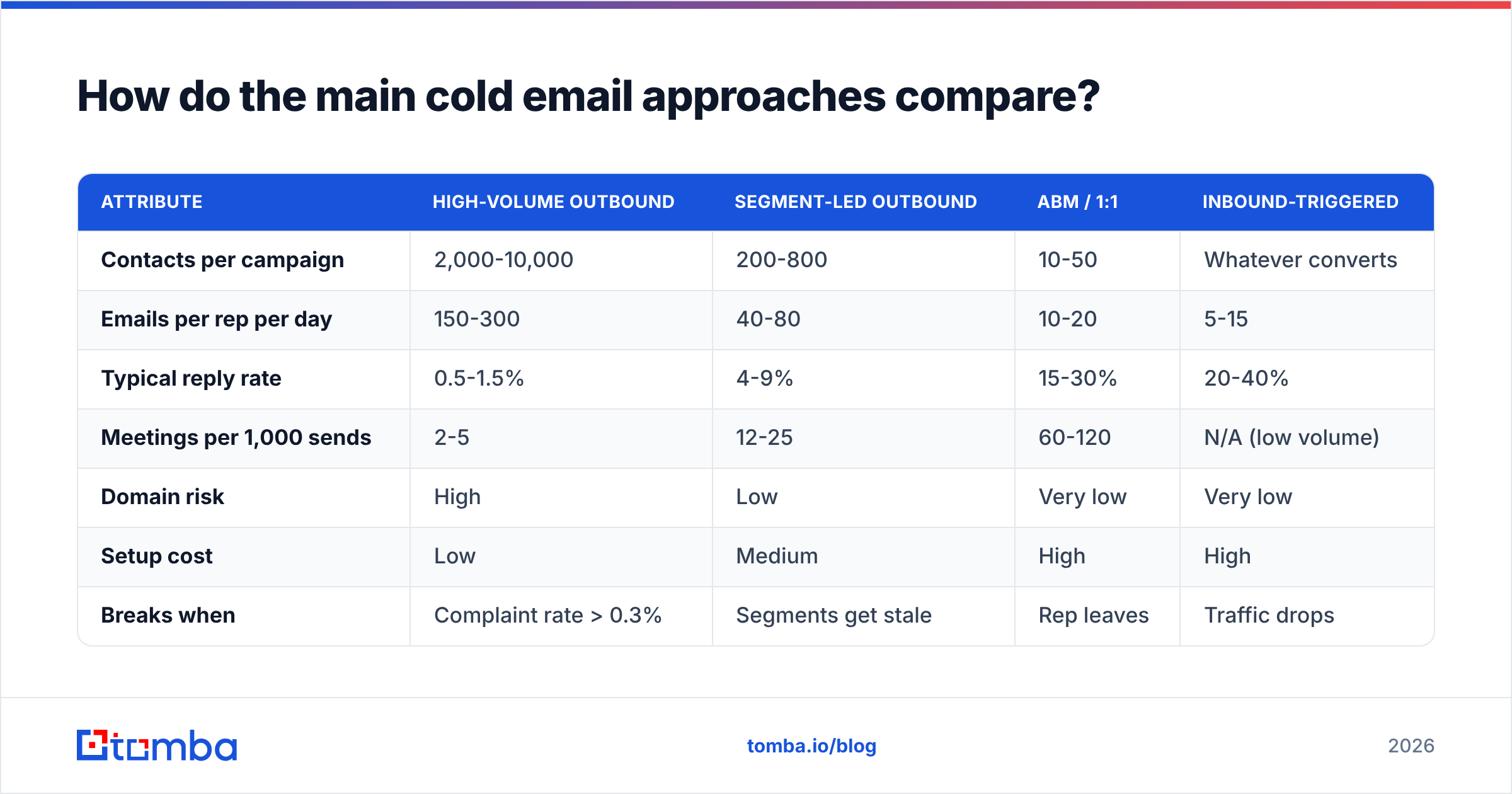
Four broad approaches dominate. Each is internally coherent — they fail when you mix their assumptions.
| Attribute | High-volume outbound | Segment-led outbound | ABM / 1:1 | Inbound-triggered |
|---|---|---|---|---|
| Contacts per campaign | 2,000-10,000 | 200-800 | 10-50 | Whatever converts |
| Emails per rep per day | 150-300 | 40-80 | 10-20 | 5-15 |
| Typical reply rate | 0.5-1.5% | 4-9% | 15-30% | 20-40% |
| Meetings per 1,000 sends | 2-5 | 12-25 | 60-120 | N/A (low volume) |
| Domain risk | High | Low | Very low | Very low |
| Setup cost | Low | Medium | High | High |
| Breaks when | Complaint rate > 0.3% | Segments get stale | Rep leaves | Traffic drops |
| Best for | Broad, low-ACV SaaS | Most B2B teams | ACV > $30k | Product-led motions |
The honest read: segment-led outbound is the right default for the overwhelming majority of B2B teams. High-volume outbound is a strategy that mostly persists because its costs — domain reputation, brand damage, opportunity cost of the segments you never built — are invisible on the dashboard that measures it.
If you're currently running high-volume and it's "working," check the denominator. Meetings per 1,000 sends is the number that exposes the tradeoff. Reply rate hides it.
What does a cold email that actually gets replies look like?#
Structure, not magic. Four parts, in this order.
The trigger line. One sentence, first sentence, that proves you looked. It should be falsifiable — a fact, not a compliment. "You've had a Head of Growth role open since April" is falsifiable. "Your growth trajectory is impressive" is not.
The connection. One sentence linking that fact to a problem you plausibly solve. This is where most emails collapse into a product description. Don't describe the product. Describe the problem the fact implies.
The proof. One clause, not a paragraph. A number, a comparable customer, or nothing at all. If your proof needs setup, it isn't proof yet.
The ask. A question that can be answered with one word. "Worth a look?" outperforms "Do you have 15 minutes on Thursday?" because it costs less to answer, and a reply of any kind is what you're actually optimizing for.
Total: 60-110 words. Under 60 reads as a bot. Over 130 gets skimmed and archived.
What to cut: the greeting paragraph, the "I hope this finds you well," the company boilerplate, the calendar link in touch one, the P.S. that undercuts your ask, and every adjective. If a sentence would survive being pasted into a different prospect's email unchanged, delete it or rewrite it.
Subject lines follow the same logic — lowercase, three to five words, no punctuation gimmicks. "quick question about hiring" beats "🚀 Transform Your Outbound in 2026." If you want a starting point rather than a blank page, cold email templates are useful as structure, harmful as scripts. Rewrite every sentence or don't use them.
How do you protect deliverability while running cold email?#
This is the unglamorous half, and it's where campaigns are actually won or lost.
- Authenticate before you send anything. SPF, DKIM, and a DMARC policy at
p=noneminimum. Check your SPF record actually resolves — a syntactically valid record pointing at a stale include is a common silent failure. - Use a separate sending domain. Never cold email from your root domain.
getacme.comoracme-mail.com, warmed independently, keeps a bad quarter from taking your invoices and password resets down with it. - Warm up for at least three weeks. Ramp from 5 to 40 sends/day. Warmup tools help, but a new domain sending 100 cold emails on day one is a reputation problem no tool fixes.
- Watch Postmaster, not your ESP dashboard. Gmail Postmaster Tools shows the spam rate Google actually recorded. Your sending platform shows what it thinks happened. Only one of those decides your fate.
- Honor unsubscribes instantly, and make them easy. A one-click unsubscribe that costs you a contact is dramatically cheaper than a spam complaint that costs you a domain. Under the CAN-SPAM Act in the US and GDPR's legitimate-interest framework in the EU, this is also a legal floor, not a nicety.
- Treat catch-all domains as a separate risk class. They accept everything, verify nothing, and can silently poison your bounce math. Route them through a catch-all verifier or hold them in a lower-priority segment.
The rule of thumb: your complaint rate should live under 0.1%, so that a bad week doesn't push you over 0.3%. Manage to the buffer, not to the limit.
Where should you get contact data?#
The list is the campaign. Everything downstream is amplification — of quality or of garbage.
Four sourcing patterns, in rough order of accuracy:
- Pattern-based finding from a known domain. You know the company and the person; you need the address. Tools like Tomba's email finder resolve the format and validate the specific mailbox, which is why this path tends to produce the lowest bounce rates.
- Purchased, human-verified B2B lists. Vendors like BookYourData sell pre-verified contacts with bounce guarantees. Genuinely useful when you need coverage in a segment you can't enumerate yourself, and the verification guarantee does real work. The tradeoff is that everyone else can buy the same list.
- Enriched CRM records. Your existing closed-lost and churned accounts are the most underused list in B2B. Enrich, re-verify, re-segment. Reply rates here routinely run 3-5x cold.
- Scraped or exported lists. Fastest, cheapest, and the origin of most deliverability disasters. If you must, verify every single row before it touches a sequence. No exceptions.
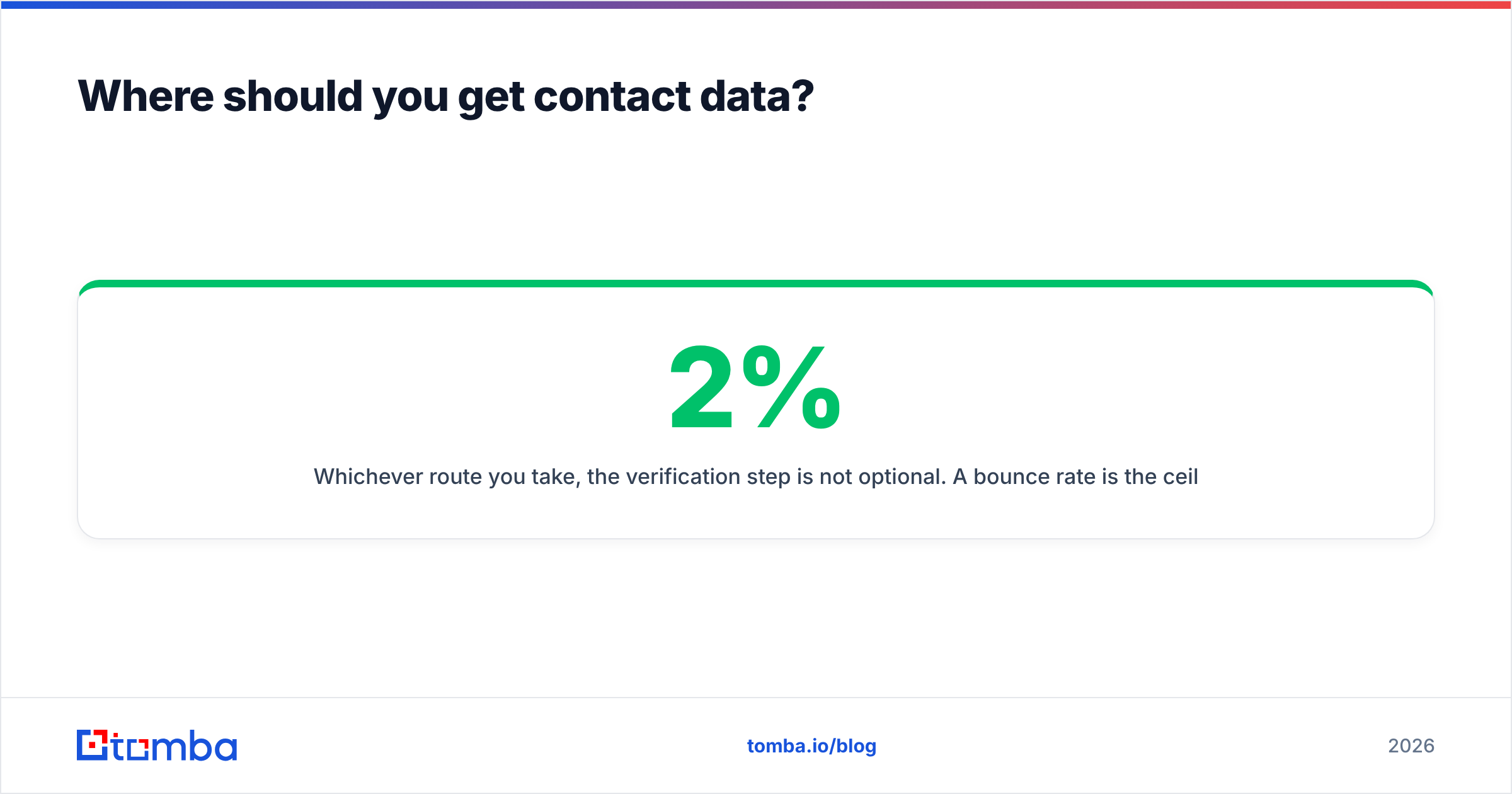
Whichever route you take, the verification step is not optional. A 2% bounce rate is the ceiling you're managing to, and unverified lists routinely run 8-15%. That gap is the entire difference between a campaign that compounds and one that quietly stops reaching anyone.
How many follow-ups should a cold email sequence have?#
Three to four. Here's the reasoning, not just the number.
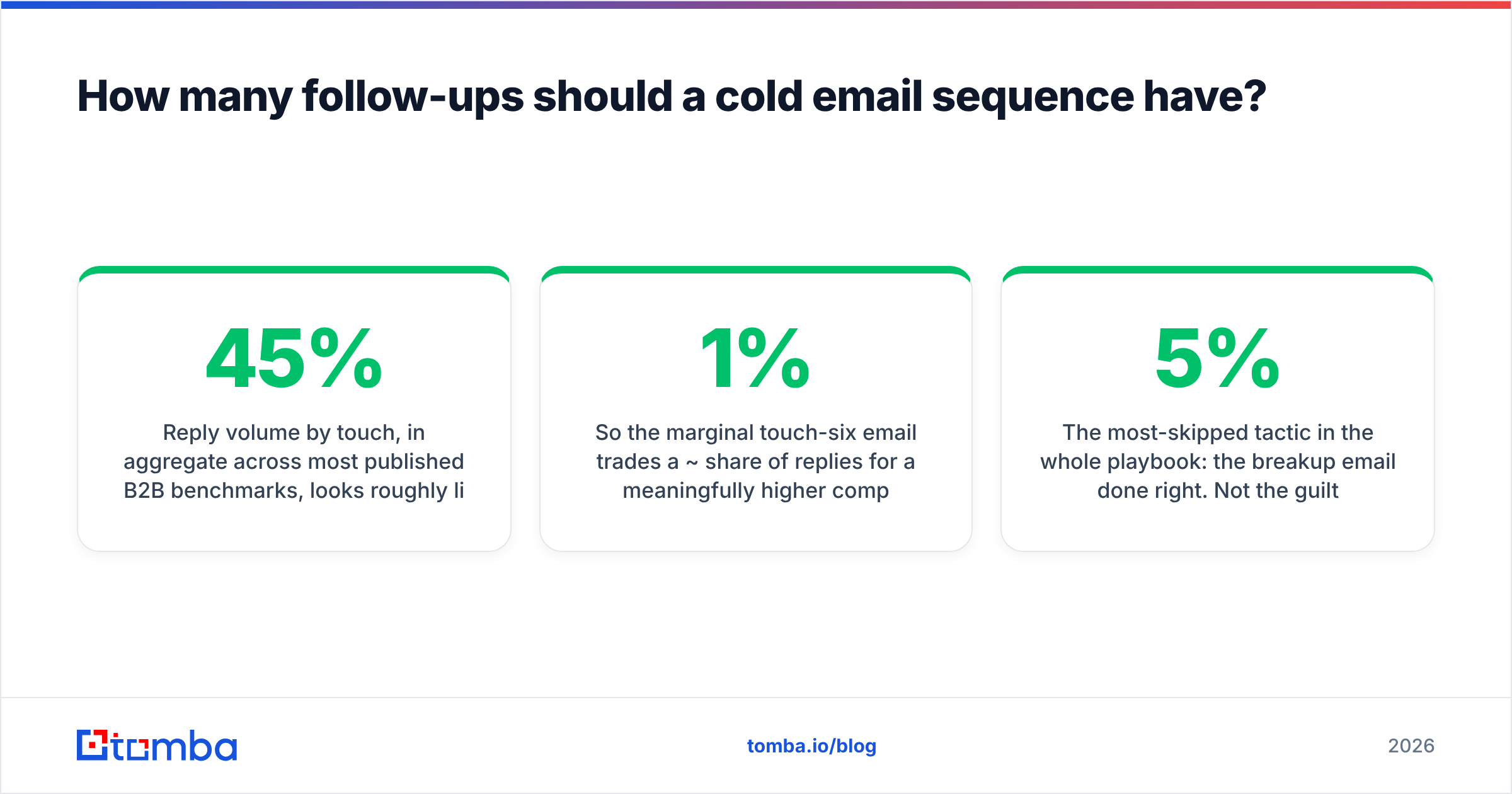
Reply volume by touch, in aggregate across most published B2B benchmarks, looks roughly like: touch one produces about 45% of total replies, touch two about 25%, touch three about 15%, touch four about 9%, and everything after that splits the remaining 6%.
Complaint volume runs the other direction. Complaints per send climb with each touch, because the people who were going to reply already did, and the people still receiving your emails have now signaled disinterest four times by ignoring you.
So the marginal touch-six email trades a ~1% share of replies for a meaningfully higher complaint rate on a colder audience. That's a bad trade at any volume, and a catastrophic one at scale.
Spacing matters too. Days 1, 4, 9, and 16 works well: tight enough to stay in memory, loose enough that you don't look frantic. And each follow-up should add something — a new angle, a relevant piece of news, a different problem framing. "Just bumping this to the top of your inbox" is not a follow-up. It's a complaint waiting for a click.
The most-skipped tactic in the whole playbook: the breakup email done right. Not the guilt-trip version. A single line — "Seems like this isn't a priority right now; I'll close the file. If that changes, reply anytime." — regularly pulls a 3-5% reply rate and, more usefully, leaves the door open instead of nailing it shut.
What should you measure?#
Not open rate. Apple Mail Privacy Protection and Gmail image proxying broke it years ago, and the number you see is now mostly noise with a flattering upward bias.
Measure, in this order:
- Spam complaint rate — your survival metric. Under 0.1%.
- Bounce rate — your list quality proxy. Under 2%.
- Reply rate — total replies over delivered, including negatives. Negatives are data.
- Positive reply rate — the only number that correlates with pipeline.
- Meetings per 1,000 sends — the number that exposes whether volume is helping or hiding.
Track these per segment, not per campaign. Campaign-level averages hide the segment that's generating all your complaints and the one that's generating all your meetings.
Get the list right before you write a word#
Every tactic on this page depends on the same foundation: sending to real people, at real addresses, who share a real attribute. The copy is downstream. The sequence is downstream. Even the deliverability setup only protects a list that deserved protecting.
That's the part Tomba's Email Finder is built for — resolving verified professional addresses from a name and domain, with catch-all handling and enrichment attached, so the list that enters your sequence is one you can afford to send to. The free tier gives you 25 searches a month to test the difference on a real segment; paid plans start at $49/mo, and full Tomba pricing is public.
Run one campaign the boring way: verified list, tight segment, 90-word email, four touches, 40 sends a day. Then compare the meetings-per-1,000 number to whatever you're doing now. The tactic that wins is usually the one nobody wanted to do.
Related guides#
Ready to find emails that actually work?
Join 150,000+ professionals who stopped guessing and started sending. Free credits on signup — no credit card required.
Get the Tomba newsletter
Practical outbound tactics and product updates — once every two weeks.
About the author